Rules for Radicals: What Constitutional Conservatives Should Know About Saul Alinsky


122K subscribers
SUBSCRIBE
David Horowitz Published in 1972, Saul Alinsky’s Rules for Radicals still enjoys brisk sales. With a former community organizer now commander-in-chief, and the idea of transformative leadership through radical change not just a theory, it is important for partisans of the Constitution to understand the roots of today’s radicalism. Presented as part of the First Principles on First Fridays series for the month of July, 2010. Recorded July 9, 2010. (c) Hillsdale College, 2010. http://kirbycenter.hillsdale.edu/

Passion for Politics Meets the Story of Christmas


150K subscribers

Join Bill Whittle, Scott Ott, Stephen Green and the Members and fans of this show on a 3-night cruise in May 2020. Reserve your cabin now at https://BillWhittleCruise.com —– Why do you even care about politics — a distant enterprise, operated by people you don’t really know, arguing about things that often don’t even impact you? The passion for politics, that inner drive that keeps you on fire with emotion, has a reason. Scott Ott has a theory that ties your desire for good governance to the story of Christmas. Right Angle comes to you 20-times each month thanks to our Members. Meet them and unlock new levels of engagement by becoming a one of us at https;//BillWhittle.com/register/ Listen to audio versions of this show at https://bit.ly/BWN-Podcasts Ask Alexa to play Bill Whittle Network on TuneIn Radio , or watch Bill Whittle Network on your Fire TV

The Poorest 20% of Americans Are Richer on Average Than Most Nations of Europe


A groundbreaking study by Just Facts has discovered that after accounting for all income, charity, and non-cash welfare benefits like subsidized housing and Food Stamps—the poorest 20% of Americans consume more goods and services than the national averages for all people in most affluent countries. This includes the majority of countries in the prestigious Organization for Economic Cooperation and Development (OECD), including its European members. In other words, if the U.S. “poor” were a nation, it would be one of the world’s richest.

Notably, this study was reviewed by Dr. Henrique Schneider, professor of economics at Nordakademie University in Germany and the chief economist of the Swiss Federation of Small and Medium-Sized Enterprises. After examining the source data and Just Facts’ methodology, he concluded: “This study is sound and conforms with academic standards. I personally think it provides valuable insight into poverty measures and adds considerably to this field of research.”

The “Poorest” Rich Nation?

In a July 1st New York Times video op-ed that decries “fake news” and calls for “a more truthful approach” to “the myth of America as the greatest nation on earth,” Times producers Taige Jensen and Nayeema Raza claim that the U.S. has “fallen well behind Europe” in many respects and has “more in common with ‘developing countries’ than we’d like to admit.”

“One good test” of this, they say, is how the U.S. ranks in the OECD, a group of “36 countries, predominantly wealthy, Western, and Democratic.” While examining these rankings, they corrupt the truth in ways that violate the Times’ op-ed standards, which declare that “you can have any opinion you would like,” but “the facts in a piece must be supported and validated,” and “you can’t say that a certain battle began on a certain day if it did not.”

A prime example is their claim that “America is the richest country” in the OECD, “but we’re also the poorest, with a whopping 18% poverty rate—closer to Mexico than Western Europe.” That assertion prompted Just Facts to conduct a rigorous, original study of this issue with data from the OECD, the World Bank, and the U.S. government’s Bureau of Economic Analysis. It found that the Times is not merely wrong about this issue but is reporting the polar opposite of reality.

Poor Compared to Who?

The most glaring evidence against the Times’ rhetoric is a note located just above the OECD’s data for poverty rates. It explains that these rates measure relative poverty within nations, not between nations. As the note states, the figures represent portions of people with less than “half the median household income” in their own nations—and thus—”two countries with the same poverty rates may differ in terms of the relative income-level of the poor.”

The upshot is laid bare by the fact that this OECD measure assigns a higher poverty rate to the U.S. (17.8%) than to Mexico (16.6%). Yet, World Bank data shows that 35% of Mexico’s population lives on less than $5.50 per day, as compared to only 2% of people in the United States.

Hence, the OECD’s poverty rates say nothing about which nation is “the poorest.” Nonetheless, this is exactly how the Times misrepresented them.

The same point applies to broader discussions about poverty, which can be measured in two very different ways: (1) relative poverty or (2) absolute poverty. Relative measures of poverty, like the one cited by the Times, can be misleading if the presenter does not answer the question: “Poor compared to who?” Absolute measures, like the number of people with income below a certain level, are more straightforward and enlightening.

Unmeasured Income and Benefits

To accurately compare living standards across or within nations, it is necessary to account for all major aspects of material welfare. None of the data above does this.

The OECD data is particularly flawed because it is based on “income,” which excludes a host of non-cash government benefits and private charity that are abundant in the United States. Examples include but are not limited to:

  • healthcare provided by Medicaid, free clinics, and the Children’s Health Insurance Program.
  • nourishment provided by Food Stamps, school lunches, school breakfasts, soup kitchens, food pantries, and the Women’s, Infants’ & Children’s program.
  • housing and amenities provided through rent subsidies, utility assistance, and homeless shelters.

The World Bank data includes those items but is still incomplete because it is based on government “household surveys,” and U.S. low-income households greatly underreport both their income and non-cash benefits in such surveys. As documented in a 2015 paper in the Journal of Economic Perspectives entitled “Household Surveys in Crisis”:

  • “In recent years, more than half of welfare dollars and nearly half of food stamp dollars have been missed in several major” government surveys.
  • There has been “a sharp rise” in underreporting of government benefits received by low-income households in the United States.
  • This “understatement of incomes” masks “the poverty-reducing effects of government programs” and leads to “an overstatement of poverty and inequality.”

Likewise, the U.S. Bureau of Economic Analysis explains that such surveys “have issues with recalling income and expenditures and are subject to deliberate underreporting of certain items.” The U.S. Census Bureau says much the same, writing that “for many different reasons there is a tendency in household surveys for respondents to underreport their income.”

There is also a wider lesson here. When politicians and the media talk about income inequality, they often use statistics that fail to account for large amounts of income and benefits received by low- and middle-income households. This greatly overstates inequality and feeds deceptive narratives.

Relevant, Reliable Data

The World Bank’s “preferred” indicator of material well-being is “consumption“ of goods and services. This is due to “practical reasons of reliability and because consumption is thought to better capture long-run welfare levels than current income.” Likewise, a 2003 paper in the Journal of Human Resources explains that:

  • “research on poor households in the U.S. suggests that consumption is better reported than income” and is “a more direct measure of material well-being.”
  • “consumption standards were behind the original setting of the poverty line,” but governments now use income because of its “ease of reporting.”

The World Bank publishes a comprehensive dataset on consumption that isn’t dependent on the accuracy of household surveys and includes all goods and services, but it only provides the average consumption per person in each nation—not the poorest people in each nation.

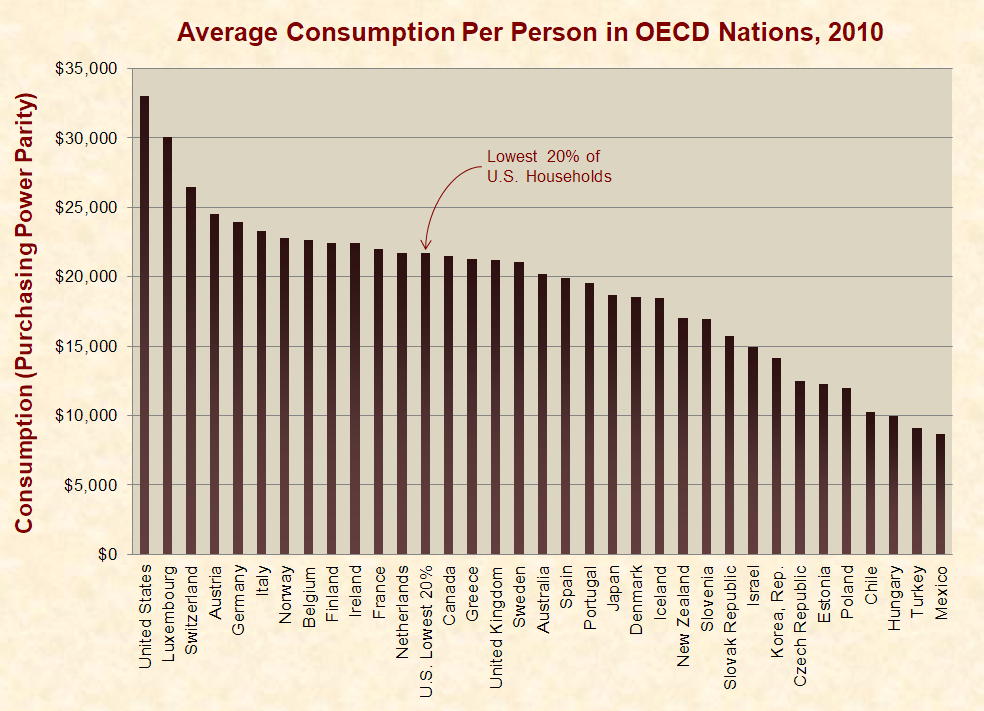
However, the U.S. Bureau of Economic Analysis published a study that provides exactly that for 2010. Combined with World Bank data for the same year, these datasets show that the poorest 20% of U.S. households have higher average consumption per person than the averages for all people in most nations of the OECD and Europe:

Average Consumption Per Person in OECD Nations, 2010

The high consumption of America’s “poor” doesn’t mean they live better than average people in the nations they outpace, like Spain, Denmark, Japan, Greece, and New Zealand. This is because people’s quality of life also depends on their communities and personal choices, like the local politicians they elect, the violent crimes they commit, and the spending decisions they make.

For instance, a Department of Agriculture study found that U.S. households receiving Food Stamps spend about 50% more on sweetened drinks, desserts and candy than on fruits & vegetables. In comparison, households not receiving Food Stamps spend slightly more on fruits & vegetables than on sweets.

Nonetheless, the fact remains that the privilege of living in the U.S. affords poor people with more material resources than the averages for most of the world’s richest nations.

Another important strength of this data is that it is adjusted for purchasing power to measure tangible realities like square feet of living area, foods, smartphones, etc. This removes the confounding effects of factors like inflation and exchange rates. Thus, an apple in one nation is counted the same as an apple in another.

To spot check the results for accuracy, Just Facts compared the World Bank consumption figure for the entire U.S. with the one from the Bureau of Economic Analysis. They were within 2% of each other. All of the data, documentation, and calculations are available in this spreadsheet.

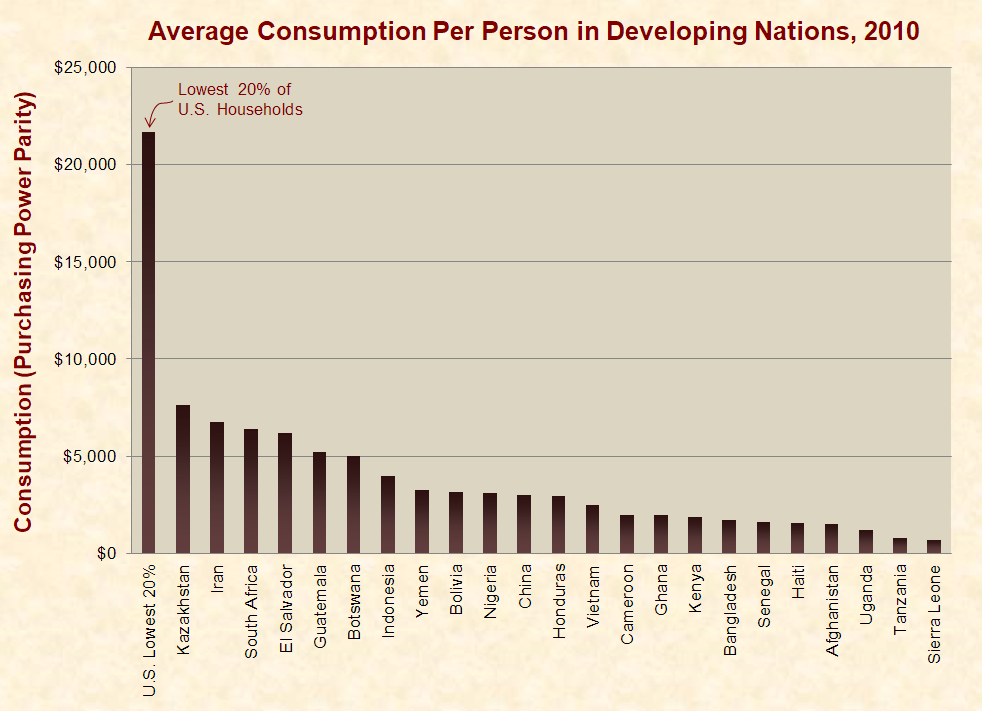
In light of these facts, the Times’ claim that the U.S. has “more in common with ‘developing countries’ than we’d like to admit” is especially far-fetched. In 2010, even the poorest 20% of Americans consumed 3 to 30 times more goods and services than the averages for all people in a wide array of developing nations around the world:

Average Consumption Per Person in Developing Nations, 2010

These immense gaps in standards of living are a major reason why people from developing nations immigrate to the U.S. instead of vice versa.

Why Is the U.S. So Much Richer?

Instead of maligning the United States, the Times could have covered this issue in a way that would help people around the world improve their material well-being by replicating what makes the U.S. so successful. However, that would require conveying the following facts, many of which the Times has previously misreported:

  • High energy prices, like those caused by ambitious “green energy” programs in Europe, depress living standards, especially for the poor.
  • High tax rates reduce incentives to work, save, and invest, and these can have widespread harmful effects.
  • Abundant social programs can reduce market income through multiple mechanisms—and as explained by President Obama’s former chief economist Lawrence Summers, “government assistance programs” provide people with “an incentive, and the means, not to work.”
  • The overall productivity of each nation trickles down to the poor, and this is partly why McDonald’s workers in the U.S. have more real purchasing power than in Europe and six times more than in Latin America, even though these workers perform the same jobs with the same technology.
  • Family disintegration driven by changing attitudes toward sex, marital fidelity, and familial responsibility has strong, negative impacts on household income.
  • In direct contradiction to the Times, a wealth of data suggests that aggressive government regulations harm economies.

Many other factors correlate with the economic conditions of nations and individuals, but the above are some key ones that give the U.S. an advantage over many European and other OECD countries.

Summary

The Times closes its video by claiming that “America may once have been the greatest, but today America, we’re just okay.” In reality, the U.S. is so economically exceptional that the poorest 20% of Americans are richer than many of the world’s most affluent nations.

Last year, the Times adopted a new slogan, “The truth is worth it.” Yet, in this case and others, it has twisted the truth in ways that can genuinely hurt people. The Times makes other spurious claims about the U.S. in this same video, which will be deflated in future articles.

Antifa Leftists Riot in London Following Massive Election Loss…


Following a major election victory for conservatives in the U.K. the Antifa-left start rioting in the streets again.  Proving once more that socialists do not accept election outcomes.

The vitriolic response from the British socialists resembles an almost identical response following the 2016 election victory of President Trump.  Same groups, same political ideology, same behavior, same violence, rage and expressed anger.

The inability of the progressive left to accept the outcome of an election is identical in both the U.K and the U.S.  Calling Boris Johnson a racist and attempting to delegitimize the election outcome has a ring of familiarity for Americans.

The decades of their united globalist efforts to tear at the very fabric of nationalism is being eliminated. The radical socialists have nothing to lose; the media is sympathetic to their objectives; their desperate need for a collectivist society is visible within their apoplexy.  They are afraid of the individual accountability that comes with freedom, and they’re damn sure displaying it.

Do not look away.

Andy Ngo

@MrAndyNgo

Antifa are rioting in London in response to the election results giving Conservatives a huge electoral win. It’s like what I saw in Portland in November 2016.

Embedded video

9,856 people are talking about this

The British Election – Socialists Lose Big Time


Conservatives are now in full control of Parliament, and Britain took one major step closer to leaving the European Union. The socialist Jeremy Corbyn said he would not lead the Labour Party in another election. All the hype about socialism and how they have been so vocal has resulted in what our computer has been projecting – not this time. There has been a shift extremely left in many elections including those in the United States. But for all the noise, yelling, and screaming, socialism is dying.

The British election was called because the opponents of BREXIT did everything in their power to obstruct the democratic result of the referendum to leave the EU. They had the audacity to claim the people were too stupid and did not understand what they were voting for because the politicians have continued to want to surrender British sovereignty to Brussels while for some they would lose their pensions.

While the election began as a second referendum on BREXIT when the polls showed that the Conservative Party of Prime Minister Boris Johnson was well ahead of Labour, the Labour Party did what politicians are great at – tried to change the subject. The Labour Party, led by Jeremy Corbyn, turned the election away from BREXIT, which he knew he would lose, and transformed it to the claim that the Conservatives would sell Britain’s National Health Service to Americans. That was really absurd since the U.S. government cannot deal with Obamacare yet they were going to take over Britain’s failing health system?

The significance of this election is demonstrating the rising frustration with governments. As they say, it is better to deal with the devil you know and in that case, it is British Parliament. The British people have no right whatsoever to vote on the policies coming from Brussels. The British government loses every time in any dispute with Brussels. It has been simply a relationship that has never enjoyed mutual respect.


The British Elections & US 2020 Election


There has always been a very interesting correlation between British politics and American. Margaret Thatcher became Prime Minister on the 4th of May 1979. Ronald Reagan was elected on November 4, 1980. The BREXIT referendum took place on the 23rd of June 2016. Donald Trump was elected on November 8, 2016. The political trends have begun in Britain and then spread to the United States like a financial contagion. That makes perfect sense because the political trends are indeed set in motion by economics.

Now we have the December 12th British election with the end result was a crushing defeat of socialism in British history. Boris Johnson’s Conservative Party would have a majority of nearly 80 seats, which is the largest Tory margin since the days of Margaret Thatcher. Meanwhile, what took place on the opposite side was the worst result since the 1930s for Labour. We may indeed see the same outcome with the Democrats who can’t seem to come up with a middle of the road candidate.

Despite the fake news promoting socialism and climate change, the Labour Party could not deter the true sentiment underlying the trend these days – the people are fed up with the same promises from politicians that never seem to materialize. Promising to tax the rich never seems to lower the taxes for anyone else. All it ever does is line the pockets of politicians and in the process still leads to highs costs and a lower standard of living for the average person. Nobody ever proposes lowering the cost of government. It just borrows more and more and never pay anything off.

While in Britain the immediate consequence is that, for the first time since the referendum of 2016, there can no longer be any question that the British people want to leave the European Union. The politicians have been lying to the people all along. The truth is that the people would be subjected to absolute tyranny from Brussels for they would have no right to vote where they would ever be able to change the policies impacting their lives. The European Commission never stands for election and the European Parliament has no power to draft laws.

The impact for the British election is a warning sign that the Democrats have lost their way just as Jeremy Corbyn of Labour who was forced to step down as the leader of the Labour Party. The promises of Corbyn similar to that of Elizabeth Warren and Bernie Sanders. If the Democrats continue down this path of socialism, our computer is warning that they too will suffer the same fate and as I have made clear, there remains a serious risk that the Democratic Party will self-destruct, split between moderate Democrats and the extreme left who seem to be drunk their own fake news and like Labour, assume the people are too stupid to figure out the truth.

Wakey Wakey – Exit Polls Show Landslide Conservative Boris Johnson Win in U.K. Elections – Open Discussion Thread….


A “landslide”, a complete “wipe-out”, a “massive victory” appears looming for Boris Johnson and the conservative party in the U.K. if exit polls are accurate.

These blowout results guarantee a faster Brexit from the European Union and the leftist labor party in the U.K. has been crushed.  Conservatives look to have picked up 50 seats and Labor has lost 71 seats; the Scottish National Party (SNP) has picked up 20.

The “Remainers” in the U.K. have been decimated, and the voters who want to “Leave” the EU have fueled a massive victory for Boris Johnson.  Liberal heads are blown-out, bigly.

(Via Daily Mail) Boris Johnson hailed his new blue-collar Tory army tonight as it emerged he is on track to secure a staggering landslide in the election battle – with Labour’s ‘red wall’ of Brexit-backing strongholds imploding.

A dramatic exit poll shows voters handing the Tories a massive 368 seats, with Labour languishing on 191 – down 71 on 2017 and the worst performance in modern history.

The bombshell numbers would give a huge Commons majority of 86, the biggest since Margaret Thatcher’s triumph in 1987, and are equivalent to a 10-point lead in the popular vote. (more)

This result also has massive ramifications for a U.S-U.K trade deal; and subsequently major leverage for the U.S. (independently) and a U.S. – U.K. alliance in future trade negotiations against the European Union.

Brexit & Generations


QUESTION:

Hi Martin

I live in the UK and I’m thinking

“Is there anyone out there that thinks the same way as I do about Brexit..??? Because no one on TV or in the media look at the Brexit situation like I do…??

However. Every single person I speak to. “Do actually agree with what I say..!!”
Here is my thinking….!!!!

1:- Why did I and many people vote for Brexit???
Answer:- Because we want to be “Free of control” from the EU….!!!
(While it was just a trading agreement it was OK.)
But when it (the EU) took control over our Laws, Jurisdiction, Parliament & or very existence without the ordinary guy in the street having any say about it.
It became something of a dictatorship.

2:- What situation do we find ourselves in now….???
Answer:- we are still under the control of the EU But in addition, we are now under the control of our own Government….!!!!

The ordinary guy in the street still has not got what he asked for…… “To Exit the EU…!!” To my mind “It’s plain and simple….!!”. This type of so-called democracy. “DOES NOT WORK…!!!”. In fact, I don’t think You can call it “Democracy” in the true sense of the word….!!!!

I would like to know what other people feel about not only Brexit. But all other “So-called” Democracies……????.
And with all the riots going on around the world now, are we heading towards a worldwide revolution by the peoples of the world…….??????
Because that’s what it seems like to me.

Kind Regards
JC in Central England

ANSWER: You are correct. The EU has deliberately rejected democracy because the elite believes that one European government will eliminate war. They have tried to create a single government, but have simultaneously refused to have consolidated the debts. Had they done that and Britain had joined, then it would be next to impossible to exit because of the debt.

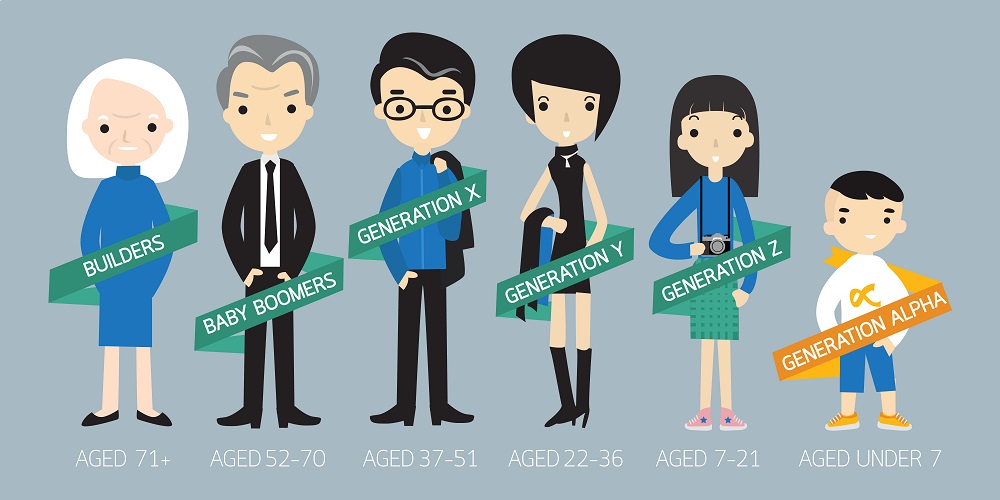
We are witnessing a worldwide revolution indeed. People are rising up against governments in general because it is obvious that corruption has become standard. Additionally, we have the third generation from World War II, which means their values have completely changed from the 1st generation. This has a host of differences from what they consider to be viable to ethics. This is one reason why the younger generations do not look at silver or gold as the first generation.

FREXIT – Is France Hurling toward Exiting the EU?


France is by no means calming down. There is a major underlying problem in France which is rising to the surface in direct confrontation with the government and Macron’s ambition to lead Europe. Macron’s confrontation with Trump over NATO is a reflection of a historical posture of the French government that has resented both Germany and the United States. Macron had said, “The Atlantic alliance can only be restored in one way, through restoring the unity of Europe.” The twelve founding members set up a headquarters together for the first time in London in 1950.

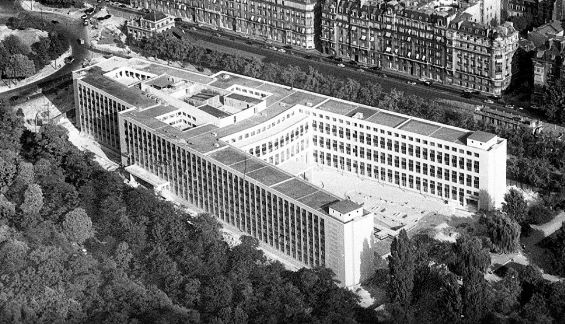
NATO Headquarters was located at 13, Belgrave Square. The last meeting to be held in London before the move to Paris was on April 1, 1952, which coincided with NATO’s third anniversary.  NATO was forced to move its headquarters from Porte Dauphine in Paris, France (the A building for Alliance) following the French withdrawal from NATO, which then moved to Brussels, Belgium in 1967.

Macron did not advocate that France should pull out of NATO as was the case under  President de Gaulle. Indeed, de Gaulle did withdraw France from NATO’s military structure in 1966, yet it remained an Ally. Macron has been also pushing for a European Army. Clearly, Macron’s agenda has been to federalize Europe and that is clashing with the people. He is NOT a proponent in having the USA a major part of NATO according to reliable sources.

Macron has been pushing economic reforms to curtail the social benefits in France in his effort to federalize Europe. In protest of his planned reforms in the pension system, the unions have organized several general strikes, which are now being joined by the yellow vests. This has resulted in bringing in hundreds of thousands of protesters to the streets. The problem which Macron faces is that France’s economic performance can no longer finance the generous welfare state which is far beyond international standards.

Everything points to a major political crisis brewing i9n France and there is talk that perhaps France should also now move to exit the EU – FREXIT. According to Harris Interactive poll taken 26–28 of November 2019,  Macron has a favorable rating of only 39% and a disproval rating of 61%. His push to federalize Europe may be his undoing. Macron admitted in January 2018 that if the French people were given a right to vote of FREXIT, a simple yes / no response to such a complex question, the French would “probably” have voted for FREXIT.

There is no question that there remains a serious risk that FREXIT can also be on the horizon for the driving force is the collapsing economic structure of socialism. American politicians will one day face the very same crisis. All the promises of benefits are coming to an end

The Opium War