QUESTION: Marty, at one of your WEC events during the nineties, if I remember correctly, you had said that your capital flow analysis revealed that the dollar rises during European and Middle Eastern wars and declines with North American wars. Could you refresh my memory on that?
I will see you in Shanghai. Never been there. Looks like it will be a very interesting conference.
Cheers;
KL
ANSWER: Nice to hear from you. Yes, your memory is not bad. Capital Flows are very distinct. Capital will always seek to move away from a war zone. In the case of Europe, it was the massive capital outflows from Europe which fled to the USA for both World War I and World War II. The USA was near-bankrupt in 1896 when JP Morgan came to the rescue. That is what made the USA the financial capital of the world. The same was true of the Suez Canal Crisis.
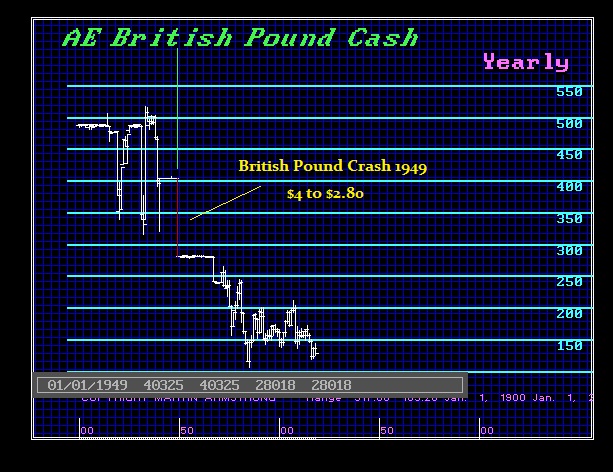
The Arab–Israeli War of 1948 broke out when five Arab nations invaded the territory in the former Palestinian mandate immediately following the announcement of the independence of the state of Israel on May 14, 1948. I hate to point out but 2020 will be 72 years from that event. This was followed by the major devaluations of currencies against the dollar – i.e. British pound. During the Cuba Missile Crisis (October 16-28, 1962), the currencies were fixed. The capital flows still managed to cause the British pound to rally from $2.78 to $2.81.
In the case of the Gulf War (August 2, 1990 – February 28, 1991), like Russia and the Lebanese War, our computer was picking up the capital flows which were indicating there was something brewing in the Middle East. You can easily see that the Euro began to spike upward in advance of the August 2, 1990, Iraqi invasion of Kuwait.
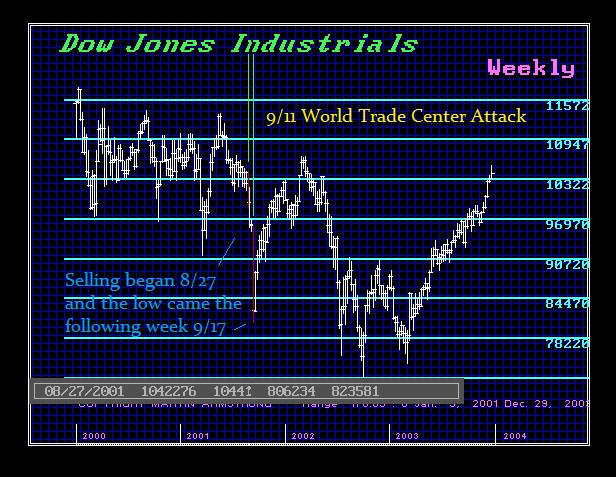
Even for 911, the US government used our study to identify the capital which was strategically moving in advance to profit from the attack. Later, the National Commission on Terrorist Attacks Upon the United States (also known as the “9/11 Commission”) conceded that there was highly unusual trading activity in the airline stocks of American and United prior to September 11, but they tried to play it down as coincidence to discourage these further strategies. The capital flows clearly reflected sharp movement in advance which was international, not domestic.
It was our Capital Flow models that forecast the collapse of Russia back in 1998. I have told the story at various WEC events how I stumbled upon this relationship. We had a client back in the 1980s which was a major bank in Lebanon. They found a leger with the price quotes each day of the Lebanese pound back into the mid 19th century. They asked if we could create a model on their currency. We fed in all the data and the computer came back and forecast that Lebanon would fall apart in 8 days. I thought there was something wrong. I told the client what the computer forecast and they very calmly asked, what currency would be best? I was stunned. They obviously knew something was brewing and on May 19, 1985, heavy fighting erupted between Amal Movement and Palestinian camp militias. The computer was correct to the very day. Then a Saudi client was one of the biggest shipping companies with very high political connections. He called and said that Iran would begin attacking shipping in the Gulf and asked what gold would do?
I began to realize that people with inside information moved money in advance of geopolitical events some to profit, and others to avoid losses. This is what the computer picks up. It does not identify the person.
QUESTION: Mr. Armstrong and thank you for what you are doing for us regular people. For my first ever question for you, would you please explain as simply as possible exactly what the REPO market is and how it works and how it affects our multi-faceted financial world.
I am truly grateful for your work and communication.
GLH
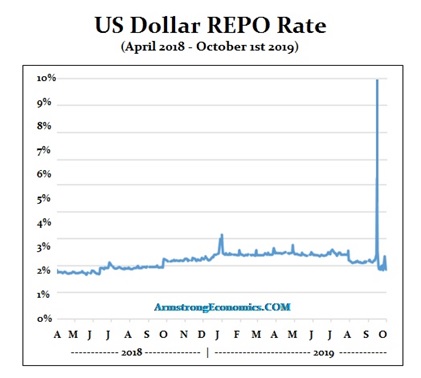
ANSWER: The REPo Market is where banks will post AAA securities and borrow against them for the night. Normally, the big banks like J.P. Morgan provide over $300 billion in liquidity daily which allows banks, hedge funds, and institutions to raise cash for the night. When the banks withdrew from lending into the Repo Market, the Fed was compelled to inject cash and thereby lending into the Repo market to prevent the short-term interest rate from rising as it did to 10% on September 17th, 2019.
A Reverse Repo (RRP) injects the purchase of securities with the agreement to sell them at a higher price at a specific future date. The party selling the security to raise cash in the market agrees to repurchase the securities (repo) from the lender at a future point in time which is known as a Repurchase Agreement (RP). Repos are classified as a money-market instrument, and they are usually used to raise short-term capital.
This is not a market that is open to the public. However, it is the basic market where everything else is factored on top of this rate. If the Fed did not intervene, then short-term rates would rise and instead of the consumer paying even 20% on a credit card, it would have jumped as must as 10%.
QE was where the Fed was trying to lower long-term rates after the mortgage-backed crisis hit in 2007 so they were buying 30-year bonds. This is the short-term which has nothing to do with QE. Here the Fed is trying to prevent short-term rates from rising rather than lowering long-term rates which they can only “influence” since the Fed posts only short-term rates like the discount rate (wholesale rate) which banks can borrow at.
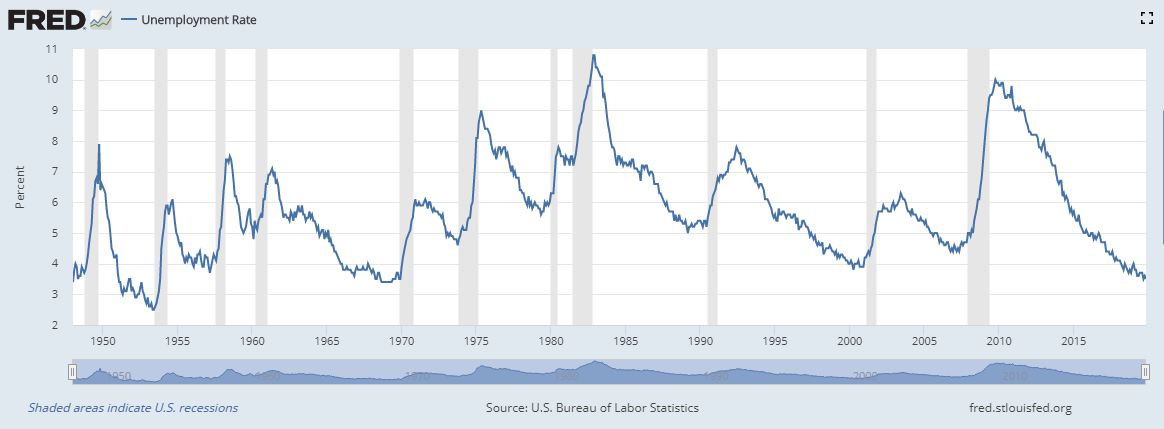
Here the economy is not declining and unemployment is back to the 1960s. All the talk about QE makes zero sense for these people do not understand what is taking place and it takes professionals in the field to grasp this issue and they cannot speak since they are under confidentiality agreements.
QUESTION: Mr. Armstrong; I just finished reading the Repo Report. I understand why you are reluctant to discuss this publicly when no one else seems to understand what is taking place. I was referred to it by a friend who is on the board of another company. He informed me that many regard you as the best analyst of all time because you have actually been in the trenches. We have no respect for academics in our company. They are always wrong and qualify their forecasts as all things remaining equal. I respect that you have actually worked at high levels. My question is this. Do you think you will be able to assist central banks in avoiding such a meltdown?
RH
ANSWER: I wish I could answer that question in a positive manner. Unfortunately, in this instance, the epicenter is outside the domestic jurisdictions of even the Federal Reserve. If you look closely at the minutes of the last meeting, there was the unanimous opinion that interest rates would not be lowered in 2020. The free market is pushing rates higher. The Fed was being bullied to lower rates just before the September Repo Crisis hit. They had a private meeting with Trump to explain he had to stop the talk of negative interest rates.
Even if the Fed called me in and gave me dictatorial powers over domestic policy, there is nothing I could do the prevent this crisis because it is outside the United States which is spreading and has become a cancer that threatens the global economy. China agreed to a trade deal as did Trump BECAUSE of the Repo Crisis. There are far bigger fish to worry about here than the nonsense of trade.
I am glad you understand the crisis I have laid out in this report. I am the only analyst who understands it appears because I have worked with institutions for nearly 40 years. These people come up with all sorts of conspiracy theories and claim this is helicopter money to just Quantitative Easing. In both circumstances, those theories were predicated upon a recession/depression which meant classic Keynesianism was being applied to increase the quantity of money to “stimulate” the economy. But unemployment is back to 1960s levels and the economy is ok. They just spout out the same nonsense they have done since 2007 without ever noticing that QE was buying long-term debt BECAUSE central banks do not control the long end of the curve. Central banks have dominated the short-term interest rates. So when the Repo Rate shot to 10%, that exposed the fact that the central banks are LOSING control of even the short-term rates.
I warned that there had been a destruction of the bond markets and I did a video interview on that when I was in Germany last year which was published in April 2019. I warned about the liquidity crisis and Basel III, which has also contributed to creating the current Repo Crisis. I also warned that we would enter a liquidity crisis come September.
Beyond that, I must be cautious with this crisis because it is the Mother of All Financial Crises and it seems only professionals even grasp the crisis. I have contacts at the very core of the marketplace who see this coming but cannot speak due to confidentiality agreements. The best I can do is keep it to a private service for the time being. I really do not have any choice. The implications can be too great and too broad. It is not something that will affect just Repo. That is simply where it begins. We are talking about a crisis that will dominate the next 8.6-year business cycle. Because this involves governments, they will search desperately for someone else to blame. The way they operate is stark and blunt because governments will NEVER accept responsibility for disrupting the global economy. They accused me of “manipulating the world economy” and the Commodity Futures Trading Commission tried to subpoena me for a list of all our clients worldwide. I had to defend against them in court and prevailed ironically because there is no law against manipulating the world economy and that is just a joke. So please respect, with this one, I just need to be cautious. I can only discus that in a limited service.
Private colleges are in financial straits, induced by their own progressive policies.
Private colleges are in serious financial trouble. According to Bloomberg, they may have to merge with others or close their doors. The seeds planted by the “homeless, tempest-tossed” academics from Frankfurt, Germany, 84 years ago, are now bearing fruit.
The private colleges are yet another casualty of the plot against American values and exceptionalism initiated by those outcasts from the Frankfurt School of Social Theory who arrived in New York, in 1935. The theorists began their long march through the Institutions, including higher education, changing the system that was among the best in the world, and poisoning the wells as they advanced. Whether fools or rogues, they soon realized that the Judeo-Christian West’s superiority could only be destroyed from within, by having their operatives join the machinery of the old institutions, and by collaborating with Third World liberation movements and other dissident minority. It would take some generations, but the prize of the most envied capitalist country in the world – America and the Free West — was worth their patience.
The learned academics within the private colleges readily complied with the new Common Core curricula, textbooks, teaching films and scripts, recognizing the Frankfurt stamp of approval. They introduced identity politics, which now requires a six-figure professional to help the children cope with the resultant tribalism and victimhood – sorely needed funds down the drain.
They welcomed new professors who spew antisemitism and anti-Americanism and stood mutely by while guest speakers with opposing opinions were jeered out of the lecture halls. The students are emerging as leftists, socialists, communists, and Islamists, decidedly ignorant in every discipline, but eagerly engaged in social justice courses, community organizing, political protests, and deadly violence to destroy the spirit of freedom and the soul of our nation. Critical Theory has taught the younger generation to break down fences before they understand why they were erected.
These are the rebels with a thousand empty causes, the socialists who will not support their universities, but who will expect compassion. Unsurprisingly, this is affecting the coffers of Academe; the alarms have been sounded.
The business of destroying American education from within is gathering momentum. As Walter E. Williams explained in Fraud in Higher Education, only 37% of white college students test as college-ready, but 70% are admitted, and only 17% of black high school graduates test as college-ready, but 58% are admitted, with most unable to read, write, and do math at 12th grade level. Forty percent of college students require developmental math and English classes at an annual cost of ~$7 billion. Only 25 percent of students who took the ACT in 2012 met the readiness benchmarks in English, reading, math and science. Students are advanced by their race, not by achievement, showing no significant improvement in critical thinking, complex reasoning and writing by the end of their sophomore year. Education Secretary Betsy deVos just confirmed, “The country is in a student achievement crisis.”
Ronald Reagan famously said, ”Freedom is never more than one generation away from extinction.” Every generation must uphold the legacy of freedom and to do so, it must understand the origins of democracy, our government structure, rights and responsibilities, and methods of public engagement. But the work of the so-called Progressives (ultra Regressives) has brought the knowledge of civics and government to an all-time low. Some young people are even learning tolerance and social justice from books supplied by the Southern Poverty Law Center, an FBI-recognized global and domestic terrorism-inspiring hate group, a perfect example of the bedfellows recommended by the Frankfurt outcasts.
National pride and patriotism are slated for destruction, corroborated by history classes that use Howard Zinn’s “A People’s History of the United States,” which focuses on the communist’s views of America’s historic injustice, with its dubious evidence and conclusions. America is shown as colonialist oppressor of the poor and disenfranchised, with no reference to our 13th amendment to the Constitution that abolished slavery here. The students are intentionally dumbed down about America’s history, and taught to accept a whitewashed Islam and Communism. Their violence against the monuments is denial of our history and extends to disrespect and breakdown of our laws and law enforcement.
Progressives vilify our national pride and corrupt public trust so as to destroy our society and reconstruct it into another – hideous – image, with the morale or soul of the generation siphoned out. Therefore, the bulk of high-quality fiction, poetry, theater and other imaginative and inspiring texts are replaced by informational prose, newspaper and social media stories – dry topics of social studies designed to enervate the individual and discourage reading. Instead of topics that encourage and inspire, young teens read of emotional difficulties and social justice issues – topics such as teen angst, bullying and sexual harassment, underage drinking, sexual molestation, complex relationships in dysfunctional families, and suicide. These depressing social issues, irrespective of the students’ emotional maturity, may well have a direct correlation to their increased suicide rate, doubled for boys and tripled for girls. Our thirty million illiterate adults are a step toward the illiteracy of despotic regimes.
The intellectual depletion shows our 15-year-olds to be lagging behind in math at 39th of their peers in 69 other countries. These are not “cultural differences,” as math is the most concrete and easiest way to judge across cultures. Common Core math offers a “one size fits all” approach that holds the children back and thwarts autonomy. DeVos reported that eighth graders failed to meet the low standard of the ‘90s, sinking below their predecessors from two years before.
In an unexpected twist, Progressives have found some inspiration in Islam and the two are now cooperating to destroy and restructure the society that has nourished them. Common Core includes the study of LGBTQ history for a full year, with transgender organizations, activists, and websites abetting gender confusion, encouraging life-altering “treatments” that damage their bodies and mental health. This is sold as “inclusivity,” but is a step toward fully accepting and imitating the Islamic family unit of one man with four wives as young as age 7, and the approval of pedophilia. The Islamic family unit is a hotbed of dysfunction, complete with rivalry, tension, childhood rape, stealth homosexuality, blame, shame, and extreme violence.
The closer we come to emulating Islam, the further we fall from grace, from the morality of Judaism and Christianity, until we become no better than lower species. Quotes from Islam’s most famous spokesman, Ayatollah Kohomeini, provided only partially here, may be found on the Internet: Sex and Islam, http://www.truthbeknown.com/islamquotes.htmPedophilia and Bestiality in Islam, by Jennifer King, stipulates that all Muslims are ordered to imitate Muhammad’s perfect example in thought, word and deed. The Prophet engaged in bestiality; it is not forbidden, but bathing instructions must be followed.
The traditional family, based on fidelity, is the surest bastion against the collective-hive society that is being planned for us. For this reason, schools are increasing sexualization even in Kindergarten, encouraging masturbation, sexual intimacy and intercourse. The comparison with Islamic practice is inescapable: the man has no need to develop self-control and the woman is responsible only to him, invisible, covered from head to toe and obedient under the threat of rape or death. The Progressive is coalescing with the Islamic mindset to shape the future agenda. The schools have replaced our Judeo-Christian values with a shared commitment to social causes – racism, supremacism, climate change, America’s evils, boycotting Israel, gun control, unlimited abortion, and more.
David Coleman was the architect of the Common Core standards. It was developed by a leftist-Washington-based think tank, Achieve, and funded with millions of dollars from the Bill and Melinda Gates Foundation, the American Civil Liberties Union, the Center for American Progress, and others, allies of the left and George Soros groups. Coleman’s vision was profoundly flawed, and parents were not consulte
Secretary of Education Betsy deVos admitted, “The results are, frankly, devastating.” Literacy and civics must be made a national priority and it is time to denounce what socialism is doing to our children. This is America’s wake-up call.
QUESTION: Marty, you laid out gold’s forecast back in October 2018 which has been amazing long-term. While you said if gold would rally after the Pi turning point from a bounce off the downtrend line, then it should rally into the bottom of the ECM. Will you now publish the gold report? I know you have been really busy. But it would be nice to hear from you. Socrates has been bullish since that turn back in 2018. That has been great. It would be nice to see a report with gold in all the currencies.
Happy New Year
LM
ANSWER: Yes it is getting time to do the Gold report. Let us see if that forecast proves correct since we are approaching the target.
QUESTION: This is the year of the Rat. It has often been the year of economic change. Do you realize the next year will be 2032?
any comment?
ANSWER: The year of the Rat is interesting. Yes, it seems to align closely with change, but not always that year. Often it has been the year before. The year of the Rat is 2020 and 2032, which is curious indeed. The year 1924 was really the beginning to the economic boom in the USA. 1936 was the year before the peak and crash in 1937. The year 1948 was the year before the first round of devaluations in Bretton Woods. The year 1960 was when JFK was headed to the White House. The year 1972 really began set in motion the floating exchange rate after Nixon closed the gold window in August 1971. Then 1984 was the year before the Plaza Accord and the birth of G5. The next target was 1996, one year before the 1997 Asian Currency Crisis. Of course, 2008 was the Crash that changed everything. Here we have 2020 and then 2032. We are showing major changes unfolding on these targets
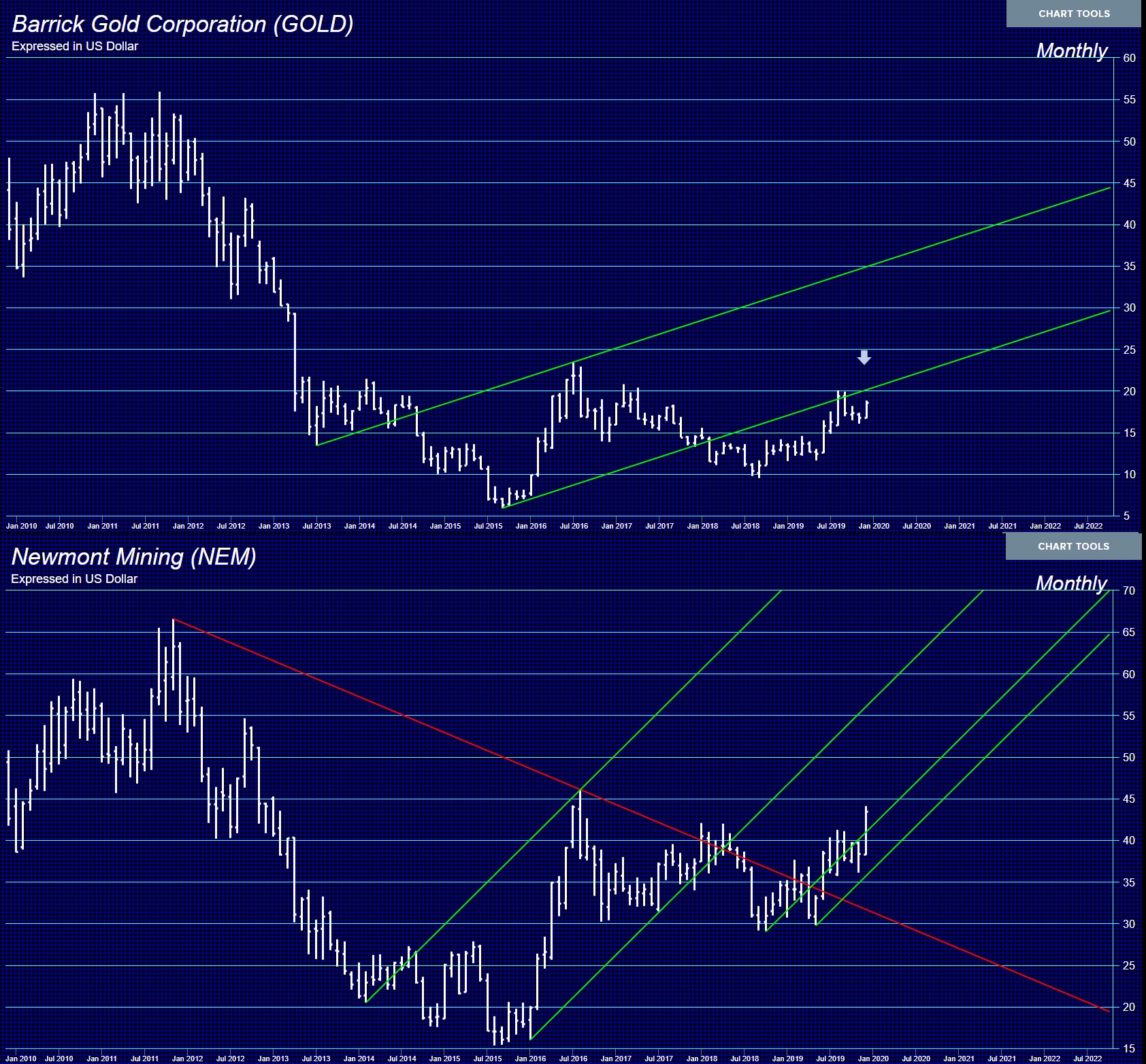
COMMENT: Marty, just wanted to say thank you for Socrates. It has been great on gold and even in the miners it has distinguished the lagers like Barrick from Newmont without worry of who is getting paid to pitch what stock.
Can’t wait for the sector overviews.
Happy New Year
PB
REPLY: It is tracking over 1,000 instruments each day. I do not have the time to write about everything. I am working on the sector overview. That should be ready with the turn in the ECM. I am so glad people are getting the hang of Socrates. I do have an expiration date and have no desire to write forever.
The Repo Crisis for year-end has had the Fed pumping in a staggering amount of about $234 billion into the repo markets. They are exchanging high-quality capital for cash to suppress market volatility and maintain the central bank’s overnight funds level, which is used as a benchmark for multiple other short-term interest rates within a range of 1.5%-1.75%. People who fail to understand this institutional market keep thinking it is quantitative easing. With inflation low and unemployment back at 1960s levels, there is no reason for quantitative easing to support the economy. Instead, the Fed is trying to maintain control over short-term rates for the free market is pushing higher. This means the actions of the Fed are an attempt to PREVENT the rise in interest rates, not to stimulate the economy.
On Monday alone, the Fed injected another $18.65 billion for a two-day repo operation and $30.8 billion in a one-day offering. However, both issues were undersubscribed which is confirming that there has been a lot of book-squaring going into year-end. This has been reflected in currency markets as short positions were being closed out in thin trading in the euro for example.
The stock market reached new all-time highs. This has occurred because the Federal Reserve’s ‘quantitative easing’ never really ended. Instead of consulting Congress like they did in 2008, the Fed simply creates currency out of thin air and hands it out to its member central banks. A lot of that easy money goes into the stock market, which mostly benefits the top of the pyramid that owns most of the major global corporations. Over 50 percent of Americans have no money in the stock market. Many millennials cannot afford to buy a house, let alone stocks.
For many, the American Dream will never become a reality. The wealth divide in this country continues to widen, thanks to the cancerous creation of the Federal Reserve. Instead of stopping booms and busts, they created larger ones, all to their own benefit.
The national debt continues to make new highs along with the stock market. That means more tax dollars will go toward paying interest on the debt. Paying down the principal is impossible unless the president declares a debt jubilee. I’m all for that as long as it also means ending the Fed.
The melt up will grow even more absurd and the wealth divide will worsen unless we change our current immoral system of money. The end of the Federal Reserve is long overdue. Let’s hope President Trump makes it one of his resolutions for 2020.
In this era of #MeToo and rampant sexual assault allegations, many media outlets, politicians, and scholars are misleading people about the prevalence of rape. They accomplish this by publicizing unscientific studies, mischaracterizing reliable ones, and making statements that have no basis in reality. Although precise figures on rape don’t exist, credible data gathered from females in the U.S. indicates that:
about 11.5% of women say they have been the victim of acts that fit the legal definition of forcible rape.
each year, about 0.2% of women enrolled in college explicitly state that they have been raped, but this figure grows to 1.0% if they are prompted with graphic descriptions of acts that fit the legal definition of rape.
each year, roughly 2.1% of college women say they have been the victim of acts that fit the legal definition of rape. However, only 1.0% consider these acts to be rape.
college-age women who are not enrolled in college are about 50% more likely to be raped than women who are enrolled in college.
about 40% of female rape victims were first raped before the age of 18, and 79% were first raped before the age of 25.
cases that involve “date-rape drugs” appear to be a very small portion of all rapes, but the data is uncertain.
Contrary to the claims of some reporters and notable organizations, there are no sound estimates for the portion of rape claims that are false. In fact, a widely cited study alleged to show that only 2% of rape claims are false actually shows many times more than that.
Certain preventative measures appear to be very effective at reducing the incidence of rape, but they chafe against notions of political correctness. Hence, many people ignore them, leaving more women vulnerable to rape.
Confirmation bias and poor critical thinking skills lead people to embrace or dismiss rape-related claims based merely on their personal experiences, assumptions, or prejudices. Coupled with false information that arises from across the political spectrum, there is ample opportunity for all sides to become misinformed. This article corrects the record by thoroughly documenting numerous facts about this horrid crime and ways to thwart it.
Defining Rape
An essential part of measuring how often rape occurs is defining it. This is more complex than it may seem, because the definition of rape varies depending upon the source.
From a federal legal perspective, a law that governs the conduct of military personnel definesrape in ways that involve “force,” threats of “bodily harm,” “rendering” a victim “unconscious,” and giving someone “without the knowledge or consent of that person, a drug, intoxicant, or other similar substance and thereby substantially impairing the ability of that other person to appraise or control conduct.” Beyond sexual intercourse, this also includes sexual “penetration, however slight, of the vulva or anus or mouth, of another by any part of the body or by any object….”
Others define rape in ways that are broader and more subjective. For example, a 2014 reportby the Centers for Disease Control and Prevention (CDC) measures the prevalence of rape by including everyone who has had sex and later said they were “unable to consent” because they were “drunk” or “high.”
The same CDC report measures “sexual violence” by including all people who have engaged in any kind of sexual activity (including kissing) because they felt “pressured in a nonphysical way.” In addition to situations like a boss “using their influence or authority over you,” this can also involve someone:
“telling you lies.”
“making promises about the future they knew were untrue.”
“wearing you down by repeatedly asking for sex, or showing they were unhappy.”
Senator Dianne Feinstein (D–CA) cited this CDC report before the widely watched testimony of Christine Blasey Ford against Supreme Court nominee Brett Kavanaugh, claiming, “In the United States, it’s estimated by the Centers for Disease Control one in three women and one in six men will experience some form of sexual violence in their lifetime.” On the next day, Senator Cory Booker (D–NJ) said the same, while adding that “this toxic culture—this pernicious patriarchy in this country—has to stop.”
Prominent and influential people have muddled this issue by grouping together very different circumstances under blanket terms like “rape” and “sexual violence.” In contrast, this article primarily covers cases of sexual penetration that involve force, threats of force, and covertly administered drugs. This does not include situations like drunken hookups or kissing a liar. Reports to Police Are Not Comprehensive
The FBI collects and tabulates reported cases of rape from local law enforcement agencies, but these figures don’t account for all rapes, because rape victims often don’t report these crimes. Also, local law enforcement agencies sometimes fail to properly record them.
As documented by the National Academy of Sciences in a 2014 report on rape and sexual assault, “There is ample evidence that the crimes of rape and sexual assault are substantially undercounted through police reports….” The authors cite an array of evidence for this, such as:
a 2012 report from the U.S. Department of Justice, which found that 65% of rapes and sexual assaults were not reported to the police during 2007–2010. This figure is based on a nationally representative sample of people who said they were raped or assaulted but did not report it. Among their most important reasons for not reporting:
28% said they feared reprisal or getting the offender in trouble.
20% said they dealt with it in another way or considered it a personal matter.
13% said they thought the police wouldn’t help.
6% said they felt the incident was not important enough to report.
33% gave another reason or said they didn’t have a single most-important reason.
a joint university/law enforcement investigation that began in 2009 and found thousands of untested sexual assault kits in Detroit Police storage facilities.
a 1998 Philadelphia Inquirerarticle, which quoted Philadelphia police officers and other sources to show that “downgrading major offenses to minor ones to polish the image of commanders and police commissioners and make the city look safer—has been a reflex in police station houses for decades.”
The bottom line is that many sexual assaults go unrecorded and unreported. Thus, contrary to President Trump, the fact that Christine Blasey Ford or her parents didn’t “immediately” file charges with “local law enforcement” doesn’t mean that the alleged attack was not “as bad as she says.” Scientific Surveys Can Be Accurate
Some believe that surveys can never be accurate, due to various notable failures. Others tend to believe any poll that tells them what they want to hear. Surveys are indispensable tools to discovering the truth, but an understanding of their inner workings is necessary to assess their accuracy and usefulness. The detailed facts in this section provide that knowledge for the skeptical and interested.
Because it is expensive and frequently impossible to collect information on every person in the United States, governments, scientists, and scholars often obtain such data through scientific surveys. This is true of frequently quoted government data on crime, education, employment, the economy, and an enormous array of Census data.
An important benefit of such surveys is that they can achieve considerable accuracy while polling only a tiny portion of the population. As the book Statistics for K–8 Educators states, “a national random sample of 1,000 people can accurately represent 200 million people.” The textbook Statistics: Concepts and Controversies explains why this is so:
Imagine sampling harvested corn by thrusting a scoop into a lot of corn kernels. The scoop doesn’t know whether it is surrounded by a bag of corn or by an entire truckload. As long as the corn is well mixed (so that the scoop selects a random sample), the availability of the result depends only on the size of the scoop.
A vital and widely unknown fact is that a small number of positive responses to a certain question does not undermine a poll’s validity. For example, if only 20 respondents in a survey of 1,000 women say they were raped, this result is no less credible than if 500 respondents in another survey of 1,000 women say they have been whistled at. In fact, the textbook Mind on Statistics shows that mathematical confidence in survey results actually increases when the portion of people who answer a poll question in a certain way is well below or above 50%.
More specifically, a poll with only 20 out of 1,000 respondents who say they were raped has a ±0.9 percentage point margin of sampling error with 95% confidence, while a poll with 500 out of 1,000 respondents who say they have been whistled at has a ±3.1 percentage point error. This is something that certain reporters and “fact checkers” don’t seem to understand.
However, surveys can be highly inaccurate if they don’t use random samples of respondents. This is often true of internet and mail surveys, because the people who respond to them typically differ in material ways from the people who don’t. As explained in Mind on Statistics: “Surveys that simply use those who respond voluntarily are sure to be biased in favor of those with strong opinions or with time on their hands.” The textbook then analyzes a poll of scientists that had a 34% response rate and states that “with only about a third of those contacted responding, it is inappropriate to generalize these findings” to most scientists.
A key point to realize about that poll is even though it surveyed scientists, was conducted by scientists, and was published in a prestigious journal named Science, it is not a scientific poll. In the words of a book about polling published by Pennsylvania State University Press: “Scientific polls use sampling procedures where random samples are used, that is, where each individual in the group has an equal chance of being selected into the sample, or where some variation on this pattern is used to account” for any differences.
To account for such differences, pollsters often use a process called weighting. Per the textbook American Government and Politics Today: Essentials, this involves “adding extra ‘weight’ to the responses of underrepresented groups,” For example, if 40% of respondents for a poll of registered voters are females, the pollster may place more mathematical weight on the responses of these women, because 53% of registered voters are women. Pollsters also perform weighting based on age, race, education, income, and many other variables.
Weighting, however, does not guarantee that a poll’s results are accurate. This is because respondents may differ in ways that transcend the factors that are weighted. For instance, because of their experiences, rape victims may be more apt to respond to an internet survey about sex crimes than those who have not been raped. Weighting for race, income, etc. will not necessarily correct for this.
Finally, even scientific surveys with perfectly random samples can still be inaccurate if respondents have a motive to lie and then do so. For example, unauthorized immigrants who participate in polls sometimes claim they are citizens in order to conceal the fact that they are in the U.S. illegally. This was proven by a 2013 paper in the journal Demographic Research, which compared Census Bureau survey data on citizenship to the number of naturalized citizens recorded by the U.S. Office of Immigration Statistics. The study found that certain groups of immigrants—including Mexican men of all ages, Mexican women aged 40 years and older, and immigrants who have been in the U.S. for less than five years—frequently misrepresent themselves as citizens. Forcible Rape
The 2014 CDC report mentioned above presents the results of a 12,727-person telephone survey of noninstitutionalized adults during 2011. For phone surveys, a key indicator of their randomness is their cooperation rate, which is the portion of “persons contacted who agreed to participate in the interview and who were determined to be eligible.” For this poll, the weighted cooperation rate was 83.1%.
Despite the solid methodology used for this survey, the CDC’s report of it is written in a way that can easily deceive. This is because the abstract uses the word “rape” 10 times without a hint that this includes everything from violent rapes to regretted drunken stands. Even the full report doesn’t make this clear. Instead, it uses the term “alcohol- or drug-facilitated penetration” without defining it. Does this only mean cases where predators secretly spiked the drinks of victims with alcohol or date-rape drugs? The report doesn’t say, but a file of supplementary information discloses that it includes all situations where people later felt they were “unable to consent” because they “were drunk, high, drugged, or passed out.”
Readers must dig four pages into this report before it reveals that about 11.5% of adult females say they have been the victim of acts that constitute forcible rape. Accounting for the margin of sampling error with 95% confidence, this result ranges from 10.3% to 12.7%. The study identifies cases of forcible rape by positive responses to questions about vaginal, oral, or anal sex acts done unwillingly because of physical force or threats of physical harm. These all fit with the definition of rape under federal law.
Like all surveys, this one has limitations. Among the most noteworthy are these:
A “telephone survey might be less likely to capture some populations that could be at higher risk for victimization (e.g., persons living in nursing homes, military bases, prisons, or shelters, or those who are homeless).”
“Victims who are involved in violent relationships or who have recently experienced severe forms of violence might be less likely to participate in surveys or might not be willing to disclose their experiences because of unresolved emotional trauma or concern for their safety, among other reasons.”
It does not address the subject of false rape reports.
It does not account for the fact that some younger respondents will be victimized later in life. Per correspondence from the CDC to Just Facts, “the estimates provided in the report were estimates at a single point in time and do not adjust for the possibility of future victimization.”
This study’s definition of forcible rape doesn’t include surreptitious drugged rapes, which are arguably forcible, because victims do not willingly consume these substances.
Even so, the results of this CDC study are in the same ballpark as a 1987 study by the U.S. Department of Justice. This study used data from the National Crime Victimization Survey (NCVS) during 1973 through 1982. It found that about 8% of females aged 12 years and older will be the victim of a completed or attempted rape at some point during those years. This study defined rape as “carnal knowledge through the use of force or the threat of force, including attempts. Statutory rape (without force) is excluded.” For reasons detailed below, the results of the study almost certainly underestimate the rate of rape as defined by federal law. College Rape
The prevalence of rape among college students is a hotly debated topic, and different studies about it have come to very different conclusions. The results of two nationally representative scientific surveys shine a great deal of light on the reasons for these differences and help sort out the big picture.
In 2014, the U.S. Department of Justice published a study of rapes and sexual assaults of college-age females during 1995 to 2013. It found that during each year an average of 0.2% of women enrolled in a college, university, trade school, or vocational school said they were raped. For college-age women not enrolled in school, the rate was 0.3%, or 50% higher than those who were enrolled.
The study was based on data from the NCVS, which polls a nationally representative sample of about 90,000 households and 160,000 people twice per year. Respondents are first interviewed in person and then via phone every 6 months for 3.5 years. The overall response rate for this study was 74%.
Unlike the CDC’s survey, this one directly asked people if they were raped. An advantage of this is that it straightforwardly measures people’s perceptions about what happened to them. A disadvantage is that people’s perceptions of rape appear to be more narrow than federal law. This may be because some people think rape only involves intercourse, while federal law states that it also covers situations like forced oral sex and penetration with a finger.
This is illustrated by a scientific survey of 4,446 college females conducted during 1997 by researchers from the U.S. Department of Justice and National Institute of Justice. The survey had a response rate of 86%, and it defined rape in precise terms, asking women if since the start of the school year someone had used force or the threat of force to sexually assault them in any of the following ways: penile-vaginal, mouth on your genitals, mouth on someone else’s genitals, penile-anal, digital-vaginal, digital-anal, object-vaginal, and object-anal. About 1.7% of the women said that others had done such things to them, but when they were asked, “Do you consider this incident to be a rape?” only 46.5% answered “Yes.”
The researchers who designed this survey also conducted a comparison survey with the same methodology except that it used the sexual assault questions posed by the NCVS. This survey found that only 0.16% of the respondents said they were raped, or about one-fifth as many who said they were raped in the primary survey. Based on these conflicting results, the authors concluded that their use of graphic questions in the primary survey “likely prompted more women who had experienced a sexual victimization to report this fact to the interviewer.” These graphic questions, which were asked before the direct question about rape, were:
Has anyone made you have sexual intercourse by using force or threatening to harm you or someone close to you? Just so there is no mistake, by intercourse I mean putting a penis in your vagina.
Has anyone made you have oral sex by force or threat of harm? By oral sex, I mean someone’s mouth or tongue making contact with your vagina or anus or your mouth or tongue making contact with someone else’s genitals or anus.
Has anyone made you have anal sex by force or threat of harm? By anal sex, I mean putting a penis in your anus or rectum.
Has anyone ever used force or threat of harm to sexually penetrate you with a foreign object? By this, I mean for example, placing a bottle or finger in your vagina or anus.
In other words, the survey described actions that fit the legal definition of rape before it asked respondents if they had been raped.
Combining the results of the studies above and assuming that the 1997 data is still roughly correct, several points emerge about the annual prevalence of rape among college-age females:
When not prompted with graphic descriptions of acts that fit the legal definition of rape, about 0.2% of women in college say they were raped.
When prompted with such graphic descriptions, roughly 1.0% of college women say they were raped.
Approximately 2.1% of college women say they have been the victim of acts that fit the legal definition of rape, but only 46.5% of these women consider these acts to be rape.
College-age women who are not enrolled in college are about 50% more likely to be raped than women who are enrolled.
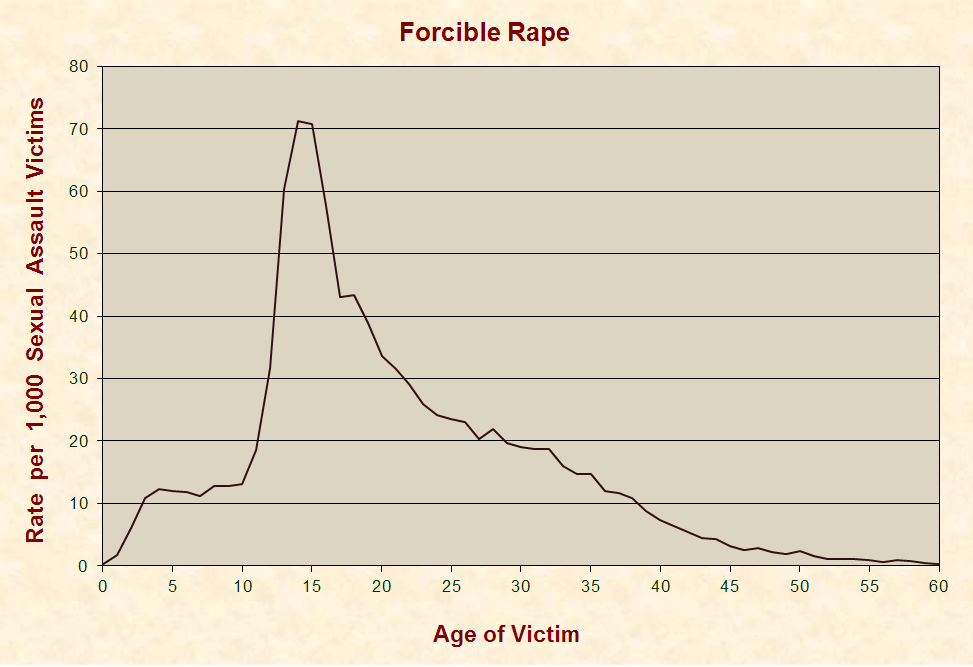
Given the last of these facts, the media’s focus on college rape appears misplaced, because this issue is primarily about age, not the safety or culture of universities. Other studies point to the same conclusion. For instance, CDC’s 2014 report on sexual assault found that 40% of female rape victims were first raped before the age of 18, and 79% were first raped before the age of 25.
Likewise, a 2000 U.S. Department of Justice study of crimes reported to law enforcement in 12 states from 1991 to 1996 found that the incidence of forcible rape peaked at the ages of 14 and 15 years and remained relatively high through the age of 25:
Drink Spiking
“Date-rape drugs” or “club drugs” are a class of recreational and prescription drugs that sexual predators covertly give to their victims to disable them. They go by street names such as Roofies, Easy-Lay, Liquid X, and Special K.
These drugs are readily available in the U.S. and are often odorless, colorless, and tasteless. Hence, they can be easily slipped into drinks. Given the nature of these attacks and high-profile cases like that of Bill Cosby, the press has devoted significant attention to such crimes.
A 2016 paper in the journal Psychology of Violence notes that there are “frequent media reports and discussions of drugging on college campuses,” but knowledge of this issue is “based almost exclusively on anecdotal data.” Various scholars, including the authors of this paper, have conducted studies on this issue using data that is not nationally representative and possibly not random, because some are based on web surveys. Thus, they cannot determine the prevalence of such crimes. Nonetheless, such studies have found that:
7.8% of students at three U.S. colleges said they suspected or knew they were unwillingly drugged, and 14.5% of these students “experienced either unwanted sexual touching” or were “forced to have sexual intercourse” while under the influence of these drugs. This amounts to a drugged sexual assault rate of 1.1%. (Psychology of Violence, 2016)
19% of emergency room patients at an urban/rural hospital in England who were alleged victims of drink-spiking tested positive for drugs that they said they did not knowingly take. None of them tested positive for common date-rape drugs, and the authors determined that their “symptoms are more likely to be a result of excess alcohol.” (British Medical Journal, 2007)
0.6% of women at two universities said they were certain someone had sexually assaulted them after slipping them a drug, and 1.7% said they suspected this happened. (Journal of American College Health, 2010)
4.9% of female sexual assault complainants at four U.S. clinics tested positive for typical date-rape drugs. Most of these women had prescriptions for the drugs and had taken them “by their own accord and not received them surreptitiously.” However, it “is possible that some of the subjects who believed they were given a drug … did not report to the clinic quickly enough for our analysis to detect” it. (University of Illinois, Department of Biopharmaceutical Sciences, 2005)
The imperfect evidence above suggests that a very small portion of rape cases involve secretly administered date-rape drugs. Similarly, a 2008 paper in the journal Trauma, Violence, & Abuse reviewed 11 studies on covert drugging and concluded:
All but one of the studies “failed to remove voluntary consumption of alcohol and drugs in their interpretation of results.”
“The only robust estimate,” which was a study conducted in the U.K., “shows that only 2% of instances of alleged drug-facilitated sexual assault were due to covert drug administration.”
“Although public health campaigns focusing only on covert drug administration are laudable, they are detracting attention from the much greater risk of being sexually assaulted following voluntary drug and/or alcohol consumption.”
False Reports
As a battle has raged over the nomination of Brett Kavanaugh to the Supreme Court, many prominent people have stated or implied that Christine Blasey Ford and the other women who have accused him of sexual assault are probably telling the truth, because false sexual assault accusations are extremely rare. Such claims appear in a broad range of articles and commentaries from media outlets like Time, ABC News, USA Today, the New York Times, the Los Angeles Times, and Vox.
To support their assertions, every one of those pieces appeals to one of two organizations:
The American Psychological Association, which states, “Research demonstrates that false claims of sexual assault are very low—between 2 and 7 percent.”
The National Sexual Violence Resource Center, which says that “the prevalence of false reporting is low between 2% and 10%.”
Tracing these claims back to the sources on which they depend reveals that the studies don’t state what these organizations declare. For instance, the “2%” figure comes from a study of rapes reported to police during 2000 to 2003 in Victoria, a state in southeastern Australia. Starting with the obvious, this study does not represent the U.S. or even all of Australia. Also, this is a study of rapes reported to the police, which as detailed above, are small portion of all alleged rapes. Moreover, these tend to be the most brutal cases. A 2002 study by the U.S. Department of Justice found that “59% of female rape victims whose victimization was reported to police received medical treatment, compared to 17% of victims whose crime went unreported.”
Most importantly, the Australian study says that the figure of 2% only counts cases that were “clearly categorized as a false report and the alleged victim was either charged” or warned that “she would be charged unless she dropped the complaint.” The study then states:
While this represents only a fraction of the sample, the findings will show a much larger proportion of cases where police were confident, or reasonably confident, that the allegations were false but there was no attempt to institute charges against the alleged victim.
How much larger? Beyond the 2% of rapes reported to police where the accusers were charged or threatened with charges for making false allegations, the study found that in 9.5%of the cases, members of the Criminal Investigation Unit “were confident or reasonably confident that the victim was making a false report.” The study also found that:
15.1% of the allegations were withdrawn.
46.4% of the allegations resulted in No Further Police Action.
21.3% of the allegations “were ‘still ongoing’ or could not be determined on the basis of the information in the case records.”
Adding together only those cases where (1) the accusers were legally imperiled for making false allegations, (2) the complaints were withdrawn, and (3) the Criminal Investigation Unit was reasonably confident that the accusers made false reports, this amounts to 27% of the reported rapes.
Adding together all cases of false, likely false, and unsubstantiated rape allegations, the total rises to 85%. Put another way, the report directly states that only 15% of rape reports resulted in charges against the accused, much less convictions. This, of course, does not mean that only 15% of the reported rapes actually occurred. By the same token, the fact that only 2% of the accusers were legally jeopardized for making false allegations does not mean that these were the only false reports.
There is no shortage of politicians, victim’s advocates, and news articles claiming that the nationwide false report rate for rape and sexual assault is almost nonexistent, presenting a figure of around 2%. This figure is not only inaccurate, but also it has no basis in reality. Reporting it publicly as a valid frequency rate with any empirical basis is either scientifically negligent or fraudulent.
So what is the actual rate of false rape allegations? A 2006 paper in the Journal of Investigative Psychology and Offender Profiling states “there is currently no way of knowing,” because:
Determining whether allegations are true or false can be extremely difficult. And, at times, the investigator will simply not have enough evidence to deem with any sufficiently small margin of error that the charges are in fact true or false.
With flagrant disregard for these facts, Snopes, an organization that claims to be “engaged in the battle against misinformation,” states that “the most recent and credible research on this topic suggests that around 5% of rape or sexual assault allegations are false.” Snopes bases this claim on a 2016 meta-analysis of seven studies, which allegedly shows that “5.2% of rape allegations were false.”
However, the meta-analysis does not say that. Instead, it states that “at least 5%” of sexual assault allegation are “confirmed false reports” and “potentially many more false report cases” exist. In fact, this paper lists four different studies that measure the frequency of “suspected” false allegations and “found false reporting rates above 40%.”
Ironically, the very first study examined in this meta-analysis is the Australian one detailed above, and the meta-analysis does not accurately represent it. The analysis says that this study found that beyond the 2% of false reports, “several more” cases were “in question” by investigators. In contrast, the study says that the number of such cases is “much larger” and doesn’t use a mealy phrase like “in question” to describe them. Again, it states that these are cases where investigators “were confident or reasonably confident that the victim was making a false report.” The analysis also mischaracterizes the 2% as “confirmed false reports of rape.” Once more, this figure only applies to cases where the accusers were charged or threatened with charges for making false allegations.
To summarize the nature of all this disinformation, media outlets and so-called fact checkers are mischaracterizing their sources, and in turn, their sources are mischaracterizing the relevant studies. This is a prime example of how the press and scholars mislead the public. It also highlights the importance of digging back to primary sources, which are those that provide “direct or firsthand evidence.”
Another common fiction surrounding the Kavanaugh nomination is that his accusers have “no motive“ to lie. This is belied by academic literature and law enforcement professionals who have identified numerous reasons why people make false allegations of rape.
For example, Linda Fairstein, former head of the Manhattan District Attorney’s sex crimes unit and “one of America’s foremost legal experts on violent crimes against women,” wrote a book titled Why Some Women Lie About Rape. In it, she details real-world cases where false accusers were motivated by “pure and simple greed,” the desire to “get back at a man for something,” and other reasons. She also notes that “sometimes there’s no real motive all, and the allegations seem to come out of thin air. Often in these cases the woman making the charges is psychologically unstable.”
Going into greater depth, a 2006 paper in the Journal of Investigative Psychology and Offender Profiling identifies “14 possible pathways” to false allegations of sexual harassment. In it, the authors present actual examples of false accusations fueled by motives like “financial gain,” “secondary gain from victim status,” “excusing poor performance,” and “hurting an individual or institution.”
The last of those motives is especially relevant given the political stakes of the Kavanaugh nomination. It also speaks to the recent epidemic of fake hate crimes that feed progressive narratives. Preventative Measures
Even though definitive data on the prevalence of rape is not available, the bulk of evidence indicates that perhaps one in 10 women in the U.S. have been forcibly raped. Add to this cases of statutory rape and attempted rape, which are not included in the data above, and the actual number may be significantly worse.
This raises the question of how to prevent rape. Beyond wholesale societal changes, there are certain actions individuals can take that appear to be very effective at reducing the risk of rape. However, they often break the boundaries of political correctness and liberal sensibilities, which makes a lot of people unwilling or afraid to discuss them.
Before delving into this, it is crucial to note that nearly all findings in this area are tentative, because they only involve associations, which cannot prove cause-and-effect. This is becausethere is always a chance that other unmeasured factors are at play. Plus, the statistical methods used to control for such factors are subject to various pitfalls.
One of the most common factors associated with rape is the voluntary consumption of alcohol and drugs. A 2014 article in the Chronicle of Higher Education explains that this topic is taboo on many college campuses, because faculty and students say it amounts to victim-blaming. Thus, some scholars who have raised this issue have been scolded and censored. Nonetheless, here are just a few of many facts that speak to this matter:
“The consumption of alcohol and/or drugs … lowers a person’s inhibitions and affects their judgment, and thus renders them more susceptible to sexual assault….” (Trauma, Violence, & Abuse, 2008)
Data “from 119 schools participating in three Harvard School of Public Health College Alcohol Study surveys” found that 72% of rape victims “experienced rape while intoxicated.” (Journal of Studies on Alcohol, 2004)
“Data from the nationally administered 2005 Core Alcohol and Drug Survey showed that 82% of students who experienced unwanted sexual intercourse during the current academic year were under the influence of AOD [alcohol and/or other drugs] when they were victimized.” (Journal of American College Health, 2009)
Another politically incorrect reality is that women who use weapons to resist sexual violence are far less likely to be raped or otherwise injured:
A 2008 paper in the journal Crime & Delinquency examined 782 rapes recorded by the NCVS during 1992 to 2004. It found that resisting attempted rape with “an object, knife, or gun reduced the odds” of being raped by 91%.
A 2014 paper in the journal Violence Against Women examined 733 rapes and 1,278 non-rape sexual assaults recorded by the NCVS during 1992 to 2002. It found that none of the 26 women who resisted these attacks with a gun, knife, or other weapon were raped or injured after she used the weapon.
A 2008 paper in the Journal of Contemporary Criminal Justice about rape risk reduction strategies states, “The empirical data clearly have shown that forceful resistance strategies do increase avoidance of rape without increasing the risk of injury by strangers and known perpetrators.”
Such findings seem to be lost on certain people who claim that physically resisting rape, especially with a gun, often leads to more harm.
A glaring example is Democratic Colorado state Senator Evie Hudak, who told a rape survivor it was good that she didn’t have a gun when she was raped. She said this to Amanda Collins, a woman who was raped at gunpoint in a parking garage just a few feet from a campus police station at the University of Nevada-Reno. Collins was a concealed carry permit holder but was banned by Nevada law from carrying it on campus. After she testified to the Colorado Senate against legislation that would similarly disarm college students, Hudak replied, “I just want to say that, actually statistics are not on your side even if you had a gun. And, chances are that if you would have had a gun, then he would have been able to get that from you and possibly use it against you.” As documented above, the facts indicate just the opposite.
The above-cited 2008 paper found that virtually all forms of forceful resistance are associated with lower rates of rape completion—the more aggressive—the better. It states that:
“victim resistance levels were inversely related to rape completion.”
“nonforceful verbal resistance” like “trying to reason with the offender, pleading, begging, or crying” has “generally been found to be ineffective in avoiding rape” except in some cases of acquaintance rape.
“forceful verbal resistance … aimed at scaring the offender and/or attracting outside help” reduced the odds of rape completion by 66%.
“forceful physical resistance” like “punching, biting, scratching, kicking” reduced the odds of rape completion by 85%.
using a weapon reduced the odds of rape completion by 91%.
To repeat, such findings are not an end-all, but they are suggestive. As explained in the above-cited 2014 paper, “given the impossibility of experimental research on this topic, it should be noted that our findings are necessarily based on observed associations between victim actions and assault outcomes, thereby precluding definitive conclusions about causal effects.”
Also, both the 2008 and 2014 papers challenge the notion that it is better for rape victims to “just lay back and take it” because resisting might lead to injury. In the words of the 2014 paper:
Researchers who found positive associations between injury and self-protection (SP) actions, and concluded that resistance provoked offenders into attacking victims, failed to establish whether SP actions preceded or followed the offender’s inflicting of injury…. In these studies, crimes where a victim was injured before doing something to resist were effectively treated as cases in which resistance provoked injury. In contrast, studies that established the injury-SP sequence have generally found that all or most types of resistance either reduce the risk of subsequent injury or have no net effect one way or the other….
In addition to the aforementioned fact that females are at the greatest risk of rape from their teen years through the age of 25, other correlations that are helpful for recognizing risk factors were revealed in a nationally representative survey of 4,446 college women:
“For both completed and attempted rapes, about 9 in 10 offenders were known to the victim. Most often, a boyfriend, ex-boyfriend, classmate, friend, acquaintance, or coworker sexually victimized the women.”
“The majority of sexual victimizations, especially rapes and physically coerced sexual contact, occurred in living quarters.”
“51.8 percent of completed rapes took place after midnight, 36.5 percent occurred between 6 PM and midnight, and only 11.8 percent took place between 6 AM and 6 PM.”
The previously cited 2008 paper on rape risk reduction strategies examines a number of means to accomplish this goal. Among the findings:
“Educating women how to identify and navigate different risky behaviors (e.g., alcohol and drug use, sexually coercive tactics), and situations (e.g., parties, bars, dating) coupled with learning how to use effective self-protective action when threatened or assaulted is critical to preventing rape.”
“Anecdotal evidence abounds as to the success of self-defense training, yet there are very few empirical evaluations of this type of training on woman’s likelihood of avoiding rape…. A few studies, primarily dissertations, have provided indirect support for the efficacy of self-defense training….”
“Rape awareness and educational programs” meant to change male mindsets “rarely work,” and “improved attitudes immediately following program participation typically rebound to preprogram levels within 2 to 5 months….”
Tom Patire, who is one of the world’s leading experts on personal protection, writes that some of the best ways to avoid rape are:
“Keep away from isolated areas; stay on main roadways and well-lit streets; be alert to your surroundings; and be selective in choosing the people with whom you fraternize.”
“If you do fall victim to rape, it’s important to keep your wits about you. Don’t expend all your energy on futile attempts to escape. Wait for your best moment—such as when your attacker is using his hands to pull down his pants—and then use your self-defense training, if you have any, or just hit (or kick) and run.”
“Notify the police” if you are stalked, and “if the behavior persists or escalates, file a harassment complaint.”
With regard to self-defense training, a very practical and quickly learned martial art is Krav Maga, which is used by the Israeli Defense Forces and many law enforcement agencies. Another good option is Model Mugging, which is an intense, highly realistic, one-weekend course where women learn to fight off a padded assailant with the full force they would use in real-life situations.
Insofar as non-lethal weaponry, high-quality gel pepper sprays are inexpensive and can be legally and privately carried in most places. These twovideos provide guidance on how to use them effectively.
Many gun owners seem to think that the mere possession of a firearm will render them able to contend with whatever life-threatening situations the world dishes out. History tells us otherwise, supporting the fact that individuals rarely (if ever) “rise to the occasion” under stress. Instead, they generally default to the skill level they have mastered. Hence, if you want to perform when it counts, training and practice are key.
Such instruction is available at gun ranges that offer tactical training. However, in the vast majority of defensive gun uses, the defender never even fires a gun, because the criminal flees when he sees that his target is armed.
It is also important to be aware of the tactics of sex traffickers. Regarding date-rape drugs, WomensHealth.gov offers tips on how to avoid becoming a victim.
In summary, stay sober, be cautious, get trained, arm yourself—and in the event of an attack—fight with everything you have.
I have created this site to help people have fun in the kitchen. I write about enjoying life both in and out of my kitchen. Life is short! Make the most of it and enjoy!
This is a library of News Events not reported by the Main Stream Media documenting & connecting the dots on How the Obama Marxist Liberal agenda is destroying America








 I warned that there had been a destruction of the bond markets and I did a






 Centinel2012