Jumping Ju-Ju Bones, Santa cancelled the recession!!
According to the latest data stats from last weekend, Saturday holiday shopping in the U.S. was more than $34.4 billion in sales. That’s the largest single day in the history of U.S. retail sales. Higher wages, record employment, low inflation, consumer confidence and economic security means more disposable income… boy howdy, these numbers are huge.
Keep in mind U.S. retail sales account for two-thirds of U.S. GDP growth. Wow:
(MSM-Bloomberg) Holiday shopping set records over the weekend, with Super Saturday sales reaching $34.4 billion, the biggest single day in U.S. retail history, according to Customer Growth Partners.
“Paced by the ‘Big Four’ mega-retailers — Walmart, Amazon, Costco and Target — Super Saturday was boosted by the best traffic our team has seen in years,” said Craig Johnson, president of the retail research firm.
Job growth and fatter wallets, along with stronger household finances, have put consumers in a buying mood this season, Johnson said. And more of them are shopping online. As retailers offer improved web platforms, online spending so far this season has accounted for 58% of sales growth from a year earlier, he said.
Super Saturday’s results topped Black Friday’s $31.2 billion in sales by 10%. The next biggest shopping days were Dec. 14, with $28.1 billion, and Cyber Monday, with $19.1 billion. (more)
The New York Times has a curious article posited today surrounding U.S. Attorney John Durham who is doing the deep investigation into DOJ, FBI, CIA and intelligence community political espionage in the 2016 election and early Trump presidency.
CTH readers are very familiar with the granular details of what’s commonly referred to as “spygate”; the unofficial weaponization of the intelligence apparatus against candidate Donald Trump, president-elect Trump, and later President Trump.
The Times posts their article about Durham’s investigation against the backdrop of the completed inspector general report on DOJ/FBI misconduct in their FISA exploits.
While the majority of the narrative engineering is oddly irrelevant; and it doesn’t take a long review to notice the Times scribes have a motive to frame Durham’s eventual outcome as adverse to their own political interests; there is one particular paragraph that seems exceptionally curious:
[…] The inspector general’s report makes no substantive reference to Mr. Durham’s investigation. But before the report’s release, Mr. Durham got into a sharp dispute with Mr. Horowitz’s team over a footnote in a draft of the report that seemed to imply that Mr. Durham agreed with all of Mr. Horowitz’s conclusions, which he did not, according to people familiar with the matter. The footnote did not appear in the final version of the report. (link)
How would the New York Times know?
Notice the citation: “according to people familiar with the matter”, that is an overly disingenuous attribution considering such a strong declarative accusation.
Something sketchy is afoot.
First, taking the declaration at face value, and ignoring the conflict the narrative engineers appear intent to create, if there is any truth to that statement – the Times is implying IG Michael Horowitz attempted to put words in the mouth of a U.S. attorney?
There’s something between the lines going on here; and if the New York Times is the tip-of-the-defensive-spear… well, that something is likely troublesome for the Coup Crew.
As we suspected, albeit against much criticism, House counsel Doug Letter has responded to the DC Appeals Court arguing the forced testimony of White House counsel Don McGahn is needed for evidence in impeachment trial. [Court pdf Avail Here]
This court filing today bolsters the unspoken background motive for delayed House Impeachment Managers. The House Judiciary Committee is using impeachment as support for their ongoing effort to gain: Don McGahn deposition, and Mueller grand jury material (6e). The goal is opposition research; impeachment is a tool to establish legal standing to obtain it. Everything else is chaff and countermeasures.
This court filing bolsters CTH analysis that rushed House articles are a means to an end. That is – a way for House lawyers to argue in court all of the constitutionally contended material is required as evidence for pending judicial proceedings, a trial in the Senate.
This would explain why all the prior evidence debated for inclusion and legal additions to “articles of impeachment” were dropped. Instead the House focused only on quickly framing two articles that can facilitate pending court cases.
REMINDER: The House Judiciary Committee (HJC) led by Chairman Jerry Nadler has been seeking: (1) Mueller grand jury material; (2) a deposition by former White House counsel Don McGahn; and less importantly (3) Trump financial and tax records. Each of these issues is currently being argued in appellate courts (6e and McGahn) and the supreme court (financials/taxes).
Looking at the legal maneuvers from that perspective means the grand jury material is the unspoken goal and impeachment is simply the enhanced means to obtain it.
The 6(e) material relates to evidence gathered by the Mueller team for grand jury proceedings in their two-year effort to construct a case against President Trump.
Remember, the Mueller evidence was gathered during a counterintelligence investigation, which means all things Trump -including his family and business interests- were subject to unbridled surveillance for two years; and a host of intelligence gathering going back in time indefinitely. A goldmine of political opposition research.
Obviously if Jerry Nadler could get his hands on this material it would quickly find its way into the DNC, and ultimately to the 2020 democrat candidate for president. This material would also be fuel for a year of leaks to DC media who could exploit rumor, supposition, and drops of information that Andrew Weissmann and team left to be discovered.
[…] “Pursuing an interbranch suit in court while simultaneously pursuing impeachment, and then using that litigation as part of the impeachment proceedings, is “far from the model of the traditional common-law cause of action at the conceptual core of the case-or-controversy requirement.” Raines v. Byrd, 521 U.S. 811, 833 (1997) (Souter, J., concurring). But that is exactly what the Committee has done. The effect of that choice is
to “embroil the federal courts in a power contest nearly at the height of its political tension.” Id.
Indeed, if this Court now were to resolve the merits question in this case, it would appear to be weighing in on a contested issue in any impeachment trial. That would be of questionable propriety whether or not such a judicial resolution preceded or post-dated any impeachment trial. Cf. Nixon v. United States, 506 U.S. 224, 232, 235-36 (1993).
The now very real possibility of this Court appearing to weigh in on an article of impeachment at a time when political tensions are at their highest levels—before, during, or after a Senate trial regarding the removal of a President—puts in stark relief why this sort of interbranch dispute is not one that has “traditionally thought to be capable of resolution through the judicial process.” Raines, 521 U.S. at 819.
This Court should decline the Committee’s request that it enter the fray and instead should dismiss this fraught suit between the political branches for lack of jurisdiction.
Senate Majority Leader Mitch McConnell appeared on Fox Morning broadcast to discuss the current status of the House impeachment and his perspective on why Speaker Nancy Pelosi is not sending the written articles of impeachment to the Senate for trial.
House Leader Kevin McCarthy stated yesterday he would recommend John Ratcliffe, Jim Jordan and Doug Collins as House members who would represent the interests of President Trump if any Senate impeachment trial was to begin. All three are exceptional legal orators who have displayed their skills during the House hearings.
Today Representative Doug Collins discussed the possibility:
By melding the principle of “government by the people” with strong checks against mob rule, the founders of the U.S. produced what is now the longest-standing constitution of all nations in the world, the U.S. is a Democratic Constitutional Republic, and Yes, It Matters
By James D. Agresti
May 2, 2019
James Madison, the father of the U.S. Constitution and primary author of the Bill of Rights, repeatedly emphasized that the United States is a “republic” and not a “democracy.” In stark contrast, Jonathan Bernstein, a Bloomberg columnist and former political science professor recently insisted:
“One of this age’s great crank ideas, that the U.S. is a ‘republic’ and not a ‘democracy’, is gaining so much ground that people in Michigan are trying to rewrite textbooks to get rid of the term ‘democracy’.”
“For all practical purposes, and in most contexts, ‘republic’ and ‘democracy’ are synonyms.”
When Madison said that the Constitution established a “republic” and not a “democracy,” he was using a “mild form of propaganda” and “none of this had to do with specific institutions or forms of government. Just word choice.”
Those statements, along with the bulk of Bernstein’s column, are misleading or patently false. In reality:
People were not trying to remove the term “democracy” from Michigan textbooks. Instead, they proposed education standards that would teach students that the U.S. is a “unique form of democracy.”
The proposed standards made clear that the U.S. is not merely a “democracy” or a “republic” but a “democratic” and “constitutional republic” that “limits the powers of the federal government.”
In Madison’s day and now, there are crucial differences between democracies and republics that are vital to the issues of human rights and equal justice.
The Michigan Standards
In 2014, the Michigan Department of Education began to revise its social studies standards, releasing a draft of them in 2018. Soon thereafter, critics began attacking the planned changes as “far-right.” Beyond the issue of whether or not this generalization is cogent, some of the specific allegations used to support it are plainly false.
For example, a Change.org petition signed by more than 75,000 people claims that the standards “would eliminate references to climate change.” In fact, the older standards contain only one reference to climate change, while the newer standards contain two. Notably, these are social studies standards, not environmental science standards.
The article that started the uproar over this issue, which was published by a Michigan news outlet called Bridge, reports that the newer standards “limited” climate change “to an optional example sixth-grade teachers can use when discussing climate in different parts of the planet.” This is deceitful in three respects:
The newer standards also mention climate change in the context of contemporary global issues.
The older standards’ lone reference to climate change also appears only in the sixth-grade section of the standards.
The Michigan Department of Education’s comparison of the older and newer standards states 74 times that the newer standards “relocated” numerous subjects to an “examples column” that spans most of the document. This includes climate change and many other topics, like “Independence Day,” “respect for rule of law,” “taking care of oneself,” “Constitution Day,” and “respect for the rights of others.”
Contrary to what Bridge led its readers to believe, this is not a case of global warming being singled out and relegated to an optional example. This was a general layout change that involved numerous issues, including many conservative ones. Yet instead of correcting Bridge, other media outlets like the Washington Post, the New York Times, and the Detroit Free Pressrepeated these specious allegations.
Likewise, Bernstein’s claim that people were trying to purge the term “democracy” is untrue. The newer standards use the word “democracy” 34 times, including 21 times in the phrase “American Democracy.” In fact, the newer standards actually use the term “democracy” one more time than the older standards.
The newer standards also repeatedly state that the U.S. is a “unique form of democracy” called a “constitutional republic.” This differs from other republics like the People’s Republic of China or the Union of Soviet Socialist Republics. It also clashes with the agenda of many people in the United States, including some of the nation’s most prominent politicians.
Why It Matters
Bernstein leads his readers to believe that there is no practical difference between republics and democracies. He asserts that “when Madison said the U.S. was a republic and not a democracy, he meant (in today’s vocabulary) that it was a representative democracy, not a direct democracy. Given that all modern democracies employ a ‘scheme of representation,’ that’s an unimportant distinction today.” Bernstein quotes a grand total of five words from one of Madison’s writings to make that case, but the full historical record shows otherwise.
Early during the convention at which the Constitution was written, Madison declared that the government it creates must provide “more effectually for the security of private rights and the steady dispensation of Justice.” He said that violations of these ideals “had more perhaps than any thing else, produced this convention.”
Madison then singled out “democracy” as the cause of those abuses and pointed out that all societies are “divided into different Sects, Factions, and interests,” and “where a majority are united by a common interest or passion, the rights of the minority are in danger.” He stressed that:
this is “verified by the histories of every country, ancient and modern.”
this is the cause of slavery, “the most oppressive dominion ever exercised by man over man.”
it is the duty of the convention to “frame a republican system” of government that will better protect the rights of the minority from the will of the majority.
Other delegates to the Constitutional Convention concurred with Madison. Edmund Randolph of Virginia observed “that the general object was to provide a cure for the evils under which the U.S. labored; that in tracing these evils to their origin every man had found it in the turbulence and follies of democracy….” Elbridge Gerry of Massachusetts stated: “The evils we experience flow from the excess of democracy.”
For the purpose of curbing such evils, Madison and the other framers of the Constitution developed a system of checks and balances on the powers of the government that they formed. In the words of Madison, these provisions were to “guard one part of the society against the injustice of the other part” and “will be exemplified in the federal republic of the United States.”
One of these features is the Electoral College, which was designed to prevent highly populated states from dominating the election for U.S. president. As shown below in the electoral precinct map from Washington State University professor Ryne Rohla, the vast majority of America’s communities voted for Donald Trump in 2016. Yet Hillary Clinton’s personal votecount was higher, mainly due to support in big cities:
Exposing the falsity of Bernstein’s storyline, most Democratic presidential hopefuls have called for abolishing the Electoral College based on arguments about democracy. South Bend, Indiana Mayor Pete Buttigieg, for example, said of the Electoral College: “It’s gotta go. We need a national popular vote. It would be reassuring from the perspective of believing that we’re a democracy.” Educators build support for such agendas when they teach students that “the U.S. is a democracy” without any qualifiers.
Another major implication is the centralization of power. President Trump and former President Obama have complained about opposition parties standing in the way of their agendas, but the founders created different branches of government for the expressed purpose of “keeping each other in their proper places.” As detailed in Federalist Paper 51, this entails a separation of powers between:
the states and federal government.
the executive, judicial, and legislative branches of the federal government.
the U.S. House of Representatives and the U.S. Senate.
A mere “representative democracy,” as described by Bernstein, does not necessarily have such features. And without them, a “stronger faction can readily unite and oppress the weaker,” as stated in Federalist 51. Such governments, wrote the paper’s author, are akin to “anarchy,” because “the weaker individual is not secured against the violence of the stronger.”
Nonetheless, some people wish the Constitution didn’t have all of these provisions. For instance, Sanford Levinson, a professor of law and government at the University of Texas at Austin has called the Constitution “imbecilic” because its “separation of powers” and “checks and balances” causes “gridlock” that “prevents needed reforms.” He would prefer that the U.S. government had more elements of a “direct democracy.”
All of these facts reveal major differences between the words “democracy” and “republic.” Hence, Bernstein’s blurring of these terms fosters ignorance of the crucial reasons why the founders of the U.S. structured the government as they did.
The Foremost Matter
The most substantial check on unfettered democracy created by the U.S. founders is Article Vof the Constitution, which allows it to be amended with the approval of three-quarters of the states. This high bar is meant to stop a simple majority from trampling on the rights of others. At the same time, it gives the Constitution flexibility to change if there is widespread agreement.
This is why George Washington, the president of the Constitutional Convention and first U.S. President, highlighted the import of Article V in his farewell address to the nation:
If, in the opinion of the people, the distribution or modification of the constitutional powers be in any particular wrong, let it be corrected by an amendment in the way which the Constitution designates. But let there be no change by usurpation; for though this, in one instance, may be the instrument of good, it is the customary weapon by which free governments are destroyed.
Many politicians and jurists have attempted to undercut this restraint on democracy. One of the most candid admissions of this came from Thurgood Marshall, a liberal icon who mentoredPresident Obama’s second Supreme Court appointee, Elena Kagan. When asked to describe his judicial philosophy, Marshall responded, “You do what you think is right and let the law catch up.”
This view is reflected in a third grade social studies textbook titled Our Communities from Macmillan/McGraw-Hill. It states: “The Supreme Court is made up of nine judges. They make sure our laws are fair.”
Marshall’s doctrine—which violates the oath of office that every public official takes to uphold the Constitution—allows a majority of the Supreme Court to flout the Constitution based on their personal notions of right and wrong. Since Supreme Court justices are appointed for lifeby the president and confirmed by the Senate, these elected officials can effectively void the Constitution by appointing jurists with such mindsets.
That is what occurred in the Supreme Court’s ruling in Korematsu v, United States. In this World War II-era case, six of President Franklin Delano Roosevelt’s appointees to the Supreme Court ruled that it was constitutional for Roosevelt to put U.S. citizens of Japanese descent into detention camps without any evidence that the individuals were disloyal to the United States. These justices ruled in this way in spite of the Constitution’s Fifth Amendmentrequirement that no person shall be “deprived of life, liberty, or property, without due process of law.”
Had the justices faithfully applied the U.S. Constitution in Korematsu, this infringement of human rights would not have happened. However, under democratic standards, it could, and it did.
Conclusion
After the uproar that ensued when the Michigan Board of Education released draft social studies standards in May of 2018, an election changed the composition of the board from an equal number of Republicans and Democrats to two Republicans and six Democrats. This new board released an altered draft of the standards in March of 2019.
These latest standards never use the phrase “constitutional republic,” which appeared 43 times in the previous standards. Instead, they use similar phrases among a jumble of other terms to describe the U.S. government, such as “republican government,” “constitutional government,” “American democracy,” “representative republic,” and “Constitutional Democracy.”
To Madison and other framers of the Constitution, the words “democracy” and “republic” had important differences. Democracy meant majority rule, and it still has this connotation today. A republic, on the other hand, meant a democratic government with limited powers that are widely divided among different voting blocs in order to protect the rights of as many people as possible.
Towards that end, the founders of the U.S. produced what is now the longest-standing constitution of all nations in the world. As explained by Encyclopædia Britannica, it is “the oldest written national constitution in use,” and it “has served as a model for other countries, its provisions being widely imitated in national constitutions throughout the world.”
Like many words, the meanings of “democracy” and “republic” have changed over past centuries, and neither now fully describes the United States or differentiates it from other “republics” like the People’s Republic of China. A term that arguably does that is “democratic constitutional republic.” This captures in modern terminology the key elements that the founders put in place.
The U.S. also distinguishes itself from other democratic constitutional republics by virtue of its stronger protections against tyranny by majorities. However, the practical application of this is sometimes undercut by politicians and jurists who violate their oaths of office and place their personal agendas over that of the Constitution.
Addendum (8/28/19): Some people claim that the United States is not “democratic” at all, but James Madison himself described the U.S. republic as a “democratic form of Government,” and he wrote that the Constitution preserves “the spirit and the form of popular government.” As such, it begins with the words “We the People.”
QUESTION: Marty:
In reading your blog about No Small Amount is Too Small, is it safe to say that the future of gift cards will be non-existent? Or will gift cards be the run-around?
NO
ANSWER: There seems to be a loophole right now with the gift cards. When I tried to buy an American Express debit card and load it with a couple hundred for a gift to send overseas, I was told I could not. It can only be in my name. As it stands now, if governments eliminated paper money but still allowed gift cards in bearer form, then they would simply become cash. It would seem that store cash gift cards would become the circulating cash in the black market economy. When that becomes more commonplace, they would probably shut that down or make them non-transferable in some name that is specific.
COMMENT: Marty; Your forecast that sports peaked with the ECM 2015.75 and would decline was really amazing. Socrates is monitoring everything and your explanation that sports would peak and decline was part of the cycle has proved that there are so many trends all interconnected.
Fantastic forecast nobody else even thought about.
GH
REPLY: Yes, it may seem amazing, but humans react the same way over the centuries given the same or similar trends in the economy. The NFL has thousands of empty seats that show everything is subject to cyclical behavior
QUESTION: Why do nearly 40% of billionaires drop out of school? It seems like the most successful people are all dropouts. Would you explain why?
Bill Gates
Steve Jobs
Mark Zuckerberg
Rush Limbaugh
Ralph Lauren
Steve Madden
Rachael Ray
Coco Chanel
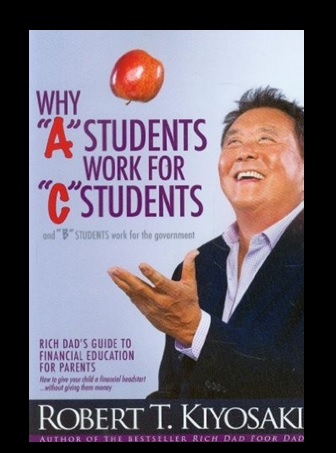
ANSWER: Very simple. Formal education is incapable of teaching creativity. This is why there is the old saying, “A students work for C students, and B students work for the government.” Formal education is merely the way we perpetuate mistakes from one generation to another. Even Albert Einstein ended up with an HONORARY degree in science. Albert was trained as a teacher in physics and mathematics. In 1901, he gained his diploma but was unable to find a teaching post. Einstein took a position as a technical assistant in the Swiss Patent Office. By mid-1905, he was awarded his PhD in physics when he had published four seminal papers (they would later be known as the annus mirabilis papers), which established special relativity, the existence of atoms, and the photoelectric effect. It then took until 1915 before he published his General Theory of Relativity. But he did this work on his own. Albert received honorary doctorate degrees in science, medicine, and philosophy from many European and American universities.
The difference between Einstein and economics is rather simple. Physics is a subject-based upon proof. Economics is a social science and has nothing to do with proof. What I have found is that less than 20% of CFOs in major companies have any degree in economics. They say 37% have MBAs, but I have encountered more with degrees in engineering than economics. The degrees these days are becoming worth less and less because they are certifications from institutions and teachers who have no real-world experience.
In truth, rarely do you find someone other than a doctor or lawyer doing what they have a degree in. This is why degrees have become worthless for many companies no longer even require a degree for that has no bearing upon your skill set. I hated economics in school for it made no sense and it was all about manipulating society with competing theories. I enjoyed physics for it was not subject to random theories that sounded nice (i.e. Marx & Keynes).
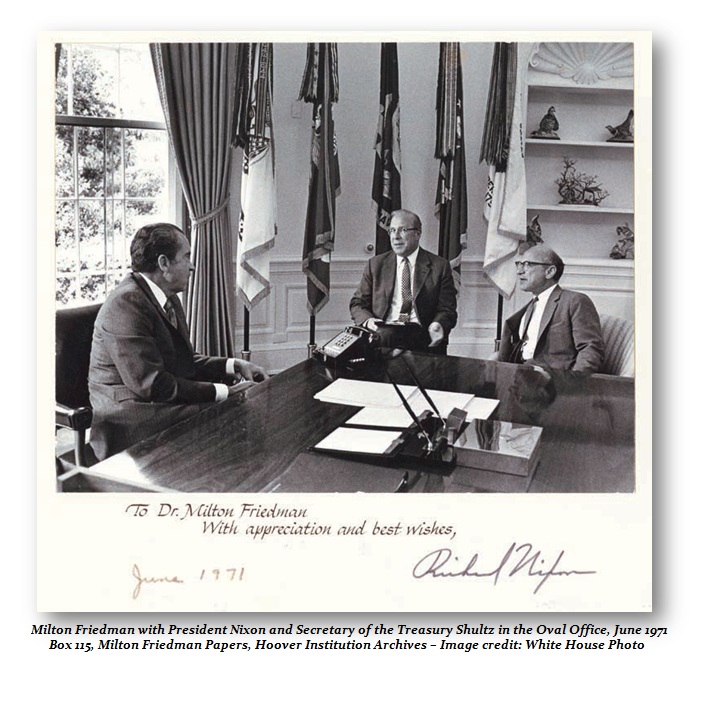
I find it curious that I ended up in economics ONLY because I was a trader who really specialized in foreign exchange. That specialty caused me to be called in during financial crises because they still do not teach foreign exchange in schools. It is also what brought Milton Friedman to come to listen to me at a Market Technician’s conference in Chicago. Milton explained to me that I was doing only what he had dreamed of back in 1953 of how the world would work under a floating exchange rate system.
When I was 13, my family took me to Europe for the summer. We traveled from Sweden down to Italy. Traveling through all those countries and having to constantly change currencies taught me about the foreign exchange at a very early age. I grew up understanding FOREX, and when 1971 came and the floating exchange rate began, my own experiences came into play. By the time the first bank failures appeared by 1974 due to currency fluctuations, I was asked to help. There were no formal classes in foreign exchange and there still are none today. One had to abandon economic analysis which is domestically focused and adopt an international view.
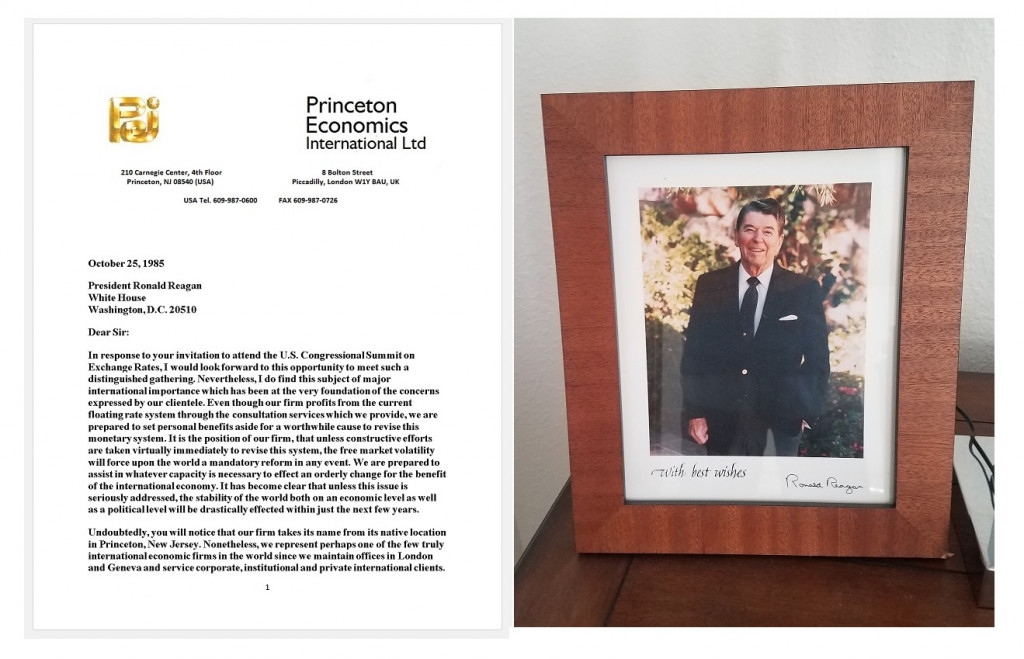
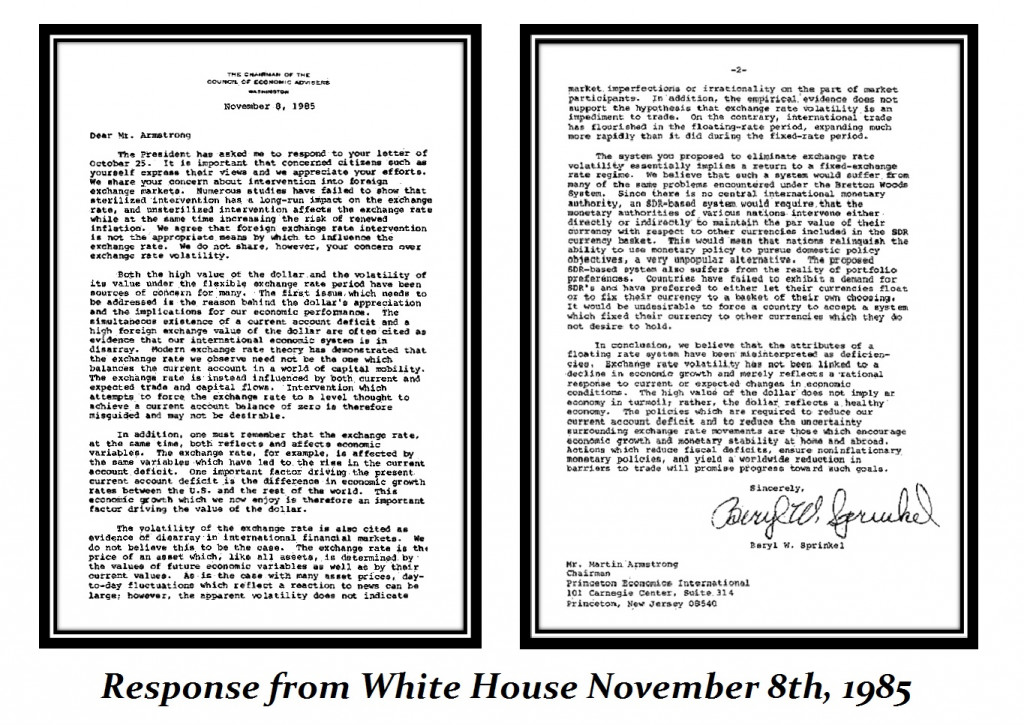
In the summer of 1985, this is when the Plaza Accord took place that created the G5 with the intent to manipulate the dollar lower. I was called in because expertise in foreign exchange was not something you went to school to get a degree in. This was a new subject and they had to turn to people in the real world, not academia.
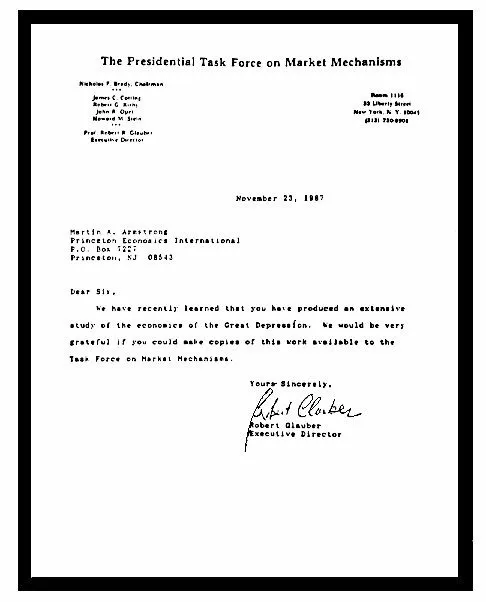
I warned that such manipulation would lead to a crash in two years. The presidential commission to investigate the 1987 Crash had to call me in.
I was called in to testify about international economics and the impact of taxes and foreign exchange on July 18, 1996.
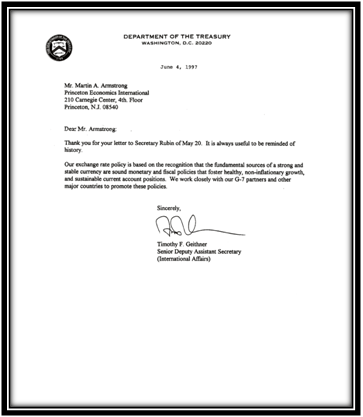
In May 1997, again, the Treasury under Robert Rubin was back at it and talking the dollar down while engaging in trade disputes. Again, I warned not to do this and again the Treasury had to respond.
My own personal career has been built upon experience. There are no degrees in hedge management any more than there are degrees to be the head of the country, no less run for Congress.
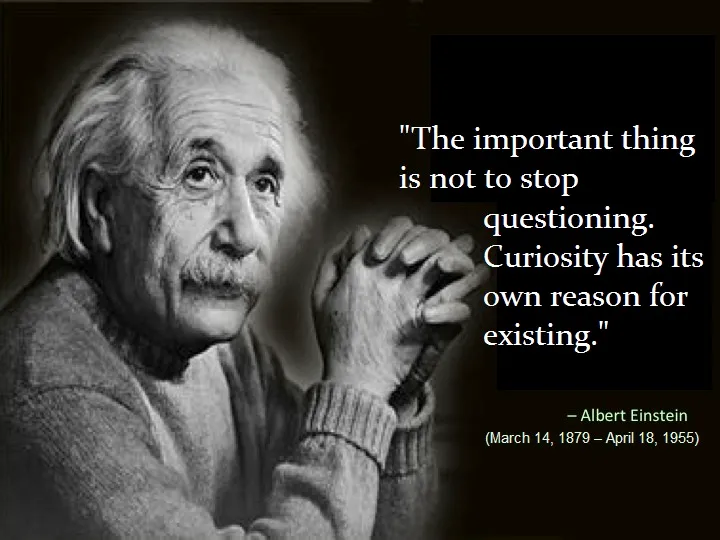
So why do a major percentage of successful businessmen not have degrees? There is no degree that teaches them to be creative. All great innovations are NEVER taught. They come only from those who are CURIOUS and question the status quo. This is why A students indeed work for C students or dropouts, because the A student accepts the status quo and teachers love that. When teachers are questioned and challenged, they typically are hostile and give lower marks to students who do not blindly accept what they say. Thus, it is not always because someone is stupid that they get the C or dropout. They do not accept the status quo. This is where ALL innovation comes from. It does not come from the A student who surrenders to the status quo, but from the dropouts or C students. As Einstein said, it is curiosity which is so essential to innovation.
Hence, degrees have become far less important today than ever before. Despite the fact that Einstein was given a degree, he studied and reasoned on his own. There is a growing list of companies no longer requiring any degree which includes Google, Apple, and the accounting firm Ernst & Young.
Anyone who thinks a degree is necessary to be even a fund manager, good luck on that. It is the track record that matters, not a degree since there are no such degrees in how to be a hedge fund manager. I was never named hedge fund manager of the year in 1998 because of a degree — it was based solely on performance.
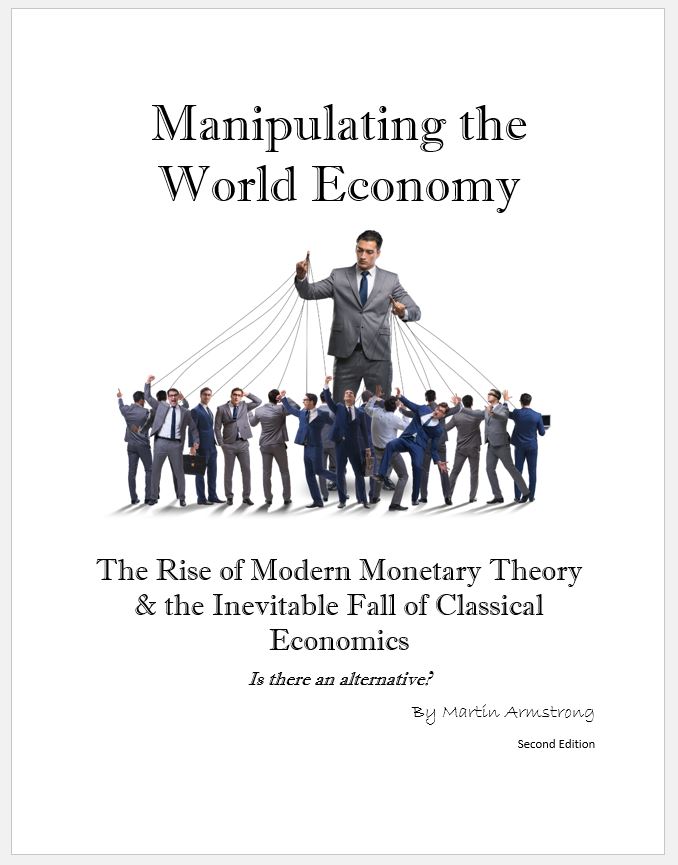
Some people have actually asked did the government buy the entire printing to prevent people from reading this book? No. Apparently this has been the fastest selling book ever on Amazon. What we have determined is that there were many people who purchased several copies to hand out as gifts. One client said he bought five copies and sent them to politicians he knew.
We will publish a Third Edition and add a reference index to the back and perhaps provide an update with the Impeachment and the events for year end. We will have this out before the end of January and we will double the edition size. We are approaching a million viewers worldwide now in 137 different countries to our various websites so we obviously underestimated the demand.
I have created this site to help people have fun in the kitchen. I write about enjoying life both in and out of my kitchen. Life is short! Make the most of it and enjoy!
This is a library of News Events not reported by the Main Stream Media documenting & connecting the dots on How the Obama Marxist Liberal agenda is destroying America








 Centinel2012