The Balkck Sea Trade – Tauric Chersonesus, Panticapaeum.
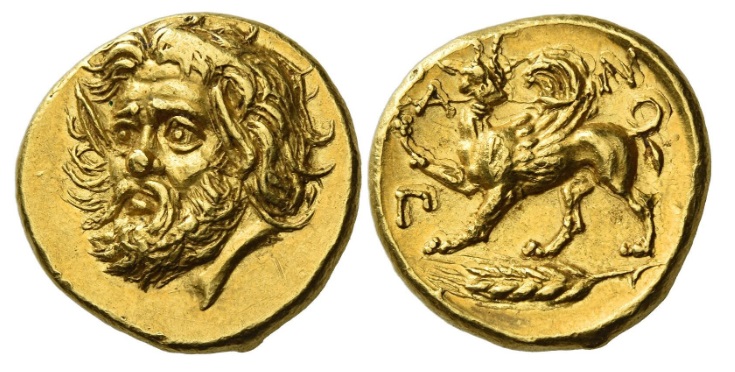
This is probably the finest known Gold Stater (circa 350-300AD) of Panticapaeum, which was the most powerful city in the Tauric Chersonesus with deep involvement in the lucrative Black Sea grain trade for even back then, Ukraine was a major bread-basket in the ancient world as well. This coin is featuring the facing and bearded head of Pan, with the reverse of a Griffin standing left. The griffin type probably alludes to the mythical composite creatures who were believed to guard the gold found in the mountains of Scythia. The Greeks were wonderful storytellers with vivid imaginations. Herodotus describes the griffins as neighbors to the Arimaspi, a northern people each possessing a single eye in the center of their foreheads, who made constant attempts to steal the gold (4.13.1). Pliny the Elder, who accepted the story at face value, expanded it to note that the griffins made their nests in burrows in the ground which contained gold nuggets and it was these that the Arimaspi tried to take while the griffins were merely defending their eggs and young (HN 7.2, 10.70).
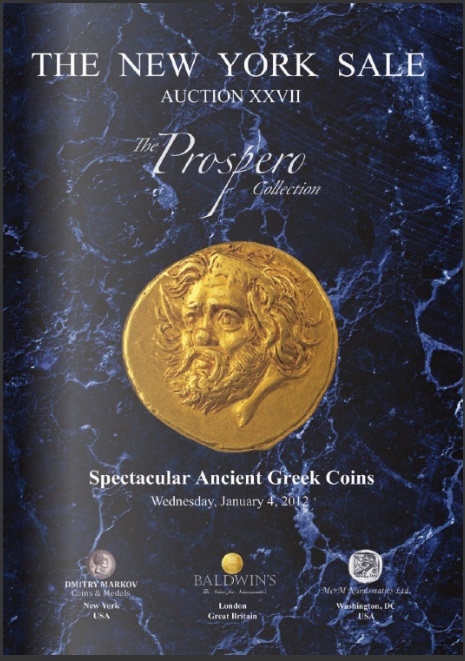
The providence of this coin dates back to Ex F. Schlessinger XI, 1934, and it was sold as the Russian Hermitage duplicates part II, lot 102. It was then sold in the New York XXVII, sale of 2012, where it was featured on the cover. Previously privately purchased from Bank Leu in 1991 in Switzerland. This coin is extremely rare with only a handful known at best. It’s artistic design is considered to be unsurpassed. This is probably the finest known. It sold at auction back in 2012 for $325.000 + 20%
.
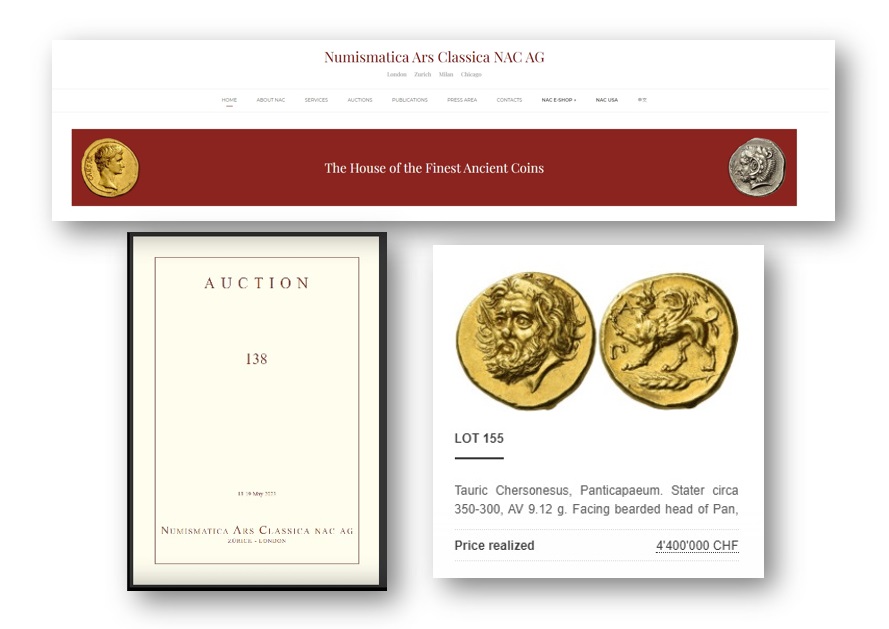
This coin just sold today in Zurich, Switzerland for 4,400,000 CHF + 20% Commission fee. In US dollars, that is $4,862,787 +20% = $5,834,400. This was about 1500% rise in just about 10 years. In all honesty, I have collected ancient coins since I was probably 12 years old. The field of ancient coins has expanded worldwide with major collectors from China to Russia. This coin was estimated at $1,250,000. The sale continues tomorrowwith the Roman. I am truly shellshocked by the prices everything is selling for these days. As I have said, ancient coins are a worldwide market unlike particular national coins which fetch the highest prices in their home country.
New mortgage originations have reached their lowest level since Q2 of 2014. Inventory remains historically low, shelter costs are historically high, and it makes no sense for most to refinance with current mortgage rates over 6% on the 30-year. Originations, including refinances, came in at $323.5 billion during Q1 of 2023. The NY Fed reported that borrowing in general has reached $17.5 trillion, a $150 billion increase, as families grapple with inflation. The refinance boom in 2020 and 2021 will impact real estate for generations to come.
The NY Fed discusses the COVID refinance boom (Q2 of 2020 to Q4 of 2021) in a recent article. Fourteen million mortgages were refinanced during this period when mortgage rates reached record lows. Mortgage rates plummeted 200 bp from Nov. 2018 to November 2020. The last upticks in refinances occurred in 2003 and again in 2013 when rates also fell 200 bp. However, rates were at their lowest level during the COVID refinance boom, allowing many to take out equity from their homes and reinvest. Home equity reached a record high in the time leading up to the pandemic, and the continued rise in home prices provided numerous owners with additional equity.
One-third of all outstanding mortgages were refinanced over the span of 7 quarters. About 64% of refinances were “rate refinances,” classified as those with a balance increase of less than 5% of the mortgage amount. Those who chose this route saved an average of $220 per month. Cash-out refinancers took out $82,000 on average, increasing monthly payments by $150. Around 5 million borrowers extracted a total of $430 billion during the COVID refinance boom—a significant sum.
The 9 million who did not extract equity reduced mortgage payments by $24 billion annually. These figures are something I do not expect to see again in my lifetime. Those holding their breath for rates to drop under 3% again should come up for air. Homeowners are disincentivized to sell at current rates, not to mention home prices are AT LEAST 36% higher than before the pandemic. Everyone’s investment strategy is unique, but those who were able to use their home’s equity to invest during the bottom of the market made out well. The period between Q2 of 2020 to Q4 of 2021 will be a reference point for years to come.
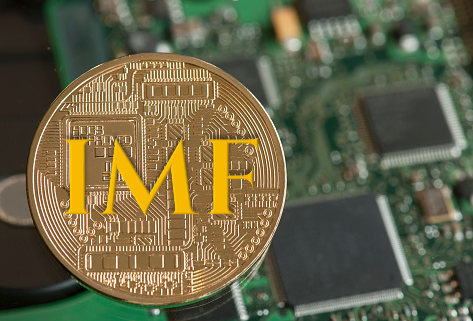
QUESTION: Marty, You are the only worthwhile analyst. You were alerting us a year ago that the IMF was creating its own digital currency. We have all these people claiming this will kill the dollar just as they proclaimed the euro when that was created. It is also well known that you were called in about revising the world monetary system numerous times. I heard that you were called in on this one and refused to assist them. You warned back in May of 2021 that the IMF was creating a new reserve digital currency.
Is this all part of the rise of the United Nations, World Bank, and IMF all becoming this one world government? I that why you declined to get involved?
LW
ANSWER: I am not at liberty to speak to issues where I am solicited. Suffice it to say, I took no part in creating this currency. This is part of what I have been warning about digital currency. They can restrict its use and anyone who thinks that somehow Bitcoin will be some independent white knight rushing in to save the day, they have drank too much of the cool aid.
Look, try depositing $10,000 in cash. Watch what happens. I have a friend who owns a bar in a college town. He takes in a lot of cash because the customers often do not have credit cards. Some banks did not even want to accept an account from him. Others required inspection and monitoring because cash CAN BE a way to launder money. Europe has been restricting cash to transactions capped at €1,000.
There is serious talk of restricting purchases for cash or CRYPTOCURRENCY and the way they enforce it is precisely restrictions on businesses and noncompliance means you are out of business when no bank will accept your account. That eliminates business in credit cards as well. This is why I say, they will create a black market through their sheer authoritarianism. Human rights will no longer be respected. This is point 8 of Schwab’s Agenda.
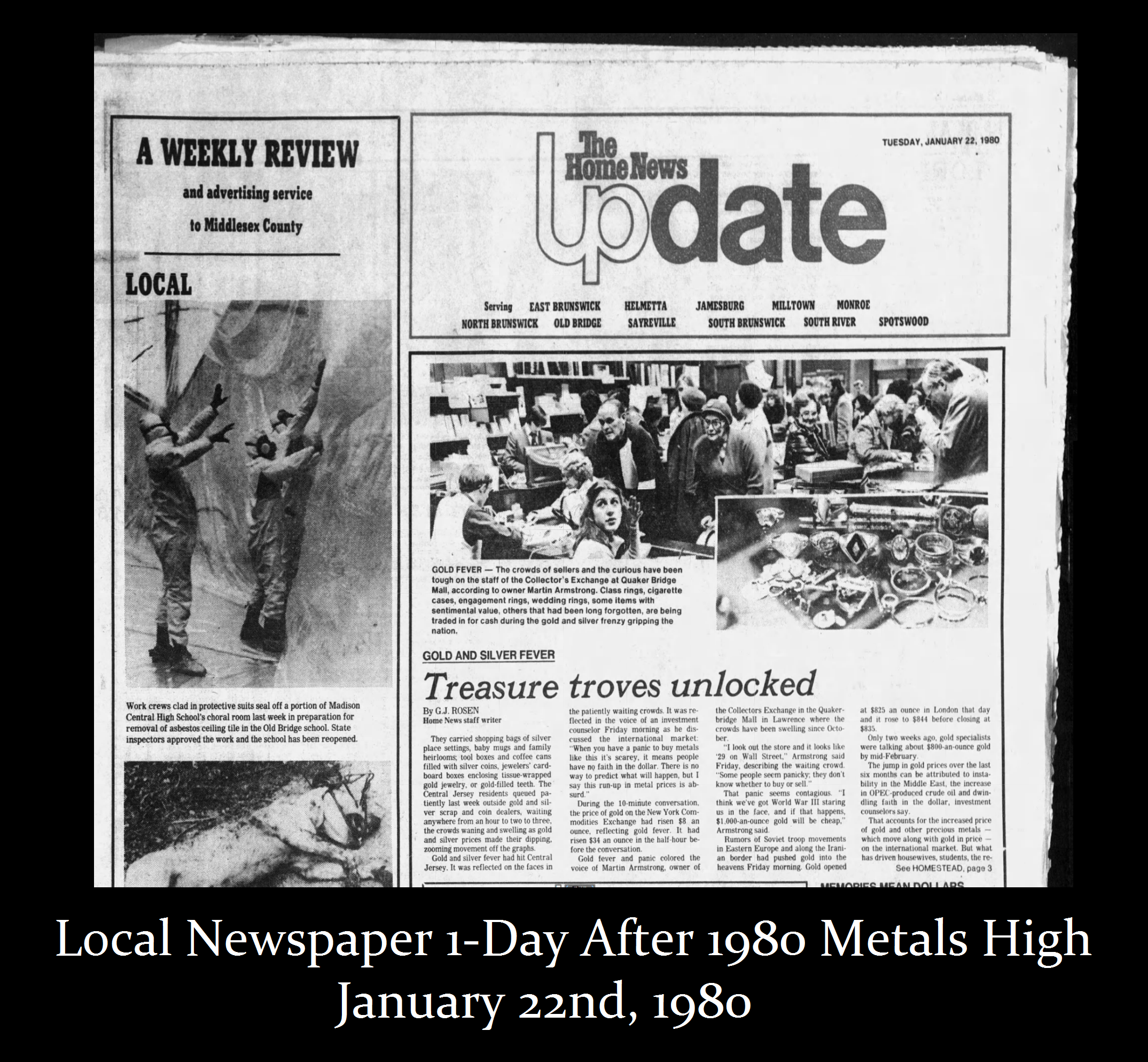
Back in 1980, the press was all over my firm. NPR came in with cameras rolling and could not believe we had just paid a woman $6,000 for a heavy silver serving plate. We had lines all day long at all my locations in addition to the fact I was making markets for all the stores nationwide. Whatever they bought that day they sold immediately;y to us and shipments were coming in from everywhere. I had a team just handling that and we would bundle it all up and send it out in Armored trucks to be refined at Engelhard which was 30 minutes away.
Because of all the publicity, the IRS came in and declared me to be a bank under the theory that Nixon only closed the gold window and gold was never demonetized. Sure, it was a novel theory that just because I was one of the 3 largest gold dealers in the country, that made me a bank without applying for a banking license. They claimed I had to report every transaction of $10,000 or more buying for selling. They sent in their stormtroopers and began going through every transaction. They then went out and audited over 3,000 clients. I decided to retire. That was it. I was not about to become a rat on everyone that walked in the door.
The point is this. They can declare everyone mining cryptocurrency to be a bank. Already, the Infrastructure Investment and Jobs Act of 2021 (IIJA) requires any transaction of $10,000 or more to be independently reported to the IRS. The government can declare you to be anything. You can fight them in court and you will lose and it will take years. In the meantime, you will have to comply. They can do ANYTHING they want. It is then your burden to argue that what they are doing is illegal. Good luck. We are no more living in a free country than Russia or China. The government can do anything it desires. It will always be your burden to say they are acting unconstitutionally.
You will NOT be able to travel internationally with even gold coins. You may not even be able to hop on a plane domestically with gold or cash. Over the past several years, a common question for U.S. taxpayers across the globe is whether or not a foreign-based virtual currency such as Bitcoin that is held overseas is reportable for FBAR (Foreign Bank and Financial Account Reporting) or FATCA (Foreign Account Tax Compliance Act) purposes. The Treasury was already pushing since 2021 for any transaction of $10,000 or more in cryptocurrency must be reported to the IRS.
Whether you are a visitor to the United States or a U.S. citizen arriving in the United States, you must complete one or more entry forms.
At the end of the day, they want their pound of flesh and they want absolutely everything to be restricted and monitored. Welcome to the new law of totalitarianism.
QUESTION: Hello Martin, Been reading your writings with keen interest for over 15 years now since while you were incarcerated. My question is: The way you paint a picture of the past economies going back hundreds and thousands of years through the discovery of coinage hoards is brilliant. How will a future “Martin Armstrong” from say 500 to 1,000 years from now be able to utilize that methodology of discovering the history of this era when we’re largely a computer digital transaction society? (Especially if government-planned digital currency takes over?) Thanks. Jerry S.
ANSWER: I know the crypto-people do not like my view that digital currency is entirely dependent upon the power grid and once money is in any official exchange, it will be subject to government regulation. Just look at Tik Tok. The government wants to ban it because they CANNOT get into the data and who is saying what. It has nothing to do with China. They are not interested if you paid the babysitter next door, but Congress is. They have backdoors into everything – not Tik Tok. That has become the hub for many threats to their form of society called the dreaded CONSERVATIVES.
Reading historical accounts of things would never provide the real picture. The coinage has been the breadcrumbs that lead to the truth. I can see the real level of debasement, and when put together with historical accounts, we can get a real picture of history. We must also respect that some periods are black holes and the coinage is what turns on the light.
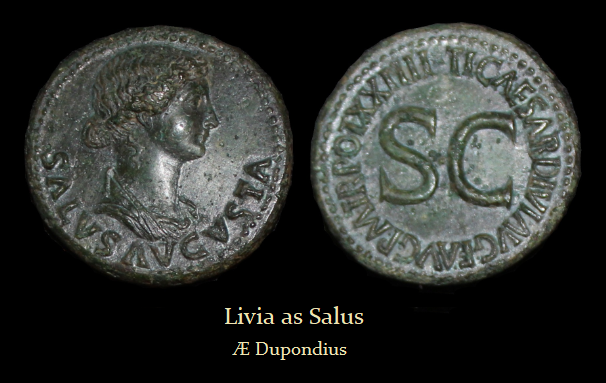
For example, it is the coinage that enables us to confirm much of history and I believe we will see the future follow the past. The wife of Augustus, Livia, the first empress of Rome, was a very powerful woman. The real power behind the thrown. I suggest watching the series – Domina. It is far better than any fictional story. It was his mother, Livia, who pushed him to be Emperor.
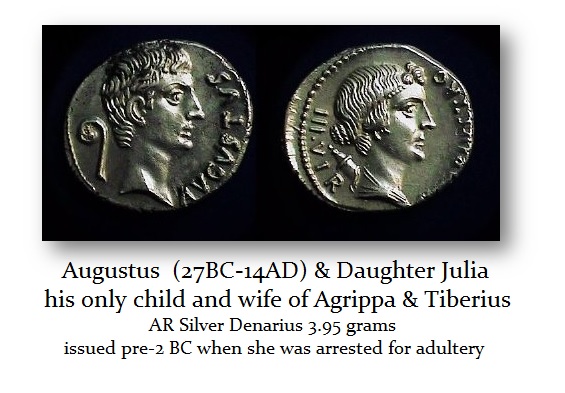
Livia was renowned for her intelligence but was also one of the most beautiful women in Rome. Tiberius was not her favorite – that was his brother Drusus. Tiberius had a son with his first wife Vipsania who was born in 14BC. Livia compelled Tiberius to marry Augustus’ daughter Julia as a way to the throne. Augustus was not fond of Tiberius for he was simply unsocial. His marriage to Julia was like a mixture of oil and water. She sought sexual parties and ignored Tiberius and was finally exiled by her father.
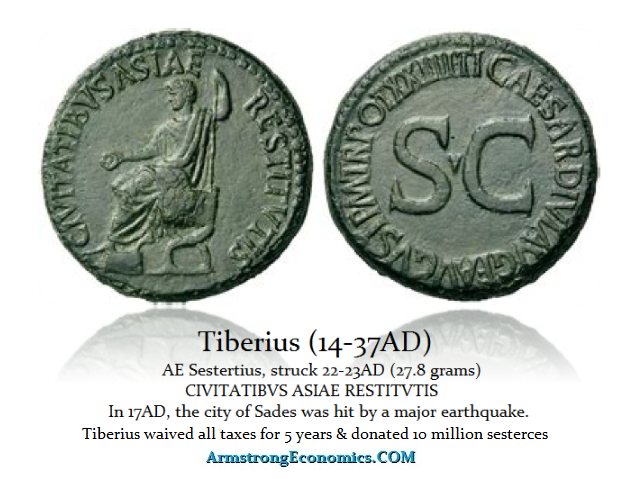
Frome the coinage, we can confirm that Tiberius responded to a major earthquake that destroyed much of Asia, modern-day Turkey. Tiberius issued coins for the aid of Asia. We also know that he waived all taxes for 5 years and donated 10 million sesterces for relief. What politicians would ever system taxes as a tool of relief today?
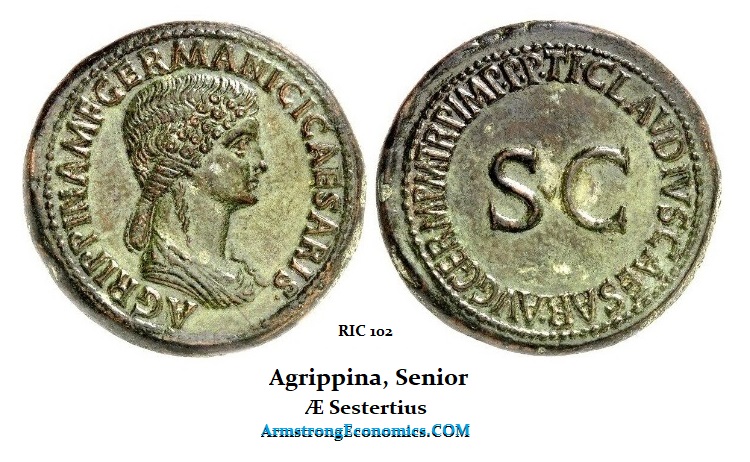
Augustus’ heir was to be Germanicus (15BC-19AD) who was the son of Nero Claudius Drusus, the younger brother of Tiberius, and Antonia, who was the daughter of Mark Antony and Augustus’ sister Octavia. He was married to Agrippina, Sr, who was the daughter of Agrippa and Augustus’ daughter Julia. Agrippina seems to have been the independent-minded woman who blamed Livia for the death of her husband.
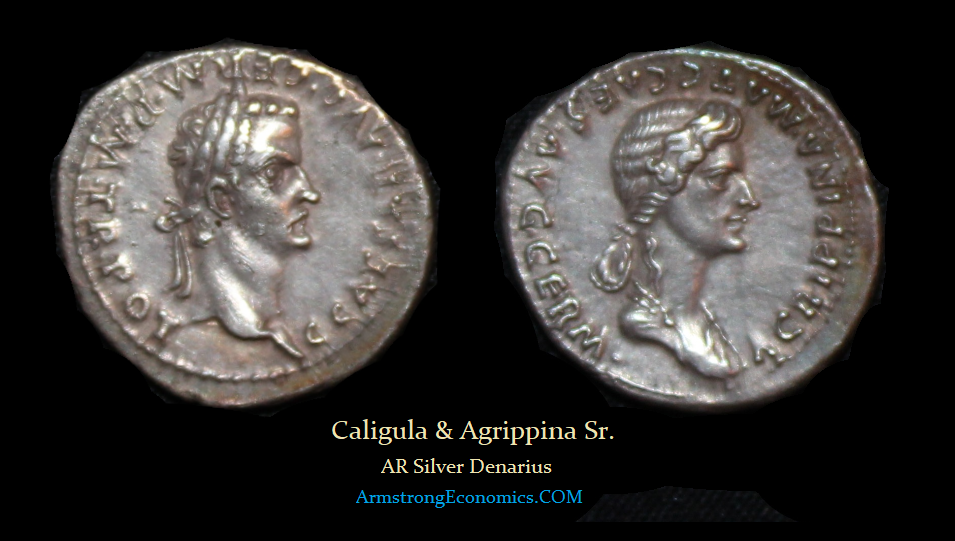
Agrippina, Sr. was such a disruption politically that Tiberius was compelled to banish her like her mother in 29AD where she eventually died of starvation in 33AD. Her son, Caligula, seems to have inherited her insanity, and her daughter Agrippina, Jr, as well. She is actually the first woman on Roman coinage displaying her name. Livia’s portrait would be used but always styled as some goddess.
Of course, her son Caligula has warranted films exclusively devoted to his. He is famous for insulting the Senators by making his horse a senator. Caligula was born in 12 AD. He was named as Tiberius’ heir in 37AD and it has been long suspected that Caligula smothered Tiberius to death to take the throne. He was notorious for his depravity and cruelty. He was assassinated by the Praetorian Guard on January 24th, 41AD.
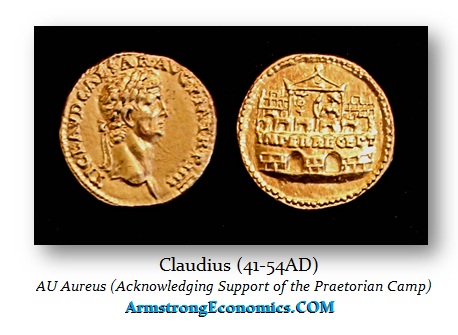
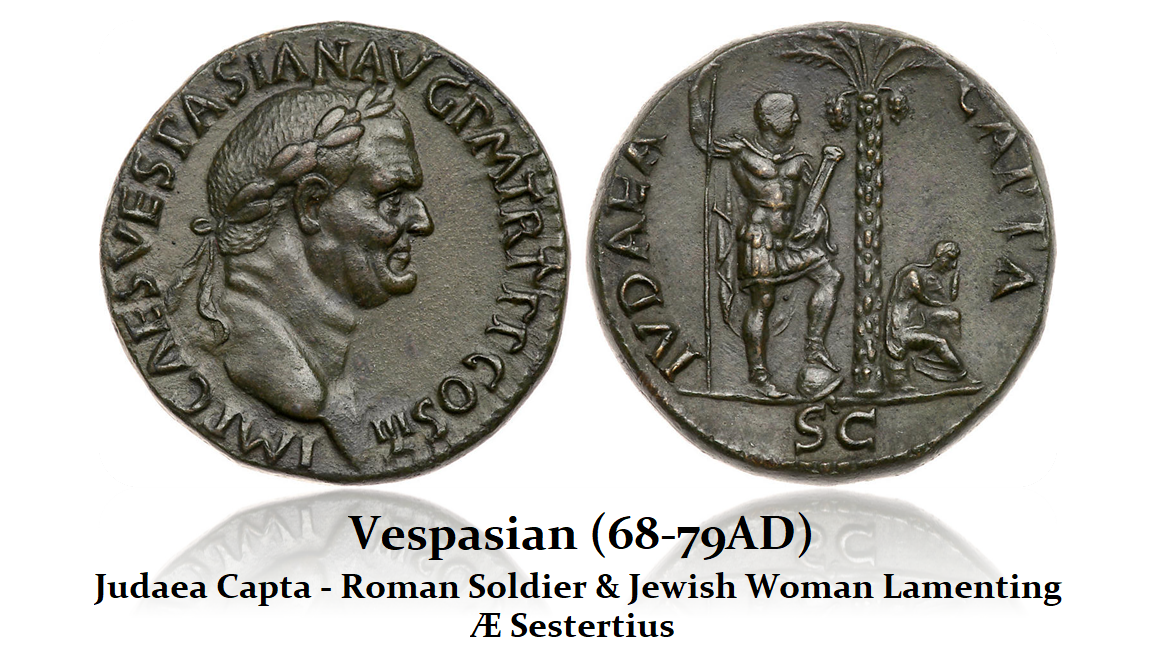
The Praetorian Guard needed an emperor or there was no point in them being the Praetorian Guard. They turned to Claudius and made him emperor. You can see from his coinage the image of the Praetorian Guard camp on the reverse announcing that he was made emperor by the Praetorians.
There is a great series of these events done years ago by the BBC. It was based on the book I Claudius and the series bares the same name – I. Cludius. That too is a worthwhile series that was produced decades ago.
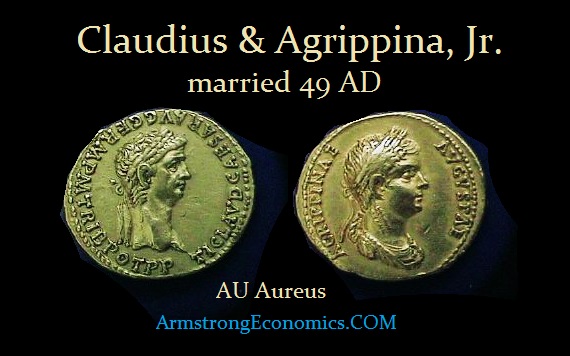
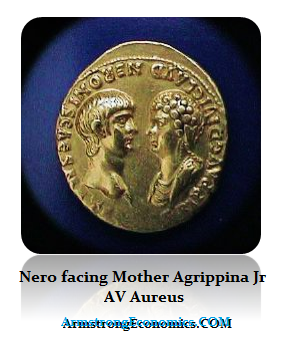
In fact, Agrippina Jr, sister of Caligula, was not only the mother of Nero who ordered her killed for her dominance, but she married he uncle Claudius to secure the throne for Nero. Once again, we find her portrait on coins alongside her son, Nero, which also reflected her dominance and effective rule of the empire. Some have likened her to Hillary Clinton for her cunning and effective rule behind the curtain.
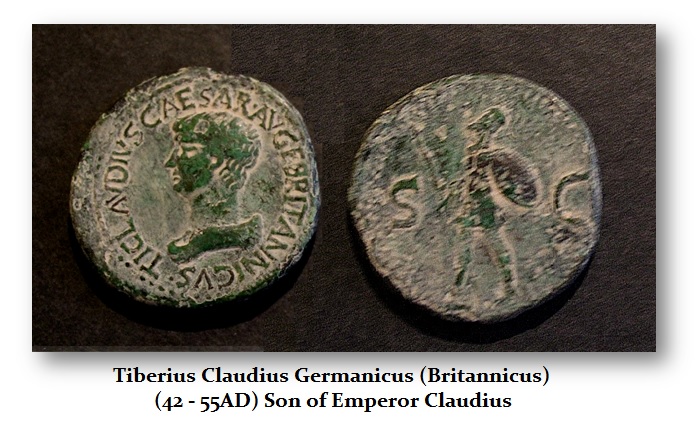
To ensure Nero would become Claudius’ heir, she poisoned Claudius’ son – Britanicus. It shows what a bad apple can do to the whole lot. Many have pointed to the fact that it was the dominance and cunning of the women that brought down the Julio-Claudian Dynasty.
Nevertheless, the coinage not merely confirms history, but also provides a window through time for us to see how human nature never changes, and as such, the future becomes merely a repetition of human contrivances.
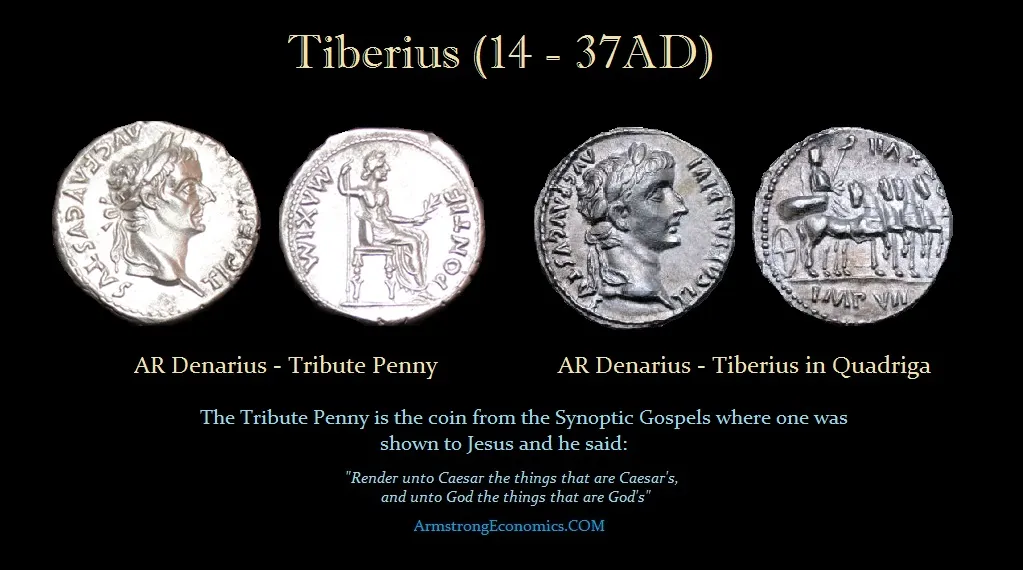
To answer the question if future historians will be able to do what I have done if the currency is eliminated and we have just electronic digital currency, I believe the answer lies in the past. We can see something rather astonishing right here during the reign of Tiberius (14-37AD).
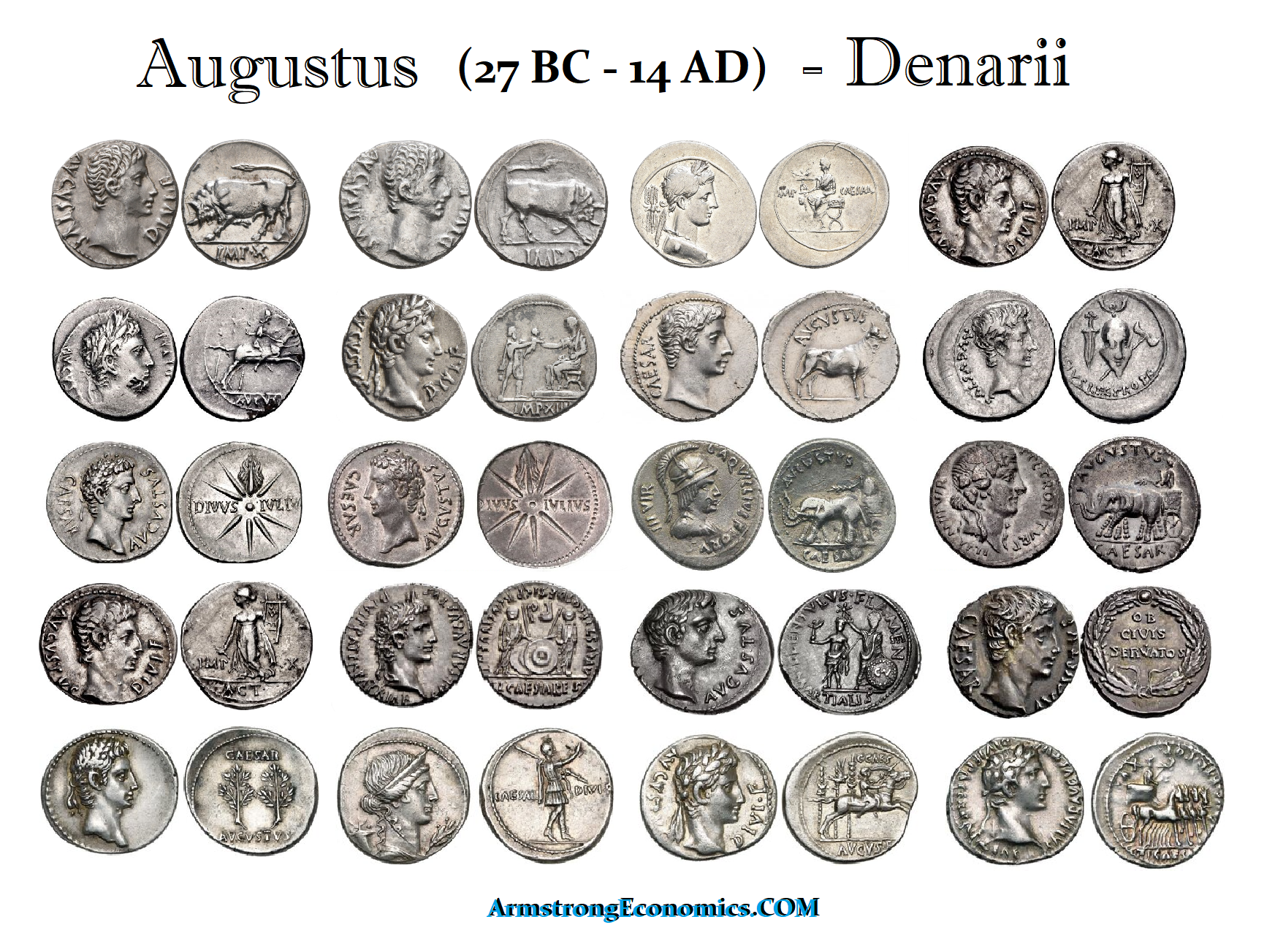
Augustus/Octavian (heir to Julius Caesar) became the first emperor of Rome following the defeat of Cleopatra and Mark Antony in 30 BC. He was granted the title Augustus in 27BC by the Senate for saving Rome from the proxy war of Cleopatra who used Mark Antony to try to conquer Rome. However, because he was the first emperor, it appears that he blanked the empire with coinage to justify his position as emperor, not king, which was really the same thing. There are over 500 different silver denarii types. I have never even heard of a collector assembling each type.
Against that backdrop, being indeed a reluctant emperor and forced into an unhappy marriage, it is understandable that being an unsocial workaholic, the circumstances most likely drove Tiberius deeper into seclusion. He rarely left Rome. In fact, he would not even attend the gladiator games. This is the extent of his coinage – two types. That’s it! Instead of the proliferation of coinage under Augustus, spending was curtailed and we can determine that from the coinage, not contemporary accounts. This led to a SHORTAGE of money, and in such a recession. That became the Financial Panic in 33AD.
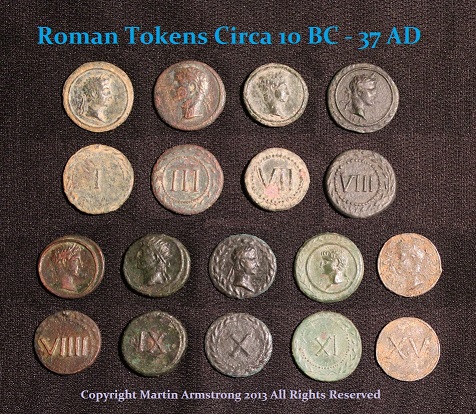
Because of the shortage of money, this is where we find the first time that the private sector began to issue its own coinage. Some have claimed they were some sort of token. But they are confined to this period of Tiberius where there was a Financial Panic and a shortage of coinage compared to the reign of Augustus.
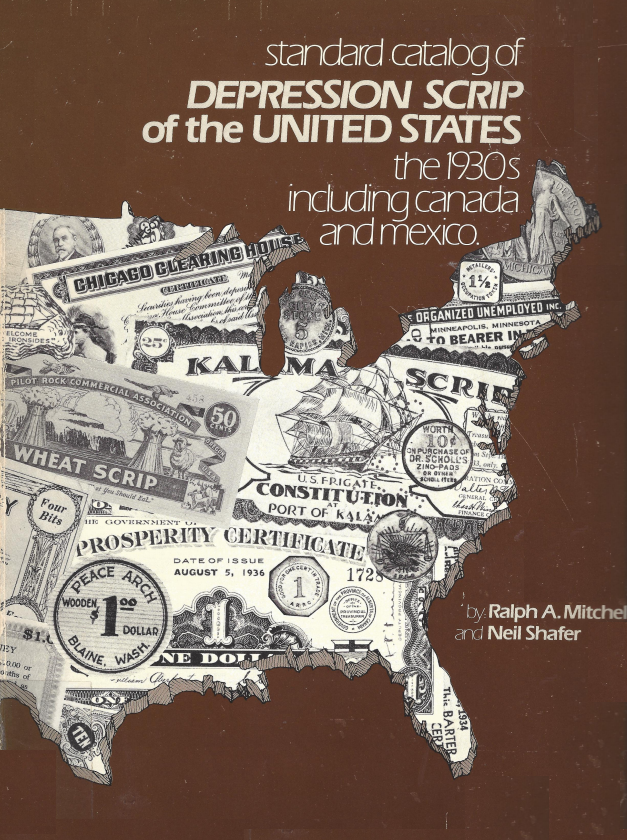
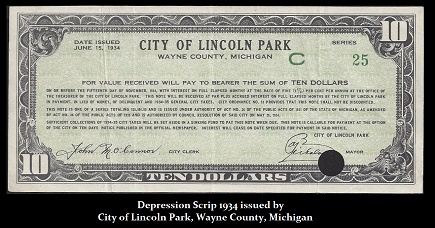
During the Great Depression, because there too the austerity measures of the government created a shortage of currency. Thus, over 200 cities in the United States began to issue their own currency for local use.
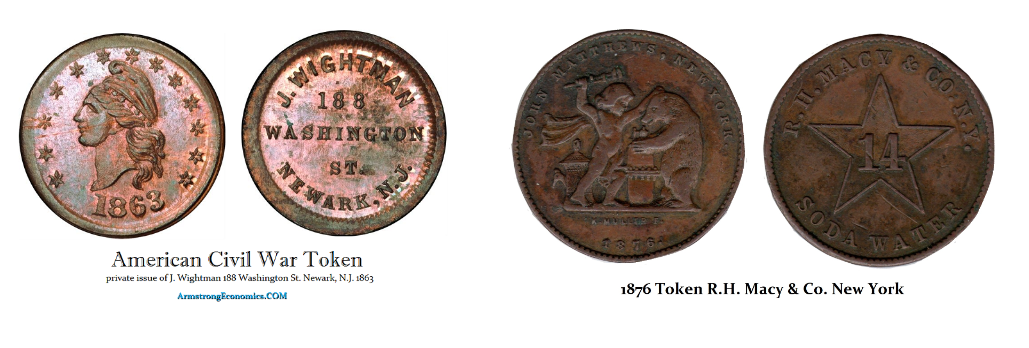
Likewise, during the Civil War, there was also a shortage of money There is a whole array of private coinage during that event. Then there was the hard time that followed the Panic of 1837, Again we have private coinage surfacing. The same again took place with the Panic of 1873.
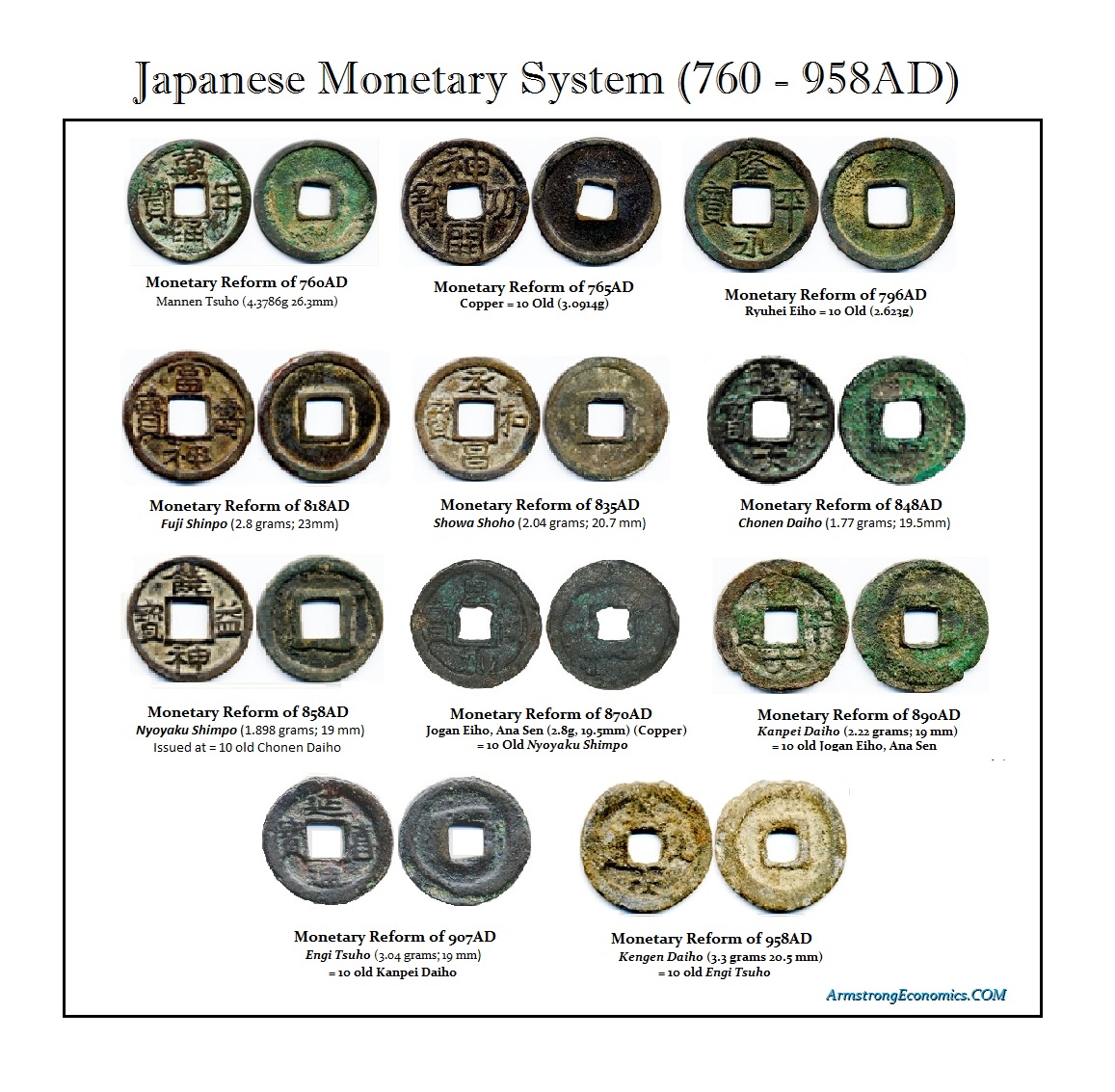
In Japan, because of the corruption of the government always devaluing the currency of the previous emperor, the Japanese finally just stopped accepting the coinage of their own government. The economy reverted to one of barter and they used the coinage of China. Japan lost the authority to even issue coinage for 600 years until the Meiji Era.
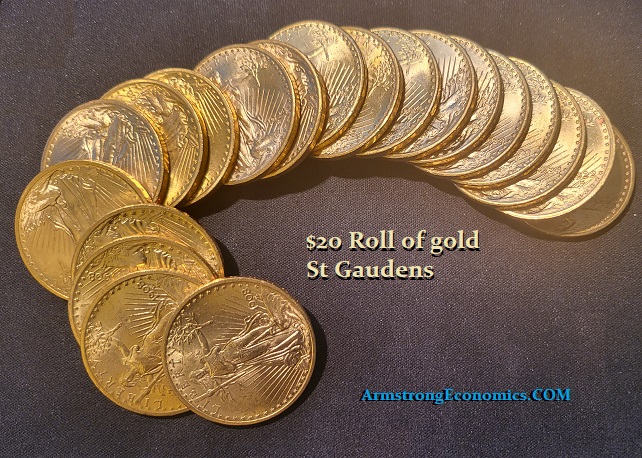
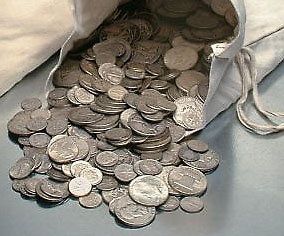
Cryptocurrency will fade with the collapse of governments. It will be too dependent on a unified power grid. If history is any guide, we will return to a barter system combined with perhaps old identifiable coinage that the average person will recognize. That is one reason why I do not recommend bars of silver or gold, but the old coinage. Bags of pre-1965 silver coins in the US or similar in Europe and Canada where the average person can look at a date and accept it whereas they cannot tell the difference between a var of silver or nickel.
Do not make the mistake of judging others by yourself. You may know was a bar of silver is, but that will not help you if the other person does not. There are videos on YouTube where people are offered a silver bar or a chocolate bar and they take the chocolate. Not everyone knows what you may know. Keep that in mind.
So at the end of the day, we will have to rebuild society from the ground up post-2032. A currency need not be backed by anything. Its value is ALWAYS based upon a belief system. The same is true with gold and silver. They had no utility value, only as jewelry from the outset. They were valued because at first, the kings reserved gold only for their adornment.
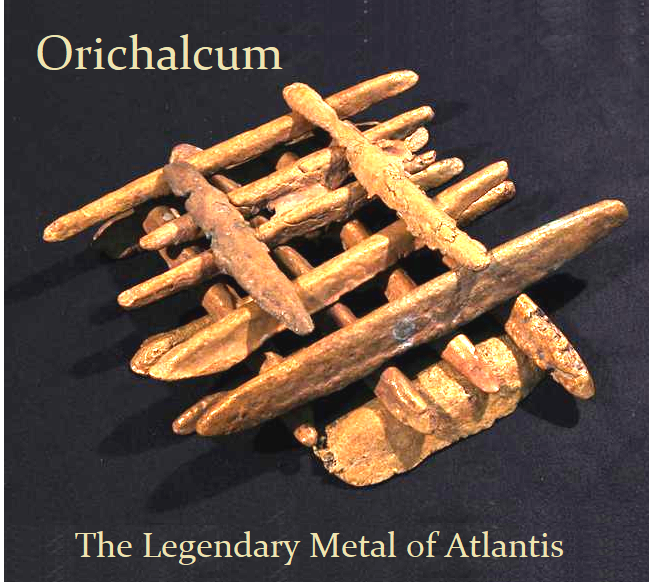
Orichalcum, brass, is the legendary metal mentioned in the story of Atlantis in the Critias of Plato. In fact, orichalcum was considered second only to gold in value and it held a greater value than even silver. It was said to have been mined in many parts of Atlantis in ancient times. These ingots of orichalcum were discovered in a shipwreck that had sunk 2,600 years ago, off the coast of Gela in southern Sicily. The ingots are an alloy consisting of 75–80% copper, 15–20% zinc, and smaller percentages of nickel, lead, and iron. In other words, they are brass. Because the color is closer to gold, this was highly prized.
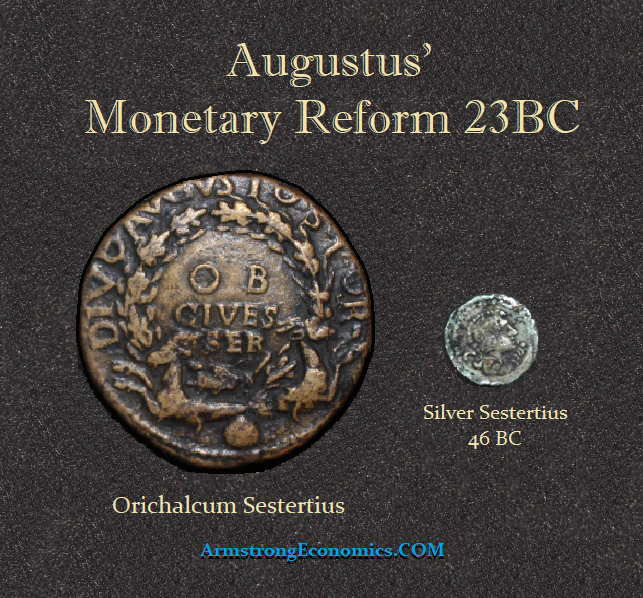
The Greeks rarely used orichalcum for coinage in the Hellenistic world. It was used experimentally by Romans under the reigns of Octavian and Mark Antony. Where we begin to see orichalcum used in the coinage consistently is dated to the monetary reform of Augustus (23 BC). It was then that he introduced sestertii and dupondii were struck in orichalcum (Cu-Zn alloy) rather than silver and bronze. The sestertius of the Republican era was a tiny silver coin of about 0.7 grams. Later, the monetary reform Nero made during 63–64 AD, introduced the use of orichalcum to the denomination of the as, semis, and quadrantes.
Following the Civil War with the death of Nero, orichalcum was replaced in the coinage with bronze. It is highly likely that someone figured out how to make orichalcum and its premium just collapsed. Counterfeiters had long figured out how to mix wrap a coin in silver and strike it to make it appear it was silver, but also to use chemicals to cause the silver to appear on the surface. We cannot rule out that someone had figured out how to make brass and thus it lost its premium.
The value of any currency is entirely based on belief. Once the ancients figured out that orichalcum was just an alloy and could be made, then it no longer seems as more valuable than silver. Even cryptocurrency is worthless. Its entire valuation is simply based that others believe it has some value. Money at its most basic core during a financial crisis is predicated upon its utility value. Hence, in Japan, bags of rice became money. It is unlikely that even cryptocurrency will survive the transition post-2032. Precious metals ONLY in the form of some recognizable coin will be accepted like the Japanese accepted Chinese coins. Barter will return as it always has. That will most likely be in the form of food.
Honest journalism has become a crime. I have appeared numerous times on Maria Zaric’s program, Zeee Media. Maria is a professional journalist who asks thought-provoking questions to the experts that appear on her show. Her content goes against the grain and traditional narrative. The Australian-based journalist has been questioning COVID, the Great Reset, governments, globalists, the war in Ukraine, and many other topics that are completely taboo in the mainstream media. They attempted to shut down her channel in the past. Now, she has been de-banked with no explanation.
“Do you shut down peoples accounts due to their political views by any chance?” Maria asked the bank representative, only to be met with silence. Maria had been banking with ING Bank for numerous years without issues. Her account was suddenly shut down shortly after releasing a story on domestic terrorism in Australia. ING Bank has been unable to explain why her account was canceled.
Interestingly, ING is a partner of the World Economic Forum. Maria has extensively covered the WEF’s agenda to “enslave humanity.” Is Australia secretly keeping track of journalists’ “social credit scores” to silence skepticism?
The idea of eliminating someone’s ability to bank is essentially eliminating them from society. We saw Canadado the same thing to those protesting the Trucker Convoy. Trudeau took things a step further by also de-banking people who simply donated to the cause. The Canadian government used the premise of money laundering as a way to coerce the banks into reporting any activity that could have been intended to help the protestors. I know of numerous people who were frantically attempting to remove their funds from the bank during this time.
As if the public needed more reasons to lose trust in the banking system. This is not limited to one bank or country. I discussed how banks have the ability to “cancel” someone after JPMorgan Chase de-banked the rapper Kanye West for antisemitic remarks. The bank acts as the jury and judge. Epstein was permitted to hold funds at JPMorgan Chase despite an ongoing pedophile ring trial. Bernie Madoff banked with JPMorgan Chase. The bank has secret ties to the Third Reich and helped the group funnel money through South America during World War II. Again, the bank acts as the jury and judge; anyone can be de-banked anytime for any reason.
Most countries may not openly have social credit scores, but they’re keeping tabs on us. They are keenly aware that resistance to this New World Order is building. So they are now using professional journalists as examples hoping that people will stop asking questions to learn the truth. That is one of the reasons why this blog is free of charge – you deserve to know the truth.
The banking crisis continues and it is impacting funds that have been buying bonds. Allianz, a subsidiary of Pimco, is writing off countless millions with Credit Suisse bonds. The banking crisis has been the result of artificially low-interest rates for far too long and banks were used to free money and buy long-term bonds all because they were making their money on the spread. Now that rates are rising, their risk management was effectively nonexistent, and thus the losses and widespread.
The Allianz subsidiary Pimco is one of the largest asset managers in the world. They have to now write off a loss in Credit Suisse bonds and it’s ain’t over yet as we head into April 10th.
The Biden Administration is responding to the panic phone calls that their Marxist philosophy will bring down the entire financial system. My ear is red as can be. I have had enough of the phone calls today to last the balance of the month. Trying just to do the right thing! Three banks have effectively gone down in the week of March 6th, which our computer was targeting. There have been Silicon Vally Bank, Signature Bank, and Silvergat Bank.
The Regulators perhaps saw the handwriting on the wall. This NO BAILOUT claiming that no taxpayer money will be used for a bailout of their hated rich, how about just using the taxpayer’s money you are throwing down the train in Ukraine? Depositors in Signature and SVB they are now saying would be made whole. If they do not cover ALL deposits, the monumental banking failure will be catastrophic.
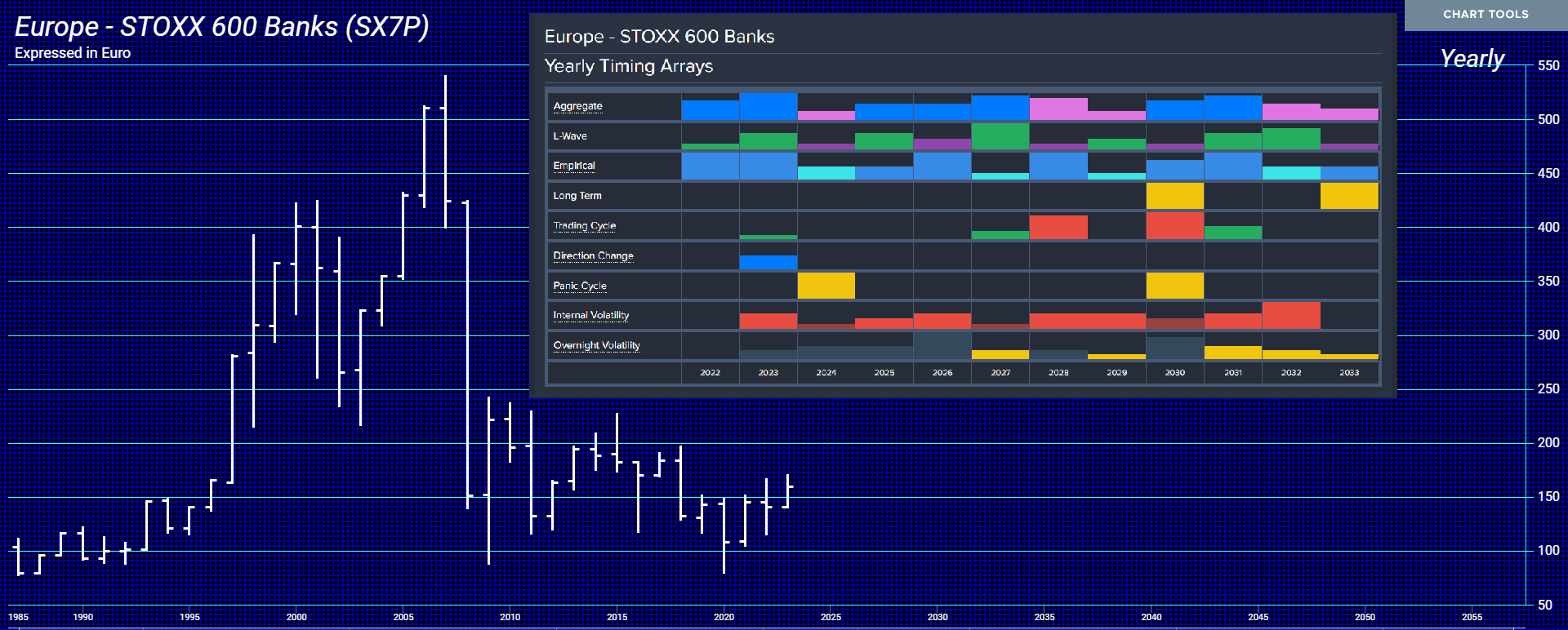
Our forecast for a Banking Crisis is by NO MEANS confined to the United States. It will be far worse in Europe. We can see our computer not only targeted 2023 for a key turning point with a Directional Change but a Panic Cycle next year in bank stocks, but interest rates will be rising higher as also the risk of banks and governments escalated especially when they insist on waging war against Russia.
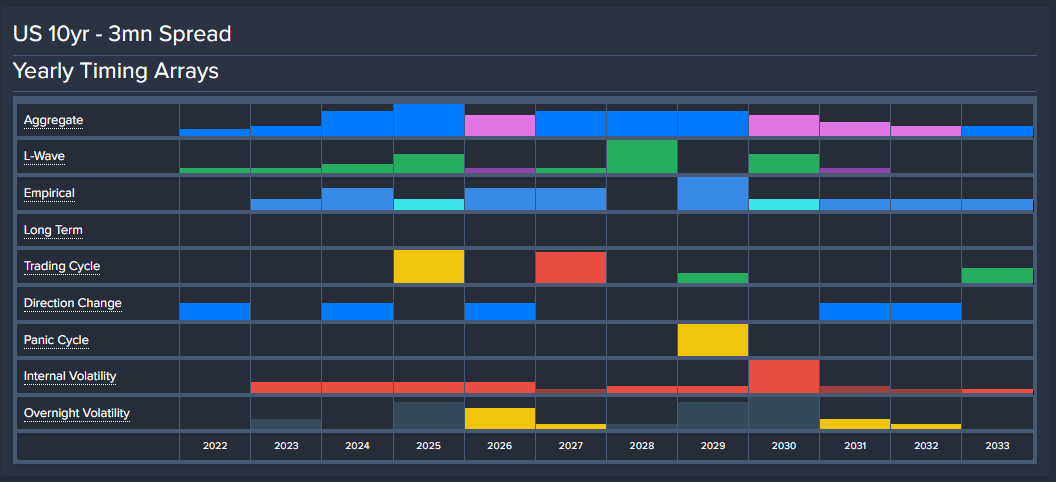
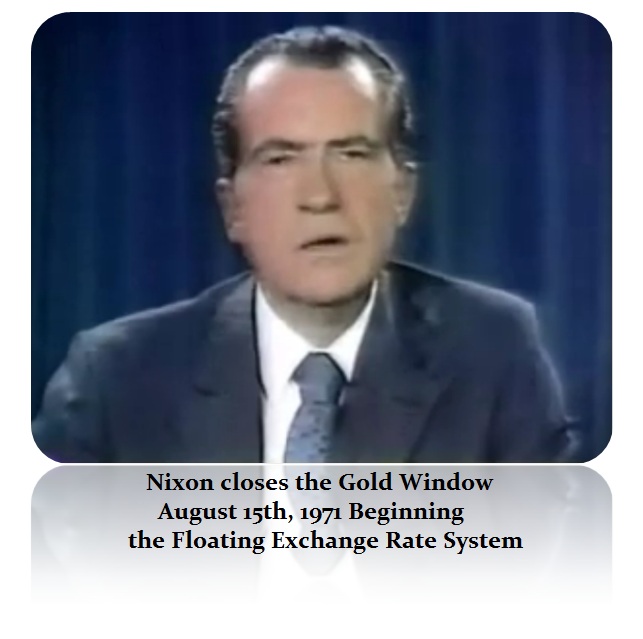
The yield curve is critical and we must understand that this insane war against Russia, even economically, will be a major financial disaster not much different from Vietnam which brought down Bretton Woods and forced Nixon to close the gold window on August 15th, 1971. It was that unrestrained spending directed by the Neocons. Then too, it was all about Russia they assumed was behind Vietnam.
Once more, the reckless spending on war promoted by the Neocons is undermining the entire economy. They have lost every war they have promoted – Vietnam, Afghanistan, Iraq, proposed Syria, Libya regime change, and now Ukraine. These people are never held accountable for all the devastation and the lives lost.
War is the primary driver of inflation and the central banks will not even address it for they do not want to “criticize” the Neocons. They might wake up with their dog’s head in the bed as in the Godfather. The central banks will NOT be able to contain this inflation or ever reach their 2% target regardless if the economy turns down just as what happened during Vietnam.
This is a warning to all small banks. Understand the REAL trend or you will NOT survive. Major capital is fleeing the long-term and rising into the short-term because they see rates are rising and any long-term bond investment during a period of war is going to be a major losing trade. Do not get trapped by the yield curve and understand that this trend is in play into 2025.
This Banking Crisis has been caused by Governments who artificially kept interest rates too low since 2008 and in the process, this banking crisis is unfolding because too many banks are UNSOPHISTICATED in forecasting and have been listening to the talking heads on TV and the desperate hope that inflation will decline while ignoring Ukraine entirely. Get that wrong – and you will NOT survive.
I strongly urge small banks to take our business services for access to real forecasting that is not biased or tarnished by human opinion with the two most dangerous words in forecasting:
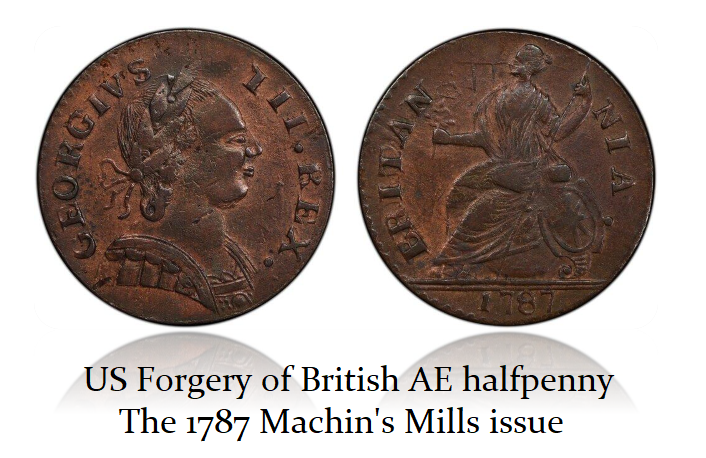
During the reign of King George III (1760–1820) the first issue of halfpennies actually was not issued until 10 years after his accession to the throne in 1770. Consequently, the vast number of halfpennies in circulation were actually all counterfeits. Indeed, counterfeiting became rampant at first because there was a coin shortage. In 1771, it was declared that counterfeiting copper coins were to be a serious crime. Nevertheless, this really made no difference. Over the course of the next twenty years, the majority of copper coins in circulation were forgeries. Even in the American Colonies, a favorite pastime was to counterfeit British halfpennies.
Coppers of this type are thought to have been minted from mid-1787 through 1788 and probably into 1789. Interestingly, it appears Thomas Machin first produced halfpence dated to the contemporary year as well as examples backdated to 1778. As the mints in Connecticut, New Jersey, and Vermont failed, their equipment ended up at Machin’s Mills. Along with imitation British halfpence, Machin’s Mills also produced illegal Connecticut coppers and some legal Vermont Coppers, with most of their Vermont coins being struck over counterfeit Irish halfpence. The illegal coining operation continued at Machin’s Mills until around early 1790, which was longer than any of the legal mints in New England.
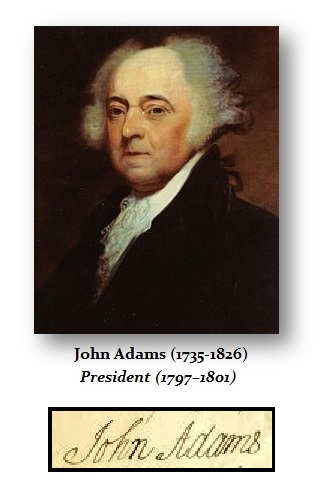
“There is a vast sum in Circulation here of base Copper: to the amount of Several hundreds of thousands of Pounds. very lately these half Pence are refused every where: I suppose in Consequence of some Concerted Scheme. and it is supposed that they will be all purchased for a trifle and Sent to the United States where they will pass for good metal, and consequently our Simple Country men be cheated of an immense sum.2 The Board of Treasury, may be ordered with out the avowed Interposition of Congress, to give the alarm to our Citizens. and the seperate States would do well to prohibit this false Money from being paid or received.3
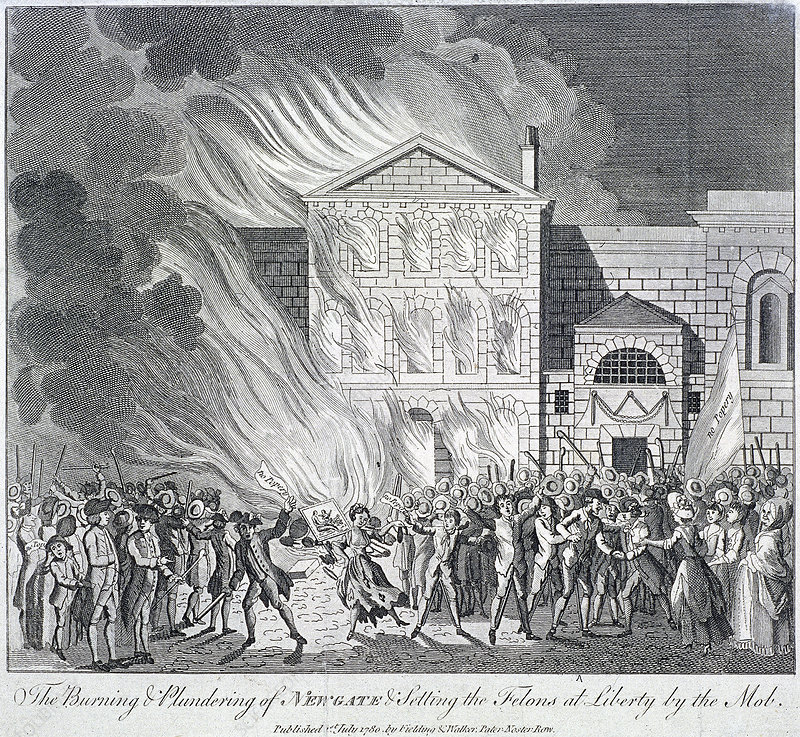
There was religious tension in Britain that still lingers to this day against Catholics. The Gordon Riots of 1780 took place over several days instigated by the anti-Catholic sentiment that again erupted with the passage of the Papists Act of 1778. That was an attempt to reduce official discrimination against British Catholics with the first legislation of the Popery Act of 1698. At the time, Lord George Gordon was the head of the Protestant Association. He argued that the law would enable Catholics to join the British Army and once in they would then use the army to plot treason. The protest became the excuse to burn people’s possessions, engaged in widespread rioting and looting, and they even used the opportunity to attack both Newgate Prison and the Bank of England. This was by far the most destructive riot in the history of London.
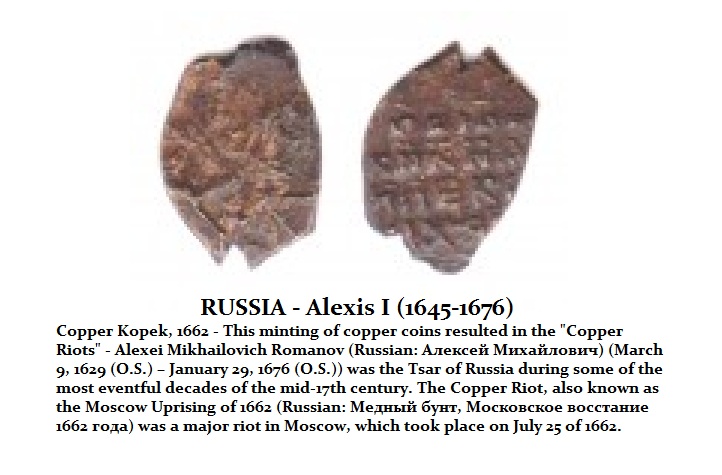
From the mid-1600s, the world money supply was increased largely with copper coins. Russia, in particular, began to overvalue the copper coins. Money is always fiat for its value is typically dictated by the government. Overvaluing copper as in the 17th and 18th centuries, led to the same trend of overvaluing silver during the 19th century. The result of this monetary manipulation by the Russian government led to what became known as the Copper Riots of 1662.
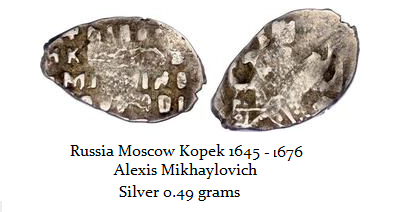
The Russian government began producing copper coins and monetizing them to be of equal value to silver Kopek currency with an average weight of about half of a gram to meet expenses during the mini-Ice Age. The effort failed and silver vanished from circulation as people began hoarding them causing the entire economy to collapse. The copper money was naturally devalued in purchasing power and then there were widespread counterfeiting operations since the official value of the copper coinage became far in excess of the cost of production. The economy collapsed into a deflationary black hole as businesses shut down and unemployment rose dramatically. This erupted into what has become known as the Copper Riots of 1662.
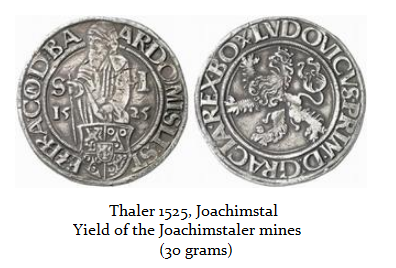
The German bankers, the Fuggers, emerged as the leading Augsburg merchant-banker, who then provided loans to local rulers secured with the silver produce of their mines. The discovery of vast silver mines eventually led to the development in 1525 of the one-ounce silver coin that was the thaler from which we derive the name “dollar” as the alternative to the British pound after the American Revolution. The Joachimsthaler of the Kingdom of Bohemia was therefore the first thaler ideally with a weight of 31 grams or one troy ounce.
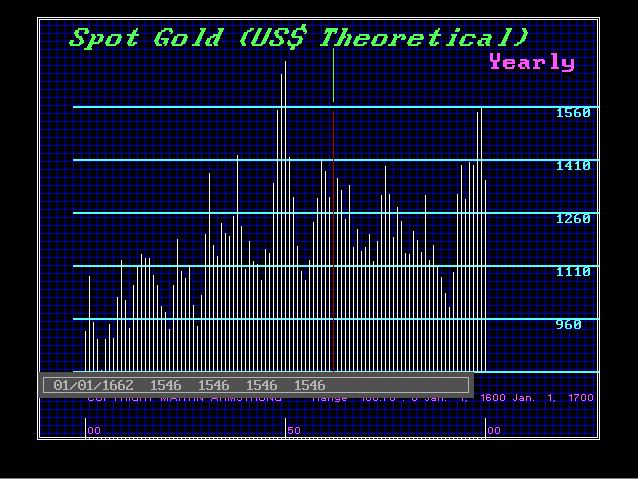
As the silver mines were declining, the decline in the supply of silver led to the rise of copper coinage during the next century. This was not an isolated incident confined to Russia. There was a shortage of precious metals going into 1662. It was most profound in Russia. Nevertheless, the price of gold rose sharply from the low of 1655 in a 7-year bull market. This also reflected the deflationary atmosphere that was emerging thanks also to the mini-Ice Age which was peaking during the 17th century yet would last well into the mid-19th century.
It was Spain’s silver mine known as the great red Cerro Rico or ‘Rich Hill’ that towered over the city of Potosí in Bolivia. It had been mined since 1545 by drafted armies of natives. The great silver boom of c1575-1635 was when Potosí alone produced nearly half the world’s silver. But the mine’s yield was starting to decline. By 1678, native workers became scarce and the output of the mines began to dwindle. This was the royal mint that produced vast amounts of ‘pieces of eight’, which became the precursor of the American dollar. The shortage of labor ended up being augmented by purchasing African slaves from the Dutch who were buying them under the pretense that they were the spoils of war, which had been the justification for slaves from ancient times.
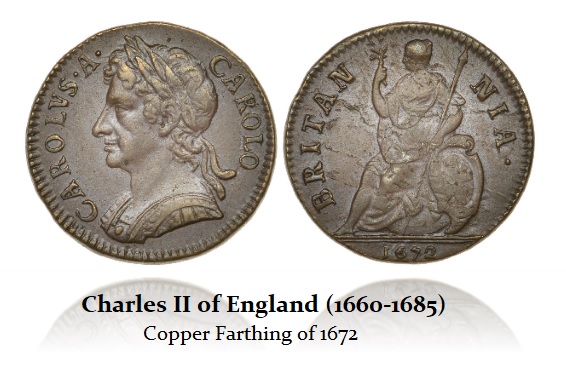
As the quantity of new silver in the world monetary system was declining, we begin to see the rise of copper coinage make its first appearance under James I of England (1603-1625). Due to a shortage of small coins, James I authorized John Harrington to issue tin-coated bronze farthings in 1613, and three main types were minted – the last being a slightly larger copper farthing without the tin coating. The first halfpenny was introduced in 1672 by Charles II (1660-1685). Charles II issued some copper halfpennies and farthings in 1672 for a single year but issued farthings again in 1873. The next issue of a farthing was struck in a tin but during 1684 and 1685.
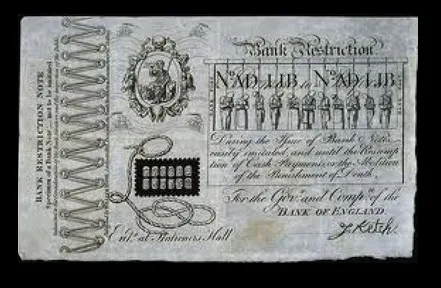
However, in 1694 the Bank of England was established to raise money for King William III’s war against France. The Bank started to issue notes in return for deposits. Therefore, the money supply for the first time began to include paper currency. By 1695 the first fraud took place. The authorities prosecuted Daniel Perrismore for forging sixty £100 notes. This incident caused the Bank of England to introduce a watermark in the paper to prevent such fraud. This was further enhanced by making counterfeiting subjected to the death penalty as a felony resulting in the confiscation of all your wealth and throwing your family out of the street as well. Pictured here, is a protest imitation note. The law was being prosecuted on the mere possession of a forged note. The complaint here was that these one-pound notes were easily forged and innocent people were duped, thereby committing a felony by mere possession. They were being hanged with no proof that they created the forgery – merely that they possessed one. This was creating an incentive not to even accept the notes in transactions.
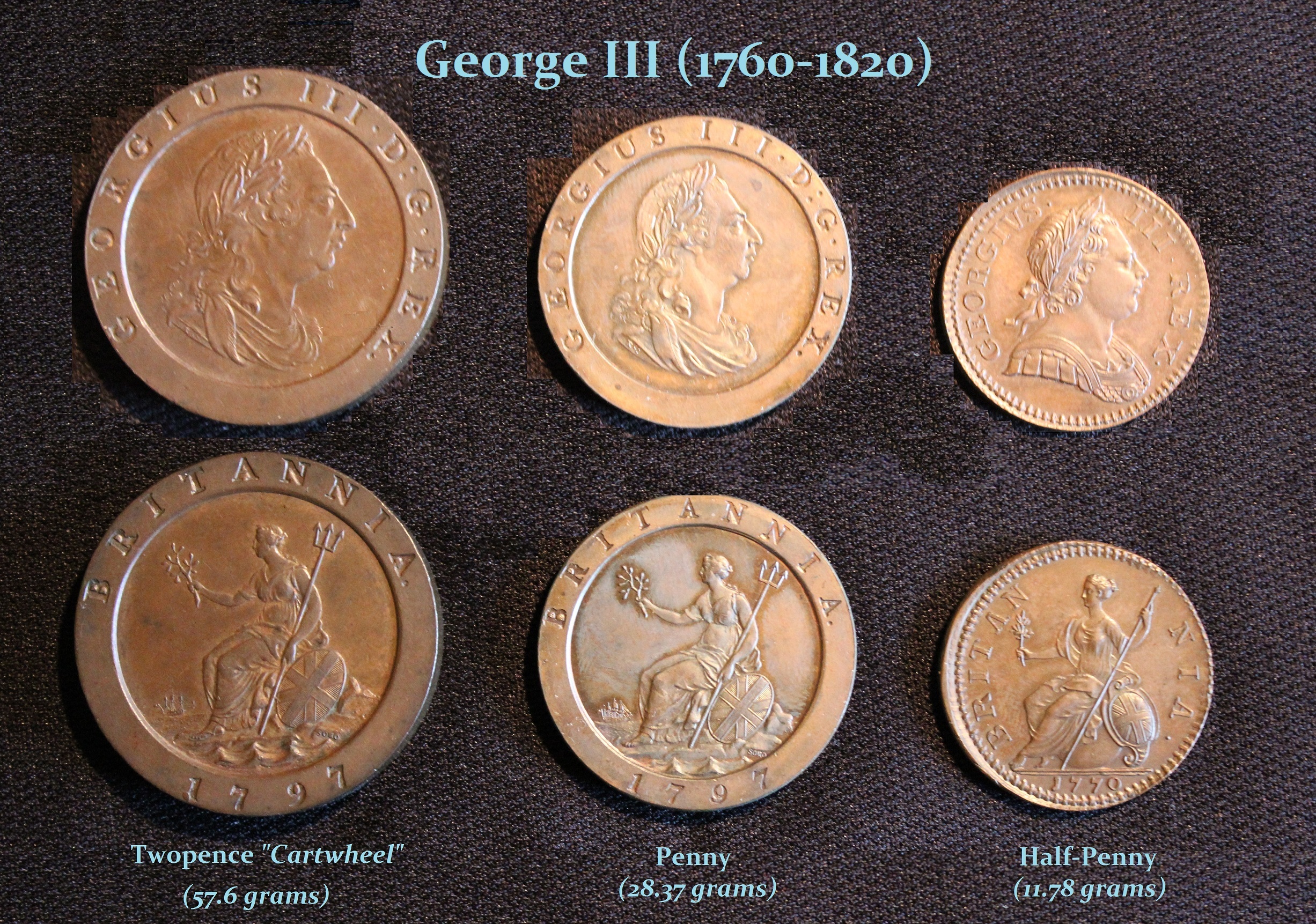
George I, II, and III all issued copper halfpennies. George III’s halfpennies were dated 1770 to 1772. The economic hard times no doubt contributed to the riots of 1780. After those events, at Newgate Prison in March 1782 a female alleged counterfeiter of halfpennies was hanged. She was then fixed to a stake and burned before the debtor’s door at Newgate prison in London as a further example of not to counterfeit.
In a letter to Lord Hawkesbury on April 14th, 1789, Matthew Boulton, who is considered the Grandfather of modern coinage, commented
“In the course of my journeys, I observe that I receive upon average two-thirds counterfeit halfpence for change at toll-gates, etc., and I believe the evil is daily increasing, as the spurious money is carried into circulation by the lowest class of manufacturers, who pay with it the principal part of the wages of the poor people they employ”.
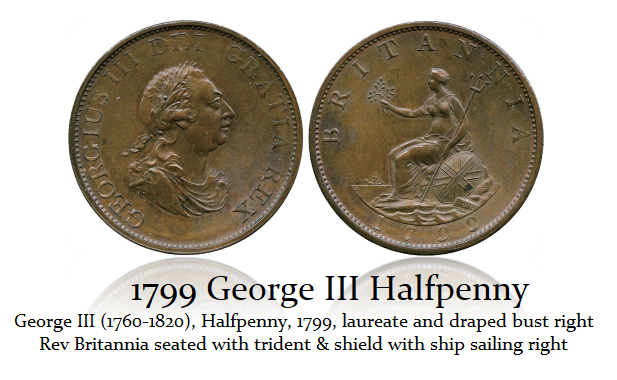
Boulton’s contract in 1797 to produce the Cartwheel pennies and twopences, thwarting the counterfeiters, did not extend to producing the halfpenny, though Boulton had expected that it would, and had prepared patterns of the appropriate size and weight in accordance with his ideas on the intrinsic value of copper coins. The reason the government gave for the omission of the denomination from the contract was that a large number of de facto halfpennies (including tokens and fakes) would be driven out of circulation and Boulton would be unable to produce enough coins to meet the demand that would ensue.
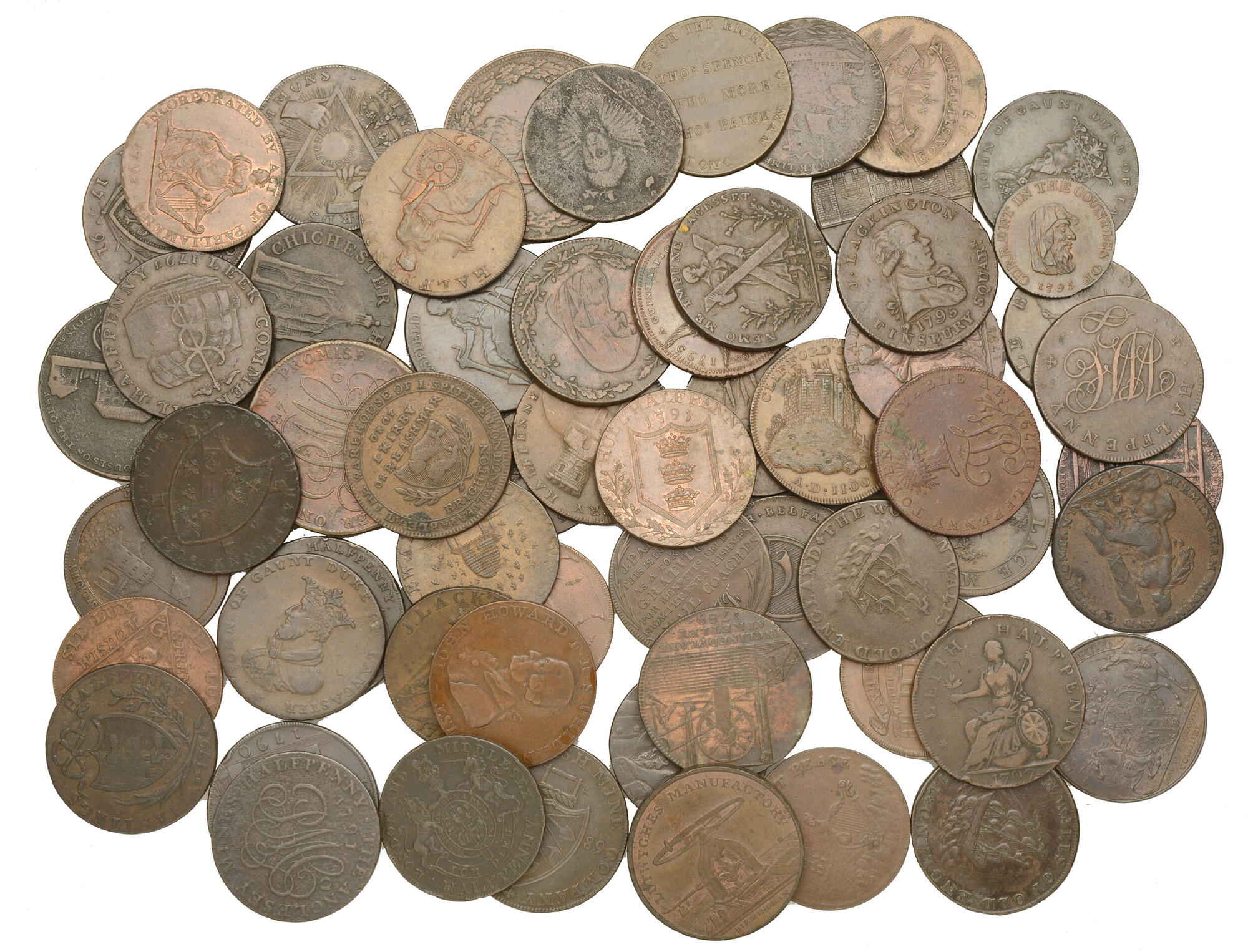
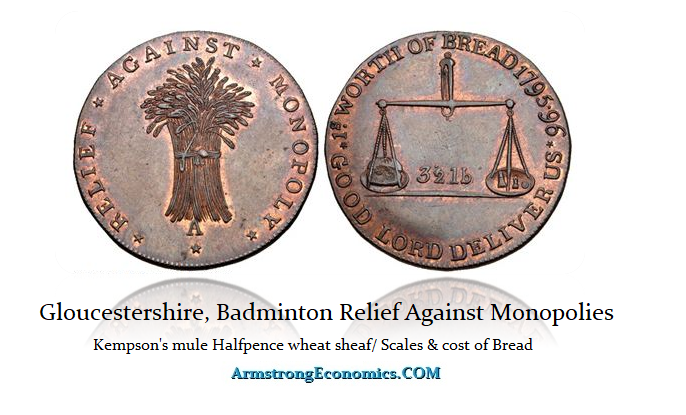
To avoid being hung for counterfeiting and burned at the stake, there was a multitude of halfpenny tokens. Many were of a political nature as this one complaining about the cost of bread. The government yielded to the private halfpenny tokens which became the majority of the small change. The overall public demand for legal halfpennies soon forced the government to change its mind, and in 1798 a contract was issued to Boulton for him to produce halfpennies and farthings dated 1799.
Interestingly, it was also at this time when inflation sent the price of copper rising, and consequently, the weight of the coins was reduced slightly, which resulted in them not being as popular as expected. In 1806 a further 427.5 tons of copper was struck into halfpennies by Boulton, but the price of copper had risen again and the weight was even less than the 1799 issue. This time, however, there was no unfavorable reaction from the public, so perhaps the national obsession with “intrinsic value” had run its course.
This was a very curious period where private money dominated the money supply for halfpennies. There are other periods where this has emerged in history primarily due to the shortage of real official money. One of the earliest such periods was during the reign of the Roman Emperor Tiberius (14-37AD).
Tiberius was legendary to be a frugal emperor. His deliberate contraction in creating new money led to the Financial Panic of 33AD. As far as Quantitative Easing, that too was nothing new. Tiberius offered loans INTEREST-FREE, but they had a limitation of three years. This was to prevent people from being forced to sell their estates further depressing land values.
There was a major earthquake in Asia, modern Turkey, and this was so devastating, he issued coins stating they were for the relief of Asia. He also waived all taxes in the region for 5 years – something our modern-day politicians would never dream of.
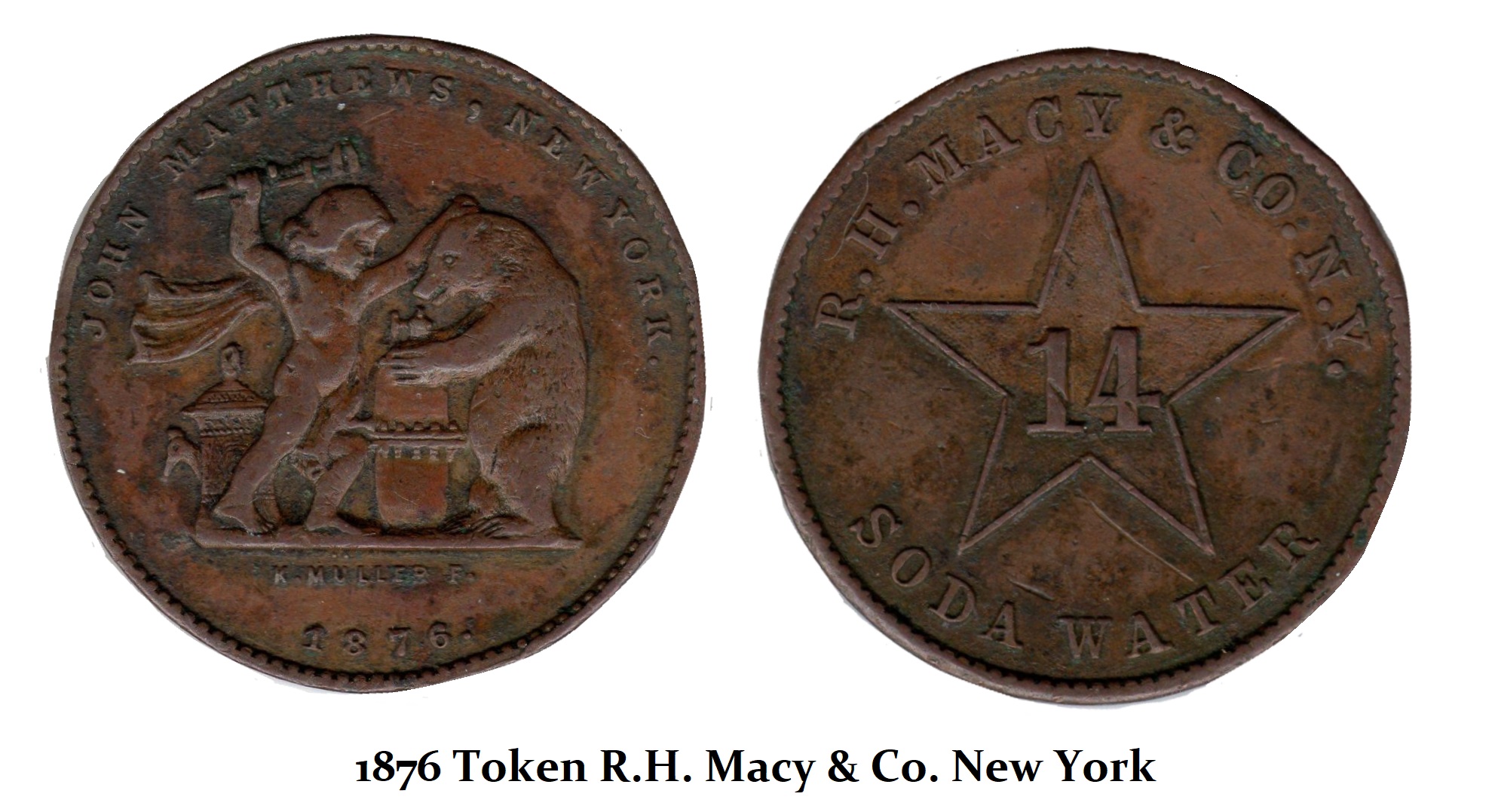
The lesson from history reveals that at times there emerges the acceptance of private money. During the 1870s, we also see private tokens circulating as money in the United States. Collectors call them the Hard Times Tokens. The very same thing took place during the American Civil War.
During the Great Depression, the shortage of money led to more than 200 cities issuing their own paper currency. As long as everyone in town accepted it, these Depressions Scrips enable people to work and to be paid locally when there was simply not enough federal money to go around.
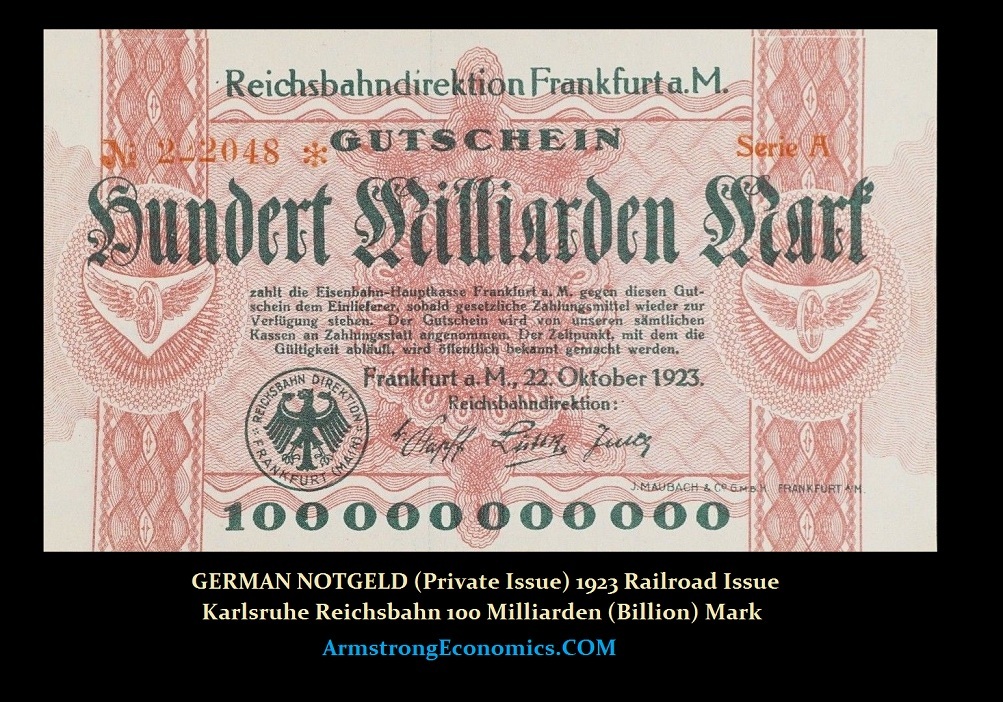
During the Hyperinflation in Germany of the 1920s, there again we see private currency being printed known as NOTGELD. Therefore, in the end, when the confidence in government declines, society is compelled to return to a barter-based society and that is when we begin to see private forms of money take hold.
I have created this site to help people have fun in the kitchen. I write about enjoying life both in and out of my kitchen. Life is short! Make the most of it and enjoy!
This is a library of News Events not reported by the Main Stream Media documenting & connecting the dots on How the Obama Marxist Liberal agenda is destroying America







 Centinel2012