Poland – The Next Crisis for the EU – Independent Sovereignty is the Issue


warsaw-2


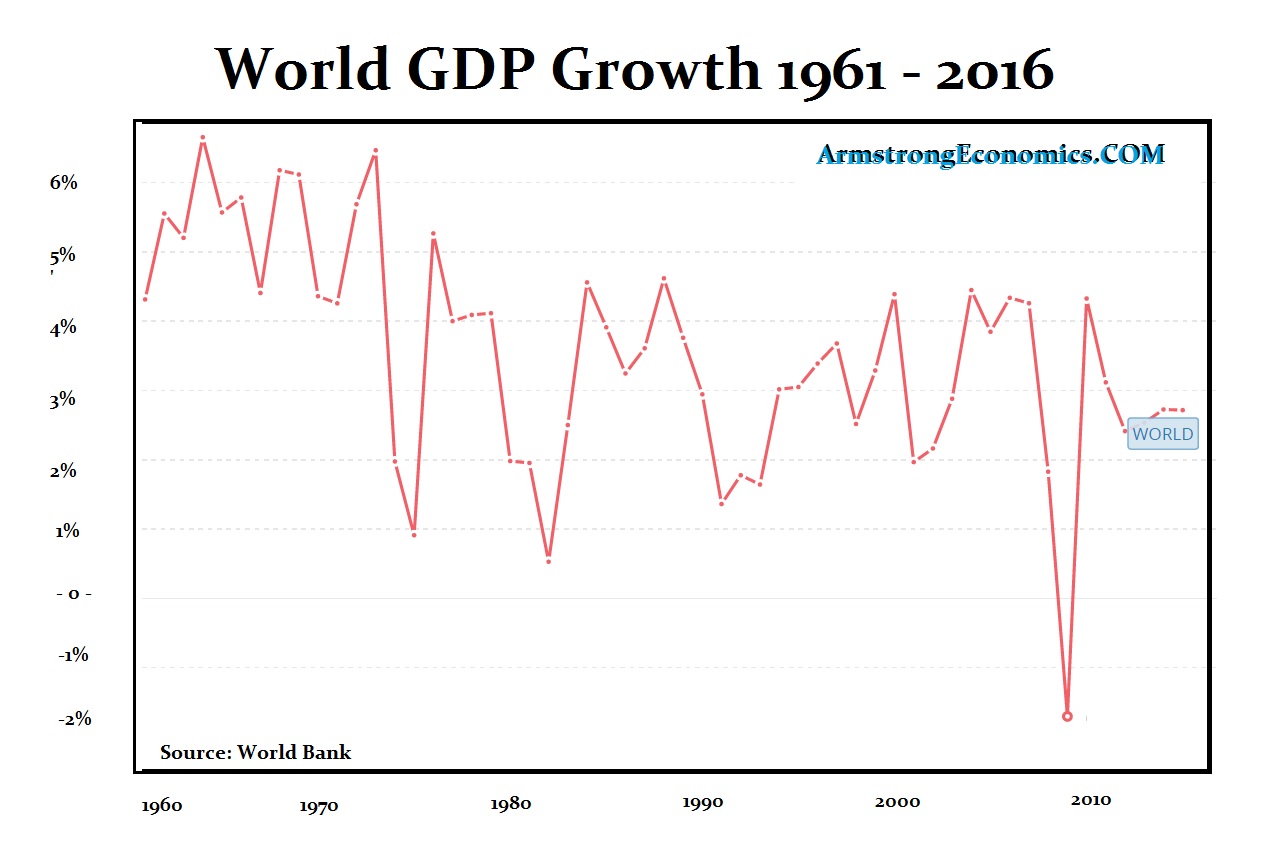
GDP World Bank 2016Poland represents a major threat to the EU. The entire idea of the EU was the propaganda that Member States would successively grow into a real Union through a longer integration process. GDP was supposed to grow, not decline, and the threat of war would vanish by surrendering sovereignty to Brussels. In reality, the exact opposite has unfolded. GDP has progressively declined and the risk of a European war has been increased with the idea of surrendering sovereignty to Brussels.

Throughout Europe, there is a growing “populist” movement especially ignited with the attempt to force member states to accept refugees when this was an unilateral decision exclusive made by Merkel to save her public image after being hard on Greece.

British GDP Growth since 1949

Even the data from the British Government clearly shows how their GDP has declined ever since joining the EU in 1973. Obviously, the exact opposite trend determines reality – not political propaganda. The movements that promotes the sovereignty of the national states and demand a weakening of the central institutions are on the rise all over Europe. This is what Brussels calls the “populist” movement.

Poland is questioning the current situation of the EU in its current form and is not finding it agreeable especially when it goes against their religious foundation. Many are alarmed because there were more Mosques built in Britain during 2016 than churches. Churches are on the decline and even synagogues are being converted to Mosques.

Poland is the largest beneficiary of EU payments receiving an annual net of just €10 billion. Nevertheless, Poland represents a huge risk to the EU for the independence and sovereignty of Poland has become a top priority in the face of forced refugees. Poland is actually more linked to the USA and Britain than to Brussels.

Is There Really More Oil in The Golan Heights than in Saudi Arabia? Who’s Genie Energy?


Golan_Heights_Map

QUESTION: Mr. Armstrong I live in Israel and today I listened to your podcast with Macrovoices. At some point you mentioned that there is more oil in Golan heights than in Saudi Arabia -and this oil belongs to genie energy. Is it true? How can it be that nobody knew nothing about this in Israel? Are you sure 100 % about this information? I will be happy to know more about this.

best regards

EP

Genie Oil & Gas

ANSWER: Yes. This is one of the best kept secrets. You can imagine that if this went into production, then the disputed Syrian land issue occupied by Israel would come to the forefront. This is why it gets no play but this is one reason Obama was working to overthrow the Syrian government. They would not have political people on the Strategic Advisory Board if they did not need political strings pulled.

Politically, you have the Pipe Line from Qatar being one major issue that was to compete with Russia in selling gas to Europe, which is why Putin is involved. He is not involved in Egypt, Israel, or even Afghanistan. This is the reason why Putin has an interest in Syria and the mainstream media of course championed Obama claiming he was defending children. Then we have Genie Oil and strategic oil reserves within occupied Syria. Just look at the people who are are heavy hitters on the Strategic Advisory Board of Genie Oil!  Not bad for a company nobody has heard of and the glaring issue is why do you need heavy hitters like this just to pump oil? Location! Location! Location! The mainstream media is not going to report on this issue. They even have Rupert Murdoch on their Strategic Advisory Board. This is hush hush in the mainstream media.

Strategic Advisory Board

The Strategic Advisory Board of Genie Oil and Gas advises management on strategic, financial, operational and public policy matters.


Michael Steinhardt (SAB Chairman)
Noted Wall Street investor and Principal Manager, Steinhardt Management LLC. Founder Steinhardt, Fine, Berkowitz & Co., and noted philanthropist.


Richard (Dick) Cheney
46th Vice President of the United States. Vice President Cheney also served as President and CEO of Halliburton Company and U.S. Secretary of Defense from 1989 to 1993.


Marry Landrieu
United States Senator from Louisiana from 1996 to 2014. Senator Landrieu served as chair of the Senate Committee on Energy and Natural Resources. In her capacity as chair, she sponsored and passed the U.S.-Israel Energy Cooperation Bill. The bill fosters partnerships focused on developing resources such as natural gas and alternative fuels, on the academic, business and governmental levels.


Rupert Murdoch
Founder and Executive Chairman of News Corporation, one of the world’s largest diversified media companies. News Corporation’s holdings include Fox Entertainment, Dow Jones and Company, the New York Post, HarperCollins and significant media assets on six continents.


Bill Richardson
Governor of New Mexico from 2003 to 2011. Mr. Richardson has served asU.S. Ambassador to the United Nations (1997-1998), Energy Secretary in the Clinton administration (1998-2001), Chairman of the 2004 Democratic National Convention, and as Chairman of the Democratic Governors Association.


Jacob Rothschild, OM, GBE
Chairman of the J. Rothschild group of companies and of RIT Capital Partners plc. Chairman of Five Arrows Limited. Lord Rothschild is a noted philanthropist and Chairman of the Rothschild Foundation.


Dr. Lawrence Summers
Charles W. Eliot University Professor and President Emeritus at Harvard University. Dr. Summers served as the 71st Secretary of the Treasury under President Clinton and as Director of the National Economic Council for President Obama.


R. James Woolsey
Director of Central Intelligence from 1993 to 1995 and as Under Secretary of the Navy from 1977 to 1979. Mr. Woolsey is co-founder of the United States Energy Security Council and is Chairman of the Foundation for Defense of Democracies

Reuters: Stunning GDP Growth Anticipated by Federal Reserve Next Quarter…


Reuters is reporting on a stunning financial prediction coming from the Federal Reserve in Atlanta.  Their 2nd Quarter prediction falls in line with many of the “new dimension” economic predictions we have been anticipating.

The Atlanta Fed is predicting 4.3% growth:

NEW YORK (Reuters) – The U.S. economy is on track to grow at a 4.3 percent annualized pace in the second quarter, rebounding from a 0.7 percent increase in the first quarter which was the weakest in three years, the Atlanta Federal Reserve’s GDP Now forecast model showed on Monday.

This is much faster than the latest second-quarter gross domestic product estimate of 2.33 percent from the New York Federal Reserve.  (read more)

There is a disconnect in traditional economic quantification that we have been predicting for well over a year.  It’s the same disconnect currently reflected in the jobs numbers between payrolls and the Fed explained here.  We also outlined additional data two months ago which the federal economists admit they cannot reconcile – Expanded HERE.

For 30+ years U.S. economic political policy has been driven by Wall Street interests. STOP. Main Street, the middle-class and the American worker have suffered. STOP. The successful election of Donald Trump, and the execution of his “main street” economic policy agenda, has sledgehammered the prior economic machine into a full seizure an halt. FULL STOP.

It was Albert Einstein who aptly stated:

“The significant problems we have cannot be solved at the same level of thinking with which we created them.”

The same basic principle applies to those who are trying to understand and evaluate current economic activity yet failing to disengage themselves from their historic economic frames of reference.

Minds who are framed around thirty years of financial political policy, intended to influence the U.S. economy and created by vested interests who were building out the legislative priorities based on Wall Streets’ best interests, will struggle to understand the new landscape which is entirely formulated to benefit Main Street.

The two economic engines are entirely divergent and detached. Time, along with focus only on Wall Street interests, has pushed those two economic engines further apart. The same policies which worked in the immediate past will not work in the immediate future.

The two economic engines are now in reverse level of importance.  Trump economics focuses on Main Street’s economic engine.  The Fed is stuck focusing on the economy through the prism of Wall Street’s economic engine.

We are now in the economic space between both engines. The traditional cause and effect (Fed) is now uncoupled.  The administrators of the economy are perplexed; this is unfamiliar terrain.

• Wage rates will be driven up by inflation in ‘non-measured’ high-turn, domestic  consumable goods: food, fuel, energy.  The Fed does not measure this segment for inflation.

• Inflation, from the perspective of the Fed will appear artificially low because prices on the measured segment will be static: non-domestic durable goods, housing etc.  Durable good prices will remain static, and in the short term fall surreptitiously – seemingly unattached to the larger expanding economy.

Until the two economies gain parity – any fed activity, taken as a consequence to their familiar traditional measurements (interest rates etc.), will have minimal to negligible impact on Main Street.

• Regional areas which benefited from high yield and high rates of return from Wall Street, ie. investment benefactors, will begin economic contraction. The downstream effect on retail and high-end service industries will also be negatively impacted.

• However, industrial areas with affordable housing and infrastructure, which have suffered in the past 20+ years, will see home values increasing as the local economy expands.

National policy (Trump Policy) which benefits Main Street also benefits local economics which are founded in manufacturing, production, and ancillary services.  In essence, the Middle-Class.

Those who benefited from high-yield international investment income will see less income.  Those who live on savings will see a moderate benefit.  However, those living day-to-day and week-to-week on their paychecks will see much more income.  Believe it.

Here’s the Deep Dive:

Traditional economic principles have revolved around the Macro and Micro with interventionist influences driven by GDP (Gross Domestic Product, or total economic output), interest rates, inflation rates and federally controlled monetary policy designed to steer the broad economic outcomes.

Additionally, in large measure, the various data points which underline Macro principles are two dimensional. As the X-Axis goes thus, the Y-Axis responds accordingly… and so it goes…. and so it has historically gone.

Traditional monetary policy has centered upon a belief of cause and effect: (ex.1) If inflation grows, it can be reduced by rising interest rates. Or, (ex.2) as GDP shrinks, it too can be affected by decreases in interest rates to stimulate investment/production etc.

However, against the backdrop of economic Globalism -vs- economic Americanism, CTH is noting the two dimensional economic approach is no longer a relevant model. There is another economic dimension, a third dimension. An undiscovered depth or distance between the “X” and the “Y”.

I believe it is critical to understand this new dimension in order to understand Trump economic principles, and the subsequent “America-First” economy he’s building.

As the distance between the X and Y increases over time, the affect detaches – slowly and almost invisibly. I believe understanding this hidden distance perspective will reconcile many of the current economic contractions. I also predict this third dimension will soon be discovered and will be extremely consequential in the coming decade.

To understand the basic theory, allow me to introduce a visual image to assist comprehension. Think about the two economies, Wall Street (paper or false economy) and Main Street (real or traditional economy) as two parallel roads or tracks. Think of Wall Street as one train engine and Main Street as another.

The Metaphor – Several decades ago, 1980-ish, our two economic engines started out in South Florida with the Wall Street economy on I-95 the East Coast, and the Main Street economy on I-75 the West Coast. The distance between them less than 100 miles.

As each economy heads North, over time the distance between them grows. As they cross the Florida State line Wall Street’s engine (I-95) is now 200 miles from Main Street’s engine (traveling I-75).

As we have discussed – the legislative outcomes, along with the monetary policy therein, follows the economic engine carrying the greatest political influence. Our historic result is monetary policy followed the Wall Street engine.

a17b2-hip-replacement-recall-bribery[…] there had to be a point where the value of the second economy (Wall Street) surpassed the value of the first economy (Main Street).

Investments, and the bets therein, needed to expand outside of the USA. hence, globalist investing.

However, a second more consequential aspect happened simultaneously. The politicians became more valuable to the Wall Street team than the Main Street team; and Wall Street had deeper pockets because their economy was now larger.

As a consequence Wall Street started funding political candidates and asking for legislation that benefited their interests.

When Main Street was purchasing the legislative influence the outcomes were beneficial to Main Street, and by direct attachment those outcomes also benefited the average American inside the real economy.

When Wall Street began purchasing the legislative influence, the outcomes therein became beneficial to Wall Street. Those benefits are detached from improving the livelihoods of main street Americans because the benefits are “global” needs. Global financial interests, investment interests, are now the primary filter through which the DC legislative outcomes are considered.

There is a natural disconnect. (more)

Here is an example of the resulting inflationary impact as felt by consumers:

economy-1

♦ TWO ECONOMIESTime is the important measurement.  Time continues to pass as each economy heads North.

Economic Globalism expands. Wall Street’s false (paper) economy becomes the far greater economy. Federal fiscal policy follows and fuels the larger economy. In turn the Wall Street benefactors pay back the politicians.  K-Street lobbyists pay for policy.

Economic Nationalism shrinks. Main Street’s real (traditional) economy shrinks. Domestic manufacturing drops. Jobs are off-shored. Main Street companies try to offset the shrinking economy with increased productivity (the fuel). Wages stagnate.

Now it’s 1990 – The Wall Street economic engine (traveling I-95) reaches Northern North Carolina. However, it’s now 500 miles away from Main Street’s engine (traveling I-75). The Appalachian range is the geographic wedge creating the natural divide (a metaphor for ‘trickle down’).

By the time the decade of 2000 arrives – Wall Street’s well fueled engine, and the accompanying DC legislative attention, influence and monetary policy, has reached Philadelphia.

However, Main Street’s engine is in Ohio (they’re now 700 miles apart) and almost out of fuel; there simply is no more productivity to squeeze.

From that moment in time, and from that geographic location, all forward travel is now only going to push the two economies further apart. I-95 now heads North East, and I-75 heads due North through Michigan. The distance between these engines is going to grow much more significantly now with each passing mile/month….

However, and this is a key reference point, if you are judging their advancing progress from a globalist vessel (filled with traditional academic economists and analysts who occupy the Federal Reserve) in the mid-Atlantic, both economies (both engines) would seem to be essentially in the same place based on their latitude.

From a two-dimensional linear perspective the FED cannot tell the distance between Wall Street and Main Street.

It is within this distance between the two economies, which grew over time, where a new economic dimension has been created and is not getting attention. It is critical to understand the detachment.

Within this three dimensional detachment you understand why Near-Zero interest rates no longer drive an expansion of the GDP. The Main Street economic engine is just too far away to gain any substantive benefit.

Despite their domestic origin in NY/DC, traditional fiscal policies (over time) have focused exclusively on the Wall Street, Globalist economy. The Wall Street Economic engine was simply seen as the only economy that would survive. The Main Street engine was viewed by DC, and those who assemble the legislative priorities therein, as a dying engine, lacking fuel, and destined to be service driven only….

Within the new 3rd economic dimension, the distance between Wall Street and Main Street economic engines, you will find the data to reconcile years of odd economic detachment.

Here’s where it gets really interesting. Understanding the distance between the real Main Street economic engine and the false Wall Street economic engine will help all of us to understand the scope of an upcoming economic lag; which, rather remarkably I would add, is a very interesting dynamic.

Donald Trump wins the election.

President Trump begins putting into effect his policy.

Think about these engines doing a turn about and beginning a rapid reverse. GDP can, and in my opinion, will, expand quickly. However, any interest rate hikes (fiscal policy) intended to cool down that expansion -fearful of inflation- will take a long time to traverse the divide.

Additionally, inflation on durable goods will be insignificant – even as international trade agreements are renegotiated. Why? Simply because the originating nations of those products are going to go through the same type of economic detachment described above.

Those global manufacturing economies will first respond to any increases in export costs (tariffs etc.), by driving their own productivity higher as an initial manufacturing cost offset, in the same manner American workers went through in the past two decades. The manufacturing enterprise and the financial sector remain focused on the pricing.

♦ Inflation on imported durable goods sold in America, while necessary, will ultimately be minimal during this initial period; and expand more significantly as time progresses and off-shored manufacturing finds less and less ways to be productive. Over time, durable good prices will increase – but it will come much later.

♦ Inflation on domestic consumable goods ‘may‘ indeed rise at a faster pace. However, it can be expected that U.S. wage rates will respond faster, naturally faster, than any fiscal policy because inflation on fast-turn consumable goods is now re-coupled to the ability of wage rates to afford them.

The fiscal policy impact lag, caused by the distance between federal fiscal action and the domestic Main Street economy, will now work in our favor. That is, in favor of the middle-class.

Within the aforementioned distance between “X” and “Y”, a result of three decades traveled by two divergent economic engines, is our new economic dimension….

Trump thumbs up

We support reinstating a modern version of the Glass-Steagall Act of 1933 which prohibits commercial banks from engaging in high-risk investment,” said the platform released by the Republican National Committee. (link)

Federal Reserve & Elastic Money & NY Clearing House Certificates


NY Clearing House

QUESTION: Why do you support the fed in what you call elastic money and not a gold standard?

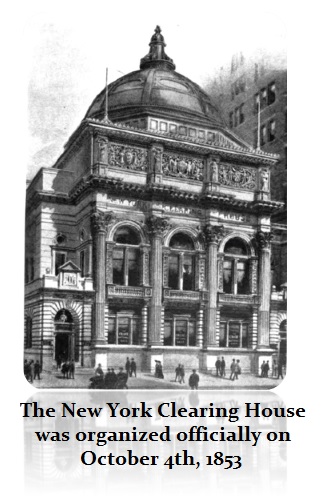
ANSWER: As usual, you listen to the nonsense about how the Fed is owned by the banks and is responsible for probably everything evil from creating wars to probably killing JFK. The entire use of “elastic money” was not invented by the government or the Fed. It began in 1853 with a little known group to try to help in the middle of a crash for what you are advocating is precisely what Europe has done – impose austerity.

The Panic of 1873 saw the government make a small gesture to try to calm the panic. They did the same thing as Quantitative Easing back then – Yes, not even that is new. The US Treasury injected cash by purchasing government bonds. It did NOTHING to help the economy. Why? When confidence crashes, people HOARD money and will not spend it if they fear the future. The cash they injected was hoarded by the banks just as it has been post-2007. Quantitative Easing in this manner NEVER produces inflation nor does it stimulate the economy.

1907 Clearing House Scrip San Fran

The banks got together to create their own “Elastic Money” using the New York Clearing House. Failing to increase the money supply meant that the value of money in purchasing power rises and all assets decline. This is the hallmark of EVERY recession or depression. During the Panic of 1873, the national banks of New York pooled their cash and collateral into a common fund, and placed this in the hands of a trust committee at the New York Clearing House, which had been founded on October 4th, 1853. The New York Clearing House then issued loan certificates that were receivable at the Clearing-house against this collateral. These certificates were absorbed like cash and could be used to pay off debt balances. Ten million dollars’ worth of these certificates were issued at first, but the sum subsequently doubled. This Clearinghouse paper served its purpose admirably.

By October 3rd, 1873 confidence had been returned and $1,000,000 of these certificates was called in to be canceled. The next day, another $1,500,000 more of these certificates were recalled. In the end, not much of this issue was outstanding very long. The Clearing-house scheme was successfully applied also in Boston, Philadelphia, Pittsburgh and other cities, but not in Chicago.

This was the birth of “Elastic Money” that makes sense. This prevents wholesale liquidation of assets to get cash in short supply. The problem is neither the Fed nor the concept of Elastic Money. The Fed was originally established in 1913 to act like the New York Clearing House but for all assets outside of Wall Street. Then came World War I the next year in 1914 and Congress ordered the Fed to buy only US government bonds. They never returned the structure of the Fed to what it was originally designed to do.

Hence, today we have Quantitative Easing when central banks buy government paper attempting to stimulate as they tried and failed every time previously. The difference was that the New York Clearing House Certificates were good among security dealers. They were not expanding the money supply nor could they be used for groceries at home.

The certificates were redeemed and those from 1873 are non-existent today because they were used among institutions. If you want to blame anybody or anything – blame the right person or group. What you are doing is blaming a murder on the person who manufactured a gun rather than the person who pulled the trigger. Blame Congress! Not the Fed!

We need a central bank and elastic money is an excellent tool. However, I would issue it in a two-tier manner. The normal tier is money commonly used. The second is the elastic money, but this automatically should expire in 6 years. Therefore, it will be redeemed as was the case in 1873.

*PS If anyone has such a New York Clearing House Certificate from 1873, I would be a buyer.

Austria Wants to Tax Any Search, Like, or Communication via Internet


Schieder Andreas

Andreas Schieder (born 1969) is the parliamentary head of Austrian Chancellor Christian Kern’s Social Democrats. He is a typical career politician since 1997 and the very type of person who has no idea about the world economy no less human nature. He is a highly dangerous bureaucrat who only looks at people like cattle from which the government can extract greater and great sums.

Schieder is obviously a Marxist who wants to now tax human behavior and any interaction you have with Twitter Inc., Google or Facebook among others. He wants to tax every time you do anything from searching, posting, tweeting or just liking someone’s post.

He claims this is really a barter transaction where it appears to be free but you are giving them your personal data that they sell to advertising. That arrangement is a form of bartering and any barter transactions is subject to the value-added tax. He said according to Bloomberg:

“The business transaction that’s going on here is that users are paying with their personal data,” Schieder told journalists in Vienna. “The business model of those internet companies is based on massive revenues that are generated with the help of those data.”

Andreas Schieder is a highly dangerous man. He only looks at what government can extract from people, never how government can reduce its size and cost to save money. It’s always just raise more and more taxes without end.

Soros At it Again – Trying to Overthrow Polish Government?


Tokyo-3-1999

Tokyo March 1999 Institutional Seminar

QUESTION: Mr. Armstrong, I attended your March 1999 conference in Tokyo when I worked for ______ bank. I remember you called out Soros and crew and said they were trying to manipulate the yen for fiscal year end. You warned the Japanese how to defeat the Club. If I remember, he and his crew lost $1 billion when everyone in Tokyo followed your advice. Many assumed what they did to you 6 months later was retribution. Now he is at it in Poland funneling money he made from such trading in through Norway to create political unrest. What is it with this guy? Why does he play God?

KE

Japanese Manipulartion March 1999

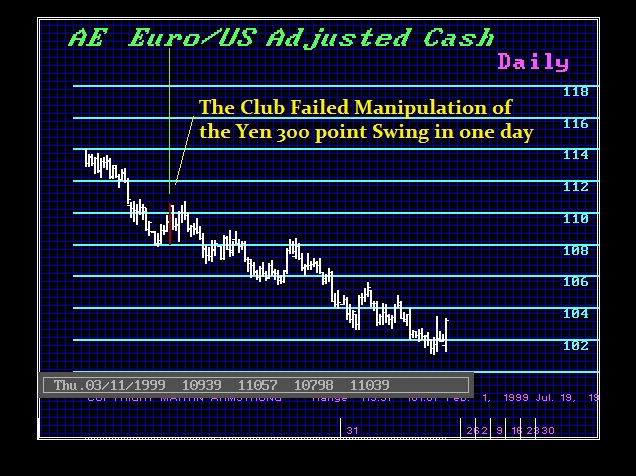
ANSWER: Oh yes. I remember that event very clearly. That why they started calling me Mr. Yen because it was me and our clients against the Club and the Club lost. They were trying to to push the yen down for the fiscal year-end roll of March 31st and then run it up into April 1st. They had our clients lock it in and that forced the manipulators out. That was a wild day. 3 big figures in a single day in an outside-reversal was a big move back then.

I know the rumor was that Soros was in on that and the Club lost $1 billion. Not sure how much they lost on that one. It was the good-old fun days of confrontations.

The Polish government wants to stop the distribution of Norwegian money flowing into Poland coming from Soros’ funded Batory Foundation, which manages over 800 million euros with a target of overthrowing the Polish government by 2020. Since 2014, the Batory Foundation has distributed some 130 million zlotys (around 31.7 million euros) to various associations and organizations within Poland to change the government. According to Bloomberg, this includes organizations for the promotion of “parliamentary democracy”,  but only if it agrees with Soros’ agenda. Effectively, Soros is trying to defeat Catholic values ​​in Poland which are supported by the population and government.

Norway is refusing to stop Soros’ agenda being implemented against Poland from inside Norway. Meanwhile, Poland and the head of the EU have been is a battle rejecting the EU policies on refugees and Brussel’s totalitarian position where he has even told Poland to accept the refugees or get out of the EU. The main concern is that the Polish government wants to determine its own future and security. The situation escalated as the EU reelected Poland’s Donald Tusk against Poland’s.

Krakow-Night

Poland should exit the EU and strike its own trade deal with the USA. Many US companies have established back-office operations there in Krakow including New York Banks. It is a very beautiful city on its own besides being a quiet place for back-office operations. Poland has well educated students, fluent in English, and they are free from the Euro. If Poland were to adopt the Euro, there are numerous companies that have expressed they would have to leave Poland or cease any further expansion under such conditions.

Soros has publicly stated he does not believe in God. Many who worked for him said they think he believes he is a god with the right to reshape the world in his image. So have many throughout history and they are responsible for the murder of countless millions. Money does not give you the right to fund revolutions to recast the world in your image.

Economic Reality: Bottom 50% Of Americans No Longer Matter


Tyler Durden's picture

Authored by Mike Shedlock via MishTalk.com,

The Fed likes to brag about the “We saved the world” recovery.

However, the unfortunate truth of the matter is a record Half of American Families Live Paycheck to Paycheck.

Does it Matter? Let’s investigate.

Unprepared for Nearly Anything

  • 50% are woefully unprepared for a financial emergency.
  • Nearly 1 in 5 (19%) Americans have nothing set aside to cover an unexpected emergency.
  • Nearly 1 in 3 (31%) Americans don’t have at least $500 set aside to cover an unexpected emergency expense, according to a survey released Tuesday by HomeServe USA, a home repair service.
  • A separate survey released Monday by insurance company MetLife found that 49% of employees are “concerned, anxious or fearful about their current financial well-being.”

Deleveraging? Where?

A Fed study shows U.S. Households Will Soon Have as Much Debt as They had in 2008.

The Federal Reserve announced Friday that the U.S. has $1 trillion in credit-card debt. Consumers hit that number in the fourth quarter of 2016, but eased on revolving credit during January 2017. The Fed announcement showed revolving consumer credit hit more than $1 trillion once again in February 2017.

“Credit card debt is rising quickly, but delinquencies are still really low,” said Matt Schulz, a senior industry analyst at the credit cards site CreditCards.com. “Many Americans are doing a good job of controlling their debts, but eventually with big debts and rising interest rates, it’s likely that something will have to give.”

Paycheck to Paycheck “Good Job”

Excuse me for asking but if half the nation lives paycheck to paycheck, is that really indicative of doing a good job at managing debt.

And as for “low delinquencies”, I remind you of my April 26 article Subprime Credit Card Losses Bite Capital One: Income Down 20%, Charge-Offs Up 30%.

Nonetheless, I remind you of an important perception.

We Saved the World

Two Reasons Not to Worry

  1. The stock market and housing are still going strong. We heard the same thing in 2007 but it’s different this time.
  2. The bottom 50% of the economy simply do not matter.

The real crux of the matter is point number two.

The Fed does not give a damn about the bottom half of the economy even though it spouts continual lies about “income inequality.

The Bottom 50% Do Not Matter

As long as the Fed can keep stocks and home prices elevated, there is no concern about the food-stamp, rent-subsidized, Medicaid-supplement, disability-income, Obamacare-subsidized 50% of Americans struggling paycheck-to-paycheck.

That money rolls in guaranteed, month after month!

That 50% cannot afford a house is irrelevant as long as suckers keep paying $500,000 to two-bedroom shacks in LA.

The game is to keep asset prices up so that the top 50% keep spending. The bottom 50% are taken care of by government (taxpayer) subsidies noted above.

Here’s the real deal: Fed Expects a Second Quarter Rebound, Higher Equity Prices.

Repeat Performance

The Fed needs to keep asset prices elevated even though it’s pretty clear concerns are mounting over bubbles.

Can the Fed save the world again?

Previously, the bottom third did not matter. Then the bottom 40% did not matter. Now the bottom 50% do not matter.

That statement is a bit over the top. By how much I don’t know. But the trend is clear, as is the fly in the ointment.

Brexit was the first warning shot. Trump was the second.

As soon as the bottom 65% don’t matter, those 65% may vote to take matters into their own hands.

Futures Rise On Government Funding Deal; Most Global Markets Closed For Holiday


Tyler Durden's picture

With much of Europe and Asia, including the U.K., France, Germany and China markets closed for Labor Day, Asian stocks and the dollar rose buoyed by news that Congress had reached a deal to keep the US government funded through the end of September. S&P futures are up 4 points or 0.2%. Oil declined as rigs targeting crude in the U.S. rose for a fifteenth week and output from Libya rebounded.

What’s happening this morning? Not a whole lot. The two big incremental headlines concerned China (the Apr PMIs were underwhelming) and US gov’t spending (as was widely expected a deal was reached to fund the gov’t until Sept 30 although a shutdown this fall, along w/a debt ceiling battle, remain distinct possibilities). Otherwise it was a relatively quiet weekend/morning. Note that a lot of the world (other than the US) is closed Mon 5/1 for Labor Day/May Day holidays (including HK/mainland China and Europe/London).

The Yen declined for a fifth day in six, while Treasuries retreated with gold.

Related Video
Global markets: US, euro zone go separate ways

The MSCI All Country World Index edged higher, after capping a sixth straight month of gains on Friday. Japan’s Topix rose to the highest level since March after its best week of the year. Trading volumes were lower than average due to holidays in most of Europe, China, India and Mexico, and a forthcoming three-day break in Japan.

MSCI’s index of Asia-Pacific shares outside Japan rose 0.1%. Japan outperforming on upbeat earnings, with Japan’s Nikkei climbing 0.4%, with high-tech blue chips gaining on strong earnings.

Asian shares initially took their cue from Wall Street, which dipped on Friday after data showed the U.S. economy grew at its weakest pace in three years in the first quarter. The mood brightened however, on news that U.S. congressional negotiators hammered out a bipartisan agreement on a spending package to keep the federal government funded through Sept. 30, thus averting a government shutdown. Asian markets were little fazed by China’s official manufacturing survey on Sunday which showed growth in the country’s factories slowed more than expected in April to a six-month low.

Pointing to a higher open for the main market later in the day, E-minis gained about 0.2% while 10-year Treasury yields rose after three successive days of declines.

“It is hard for markets to make big moves with holidays in so many places today, and people are just waiting for more information to come out,” said Harumi Taguchi, principal economist at IHS Markit in Tokyo.

“The main focus of the broader markets this week will be on the United States, with the Fed’s May 2-3 policy meeting and the jobs report on Friday,” said Masahiro Ichikawa, senior strategist at Sumitomo Mitsui Asset Management in Tokyo. “While many of the indicators in the first quarter were weak, the jobs data could confirm that labor market conditions continue to improve and lift the dollar and U.S. yields.”

In currencies, the greenback was up 0.2 percent at 111.750 yen edging back towards a four-week peak of 111.780 reached last week. The euro handed back earlier modest gains and was flat at $1.0891. The common currency had been lifted on Friday after euro zone inflation data rose more than expected and returned to the European Central Bank’s target. The euro was still in range of the 5-1/2-month high of $1.0951 struck early last week on relief over the first round of the French presidential elections. The pound was 0.3 percent lower at $1.2907 after climbing to a seven-month high of $1.2957 on Friday, when traders were seen to have closed off bets against the pound ahead of Britain’s long bank holiday weekend.  The Australian and New Zealand dollars were slightly lower at $0.7483 and $0.6856, respectively.

In commodities, crude oil prices slipped amid lingering concerns that an OPEC-led production cut has failed to significantly tighten an oversupplied market.U.S. crude shed 11 cents to $49.22 a barrel, heading back towards a one-month low of $48.20 plumbed late last week and Brent LCOc1 was down 16 cents at $51.89 per barrel. Oil was weighed by news that US rigs targeting crude in the U.S. rose for 15th week while output from Libya rebounded. The number of oil rigs operating in U.S. fields advanced to most since April 2015, according to Baker Hughes. Libya’s crude production rebounded to more than 700k b/d as the OPEC member’s biggest oil field and another deposit in its western region resumed pumping after halt. “Higher prices will attract American producers to ramp up production, especially in profitable areas like the Permian basin, and the conflict in Libya was already winding down last week,” says Sheldon Laliberte, a Rotterdam-based crude oil analyst at commodities trader Cofco International Ltd. “I’m structurally bearish oil right now.”

DISH Network, Advanced Micro Devices, Cardinal Health among companies scheduled to publish results. It is another busy week for earnings with 131 S&P 500 companies reporting and 85 Stoxx 600 companies reporting. Amongst those reporting are Apple, BP, BNP Paribas, Facebook, Merck, Tesla, Time Warner, Pfizer, HSBC, BMW, Shell and VW.

Market Snapshot

  • S&P 500 futures up 0.2% to 2,385.00
  • STOXX Europe 600 down 0.04% to 386.92
  • MXAP up 0.2% to 149.12
  • MXAPJ up 0.1% to 487.23
  • Nikkei up 0.6% to 19,310.52
  • Topix up 0.5% to 1,539.77
  • Hang Seng Index down 0.3% to 24,615.13
  • Shanghai Composite up 0.08% to 3,154.66
  • Sensex down 0.4% to 29,918.40
  • Australia S&P/ASX 200 up 0.6% to 5,956.52
  • Kospi down 0.2% to 2,205.44
  • German 10Y yield rose 2.1 bps to 0.317%
  • Euro down 0.01% to 1.0894 per US$
  • Brent Futures down 0.6% to $51.72/bbl
  • Italian 10Y yield rose 3.7 bps to 1.987%
  • Spanish 10Y yield rose 2.2 bps to 1.648%
  • Brent Futures down 0.6% to $51.72/bbl
  • Gold spot down 0.4% to $1,262.81
  • U.S. Dollar Index up 0.08% to 99.13

Top Overnight News from Bloomberg

  • U.S. House and Senate negotiators reached a bipartisan deal on a $1.1t spending bill that largely tracks with Democratic priorities and rejects most of President Donald Trump’s wish list, including money to begin building a wall along the U.S.-Mexican border
  • The U.S. is considering a range of options, from expanded economic sanctions to military operations, as it reaches out to allies in confronting North Korea’s latest provocations, according to a senior Trump administration official
  • Marine Le Pen and Emmanuel Macron kick off the final week of the French presidential campaign with major rallies in Paris after weekend sparring on subjects ranging from the euro to the environment
  • The pound fell as Prime Minister Theresa May stuck to her guns in arguing that Britain should be allowed to line up a “comprehensive” free-trade deal with the EU at the same time as it negotiates its departure from the bloc
  • China’s official factory gauge declined on lower commodity prices, clouding the outlook for sustaining the past two quarters’ acceleration in economic growth
  • U.S. Looks at Sanctions, Military Action Against North Korea; N. Korea Says Will Speed Up Steps to Bolster Nuclear Deterrence
  • Fox, Blackstone Said Teaming to Make Competing Tribune Bid
  • China Manufacturing Gauge Declines From Almost Five-Year High
  • HSBC, RBS Saudi Arabian Ventures in Talks to Merge
  • Macquarie, Hastings-Led Groups Said to Bid for Endeavour Energy
  • First NBC Bank Fails; Deposits Assumed by Hancock’s Whitney Bank
  • U.S. Oil Output to Expand 400k B/D This Year: Continental’s Hamm
  • BNSF Says Track Outages in U.S. Midwest Impacting Operations
  • Coach Said Considering Takeover of Jimmy Choo: Telegraph
  • GSO Capital Partners Said to Buy More J. Crew Debt: Reuters
  • Elliott Said to Meet BHP’s Australian Holders This Week: Reuters

Most of Asia was closed Monday for holidays (HK, mainland China, Taiwan, Korea, India, and others, were closed). Japan was open and saw decent gains (TPX +0.52%, NKY +0.59%). Australia also ended higher (+0.55%). News was quiet in Asia other than some eco headlines – the China NBS Apr PMIs were mildly underwhelming while Macau Apr gaming revs and Japan’s manufacturing PMI were both about inline. Within the NKY, tech was by far the top performer (the Japanese info tech index ended up ~3.8%) while materials did well too (energy, discretionary, healthcare, and utilities lagged). Tokyo Electron and Nippon Electric Glass both surged on earnings (up ~13.3% and ~11.7%, respectively); note that Tokyo Electron is just the latest pos. data point for semi equipment (semi equipment stocks have posted very healthy results).

Top Asian News

  • Korea Exports Surge for Sixth Month on Ships and Semiconductors
  • North Korea Test-Fires a Ballistic Missile: Yonhap
  • China April Manufacturing PMI at 51.2; Est. 51.7
  • Japan Govt Considers Installing Aegis Defense System: Kyodo
  • Mongolia Expects IMF Bailout to Happen ‘Soon’ After Postponement
  • Lotte Chairman to Meet Hershey Chairman on U.S Trip: Yonhap
  • PBOC Official Says China Should Deleverage Properly: Caijing
  • Freeport Union Says About 8,000 Grasberg Workers Join Strike
  • Nakheel, Hilton Agree Partnership for Rooms, Apartments in Dubai
  • Macau Casino Revenue Gains for Ninth Month With High-Stakes Bets

Most European markets are closed due to the Labor Day/May 1 holiday.

Top European News

  • Le Pen Says Her Presidency Will Lead to the End of the Eur
  • Macron, Le Pen Kick Off Final Week With Major Paris Rallies
  • Britain’s May Sticks to Guns Seeking Parallel Brexit Talks
  • Renzi Faces Uphill Battle to Italy Premiership After Primary Win
  • Novo Settles U.S. Probe of Kickbacks, Disguised Salespeople
  • DLR Kredit Plans to Issue DKK1b in Senior Resolution Notes
  • Alitalia Bridge Loan to Be Higher Than EU500m, La Stampa Says
  • Luxottica 1Q Rev. Soft, Improving Trends May Be Supportive: RBC
  • AB Science FY Revenue Decreases to EU1.5m
  • Netherlands April Manufacturing PMI Unchanged at 57.8
  • Danske Bank Raised to Strong Buy at Jyske Bank, PT DKK300
  • Turkey’s Erdogan Says Need to Alleviate Exchange-Rate Pressure

In currencies, the yen fell as much as 0.4 percent to 111.92 per dollar to the lowest level since the end of March and traded at 111.74 in early morning trading. The currency last week had the biggest slide since the Fed raised U.S. rates in December. The Bloomberg Dollar Spot Index added 0.1 percent, while the broader dollar DXY index was up 0.2 percent at 111.750 yen edging back towards a four-week peak of 111.780 reached last week. The euro handed back earlier modest gains and was flat at $1.0891. The common currency had been lifted on Friday after euro zone inflation data rose more than expected and returned to the European Central Bank’s target. The euro was still in range of the 5-1/2-month high of $1.0951 struck early last week on relief over the first round of the French presidential elections. The pound was 0.3 percent lower at $1.2907 after climbing to a seven-month high of $1.2957 on Friday, when traders were seen to have closed off bets against the pound ahead of Britain’s long bank holiday weekend.  The Australian and New Zealand dollars were slightly lower at $0.7483 and $0.6856, respectively.

In commodities, crude oil prices slipped amid lingering concerns that an OPEC-led production cut has failed to significantly tighten an oversupplied market.U.S. crude shed 11 cents to $49.22 a barrel, heading back towards a one-month low of $48.20 plumbed late last week and Brent LCOc1 was down 16 cents at $51.89 per barrel. Oil was weighed by news that US rigs targeting crude in the U.S. rose for 15th week while output from Libya rebounded. The number of oil rigs operating in U.S. fields advanced to most since April 2015, according to Baker Hughes. Libya’s crude production rebounded to more than 700k b/d as the OPEC member’s biggest oil field and another deposit in its western region resumed pumping after halt. “Higher prices will attract American producers to ramp up production, especially in profitable areas like the Permian basin, and the conflict in Libya was already winding down last week,” says Sheldon Laliberte, a Rotterdam-based crude oil analyst at commodities trader Cofco International Ltd. “I’m structurally bearish oil right now.”

US Event Calendar

  • 8:30am: Personal Income, est. 0.3%, prior 0.4%; Personal Spending, est. 0.2%, prior 0.1%
    • Real Personal Spending, est. 0.3%, prior -0.1%
    • PCE Deflator MoM, est. -0.2%, prior 0.1%
    • PCE Deflator YoY, est. 1.9%, prior 2.1%
    • PCE Core MoM, est. -0.1%, prior 0.2%
    • PCE Core YoY, est. 1.6%, prior 1.8%
  • 9:45am: Markit US Manufacturing PMI, est. 52.8, prior 52.8
  • 10am: ISM Manufacturing, est. 56.5, prior 57.2
    • ISM Prices Paid, est. 67.5, prior 70.5
    • ISM New Orders, prior 64.5
    • ISM Employment, prior 58.9
    • Construction Spending MoM, est. 0.45%, prior 0.8%

DB’s Jim Reid concludes the overnight wrap

Welcome to May. Given that today is either a May Day or Labour Day public holiday in most European countries we’ll be holding back the usual monthly performance review for tomorrow’s EMR. As always though we’ve got the full run through of what is another reasonably busy week ahead at the end. For markets this week we’ve got the double header of a Fed meeting on Wednesday and US employment report on Friday. Barring a big surprise though it’s more than likely that the Fed meeting is a bit of non-event and it’s hard to see the FOMC statement really diverging off course for now. It’s worth noting that there is no scheduled press conference after the meeting either. In terms of payrolls, the emphasis for now in terms of the timing and pace of global hikes in recent months has shifted away from employment and over to inflation and so this release is probably less of a focal point than it has been in the past.

Away from that, this week we’ll also get the final revisions to the April global PMIs which will be closely watched as always. Meanwhile ahead of this Sunday’s second round presidential election in France the two candidates, Macron and Le Pen, are scheduled to take part in a live televised debate on Wednesday evening which is certainly worth keeping an eye on. The last 5 polls all released in the past few days show Macron as holding an average lead of 20pp over Le Pen. This is down marginally from the 24pp average in the first 5 polls after the first round result but still represents a pretty comfortable margin for Macron. As we said this time last week it would take a numerical shock perhaps 5-10 times larger than Brexit or Trump for Le Pen to win. Staying with politics, this week President Trump is scheduled to meet Palestinian Authority President Abbas on Wednesday and Australian Prime Minister Turnbull on Thursday. After Congress averted a government shutdown on Friday lawmakers are also expected to hammer out the necessary legislation this week to keep the government funded for the rest of this fiscal year. In fact overnight news has emerged that Congress has tentatively reached a deal on a $1.1tn bill so worth seeing how that develops today. Meanwhile the situation in North Korea is never too far from the front pages with US National Security Adviser McMaster telling Fox News that the US and its allies need to respond, whether that be through military operations or enforcement of UN sanctions, following the news of a ballistic missile launch in North Korea on Saturday.

Not to be outdone, this week is another fairly big one for earnings with 131 S&P 500 companies and 85 Stoxx 600 companies reporting. Amongst the big names are Apple (Tuesday), BP (Tuesday), Facebook (Wednesday) and Shell (Thursday).

We’ll see if they can continue what has been a decent start to earnings season to date. Indeed the trend so far is one of the strongest on record. In the US we have had reports from about 60% of the S&P 500 and 81% have beat at the earnings line, coming in 6.7% above consensus. This compares to the historical beat of 73% of companies and a median beat of 3.4%. This is made even more impressive by the fact that consensus estimates were not downgraded in the month leading up to earnings season compared to a typical 1% downgrade according to DB’s Binky Chadha. He notes also that the results so far point to 15% EPS growth in Q1 which is the fastest pace since 2011. Our European equity strategists note also that EPS growth of Stoxx 600 companies has accelerated to 23% with reported earnings being 13% above pre-season expectations.

Switching our focus now to the main weekend news. In terms of data, the main focus was on China where yesterday we got the official April PMIs. The data came in a little bit softer compared to March. The manufacturing PMI was reported as falling 0.6pts to 51.2 (vs. 51.7 expected) and the lowest level this year, while the non-manufacturing PMI declined 1.1pts to 54.0 and the lowest since October last year. The majority of markets in Asia are closed today including China so we might have to wait to see if there is much of a reaction tomorrow. Of those open however both the Nikkei (+0.50%) and ASX (+0.29%) have edged higher on thin volumes while US equity futures are also slightly firmer. The Greenback also rebounded from early losses following the spending bill headlines.

In terms of other news to report from the weekend, in Italy former PM Renzi was re-elected as the head of the ruling Democratic Party after securing more than 70% of votes. His reappointment was largely as expected however the margin of victory will likely be seen as giving Renzi a strong mandate ahead of a general election early next year. Meanwhile the latest Brexit development concerns the release of the European Council guidelines which are intended to govern the EU’s Brexit negotiations with the UK (you can find them here https://goo.gl/ nW8NBO) which were unanimously backed following a gathering in Brussels on Saturday. EU President Donald Tusk said following the meeting that “we now have unanimous support from all the 27 member states and the EU institutions, giving us a strong political mandate for these negotiations”. EC President Juncker added that “the negotiations will be difficult and it will be even difficult to retain the unity that we were able to have today”.

A quick wrap-up now of how markets closed out last week. Following a strong run for most of the week, risk assets seemed to run out of steam a bit on Friday. Despite some decent earnings in the tech sector from Amazon and Alphabet the S&P 500 (-0.19%), Dow (-0.19%), Stoxx 600 (-0.18%) and DAX (-0.05%) all finished with what were fairly modest losses still as markets digested a huge amount of economic data released on both sides on the pond. Much of the focus was on the Q1 GDP report in the US which revealed growth of just +0.7% qoq (vs. +1.0% expected). A negative contribution from inventories was cited as significantly weighing on growth along with a decline in government consumption. Private consumption eked out a small +0.3% saar gain. Our US economists estimate also that one reason for the weakness is residual seasonality with government statisticians not properly adjusting the data for normal seasonal variation. They estimate this to be worth 110bps on Q1 real GDP. Rates markets were seemingly more distracted by the ECI print however which came in at a higher than expected +0.8% qoq (vs. +0.6% expected) and the largest quarterly increase since Q4 2007. 10y Treasury yields touched a high of 2.334% intraday following that before settling down to finish just over 1bp lower on the day at 2.281%.

Away from that, in the US we also got the April Chicago PMI which was up 0.6pts to 58.3 in the month (vs. 56.2 expected). The final University of Michigan consumer sentiment reading for April was revised down 1pt to 97.0. Measures of inflation expectations were left unchanged however.

Closer to home in Europe the main focus was on the April CPI report for the Euro area. Headline CPI rebounded four-tenths to +1.9% yoy last month (vs. +1.8% expected) while the core rebounded five-tenths to +1.2% yoy (vs. +1.0% expected) which is the highest since June 2013. Given the timing of Easter – with services inflation accounting for the big jump – we will need to see another month of data to assess how much of the move has been sustained in reality. Away from that, Q1 GDP in the UK came in at +0.3% qoq which was also the same for growth in France. Both were a tenth below expectations.

Over to this week’s calendar now. As highlighted earlier, with it being a public holiday in the UK, Germany and France amongst other countries today, the main focus will be on the US session where there are a number of important releases include the PCE core and deflator readings and personal income and spending reports for March, as well as the ISM manufacturing reading for April and construction spending in March. Tuesday kicks off in Asia with the Japan services and composite April PMIs and Caixin manufacturing PMI in China. Over in Europe all eyes will be on the final April manufacturing PMIs as well as a first look at the data for the periphery and UK. The Euro area unemployment rate will also be released. In the US tomorrow the only data due out is vehicle sales in April.

Kicking things off on Wednesday will be Germany where the April unemployment numbers are due to be released. Shortly after that we’ll get Euro area PPI for March and then the advanced Q1 GDP report for the Euro area. In the US on Wednesday we’ll get the ADP employment change report in April and the final April PMIs and ISM non-manufacturing reading. In the evening on Wednesday all eyes then turn over to the Fed meeting. In Asia on Thursday the early data is out of China with the remaining April Caixin PMIs. In Europe we’ll also get the remaining April services and composite PMIs as well as Euro area retail sales in March and UK money and credit aggregates data. In the US on Thursday the data includes initial jobless claims, Q1 nonfarm productivity and unit labour costs, March trade balance, March factory orders and the final revisions to March durable and capital goods orders. With little of note in Europe on Friday the main focus will be on the US where we’ll get the April employment report including nonfarm payrolls.

Away from the data, this week’s Fedspeak is reserved for Friday when we’ll hear separately from Fischer, Williams and Yellen, as well as a panel debate with Rosengren, Evans and Bullard. Over at the ECB this week we are due to hear from Nouy and Nowotny on Tuesday and Lautenschlaeger, Praet, Draghi and Mersch on Thursday. At the BoJ we are due to hear from Kuroda on Tuesday, as well as receiving the minutes from the BoJ meeting last month. Other important events this week include a Fox interview with US Treasury Secretary Steven Mnuchin today, a meeting between Germany’s Merkel and Russia’s Putin on Tuesday, Wednesday’s live televised debate between French presidential candidates Macron and Le Pen, Wednesday’s meeting between President Trump and Palestinian Authority President Abbas and UK local elections on Thursday. Finally, expect earnings to also be a big focus for markets this week with 131 S&P 500 companies reporting and 85 Stoxx 600 companies reporting. Amongst those reporting are Apple, BP, BNP Paribas, Facebook, Merck, Tesla, Time Warner, Pfizer, HSBC, BMW, Shell and VW.

The Dow & The Future – May 1st, 2017


DJIND-W 5-1-2017

The closing for April in the Dow Jones Industrial Index was very interesting to say the least. The closing at 20940.51 was just under our numbers defining bullish indicators – 20770-20975. This tends to suggest we are not breaking-out just yet and the turning point to watch has been the week of May 8th. If we look at the energy model above, we can see that energy is still positive. Typically, this indicator begin to decline showing little positive activity just before a crash when it goes negative. Here you can see our proprietary indicator back into 2007. The real crash was negative and pronounced. The other two times it went negative were marginal warning a brief correction and not a major change in trend.

We can see even technically it will now take a weekly closing below 2000 to spark a sustainable correction.

DJIND-W FOR 5-1-2017

Can Anyone Really Save The Economy in a Crash?


1998-ltcm-contagion

QUESTION: Mr. Armstrong; Did anyone ever save the world financial system during the 1998 Crash or the 2008 Crash?Also, you said that government will never heed the advice of anyone. You worked on Capitol Hill and testified before Congress and was called upon to form the G5. Yet you say it is impossible to prevent anything for it always crash and burn. Then anyone who claims they saved the economy or markets cannot be telling the truth. Care to comment?

ANSWER: Back in 1985 when I was called upon with the birth of the G5, it taught me a lesson. They will call people in to PRETEND they have consulted experts, but it is just a dog & pony show. They already predetermined what they will do and absolutely nobody can step up and advise them to prevent any such crash. Absolutely no government will ever take a precautionary action in such a manner. Government only responds to event – does not prevent them.

1998-sp500-july-20

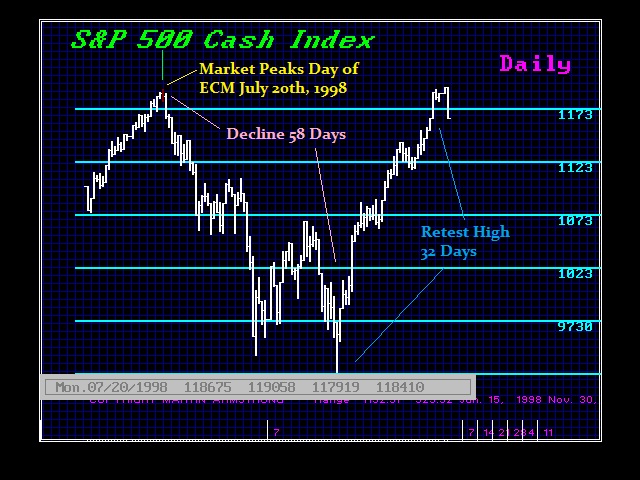
There is absolutely nobody who can save the markets or economy in the middle of a crash – NOBODY! First of all, it was a contagion that began in Russia and because they could not sell Russian assets, they sold every other market to raise cash. So I fail to see how any person or any single country could stop a crash that is a global contagion.

Yes, in 1985 they call upon several analysts to pretend they listened but nobody directed them to create the G5. I wrote to President Reagan back then detailing why the G5 would increase volatility and fail. If you want to call me a Presidential Adviser, I think that is a stretch. If you presume you give advise which is then acted upon, there is nobody who can claim to be a Presidential Adviser to prevent anything. Sure I get calls in the midst of a crash, but there is nothing anyone can do to stop a meltdown. They are short-lived and have to play out.

I wrote to Robert Rubin warning about his jawboning the dollar would crate the same crisis as the 1987 Crash. Tim Geithner quickly responded saying they weren’t doing that. The 1997 Currency Crash came within weeks.

Sorry, I do not believe anyone can prevent anything or save the economy in the middle of crash