QUESTION: Marty, It was a fantastic WEC. You tied it all together brilliantly and how the real issue is this liquidity crisis. Suddenly the ECB came out and said that inflation will not subside given a recession. It appears they were watching the WEC. Do you think that the ECB is at least listening now?
NG
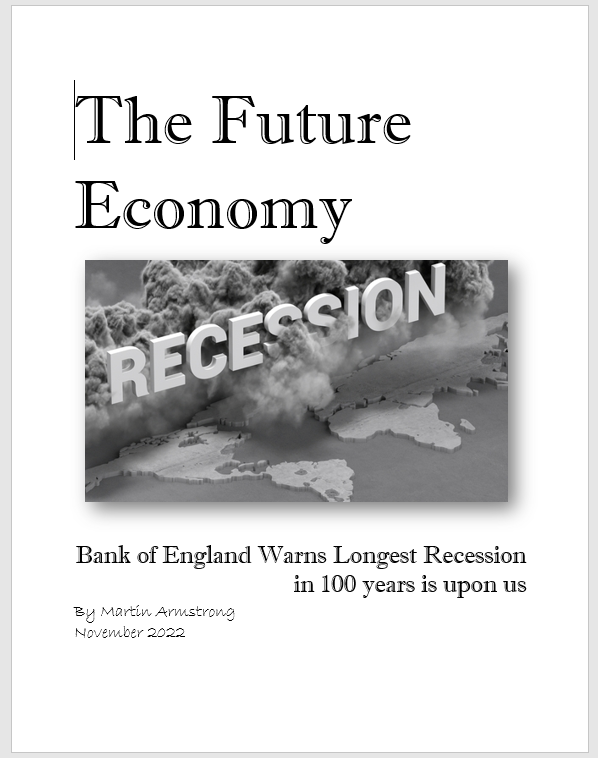
ANSWER: For Christine Lagarde to publicly state that a “mild recession” will not reduce inflation is admitting that inflation has been instigated by COVID lockdowns that disrupted the supply chain and unleashed shortages. The Bank of England has come out and stated that we will see the longest recession in 100 years.
The ECB has just forced banks to repay their loans withdrawing $300 billion euros from the banking system in a desperate effort to stop inflation. This will not help for Legarde knows that even an economic recession will not prevent this type of inflation that is more akin to the STAGFLATION of the ’70s where costs rose thanks to the OPEC crisis and where we have the COVID Crisis that created shortages mixed with the climate change zealots determined to end fossil fuels despite the fact there are no alternatives. How do you even make steel without coal?
Everything is now unfolding on schedule. We are facing 2023 which will be known as the year of chaos.
Retail relies on the holiday season for the bulk of its revenue. In fact, a quarter of all retail spending in the US occurs in the last two months of the year. Numerous retailers have already downgraded their forecasts for the holiday season, and therefore, overall revenue estimates will go down. I reported that early indications of Halloween spending amid inflation were cause for concern. People were still willing to spend on the holiday, but everything cost significantly more, and availability was limited.
Two weeks ago, reports were coming in of hiring halts, but now mass layoffs are suddenly appearing in the news. Amazon plans to fire 10,000 employees this week alone. This is a steep mass layoff that represents 3% of corporate employees and 1% of the entire workforce. This is the largest layoff in the company’s history.
Other retailers have announced layoffs as well, and this is not limited to the US. E-commerce giant Alibaba also laid off nearly 10,000 workers this past August due to poor numbers. AliExpress eliminated 40% of its entire workforce and cited supply chain disruptions as the main culprit, as it was one of the most popular shopping apps in Russia.
Gap Inc. will eliminate 500 corporate roles in the US and Asia. Peloton parted ways with 500 people in October in its most recent round of layoffs. Shopify eliminated 10% of its staff in July and plans to make additional cuts. Nordstrom fired 200 employees from a warehouse distribution center. Wayfair eliminated 900 positions after a hiring freeze in May. Mass layoffs are becoming a common occurrence during a time when retailers usually hire additional staff.
The supply chain crisis is to blame. FedEx plans to furlough employees right before the busy Christmas season. Their revenue was up 21% last quarter, but shipments fell 5% in the same time period. Overall inflation and wage losses are a positive sign for the Fed but a complete disaster to individuals and their families. Expect sales as retailers attempt to eliminate outdated inventory to make room for delayed shipments.
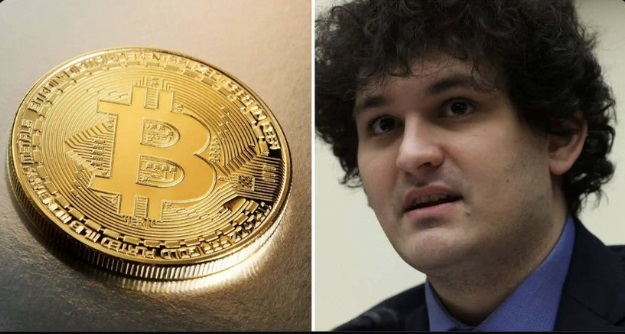
The collapse of the FTX Exchange is pretty straightforward insofar as this is the same lesson that constantly repeats in finance time and time again. Basically, FTX lent US$10bn of client funds to their trading arm Alameda, which used it for leveraged their own crypto speculation because the crypto market has been collapsing. Typically, someone like Sam Bankman-Fried had his whole life wrapped up in this venture. Lacking financial controls operating from the Bahamas, moving the money from client funds to his trading arm Alameda was possible. Historically, someone in this position sees his world collapsing but is not prepared to see that unfold for it requires admitting that he was wrong on crypto, to begin with. Consequently, such a person is not trying to actually rob clients’ money, they most likely see it as a temporary loan to save the company and the market will bounce back – or so they believe.
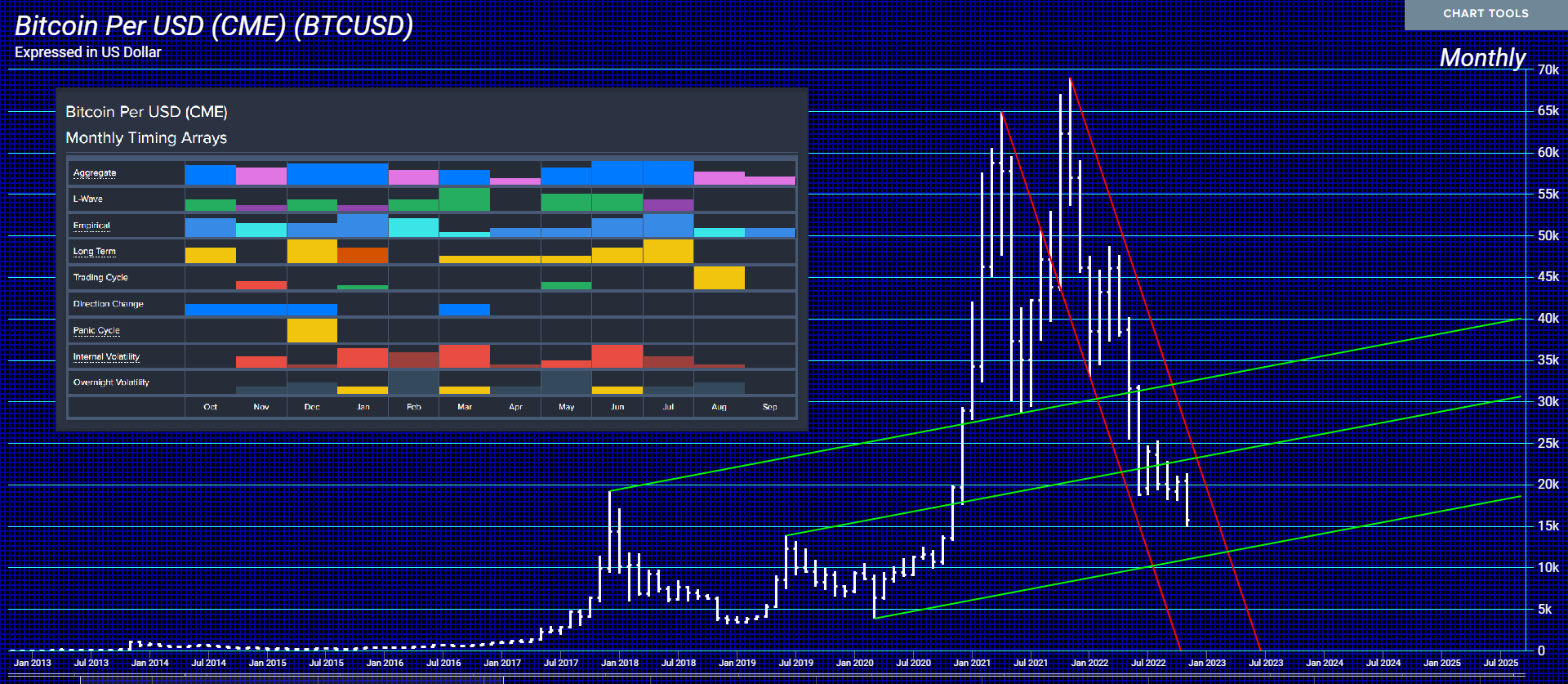
Our computer had picked the high in Bitcoin perfectly and has been projecting the collapse all along the way. But crypto has become a religion and in so doing it clouds the judgment of people who want to believe the story. Alameda blew up in a crypto meltdown because it did not want to accept that the crypto boom was over. The loan he probably thought would be temporary, vanished in the implosion. At first, I would have assumed they had actually invested the money and lost it on the bond market collapse. But that was perhaps too traditional. Here, it appears they were trying to defend their own cryptocurrency and trying to buy the low that kept moving lower. It appears he was allegedly simply using clients’ funds to trade keeping gains for his firm and the clients now suffer the risk.
It appears that they allegedly were trying to defend the crypto market and did not understand that the boom was over. The loans could not then be repaid. As crypto was crashing, some people needed to cash out. The attempt to pull out US$5bn from FTX exposed the fact that the cash was all gone. This is not so unusual. It has happened before. This time, the prosecutors are clamoring to be the one to charge him so they can become famous over his dead body.
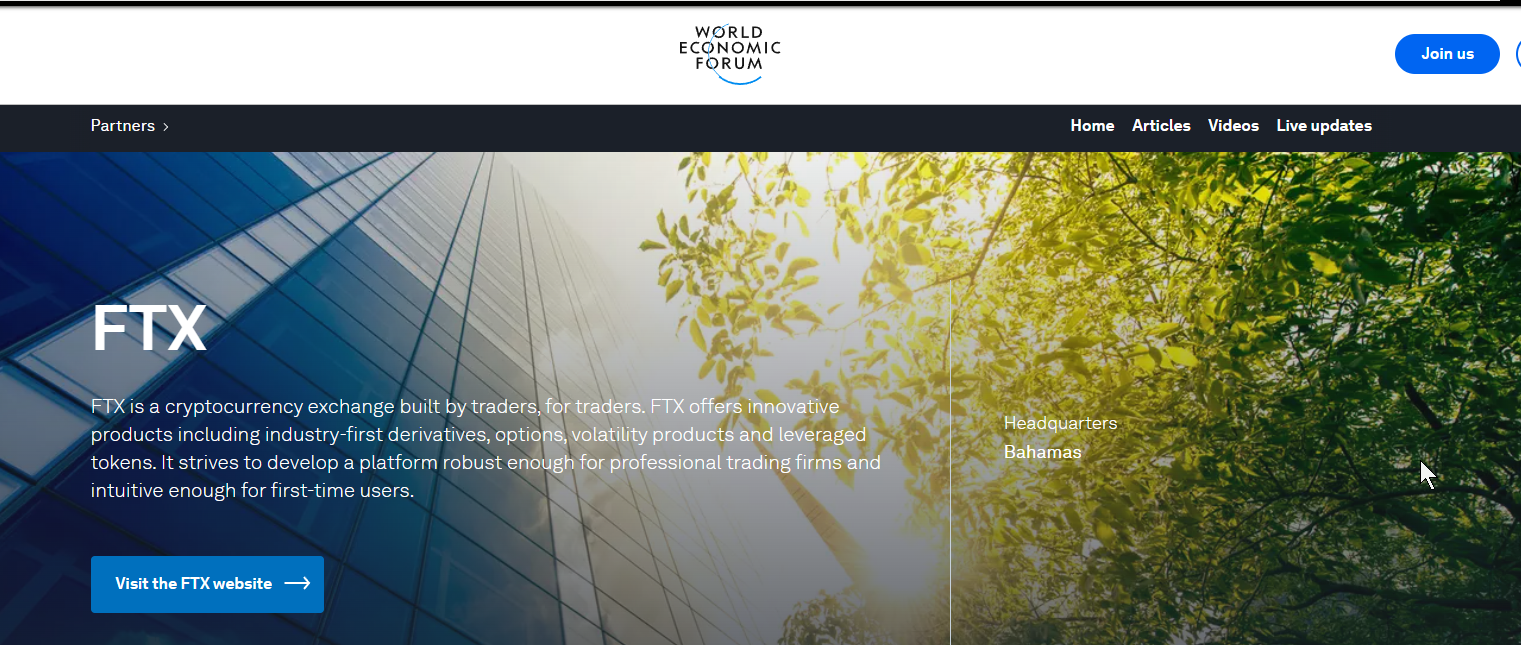
FTX was a partner with Klaus Schwab’s World Economic Forum (WEF). Of course, the WEF has suddenly removed the page and is desperately trying to hide their involvement with FTX and Sam Bankman-Fried. Naturally, eliminating paper currency has been the goal of the WEF because they support the end of not just capitalism, but also democracy. Schwab’s push has been his Great Reset and to control society to impose his economic philosophy inspired by Marx and Lenin.
This is by no means the first violation of fiduciary responsibility that presents a custodial risk. MF Global Holdings Ltd., you might recall, was a firm formerly run by New Jersey ex-Gov. Jon Corzine was accused in 2013 of unlawfully using customer money to meet his firm’s funding needs. When MF Global went bust because of trading by ex-Goldman Sach’s Jon Corzine’s trading using his client’s money in London also outside the regulatory eye of the USA, he was NEVER prosecuted for illegally using $1.6 billion of 26,000 client’s money. That is not going to be the case this time. So what is the difference between Corzine and Bankman-Fried? Corzine was ex-Goldman Sachs.
Indeed, Corzine was well-connected right into the White House with Obama. Nobody went to jail and clients had to wait in bankruptcy to get their money – even cash in the accounts was taken. There are clear risks with the broker and clearer. As long as the SEC is run with former Goldman Sachs staff, there will NEVER be an honest regulator. Even when all the banks pled criminally guilty, the SEC exempted everyone from losing their licenses. They would NEVER do that with anyone outside of New York City. The SEC will never prosecute the banks – EVER!!!!
Indeed, several federal investigations had been launched into MF Global, including probes by the Commodity Futures Trading Commission (its main regulator), the Securities and Exchange Commission, the Federal Bureau of Investigation, and Justice Department prosecutors in both Chicago and New York. The brokerage has also been the focus of several congressional hearings. Not a single one charged Corzine with trading with his client’s money. The losses that eventually drove MF Global into bankruptcy stemmed from high-risk bets on European sovereign bonds that Corzine made as he swung for the fences. Corzine bet big that the bond issuers would not default.
Commodity Futures Trading Commission simply fined Jon Corzine only $5 million over MF Global’s rapid descent into bankruptcy on Oct. 31, 2011, as an estimated $1.6 billion of customer money went missing. Anyone else would have been in prison for a minimum of 20 years.
It was Martin Glenn who was the judge in New York on M.F. Global bankruptcy. He was the first one to engage in FORCED LOANS by abandoning the rule of law to help the bankers by protecting them from losses taking client accounts to cover M.F. Global’s losses. He simply allowed the confiscation of client funds when in fact the rule of law should have been that the bankers were responsible and M.F. Global’s losses should have been reversed as they did even when Robert Maxwell’s companies failed in London from his illegal trading taking employee pension funds.
Yes, that was Ghislaine Maxwell’s father and the guy who was in control of the company that Bill Browder worked for before Edmond Safra. Never should the client’s funds be taken for M.F. Global’s losses to the NY Bankers. It was Judge Martin Glen who placed the entire financial; system at risk by trying to protect the bankers. Martin Glenn pampered these bankers making them the new UNTOUCHABLES. We have to be concerned that there really is no rule of law that will protect you in a crisis.
On Bloomberg TV, Sam Bankman-Fried explained why he even created FTX. He said he was experiencing his own frustration at Alameda Research, which was his crypto-focused proprietary trading firm. He was frustrated with the execution he was receiving at various crypto exchanges so he claimed that inspired FTX’s creation in May 2019. FTX grew rapidly to become the third largest crypto exchange in the world, with approximately $16 billion of customer assets under custody over 43 months.
Bankman-Fried stated that Alameda was making lots of money, but it could have been making more and he did not have access to venture capital. Claims of 100% annualized returns are not uncommon in a boom, but any experienced trader knows what goes up, also comes down. Alameda was relying on “cobbling together lines of credit” to expand its capital base. He then created FTX to solve his funding problem creating his own exchange that even the WEF cheered as a partner. He actually created a platform that was tailored for his own company, Alameda, to facilitate its trading needs. FTX coined the phrase “built by traders, for traders.”
There was an obvious conflict of interest questions regarding the close relationship between FTX and Alameda. Being operated from the Bahamas raised questions among those of us who are seasoned financial market observers whether the two were truly arm’s length from each other. However, people were so pumped up on adrenalin with crypto being the end of the dollar and central banks that this new free-wheeling crypto world believed what they wanted to believe and never looked too closely. FTX operated outside the reach of the US regulatory domain and there was a lack of any fiduciary confirmation. When the founder of Binance, the world’s largest crypto exchange, Changpeng Zhao, openly questioned the soundness of the FTX/Alameda nexus on Twitter saying he would sell over $500 million worth of FTX’s token FTT, that was the kiss of death weather or not he realized he would unleash a crypto panic that would engulf the entire industry in a matter of days.
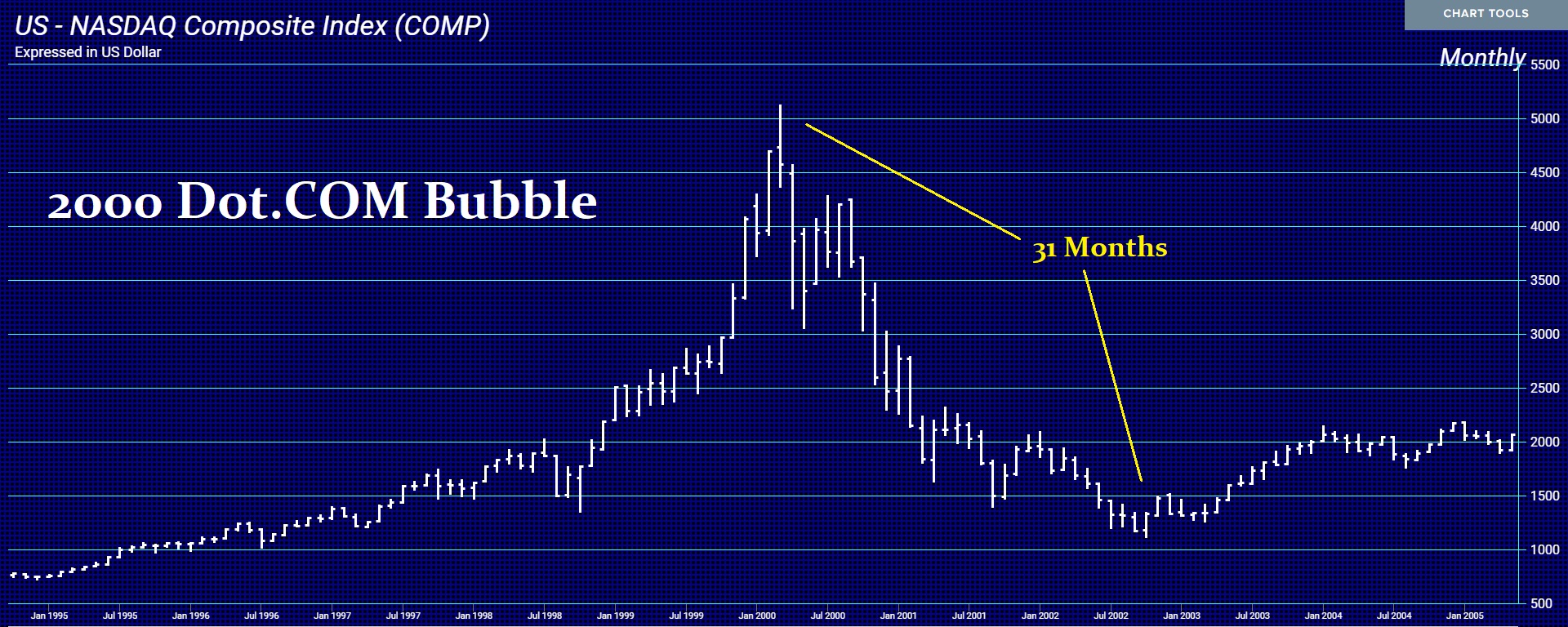
The collapse of FTX will now become a contagion for the crypto world. This 20-something group of inexperienced traders has signaled the demise of an industry that was getting all the hype with no substance. This crypto world will be seen as the DOT COM Bubble of 2000. With a recession on the horizon, the collapse of sovereign debt, and the monetary system as a whole, people will be looking for more of the safe bets rather than roll the dice on crypto. Nothing ever goes straight down. But by year-end, the volatility should perk up everyone’s view of the world.
Posted originally on the conservative tree house on November 12, 2022 | sundance
FTX crypto currency exchange CEO Sam Bankman-Fried is a major donor to multiple progressive causes and politicians. This week as FTX starts to collapse, the financial system underneath the exchange looks more like a Ponzi scheme falling apart.
The CEO had been a major donor to regulators on Capitol Hill, and the tentacles of FTX extend to Ukraine where Sam Bankman-Fried was operating to support the Ukraine government with crypto currency collections and donations. The FTX corporation and CEO Sam Bankman-Fried is now under multiple investigations. Here’s the 90-second recap of the current dynamic. WATCH:
.
(Via Daily Caller) Sam Bankman-Fried, prolific Democratic donor and ex-CEO of now-bankrupt cryptocurrency exchange FTX, funded the campaigns of members of Congress overseeing the Commodity Futures Trading Commission (CFTC), one of the key bodies tasked with regulating the crypto industry and the subject of Bankman-Fried’s aggressive lobbying.
Bankman-Fried’s FTX is currently under investigation by the CFTC and the Securities and Exchange Commission (SEC) after Bankman-Fried allegedly moved $10 billion in client assets from his crypto exchange to his trading firm Alameda Research, and a liquidity crisis at his exchange which prompted the company to file for bankruptcy. However, prior to the agency’s probe, Bankman-Fried aggressively courted the CFTC – and funded several key lawmakers charged with overseeing the agency, pouring cash into their campaign coffers. (read more)
(Via CoinDesk) The past week has seen a dizzying downward spiral for Sam Bankman-Fried’s huge crypto empire. Bankman-Fried’s FTX crypto exchange has paused withdrawals, and a tentative bailout from rival Binance appears to be kaput. That could put depositor funds at risk, and certainly spells a major setback for not only Bankman-Fried but for the cryptocurrency industry as a whole.
These downfalls aren’t rare in crypto, which is subject to extreme boom-bust cycles. But FTX and Bankman-Fried are unique in the stature they achieved before self-immolating. Over the past three years, FTX has come to be widely regarded as a reputable exchange, despite not submitting to U.S. regulation. Bankman-Fried has himself become globally influential, thanks to his thoughts on cryptocurrency regulation and his financial support for U.S. electoral candidates – not necessarily in that order.
These narratives about both FTX and Bankman-Fried are now clearly dead in the water, given recent evidence that everything was not as it seemed at the exchange, or at Bankman-Fried’s other firm, Alameda Research. (read more)
QUESTION: Mr. Armstrong; Nobody knows history better than you. Will QE continue if we end up in war? It seems there would be no choice.
Thank you for your very enlightening blog.
PG
ANSWER: Yes. The Fed was “directed” by the White House to carry out QE during World War II. They were to prevent interest rates from rising and the debt rose. That finally led to the Federal Reserve breaking with the White House after the war when they expected it to continue for the Korean War. That is when the Fed asserted its independence.
This time, we may have a different problem. As the war unfolds in Europe, the capital will flee as usual to the States. But the money supply will have to increase because the dollar will become the only viable currency still standing. That is why you are witnessing the pound and the euro collapse. Things will unfold differently this time. The Fed has been raising rates to fight inflation that will fail because this has to do with shortages – not speculation.
The October 3, 2022 Emergency Meeting was closed to public observation by Order of the Board of Governors because the matters fell under exemption(s) 9(A)(i) of the Government in the Sunshine Act (5 U.S.C. Section 552b(c)), and it was determined that the public interest did not require opening the meeting. That said, the Fed is faced with a triple crisis – liquidity, banking stability, and an inevitable Sovereign Debt Crisis. As interest rates have risen based on domestic inflation rates, simultaneously, the higher rates have undermined both European banks as well as Emerging Markets. The Federal Reserve has become the DEFACTO central bank of the world.
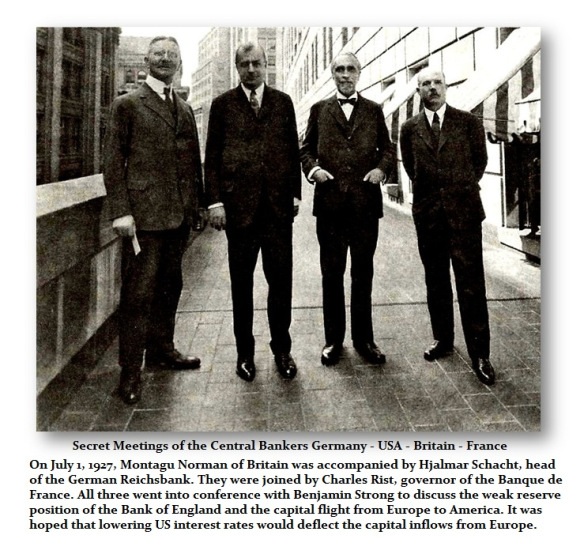
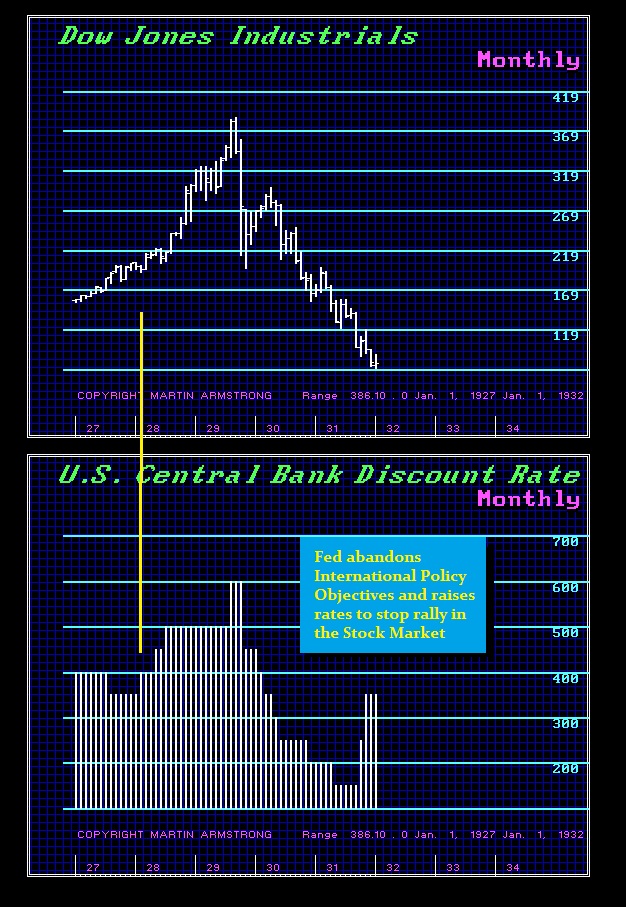
This is a crisis similar in part to 1927 when the European central banks lobbied the Fed to lower rates because of their debt crisis. They lowered rates to accommodate Europe and that was then blamed on the Fed for creating the 1929 boom. This is also why FDR then seized control of the Federal Reserve and move the head to Washington and made the Chairman subservient to the President.
I know so many blame the Fed for everything. They are actually facilitating Congress. The Fed has no control over fiscal spending or the debt level. In the end, it is really the debt that has become the money supply that simply pays interest.
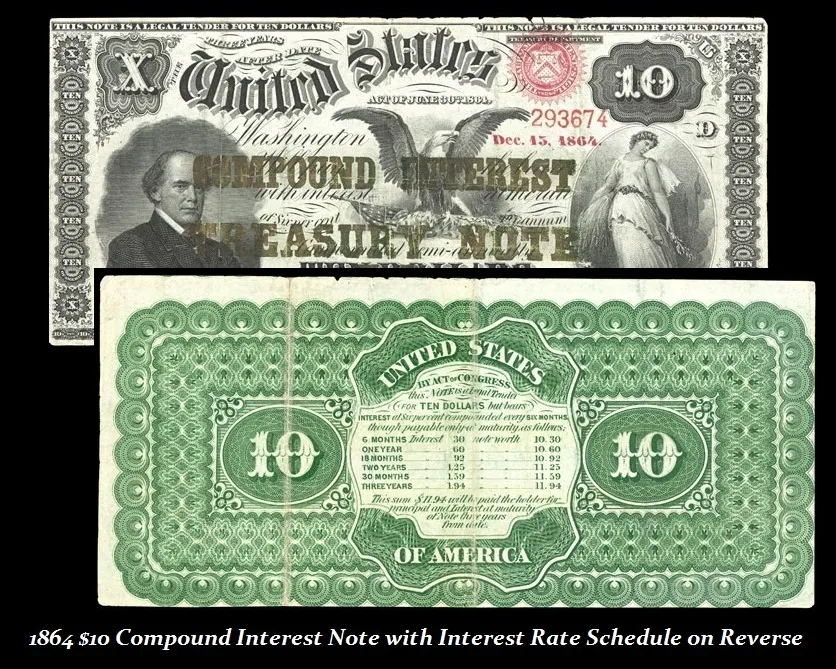
There was no US paper money before the Civil War. The first issues of paper money were actually a hybrid bond – they paid interest. The term “greenback” developed for “demand notes” that came later as the cost of the war rose. They no longer paid interest so what was on the back was just green ink – no interest rate table to show what the note was worth.
I will be doing a full report on this subject for the WEC. It is complex, yet exceptionally interesting for what we face.
The title speaks for itself. The Fed is going to continue raising rates until inflation shows notable improvement. Some still question whether the Fed will ease on its hawkish policies, but there is absolutely every indication to believe they will continue at full speed. Core PCE rose 4.9% in August from the year prior and increased 0.6% for the month.
Before the aforementioned data was released, Chicago Federal Reserve President Charles Evans said he was “cautiously optimistic” that the US could avoid a recession. “There are lags in monetary policy and we have moved expeditiously. We have done three 75 basis point increases in a row and there is a talk of more to get to that 4.25% to 4.5% by the end of the year, you’re not leaving much time to sort of look at each monthly release,” Evans, who is set to retire next year, said.
The truth of the matter is that the White House simply changed the definition of a recession. The majority is hurting financially right now, and I don’t think we need the talking heads to tell us that we are already in a recession. The typical analysis looks only at domestic conditions, but internationally, most central banks are in the process of raising rates and backtracking on failed QE policies.
Every month there are reports of the market being “spooked” by rate hikes. People come on TV and act surprised that the Fed has the audacity to raise rates yet again. Why? Powell stated in every possible way that the FOMC will raise rates for “some time.” In Powell language, that means rates will continue to rise for a while. The computer foresees havoc going into 2023. Things must get worse before they become better. Unemployment must rise, rates must go higher, and you must adjust your strategy accordingly.
I have created this site to help people have fun in the kitchen. I write about enjoying life both in and out of my kitchen. Life is short! Make the most of it and enjoy!
This is a library of News Events not reported by the Main Stream Media documenting & connecting the dots on How the Obama Marxist Liberal agenda is destroying America







 Centinel2012