The IMF Is Not Done Destroying Greece Yet


Tyler Durden's picture

Authored by Raul Ilargi Meijer via The Automatic Earth blog,

Austerity is over, proclaimed the IMF this week. And no doubt attributed that to the ‘successful’ period of ‘five years of belt tightening’ a.k.a. ‘gradual fiscal consolidation’ it has, along with its econo-religious ilk, imposed on many of the world’s people. Only, it’s not true of course. Austerity is not over. You can ask many of those same people about that. It’s certainly not true in Greece.

IMF Says Austerity Is Over

Austerity is over as governments across the rich world increased spending last year and plan to keep their wallets open for the foreseeable future. After five years of belt tightening, the IMF says the era of spending cuts that followed the financial crisis is now at an end. “Advanced economies eased their fiscal stance by one-fifth of 1pc of GDP in 2016, breaking a five-year trend of gradual fiscal consolidation,” said the IMF in its fiscal monitor.

In Greece, the government did not increase spending in 2016. Nor is the country’s era of spending cuts at an end. So did the IMF ‘forget’ about Greece? Or does it not count it as part of the rich world? Greece is a member of the EU, and the EU is absolutely part of the rich world, so that can’t be it. Something Freudian, wishful thinking perhaps?

However this may be, it’s obvious the IMF are not done with Greece yet. And neither are the rest of the Troika. They are still demanding measures that are dead certain to plunge the Greeks much further into their abyss in the future. As my friend Steve Keen put it to me recently: “Dreadful. It will become Europe’s Somalia.”

An excellent example of this is the Greek primary budget surplus. The Troika has been demanding that it reach 3.5% of GDP for the next number of years (the number changes all the time, 3, 5, 10?). Which is the worst thing it could do, at least for the Greek people and the Greek economy. Not for those who seek to buy Greek assets on the cheap.

But sure enough, the Hellenic Statistical Authority (ELSTAT) jubilantly announced on Friday that the 2016 primary surplus was 4.19% (8 times more than the 0.5% expected). This is bad news for Greeks, though they don’t know it. It is also a condition for receiving the next phase of the current bailout. Here’s what that comes down to: in order to save itself from default/bankruptcy, the country is required to destroy its economy.

And that’s not all: the surplus is a requirement to get a next bailout tranche, and debt relief, but as a reward for achieving that surplus, Greece can now expect to get less … debt relief. Because obviously they’re doing great, right?! They managed to squeeze another €7.3 billion out of their poor. So they should always be able to do that in every subsequent year.

The government in Athens sees the surplus as a ‘weapon’ that can be used in the never-ending bailout negotiations, but the Troika will simply move the goalposts again; that’s its MO.

A country in a shape as bad as Greece’s needs stimulus, not a budget surplus; a deficit would be much more helpful. You could perhaps demand that the country goes for a 0% deficit, though even that is far from ideal. But never a surplus. Every penny of the surplus should have been spent to make sure the economy doesn’t get even worse.

Greek news outlet Kathimerini gets it sort of right, though its headline should have read “Greek Primary Surplus Chokes Economy“.

Greek Primary Surplus Chokes Market

The state’s fiscal performance last year has exceeded even the most ambitious targets, as the primary budget surplus as defined by the Greek bailout program, came to 4.19% of GDP, government spokesman Dimitris Tzanakopoulos announced on Friday. It came to €7.369 billion against a target for €879 million, or just 0.5% of GDP. A little earlier, the president of the Hellenic Statistical Authority (ELSTAT), Thanos Thanopoulos, announced the primary surplus according to Eurostat rules, saying that it came to 3.9% of GDP or €6.937 billion.

The two calculations differ in methodology, but it is the surplus attained according to the bailout rules that matters for assessing the course of the program. This was also the first time since 1995 that Greece achieved a general government surplus – equal to 0.7% of GDP – which includes the cost of paying interest to the country’s creditors. There is a downside to the news, however, as the figures point to overtaxation imposed last year combined with excessive containment of expenditure.

The amount of €6-6.5 billion collected in excess of the budgeted surplus has put a chokehold on the economy, contributing to a great extent to the stagnation recorded on the GDP level in 2016. On the one hand, the impressive result could be a valuable weapon for the government in its negotiations with creditors to argue that it is on the right track to fiscal streamlining and can achieve or even exceed the agreed targets. On the other hand, however, the overperformance of the budget may weaken the argument in favor of lightening the country’s debt load.

Eurogroup head Dijsselbloem sees no shame in admitting this last point :

Dijsselbloem Sees ‘Tough’ Greek Debt Relief Talks With IMF

“That will be a tough discussion with the IMF,” said Dijsselbloem, who is also the Dutch Finance Minister in a caretaker cabinet, “There are some political constraints where we can go and where we can’t go.” The level of Greece’s primary budget surplus is key in determining the kind of debt relief it will need. The more such surplus it has, the less debt relief will be needed.

That’s just plain insane, malicious even. Greek PM Tsipras should never have accepted any such thing, neither the surplus demands nor the fact that they affect debt relief, since both assure a further demise of the economy.

Because: where does the surplus come from? Easy: from Troika-mandated pension cuts and rising tax levels. That means the Greek government is taking money OUT of the economy. And not a little bit, but a full 4% of GDP, over €7 billion. An economy from which so much has already vanished.

The €7.369 billion primary surplus, in a country of somewhere between 10 and 11 million people, means some €700 per capita has been taken out of the economy in 2016. Money that could have been used to spend inside that economy, saving jobs, and keeping people fed and sheltered. For a family of 3.5 people that means €200 per month less to spend on necessities (the only thing most Greeks can spend any money on).

I’ve listed some of the things a number of times before that have happened to Greece since the EU and IMF declared de facto financial war on the country. Here are a few (there are many more where these came from):

25-30% of working age Greeks are unemployed (and that’s just official numbers), well over 1 million people; over 50% of young people are unemployed. Only one in ten unemployed Greeks receive an unemployment benefit (€360 per month), and only for one year. 9 out of 10 get nothing.

Which means 52% of Greek households are forced to live off the pension of an elderly family member. 60% of Greek pensioners receive pensions below €700. 45% of pensioners live below the poverty line with pensions below €665. Pensions have been cut some 12 times already. More cuts are in the pipeline.

40% of -small- businesses have said they expect to close in 2017. Even if it’s just half that, imagine the number of additional jobs that will disappear.

But the Troika demands don’t stop there; they are manifold. On top of the pension cuts and the primary surplus requirement, there are the tax hikes. So the vast majority of Greeks have ever less money to spend, the government takes money out of the economy to achieve a surplus, and on top of that everything gets more expensive because of rising taxes. Did I ever mention businesses must pay their taxes up front for a full year?

The Troika is not “rebalancing Greece’s public finances in a growth-friendly manner”, as Dijsselbloem put it, it is strangling the economy. And then strangling it some more.

There may have been all sorts of things wrong in Greece, including financially. But that is true to some degree for every country. And there’s no doubt there was, and still is, a lot of corruption. But that would seem to mean the EU must help fight that corruption, not suffocate the poor.


Yes, that’s about a 30% decline in GDP since 2007


The ECB effectively closed down the Greek banking system in 2015, in a move that’s likely illegal. It asked for a legal opinion on the move but refuses to publish that opinion. As if Europeans have no right to know what the legal status is of what their central bank does.

The ECB also keeps on refusing to include Greece in its QE program. It buys bonds and securities from Germany, which doesn’t need the stimulus, and not those of Greece, which does have that need. Maybe someone should ask for a legal opinion on that too.

The surplus requirements will be the nail in the coffin that do Greece in. Our economies depend for their GDP numbers on consumer spending, to the tune of 60-70%. Since Greek ‘consumers’ can only spend on basic necessities, that number may be even higher there. And that is the number the country is required to cut even more. Where do you think GDP is headed in that scenario? And unemployment, and the economy at large?

The question must be: don’t the Troika people understand what they’re doing? It’s real basic economics. Or do they have an alternative agenda, one that is diametrically opposed to the “rebalancing Greece’s public finances in a growth-friendly manner” line? It has to be one of the two; those are all the flavors we have.

You can perhaps have an idea that a country can spend money on wrong, wasteful things. But that risk is close to zilch in Greece, where many if not most people already can’t afford the necessities. Necessities and waste are mutually exclusive. A lot more money is wasted in Dijsselbloem’s Holland than in Greece.

In a situation like the one Greece is in, deflation is a certainty, and it’s a deadly kind of deflation. What makes it worse is that this remains hidden because barely a soul knows what deflation is.

Greece’s deflation hides behind rising taxes. Which is why taxes should never be counted towards inflation; it would mean all a government has to do to raise inflation is to raise taxes; a truly dumb idea. Which is nevertheless used everywhere on a daily basis.

In reality, inflation/deflation is money/credit supply multiplied by the velocity of money. And in Greece both are falling rapidly. The primary surplus requirements make it that much worse. It really is the worst thing one could invent for the country.

For the Greek economy, for its businesses, for its people, to survive and at some point perhaps even claw back some of the 30% of GDP it lost since 2007, what is needed is a way to make sure money can flow. Not in wasteful ways, but in ways that allow for people to buy food and clothing and pay for rent and power.

If you want to do that, taking 4% of GDP out of an economy, and 3.5% annually for years to come, is the very worst thing. That can only make things worse. And if the Greek economy deteriorates further, how can the country ever repay the debts it supposedly has? Isn’t that a lesson learned from the 1919 Versailles treaty?

The economists at the IMF and the EU/ECB, and the politicians they serve, either don’t understand basic economics, or they have their eyes on some other prize.

Wilbur Ross Hits Canada With Soft Wood Import Tariff…


How do you get congress to accept the NAFTA notification of intent letter? Why, you backstop the Canadian decision to undermine U.S. dairy farm exports by applying equity import tariffs and offsetting losses to U.S. manufacturers.

First stop, lumber mills. ie U.S. regional impacts, not coincidentally, represented by key Democrat constituents.

The congressional delegations from Washington State and Oregon happen to be mostly elected Democrats; and they happen to applaud the efforts; which means they are not able to criticize the approach. Hmm, it’s almost as if Wilburine and POTUS had a strategy or something.   Nah, couldn’t be.

(Via CNN) These are the first tariffs imposed by President Trump, who during his election campaign threatened to use them on imports from both China and Mexico. The decision on Monday is bound to lead to a standoff and could stoke fears of a trade war between the US and Canada, two of the world’s largest trade powers.

Commerce Secretary Wilbur Ross said the tariffs, or taxes, announced Monday evening were being imposed after trade talks on dairy products fell through.

“It has been a bad week for US-Canada trade relations,” Ross said in a statement. Trump’s tariffs come as the US, Canada and Mexico prepare to renegotiate NAFTA, the free trade agreement among the three countries that came into being in 1994. Trump has directed almost all of his NAFTA criticism at Mexico, which makes this decision even more surprising.

When Canadian Prime Minister Justin Trudeau visited Trump in February, Trump said he only expected to be “tweaking” the US-Canada trade relationship.

The tariffs — also called duties — ranged from 3% to 24% on specifically five Canadian lumber companies. For all other Canadian lumber companies, there’s a nearly 20% duty imposed on exports to the US.

The five firms were: West Fraser Mills, Tolko Marketing and Sales, J.D. Irving, Canfor Corporation, and Resolute FP Canada. West Fraser Mills will pay the highest duty of 24%.

The duties were imposed to create a level playing field for American lumber companies.

U.S. lumber companies allege Canadian firms are provided with unfair subsidies by the Canadian government.

Canadian exports of softwood lumber to the U.S. were valued at $5.6 billion last year, according to the Commerce Department.

The Commerce Department said the duties are preliminary and a final determination will be made in September. The U.S. Lumber Coalition, which represents the industry, said the duties will likely take effect starting sometime next week. The Commerce Department wasn’t available to clarify. (read more)

REACTION: Senator Ron Wyden (Democrat-Oregon.), the ranking member of the Senate Finance Committee, applauded the Commerce Department’s decision.

“Unfairly traded softwood lumber from Canada has for decades hurt mill towns and American millworkers in Oregon and across the country,” Wyden said.

“Today’s announcement sends the message that help is on the way,” he said. (link)

The Fate of the Euro


Albert Einstein We cannot solve our problems with the same thinking we used when we created them.

QUESTION: The bounce in the Euro is a fool’s’ game?

ANSWER: Absolutely. The Euro is doomed because especially if Le Pen loses, Brussels will be relieved and proceed as usual. The same problems will merely exist and no reform will come forward to save the day. A good wind will blow over the European banking system. You are expecting politicians to admit they were wrong and surrender power in Brussels. NOT GOING TO HAPPEN. As Einstein said, you will NEVER solve the problem of the Euro with the same thinking process.

IBEUUS-M 4-24-2017

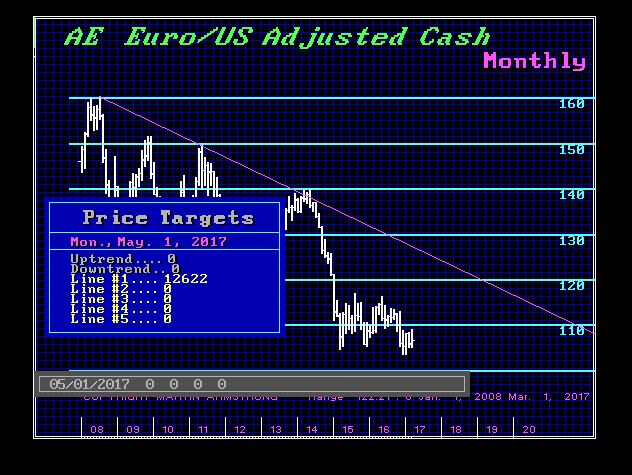
As weekly closing above the 10860 level in the Euro will imply the rally will press high to test the 112-114 level. Just look at the technical perspective on a monthly level. The Downtrend Line stands in May up at 12622. We are nowhere near reversing the trend in the Euro.

We have the French, British, and then German elections here in 2017. We do not expect total chaos before 2018. That seems to be the point of a major shift.

The French Elections & Socrates


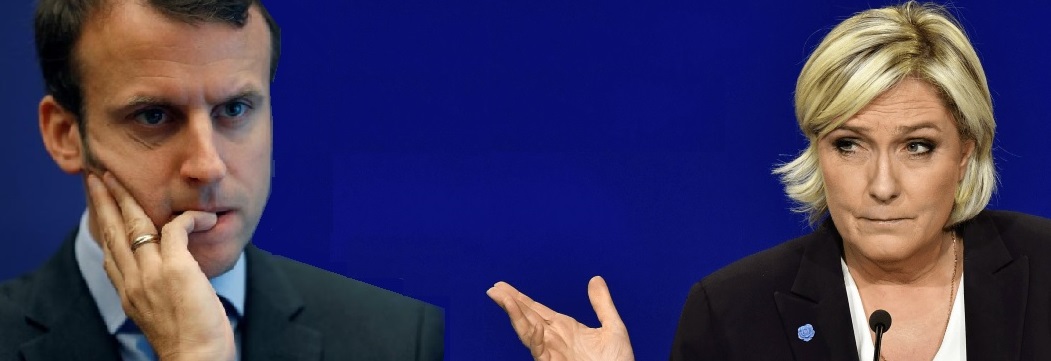
QUESTION: Mr. Armstrong, I saved you article from November 25th last year where your computer forecast the collapse of mainstream politics. Macron was not even in the picture back then. Have you recalculated now that all the parties collapsed and it is Macron v Le Pen?

Image12

ANSWER: I am very familiar with France. I was supposed to debate Michel Sapin, the Finance Minister of France on national TV. He backed out.

As you can see in that article, the only way to approach this is to look at the philosophy rather than the party since we were showing that the parties would collapse as they have done. I concluded that article writing:

“Clearly, the socialists are finished. However, we are within this 10 year window between 2013 and 2023. This clearly shifts the favor toward a new power. Le Pen can win within this window. However, expect this to be also very divisive as in the United States.”

We could extrapolate and say all other party members will vote for Macron. However, that would just be a guess. The wildcard now is we know that Le Pen will get probably 30% for that is her hardcore base. The question becomes, what portion of the other parties will now vote for Le Pen. Keep in mind that the Euro will rally as fools think this will save the day if she loses. Such an event will only postpone the inevitable for the same thinking process will remain in place.

Einstein solving

An “Increasingly Worried” Chinese President Tells Trump To “Exercise Restraint” Over N.Korea


Tyler Durden's picture

France, and the European “populist wave”, may be fixed for now, but geopolitical concerns remain as was made clear last night when during a phone call late on Sunday between Chinese President Xi Jinping and Donald Trump, the North Korean neighbor called for all sides to “exercise restraint” as Japan conducted exercises with a U.S. aircraft carrier strike group headed for Korean waters. China, which has repeatedly called for the de-nuclearization of the Korean peninsula, is “increasingly worried” the situation could spin out of control, leading to war and a chaotic collapse of North Korea, something we cautioned over two months ago.

Xi told Trump on the phone that China resolutely opposed any actions that ran counter to U.N. Security Council resolutions, the Chinese foreign ministry said quoted by Reuters. China “hopes that all relevant sides exercise restraint, and avoid doing anything to worsen the tense situation on the peninsula”, the ministry said in a statement, paraphrasing Xi. The nuclear issue could only be resolved quickly with all relevant countries pulling in the same direction, and China was willing to work with all parties, including the United States, to ensure peace, Xi said.

A potential risk catalyst is just hours away: North Korea prepares to celebrate the 85th anniversary of the foundation of its Korean People’s Army on Tuesday. It has marked similar events in the past with nuclear tests or missile launches.

That said, a Chinese foreign ministry spokesman said the call between the two presidents was the latest manifestation of their close communication, which was good for both of their countries and the world.

China urges calm as Trump holds calls on North Korea

On Sunday, Trump also spoke by telephone with Japanese Prime Minister Shinzo Abe, who later described the conversation as a “thorough exchange of views”.

“We agreed to strongly demand that North Korea, which is repeating its provocation, show restraint,” Abe told reporters. “We will maintain close contact with the United States, keep a high level of vigilance and respond firmly,” he said. Abe also said he and Trump agreed that China should play a large role in dealing with it.

According to Reuters, a Japanese official said the phone call between Trump and Abe was not prompted by any specific change in the situation. Envoys on the North Korean nuclear issue from the United States, South Korea and Japan are due to meet in Tokyo on Tuesday. The U.S. government has not specified where the carrier strike group is, but U.S. Vice President Mike Pence said on Saturday it would arrive “within days”.

Meanwhile, South Korean Defence Ministry spokesman Moon Sang-gyun gave no details about the South’s plan to join the approaching U.S. carrier group for exercises, apart from saying Seoul was holding discussions with the U.S. Navy. “I can say the South Korean and U.S. militaries are fully ready for North Korea’s nuclear test,” Moon said. South Korean and U.S. officials have feared for some time that North Korea could soon carry out its sixth nuclear test.

As reported on Friday, satellite imagery analyzed by 38 North, a Washington-based North Korea monitoring project, found some activity at North Korea’s Punggye-ri nuclear test site last week. However, the group said it was unclear whether the site was in a “tactical pause” before another test or was carrying out normal operations.

Adding to the already tense situation, North Korea detained a U.S. citizen on Saturday as he attempted to leave the country. The arrest will be a topic of discussion when Trump hold a top level briefing with Senators on April 26.

As a reminder, Trump sent a carrier group for exercises in waters off the Korean peninsula as a warning, amid growing fears North Korea could conduct another nuclear test in defiance of United Nations sanctions.

Angered by the approach of the USS Carl Vinson carrier group, a defiant North Korea said on Monday the deployment was “an extremely dangerous act by those who plan a nuclear war to invade”. “The United States should not run amok and should consider carefully any catastrophic consequence from its foolish military provocative act,” Rodong Sinmun, the official newspaper of the North’s ruling Workers’ Party, said in a commentary on Monday.

“What’s only laid for aggressors is dead bodies,” the newspaper said.

Two Japanese destroyers have joined the carrier group for exercises in the western Pacific, and South Korea said on Monday it was also in talks about holding joint naval exercises.

One Trader Is Surprised At Market Euphoria From A “Result That Was Everybody’s Base Case”


Tyler Durden's picture

The risk of a Eurozone breakdown now appears to be taken off the table after a French election that has led to a dramatic repricing in European risk assets. And yet the outcome – which was largely expected – has prompted Bloomberg’s Richard Bresow to muse just how much was truly priced in:

“I guess it shouldn’t come as a huge surprise. It truly unnerved the commentariat that the unpredictable seemed to be unpredictable. The second vote is apparently now knowable with certainty. Europe is saved. Populism is about to be vanquished. A strong euro is a good thing for the economy. And ECB President Draghi can begin normalizing rates. Presto chango. Not bad for a result that was everybody’s base case.”

And yet, as Breslow adds, the wholesale reaction leaves something to be desired:

Gold is interesting. I’d have expected it to leak more than it did. It may require Treasury yields to push higher. As we speak, they left a nasty gap and sit right where the bulls were hoping they wouldn’t have to see anytime soon. This may be the most interesting asset of all.

Equities are happy. Think of all that hard-earned wealth creation. And they get to ignore the Shanghai meltdown and potential U.S. government shutdown. Make tax cuts, not war. Another one-half percent higher in the E-mini and dreams of new all-time highs will be dancing in traders’ heads.

For now, however, it is “springtime in Paris”, and all other concerns can be put on the backburner, if only for the next few days.

The full note from Richard Breslow, a former FX trader and fund manager who writes for Bloomberg

* * *

It’s Morning Time for Springtime in Paris

And they get to ignore the Shanghai meltdown and potential U.S. government shutdown. Make tax cuts, not war. Another one-half percent higher in the E-mini and dreams of new all-time highs will be dancing in traders’ heads.

It’s Morning Time for Springtime in Paris

The pollsters won the first round of the French presidential election. In other news, Emmanuel Macron and Marine Le Pen have advanced to the next phase. There were times last night when there seemed to be as much relief from the forecasts being accurate as the diminished likelihood that one of the extremists will win the ultimate prize. Despite the far-right representative coming second and ahead of either of the main party candidates.

I guess it shouldn’t come as a huge surprise. It truly unnerved the commentariat that the unpredictable seemed to be unpredictable. The second vote is apparently now knowable with certainty. Europe is saved. Populism is about to be vanquished. A strong euro is a good thing for the economy. And ECB President Draghi can begin normalizing rates. Presto chango. Not bad for a result that was everybody’s base case.

Some of the other big winners include SNB President Thomas Jordan as EUR/CHF made a new high on the year. This is a good one to keep an eye on as 1.0850, where it peaked, is where heavy technical resistance begins. If the “everything is right with the world” meme is to hold, the cross needs to show it. Game theory would suggest it wouldn’t be a bad time for him to give it a little nudge.

The BOJ has to be feeling a bit better. And will feel a whole lot more sanguine if EUR/JPY can stick above the really pivotal 120 level. It was just last Monday that 115 was under threat. The U.S. can’t really fault the Japanese for this yen weakness, as they will be referred to the French ministry.

Gold is interesting. I’d have expected it to leak more than it did. It may require Treasury yields to push higher. As we speak, they left a nasty gap and sit right where the bulls were hoping they wouldn’t have to see anytime soon. This may be the most interesting asset of all.

Equities are happy. Think of all that hard-earned wealth creation. And they get to ignore the Shanghai meltdown and potential U.S. government shutdown. Make tax cuts, not war. Another one-half percent higher in the E-mini and dreams of new all-time highs will be dancing in traders’ heads.

Springtime in Paris can indeed be very enchanting.

T-Rex: No Further Questions Needed on Russia Sanctions Being Lifted,… EVER !


Funny call readout from Secretary Tillerson’s office today.  The last paragraph is extraordinarily blunt (emphasis mine):

[Dept. of State] Secretary Tillerson phoned Ukrainian President Petro Poroshenko today to discuss his recent trip to Moscow and his message to the Russian leadership that, although the United States is interested in improving relations with Russia, Russia’s actions in eastern Ukraine remain an obstacle. The Secretary emphasized the importance of Ukraine’s continued progress on reform and combating corruption.

The Secretary accepted condolences from President Poroshenko on the death today of a U.S. member of the Organization for Security and Cooperation in Europe (OSCE) Special Monitoring Mission (SMM). The leaders agreed that the OSCE SMM has played a vital role in its role of monitoring the Minsk agreements designed to bring peace to eastern Ukraine, and that this tragic incident makes clear the need for all sides- and particularly the Russian-led separatist forces-to implement their commitments under the Minsk Agreements immediately.

Secretary Tillerson reiterated the United States’ firm commitment to Ukraine’s sovereignty and territorial integrity and confirmed that sanctions will remain in place until Russia returns control of the Crimean peninsula to Ukraine and fully implements its commitments in the Minsk agreements. (link)

Oh well, I guess that’s that then.

No need to ever wonder about those pesky sanctions ever being lifted.

Ever.

Horse = Dead.

Moving on…


French Election – No Surprise – Or Is There?


2017 Election

Our computer had correctly projected that Le Pen would defeat the mainstream party Socialists. Indeed, Hollende did not even run he was so unpopular. The result of this election is really now a wildcard. For the most important aspect worth underlining in BOLD is the striking fact that this is the first time in modern French history all the mainstream centre-right or centre-left parties of government that have ruled France since the World War II will not make it to stand for the second round of a presidential election.

Macron & WifeWe can now safely count that Le Pen’s base is very solid. Those who support her will be out in sheer force to take their country back – FRANCE FIRST as they are saying. The wildcard is now Macron, who just started his party last August. All the mainstream media and mainstream politicians will be throwing their support now to Macron. Mainstream press is already estimating Macron took 24% of the vote, with Le Pen close behind with 21.8%. The question is clear that his base is nowhere near as firm as that of Le Pen.

Macron is the mirror image of Trump. Just a bureaucrat, but his wife is 24 years older than him compared to Trump who is 25 years older than his wife. Macron lacks any real experience to speak of outside of government and the joke is that since men mature slower than women, he is just a boy toy who is not ready for prime time who needs his hand held when crossing streets. The two studies bantered about are curious indeed. If a man marries and older woman, she dies sooner whereas a man who marries a younger woman increases his life expectancy by at least 11%. Guess the younger girl keeps him in better shape whereas the boy toy wears out his spouse so they say. Well we have had just about every other scenario arise in politics. Guess its time to change up.

Macron’s platform is typical for a bureaucrat – something for everybody. He claims he wants to cut costs and bureaucracy to boost hiring, while promoting investment in what he called the economy of the future. These are nice vague objectives for which has has come under fire. He then came up with six main priorities: education, work, economic modernization, security, democratic renewal and international engagement.

Mean while, the ECB has firmed up plans to help bailout French banks in the middle of pending uncertainty. May is looking more and more interesting. A Le Pen victory will actually provide a soft-landing for the EU and force it to begin to look at what it is doing so terribly wrong. A Macron victory will doom the EU to a complete collapse and a hard landing in 2018. Why? Brussels will wipe their brow and cheer the end of “populism” and that means they will continue down the same road without any reform. BREXIT should have sparked some internal review. Instead, they just blame the Brits and move on.

50,000 Police Monitor As 47 Million French Voters Decide The Fate Of Europe


Tyler Durden's picture

After months of anticipatory build up, voting is underway in France on Sunday in the first round of a bitterly fought presidential election that is seen as crucial to the future of the Eurozone, and a closely-watched test of voters’ anger with the political establishment.

Local polling stations opened at 0600 GMT and will close at 1800 GMT, with about 47 million voters expected to cast their ballots in around 67,000 polling stations amid a high terror alert.

Voters, on edge after Thursday’s latest ISIS terrorist attack, will be monitored by more than 50,000 police officers backed by elite units of the French security services patrolled the streets less than three days after a suspected Islamist gunman shot dead a policeman and wounded two others on the central Champs Elysees avenue.

Related Video
Candidates vote in French election

By noon (6.00 a.m. ET), turnout amid perfect weather conditions across much of France was 28.54%, according to official figures, roughly the same as in the 2012 first round, in which almost 80% eventually took part.


Some polls had been predicting a much lower turnout, closer to the 70% that took the then National Front leader Jean-Marie Le Pen into the second round in 2002. Pollsters are unclear about what a low or high turnout could mean in 2017.


While we have previewed today‘s event extensively (most recently here), Reuters summarized it best: today “voters will decide whether to back a pro-EU centrist newcomer [and a former Rothschild banker], a scandal-ridden veteran conservative who wants to slash public spending, a far-left eurosceptic admirer of Fidel Castro or to appoint France’s first woman president who would shut borders and ditch the euro.”

The outcome of today’s election will show whether the populist tide that led to Brexit and Donald Trump’s victory is still rising, or starting to ebb.

The biggest wildcard ahead of today’s outcome is the high level of indecision among the population, with nearly a third of potential voters undecided until the last minute. Hanan Fanidi, a 33-year-old financial project manager, was still unsure as she arrived at a polling station in Paris’ 18th arrondissement.

“I don’t believe in anyone, actually. I haven’t arrived at a candidate in particular who could advance things. I’m very, very pessimistic,” she said.

Looking at the outcome of today’s vote, while the possibility of a Le Pen-Melenchon run-off is not the most likely scenario, it is the one which alarms bankers and investors.

Putting the performance of Marin Le Pen – as well as that of her father Jean-Marie – in election context:

  • Jean-Marie Le Pen, 2002: 16.8%
  • Jean-Marie Le Pen, 2007: 10.4%
  • Marine Le Pen, 2012: 17.9%

Le Pen has told supporters “the EU will die”, while Macron, 39, a former Rothschild banker wants to further beef up the euro zone. Le Pen further wants to return to the Franc, re-denominate the country’s debt stock, tax imports and reject international treaties. Melenchon also wants to radically overhaul the European Union and hold a referendum on whether to leave the bloc.

Le Pen or Melenchon would struggle, in parliamentary elections in June, to win a majority to carry out such radical moves, but their growing popularity also worries France’s EU partners.

Germany’s position on today’s election is hardly a surprise: “It is no secret that we will not be cheering madly should Sunday’s result produce a second round between Le Pen and Melenchon,” German Finance Minister Wolfgang Schaeuble said. If either Macron or Fillon were victorious, each would face challenges. For Macron, a big question would be whether he could win a majority in parliament in June. Fillon, though likely to struggle less to get a majority, would likely be dogged by an embezzlement scandal, in which he denies wrongdoing.

Meanwhile, polls opened on Saturday in France’s overseas territories, allowing citizens to cast their ballots a day ahead of voters on the French mainland. According to unconfirmed twitter reports, based on preliminary offshore results, support for Melenchon is far greater than for any of his competitors.


If You Can’t Reform – Just Blow The Budget Completely Apart


Students-1

You really have to wonder how politicians ever come to these ideas that they have a right to discriminate and suppress anyone based solely upon what material things they possess. In France, the left is running to take 90% from the rich and hand it to everyone else. Why should they continue to invest, take risks, or even work for that matter. I would close up shop and just leave.

In February, the city of San Francisco came up with a new “free college” plan for city residents that included an added stipend for books and travel expenses. Of course, it was by no means “free” because they were raising taxes in the city to pay for it.

In Europe where education is free, kids keep going to school collecting degrees because (1) its free, (2) they cannot find a job, and (3) who wants to work and pay taxes? The education is really indoctrination and nobody ever learned how to actually do something from a school. Even doctors have to do an internship actually doing the job to get into the door.

Well now the state of New York has joined the socialist agenda of Marx and on April 9th, the N.Y. legislature passed “The Excelsior Scholarship” bill to grant free public college to state residents. On April 13th, N.Y. Governor Andrew Cuomo signed it into law.

The N.Y. college tuition of any state resident whose family earns up to $100,000 a year prior to the fall semester this year, $110,000 in the fall of 2018, and $125,000 in 2019 will be eligible. They have adopted the communist system where once you earned your free degree, you had to work for the state. Here, New York required that the student must stay in New York for four years after they graduate. If you cannot find a job in New York and there is one in California, sorry – you can’t take it.

Interesting regulations.