Bank of England Cuts Interest Rates


Posted originally on Aug 8, 2025 by Martin Armstrong |  
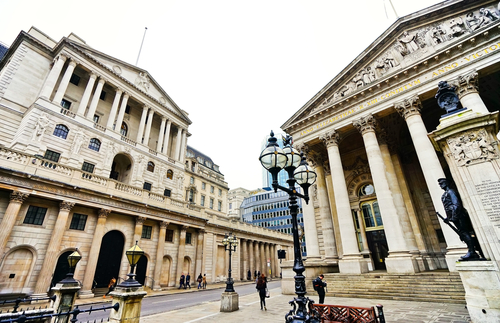
Bank of England Royal Exchange

The Bank of England has cut its base interest rate to 4%, even as it warns of rising inflation. “We’ve cut interest rates today, but it was a finely balanced decision. Interest rates are still on a downward path, but any future cuts will need to be made gradually and carefully,” Governor Andrew Bailey stated.

The nine-member panel of the Monetary Policy Committee voted to lower rates by 0.25 percentage points, but failed to reach a unanimous vote with four members wishing to pause and another voting for a cut. The committee initially began with a 0.5 percentage point vote before reducing it to 0.25, marking the first time the MPC has needed a second vote—no one knows what they are doing.

The bank lowered rates but admitted that headline inflation is expected to hit 4% in September, up from the initial 3.75% estimate. Households are already spending one-tenth of their income on food, yet the bank expects food inflation to spike to 5.5% this year.

The central bank attempted to blame grocery store employee wages for price increases. “Furthermore, overall labour costs of supermarkets are likely to have been disproportionately affected by the lower threshold at which employers start paying NICs… these material increases in labour costs are likely to have pushed up food prices.” Every nation is facing a sharp upturn in food prices and store employees are not the culprit. The bank also acknowledged that unemployment has risen for five consecutive months, with unemployment reaching a four-year high in May 2025 at 4.7%.

The central bank cannot fight inflation as consumer demand is not driving price increases. Russian sanctions, net zero insanity, regulation, taxes, and an overall decline in public confidence have led Britain to decline. Let us not forget the looming sovereign debt crisis that every central bank is attempting to ignore publicly. Starmer is steering the nation directly into war, which never benefits the people and will become the primary culprit of inflation in time. The central bank cannot control fiscal policy; it cannot control inflation—all it can do is pretend to have a grasp on the situation to quell panic.

New Report On Biden-FBI Catholic Spy Ring, Liz Yore Reacts


Posted originally on Rumble By Bannon’s War Room on: August 6, 2025

SHOCKING: GOP Virginia Lawmaker Set Ablaze with GASOLINE – Suspect Captured! | Elijah Schaffer


Published originally on Rumble By The Gateway Pundit on August 1, 2025

ICE Takes Down Hundreds Of Illegal Alien Child Predators | Drew Hernandez


Published originally on Rumble By The Gateway Pundit on July 31 2025

Woke Cincinnati Police Chief Sued For Discriminating Against White Officers | Drew Hernandez


Published originally on Rumble By The Gateway Pundit on July 30 2025

Brazil Protest LIVE: Demonstration in Support of Former Brazilian President Bolsonaro


Posted originally on Rumble By Bannon’s War Room on: August 3, 2025

“Bolsonaro Is On Trial For His Life.” Ana Paula Henkel On Political Persecution In Brazil


Posted originally on Rumble By Bannon’s War Room on: August 1, 2025

Matthews: “What Is All Common In These Mass Killings Is Withholding Of Mental Health Records.”


Posted originally on Rumble By Bannon’s War Room on: July 29, 2025

Canadian Officials Continue Wondering Why Trump Administration Projects Ambivalence Toward U.S-Canada Trade Deal


Posted originally on CTH on July 29, 2025 | Sundance

The reality of the U.S-Canada economic relationship and the position of President Donald Trump is not that difficult to understand if you take all the disparate datapoints and quotes from Trump and put them into context.

During a White House meeting with Mark Carney, President Trump essentially told the Canadian Prime Minister why he was in no hurry to get to a deal with Canada.

The 35% tariffs on non-USMCA goods are going to trigger on August 1st, because the main priority of Trump -looking toward Canada- is to dissolve the USMCA.

During the May 6th oval office meeting with Carney, President Trump was discussing the USMCA and said:  “As you know it terminates fairly shortly. It gets renegotiated fairly shortly.” … “This was a transitional deal, and we’ll see what happens, we’re going to start renegotiating that” … “I don’t know if it serves a purpose anymore.”  …. “And the biggest purpose it served was, we got rid of NAFTA.”

To understand why President Trump wants to dissolve the USMCA {SEE HERE}.  To understand the technical value of dissolving the USMCA {SEE HERE}.  It’s not a complicated economic analysis; it’s common sense.

Currently, approximately 60% of the traded goods and services between the U.S. and Canada are covered by the USMCA; the remaining 40% will be hit by tariffs on August 1st at a 35% rate.

When the USMCA is renegotiated, predictably dissolved in favor of two bilateral trade agreements – one for Mexico and one for Canada, all of the U.S-Canada trade sectors will be part of the enlarged free trade negotiation.  As a result, there is absolutely no motive to engage in trade discussions now.

♦ President Trump’s position is essentially to talk about the details when the USMCA is dissolved; hence, the ambivalence.

Politico is noting the Canadian trade team simply doesn’t understand this. “[D]espite months of back and forth, the terms for a deal have not yet been set, a senior government source said, with the White House informing the Canadian side that Trump is more focused on securing deals with other partners like India.

(Politico cont..) […] Earlier this month, Canada conceded that any deal with Trump is likely to include tariffs.

Carney’s government wants stability around the tariffs Trump invoked using Section 232 of the Trade Expansion Act.

They are crushing Canada’s auto, steel, aluminum and forestry industries. Trump also plans to hit imported copper with 50 percent tariffs starting Aug. 1 — with semiconductor and pharmaceutical imports likely to follow.

Canada ultimately wants the tariffs eliminated or lowered to a fixed level that doesn’t fluctuate, the senior government official said. “If we know what world we’re going into, then we can have better plans and policies to attract investment.”

Canada’s premiers say the unpredictability is punishing the economy.

“Private investment is not growing because everybody’s on pause,” Quebec Premier François Legault told reporters last week. “They are waiting to see what will happen. I’ve been in business — it’s about the worst thing you can have is uncertainty.” (read more)

The certainty the Canadians are looking for can be found easily if they stop pretending.

(1) U.S. tariffs against non-USMCA products from Canada will go into effect on August 1st.  (2) As soon as the USMCA is reopened, it will be dissolved.  (3) After the USMCA dissolution, a bilateral free trade agreement between the USA and Canada will be negotiated.

Every current effort by Canada to change the nature of the trade system, between now and the reopening of the USMCA (to dissolve it), is futile.

Again, I’m not exactly sure why this reality is so challenging for the Canadian govt to understand.

“So, you’re saying there’s a chance.”

Episode 4663: Trump Meets With EU Leaders; Bringing Giuliani Era Law And Order To England


Posted originally on Rumble By Bannon’s War Room on: July 28, 2025