The Saudi people and the Kingdom of Saudi Arabia are very proud of what they were able to accomplish during this historic visit by President Donald Trump to the summit of a united Arab coalition. (Summit Production Video):
.
The entire region should be proud.
Despite the popular western dismissive media narrative, the summit was a resounding success. Beyond the royal pageantry, we can only imagine the internal anxiety if our beloved America was defined by the abhorrent behavior of the Westboro Baptist Church.
Consider:
Imprimipostest – This is an incredible American initiative, very pragmatic in its overall tone, yet filled with tremendous theoretical implications for future relations with Near-Eastern Islamic cultures.
Even the iconic symbolism of President Trump, Melania, Ivanka, and those accompanying the President (from the single Marine in dress uniform standing vigilantly behind him when walking down the reception red carpet, to the extremely competent cabinet members accompanying him in the conferences) that has been televised throughout those regions will have dramatic repercussions for the good.
The long-term potential shift of mentality within the general population throughout those regions may now include an enhanced awareness the United States and the true principles upon which it is founded.
As well, such may have implications long-term on how the Qur’an may be interpreted as critical historical scholarship concerning its historical sources and meanings will likely become more thoroughly examined and assimilated. This may be but one of the fruits to emerge from the President’s proposal of establishing a ‘Globalist Center for Combating Extremist Ideology’.
This dramatic American action may well have laid the foundation and conditions for a new and fruitful future for Islam, Israel, and Christianity. (link)
There are sure to be detractors, antagonists, who would choose the dismissive route even amid our own country.
Within that reaction from David Axelrod we find the inherent liberal disconnect known as projection. Notice his use of the term “we”, who said “we”?
President Trump is challenging Islam to cleanse itself of evil, not us; “them“, their fight, their struggle – our support.
[…] The expressed policy outlook of President Trump is for the United States to be the best; and through our actions and behaviors to lead on global initiatives that show how we define ourselves and our values.
This approach is specifically centered around a policy position stating we do not need to demand acceptance of those values, and we respect independent nations’ that may hold values or beliefs not identical to our own.
Secretary of State Rex Tillerson has cultured this approach throughout each of his diplomatic engagements. The U.S. leans forward on all Trump policy objectives through the perspective of our national needs first; but that does not necessarily mean we demand or force other nations into a compliance mindset.
Compliance implies aversarialism. President Trump and Secretary Tillerson do not view international engagements as necessarily adversarial.
The U.S. can engage eye-to-eye with the same level of respect to the smallest as we exhibit toward the largest (our own size does not need to be part of the equation, it is self evident), and work policy objectives toward the point of mutual benefit. If the engaged nation does not receive benefit from the policy, we do not demand an acceptance of it; and more importantly we express both an understanding and a respect of their position and inability.
This Trumpian approach, a willingness not to undermine and to accept the partners downside position within any policy, is grounded on inherent truth.
President Trump and Secretary Tillerson openly accept and admit when the engaged partner will be unable to meet our defined terms; we discuss what actions can be take to remove the inherent obstacle in the future; we make a commitment (or not) toward removing that obstacle; we shake hands and we part company retaining the position of friendship and optimism for the potential of re-engagement at a later date.
[…] This dynamic is unique – because no member of the Trump Administration’s policy team is approaching any of the policies from a position of their own inherent politics. Team Trump, writ large, represents America’s best interests, not the political construct of America’s best interests. [Coincidentally this approach is why Trump has so much domestic opposition]
This non-political approach and simultaneous respect exhibits honesty within the transaction. Yes, both Tillerson and Trump approach politics through the transactional prism, it’s what deal-makers do. (more)
♦”Sorry I don’t know the answer, but Trump does not understand Islam. Wait and see.”
SHARON – If, on the other hand, he does actually understand Islam and as the President of our Sovereign Nation wishes to speak truth to a great assembly of Islamic leaders while demanding their respect and expecting a yielding response, how would he speak differently?
There are people I do not trust as far as I can throw them (including some in my own extended family) but I do not thereby refuse to speak with them or count every occasion in their presence as an opportunity to go after their worst foibles.
Are you assuming that Trump does not understand Islam because he is present with them? Do you assume that he doesn’t understand Chinese Communism because he met with President Xi? Do you assume that he doesn’t understand Catholicism because he won’t (as a Presbyterian) go to the Vatican and preach John Calvin?
Are you projecting your perceptions of what he should do instead of what he did do and assuming that his choice – different than yours – reflects lack of understanding?
This actually is the man who has persisted in stopping/restricting Moslem immigration into the United States. Seems to me that reflects some basic understanding of Islam. (link)
We, the proud deplorables, we band of brothers and sisters, are entirely clear-eyed as to the scope of the challenge. No-one amid our association is naive to the seemingly impossible scale against the backdrop of history.
It may be that their task is impossible. Yet, if they do not try then how will we know it can’t be done? And if they do not try, it most certainly won’t be done…
The pageantry and scale of the royal reception toward President Trump and the U.S. is reflective of much more than a singular presidential visit to a nation and region of geo-strategic importance.
The word “reset” is frequent amid media reporting of the Saudi trip but few people have followed the recent regional history to thoroughly understand what exactly is being reset.
~ President Donald Trump and Saudi King Salman – Joint Statement.
President Trump is being recognized and respected by the regional Arab coalition for his specific approach and outward worldview which is based on eye-to-eye diplomacy.
Through the contacts, discussions, emissary meetings and individual diplomatic engagements over the past six months, the Arab region members of the Gulf Cooperation Council (GCC) -and specifically Saudi Arabia- are overjoyed to find a fresh U.S. perspective based on mutual respect.
The pageantry/scale of the royal reception is directly proportional to the scale of respect being shown by the regional partners toward the worlds largest and most influential leader.
Around the world no-one doubts who is the biggest most significant nation; the size of the U.S. economy speaks for itself. It does not need to be proven – it is self evident.
What is different with the Trump administration as they engage each nation is the change in nationalistic outlook, and specifically foreign policy therein, toward other national leaders as independent sovereign representatives – with respect to their individual cultures and norms.
No longer is the U.S. approaching nations from an inherent need to prove we are ‘better than’, or leverage our interests into their neighborhood.
The expressed policy outlook of President Trump is for the United States to be the best; and through our actions and behaviors to lead on global initiatives that show how we define ourselves and our values. This approach is specifically centered around a policy position stating we do not need to demand acceptance of those values, and we respect independent nations’ that may hold values or beliefs not identical to our own.
Secretary of State Rex Tillerson has cultured this approach throughout each of his diplomatic engagements. The U.S. leans forward on all Trump policy objectives through the perspective of our national needs first; but that does not necessarily mean we demand or force other nations into a compliance mindset.
Compliance implies aversarialism. President Trump and Secretary Tillerson do not view international engagements as necessarily adversarial.
The U.S. can engage eye-to-eye with the same level of respect to the smallest as we exhibit toward the largest (our own size does not need to be part of the equation, it is self evident), and work policy objectives toward the point of mutual benefit. If the engaged nation does not receive benefit from the policy, we do not demand an acceptance of it; and more importantly we express both an understanding and a respect of their position and inability.
This Trumpian approach, a willingness not to undermine and to accept the partners downside position within any policy, is grounded on inherent truth.
President Trump and Secretary Tillerson openly accept and admit when the engaged partner will be unable to meet our defined terms, we discuss what actions can be take to remove the inherent obstacle in the future, we make a commitment (or not) toward removing that obstacle, we shake hands, and we part company retaining the position of friendship and optimism for the potential of re-engagement at a later date.
In all recent previous administrations there was an implied message that engagement with the United States came with terms and conditions that might be antithetical to the sovereign nations’ best interests. If you want “X” (their need) you must deliver “Y” (our need), and the “Y” might be something which creates conflict or tension.
President Trump and Secretary Tillerson ask about the impact of “Y”, the possibility of the downside, prior to making a decision on fulfillment of the request (“X”), but the inquiry does not necessarily preclude our willingness to deliver.
This dynamic is unique to the engaged nation because no member of the Trump Administration’s policy team is approaching any of the policies from a position of their own inherent politics. Team Trump, writ large, represents America’s best interests, not the political construct of America’s best interests. [Coincidentally this approach is why Trump has so much domestic opposition]
This non-political approach and respect, exhibits honesty within the transaction. Yes, both Tillerson and Trump approach politics through the transactional prism, it’s what deal-makers do.
This non-political approach is what causes leaders like Egyptian President Abdel Fattah al-Sisi make the following remarks:
Abdel Fattah al-Sisi: “I first saw the campaign of his excellency President Trump, and I listened to his speech of the neccessity of facing and confronting terrorism all over the world; that he is a great personality and a unique individual, and that he will find great success.”
“I fully trust the capabilities of President Trump, and I have full conviction that he can do things, exert efforts, that very few people can do. And he can succeed in so many fields that others cannot. I trust him wholeheartedly.”
“I followed all his announcements through his campaign, he has a very unique personality and administration, and now I’m speaking with full confidence of unprecedented success for him. He is seeking the interests of the United States and the American people in a very clear manner, and a very direct manner. And a very strong manner as well.”
“His true will is a very strong will to counter terrorism and extremism in the world; and that is a very strong commitment from his excellency the president, and in addition I am very supportive with full force in facing this terrorism.”
“There is a true understanding to the realities in the region, and there is a seriousness and responsible actions in facing extremism and terrorism in the region, and that’s a wonderful thing indeed. There is nothing better than to counter evil.” (link)
Back in October 2015, we reported that “in response to the refugee crisis, the German city of Hamburg has enacted a new law that will enable the government to seize vacant commercial properties to provide temporary housing for refugees. The law will go into effect next and will last until March 2017. Despite the additional measures, many refugees will die of exposure during the cold German winter.”
Hamburg authorities confiscated six residential units in the Hamm district near the city center. The city is now renovating the properties and will rent them against the will of the owner to tenants chosen by the city. Worse yet, all renovation costs will be billed to the owner of the properties.
Hamburg is still at it and this raises serious questions about the right to property in Germany. The measure is obviously unconstitutional, but exactly why it has not been stopped raises even more concern. Those who seriously think the Euro will be fine since Macron won the French election remind me of the old joke about the optimist and the pessimist who are blown off the top of a 100 story building in New York City. The pessimist immediate begins to pray for forgiveness. The optimist as he is passing the fourth floor says: “Well, so far so good!
QUESTION: Marty; You said gold was still vulnerable in dollars but that the low was probably in place in Euros. I have been trying to reconcile that statement in my mind. The only way that happens is a real crisis in Europe and a strong dollar. Correct? It seems really naive that people get bullish on a few weeks of price movement and predict the next 10 years. The dollar first is week with Trump and bullish euro for Macron? Right?
Thank you for a lone voice in the wilderness of analysis.
OT
ANSWER: Yes. Just compare the two chart patterns. Notice that gold in euros bottomed back in December 2013 compared to December 2015 in dollars. The numbers will not come down unless gold makes a new low in dollars. Then the breakout will drop from the 1362 level. Just looking at gold in euros exposes the real trend.
The fools keep saying see the euro rallies and the dollar declines so I have to be wrong. The European Central Bank is the one at risk of collapsing. Draghi bought 40% of all Eurozone debt. He raises interest rates at his own balance sheet takes the hit. This fool is really in trouble and then you have Germany turning against the Draghi. Neither the Fed nor the Bank of Japan are in such a dangerous position.
The perpetual dollar bears cannot see the light. Just how is the world economy going to crack with a lower dollar? They look at the dollar as if it is a SHARE PRICE up is bullish and down is bearish for America. Currency is the opposite of share prices. The higher the currency, the greater the deflation and the lower the economic growth. They never heard of “competitive devaluations” or currency wars. Every crisis has come with a rising dollar. The solution was a dollar devaluation as Roosevelt did in 1934. They look at everything backwards and that’s why the lose a fortune consistently buying highs.
Here is the CAC40 of France. The high in the French stock market is 1999. Yet everyone is cheering as if the US is down and Europe is the new wonderland?
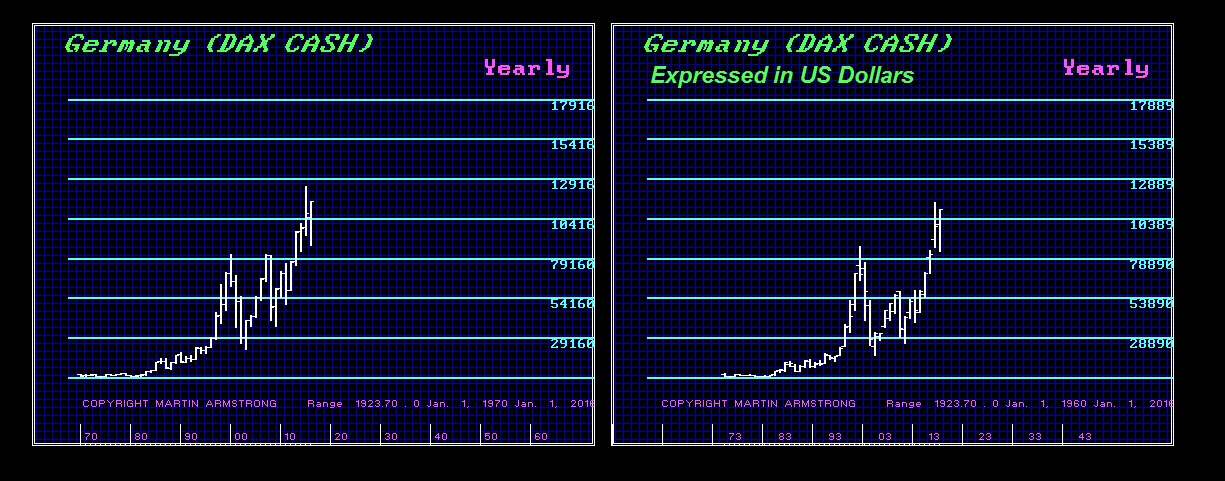
Compare the German stock market in euros and in dollars. It has finally made new international highs only in 2015. We have to look at everything from a global perspective. The new highs in the Dax in international terms is ONLY because of the decline in the euro. With the bounce in the euro, the Dax will rally in euros, but only to a point.
A spike up in the dollar can be achieved from political chaos, but also geopolitical. Only a rise in the dollar will break the system and end the dollar as the reserve currency. The debt crisis we face is building and with higher interest rates, then there will be the risk for major loses overseas and capital will contract once again. It was the US capital outflows that rebuilt the world. A lower dollar encourages overseas investment. A higher dollar causes a contraction.
Only a total idiot forecasts the long-term by one month worth of price action. We need these fools to make the trends. Somebody has to buy the high and sell the low. This entire political-geopolitical mess us starting to bubble up. Why are two Republicans, McCain and Graham, acting as Trump’s worst enemy trying to destroy the Republican Agenda? They are being paid by their lobbyists to protect the corrupt establishment. They are against their own Party and should just join Hillary on vacation. Oh that’s right. They have the same backers. Graham’s number one contributors are law firms really on behalf of their clients to hide the source of the money I believe.
It cannot be said enough: thank you for everything that you do.
While I would love the opportunity to sit down with you as I have a million questions concerning your excellent posts of today, let me focus in on The Coming Central Bank Crisis.
As the Fed begins to unwind its balance sheet this year, will that spur the Germans to demand Draghi stop with his program and unwind the ECB balance sheet in 2018, since the Fed will be successful? Also, how can that occur if we are in a recession? (Correct me if I’m wrong, but you are indeed calling for a recession by 2018?)
Thank You,
D
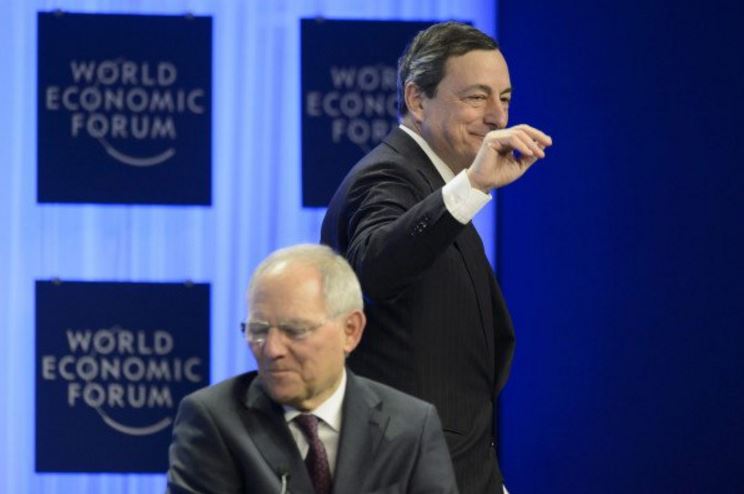
ANSWER:Wolfgang Schäuble has already been jawboning Draghi to reverse course. Draghi knows he has 40% of all Eurozone public debt. He has lost total control of the crisis and has become the crisis. He is frozen like a deer in headlights. Schäuble wants Draghi to leave, but he has a 10 year term. This will not end nicely. We may see the crisis be the reason the Euro turns back down after testing the overhead Reversals in the 113-114 zone.
We have been in a major economic declining trend ever since the 1950s. Yes there are bouts with booming economic periods, but the growth during such rallies is progressively making lower highs. Once upon a time, we had growth of 8-10%. Volcker raised interest rates to 14% to stop inflation. Today, we celebrate 2% growth. This is a worldwide consequence of socialism. Government have doubled in size since 1950 and people wonder why Trump, BREXIT or even Le Pen won nearly 35% of the vote compare to 5% 20 years ago in France.
So are we in a recession? Economists would say no unless there are two-consecutive quarterly declines in GDP growth. As a trade, you have to say we are on a very long protracted Bear Market in economic growth and the future, for us and our children, rests solely in the hands of this “populist” movement to replace socialism.
Earlier today the U.S. State Department held a special briefing to outline concerning discoveries within Syria, including a new crematorium for use in the disposal of bodies.
[Transcript] MS NAUERT: It’s great to see you. Thanks, everyone, for assembling here so quickly today. Welcome to the State Department. We asked you here to provide you with some new information on the six-year crisis in Syria. I’m joined today by Acting Assistant Secretary for the Bureau of Near Eastern Affairs Stuart Jones. Stuart recently returned from the talks in Astana. He’ll give us an update and also provide you with some newly declassified information on Syria today.
Last week, Secretary Tillerson met with Russian Foreign Minister Sergey Lavrov for more than an hour here in Washington. You’ve read the readout from that meeting, but I’d like to provide you with some additional context and details coming out of that meeting today.
Secretary Tillerson was firm and clear with Minister Lavrov: Russia holds tremendous influence over Bashar al-Assad. A key point that took place in that bilateral meeting was telling Russia to use its power to rein in the regime. Simply put, the killing and devastation has gone on for far too long in Syria.
Minister Lavrov was clear as well that he shares the same goals as the United States does in Syria: a unified and stable nation. Both men agreed that the way to bring stability to Syria must come through diplomatic and political means.
We call upon Russia to use its influence with the Assad regime to get it to adhere to a lasting negotiated ceasefire. That ceasefire, we believe, will reduce violence and also ensure unhindered humanitarian access and stop the indiscriminate killings of civilians. These actions will help create the conditions on the ground for a political resolution of that conflict.
And with that, I’ll turn it over to Acting Assistant Secretary Stuart Jones. He will take your questions at the end. Thank you.
Sir.
MR JONES: Thank you, Heather. Good morning. Thank you for being here this morning. Since Syria’s civil conflict began in 2011, the Assad regime has treated opposition forces and unarmed civilians as one and the same, committing widespread violations of international law, including the Law of Armed Conflict and Human Rights law. Today, we are releasing newly declassified reporting and photos that underscore the depths to which the Syrian regime has gone with the continuing support of its allies Russia and Iran.
The facts we’re presenting today are based on reporting from international and local nongovernmental organizations, press reporting, and also Intelligence Community assessments. The continued brutality of the Assad regime, including its use of chemical weapons, presents a clear threat to regional stability and security as well as to the national security interests of the United States and our allies.
According to the United Nations and credible human rights organizations, the Syrian civil war has claimed more than 400,000 lives, many of which were civilians. The Assad regime’s actions include well-documented airstrikes and artillery strikes; chemical weapons attacks; arbitrary arrests; extrajudicial killings; starvation; sexual violence; and denial of essential services such as food, water, and medical care to the civilian population.
Since 2012, the regime has routinely conducted airstrikes and artillery strikes in dense urban centers, including with barrel bombs, improvised unguided bombs, which are sometimes described as air-dropped IEDs. The Assad regime systemically targeted eastern Aleppo’s hospitals in multiple strikes, killing patients and medical professionals. (Coughs.) Excuse me.
In addition to airstrikes, the regime continues to systematically abduct and torture civilian detainees, often beating, electrocuting, and raping these victims. A former regime photo-documentarian working under the name Caesar has shared more than 10,000 photos of Assad’s victims with the international community. According to numerous NGOs, the regime has abducted and detained between 65,000 and 117,000 people between 2011 and 2015[1].
Moreover, the regime has also authorized the extrajudicial killings of thousands of detainees using mass hangings at the Saydnaya military prison. Saydnaya is a 45-minute drive outside of Damascus and is one of Syria’s largest and most secure prison complexes. Saydnaya is but one of many detention facilities where prisoners are being held and abused. Others include the Mezzeh airport detention facility and Military Security Branches 215, 227, 235, 248, and 291, which are all located throughout Syria.
The regime holds as many as 70 prisoners in Saydnaya in cells that have a five-person capacity. And according to multiple sources, the regime is responsible for killing as many as 50 detainees per day at Saydnaya. Credible sources have believed that many of the bodies have been disposed in mass graves. We now believe that the Syrian regime has installed a crematorium in the Saydnaya prison complex which could dispose of detainees’ remains with little evidence.
Beginning in 2013, the Syrian regime modified a building within the Saydnaya complex to support what we believe is a crematorium, as shown in the photos that we have distributed to you. Although the regime’s many atrocities are well documented, we believe that the building of a crematorium is an effort to cover up the extent of mass murders taking place in Saydnaya prison.
The United States is on record, has stated many times, that we are appalled by the atrocities that have been carried out by the Syrian regime. And these atrocities have been carried out seemingly with the unconditional support from Russia and Iran. Two weeks ago, as Heather said, I attended the Astana conference in Kazakhstan as the U.S. observer. At that meeting – led by Turkey, Russia, and Iran, the guarantors of the Astana process – it was agreed to create de-escalation zones that would reduce violence and save lives.
In light of the failures of the past ceasefire agreements, we have reason to be skeptical. The regime must stop all attacks on civilians and opposition forces, and Russia must bear responsibility to ensure regime compliance. Russia joined the unanimous UN Security Council Resolution 2254, which demands that all parties immediately cease any tacks – any attacks against civilians. Russia has either aided in or passively looked away as the regime has conducted an airstrike against a UN convoy, destroyed east Aleppo, and used chemical weapons, including sarin, against civilians in Idlib province on April 4th.
During his visit here last week, Foreign Minister Lavrov acknowledged that there is no military solution to the Syrian conflict. Russia must now with great urgency exercise its influence over the Syrian regime to guarantee that horrific violations stop now.
So with that, I’ll take your questions. Thank you very much.
MS NAUERT: And I’ll help facilitate that.
QUESTION: Thank you. Two things. One, are you suggesting that Russia and/or Iran have anything to do with this crematorium?
MR JONES: No.
QUESTION: No, okay. And then secondly, do you have any idea how many – you said thousands, mass hangings – how many of the bodies are being disposed of in mass graves or – and how many are being burned?
MR JONES: No. So you’re familiar with the Amnesty International report which projected that as many – between 5- and 11,000 people had been killed in Saydnaya between 2011 and 2015[2].
QUESTION: Right.
MR JONES: So that gives you some idea of what the —
QUESTION: Right.
MR JONES: And then there’s other – other data which suggests as many as 50 murders a day coming out of the complex.
QUESTION: That’s a lot. I mean, that’s a lot. Do you – are all of those – do you think all of the 50 a day are being burned or are —
MR JONES: So I don’t know. But so – but our – what we’re project – what we’re assessing is that if you have that level of production of mass murder, then using the crematorium would help – would allow the regime to manage that number of corpses coming out of the prison complex.
MS NAUERT: Margaret.
MR JONES: And without evidence.
QUESTION: Thank you very much for doing this. Two questions for you. One, do you have any status update on the Americans, Austin Tice or others, who may be held or believed to be held by the regime? And if there’s any connection here, please tell me. And secondly, you talked about the conversations with Lavrov – again the case made that Russia is aiding and abetting here. Did the Secretary walk away with any kind of agreement from his meeting or any kind of achievement to have them say they’re willing to step back? They’ve been telling multiple secretaries of state for some time they’re not wedded to the Assad regime.
MR JONES: So on the issue of the U.S. hostages, no, we don’t see a connection between U.S. hostages and what we’re talking about what’s going on here at Saydnaya prison.
On the issue of the conversation between the Secretary and Foreign Minister Lavrov, there was productive conversations between the Secretary and the foreign minister. They talked about a way forward on Syria. And the president – and sorry, the Secretary acknowledged that the state of the relationship between Russia and the United States is at a low point. Syria is one of the factors where we would like to see the relations improve, but I would not say that they mapped out a specific way forward on how to address the issue of Syrian atrocities or even how to move forward on the Geneva process. Though of course we’re participating in the Geneva process, we support the Geneva process, we believe that in addition to achieving a ceasefire in Syria and cessation of hostilities that the political process needs to follow.
QUESTION: What made it productive, then?
MR JONES: I think —
MS NAUERT: (Inaudible) Nicole.
QUESTION: Hi, thank you for doing this. Have you presented Russia with this visual evidence? Have you asked them to take any actions and/or gotten any response from them?
MR JONES: So we have a – we have not presented this particular – I have not presented this particular evidence to the Russians, but we have an ongoing conversation with the Russians talking about the problem that their failure to condemn Syrian atrocities and their apparent tolerance of Syrian atrocities has created, and we have urged the regime – we have urged the Russian Government to hold the regime responsible for these atrocities.
QUESTION: Sir? Yeah, sir? (Inaudible.)
MS NAUERT: Rich Edson.
QUESTION: Doesn’t this or does this make the case, or is there a consideration of military action to destroy crematorium, some of this apparatus here?
MR JONES: As the President said, we’re not going to signal what we are going to do and what we’re not going to do. At this point we are talking about this evidence and bringing it forward to the international community, which we hope will put pressure on the regime to change its behavior.
QUESTION: Can I just – one very – extremely briefly? What makes you so sure that this is a crematorium and not just some other building? Is it this thing with the snowmelt? Because, I mean, people are going to look at this – the regime in particular or – and the Russians, who you’re – are going to look at this and say: Well, all this proves is that there is a building there and that that part where there’s – snow is melted is simply warmer than the rest of the building. It looks —
MR JONES: So if you look – so obviously, these photos date over several years from 2013 to 2017. If you look at the earliest photo, the August 13 photo, this is during the construction phase, and these HVAC facilities, the discharge stack, the probable firewall, the probable air intake, this is in the construction phase. This would be consistent if they were building a crematorium.
Then we look at the January 15 and we’re looking at snowmelt on the roof that would be consistent with a crematorium. So —
QUESTION: Or just a warmer part of a building, right?
MR JONES: Possibly.
QUESTION: Sir —
MS NAUERT: Dave Clark.
QUESTION: — could I ask you on —
MS NAUERT: Final question.
QUESTION: If Russia refuses to do anything about this, what’s next?
MR JONES: Well, the Russians – Russian Foreign Minister Lavrov and the Russian Government have indicated to us that they are interested in finding a solution on Syria, and there is no solution on Syria without a political process and certainly an end to these atrocities. So we hope that the – we will now be able to work with the Russians in a constructive way to put pressure on the regime to end these atrocities, that the Russian Government will take responsibility for their partner, the Syrian regime, to end these atrocities and —
QUESTION: Can I just follow up briefly on that there? You said this evidence dates back – well, you had been built up over four years, 2013, 2017. Did this intelligence just become concrete recently and is that why you’re releasing it today? Or are you releasing it today with the hope of a political effect?
MR JONES: I would say that this information has been developing, and with the meeting last week between the Foreign Minister Lavrov and the Secretary, this was an opportune time to remind people about the atrocities that are being carried out inside of Syria all the time, of which this is one discrete additive piece of evidence.
QUESTION: Sir, on ending —
MS NAUERT: Thank you, everyone.
QUESTION: — on ending the attacks against the opposition, does that include ISIS and al-Nusrah?
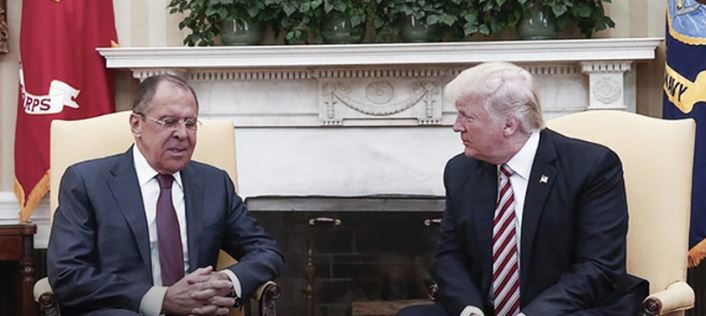
Members of President Trump’s administration denied details of a Monday Washington Post report that during a meeting with the Russian foreign minister and ambassador to the United States, Trump shared confidential information pertaining to an Islamic State (ISIS) threat.
The Washington Post wrote:
“President Trump revealed highly classified information to the Russian foreign minister and ambassador in a White House meeting last week, according to current and former U.S. officials, who said Trump’s disclosures jeopardized a critical source of intelligence on the Islamic State.”
Democrats on Capitol Hill jumped all over this. Trump has got to understand he has a hard of enemies within the Deep States and the Democrats will use every possible issue to stop any economic reforms or tax cuts. The
Democrats and the press continue in this move to demonize Russia and to prevent any coordinated effort against the common enemy ISIS. It is far more important to prevent any economic reform than to create world peace. This constant controversy after controversy is giving a life to the Euro and putting at risk an economic downturn.
Macron’s funding reveals that elite Socialists were really behind him changing the label to sell a centrist agenda, but in reality, to maintain their agenda. Macron was able to raise funds from French abroad with the promises of change, and this targeted particularly the French who fled Hollande living in London and New York. He did a photo-op with Nobel Prize laureate Joseph E. Stiglitz before journalists who is critical of the management of globalization, against laissez-faire economists who he classifies a “free market fundamentalists”, as well as international institutions such as the International Monetary Fund (IMF) and the World Bank.
Stiglitz is an American economist and a professor at Columbia University and is a former senior vice president and chief economist of the World Bank. He was also a former member and chairman of the Council of Economic Advisers under Bill Clinton and supported Hillary over Obama saying she is more “liberal” (socialist) than Obama. Stiglitz believes in Georgism, which is a variety of Marxism whereby the State should own all the resources derived from land, which is an old Physicocrat (French) idea that wealth is derived from land. In this way, all natural resources should belong to government from mining to energy just for starters as if government operated industries ever ran efficient or were free from corruption. He also supported a single tax for all and believes that, while people should own the value what they produce themselves with everything derived from land should belong to government characterized as belonging equally to all members of society (government).
Joseph Stiglitz criticized Obama publicly saying that the Trans-Pacific Partnership (TTP) trade deal should not be about “who makes the trade rules—China or the United States?’” Stiglitz said “I think the big issue is, this is about who makes the rules of trade—the American people, our democratic process, or the corporations? And who they’re made for, which is, for the corporations or for all of us?”
Stiglitz is a core Marxist, which is why he is liked in France where Communism began and convinced Marx this was the way to go. In 2015, Stiglitz wrote two books, The Great Divide and Rewriting the Rules of the American Economy, which are based upon select years for research to support his idea rather than all history.Each book highlights a series of problems he maintains have led to the current state of economic inequality with the gap between the rich and the poor. Stiglitz merely maintains that taking from the rich in greater proportion is necessary to even the playing field and this somehow will make everything better ignoring the fact that as government grows, it consumes the wealth of a nation rather than raises the standard of living. He thus blames everything on a faulty tax code that rewards the rich and hampers the poor, an increase in behavior that boosts the economic gains of only a few while extracting more capital from the majority, and a misplaced focus on altering the economy in a way that benefits shareholders, executives, and investors, but not the average worker.
Macron publicly wanted to be photographed with Stiglitz who is a popular socialist in France. In total, he collected around €15 million, all from private individuals.1.7% of the donors gave 45% of the funds.He collected €1.9 million when he was still an economic minister illustrating that he saw the collapse in popularity of Hollande, and decides to repackage the same old agenda pretending it was now centrist.
Even Stiglitz believes the Euro is a failure and should be split into a “flexible” euro creating separate groups within Europe, which by default would also be the end of the European Central Ban
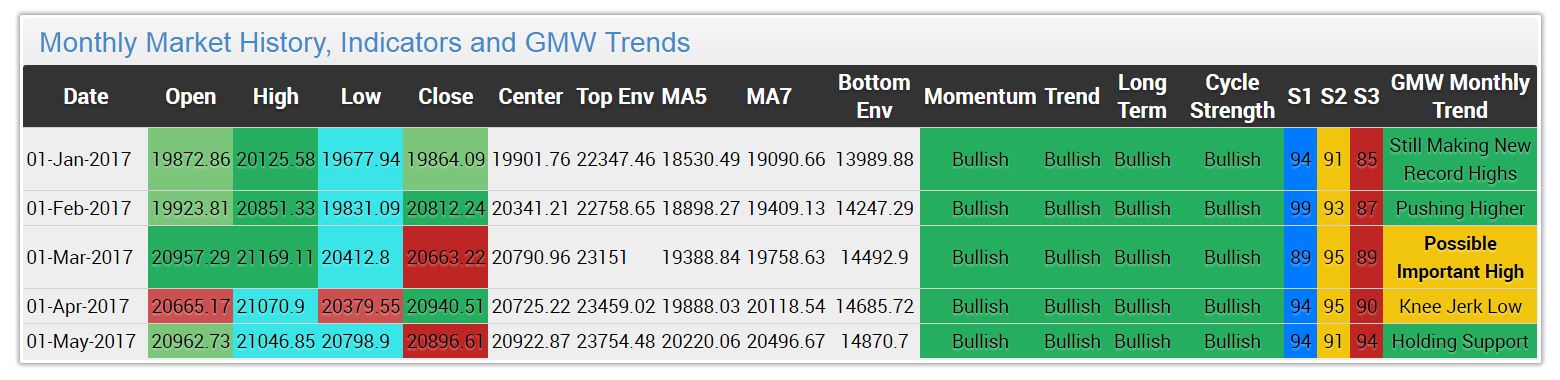
COMMENT: Mr. Armstrong, I have been on Socrates for about one year now on what you now call your standard edition. I have to say, you have done an amazing job of programming. To have a computer simply provide a comment that is short and to the point that you can look at the whole whole at your finer tips, is the most fantastic tool I have ever encountered. Its calls just on the Dow Jones have saved me countless multiples of the cost of service and I am a small investor. This is what you are expanding to over 5,000 instruments worldwide?
REPLY: Yes. The Global Market Watch was originally designed for hedge fund use and was inspired by one of our major institutional clients back in 1995. They did not have the time to read a written report on everything in their portfolio. They wanted a quick cheat-sheet that was visually a view of their portfolio. We use to sell this for $250,000 annually. However, since we are looking to simply open up Socrates to the world in hopes that it will ultimately help politically manage the economy rather than constantly shooting from the hip, the best way to prove the world is interconnected is to let everyone see for themselves.
Analysis is also changing. You still have the huxtsers who make up flashy headlines to sell stuff that is just opinion. Those days are fading. Under new EU Rules, investment banks charged fees for doing business and they gave you the research free if you did business with them. Indeed, that is how I started. The research was free as long as you were a client back in the days when I was a market-maker. When I retired, the clients still wanted the research. That was the beginning of our firm. Bit reports were delivered by telex so the communication costs would often reach $250,000 annually. That is why we were institutional only. Then came fax. The cost to deliver dropped from $50 to $3. Now we have the internet and the cost to deliver is basically zero.
We have institutions buying access per 100 for employees. For you see, research is changing. Under the new rules, research must be paid for separately. The London FT reported:
“Under draft rules published by the commission, the EU’s executive arm, last month, the fund industry’s decades-long practice of lumping together the fees they pay investment banks and brokers for research and trading will come to an end. Instead, for the first time, asset managers in Europe will have to make it clear to investors exactly what they are paying for.”
We have more people and institutions signing up than anyone would imagine. One bank just took 250 subscriptions for employees. Research has to be separate and accountable. It cannot be lumped in any more. Major institutions do not read the huxtsers who offer just opinion and all sorts of claims for they do not cover markets every day of a major scale. They also do not tell the press what they are doing until AFTER the fact. This is the only product like this in the world.
The Global Market Watch was designed as a wind into the inter-connectivity of the world. It does not matter if you are investing in India or Singapore and Greece. Being able to cover the world in a consistent manner that is completely computer driven so there is no human interaction and opinion is the key to the future. All other analysis will eventually die out and become obsolete. We live in a global economy and this domestic restricted view is primitive to say the least no much different from those who refused the believe that the Earth was not the center of the universe or the the Earth was no fla
QUESTION: Martin; it seems the Emerging Markets are back in favor just as interest rates are on the rise and their dollar borrowings have exploded. Is this the final bubble that is unfolding? When the WSJ writes about a trend it is usually the end. They are noting that significant flows of funds are now going out of the US and into Europe. Is this time to sell the emerging markets and Europe? Picking up the rug here in Berlin, nothing seems to have really changed. Any comment?
ANSWER: Yes, the move back to Europe after the French election seems to be the relief rally that is always the case for hot money. The Emerging Market debt bubble is what I wrote about a few days ago that the rush to emerging markets has seen an explosion in new debt offerings. This is very alarming. People act like you should short the US stock market and buy Emerging Markets. You really have to wonder if they understand the global economy at all. The willingness of investors to buy debt securities is rooted in these bearish forecasts for U.S. equities. But the bulk of this is really desperate pensions funds who are in search of higher yields. This is by no means the start of some new Emerging Market boom of prosperity. It reminds me of Andrew Melon’s comment when the stock market began to decline in 1929 before the bond meltdown in emerging markets back then: “Gentlemen buy bonds!”
The fool will jump in with both feet as always. You need people to buy the highs. The US equities have been in a sideways consolidation since February and their greatest vulnerability is Trump’s stupid firing of Comey that the Democrats are calling a Constitutional Crisis. Trump should have been wiser than this. The danger is this distraction holds off any tax reform for that has been the underpinning to the US equities.
A friend of mine was Chief of Staff in the White House years ago. We went to dinner after he won the position. He was so optimistic that he would be able to accomplish a lot. He knew my view he would never get to anything by the end of the day. After he left the White House we went to dinner. I said nothing. He burst out and said alright you SOB, I never got to a single thing I wanted to change. That is Washington for you. Trump’s greatest flaw is he fails to understand that. Stupid moves like firing Comey are costly. They will eat up time and delay everything if not block tax reform. Congress loves to investigate every leaf that falls to the ground and assign blame even in the middle of a wind storm. That’s just the way it goes in that city. Trump handed them a controversy on a gold platter.
As far as money rushing back to Europe, yes, there was the parking of money here for fear of the French election. But this is nothing more than a short-term knee-jerk reaction. European growth has nothing to offer long-term but higher taxes.
The US share market has been unable to make a significant correction and the numbers remains the same. The surge into emerging markets has been taking place over the past year and this has been the desperate search for higher yields. This is a bubble that is very dangerous and smells like the Russian one back in 1998.
The only way to bring about real economic change remains a rising dollar – not a lower one. That will kill the emerging markets. The US share market remains flat-to-lower and only a breakout to new highs will signal the next leg up. The main area to watch is the 20000 level in the Dow on a weekly closing basis.
Not a single European bank parking money at the Fed through their US branches have reversed that trade. Not a single major player among our clients has been a buyer of Emerging Market debt in this bubble. So the flows written about by the WSJ are indeed the tail-end and not some major brand new trend emerging
I have created this site to help people have fun in the kitchen. I write about enjoying life both in and out of my kitchen. Life is short! Make the most of it and enjoy!
This is a library of News Events not reported by the Main Stream Media documenting & connecting the dots on How the Obama Marxist Liberal agenda is destroying America