After Warning US With “Retaliation” Iran Plans Russian Fighter Jet Purchase, Naval Bases In Syria, Yemen


Tyler Durden's picture

As tensions once again grow between Iran and the US, with both countries unsure if Donald Trump will extend Barack Obama’s landmark “nuclear deal” which in January 2016 lifted Iran’s sanctions (imposed previously by the same Obama regime) and allowed Iran to export three times as much crude oil as the country did one year ago, Iran has fallen back to the same diplomacy that marked the darker periods of diplomacy between Tehran and Washington.

As a result, earlier this week Iran explicitly warned the Trump administration, that extending U.S. sanctions on Iran for 10 years would breach the Iranian nuclear agreement, with Iran’s Supreme Leader Ayatollah Khamenei warning that Tehran would retaliate if the sanctions are approved. The U.S. House of Representatives re-authorized last week the Iran Sanctions Act, or ISA, for 10 years. The law was first adopted in 1996 to punish investments in Iran’s energy industry and deter Iran’s pursuit of nuclear weapons. The Iran measure will expire at the end of 2016 if it is not renewed. The House bill must still be passed by the Senate and signed by President Barack Obama to become law.

Iran and world powers concluded the nuclear agreement, also known as JCPOA, last year. It imposed curbs on Iran’s nuclear program in return for easing sanctions that have badly hurt its economy. “The current U.S. government has breached the nuclear deal in many occasions,” Khamenei said, addressing a gathering of members of the Revolutionary Guards, according to his website. “The latest is extension of sanctions for 10 years, that if it happens, would surely be against JCPOA, and the Islamic Republic would definitely react to it.”

As a reminder courtesy of Reuters, the U.S. lawmakers passed the bill one week after Republican Donald Trump was elected U.S. president. Republicans in Congress unanimously opposed the agreement, along with about two dozen Democrats, and Trump has also criticized it.

 So what can Iran do to retaliate against the US? The simplest thing is what many of the other nations in the region have already done: continue their ongoing political, economic and military pivot toward Russia. And sure enough, according to Reuters, earlier today Iran’s Defense Minister said that the country plans to purchase Russian Sukhoi Su-30 fighter planes to modernise its air force. More troubling to the US, the Iranian minister also threatened that Tehran might again allow Russia to use an Iranian air base for its operations in Syria.


Iranian Defence Minister Hossein Dehghan delivers a speech as
he attends the 5th Moscow Conference on International Security

“The purchase of this fighter is on the agenda of the Defence Ministry,” Defence Minister Hossein Dehghan told reporters, according to the Tasneem news agency, without saying how many planes Iran is negotiating to buy. “However, any purchase of the military planes from Russia should include receiving technology and joint investment, he underlined, saying Russia accepted it in the negotiations,” Tasneem reported. The gambit is clear: should the US revert to a regime of sanctions with Iran, Tehran will immediate pledge allegiance to Putin, extending a new “axis” in the middle east that begins in Moscow and stretches to Syria, and in recent weeks, Turkey, Egypt and now Iran.

There was more.

As the semi-official Tasnim news agency also reported on Saturday, Iran’s chief of staff of the armed forces said that Tehran may be interested in setting up naval bases in both Syria and Yemen. The report by Tasnim, close to military, quoted Gen. Mohammad Hossein Bagheri as saying, “Maybe, at some point we will need bases on the shores of Yemen and Syria.”

He said “Having naval bases in remote distances is not less than nuclear power. It is ten times more important and creates deterrence.”

Gen. Bagheri added that setting up naval platforms off the shores of those countries requires “infrastructures there first.” He said Iran is also able to set up permanent platforms for military purposes in the Persian Gulf and roving ones in other places.

As cited by AP, Bagheri did not elaborate but said “When two thirds of the world’s population lives near shores and the world economy depends on the sea, we have to take measures. Though there is a need for the time for these (steps).”

Unlike the previous “threat” that Iran may purchase Russian military equipment. this is the first time that an Iranian military official has spoken of setting up naval bases in another country in the region.

No Middle Eastern country is known to have a formal naval base in another Mideast country, perhaps because alliances in the region tend to be painfully fickle and countries that until recently were allies quickly become foes.  More from AP:

 Iran regularly sends its warships to the Gulf of Aden to fight piracy. It also conducts occasional naval maneuvers in the Persian Gulf and the Sea of Oman. Iran’s warships regularly visit seaports of friendly countries, including a recent visit to the South African port of Durban.

Iran’s Supreme Leader have repeatedly supported increasing the power of the country’s navy, last year describing the sea as the scene of “powerful confrontation with enemies”. saying the future of power is based on powerful presence in the seas. The country has dozens of warships and light and Kilo-class submarines. It has hundreds of speed boats too, four of which harassed a U.S. warship earlier this year.

Iran is currently helping the Shiite Houthi rebels in Yemen and the Syrian government in their fights against the extremist Islamic State group.

The good news for Obama is that the outgoing president is no longer relevant: it will be Trump’s task to difuse the situation, which is somewhat paradoxical. On the one hand, the President-elect is hoping to restore relations with the Kremlin; on the other he is planning to burn the biggest bridge with Iran, one which will unelash a new era of Russian-Iranian cooperation, and an aggressive Iranian military expansion in the region, one which may bring Israel back out of geopolitical hibernation. Ultimately it will be up to Trump’s Secretary of State – whether Romney or Giuliani – to figure out a solution to this dilemma without risking further national interest losses in either Eastern Europe or the Middle East.

Trump Slams “Brutal Dictator” Castro’s “Legacy Of Firing Squads, Theft, Suffering And Poverty”


Tyler Durden's picture
fidel-castro-dead-3

Having been unable to find a compromise on any topic affecting the living, outgoing president Obama and president-elect Donald Trump found a way to disagree even on the topic of death: that of Fidel Castro.

Earlier this morning, President Obama issued a typically soothing, celebratory statement in which he extended a hand of friendship to the Cuban people and offered condolences to Castro’s family, adding that “history will record and judge the enormous impact of this singular figure on the people and world around him.”

Trump, on the other hand, had far less patience with history and delivered his visceral judgment right now, slamming “the passing of a brutal dictator who oppressed his own people for nearly six decades. Fidel Castro’s legacy is one of firing squads, theft, unimaginable suffering, poverty and the denial of fundamental human rights.”

From Obama:

At this time of Fidel Castro’s passing, we extend a hand of friendship to the Cuban people. We know that this moment fills Cubans – in Cuba and in the United States – with powerful emotions, recalling the countless ways in which Fidel Castro altered the course of individual lives, families, and of the Cuban nation. History will record and judge the enormous impact of this singular figure on the people and world around him.


‎For nearly six decades, the relationship between the United States and Cuba was marked by discord and profound political disagreements. During my presidency, we have worked hard to put the past behind us, pursuing a future in which the relationship between our two countries is defined not by our differences but by the many things that we share as neighbors and friends – bonds of family, culture, commerce, and common humanity. This engagement includes the contributions of Cuban Americans, who have done so much for our country and who care deeply about their loved ones in Cuba.


Today, we offer condolences to Fidel Castro’s family, and our thoughts and prayers are with the Cuban people. In the days ahead, they will recall the past and also look to the future. As they do, the Cuban people must know that they have a friend and partner in the United States of America.

And here is Trump’s statement on Castro’s passage:

Today, the world marks the passing of a brutal dictator who oppressed his own people for nearly six decades. Fidel Castro’s legacy is one of firing squads, theft, unimaginable suffering, poverty and the denial of fundamental human rights. 


While Cuba remains a totalitarian island, it is my hope that today marks a move away from the horrors endured for too long, and toward a future in which the wonderful Cuban people finally live in the freedom they so richly deserve. 


Though the tragedies, deaths and pain caused by Fidel Castro cannot be erased, our administration will do all it can to ensure the Cuban people can finally begin their journey toward prosperity and liberty. I join the many Cuban Americans who supported me so greatly in the presidential campaign, including the Brigade 2506 Veterans Association that endorsed me, with the hope of one day soon seeing a free Cuba.”

Fidel Castro Dead


The tear-filled eulogies from the violent U.S. leftists commence in 3… 2… 1… HAVANA (AP) — Former President Fidel Castro, who led a rebel army to improbable victory in Cuba, embra…

Source: Fidel Castro Dead

Syria — Arlin Report


I agree the Muslims are not our friends!

kommonsentsjane's avatarkommonsentsjane

Originally posted on HarsH ReaLiTy: We failed in Syria. The United States missed the window of opportunity we had to fully support the rebels there before Russia arrived and now it has become so confused we don’t know who is on what side. Or maybe we do know. Maybe our media wants us to think…

via Syria — Arlin Report

Reblogged on kommonsentsjane/blogkommonsents.

When Obama pulled the first troops out – that should have been a signal that that country would fail on its own  and it did.  It is time we stop getting involved in religious wars with a religion who is fighting itself – Islam.  Look how many of our young people have been killed – for what –  Islam?  How does that benefit America?

If Islam cannot work among their own different tribes – how do we decide which side is the right side to help.  Until they…

View original post 87 more words

Shipbuilding in Japan, Korea, China Collapses in Death Spiral of Orders


A collapse in shipping means there was a collapse in the movement of product and that means that sales have collapsed as well. So the bottom line is that since the governments have taken all the money there is no money to buy things!

Martin Armstrong Economics Political and Geo Chaos


The Next Great Depression Is Going To Be A Collapse Of Bonds And Governments Martin Armstrong


THAAD Is Coming to China’s Doorstep (But Beijing Has a Plan to Push Back)


China has always had the option of stopping the North, so they bring this on themselves

India Economy Falls into Chaos – Dollar Rise in Huge Demand


india-cash-protest

US dollars are soaring in premiums on the street. There is a serious risk that the government has shaken the confidence of the people to such a degree, that they trust the US dollar more than their own currency. Prime Minister Narendra Modi has come out an said the currency changeover could still take a few weeks and could lead to inconveniences, according to the magazine Brics. The Indian economy is a highly cash transacted economy far more so than the United States and Europe. The government has brought the economy to a virtually standstill. Food stores are close to closing because the customers have no money. Small and medium-sized enterprises have stopped functioning because the invoices are not paid for.

When Japan would routinely devalue the outstanding currency in the same manner each time a new emperor took the throne, the population responded by using rice and Chinese coins. The Indian economy is turning to the dollar. Physical dollars are commanding a premium because they can politically trust the dollar and not their own currency.

Indians are participating in protests against the the government simply cancelling the 500 and 1,000-rupee notes. This has unleashed real chaos in India and the experiment is proving to be a complete disaster, which is good news for the West. Literally, hundreds of thousands of Indians have stormed the ATMs trying to get cash, reports the Hindustan Times. They are trying to get their money out of banks. This has proven in many places to be just not possible as cash is in short supply.

French Elections 2017


french-revolution

Trying work out models on the French elections is by no means easy. The parties have changed and combined many times since 1973 alone. The National Front (FN) is a generally regarded as far-right because they are a Euroskeptic party since 1993 from its outset. Primarily, the FN is a socially conservative, nationalist political party in France whose major policies include economic protectionism, a zero tolerance approach to law and order issues, and opposition to immigration. The media portrays them as far-right since the party was founded in 1972 to unify a variety of French nationalist movements of the time. Jean-Marie Le Pen was the party’s first leader and the undisputed center of the party from its start until his resignation in 2011. Marine Le Pen, his daughter, was elected as the current leader. The party was at best a marginal force for its first ten years. However, ever since 1984 as the US dollar surged. FN has been the significant force of French nationalism.

french-presidential-elections-1974-to-2012
The 2002 presidential election was the first in France to include a National Front candidate in the run-off, after Jean-Marie Le Pen beat the Socialist candidate in the first round. In the run-off, he finished a distant second to Jacques Chirac. Due to the French electoral system, the party’s representation in public office has been limited, despite its significant share of the vote. Note that the Socialists were our of the final run in 2002. They made a two election come back, but that was just a reaction reaching 51.63% compared to their peak at 51.76% in 1981. This suggests they will be out of the final run and it may simply be conservatives v FN in 2017.

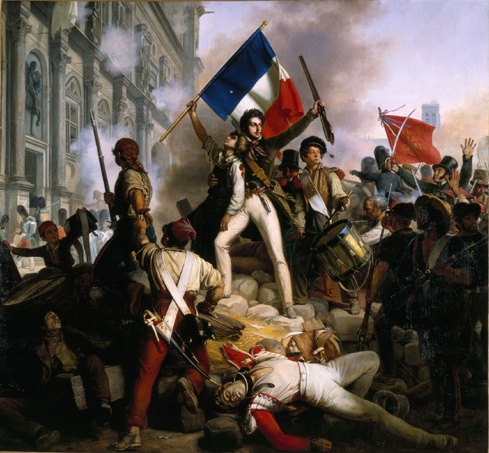
Yet to grasp what is taking place in France, we must step back and look at the broader picture. The French Revolution (May 5th, 1789–November 9th, 1799) basically overthrew the monarchy establishing a republic and was marked by very violent periods of political turmoil. Eventually, the French Revolution culminated in a dictatorship under Napoleon. It was this revolution that rapidly extended its principles to Western Europe and beyond marking the end of monarchy. In that respect, it was bookend to the American Revolution that completed the revolt against monarchy.

The French Revolution was strangely inspired by both liberal and radical ideas. Through the French Revolutionary Wars, what was unleashed set off a wave of global conflicts extending beyond Europe stretching to the Caribbean in the New World down to the Middle East. This was certainly a profound event and Napoleon brought to the doorstep of Europe, a monumental change in the form of government from monarchy to republic. It was certainly inspired philosophically by the publication of the Decline and Fall of the Roman Empire in 1776.

Economically, there is nothing that moves the masses to revolution like taxation. Historically, governments routinely raise taxes and only see things from their perspective. Never do they consider the people they claim to benefit. This is true be it a monarchy or a republic. For all forms of government share one common bond – they act in their self-interest. The French Revolution followed the Seven Years’ War and the American Revolutionary War. These events left the French government was deeply in debt and attempted to restore its financial status through unpopular taxation schemes. The weather was an impact for this was also the low in the energy output of the sun, which resulted in years of bad harvests leading up to the Revolution. This led to the famous rumor where Queen Marie Antoinette was said to have said: “Let them eat cake” which is the traditional translation of the French phrase “Qu’ils mangent de la brioche”. While it is commonly attributed to her, there is no record of this phrase ever having been said by Marie Antoinette. It appears in Jean-Jacques Rousseau’s Confessions  written in 1765, when Marie Antoinette was just nine years old.

Nevertheless, the economic decline, crop failures, and raising taxes inflamed popular resentment of the privileges enjoyed by both the clergy and the aristocracy. The first year of the Revolution saw members of the Third Estate taking control, the assault on the Bastille in July, and the passage of the Declaration of the Rights of Man and of the Citizen in August where there was the abolition of feudalism and the old rules and privileges. There was the women’s march upon Versailles which resulted in the royal court being forced to return to Paris in October that year.

beheading-louisThe economic turmoil led many elite French to flee to Geneva in Switzerland. Over the course of the first few years, there were political struggles and clashes between various liberal assemblies and right-wing supporters of the monarchy who wanted to maintain the status quo just as we saw the press conspire with Hillary in the 2016 elections. France essentially collapsed and was transformed into a democratic and secular society with freedom of religion, legalization of divorce, and civil rights for Jews and black people. The Republic was proclaimed in September 1792 after the French victory at Valmy. In a momentous event that led to international condemnation, Louis XVI was beheaded in January 1793. The king was only one of the thousands of victims of Robespierre.

The beheading of King Louis XVI came 144 years following the English Glorious Revolution and the beheading of Charles I on January 30th, 1649. No doubt, the manner in which the Puritans executed Charles I played some role in the executions carried out during the French Revolution by Robespierre, who himself would be declared an outlaw and he was arrested and was placed in the same cell where he held Marie Antoinette before her execution. Then on July 28th, 1794, Robespierre was guillotined without trial in the Place de la Révolution.

Le Pen Marine

The 224 Year Cycle of Political Change thus targets the beginning as 2013 and the end of this upheaval in France going into the peak of the next 8.6 year wave 2023-2024. Marine Le Pen first reach more than 17% of the vote in 2012. The cycle was starting to turn up, but it was just ahead of the time. Now, Le Pen is polling twice that of the President. Because of the fragmented political parties in France, it is difficult to forecast Le Pen will win. What is clear is that the socialists will lose. That much is certain. Nicolas Sarkozy has been thrown out of the elections by the conservative front runner Francois Fillon. The gap is closing between the conservatives and the right-wing. Clearly, the socialists are finished. However, we are within this 10 year window between 2013 and 2023. This clearly shifts the favor toward a new power. Le Pen can win within this window. However, expect this to be also very divisive as in the United States.

Will attempt to create a simulated election history based upon purely philosophy rather than party labels. We will report when that is completed.