
Armstrong Economics Blog/European Union
Re-Posted Mar 29, 2019 by Martin Armstrong
The British Parliament has rejected Prime Minister May’s BREXIT plan for a third time. This now leaves them to come up with a plan that Brussels must accept by April 12th or face a hard exit. On top of that, the phone here is melting down with questions about how “hard” is a “hard-landing” going to be from various political sources. Central banks are shifting already to once again stimulate. This is not looking very good, to say the least. Ten years of stimulation has been a complete failure in Europe. We have major political and banking turmoil and financial chaos looking ever more serious for May.
The Only Solution
Armstrong Economics Blog/Reports and DVDs
Re-Posted Mar 29, 2019 by Martin Armstrong
QUESTION: Re Solution to a new monetary system::
In the “Solution” presented it was suggested that the existing US bonds be required to invest in companies in the USA. Does the govt just print the money for the bond values to give to the companies? If the companies receive the bonds, how are they liquidated otherwise?
KB
ANSWER: It becomes a debt for equity swap. The debt must be retired. It is replaced with just the creation of money. Now people will yell that is hyperinflationary. Not true. Since 1971, government debt is acceptable for collateral when you trade your accounts at a broker. It is simply cash that pays interest. It is already part of the money supply. What you are implying is really old school economics that believe increasing the money supply will be inflationary. This is just not the case. Even after 10 years of Quantitative Easing, we still have deflationary trends in pockets like Europe and Japan.
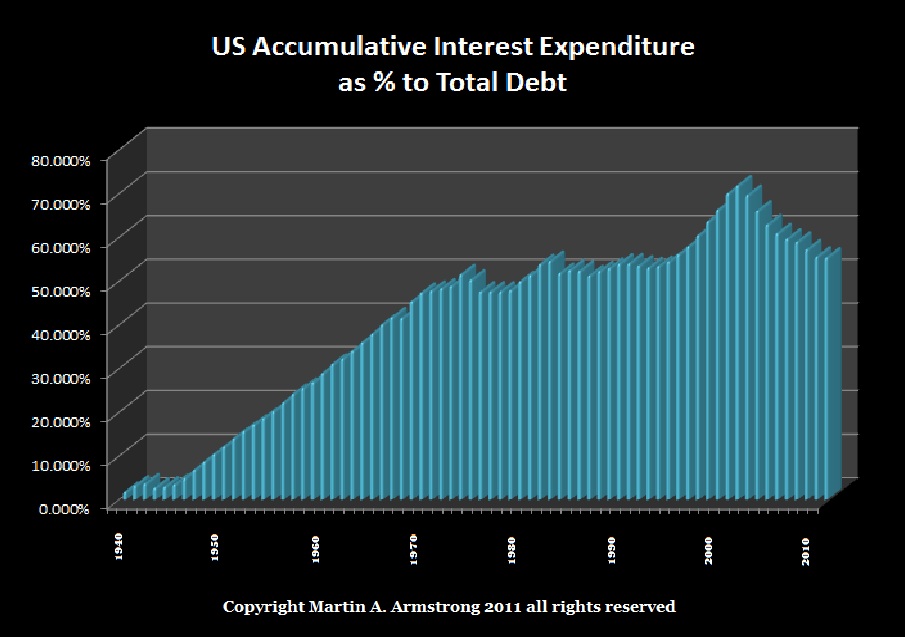
Some wrongly believe that you are just increasing the money supply. Pre-1971, when bonds were not allowed to be collateral, then yes, it was less inflationary to borrow than to print. However, since the debt is already cash that now pays interest post-1971, it is just a swap. Huge distinction.
Interest expenditures will soon exceed that of the military. This solution will reduce the cost of government, and thereafter, you outlaw any possible right to borrow once again.
Are 95% of Bitcoin Trades Fake?
Armstrong Economics Blog/Cryptocurrency
Re-Posted Mar 29, 2019 by Martin Armstrong
QUESTION: Mr. Armstrong; I love the fact you always stand in the middle. Do you believe that 95% of Bitcoin Trading is fake?
Thank you
KL
ANSWER: I did not conduct that study. It does sound a bit high. However, manipulation has been a historical problem in the commodity world. As I stated before, the manipulations were common practice in commodities during the 1970s. It was brought to Wall Street when Phibro took over Solomon Brothers in the early 80s. By 1991, they were charged with manipulating the US government bond market. How did they do that? The very same way these allegations of fake Bitcoin trades are taking place. You put in bids to pretend the market is deep and so you buy ever increasing the price.
Do I personally believe there is fake trading in Bitcoin taking place off-exchange? Absolutely. Would I assume that 95% is fake? I would question that high of a number. I would have to review their criteria for classifying a trade as fake. I would probably place it at the 50%+ level but not 95%. That is just my opinion based upon historical levels of manipulations in commodities.
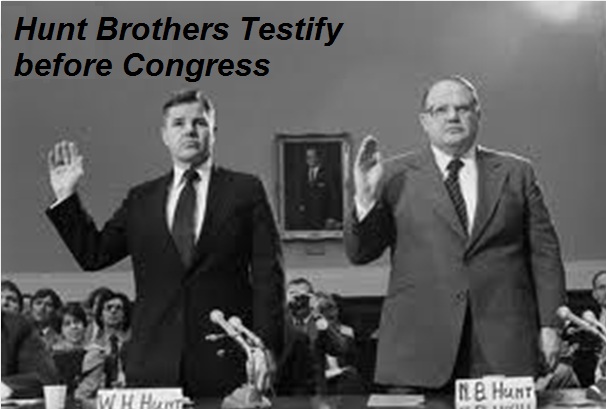
For example, I knew the Hunt brothers as clients in the early 1970s. Only a few months before the high, the world suddenly knew what they were up to. That info was spread by the dealers to get everyone in the retail market to rush in and buy silver with claims it was heading to $100. But the dealers, I believe, bribed the CFTC and the exchange into raising margins to be long on silver and making shorts required to put up a fraction of that margin requirement. The dealers shorted silver, the public lost, and they bankrupted the Hunts. They made so much money that they then began to buy Wall Street.
A Technical Study in the Relationships of Solar Flux, Water, Carbon Dioxide and Global Temperatures, February 2019
From the attached report on climate change for February 2019 we have the two charts showing how much has the global temperature actually gone up since we started to measure CO2 in the atmosphere? To show this graphically Chart 8 was constructed by plotting CO2 as a percent increase from when it was first measured in 1958, the Black plot, the scale is on the left and it shows CO2 going up about 30.0% from 1958 to February of 2019. That is a very large change as anyone would have to agree. Now how about temperature, well when we look at the percentage change in temperature from 1958, using Kelvin (which does measure the change in heat), we find that the changes in global temperature (heat) are almost un-measurable. The scale on the right side had to be expanded 10 times (the range is 40 % on the left and 4% on the right) to be able to see the plot in the same chart in any detail. The red plot, starting in 1958, shows that the thermal energy in the earth’s atmosphere increased by .30%; while CO2 has increased by 30.0% which is 100 times that of the increase in temperature. So is there really a meaningful link between them that would give as a major problem? The numbers tell us no there isn’t.
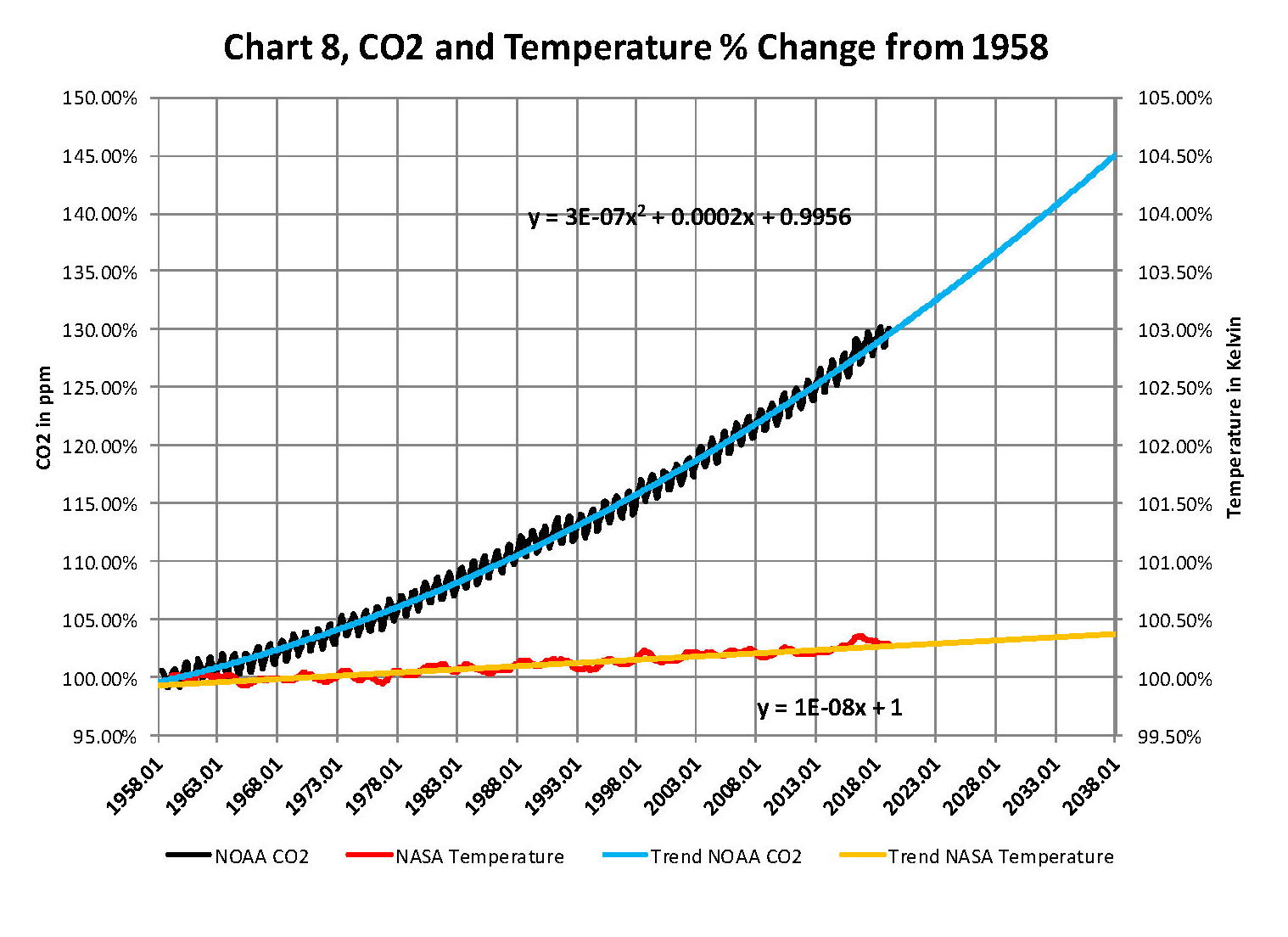
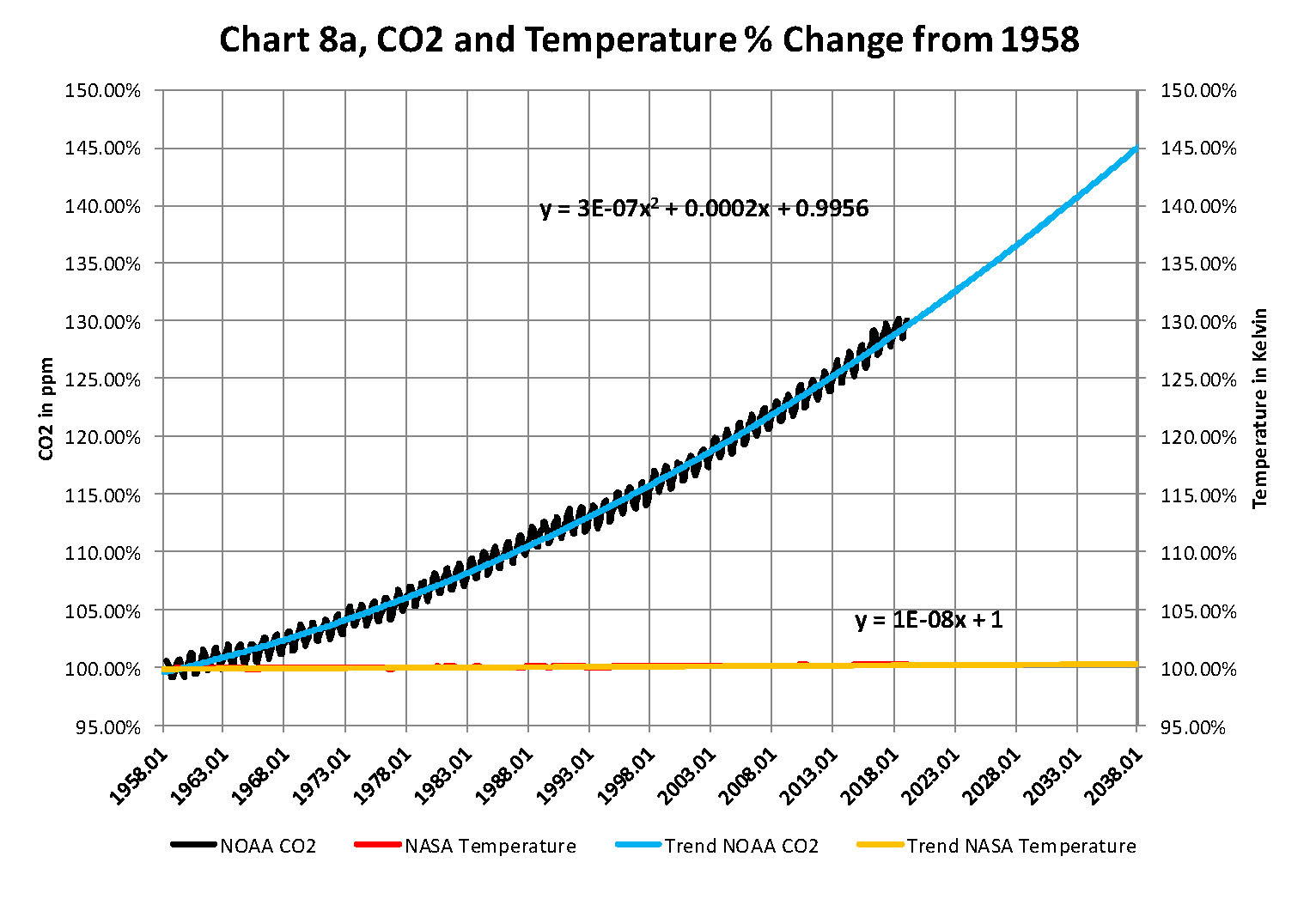
The next chart is Chart 8a which is the same as Chart 8 except for the scales which are the same for both CO2 and Temperature. As you see the increase in energy, heat, is not visually observably in this chart hence the need for the previous chart 8 to show the minuscule increase in thermal energy shown by NASA in relationship to the change in CO2. Based to these trends, determined by excel not me, in 2028 CO2 will be 428 ppm and temperatures will be 15.0o Celsius and in 2038 CO2 will be 458 ppm and temperatures will be 15.6O Celsius. This is what the data shows no matter what the reasons are, so I have no idea how the IPCC gets to predict that the world will end in ten or twenty years.
The full 37 page report explains how these charts were developed and why using NASA and NOAA data are used with out change to prove that The New Green Deal is not required and any attempt to compliment that plan will be a world wide disaster.
Click on the link below for the full report that you can download.
Inverted Yield Curve Points to Recession?
Armstrong Aconomic Blog/Bonds
Re-Posted Mar 28, 2019 by Martin Armstrong

Last week, the yield on the 10-year U.S. Treasury bill fell below that of the 3-month note for the first time since 2007. This is what everyone calls an Inverted Yield Curve, and is seen as an early indicator of a recession. In that regard, it is conforming to the Economic Confidence Model (ECM) which has been warning that this last leg should be a hard landing economically for most of the world. Nonetheless, while the yield curve has inverted, it has done so in a rather unusual manner. This is NOT suggesting a major recession in the United States. Instead, it is a reflection of global uncertainty outside the USA.
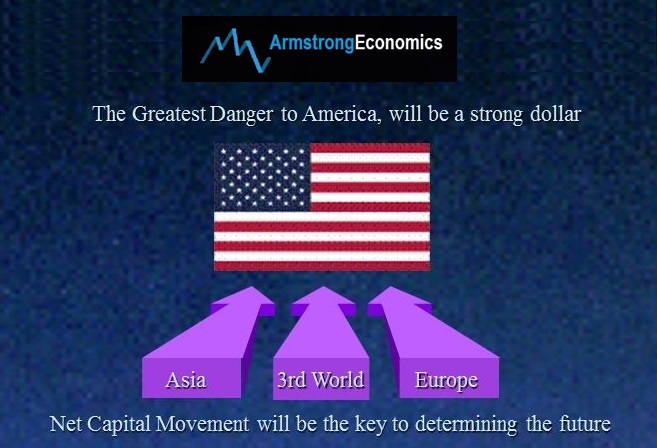
This Inverted Yield Curve is confirming that as the political chaos emerging around the world, and that more and more foreign capital is parking in the dollar. With the May elections on the horizon in Europe, and the October elections in even Canada, April elections in Israel … etc. etc., the capital flows are still pointing ever stronger into the dollar right now. The foreign capital has been buying the 10-year notes driving the spread lower.

We can see that the 10-year premium to the 2-years has been in a major decline ever since our War Cycle turned in 2014. The Yield Curve (10-2yr) has not inverted. This is clearly showing the capital flight to the dollar that has been going on post-2014. This is not reflecting a major recession in the USA, but it is inferring that the ECM will be turning soon
Regulating the Virtual & Cryptocurrency World
Armstrong Economics Blog/Cryptocurrency
Re-Posted Mar 28, 2019 by Martin Armstrong

While many believe that the off-exchange trading platforms in Bitcoin bypass fiat central banks, there are developments in the legal world that warn of regulation is headed into the field with a vengeance. There were three important recent actions in federal courts that illustrate the interplay among the Securities and Exchange Commission (SEC) & Commodity Futures Trading Commission (CFTC) federal regulators seeking to expand their jurisdiction into the virtual currency world. This movement to expand their jurisdiction does not come from Congress. Instead, they charge people and create legal precedents and this is how most “law” is actually made. Clearly, these actions illustrate that they are moving into the virtual currency arena. The three cases are:
- On September 26, 2018, Judge Rya W. Zobel of the U.S. District Court for the District of Massachusetts handed down an important decision in a case alleging the fraudulent sale of a virtual currency called My Big Coin (MBC).2 In denying the defendants’ motion to dismiss, Judge Zobel confirmed the CFTC’s sweeping assertion of authority to police virtual currency markets under the antifraud and manipulation provisions of the Commodity Exchange Act (CEA) and its implementing regulations.
- On September 11, 2018, Judge Raymond J. Dearie of the U.S. District Court for the Eastern District of New York denied a motion to dismiss the United States’ indictment for fraud under the Securities Exchange Act of 1934 (Exchange Act) in connection with the sale of virtual currencies claimed to be backed by real estate and diamonds.3 In denying the defendants’ motion to dismiss, Judge Dearie found that the virtual currencies at issue could reasonably be considered investment contracts and thus securities
- On September 27, 2018, the SEC and the CFTC filed parallel complaints in the U.S. District Court for the District of Columbia against an online trading platform and its CEO offering swaps based on underlying securities and commodities funded with bitcoin, alleging violations of the federal securities and commodities laws.
My biggest concern is that it will be a tiny step for mankind to declare off-exchanges to be illegally operating without registration and it would not be too far behind for they to be criminally prosecuted for also money laundering just like any bank for the failure to report every individual trading on these platforms. I would suspect we will see the further expansion into the virtual currency world by the SEC, CFTC, and DOJ long before we see any real legislation from Congress. They will ALWAYS pick the worse cases to make law and then apply it to everyone.
Greenland Glacier has been Growing for the past 2 years & it will Probably end up 3 for 3 when this season ends
Armstrong Economics Blog/Climate
Re-Posted Mar 28, 2019 by Martin Armstrong

COMMENT: Mr. Armstrong; It is clear that your computer is really amazing. I was just ready how the Greenland Glacier is expanding, not melting. What you have accomplished by seeking to eliminate yourself is really a major contribution to society.
Job well done, sir.
PH
 REPLY: Thank you. A number of people have read the same article and have been sending it in. I would like to also thank all the people who have dome sone and your comments. It is so important to eliminate bias. I moved to Florida trying to find Global Warming. To me, it is just stunning how people do not understand that everything has a cycle from weather to why we must eventually die. The Greenland glacier 2012 was retreating about 1.8 miles back in 2012 annually. However, as the climate has been getting colder nor for the third year, interestingly enough, the Greenland Glacier has begun to grow in mass once again.
This is NOT a forecast I want to see happen. I hate cold. So I do not enjoy even having to say see I told you so. Wish I was wrong on this one.
World In Midst of Carbon Drought (w/ Prof. William Happer, Princeton University)

Published on Jun 22, 2015
Princeton physicist: There’s a ‘cult’ building around climate scientists

Facebook to Launch a Cryptocurrency & Compete Against Banks?
Armstrong Economics Blog/Cryptocurrency
Re-Posted Mar 27, 2019 by Martin Armstrong

QUESTION: Why is Facebook going to issue a cryptocurrency? Doesn’t that confirm the evolutionary path of technology?
ND
ANSWER: The term “cryptocurrency” is being thrown around very loosely. It is true that there is increasing hype and speculation regarding a theoretical Facebook Coin. However, this is not a “cryptocurrency” it is simply a digital entry and nothing more. The proposed Facebook Coin is the polar opposite of Bitcoin. AFacebook is creating a pretend cryptocurrency for WhatsApp. This is not a real cryptocurrency. The cryptocurrency enthusiasts are only looking at the label. The Facebook Coin is nothing like Bitcoin (BTC).
Thet Facebook Coin will be pegged to a fiat currency similar to that of Tether (USDT) and USD Coin (USDC) and it will use blockchain technology. The only real unique aspect about Facebook Coin versus a regular stablecoin is that it could be backed by a basket of fiat currencies, all held in Facebook bank accounts. This is more along the lines of the ultimate evolution of what I would expect to become the next reserve currency – a basket of currencies rather than a single currency.
If our sources are correct, this means that a Facebook Coin would easily compete with the rest of the $2-3 billion stablecoin markets where the biggest stablecoin remains Tether (USDT). Tether (USDT) has had some problems with its backing which resulted in its decline by as much as 10% below the value of a U.S. dollar.
That said, since Facebook Coin would be a stablecoin, it will not be possible to invest in it so it would not be a trading vehicle like Bitcoin. That means it would be more of a store of value which is quite different from Bitcoin (BTC) and most other cryptocurrencies where fluctuating prices really prevent them from becoming a true currency digital or otherwise. Clearly, Facebook has no intention of launching a trading cryptocurrency. If they did, it would probably blow Bitcoin out of the water. Facebook is not going this route for it is looking to get into really the digital currency world, not cryptocurrency. However, Facebook’s total stock has a market cap of $463 billion is closer to 4 times that of the entire crypto market cap of $130 billion.
If we pull back the curtain, Facebook is much more interested in a real-world market by creating its own payment network independent of Visa and PayPal. Effectively, venturing into a digital currency world backed by a basket of currencies or allowing clients to select their currency means they would compete for deposits like banks but globally. With Facebook’s immense user base, such as a payment network would be extremely competitive in the banking world. Obviously, Facebook sees that a digital payment network will be unique out of all the other big name fiat payment networks since it will use blockchain technology and its client base to launch it into the future..

