Aurora Borealis Warning the Climate May Turn Sharply Colder into 2032


There may actually be a confirmation that we are heading into a much colder climate. The Aurora Borealis, also known as the Northern Lights, can now be seen in the UK. Normally, the Northern Lights can be seen only extremely north as in Alaska. Sir Edmund Halley (1656 – 1742), the man who discovered Halley’s Comet, was a friend of Isaac Newton. He was asked to speak about the unusual events that were taking place in the sky. He addressed the British Royal Society, stating:

The Royal Society, having received accounts from very many parts of Great Britain, of the unusual lights which have of late appeared in the heavens ; were pleased to signify their desires to me, that I should draw up a general resation (sic) of the fact, and explain more at large some conceptions of mine I had proposed to them about it, as seeming to some of them to render a tollerable [sic] solution of the very strange and surprizing [sic] phænomena thereof.
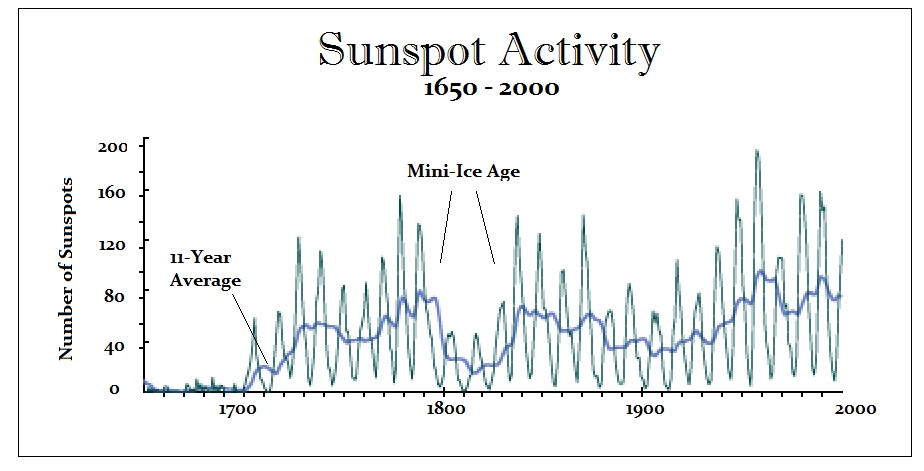
During the period of Halley’s investigation, the Little Ice Age dominated the decades and it bottomed around 1680. The Aurora Borealis actually expands and moves further south during periods of a colder climate. The Northern Lights being visible in the UK is not a good sign for climate change. This may be warning that we are headed back to a prolonged colder climate. Solar cycle 14 had the record high for sunspots during February in 1906. The annual peak took place in 1957 with 190 sunspots taking place that year. Based upon our models, the ideal low was most likely 1686/1687. From the 1957 high, the collapse to just 10 sunspots per year took place in 1964 — 7 years later.

Just before the Mini Ice Age, sunspot activity peaked during 1787 at 132 (mean) and crashed for 11 years into 1798, dropping to just 4 sunspots. If we continue to witness this declining trend from the 2000 high where there are virtually no sunspots, we appear to be vulnerable to a significant decline at least into 2032.

Are Bonds Preferable to Stocks in a Crisis?


QUESTION: There are a few people coming out claiming the stock market will crash so buy bonds even though you will lose money. How can people keep calling for a mega-crash so long with constantly being wrong since 2010?

Thank you for your reason

NR

ANSWER: These people are still living in a world that is defined by the event of the Great Depression. Even Germany forces austerity upon Europe because they do not understand the events behind their own hyperinflation and stupidly assume it was merely an increase in the supply of money that caused the event. Nobody seems to be bothered to ask which comes first – the chicken or the egg?

Here is a chart of the stock market with the US Long Bond. Andrew Jackson paid off the national debt in 1835. President Jackson also shut down the Second Bank of the United States on Sept. 10th, 1833. Jackson announced that the government would no longer deposit federal funds in the Second Bank of the United States, which was a quasi-governmental national bank. The stock market peaked in 1835 and began its decline without a central bank. Then during July 1836, Jackson issued the Specie Circular. Under this act, the government would only accept gold or silver in payment for federal land.

Jackson’s Bank War closing down the Bank of the United States was personal because they funded his opposition. By shifting deposits to state banks, Jackson set off a major crisis undermining the entire monetary system. He effectively devalued all the circulating currency in the country with one law – the Specie Circular. Suddenly, there was a run on gold. The Panic of 1837 unfolds as New York banks suspended all withdrawals of gold. Jackson created massive austerity, but he had shut down the national debt as well. This was a very complicated financial crisis with an interesting mix of events combining together.

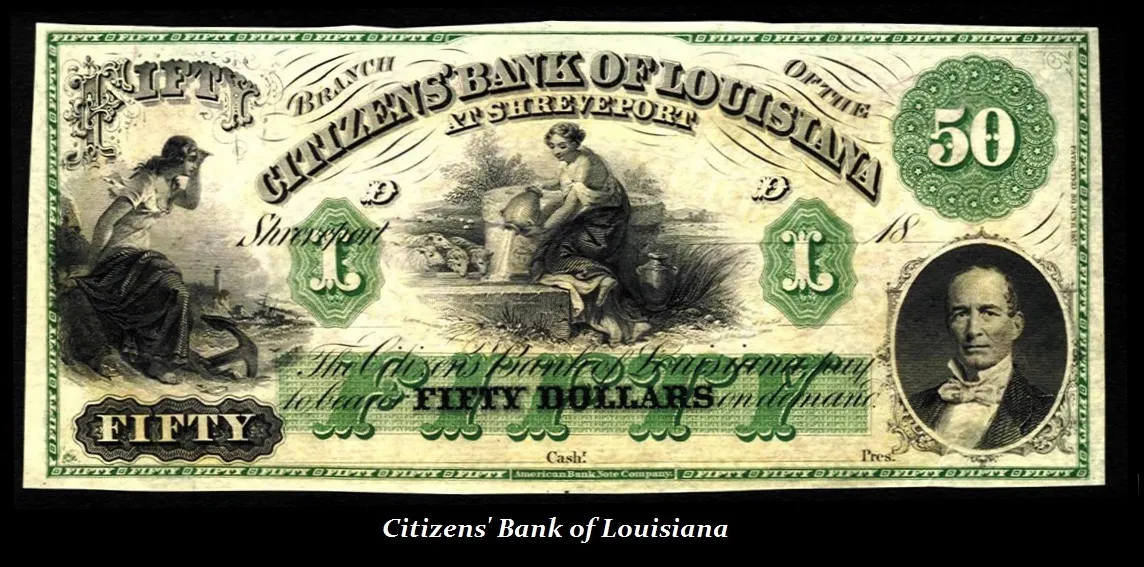
There were NO federal issues of paper money and the first paper dollar to be issued by the government did not unfold until 1860 to fund the Civil War. Therefore, Jackson effectively canceled all paper money by refusing to accept it and this resulted in a gold panic forcing the banks to suspend all payments. People were rushing to banks to exchange their paper currency for gold and banks could not meet the demand and suspended all demands for gold.

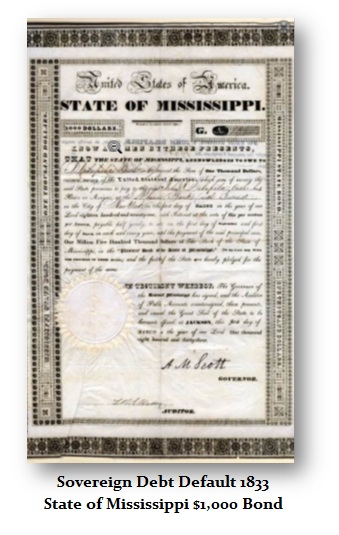
When federal bonds resumed in 1842, they had declined in value as interest rates rose. There was no flight to quality, only to gold given there were no federal bonds. This is when several states moved into default permanently upon their debt. Therefore, the Monetary Crisis Cycle that hit then was felt in the state and local levels – not federal. The Monetary Crisis Cycle that hit in 1931 resulted in widespread sovereign defaults outside the USA.

Each cycle that hits is slightly different characters and reasons. I highly warn against buying any sovereign debt whatsoever. Any federal debt to hold must be short-term no more than 90-day paper. In the case of the Hard Times of 1837-1842, the stock market crashed in terms of gold because all money was effectively canceled. Paper money collapsed as notes lost their legal-tender value. Thus, only gold rose in value as the medium of exchange thanks to Jackson refusing to accept anything but gold.

This time around, bonds are legal tender so that is the money that will decline in value far more than anyone expects. Both the Bank of Japan and the ECB in Europe have wiped out their bonds markets for they have been the primary buyer of government debt which they cannot now resell.


The Stock Market – Up & Away or Crash & Burn?


QUESTION: Mr. Armstrong,

In your blog you talked about a global recession and hard landing. Does this mean the US stock market will rally because funds will flow from the rest of the world to the US stock market? Or will the US stock market succumb to the global recession and go lower too?

This is very confusing for most of us and a very critical time in the markets. I hope you will guides us with your knowledge and experience.

Thank you for all you do!

KC

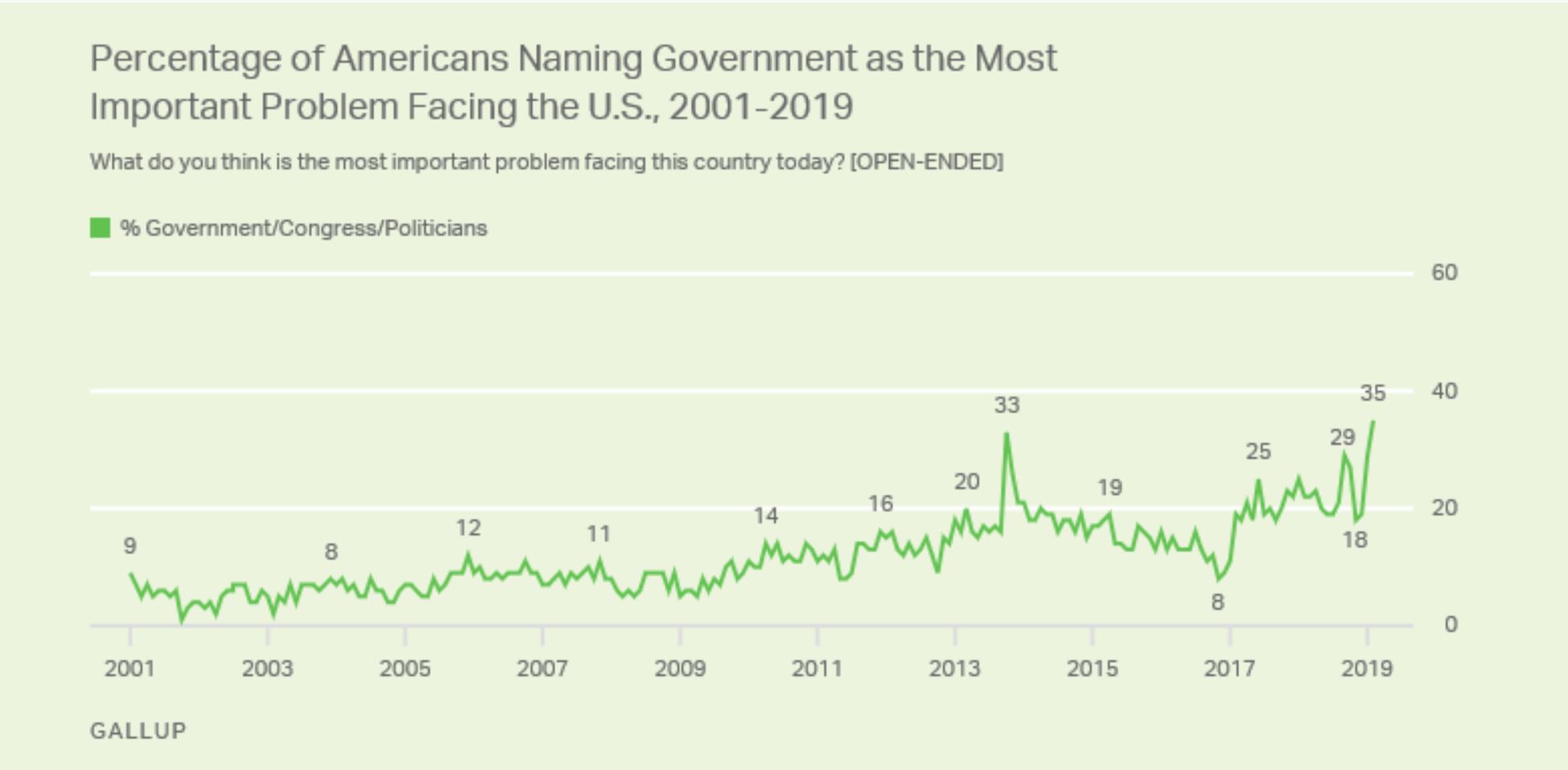
ANSWER: The key to pushing capital fleeing into the stock market will be the decline in public confidence within the government. Everything is unfolding on schedule. You see turmoil everywhere from Canada to France and Italy. The level of people distrusting government is climbing. Normally, it will take a 45% level of people turning against the government to set off the spark.

So no, there still does not appear to be a major crash of 50-62% as the majority are calling. The market is testing resistance, but here too we do not see this as breaking out and taking off just yet. We are in a choppy consolidation building a higher base that qualifies as a cycle low. We will be ready to take off soon. Just be patient.


The Rally Beyond 2015 in the Dow Has Proven We are in a Cycle Inversion


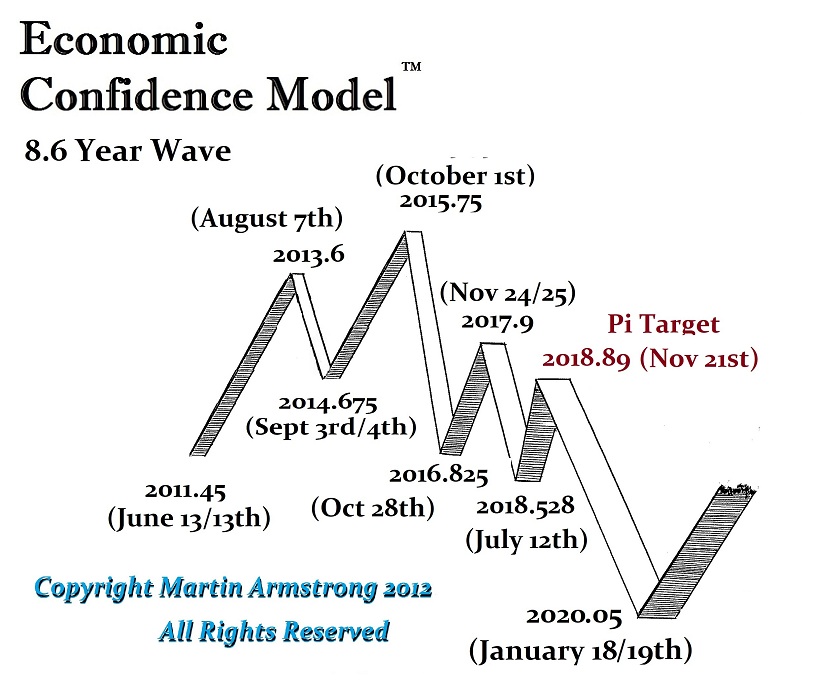
QUESTION: There are many people who are now saying we are headed into a recession. Your model shows we are coming to the end. Yet you have been the only analyst who has been correct. There are bankers warning the stock market will collapse by 50% because it always goes down in a recession. I watched the market rally to new high as you forecast back in 2010 going into 2015. Then you warned the market would invert and continue the rally after 2015. The market rallied into nearly your Pi Target in 2018. You said at the last WEC there would be a correction back to retest the monthly bearish reversal.

You have been correct at every turn. Back in 2014, you posted: “What will not go down when the cycles shift, inverts and rises even further.” It seems that this has been a cycle inversion where the market has just been rising through the upside and downside of your model. My question is this. You still forecast that this is just the staging ground and we are about to see a different pattern altogether. Is this all part of the cycle inversion you have been stating is underway?

NM

ANSWER: Yes. I also wrote in that post: “This is why I have been warning a cycle inversion is coming. We may be in that process now starting from November 19th/20th.” With all the craziness on the horizon economically, the government was the one in trouble, not the private sector. That meant we had to undergo a cycle inversion. That is what is underway. A normal cycle would have seen the market peak in October 2015 and then decline. The fact that the market has continued to rally past 2015 proves this is a cycle inversion. We will be addressing this at the Rome WEC. We are about to make a major play that will be critical to understanding for the future.