Commerce Secretary Wilbur Ross Talks To Lou Dobbs….


Ah, the simple joys in life.  Wilburine Ross interviewed by Lou Dobbs… Sip slowly.

The general status of angst created by ordinary swamp review has a tendency to wear down a soul. It’s at the times when we feel surrounded we should reflect upon how lucky we are to have the T’Rex’s and Wilburines on our team. We’ve already won, our opponents just haven’t noticed yet.

White House Responds to Judge Orrick Defunding “Sanctuary City” Injunction…


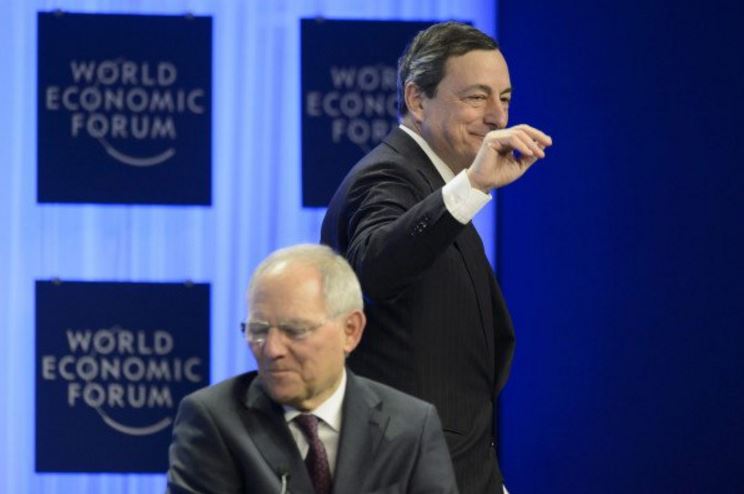
Does Schäuble want Draghi to Exit the Stage Once & For All?


Draghi Schauble

Federal Minister of Finance Wolfgang Schäuble of Germany is starting to show signs of rebellion against the elite in Brussels. With the event of BREXIT, the EU is more concerned about trying to punish Britain than they are in reflecting upon what is going so terribly wrong. They will throw their support behind Macron in France fearing that a Le Pen win may be the end of Brussels. Consequently, the EU Commission is trying to punish Britain, and is actually dividing Europe once again. There will be the EU membership, and then there will be the Eurozone within, limited to those countries who surrender their sovereignty to Brussels relinquishing their currency, but not their debt.

Schäuble is clearly attempting to save the Eurozone and make it operational at the same time to protect German exports within Europe. The driving force behind the Euro was to eliminate foreign exchange risk so German manufacturers could sell to all of Europe on a regular basis without currency fluctuation disturbing their sales.

Yet Schäuble is actually looking at reducing the power of the EU for reading between the lines, he has no confidence in the abilities of the EU Commission to manage Europe. Obviously, BREXIT is restructuring the EU only insofar as they seek to punish Britain rather than reform the problems that caused it. That means the Euro zone will be restructured as a block within the EU leaving the institutions, such as the ECB, applicable to the EU. The rules within the Eurozone are by no means clearly defined. This is how Markel opened the gates to refugees without ever going to a vote first in the EU. Thus, the unilateral decisions of Germany have then been applied to all of Europe without any democratic process whatsoever.

Schäuble is looking at the distinction between the EU and the Eurozone and thus reducing the power of the EU Commission to save the Eurozone – a second Europe within Europe, of which Britain was never a member. Schäuble attacked the ECB and Mario Draghi saying: “The ultralock money policy that exists in many regions is not helpful.”  Schäuble said this opening on his trip to Washington. The ECB, Schäuble argues, is creating risks such as asset price bubbles with its negative interest rate policy. This is the clash of philosophies with Schäuble’s view on AUSTERITY.

Schäuble demanded a change of direction from Mario Draghi. He warned that Draghi was increasing the risk of creating a whole new crisis rather than lessening it. The Federal Reserve reverse course right after 2015.75 on the ECM that targeted October 1st, 2015 with the first rate hike in December 2015. Schäuble remarked that it “would not be a bad idea if the European Central Bank and other central banks followed” the course of the Fed. Schäuble has clashed with Draghi who still considers his stimulus quantitative easing policy of the ECB still necessary. Draghi said on this trip to Washington that a “very significant amount of monetary easing is still needed.”

Schäuble has also proposed that the basic structure of the Eurozone in the form of budgetary policy must be changed. Schäuble remains rightly concerned what happens when Draghi changes course and raises rates. Schäuble is deeply concerned that national debts will then explode with higher interest rates. For this reason, Schäuble wants the euro rescue umbrella ESM in the near future converted to a European Monetary Fund. Schäuble sees this as a European version of the International Monetary Fund (IMF). If a new aid program for a crisis country were to run without the IMF because the IMF has disagreed with the draconian measures imposed upon Greece. Schäuble wants to replace the IMF to impose austerity. Apparently, Schäuble has also convinced Chancellor Angela Merkel of this proposal since the IMF disagrees with the austerity ideas of Schäuble.

Troika-Unelected

This new European Monetary Fund to replace the IMF, which is a member of the Troika, will then be given the task of budgetary monitoring of Eurozone countries. Therefore, we will have the EU, but a separate system within the EU for the Eurozone all based upon extending austerity. This is obviously a disempowerment of the EU Commission.

Greece is still an unsolved problem – and Schäuble also sees that Greece should exit the Eurozone. Schäuble also sees a better partnership with Russia and an emancipation from the USA. This was really based upon German manufacture having a new market to sell into given the rise of Donald Trump. Then Schäuble wanted a nuclear Europe to stand against America and Russia. Schäuble’s view is that the core of Europe is Germany, France, Belgium, Luxembourg and the Netherlands. It never included Britain. The Franco-German axis was to become the economic engine of the future. To Schäuble, the core is simply the Euro for that evens the playing field for Germany to sell products into Europe. He has embraced the Euro, but never accepting a federal debt for Europe. This is why he has never seen Italy, Spain or Greece as the core of the EU – just vassal states to sell products to.

London Property Sales Crashed 40% Thanks to Tax Increase


62 Cornall Gardens

Where I use to live back in 1985

George Osborne budgetThe London housing market sales has crashed to its lowest level now since 2013. We reported in November 2015 with the turn in the ECM on 2015.75 that the London property market peaked. Valued crashed by 11.5% in the first month after the turn of the ECM. Landlords are joining together to challenge the Conservative’s (i.e. Tory’s) tax hike by filing a suit in the high court against their tax increase on “buy-to-let” investment properties.  In July 2015, we warned that the Conservatives were going after the non-domiciled residents in London and that would stop the real estate boom.

The figures are now out and they show that the number of homes bought over the last year crashed by 40% between March 2017 and March 2016, from 173,860 to 102,810. “That was thanks to new stamp duty rules introduced at the beginning of last April, which hiked stamp duty on second homes and led to a buying frenzy just before the rules were introduced,” reported Emma Haslett.

Keep in mind that we are only human. Consequently, if you see municipal taxes rising in the USA, expect property values to also decline. It is the same worldwide.

Le Pen Seeks to Broaden Her Support


2017 Election

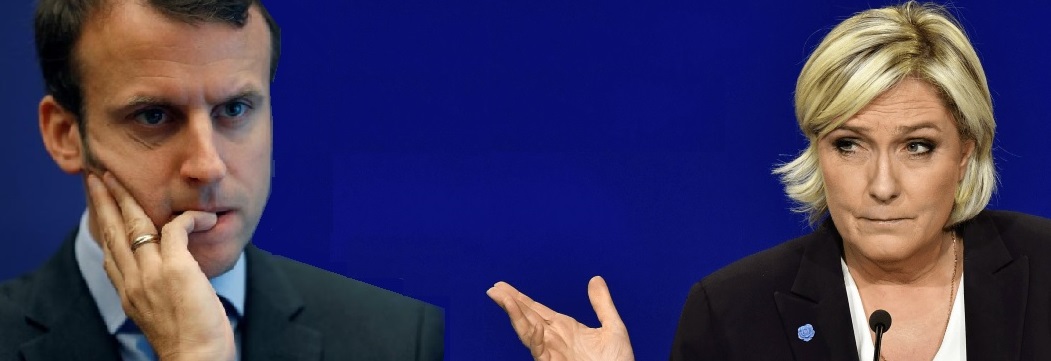
French Presidential candidate Marine Le Pen says she is temporarily stepping down as head of her National Front party. She is still in the race, just attempting to distance herself a bit more from her party to broaden her appeal. The May 7 run-off between herself and Emmanuel Macron, will be interesting for it is a test of how strong the populist movement has become.

People who think “populist” is a particular philosophy are seriously wrong. It was a “populist” movement that put FDR in the White House in 1933. It also put into power Lenin, Hitler and Mao. “Populist” is effective the label applied to any movement Indeed, FDR actually did embrace many elements of fascism, which differs from communism insofar as it supported worker unions and the ownership of business run by the workers. The Populist movement was in fact Marxism during the late 19th century, which manifested into Communism, fascism, and socialism. All three were constructed upon a strong central power of government to different degrees.

“Populist Movements are not particularly a single right or left philosophy. The term is applied to effectively an anti-establishment movement against the status quo.

Le Pen said “Tonight, I am no longer the president of the National Front. I am the presidential candidate,” on French public television news. She hopes that by distancing herself from the party founded by her father in 1972, more people will reach out to her for real change in France. Le Pen hopes to tap into the Eurosceptic and protectionist voters in other parties. The underling trend is certainly anti-EU throughout all of Europe to varying degrees.

Macron is the favorite of Brussels and all the politicians nobody wants to vote for, so what does that really tell you? All the politicians are cheering only because they do not want any real change. They like everything as is – thank you very much they say off camera. But Macron is really out there in la la land. Those who think Trump says some crazy stuff, should turn and look at Macron. How about these!

“I’ve always accepted the vertical dimension, of transcendence, but, at the same time, it has to be utterly anchored in the immanent, in the material.”

Ok, not sure what that means at all. How about this one!

“We all have our roots. And because we all do, there are trees next to us, there are rivers, there are fish. There are brothers and sisters …”

Ok roots and trees go together. What about the rivers and fish? Brothers and sisters is family. Does everyone come from fish out of the river?

If he will be the new face of France, I would probably want to double short the Euro when the cycle changes.

The IMF Is Not Done Destroying Greece Yet


Tyler Durden's picture

Authored by Raul Ilargi Meijer via The Automatic Earth blog,

Austerity is over, proclaimed the IMF this week. And no doubt attributed that to the ‘successful’ period of ‘five years of belt tightening’ a.k.a. ‘gradual fiscal consolidation’ it has, along with its econo-religious ilk, imposed on many of the world’s people. Only, it’s not true of course. Austerity is not over. You can ask many of those same people about that. It’s certainly not true in Greece.

IMF Says Austerity Is Over

Austerity is over as governments across the rich world increased spending last year and plan to keep their wallets open for the foreseeable future. After five years of belt tightening, the IMF says the era of spending cuts that followed the financial crisis is now at an end. “Advanced economies eased their fiscal stance by one-fifth of 1pc of GDP in 2016, breaking a five-year trend of gradual fiscal consolidation,” said the IMF in its fiscal monitor.

In Greece, the government did not increase spending in 2016. Nor is the country’s era of spending cuts at an end. So did the IMF ‘forget’ about Greece? Or does it not count it as part of the rich world? Greece is a member of the EU, and the EU is absolutely part of the rich world, so that can’t be it. Something Freudian, wishful thinking perhaps?

However this may be, it’s obvious the IMF are not done with Greece yet. And neither are the rest of the Troika. They are still demanding measures that are dead certain to plunge the Greeks much further into their abyss in the future. As my friend Steve Keen put it to me recently: “Dreadful. It will become Europe’s Somalia.”

An excellent example of this is the Greek primary budget surplus. The Troika has been demanding that it reach 3.5% of GDP for the next number of years (the number changes all the time, 3, 5, 10?). Which is the worst thing it could do, at least for the Greek people and the Greek economy. Not for those who seek to buy Greek assets on the cheap.

But sure enough, the Hellenic Statistical Authority (ELSTAT) jubilantly announced on Friday that the 2016 primary surplus was 4.19% (8 times more than the 0.5% expected). This is bad news for Greeks, though they don’t know it. It is also a condition for receiving the next phase of the current bailout. Here’s what that comes down to: in order to save itself from default/bankruptcy, the country is required to destroy its economy.

And that’s not all: the surplus is a requirement to get a next bailout tranche, and debt relief, but as a reward for achieving that surplus, Greece can now expect to get less … debt relief. Because obviously they’re doing great, right?! They managed to squeeze another €7.3 billion out of their poor. So they should always be able to do that in every subsequent year.

The government in Athens sees the surplus as a ‘weapon’ that can be used in the never-ending bailout negotiations, but the Troika will simply move the goalposts again; that’s its MO.

A country in a shape as bad as Greece’s needs stimulus, not a budget surplus; a deficit would be much more helpful. You could perhaps demand that the country goes for a 0% deficit, though even that is far from ideal. But never a surplus. Every penny of the surplus should have been spent to make sure the economy doesn’t get even worse.

Greek news outlet Kathimerini gets it sort of right, though its headline should have read “Greek Primary Surplus Chokes Economy“.

Greek Primary Surplus Chokes Market

The state’s fiscal performance last year has exceeded even the most ambitious targets, as the primary budget surplus as defined by the Greek bailout program, came to 4.19% of GDP, government spokesman Dimitris Tzanakopoulos announced on Friday. It came to €7.369 billion against a target for €879 million, or just 0.5% of GDP. A little earlier, the president of the Hellenic Statistical Authority (ELSTAT), Thanos Thanopoulos, announced the primary surplus according to Eurostat rules, saying that it came to 3.9% of GDP or €6.937 billion.

The two calculations differ in methodology, but it is the surplus attained according to the bailout rules that matters for assessing the course of the program. This was also the first time since 1995 that Greece achieved a general government surplus – equal to 0.7% of GDP – which includes the cost of paying interest to the country’s creditors. There is a downside to the news, however, as the figures point to overtaxation imposed last year combined with excessive containment of expenditure.

The amount of €6-6.5 billion collected in excess of the budgeted surplus has put a chokehold on the economy, contributing to a great extent to the stagnation recorded on the GDP level in 2016. On the one hand, the impressive result could be a valuable weapon for the government in its negotiations with creditors to argue that it is on the right track to fiscal streamlining and can achieve or even exceed the agreed targets. On the other hand, however, the overperformance of the budget may weaken the argument in favor of lightening the country’s debt load.

Eurogroup head Dijsselbloem sees no shame in admitting this last point :

Dijsselbloem Sees ‘Tough’ Greek Debt Relief Talks With IMF

“That will be a tough discussion with the IMF,” said Dijsselbloem, who is also the Dutch Finance Minister in a caretaker cabinet, “There are some political constraints where we can go and where we can’t go.” The level of Greece’s primary budget surplus is key in determining the kind of debt relief it will need. The more such surplus it has, the less debt relief will be needed.

That’s just plain insane, malicious even. Greek PM Tsipras should never have accepted any such thing, neither the surplus demands nor the fact that they affect debt relief, since both assure a further demise of the economy.

Because: where does the surplus come from? Easy: from Troika-mandated pension cuts and rising tax levels. That means the Greek government is taking money OUT of the economy. And not a little bit, but a full 4% of GDP, over €7 billion. An economy from which so much has already vanished.

The €7.369 billion primary surplus, in a country of somewhere between 10 and 11 million people, means some €700 per capita has been taken out of the economy in 2016. Money that could have been used to spend inside that economy, saving jobs, and keeping people fed and sheltered. For a family of 3.5 people that means €200 per month less to spend on necessities (the only thing most Greeks can spend any money on).

I’ve listed some of the things a number of times before that have happened to Greece since the EU and IMF declared de facto financial war on the country. Here are a few (there are many more where these came from):

25-30% of working age Greeks are unemployed (and that’s just official numbers), well over 1 million people; over 50% of young people are unemployed. Only one in ten unemployed Greeks receive an unemployment benefit (€360 per month), and only for one year. 9 out of 10 get nothing.

Which means 52% of Greek households are forced to live off the pension of an elderly family member. 60% of Greek pensioners receive pensions below €700. 45% of pensioners live below the poverty line with pensions below €665. Pensions have been cut some 12 times already. More cuts are in the pipeline.

40% of -small- businesses have said they expect to close in 2017. Even if it’s just half that, imagine the number of additional jobs that will disappear.

But the Troika demands don’t stop there; they are manifold. On top of the pension cuts and the primary surplus requirement, there are the tax hikes. So the vast majority of Greeks have ever less money to spend, the government takes money out of the economy to achieve a surplus, and on top of that everything gets more expensive because of rising taxes. Did I ever mention businesses must pay their taxes up front for a full year?

The Troika is not “rebalancing Greece’s public finances in a growth-friendly manner”, as Dijsselbloem put it, it is strangling the economy. And then strangling it some more.

There may have been all sorts of things wrong in Greece, including financially. But that is true to some degree for every country. And there’s no doubt there was, and still is, a lot of corruption. But that would seem to mean the EU must help fight that corruption, not suffocate the poor.


Yes, that’s about a 30% decline in GDP since 2007


The ECB effectively closed down the Greek banking system in 2015, in a move that’s likely illegal. It asked for a legal opinion on the move but refuses to publish that opinion. As if Europeans have no right to know what the legal status is of what their central bank does.

The ECB also keeps on refusing to include Greece in its QE program. It buys bonds and securities from Germany, which doesn’t need the stimulus, and not those of Greece, which does have that need. Maybe someone should ask for a legal opinion on that too.

The surplus requirements will be the nail in the coffin that do Greece in. Our economies depend for their GDP numbers on consumer spending, to the tune of 60-70%. Since Greek ‘consumers’ can only spend on basic necessities, that number may be even higher there. And that is the number the country is required to cut even more. Where do you think GDP is headed in that scenario? And unemployment, and the economy at large?

The question must be: don’t the Troika people understand what they’re doing? It’s real basic economics. Or do they have an alternative agenda, one that is diametrically opposed to the “rebalancing Greece’s public finances in a growth-friendly manner” line? It has to be one of the two; those are all the flavors we have.

You can perhaps have an idea that a country can spend money on wrong, wasteful things. But that risk is close to zilch in Greece, where many if not most people already can’t afford the necessities. Necessities and waste are mutually exclusive. A lot more money is wasted in Dijsselbloem’s Holland than in Greece.

In a situation like the one Greece is in, deflation is a certainty, and it’s a deadly kind of deflation. What makes it worse is that this remains hidden because barely a soul knows what deflation is.

Greece’s deflation hides behind rising taxes. Which is why taxes should never be counted towards inflation; it would mean all a government has to do to raise inflation is to raise taxes; a truly dumb idea. Which is nevertheless used everywhere on a daily basis.

In reality, inflation/deflation is money/credit supply multiplied by the velocity of money. And in Greece both are falling rapidly. The primary surplus requirements make it that much worse. It really is the worst thing one could invent for the country.

For the Greek economy, for its businesses, for its people, to survive and at some point perhaps even claw back some of the 30% of GDP it lost since 2007, what is needed is a way to make sure money can flow. Not in wasteful ways, but in ways that allow for people to buy food and clothing and pay for rent and power.

If you want to do that, taking 4% of GDP out of an economy, and 3.5% annually for years to come, is the very worst thing. That can only make things worse. And if the Greek economy deteriorates further, how can the country ever repay the debts it supposedly has? Isn’t that a lesson learned from the 1919 Versailles treaty?

The economists at the IMF and the EU/ECB, and the politicians they serve, either don’t understand basic economics, or they have their eyes on some other prize.

Wilbur Ross Hits Canada With Soft Wood Import Tariff…


How do you get congress to accept the NAFTA notification of intent letter? Why, you backstop the Canadian decision to undermine U.S. dairy farm exports by applying equity import tariffs and offsetting losses to U.S. manufacturers.

First stop, lumber mills. ie U.S. regional impacts, not coincidentally, represented by key Democrat constituents.

The congressional delegations from Washington State and Oregon happen to be mostly elected Democrats; and they happen to applaud the efforts; which means they are not able to criticize the approach. Hmm, it’s almost as if Wilburine and POTUS had a strategy or something.   Nah, couldn’t be.

(Via CNN) These are the first tariffs imposed by President Trump, who during his election campaign threatened to use them on imports from both China and Mexico. The decision on Monday is bound to lead to a standoff and could stoke fears of a trade war between the US and Canada, two of the world’s largest trade powers.

Commerce Secretary Wilbur Ross said the tariffs, or taxes, announced Monday evening were being imposed after trade talks on dairy products fell through.

“It has been a bad week for US-Canada trade relations,” Ross said in a statement. Trump’s tariffs come as the US, Canada and Mexico prepare to renegotiate NAFTA, the free trade agreement among the three countries that came into being in 1994. Trump has directed almost all of his NAFTA criticism at Mexico, which makes this decision even more surprising.

When Canadian Prime Minister Justin Trudeau visited Trump in February, Trump said he only expected to be “tweaking” the US-Canada trade relationship.

The tariffs — also called duties — ranged from 3% to 24% on specifically five Canadian lumber companies. For all other Canadian lumber companies, there’s a nearly 20% duty imposed on exports to the US.

The five firms were: West Fraser Mills, Tolko Marketing and Sales, J.D. Irving, Canfor Corporation, and Resolute FP Canada. West Fraser Mills will pay the highest duty of 24%.

The duties were imposed to create a level playing field for American lumber companies.

U.S. lumber companies allege Canadian firms are provided with unfair subsidies by the Canadian government.

Canadian exports of softwood lumber to the U.S. were valued at $5.6 billion last year, according to the Commerce Department.

The Commerce Department said the duties are preliminary and a final determination will be made in September. The U.S. Lumber Coalition, which represents the industry, said the duties will likely take effect starting sometime next week. The Commerce Department wasn’t available to clarify. (read more)

REACTION: Senator Ron Wyden (Democrat-Oregon.), the ranking member of the Senate Finance Committee, applauded the Commerce Department’s decision.

“Unfairly traded softwood lumber from Canada has for decades hurt mill towns and American millworkers in Oregon and across the country,” Wyden said.

“Today’s announcement sends the message that help is on the way,” he said. (link)

The Fate of the Euro


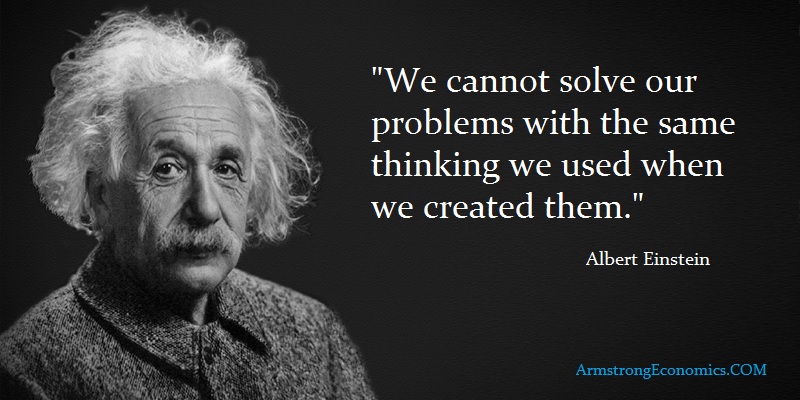
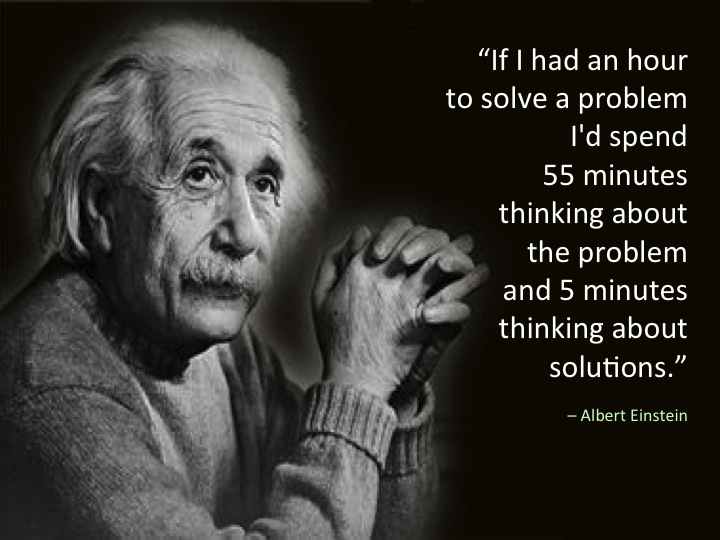
Albert Einstein We cannot solve our problems with the same thinking we used when we created them.

QUESTION: The bounce in the Euro is a fool’s’ game?

ANSWER: Absolutely. The Euro is doomed because especially if Le Pen loses, Brussels will be relieved and proceed as usual. The same problems will merely exist and no reform will come forward to save the day. A good wind will blow over the European banking system. You are expecting politicians to admit they were wrong and surrender power in Brussels. NOT GOING TO HAPPEN. As Einstein said, you will NEVER solve the problem of the Euro with the same thinking process.

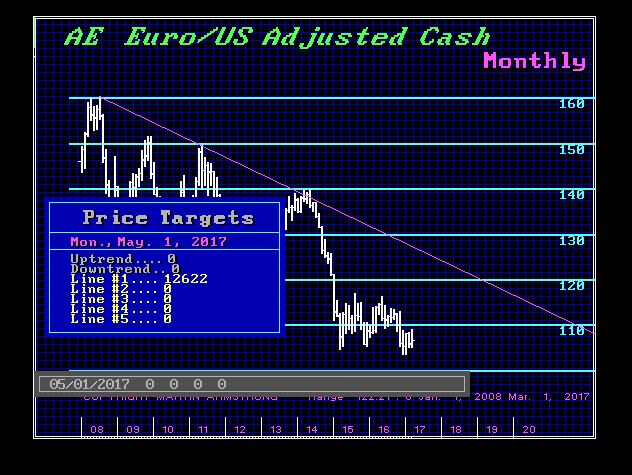
IBEUUS-M 4-24-2017

As weekly closing above the 10860 level in the Euro will imply the rally will press high to test the 112-114 level. Just look at the technical perspective on a monthly level. The Downtrend Line stands in May up at 12622. We are nowhere near reversing the trend in the Euro.

We have the French, British, and then German elections here in 2017. We do not expect total chaos before 2018. That seems to be the point of a major shift.

If US Election Were Held today – Trump Would Get More Votes Polls Show


Trump Sworn In

The latest polls show that most people who voted for Trump are satisfied. When the same questions have been asking about Hillary, the opposite response appears. The polls are actually showing that Trump would win a greater margin today than last year. This is interesting for it is confirming the collapse in government with Big Bang that began on October 1st, 2015.

BIG BANG ECM 2015.75

Big Bang was the start of the collapse in confidence in government. This cycle should intensify starting in 2018 running head long into 2020. This is all good for the volatility in markets we see ahead. This is the same trend that produced BREXIT and just wiped out all mainstream parties in France.

The French Elections & Socrates


QUESTION: Mr. Armstrong, I saved you article from November 25th last year where your computer forecast the collapse of mainstream politics. Macron was not even in the picture back then. Have you recalculated now that all the parties collapsed and it is Macron v Le Pen?

Image12

ANSWER: I am very familiar with France. I was supposed to debate Michel Sapin, the Finance Minister of France on national TV. He backed out.

As you can see in that article, the only way to approach this is to look at the philosophy rather than the party since we were showing that the parties would collapse as they have done. I concluded that article writing:

“Clearly, the socialists are finished. However, we are within this 10 year window between 2013 and 2023. This clearly shifts the favor toward a new power. Le Pen can win within this window. However, expect this to be also very divisive as in the United States.”

We could extrapolate and say all other party members will vote for Macron. However, that would just be a guess. The wildcard now is we know that Le Pen will get probably 30% for that is her hardcore base. The question becomes, what portion of the other parties will now vote for Le Pen. Keep in mind that the Euro will rally as fools think this will save the day if she loses. Such an event will only postpone the inevitable for the same thinking process will remain in place.

Einstein solving