The Federal Reserve Bank of Dallas believes that mass deportation efforts will negatively impact US GDP. Projections speculate that GDP could decline by nearly a percentage point in 2025, followed by larger cuts in the coming years.
GOVERNMENT SPENDING IS FACTORED INTO GDP.
I have repeatedly warned that Donald Trump would be blamed for the stagflation we are experiencing, when in reality his policies could not have impacted a cycle that was already in motion.
The study used a baseline scenario where 2.4 unauthorized migrants were deported in 2025, leading to a 0.8% drop in GDP for 2025. In a scenario where 1 million migrants are deported annually through 2027, the study believes GDP could decline by 0.9% in 2025 and 1.5 percentage points by 2027.
The study states that the labor force will contract as a result of closed borders, which is not a reflection of reality, as Americans are filling the roles once taken by non-foreign-born workers.
The problem is the brain-dead method used to calculate GDP. Government spending happens to be one of the main components of GDP. Cutting the public sector, for example, cut into GDP as even the salaries of government employees are factored into calculations.
GDP=C+I+G+(X−M)
C is consumer spending,
I is business investment,
G is government spending on goods and services,
X is exports,
M is imports
An untold fortune has been spent on open border policies. New York City alone believes migrant-related costs will reach $12 billion by mid-2025. The House Budget Committee stated in a 2024 report that American taxpayers were forced to pay at least $150.7 billion on “President Biden’s open border policies,” but that is a low estimate.
The American people are forced into increased taxation as a result of these policies. GDP calculations are a disaster and too warped to reveal the true health of the economy. Stagflation was inevitable, but the academics will continue to blame Trump-era policies that have had absolutely zero impact on the ongoing cycle.
Posted originally on Jul 14, 2025 by Martin Armstrong
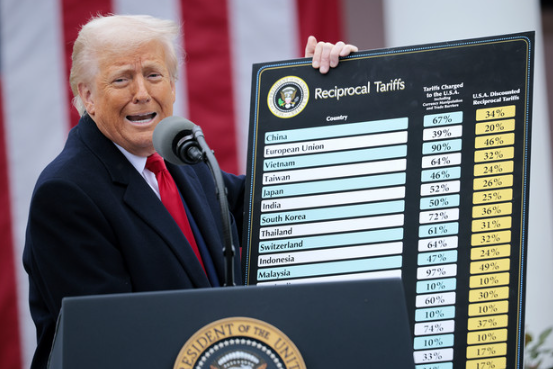
The Council of Economic Advisers (CEA) issued a new report that found tariffs are not to blame for inflation. In fact, the cost of imported goods has fallen this past year to a lower level than that of overall goods.
“CEA’s directional findings using this method of analyzing the PCE are consistent across core goods (excluding food and energy), durables (which last for at least three years), and nondurables,” the report reads. “The import contribution to inflation includes both the direct impact of imported final goods for consumption and indirect effects of imported intermediate inputs.”
Imported goods fell by 0.8% while the price of overall goods remained stagnant. The PCE index rose 0.4% from December to May or a 1% annualized rate, according to the CEA’s findings. Yet, the imported portion of PCE fell by 0.1% during the same period.
“The results clearly show the price of imported components declining, starting in March, while overall prices were close to unchanged or increased slightly,” the report reads. “Cumulatively, overall PCE prices have increased by about 1.1% since December compared to about 0.2% for PCE import prices. However, those values include pricing for services, which tend to have lower import intensity, so the divergence could be due to stickier services prices.”
The agency concluded “there is no clear trend break” this year in prices, despite the headlines claiming tariffs are the reason inflation remains above target.
Posted originally on Jul 11, 2025 by Martin Armstrong
The Minutes Report by the Federal Reserve indicates that the central bank is unlikely to cut rates at the next Federal Open Market Committee meeting on July 29-30. FOMC members unanimously maintained the borrowing range between 4.25%-4.5% where it has stood since December 2024. The central bank knows that it has limited power to control inflation through rate cuts, and stimulating demand is a moot point when the government is the largest borrower.
Instead of noting that the government simply borrows in perpetuity, Fed members focused on uncertainty surrounding tariffs and a potentially weakening labor market. Chairman Jerome Powell stated that cutting rates was a “closer call” as the 2% inflation target as been out of reach for several years. “With regard to the outlook for inflation, participants expected that inflation would continue to move toward 2 percent, although they noted that recent higher-than-expected readings on inflation, and the effects of potential changes in trade and immigration policy, suggested that the process could take longer than previously anticipated,” the FOMC minutes said. The last CPI reading was 2.7% with the PCE coming in at 2.4%.
The ongoing Trump v Powell feud is potentially spilling over into policy. Despite non-foreign-born citizens picking up over 2 million jobs as a direct result of deportation efforts, the Fed believes that the weakening labor market could be the result of deporting cheap labor. “Almost all participants judged that upside risks to the inflation outlook had increased. As reasons for this judgment, participants cited recent stronger-than-expected readings on inflation and the likely effects of potential changes in trade and immigration policy,” the minutes said. Unemployment fell to 4.1% with June posting an increase of 147,000 jobs.
The Fed is also blaming Trump’s tariff policies for inflation. “Ultimately, the cost of the tariff has to be paid, and some of it will fall on the end consumer,” the Fed Chair told reporters in June. “We do expect to see more of that over the course of the summer.” Powell is confusing a one-time price adjustment with a monetary-driven inflationary wave that began in 2015 and soared after the pandemic. As previously noted, “almost all” participants saw trade policy as an upside risk to inflation. “Many participants noted that the eventual effect of tariffs on inflation could be more limited if trade deals are reached soon, if firms are able to quickly adjust their supply chains, or if firms can use other margins of adjustment to reduce their exposure to the effects of tariffs,” the Minutes stated.
A ”couple” of members stated rate cuts could happen at the next meeting, with Fed Governors Michelle Bowman and Christopher Waller going on record to say that they believe rate cuts are appropriate this month. “Several” officials said the overnight rate “may not be far” from target, believing a bit of adjustment could bring inflation to target. The “dot plot” of individual officials indicates a divide on the outlook of cuts.
The Minutes Report noted that two rate cuts could potentially happen in 2025, followed by additional cuts over the next few years. Powell has less than a year left in office, and the president is certain to appoint someone who will abide by his policy that he sees through the eyes of a borrower and not a lender.
Posted originally on Jul 8, 2025 by Martin Armstrong
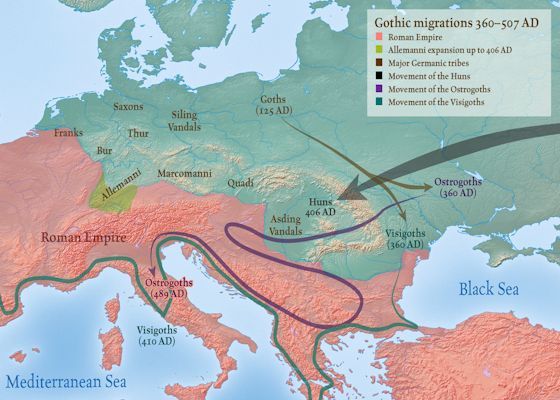
The globalists refuse to declare the migrant crisis an “invasion,” but we have history’s guidance to show us what happens when an unsustainable number of people enter a nation. The Goths, a non-military group considered migrants, are a perfect example. These men, women, and children sought refuge within the Roman Empire. This was not an invading army but rather a fleeing population seeking safety from the Huns. The Goths, long-time foes of the Romans, appealed to be admitted to Roman territory due to the threat they faced and needed to seek asylum. This event led to significant consequences and marked a turning point in the history of the Roman Empire.
The great Gothic migration involved hundreds of thousands of men, women, and children. While, to some degree, the growing unrest in the East pushed them southward, there is also little doubt that the border defenses of the Roman Empire had also been seriously weakened by the political instability and economic pressures that were building within Rome itself. Of course, the rumor of great plunder and riches available in Roman territory acted like a magnet much in the same way as the rumors of streets paved in gold in America prompted great European migrations during the 19th and early 20th centuries or the outdated stereotype of the American Dream.
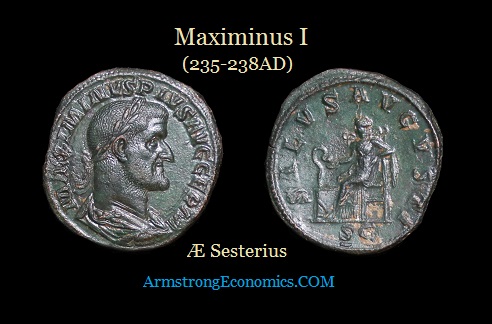
By 238 AD, the Gothic position was so threatening to the Roman Empire that Emperor Maximinus was forced to pay them vast amounts of tribute, similar to how countries currently pay all expenses for migrants. While his aim may have been to buy time, this demonstrated weakness on the part of the Romans, who were still in the middle of internal political struggles for power. Internal imperial rivalries ultimately defeated Maximinis. Within less than four years thereafter, the Goths began a series of raids along the Danube.
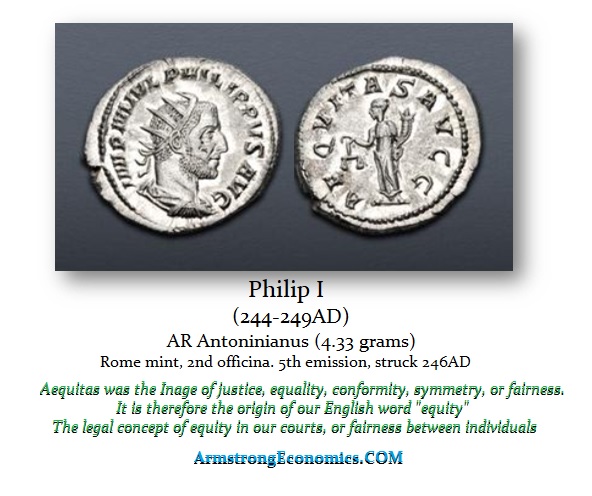
A decade later and Philip I attempted to quell the influx of migrants, but died while battling his successor, Trajan Decius. Rome was simply decaying gradually from internal struggles, which weakened the economy and constantly pitted one legion against another in a struggle for power. We see internal struggles today throughout the West as politics continue to divide the people. The Romans did not consider the Goths to be a force that would threaten the entire Empire, but rather more as a barbarian force looking for plunder rather than power.
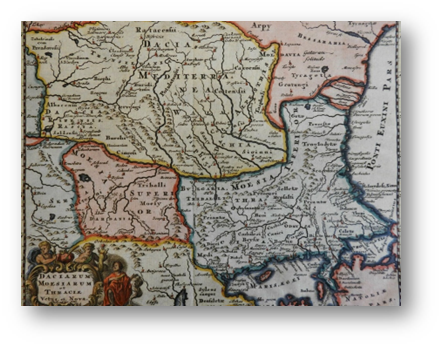
Trajanus Decius declared the Goths an enemy and attempted to force them out of the empire, only for the masses to return a year later. The Goths were prepared this time and formed several strategic alliances with enemies, such as the Dacian Carpi. This led to a full-scale invasion, and the Roman Empire suddenly found itself besieged as war raged on in Moesia, Dacia, and even in Thrace, while the main body of the Gothic invasion was preparing a descent into the region of the Black Sea.
After many battles, the Goths emerged as the new masters of the entire Danube territory, all the way to the Black Sea. Trebonianus Gallus emerged as the new Emperor who could do nothing to reverse the Empire’s humiliating defeat. The Goths now turned to Illyricum and Thrace, burning and plundering their way across the region. By 253 AD, the Goths set sail along the Black Sea, headed straight for Asia Minor, which was wide open and waiting to be plundered.
The Roman Empire was declining until Emperor Aurelian came to power and began restorative efforts, including anti-immigration policies. He not merely launched defensive measures, he moved on the offensive against the Goths and demolished them through a series of battles. The Goths were driven out of the Balkans and into Dacia. Aurelian also greatly restored the Black Sea defenses, which helped those regions rebuild their economies as well. However, Aurelian failed to pursue the barbarians into the Roman province of Dacia, pulling back and establishing the new border once again along the natural border as originally defined by Augustus – the Danube.
Aurelian’s decision to redraw the borders left Dacia in the hands of the Carpi and the Goths. Once the Goths were contained, they began to divide into two distinct groups – Ostrogothic and Visigothic kingdoms. These groups would evolve into powerful states that would ultimately bring down the Roman Empire in the West.
Those in favor of the Gothic migration stated that the newcomers would increase tax revenue and benefit the Roman economy. It was a humanitarian crisis and Rome’s responsibility to solve. Instead, the unsustainable influx of Gothic refugees contributed to the eventual fall of the Western Roman Empire. The event marked a turning point in Roman history and was part of a period in which the Roman Empire nearly collapsed under the combined pressures of invasion, civil war, plague, and economic depression. History always repeats.
Posted originally on Jul 7, 2025 by Martin Armstrong
The primary difference between mutual funds and ETFs (exchange-traded funds) is that while an open-end mutual fund is priced once based on the market closing, ETFs, as well as closed-end mutual funds, trade all day. This actually goes back to the Panic of 1966 when mutual funds were open-ended but traded on the exchange and were bid up and down based on emotion rather than net asset value. The crash took place because mutual funds were, at times, selling well above net asset value.
If we look at the reforms post-1966, investors in mutual funds buy or sell them directly from the mutual fund companies themselves. That creates a different tax structure than an ETF in which purchases go to the market and the ETF is simply created by purchasing the underlying basket.
Mutual funds and most ETFs are governed by the Investment Company Act of 1940. Therefore, this legislation treats them like a pass-through company. When a mutual-fund investor wants to sell, the fund sells shares of appreciated stock to generate cash, which creates a taxable capital gain. Since most funds operate as simple pass-through vehicles, those tax liabilities from the gains accrue to all investors in the fund, including those who have not sold any holdings.
ETFs actually do avoid that type of tax issue. ETFs are not direct buyers or sellers of shares as a mutual fund. The ETF is created by a market maker with a special contract with the ETF provider. The investor has the newly created ETF share, which is created by purchasing all of the holdings in the underlying ETF. This basket of shares is given to the ETF issuer, thereby creating the ETF shares.
Because an ETF is not a direct buyer of the underlying shares as in a mutual fund, the ETF itself is not a buyer or seller. The basket of shares is swapped and is therefore an in-kind transaction; thus, there is no pass-through capital-gains tax bill. This is the tax advantage of an ETF over a mutual fund.
Posted originally on CTH on June 29, 2025 | Sundance
“Elbows up” and knees bent. As expected given the nature of their dependency, the Canadian government has rescinded the digital services tax against U.S. tech companies.
The June 30th collection is halted and the Canadian government led by Mark Carney will be bringing legislation to rescind the tax entirely.
CANADA – […] Minister of Finance and National Revenue, the Honourable François-Philippe Champagne, announced today that Canada would rescind the Digital Services Tax (DST) in anticipation of a mutually beneficial comprehensive trade arrangement with the United States. Consistent with this action, Prime Minister Carney and President Trump have agreed that parties will resume negotiations with a view towards agreeing on a deal by July 21, 2025.
The DST was announced in 2020 to address the fact that many large technology companies operating in Canada may not otherwise pay tax on revenues generated from Canadians. Canada’s preference has always been a multilateral agreement related to digital services taxation. While Canada was working with international partners, including the United States, on a multilateral agreement that would replace national digital services taxes, the DST was enacted to address the aforementioned taxation gap.
The June 30, 2025 collection will be halted, and Minister Champagne will soon bring forward legislation to rescind the Digital Services Tax Act. (LINK)
In the bigger picture Canada has a serious problem.
Canada is entirely dependent on the USA; there is no part of the Canadian economic system that can survive without total dependence on the USA. The Canadian economy is currently stagnant and their leftist government is desperate to find a way to collect revenue somehow, any way possible. Additionally, President Trump is going to end the USMCA trade agreement and shut down a majority of the benefits Canada has been extracting.
The most remarkable aspect to this reality is the denial within Canada. There are maybe a handful of honest Canadian economists, financial types and/or pundits who understand economic matters that are willing to outline and explain the details of Canada’s vulnerability…..
…. The rest are in denial, shouting ‘elbows up’ as if that is going to change the inevitable. The pretending is strong amid the snow Mexicans. Their denial is a mass formation psychosis. Stunningly so.
Posted originally on CTH on June 28, 2025 | Sundance
CTH has continually said that almost no one in Canada has any grasp of what is about to happen within their economy, specifically because only a handful of people realize what President Trump intends to do.
This interview with Kevin O’Leary is a case study in what I have been warning about. If you have any financial affiliation with O’Leary Ventures or ancillary investments that touch on a dependency therein, be forewarned.
O’Leary is only a few months away from exploding against President Trump in a manner that will make the Elon Musk statements about Epstein and Trump seem small by comparison. As yet another Canadian financial voice that just doesn’t get it, O’Leary has no idea the USMCA is about to end. And when it does, oh boy… he will go bananas.
Posted originally on Jun 26, 2025 by Martin Armstrong
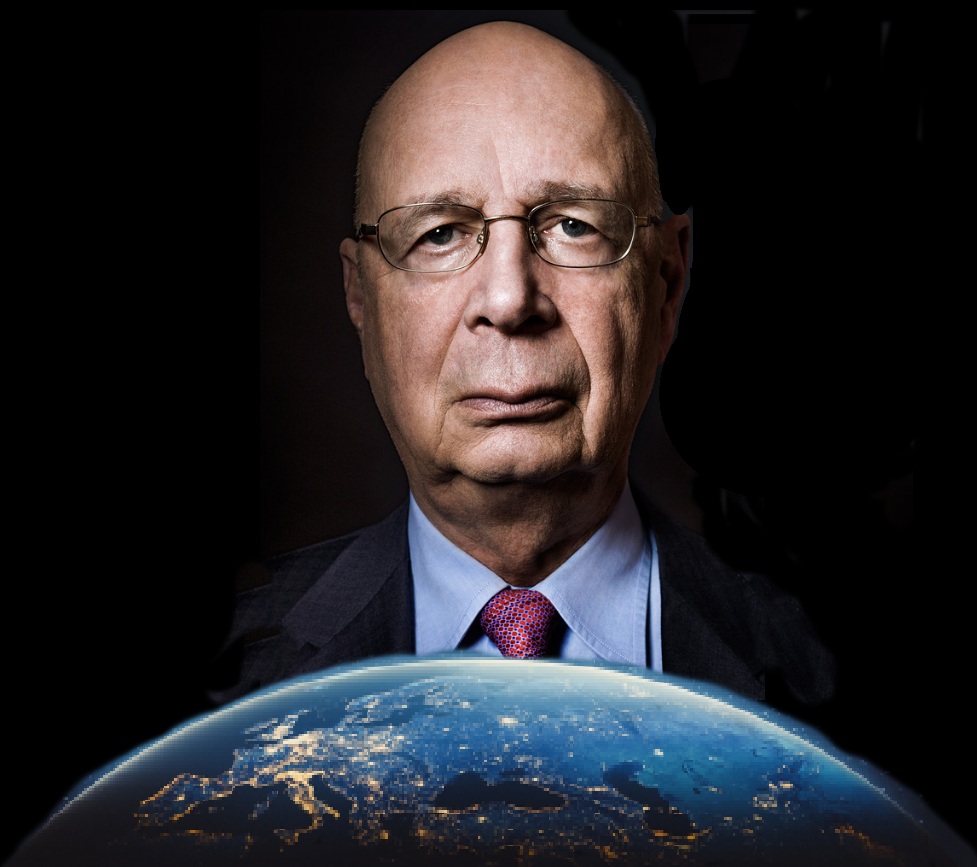
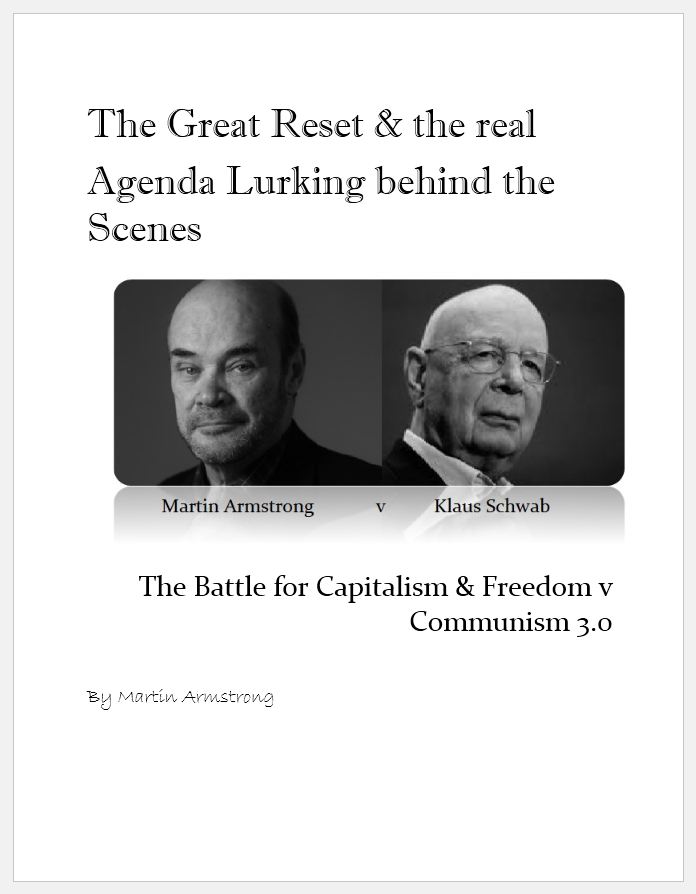
World Economic Forum founder Klaus Schwab stepped down from his chairman position at the organization on April 20, 2025, amid accusations of fraud. Our computer had forecast that the WEF would enter a declining trend with the 2024 ECM turning point. This staged coup happened about 37 years after the first Davos meeting (8.6 x 4.3). From our model’s perspective, this was right on time. Now, Schwab and the WEF are working to repair ties.
An anonymous whistleblower claimed that Klaus Schwab and his wife collaborated with USAID to steal tens of millions in funding. The whistleblower has always been anonymous, and it remains very suspicious that the very organization he created would turn on him after receiving an anonymous letter that they admitted may not have been credible. Something like this would never be acceptable in any court of law, especially if it’s anonymous. It would be the worst or the worst hearsay, where you cannot even point to who made the allegation.
Back in April, the WEF said its board unanimously supported the decision to initiate an independent investigation “following a whistleblower letter containing allegations against former Chairman Klaus Schwab. This decision was made after consultation with external legal counsel.”
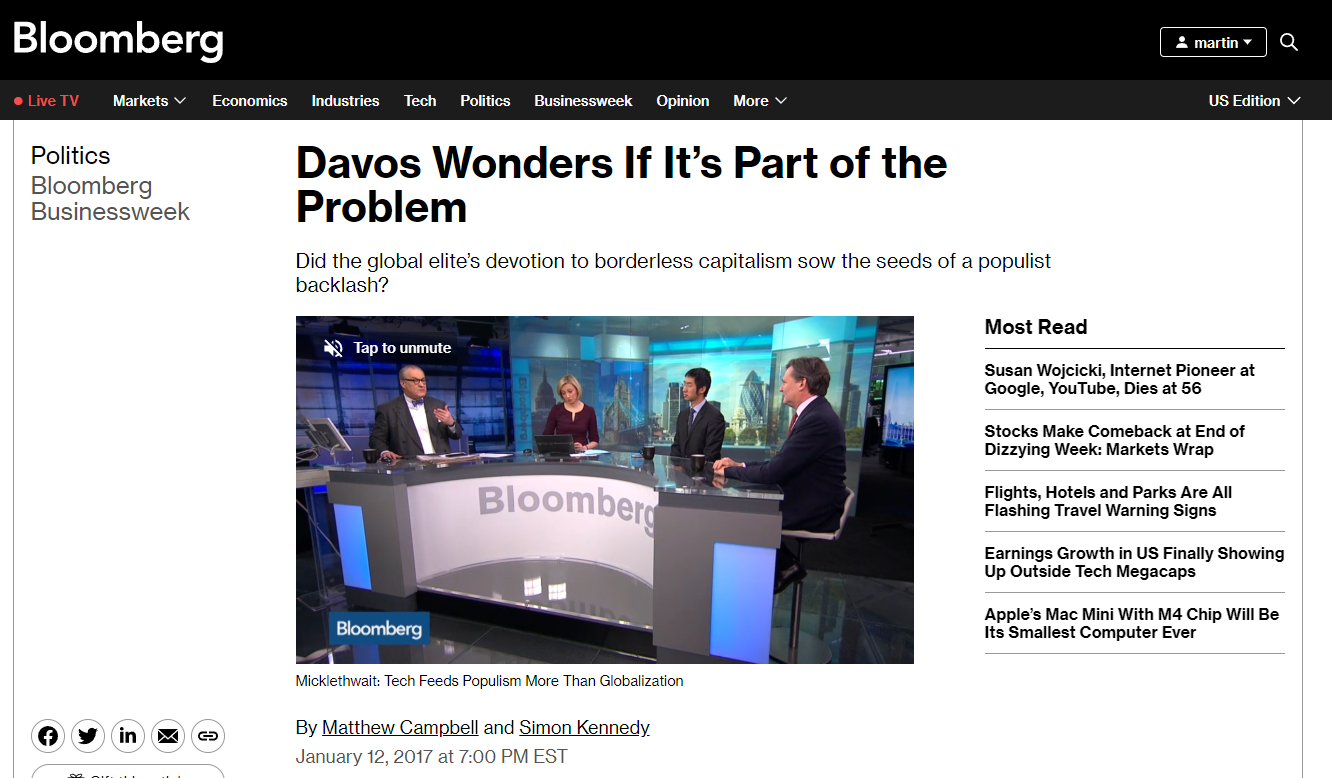
Now, the WEF is attempting to repair its relationship with its founder ahead of the next Davos meeting. Bloomberg reported that the WEF would like to “normalize their relationship [with Klaus Schwab] in order to safeguard the forum and the legacy of the founder.”
Peter Brabeck-Letmathe has replaced Schwab for the time being, but is less of a commanding force. Schwab’s sudden departure has caused instability in the organization and its ongoing mission. Board members are concerned that support for the organization will begin to decline as this situation remains unresolved.
The World Economic Forum’s annual revenue in 2024 was 440 million francs ($543 million), with the majority of proceeds coming from member companies and fees. Yet, the number of people registered to attend the 2025 Davos event is on par if not slightly exceeding the number of participants from the year prior.
Schwab’s departure has damaged the Davos brand. There is a possibility that the organization is attempted to rebrand after Agenda 2030 failed. The WEF attempted to move away from its zero tolerance stance on ESG initiatives after they became widely unpopular among the big industry players and shifting governments. The brand has attempted to integrate the importance of digital transformation and AI to remain relevant as the tech gurus grow in power and popularity. Those who are familiar with Klaus Schwab know the phrase, “You will own nothing and be happy.” These words have been widely unpopular and caused a type of sinister chaos to surround the brand that was once respected as the high-brow institution of globalist elites.
European Central Bank President Christine Lagarde was slated to replace Schwab in 2027 when her term ends, and all reports claimed that he was prepared to remain in the chairman role for an additional two years to ensure Lagarde could take his place. What changed seemingly overnight that would cause the organization to discard Schwab before he was due to retire?
Schwab denies any misconduct and filed lawsuits against the whistleblowers, calling the accusations “calumnious” and “unfounded.” He believes “character assassination” was the premise of the claims.
I am no fan of Klaus Schwab, as everyone knows. I disagree with his theories from start to finish. Nevertheless, something doesn’t smell right here. This appears to be an internal coup, perhaps to distract attention from the question of alleged funds for the WEF from USAID, or to try to salvage the failed Agenda 2030. Perhaps they will claim that no misconduct had occurred since DOGE did not raise concerns or there is a possibility that those behind the internal coup are concerned that Schwab’s counter lawsuit could uncover new corruption. The investigation into Schwab has not concluded, but after only three months, the WEF would like to wrap it up. It appears that the WEF does not want to welcome Schwab back; rather, they would like to ensure an amicable resolution to maintain both the brand’s reputation as well as the founder’s.
I have created this site to help people have fun in the kitchen. I write about enjoying life both in and out of my kitchen. Life is short! Make the most of it and enjoy!
This is a library of News Events not reported by the Main Stream Media documenting & connecting the dots on How the Obama Marxist Liberal agenda is destroying America










 Centinel2012