Posted originally on CTH on June 9, 2025 | Sundance
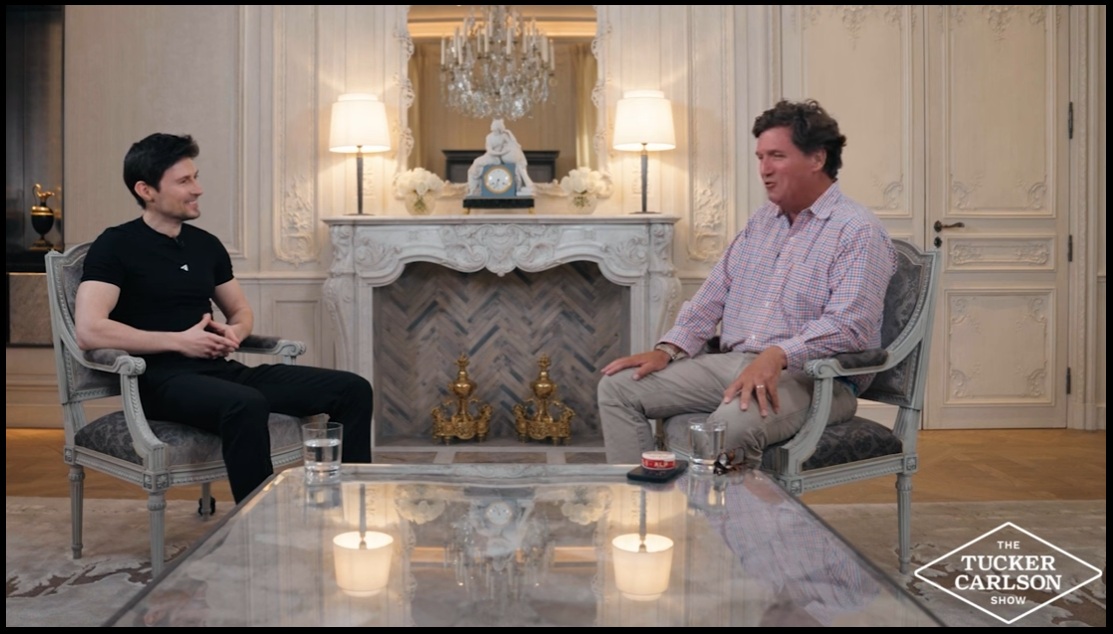
Tucker Carlson traveled to France in order to interview Telegram Founder and CEO Pavel Durov who remains in French detention as he awaits the judicial system to release him. Telegram is used as a messaging ap by over a billion users worldwide. Pavel Durov was accused of noncompliance with EU judicial demands and arrested during a holiday last year. He remains under quasi-detention confinement.
Many people have increasingly expressed annoyance at the change in Tucker Carlson’s interview style. The increased interruptions, wandering rambling that takes the point off subject, inappropriate -borderline annoying- laughter at the wrong moments, and increasing Hannityesque behavior has been a sidebar topic of conversation. However, this is the first interview in which I can say these distracting interview traits have become unbearable.
I really wanted to hear from Durov, but I could not survive the inappropriate timing of the interruptions, and increasingly odd mannerisms from Mr Carlson. From a mental strength, stability and intellectual perspective, Carlson is way over his head trying to interview Durov. Perhaps that explains the performative and seemingly odd behavior of Tucker in this interview. It gets worse as it progresses. See for yourself. WATCH:
.
Pavel Durov is a very deliberate man with an exceptionally stable disposition. He is one of the most important people in the world of information, communication and the free exchange of ideas. Yeah, I’m a little frustrated with this missed opportunity to go into important considerations in the world of information sharing.
Chapters: 0:00 Being Arrested in France 10:57 France’s Attempt to Humiliate and Tarnish Durov 15:54 Did the Russian Government Ever Try to Arrest Durov? 17:21 How Telegram Makes Money 20:04 Are They Attacking Durov Because He’s Russian? 21:19 Did Anyone Defend Durov? 24:23 What Did Durov Do in Jail? 25:17 Is Durov Allowed to Leave France? 30:37 The Real Reason They’re Attacking Durov 31:56 Europe’s Mission to Make Privacy Illegal 39:20 France’s Confiscation of Durov’s Phone 40:47 The Investigation Into Durov 56:52 How Telegram Stays Neutral in Global Politics 58:44 The Advancements of Encryption Technology 1:00:47 Is There Anything That Can Prevent a Government From Spying on You? 1:02:42 The Importance of Disconnecting 1:04:40 Durov’s Thoughts on Ross Ulbricht 1:06:54 Will Durov Stay in France After the Investigation?
Posted originally on Jun 5, 2025 by Martin Armstrong
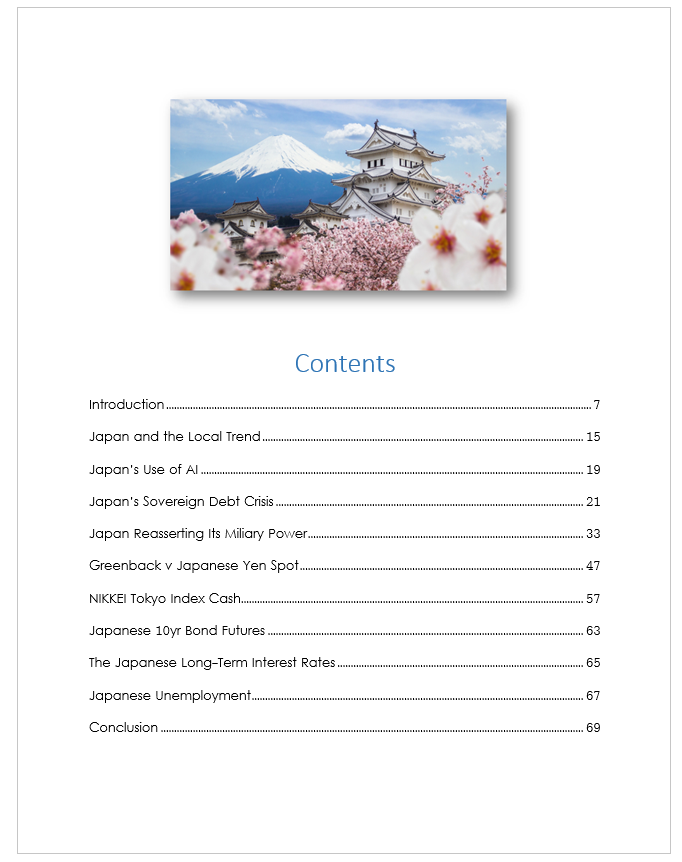
This is the first installment for our Institutional Clients concerning the two countries at the greatest risk of DEFAULT – Japan and Germany. We have provided the forecast for Japan’s default and explained in detail the internal battle between the Government, the Bank of Japan, and the Private Sector. This report exposes the truth about who holds what and the threat to instability as Japan also tries to cozy up close to NATO as a diversion for its fiscal mismanagement.
Investors have long fretted about the sustainability of Japan’s government debt as other nations, including Germany, are facing unsustainable fiscal mismanagement across the developed world. Japan has garnered the most attention due to its highest debt load relative to economic output and the heaviest debt-service burden. At the same time, the excuse has been that they are mostly self-funded, and as such, appearances are deceptive. Still, all Western nations are on a collision course with a sovereign debt crisis that will bring them all crashing down when the line at the door stops buying the new debt to roll over the old.
Japan’s fiscal mismanagement is not significantly worse than that of others. The pandemic, climate change, sluggish growth, and financial crises, accompanied by a lack of confidence, have led to an increase in government debt for many wealthy countries. At more than 250% of GDP, Japan’s gross debt stands out. Combined with sluggish growth and a shrinking population, many financiers and economists see it as an existential risk. The real question this report addresses is the real story behind the curtain, and when does this come to a head?
Posted originally on Jun 4, 2025 by Martin Armstrong
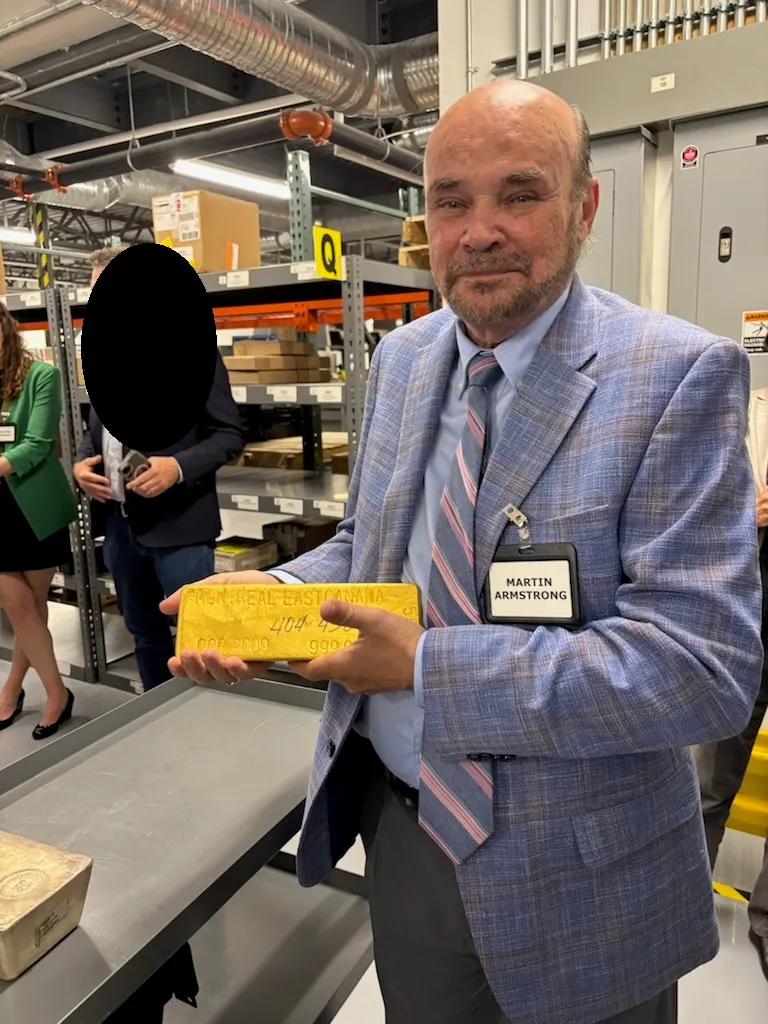
Holding a 400 oz Gold Bar – Central Bank Standard
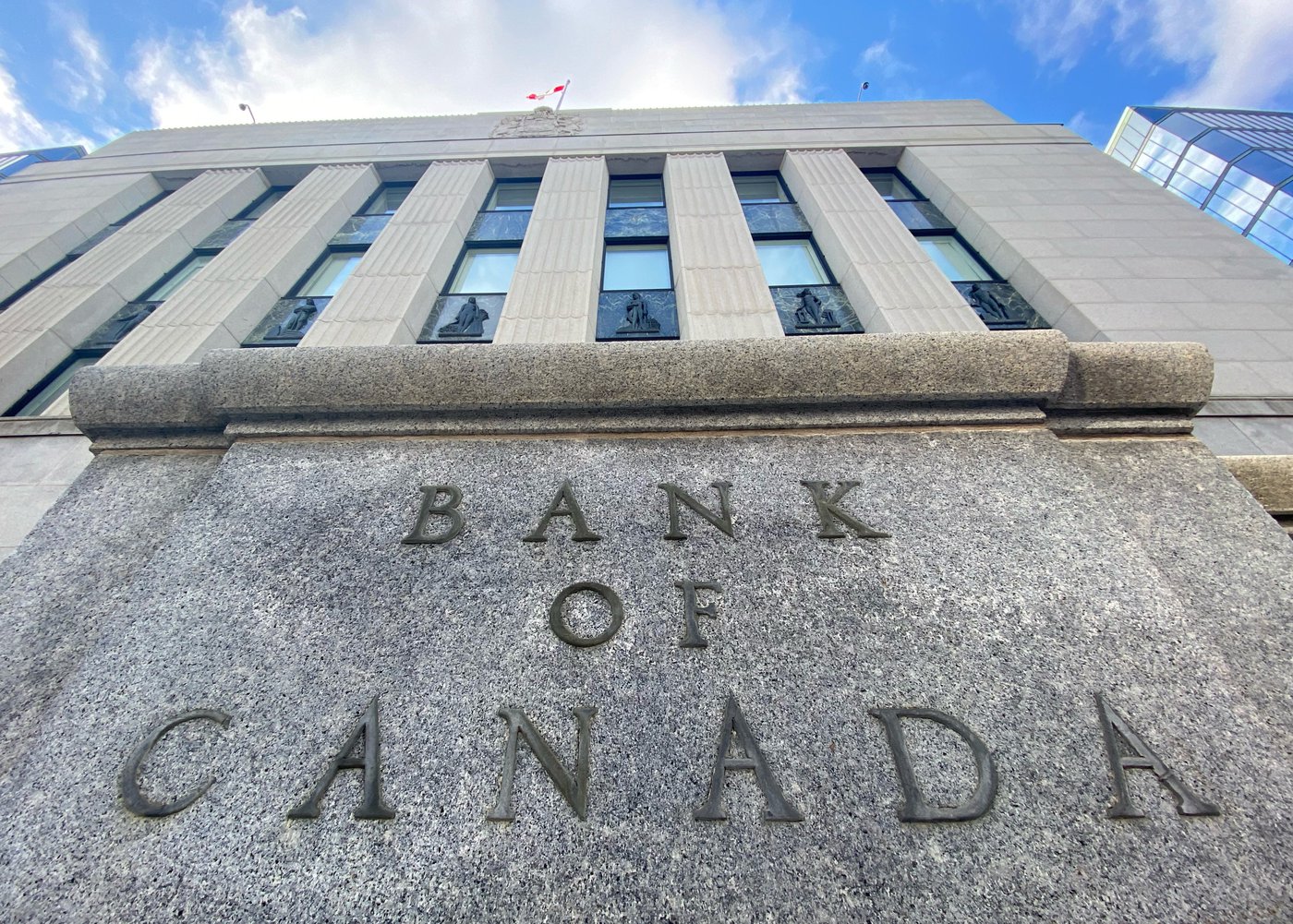
QUESTION: Hello Martin – Here in Canada, we have a vexing question – why no Gold Reserves at BofC? USA has a date with destiny aka Ft Knox Audit that Trump and Bessent seemed engaged on this file but are preoccupied lately with a litany of distractions, I’m 74 with health issues surfacing, which rearrange one’s priorities – many millions of Boomers in same boat – but that’s the price you knew was coming
jw
ANSWER: Canada’s lack of significant gold reserves is the result of a deliberate policy decision spanning several decades, primarily driven by the following reasons:
Opportunity Cost: Gold pays no interest or dividends. The Bank of Canada (BoC) decided it could achieve better returns by holding interest-bearing assets like foreign government bonds (US Treasuries, German Bunds, etc.) and deposits.
The Shift to More Liquid Assets: The BoC prioritized holding foreign exchange reserves (primarily US dollars, euros, yen, etc.), which are highly liquid and easily used for direct intervention in currency markets to stabilize the Canadian dollar (CAD).
Canada began the process of gradually selling off its gold in the 1980s, when gold rallied to $875 on January 21, 1980, and then began a 19-year decline to $250. Canada significantly accelerated its gold sales during the 1990s and early 2000s under the leadership of Finance Minister Paul Martin and Governor Gordon Thiessen, aiming to optimize reserve asset management. By 2016, Canada sold its last significant holdings. As of today, Canada’s official gold reserves are reported as zero tonnes (or negligible amounts – e.g., 77 ounces reported in 2022, worth a trivial sum relative to total reserves). In essence, Canada decided that the costs and lack of yield associated with holding large gold reserves outweighed the traditional benefits. They opted instead to hold foreign currencies and bonds that are easier to use for market intervention and generate income, relying on the strength of the Canadian economy itself to support the value of its currency.
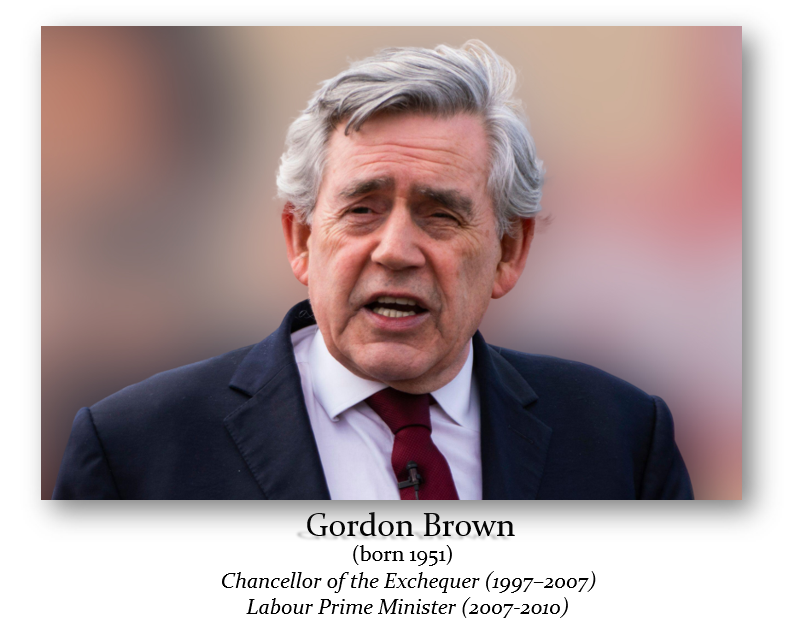
Gordon Brown, as Labour Chancellor of the Exchequer (1997-2007), authorized the sale of a very significant portion (roughly half) of the UK’s gold reserves. He was a member of the Labour Party, which viewed gold as a rich man’s toy. He sold approximately 395 tonnes of gold. The sales took place between July 1999 and March 2002. This represented about 58% of the UK’s total gold reserves at the time (which were around 715 tonnes before the sales). After the sales, the UK’s reserves stood at about 310 tonnes, where they remain today. The sales occurred during a period when the gold price was near a 20-year low, averaging around $275 per ounce. Shortly after the sales concluded, the gold price began a historic bull run, rising dramatically over the next decade to peak over $1,900 per ounce in 2011. This timing led to massive criticism that the UK sold at the absolute bottom of the market, potentially losing billions of pounds in potential value. The period is often referred to as the “Brown Bottom” in financial circles. Brown was ignorant of how markets function. He announced in advance the strategy to sell its gold reserves, so the market held back, anticipating a greater supply. The proceeds were invested in foreign currency and government bonds. While these assets generated interest income, the capital appreciation of gold vastly outstripped the returns on those bonds over the following years.
The head of the Bank of Canada during the main phase of Canada’s gold reserve sell-off (mid-to-late 1990s) was Gordon Thiessen (born 1938). He served as Governor from February 1, 1994, to January 31, 2001. Thiessen spent his entire career within the Bank of Canada, joining in 1963. However, it was his predecessor, John Crow (1987-1994), who began reducing its gold reserves significantly in the 1980s. While the Bank of Canada managed the sales operationally, the ultimate decision to sell the gold rested with the Government of Canada (specifically, the Minister of Finance and the Department of Finance). The Bank acted as the government’s agent in this matter.
Posted originally on May 31, 2025 by Martin Armstrong
QUESTION: Marty, There seems to be a growing trend with States approving gold and silver coins as acceptable payment methods. You have always said that it would be coins and not bars. However Florida now states that the silver must be 99% pure. How will this affect the pre 65 constitutional coins like dimes, quarters and half dollars generally referred to a junk silver? Junk silver coins will of course be worth more if the price of silver increases however it appears that one may not be able to use them for any daily transactions. Would one be better off selling their junk silver and converting it to silver rounds immediately? What does Socrates or Socrates Jr think on this topic as it is certainly a new wrinkle. Thanks ! JimJ
ANSWER: I understand the act, and it only illustrates my point that when it comes to a silver bar, 99% of the people out there would NEVER know the difference between that and a bar of Nickel. That’s what I said; I prefer the pre-1965 silver coins because the average person can easily identify the date. They are ALREADY legal tender. So they are not demonetizing the silver coins.
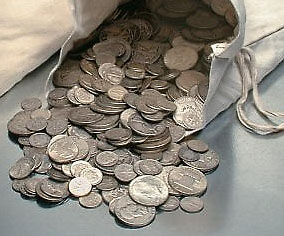
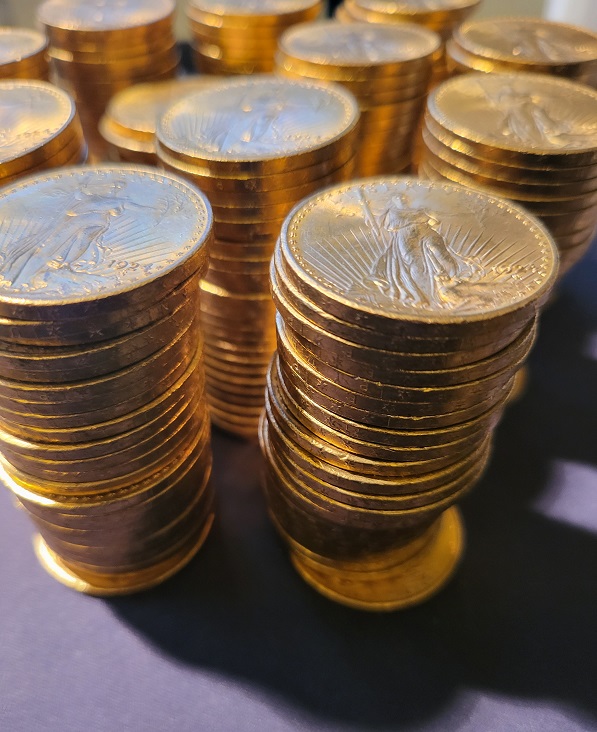
The Roll of 20 – 2025 $1 American Silver Eagles are 99.9% silver. However, they are denominated as $1. This may be more confusing to the average smuck on the street. Personally, I have bags of silver coins, and I have a hoard of $20 gold coins that came from a central bank, which found them tucked away in the basement vault. They are all uncirculated 1924 Saints. This was a private offering.
Posted originally on May 30, 2025 by Martin Armstrong
Happening now: @GovRonDeSantis is in Apopka to sign HB 999 which “sets in motion #Florida’s full recognition of gold and silver as legal tender, giving Floridians the freedom to use precious metals for everyday transactions alongside traditional currency.”https://t.co/fRkQpDJE7Dpic.twitter.com/dOMajgwAsj
Florida Governor Ron DeSantis has declared gold and silver legal tender. HB 999 maintains that these precious metals may be used in payments if they meet specific purity standards. The bill goes into effect on July 1, 2026, but many are confused as to what this will entail.
As stated in the legislation: “Legal Tender; Revising the sales and use tax exemption for certain coin or currency; specifying that a person who claims the sales tax exemption bears the burden for determining whether the gold coin or silver coin meets a specified definition; providing a presumption regarding the purity requirements of gold coin and silver coin, etc.”
“We are the first large state to step up and to get this done,” DeSantis said. “And this is right out of the Constitution of the United States. So this legislation will authorize money services business like check cashers or PayPal to transmit and accept payment in gold and silver.” State Rep. Bill Bankson sponsored the bill with the goal to “eliminate the tax burden and make it a functional means of transaction between willing parties.”
To begin, Florida is not the first state to declare gold and/or silver legal tender. Utah passed the Utah Legal Tender Act of 2011, which declared coins of either metal legal tender. Oklahoma passed Senate Bill 862 in 2014, recognizing U.S.-minted gold and silver coins as legal tender and exempting them from taxation. Kansas and West Virginia have similar policies. Texas has recognized these coins as legal tender and enacted legislation to protect them from state seizure. Wyoming treats gold and silver as currency and has exempted it from sales tax. South Carolina and Louisiana have similar policies.
Florida’s approach is a bit more structured. Gold coins must be at least 99.5% pure and silver coins at least 99.9% pure to qualify as legal tender. The weight and purity must be imprinted on the metal with the name or symbol of the mint refiner. Both will be exempt from sales tax. The state government may choose to accept silver and gold coins for payments on taxes, dues, charges, and debts. Yet, these transactions must be done electronically, and the coins will be held by a public depository while processing. A regulatory regime will be established to handle coinage, process insurance, record-keeping, licensing, and consumer disclosure agreements, which the Office of Financial Regulation will oversee.
Will Floridians see people using silver coins to check out at the grocery store? No. The law entails that payments in gold and silver coinage are entirely optional, and no person or business is required to accept them in payments. Merchants will not be required to attain knowledge on metal purity or have scales behind the cash register. The difference now is that businesses are allowed to accept them if they choose to do so. There are numerous tax benefits to choosing metal over cash.
If John Doe wants to purchase a boat from a dealership with gold, for example, the dealership must voluntarily accept the coinage but is in no way obligated to do so. Then the dealership has the burden of verifying the spot price of gold or silver rather than the state. However, if you go to a bank to cash a check, the bank will have the ability to offer clients payments in gold or silver coinage rather than cash. Another aspect to consider is that Florida will no longer add a sales tax on transactions in gold and silver, lowering the cost for businesses and consumers by around 6%.
This signals the ongoing loss of confidence in the federal government. States are rebelling against federal mismanagement and offering residents alternatives to move off the grid. People tend to hoard gold and spend paper. Gold and silver are not practical as daily commerce but are a symbolic store of wealth. We are entering a phase where sovereign debt will become toxic, and states will begin to prepare for the inevitable chaos coming from Washington.
originally on Posted May 30, 2025 by Martin Armstrong
The US economy contracted by 0.2% from January through March of 2025. This is the second Q1 estimate provided by the US Commerce Department, with a third on the way on June 26.
Imports surged into the US during Q1 as corporations aimed to avoid incoming tariffs. The 42.6% uptick in imports marked the fastest pace of goods arriving in the US since Q3 2020. Business investment rose 24.4% in Q1, with business inventories adding 2.6 percentage points to overall GDP. Federal government spending fell by 4.6%, the largest drop in three years, but a deduction from overall GDP calculations.
Real consumer spending rose by 1.2%, albeit far less than the 4% posted during Q4 2024 and revised down from the first reading of 1.8%. Other reports indicate that Americans are spending far more on the essentials like utilities, health care, and housing. The Fed’s preferred inflation measure (PCE price index) rose 3.6%. Persistent inflation has led to cautious consumer behavior and a decline in demand for goods, contributing to the overall weakened reading for Q1.
Discretionary retail fell by 3% this quarter to 23% as consumers are less likely to purchase items like clothing, furniture, and electronics. Durable goods experienced a significant decline of 19%. The University of Michigan’s survey noted that decreased confidence has caused the demand for big-ticket items to decline. A lot of the demand we did see in Q1 was spending to offset anticipated tariffs. Autos, for example, rose by 11% YoY in March alone, and Q1 saw an overall 4.8% in auto purchases. That trend is not expected to continue as consumer sentiment is low.
April’s 2.3% CPI reading was the smallest annual increase since 2021, yet still above the 2% target set by the Fed years ago. The Fed isn’t fighting inflation. That phase is over. What they’re really fighting now is a collapse in confidence in the bond market, the dollar, and in the entire public sector. There will be no soft landing as once anticipated, as we are currently in a stage of stagflation.
Meanwhile, Fed Chair Jerome Powell met Trump at the White House on Thursday to declare that rate decisions would be based on “careful, objective, and non-political analysis.” “I’ve never asked for a meeting with any president, and I never will,” Powell said. “I wouldn’t do that. There’s never a reason for me to ask for a meeting. It’s always been the other way.” Trump invited Powell to the White House to encourage him to cut rates at the June meeting. The markets were pricing in a rate cut in June but now that does not seem as likely.
Trump fails to realize that the Fed is attempting to preserve confidence in the US, primarily in the debt market. We are witnessing cash deficits of over $1 trillion per quarter. Moody’s recently downgraded the US and no longer believes that Treasuries are a certain bet. The government is broke and the Fed must maintain the illusion of solvency.
Posted originally on CTH on May 29, 2025 | Sundance
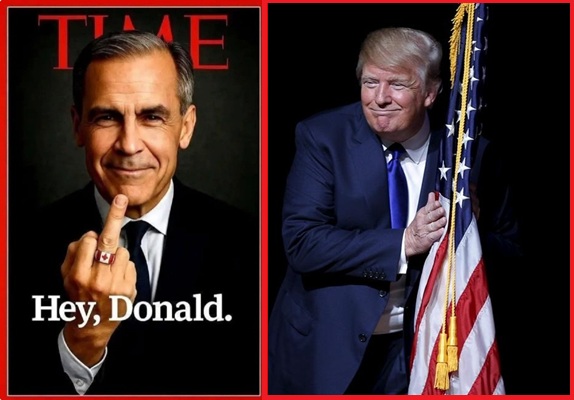
The current Canadian Prime Minister is genuinely a walking meme of a Canadian Prime Minister parody.
During his remarks to parliament today, Prime Minister Carney waxed gleefully about the U.S. federal trade court ruling against President Trump’s tariffs, just moments before the federal appeals court stayed the opinion of the lower court. It’s a little funny.
PM Carney doesn’t seem to recognize the reality of the economic landscape before him. He complains about blocked access to the U.S. consumer base with a level of entitlement that’s genuinely humorous. Meanwhile, the Canadian economy around him is collapsing. WATCH:
♦ BACKGROUND – Following the 2024 presidential election, Prime Minister Justin Trudeau traveled to Mar-a-Lago and said if President Trump was to make the Canadian government face reciprocal tariffs, open the USMCA trade agreements to force reciprocity, and/or balance economic relations on non-tariff issues, then Canada would collapse upon itself economically and cease to exist. In essence, in addition to the NATO defense shortfall, Canada cannot survive as a free and independent north American nation, without receiving all the one-way benefits from the U.S. economy.
To wit, President Trump then said, if Canada cannot survive in a balanced rules environment, including putting together their own military and defenses and meeting their NATO obligations, then Canada should become the 51st U.S state. It was following this meeting that President Trump started emphasizing this point and shocking everyone in the process. However, in the emotional reaction to Trump’s statements, no-one looked at the core issues outlined by Trudeau that framed President Trump’s opinion.
Representing Canada, Justin Trudeau was not expressing an unwillingness to comply with fairness and reciprocity in trade with the USA, what Trudeau was expressing was an inability to comply.
Quite simply, after decades of shifting priorities, Canada no longer has the internal economic capability to comply with a fair-trade agreement (FTA). Trudeau was not lying, and President Trump understood the argument; hence his 51st state remarks.
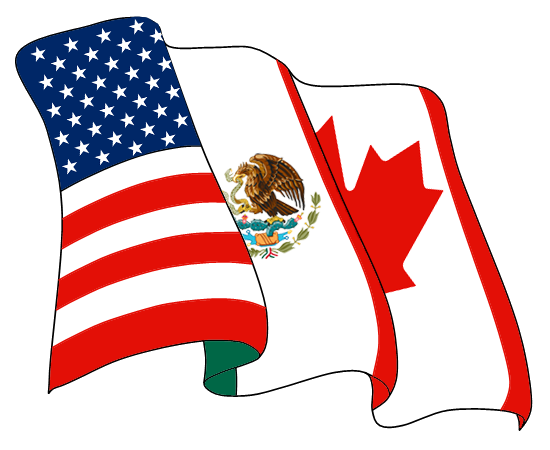
This is where it becomes important to understand the core reason why Trump, Ross and Lighthizer (2017) did not structurally want to replace the NAFTA agreement with another trilateral trade deal. Mexico and Canada are completely different as it pertains to trade with the USA. President Trump would rather have two separate bilateral agreements; one for Mexico and one for Canada.
♦ Firstly, Canada is a NATO partner, Mexico is not. As President Trump affirmed to Justin Trudeau during the meeting, it would be unfair of President Trump to discuss NATO funding with the European Union, while Canada is one of the worst offenders. Trump is leveraging favorable trade terms and tariff relief with the EU member states, as a carrot to get them into compliance with the 2.0 to 2.5% spending requirement for their military.
If the NATO member states contribute more to their own defense, the U.S. can pull back spending and save Americans money. However, Canada is currently 26th in NATO funding, spending only 1.37% of their GDP on defense (link).
Canada would have to spend at least another $15 billion/yr on their defense programs in order to reach 2.0%. Justin Trudeau told President Trump that was an impossible goal given the nature of the Canadian political system, and the current size of their economy ($2.25 trillion).
♦ Secondly, over the last 40 years Canada has deindustrialized their economy, Mexico has not. As the progressive political ideology of their politicians took control of Canada policy, the ‘climate change’ agenda and ‘green’ economy became their focus. The dirty industrialized systems were not compliant with the goals of the Canadian policy makers.
The dirty mining sector (coal, coking coal, ore) no longer exists at scale to support self-sufficient manufacturing. The dirty oil refineries do not exist to refine the crude oil they extract. Large industrial heavy industry no longer exists at a scale needed to be self-sufficient. Instead, Canada purchases forged and rolled steel component parts from overseas (mostly China). Making the issue more challenging, Canada doesn’t even have enough people skilled to do the dirty jobs within the heavy manufacturing; they would need a national apprenticeship program. Again, all points raised by Trudeau to explain why bilateral trade compliance was impossible.
♦ Thirdly, the trade between Canada/U. S and Mexico/U. S is entirely different. The main imports from Canada are energy, lumber and raw materials. The main imports from Mexico are agriculture, cars and finished industrial goods. Mexico refines its own oil; Canada ships their oil to the USA for refining. There are obviously some similar products from Mexico and Canada, but for the most part there is a big difference.
♦ Forth, USA banks are allowed to operate in Mexico, but USA banks are not allowed to operate in Canada. USA media organizations are allowed to broadcast in Mexico, but USA media organizations are regulated and not permitted to broadcast in Canada. The Canadian government has strong regulations and restrictions on information and Intellectual Property.
All of these points of difference highlight why a trilateral trade agreement like NAFTA and the USMCA just don’t work out for the USA.
Additionally, if President Trump levies a tariff on Chinese imports, it hits Canada much harder than Mexico because Canada has deindustrialized and now imports from China to assemble into finished goods destined to the USA. In a very direct way Canada is a passthrough for Chinese products. Canada is now more of an assembly economy, not a dirty job manufacturing economy.
When Trudeau outlines the inability of Canada to agree to trade terms, simply because his country no longer has the capability of adhering to those trade terms, a frustrated President Trump says, “then become a state.”
There is no option to remain taking advantage of the USA on this level, and things are only getting worse. Thus, the point of irreconcilable conflict is identified.
Because the Canadian government became so dependent on their role as an assembly economy, they enmeshed with China in a way that made them dependent. The political issues of Chinese influence within Canada are a direct result of this dynamic. In fact, China was the big winner from the outcome of the recent election because all of their investments into Canada are grounded on retaining Liberal government dependency.
If Trump targets China with punitive tariffs, the Canadian economy will be collaterally damaged. Canada will end up paying a tariff rate because they use cheap Chinese component parts in their finished goods. Canada has structurally designed their economy to do this over multiple years.
Understanding the unique nature of the Canadian economic conundrum, the only way to address the issue is to break out the USMCA into two separate bilateral trade agreements. One set of trade terms for Mexico that leverages border security, and one set of trade terms for Canada that leverages NATO security and border security. The only substantive similarity between them will be in the auto and agriculture sector.
If you think the multinational corporations, political leftists and UniParty Republicans in the USA are strongly opposing Trump now, just wait until later this year when the Trump administration proposes the elimination of the trilateral North American trade agreement, USMCA.
According to the World Bank, the USA economy is $27.3 trillion. Canada is $2.1 trillion.
Do the math!
[…] The expectation, according to two people close to the White House, is that negotiations to permanently remove the threat of painful 25 percent tariffs on Canada — which Trump mostly rolled back earlier this month — and other sector-specific tariffs are likely to be folded into the upcoming review of the U.S.-Mexico-Canada Agreement. That review is due in 2026, but the Trump administration wants to accelerate to this calendar year.
“It makes sense to separate out Canada and Mexico from the rest because they are going to want to redo the USMCA,” said one of the people close to the White House, who were granted anonymity to discuss ongoing deliberations. “They’re going to have separate tariffs that focus specifically on Mexico and Canada, and they’re going to take some actions to squeeze them a little bit.” [LINK]
I have created this site to help people have fun in the kitchen. I write about enjoying life both in and out of my kitchen. Life is short! Make the most of it and enjoy!
This is a library of News Events not reported by the Main Stream Media documenting & connecting the dots on How the Obama Marxist Liberal agenda is destroying America







 Centinel2012