Posted originally on CTH on August 11, 2025 | Sundance
The intellectually honest political watcher knows that overall Ukraine represents the largest international money laundering operation to shift wealth from taxpayers to the politically connected institutions, since COVID-19. The money is the motive to continue the conflict.
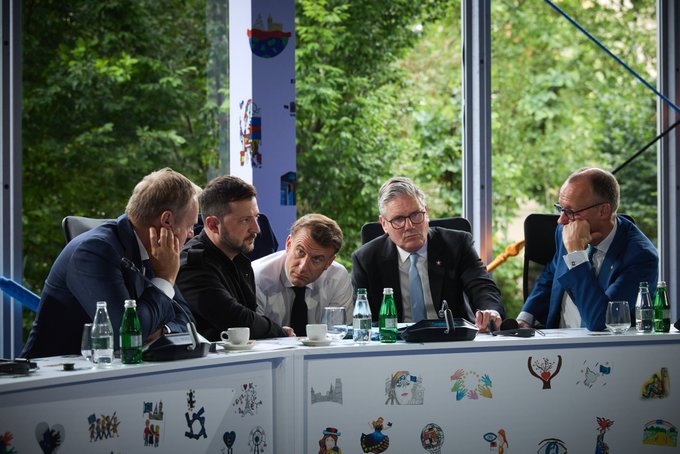
With President Donald Trump and Vladimir Putin scheduled to meet in Alaska for a summit to negotiate a ceasefire, German Chancellor Friedrich Merz quickly organizes a meeting between EU leaders and the U.K to figure out how the keep the war going.
As the industrial capital of the EU, Germany has a lot at stake given the nature of their contracting economy. The EU military industrial complex is centered around the nation Merz represents. There are trillions at stake.
BERLIN — U.S. President Donald Trump will join European leaders including Ukrainian President Volodymyr Zelenskyy for an emergency virtual summit on Wednesday.
The call, organized by German Chancellor Friedrich Merz, comes ahead of Friday’s summit in Alaska between Trump and Russian President Vladimir Putin on the war in Ukraine.
The virtual summit will focus on pressure options against Russia, questions about Ukrainian territories seized by Russia, security guarantees for Kyiv and the sequencing of potential peace talks, a German government spokesperson told POLITICO.
Merz and other European leaders demand that Putin first agrees to a ceasefire before any peace talks or land swaps between Moscow and Kyiv can take place. They have also made clear that any potential territorial exchanges must be balanced and agreed with Kyiv, and that Ukraine should receive firm security guarantees to protect it against further aggression.
Three diplomats told POLITICO that Merz’s team had been in intensive discussions with other capitals in recent days to organize the virtual meeting. (read more)
Posted originally on Aug 8, 2025 by Martin Armstrong |
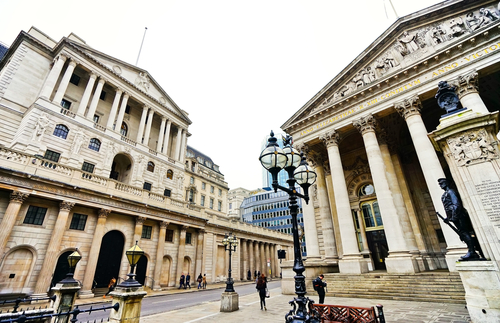
The Bank of England has cut its base interest rate to 4%, even as it warns of rising inflation. “We’ve cut interest rates today, but it was a finely balanced decision. Interest rates are still on a downward path, but any future cuts will need to be made gradually and carefully,” Governor Andrew Bailey stated.
The nine-member panel of the Monetary Policy Committee voted to lower rates by 0.25 percentage points, but failed to reach a unanimous vote with four members wishing to pause and another voting for a cut. The committee initially began with a 0.5 percentage point vote before reducing it to 0.25, marking the first time the MPC has needed a second vote—no one knows what they are doing.
The bank lowered rates but admitted that headline inflation is expected to hit 4% in September, up from the initial 3.75% estimate. Households are already spending one-tenth of their income on food, yet the bank expects food inflation to spike to 5.5% this year.
The central bank attempted to blame grocery store employee wages for price increases. “Furthermore, overall labour costs of supermarkets are likely to have been disproportionately affected by the lower threshold at which employers start paying NICs… these material increases in labour costs are likely to have pushed up food prices.” Every nation is facing a sharp upturn in food prices and store employees are not the culprit. The bank also acknowledged that unemployment has risen for five consecutive months, with unemployment reaching a four-year high in May 2025 at 4.7%.
The central bank cannot fight inflation as consumer demand is not driving price increases. Russian sanctions, net zero insanity, regulation, taxes, and an overall decline in public confidence have led Britain to decline. Let us not forget the looming sovereign debt crisis that every central bank is attempting to ignore publicly. Starmer is steering the nation directly into war, which never benefits the people and will become the primary culprit of inflation in time. The central bank cannot control fiscal policy; it cannot control inflation—all it can do is pretend to have a grasp on the situation to quell panic.
Posted originally on Jul 30, 2025 by Martin Armstrong
The fact that Trump is threatening sanctions against India for buying Russian oil and to hammer Russia to somehow force Putin to his knees and accept whatever terms Europe demands, proves that Trump is now taking advice from Lindsey Grachm, NATO, their puppet EU leaders, and the Neocons with the likes of Cheney in the background witgh a HUGE smile on her face.
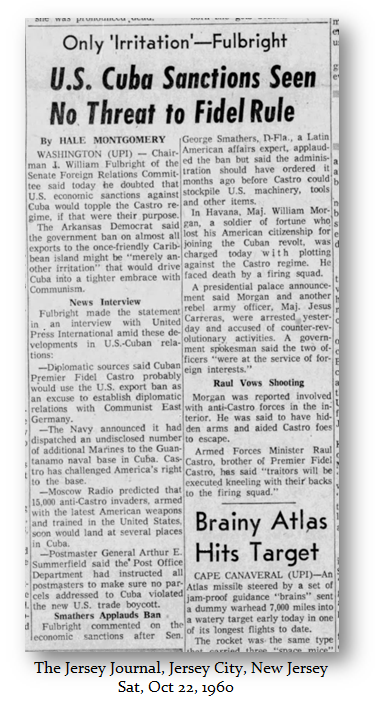
Cuba (1960s-present): U.S. sanctions have failed to topple the Castro regime or force democratic reforms. Despite economic hardship, the government adapted through alternative trade partners and domestic resilience, suggesting sanctions can entrench regimes and slter the world economy, which has taken place with the development of BRICS. The U.S. embargo (blockade) against Cuba remains in place, requiring Congressional action to lift it entirely. While some sanctions have been eased temporarily, no administration has completely ended them. After more than 60 years, this stands as a prime example of how sanctions have NEVER worked even once.
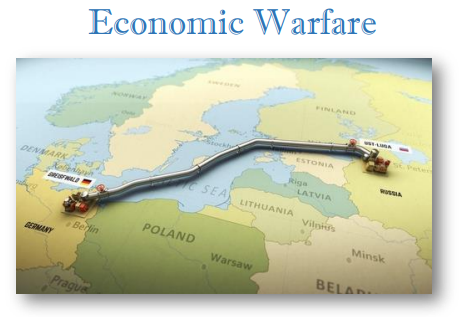
The United States has imposed sanctions on German and other European companies involved in the construction of the Nord Stream 2 gas pipeline, which was designed to transport Russian natural gas to Europe. In 2019–2021, the U.S. sanctioned firms like Swiss-based Allseas (forcing it to withdraw) and later targeted Russian and German entities.
The U.S. imposed sanctions on the Soviet-European gas pipeline in 1982 (under Reagan), targeting Western companies supplying equipment for the Urengoy–Pomary–Uzhhorod pipeline, which supplied gas to Western Europe. The U.S. opposed this project due to concerns over European energy dependence on the USSR. They, too, failed and had to be relaxed under Allied pressure.
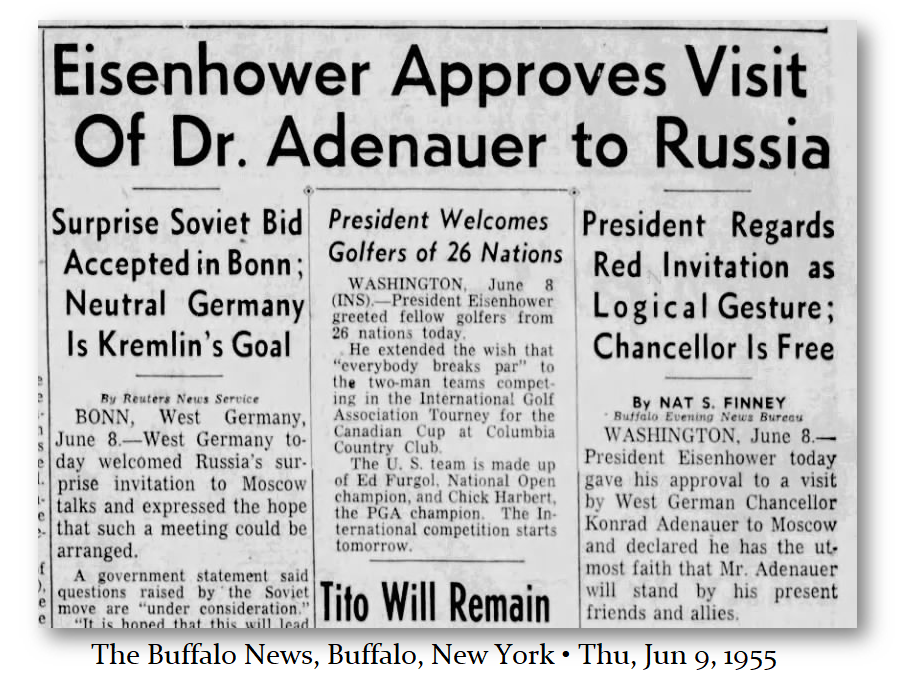
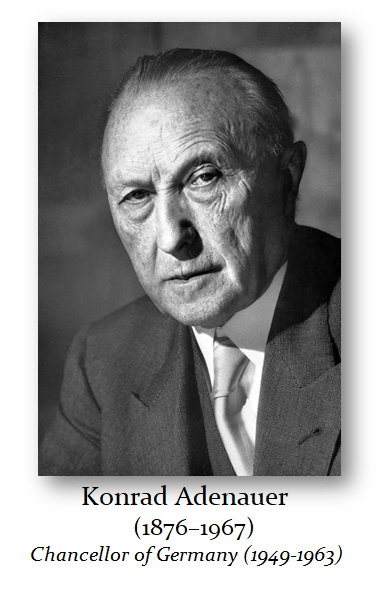
The Neocons, from the outset of any negotiations between Germany and Russia back in the communist days, did everything in their power to deny Germany access to Russian energy. It was 1955 when West German Chancellor Konrad Adenauer (1876-1967) visited Moscow in June and then established diplomatic relations for the first time between the new Federal Republic of Germany and the Soviet Union. The Neocons were outraged, but President Eisenhower saw it as no threat given Adenauer’s oppression by Hitler. The Necons wanted to prevent any meeting but Eisenhower declined.
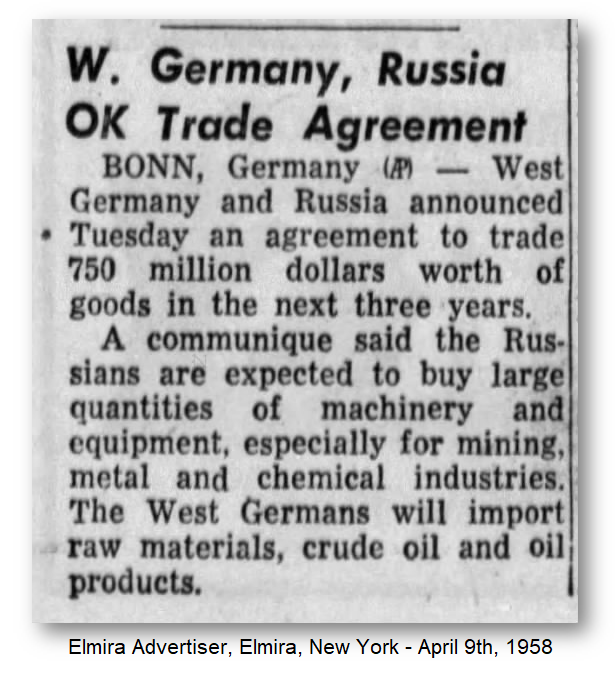
Adenauer was Chancellor from 1949 to 1963. Adenauer was one of the first opponents of the leader of the Nazi Party. Konrad Adenauer helped draft a constitution completed in May 1949. He opened the door for the trade agreement that followed in 1958, and by 1960, bilateral trade between the countries was booming.
The Trade Agreement was reported worldwide by the Associated Press on April 9th, 1958 (1958.271). Even so, from the very beginning, that trade link between Germany and Russia was controversial, to say the least. The United States, at the direction of the Neocons, was always against it and would criticize Germany behind every closed-door session. However, the US intimidation failed because it was necessary for the German people and their future.
While the U.S. did not impose formal sanctions on German pipe producers in 1955–1958, it actively discouraged such trade, setting the stage for the 1960s pipe embargoes. The major crackdown came later, but diplomatic and economic pressure began in the late 1950s.
Iraq (1990s): UN sanctions after the Gulf War devastated the economy, reducing GDP by nearly 50%, but Saddam Hussein’s regime remained intact. Political change only occurred after the 2003 invasion, not sanctions alone, and civilian suffering often strengthened regime propaganda.
North Korea (2000s-present): Decades of sanctions have crippled the economy but haven’t shifted the Kim regime’s policies or structure. Black market trade and Chinese support have mitigated impacts, and the regime uses isolation to reinforce control.
South Africa (1980s-1990s): Comprehensive sanctions, including trade bans and financial restrictions, the Neocons insist, contributed to ending apartheid. However, there was already internal resistance. It still took 14 years before any democratic reforms took place by 1994. Studies estimate that the sanctions reduced South Africa’s GDP only by 1-2% annually.
Iran (2010s): Heavy U.S. and EU sanctions targeting oil exports and banking, which the Neocons insist forced Iran to negotiate the 2015 nuclear deal (JCPOA). Oil revenues dropped by over 50% from 2011 to 2013, and inflation soared, but the regime did not fall. The regime didn’t fundamentally change its political system, showing again that sanctions have NEVER even once overthrown the core governance.
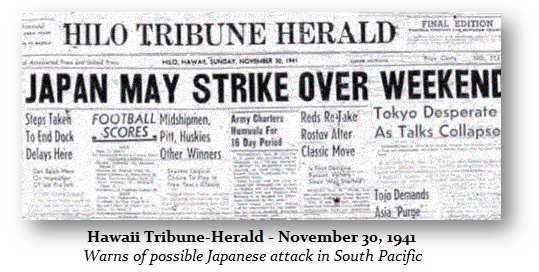
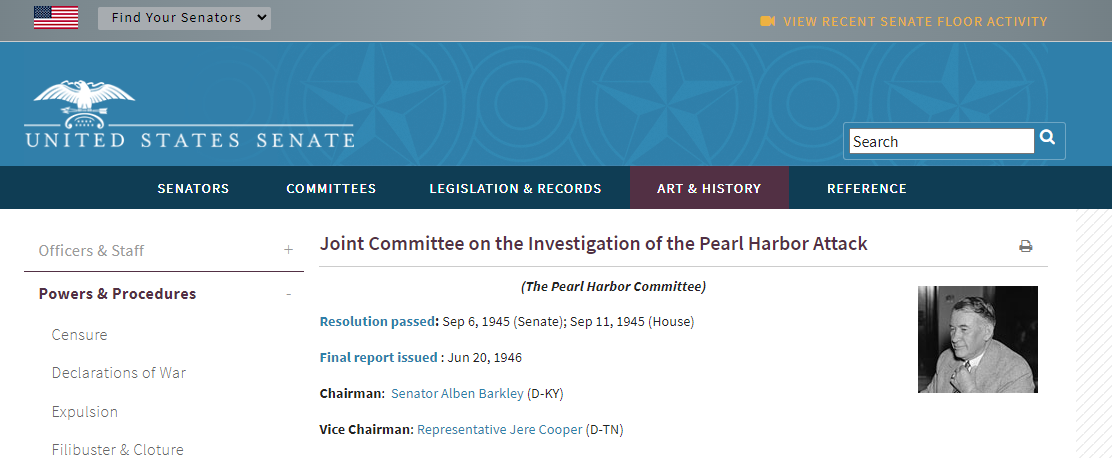
FDR deliberately imposed sanctions on Japan to get them to attack the United States, all because Congress would not authorize joining World War II in Europe. That led to a Senate investigation later because it became so obvious that FDR even knew when Pearl Harbor would take place and deliberately allowed thousands to be killed just so he could enter the war. It came out that US had broken the Japanese code and knew all about the attack. There was even a lead to the press a few days before reporting that they were about to be attacked.
Before the attack on Pearl Harbor on December 7, 1941, President Franklin D. Roosevelt (FDR) imposed a series of escalating economic sanctions on Japan in response to its aggressive expansion in Asia, particularly its invasion of China. These sanctions were meant to pressure Japan into halting its militaristic actions, but ultimately contributed to the tensions that led to war.
In 1938, FDR imposed a “moral embargo” on aircraft and aviation parts sales to Japan following its bombing of Chinese civilians. This was not a formal ban but a strong discouragement of exports. Then in July 1939, FDR announced the termination of the 1911 U.S.-Japan Treaty of Commerce and Navigation, removing legal barriers to future trade restrictions. This took effect in January 1940.
Now that the door was open for sanctions, in July 1940, the U.S. restricted exports of aviation fuel, lubricants, and high-grade scrap metal to Japan under the Export Control Act. That was followed by the September 1940 complete embargo on scrap iron and steel.
Then, FDR, like the West has done to Russia, froze all Japanese assets in the U.S. (July 26, 1941), effectively cutting off trade and financial transactions. That was followed by a complete oil embargo along with Britain and the Dutch government-in-exile. Since Japan relied on the U.S. for 80% of its oil, this was a crippling blow. FDR knew that Japan would take it as an act of war, as they then saw these sanctions as an existential threat, as they crippled its ability to fuel its military and industry.
The oil embargo, in particular, forced Japan to either negotiate a withdrawal from China (which it refused) or seize oil-rich territories in Southeast Asia (which risked war with the U.S.). The sanctions contributed to Japan’s decision to attack Pearl Harbor (December 7, 1941) to neutralize the U.S. Pacific Fleet before invading British and Dutch colonies. These sanctions deliberately pushed Japan toward a desperate military confrontation, culminating in the attack on Pearl Harbor and the U.S. entry into World War II, which was the objective of FDR from the outset. The outrage was so intense that in 1945, after the war, the Senate was forced to investigate FDR’s action and whitewashed the affair, claiming they were unsure if FDR had been fully advised of the Pearl Harbor attack in advance, even though leaks made the papers in advance.
There is NOT a single incident to demonstrate that sanctions have EVER worked. Nevertheless, the Neocons constantly advise heads of state to impose sanctions, hoping that they will bring about the collapse of that government. They will not work this time either and the real risk is that they will lead to war as we saw in FDR’s actions against Japan.
Posted originally on Jul 31, 2025 by Martin Armstrong
President Trump announced a 25% on India beginning August 1 due to its continued purchase of Russian oil. “Remember, while India is our friend, we have, over the years, done relatively little business with them because their Tariffs are far too high, among the highest in the World, and they have the most strenuous and obnoxious non-monetary Trade Barriers of any Country,” the president posted to Truth on Wednesday morning. “Also, they have always bought a vast majority of their military equipment from Russia, and are Russia’s largest buyer of ENERGY, along with China, at a time when everyone wants Russia to STOP THE KILLING IN UKRAINE,” he added.
India began drastically increasing its imports of Russian crude at the start of the Russia-Ukraine war in 2022, with good reason, as the oil became significantly cheaper and India was able to resell it at a premium to nations that simply wanted to bypass all things Russia. In January 2022, India was importing around 68,000 barrels per day (bpd) in Russian crude, which represented only 0.2% of crude imports. The war broke out a month later and by June India was importing 1.12 million bpd from Russia who overtook Iraq as the nation’s top supplier. Nearly a year later in May 2023, Russian imports peaked at 2.15 million bpd, with India currently importing around 1.7 million to 2.1 million bpd as of July 2025.
Around 35% to 40% of India’s crude oil now comes from Russia. Now, Russian crude was around $50 per barrel in May 2025 when imports to India peaked. Middle Eastern grades were around $10 to $20 higher at the time. The deal was a no-brainer.
India-US bilateral trade hit $118.4 billion in 2024. India exported approximately $79.4 billion in goods to the US and imported $39 billion. The current trade deficit with the US sits at $45.7 billion. A 25% tariff could cost India billions in lost revenue from exports and threaten jobs in key sectors such as autos, chemicals, jewelry, gems, electronics, and textiles. Other Asian exporters would become more desirable, but China actually purchases more Russian crude than India at this point and other nations in the region have drastically smaller economies. Estimates state India could risk losing $15 billion to $20 billion annually as a result of the 25% tariff.
Now, if India were forced to buy from the Middle East for $10 to $20 more per barrel, the nation would need to spend around $6 to $10 billion more on energy annually. India does refine and resells Russian crude and is said to bring in around $1.5 billion to $3.5 billion from that practice.
On paper, it would seem as if India has more to lose by continuing to purchase Russian oil. However, the US is showing the world that it has the ability to dictate political policy through economic warfare. India declared that it remains committed to continuing “mutually beneficial bilateral trade” with the US after the 25% tariff was announced. The US will go after all BRICS nations in an attempt to dismantle the alliance, but BRICS members have shown that they no longer need to rely on the West, and tariffs from the US may not hold the same leverage as they once did.
Posted originally on CTH on July 29, 2025 | Sundance
The reality of the U.S-Canada economic relationship and the position of President Donald Trump is not that difficult to understand if you take all the disparate datapoints and quotes from Trump and put them into context.
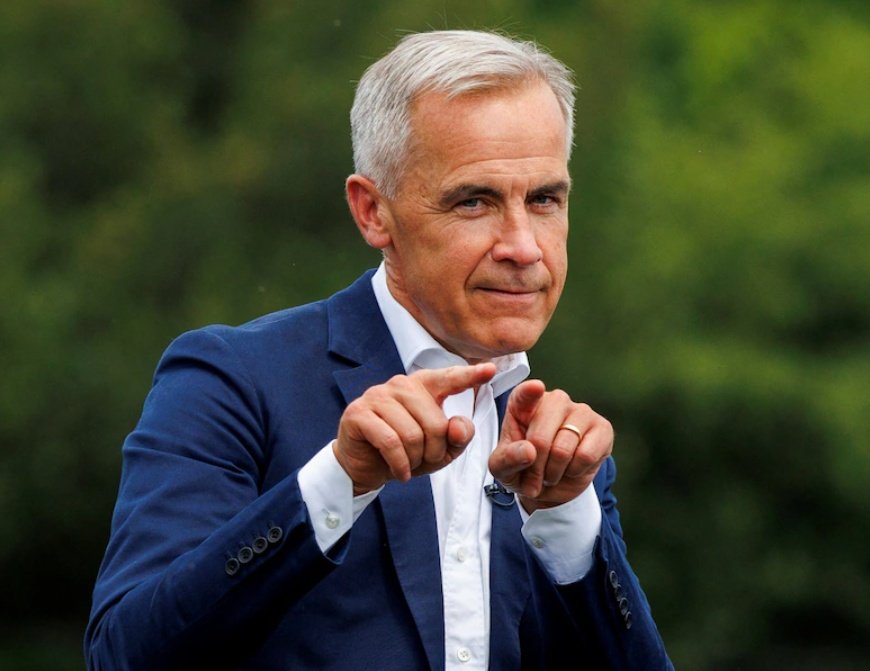
During a White House meeting with Mark Carney, President Trump essentially told the Canadian Prime Minister why he was in no hurry to get to a deal with Canada.
The 35% tariffs on non-USMCA goods are going to trigger on August 1st, because the main priority of Trump -looking toward Canada- is to dissolve the USMCA.
During the May 6th oval office meeting with Carney, President Trump was discussing the USMCA and said: “As you know it terminates fairly shortly. It gets renegotiated fairly shortly.” … “This was a transitional deal, and we’ll see what happens, we’re going to start renegotiating that” … “I don’t know if it serves a purpose anymore.” …. “And the biggest purpose it served was, we got rid of NAFTA.”
To understand why President Trump wants to dissolve the USMCA {SEE HERE}. To understand the technical value of dissolving the USMCA {SEE HERE}. It’s not a complicated economic analysis; it’s common sense.
Currently, approximately 60% of the traded goods and services between the U.S. and Canada are covered by the USMCA; the remaining 40% will be hit by tariffs on August 1st at a 35% rate.
When the USMCA is renegotiated, predictably dissolved in favor of two bilateral trade agreements – one for Mexico and one for Canada, all of the U.S-Canada trade sectors will be part of the enlarged free trade negotiation. As a result, there is absolutely no motive to engage in trade discussions now.
♦ President Trump’s position is essentially to talk about the details when the USMCA is dissolved; hence, the ambivalence.
Politico is noting the Canadian trade team simply doesn’t understand this. “[D]espite months of back and forth, the terms for a deal have not yet been set, a senior government source said, with the White House informing the Canadian side that Trump is more focused on securing deals with other partners like India.”
(Politico cont..) […] Earlier this month, Canada conceded that any deal with Trump is likely to include tariffs.
Carney’s government wants stability around the tariffs Trump invoked using Section 232 of the Trade Expansion Act.
They are crushing Canada’s auto, steel, aluminum and forestry industries. Trump also plans to hit imported copper with 50 percent tariffs starting Aug. 1 — with semiconductor and pharmaceutical imports likely to follow.
Canada ultimately wants the tariffs eliminated or lowered to a fixed level that doesn’t fluctuate, the senior government official said. “If we know what world we’re going into, then we can have better plans and policies to attract investment.”
Canada’s premiers say the unpredictability is punishing the economy.
“Private investment is not growing because everybody’s on pause,” Quebec Premier François Legault told reporters last week. “They are waiting to see what will happen. I’ve been in business — it’s about the worst thing you can have is uncertainty.” (read more)
The certainty the Canadians are looking for can be found easily if they stop pretending.
(1) U.S. tariffs against non-USMCA products from Canada will go into effect on August 1st. (2) As soon as the USMCA is reopened, it will be dissolved. (3) After the USMCA dissolution, a bilateral free trade agreement between the USA and Canada will be negotiated.
Every current effort by Canada to change the nature of the trade system, between now and the reopening of the USMCA (to dissolve it), is futile.
Again, I’m not exactly sure why this reality is so challenging for the Canadian govt to understand.
I have created this site to help people have fun in the kitchen. I write about enjoying life both in and out of my kitchen. Life is short! Make the most of it and enjoy!
This is a library of News Events not reported by the Main Stream Media documenting & connecting the dots on How the Obama Marxist Liberal agenda is destroying America




 Centinel2012