‘My Carbon’: An approach for inclusive and sustainable cities was released in September 2022, and you were part of the test group. The WEF-funded “research” states cities account for 75% of all carbon emissions. As countless governments abandoned their morality to the Great Reset, cities are on track to reduce emissions by nearly half in the coming years. They even want to limit our personal carbon allowance, assisted by digital IDs and credit scores. Most notable in this paper is that COVID was merely a ploy to test how well the masses would comply.
They found three major developments:
COVID-19 was the test of social responsibility – A huge number of unimaginable restrictions for public health were adopted by billions of citizens across the world. There were numerous examples globally of maintaining social distancing, wearing masks, mass vaccinations and acceptance of contact-tracing applications for public health, which demonstrated the core of individual social responsibility.
Fourth Industrial Revolution technology breakthroughs – Advances in emerging technologies like AI, blockchain and digitization can enable tracking personal carbon emissions, raise awareness and also provide individual advisories on lower carbon and ethical choices for consumption of product and services. The World Economic Forum’s Scale 360 initiative demonstrates the use of fourth industrial revolution technologies across the whole life cycle of products and services.
There have been major advances in smart home technologies, transport choices with carbon implications, the roll-out of smart meters in providing individual choices to reduce their energy-related emissions, the development of new personalized apps to account for personal emissions, and better personal choices for food and consumption-related emissions. AI can also help strengthen circular economy business models like product as a service models, demand predictions, and smart asset management by combining real time and historical data from products and users.
There is a significant number of programs and applications enabling citizens to contribute towards carbon emissions by providing them in-depth awareness on the choices of personal carbon for food, transport, home energy and lifestyle choices.
These energy efficiency apps give suggestions and statistics regarding greenhouse emissions and offer ways to reduce your personal footprint. Keeping track of energy consumption in the home and motivating people to make lifestyle changes and to contribute your share towards the betterment of the environment.
Raised awareness and ownership for nature and environment – In the last few years, there is an increased awareness and public concern on climate change and specially among youth. The UNDP’s “Peoples’ Climate Vote” reflects that over 64% of people believe climate change is a global emergency. A new Pew Research Center survey in 17 advanced economies found widespread concern about the personal impact of global climate change: 80% of citizens say they are willing to change how they live and work to combat the effects of climate change. Young adults, who have been at the forefront of some of the most prominent climate change protests in recent years, are more concerned than their older counterparts about the personal impact of a warming planet in many public surveys.
The first point mentions that they implemented “a huge number of unimaginable restrictions for public health” and billions of citizens across the world blindly followed their guidance. There could have been a mass outcry or revolution, but the people stayed inside and followed instructions obediently.
The second point shows that a portion of the population is now on-board with the green agenda. People have downloaded apps to track their personal energy consumption, and going back to point one, feel a sense of personal responsibility. We saw numerous countries adopt digital IDs during COVID that restricted the movement of the people.
The third step notes that there is a raised awareness, and additional personal responsibility, for the state of the environment. At the time of the publication, a Pew Research Center poll of 17 advanced economies found that 80% of citizens wanted to change how they live and work to fight the effects of weather patterns. As Nicole Schwab stated in her leaked 2020 interview, the youth are at the forefront of this movement, creating climate change protests throughout the world.
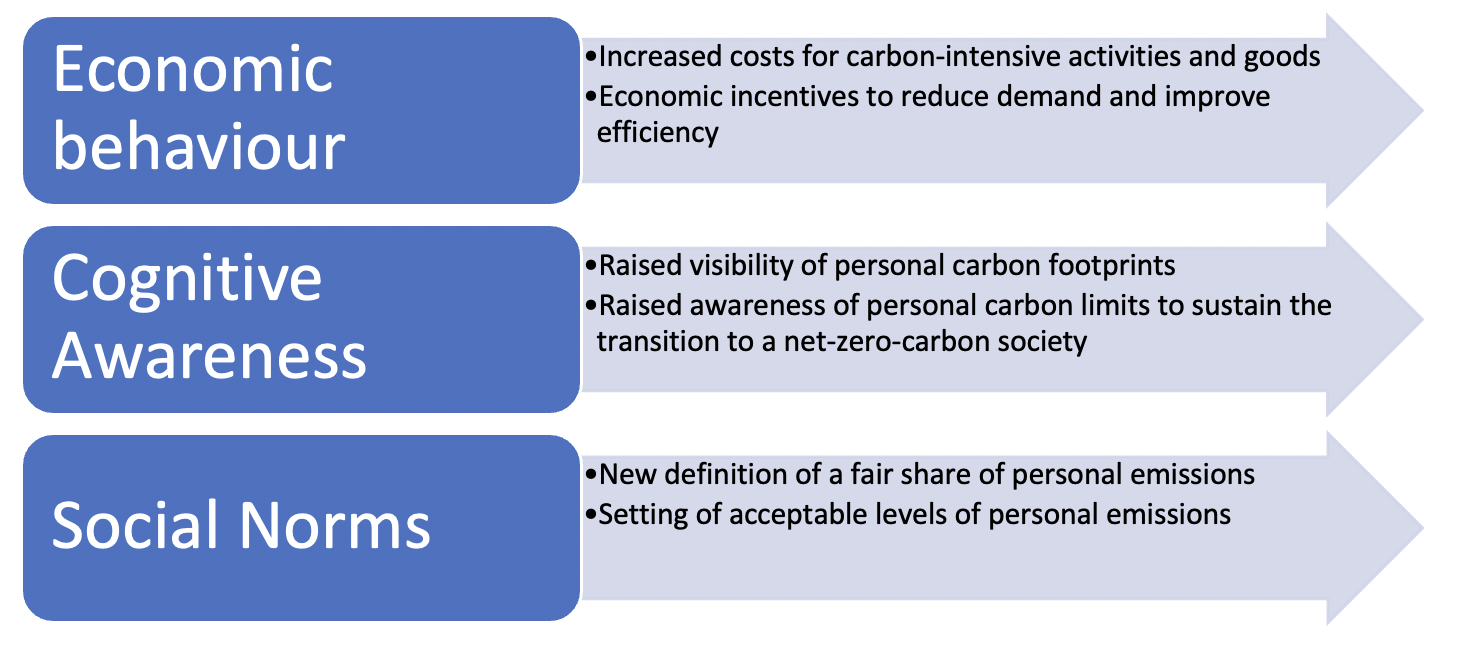
So this all breaks down into changing global economic behavior, cognitive awareness, and social norms. We see with the ESG scores that companies are punished for refusing to comply with the green agenda. The study states there are “incentives to reduce demand and improve efficiency,” but all we have seen are punishments. High gas costs, a loss of energy independence, banning gas and coal-powered items. Cognitive awareness is simply a way of saying brainwashing. They want the masses to believe that everything they do creates a carbon footprint that will certainly ruin the entire planet and cause a mass extinction. “They” fly on private jets throughout the week to discuss how the peasants can become a net-zero-carbon society.
Societal norms, the third noted trend, have allowed the Build Back Better crowd to determine what are considered acceptable levels of emissions. The masses want to obey, so those in power are slowly changing what is normal. Coal or wood-fired ovens? Selfish and harmful to society. Personal vehicles? You’re basically a climate war criminal!
None of the policies they wish to implement are normal. Resistance is NOT FUTILE. I, for one, will never be locked down again. I will not comply to climate lockdowns. I will not abandon my ability to move freely in society. I will not allow myself to be brainwashed to accept personal responsibility for naturally occurring cyclical weather patterns. They may have taken advantage of us during COVID, but hopefully, more people are waking up and seeing the truth – rules for thee, not for me.
The Canadian government does not want people sharing news stories online. The government should be the sole source of information. The Online News Act (Bill C-18) would require social media platforms and online sources to compensate Canadian news agencies for sharing news online. A report by Angus Reid found that 85% of Canadians do not subscribe to news outlets and primarily rely on the internet for information. The government cannot control what is published online (yet) but they can easily control official news agencies.
Google said the bill “breaks the way the web and search engines have worked for more than 30 years.” It prevents Canadians from freely accessing information, as those costs need to be reacquired somewhere. Any time someone interacts with a news article, the Canadian government wants a cut. In turn, major platforms such as Meta and Google have announced that they will no longer publish news articles by Canadian outlets.
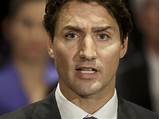
“In order to provide clarity to the millions of Canadians and businesses who use our platforms, we are announcing today that we have begun the process of ending news availability permanently in Canada,” Meta said in a statement. Dictator Trudeau has made a big push toward full media censorship.
“It’s like 1984,” Conservative Leader Pierre Poilievre stated. “You have a prime minister passing a law to make news articles disappear from the internet. Who would’ve ever imagined that in Canada, the federal government would pass laws banning people from effectively seeing the news? Who would’ve thought that we’d have a government that would pass a law to manipulate the algorithms of the internet?” Trudeau will continue to usurp as much power as possible at the expense of the Canadian people.
A man attempted to purchase strawberries with cash at an Aldi grocery store in the UK, possibly leading to his arrest. They want us to adjust to the cashless society that will implement globally by the World Economic Forum under its Digital Currency Governance Consortium. Some call cash “hard currency” to further differentiate it from the coming digital world of finance. Piers Corbyn, who happens to be the brother of British Labour Party leader Piers Corbyn, has gone viral for what many are calling an act of rebellion against the globalists.
The Aldi in Greenwich only accepts payments through the Aldi App. Aldi implemented this measure during COVID and never repealed it. Stores are commonly banning all cash transactions, and it is legal for them to deny cash. These stores may not realize that the WEF will soon implement one “globally coordinated approach to [digital currency] regulation” and their individual apps will be obsolete.
As for Corbyn, he placed his cash on the counter and left the store with his strawberries. People cheered as he left the store. Aldi employees called the authorities. “I’m offering exactly the right amount of money here,” he announced, “I’ve paid my legal tender.”
“Legal tender” is merely any form of payment accepted by law. So while the “hard currency” produced by the Royal Mint may be considered legal tender to some, the grey area here is that sellers do not need to accept it as a form of payment. So what was once a commonly accepted legal tender is now fiat, containing no intrinsic value without the backing of CONFIDENCE.
When the gold coin was money during the 19th century, it rose and fell in purchasing power no different than any paper currency. You cannot walk into a grocery today and pay in gold. People only accepted paper money because they knew others would accept it as a form of payment. Fiat is simply an arbitrary decree.
Governments are telling the people loud and clear that cash will be phased out. They are making us accustomed to the idea, gaslighting us into thinking digital is more convenient. The truth of the matter is that the day will come when they ask us all to turn in our “hard currencies” in exchange for CBDC. I applaud this man for his act of bravery and hope he was not arrested over a pint of strawberries.
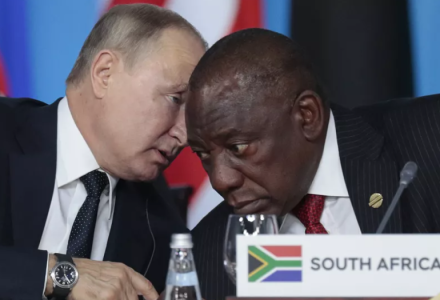
Putin invited numerous African leaders to St. Petersburg, where they discussed strengthening their alliance. The Russia-Africa summit gave Moscow a platform to show that it has not been isolated by all its allies. The biggest bargaining chip on the table was reimplementing of the grain deal. The UN has all but promised food shortages and famine in Africa caused by the war. Putin has now promised to begin shipping 25,000 to 50,000 tons of grain, free of charge, over the next three or four months.
Only 17 of 54 African leaders attended the conference, compared to the 43 who attended in 2019. The West is touting this as a win, but Moscow said many are afraid to enter the conflict. African nations simply want their people to prosper. Despite having valuable national resources, the continent is deeply indebted to the world. Russia agreed to cancel $23 billion in debt to African nations and hinted that their allies (i.e., India and China) may also offer aid.
South African President Cyril Ramaphosa said, “We are not here to plead for donations for the African continent.” Instead, they are looking to become a respected trading partner. President of Chad Mahamat called out Russia for failing to improve trade. “Putin vowed to double Russia’s trade with the continent within five years. Instead, it has stalled at around $18 billion a year,” he stated. African nations want a seat at the table, shedding its colonist past that still indebts their people.
Putin has promised that the grain harvest will exceed expectations this year. African countries have a large bargaining chip here. The West provides Africa with more aid than Russia, but at what cost? Africa receives the vast majority of its grain directly from Russia and would certainly face food shortages without their help. Putin will need to offer African nations an opportunity to become a valued trading partner and get his other main global allies on board with the idea too.
Nicole Schwab, the offspring of World Economic Forum mastermind Klaus Schwab, admitted that COVID was simply a precursor for coming climate lockdowns. In the leaked video above from a June 2020 panel discussion in Switzerland, Nicole comments that COVID proved the world could strongly shift once people felt an extreme threat to their livelihoods. She notes that policymakers now have more power post-COVID, and changes need not be incremental. In the full video, she states:“So I see it as a tremendous opportunity to really have this Great Reset and to use this huge flows of money — to use the increased levers that policymakers have today — in a way that was not possible before to create a change that is not incremental but that we can look back and we can say this is the moment where we really started to position nature at the core of the economy. And there are plenty of opportunities and this is again a mindset of actually innovation technology and a business growth can happen with a positive impact of nature and kind of laying out some of these examples. Regenerative agriculture is, of course, a huge part of that as well.”
I will go into regenerative farming in another post, but it ultimately transfers the production of crops to the globalists under the lie of climate change.
Nicole Schwab stated that the youth would be the easiest to brainwash into accepting this new reality. “And one of the key reflection points here is also around engaging youth, and for me, it’s again, I come back to this shift in the mindset of the restoration generation can we conceive of ourselves as humans?” she stated. Hence, they are confusing children in schools about their identity and disrupting their sense of self at the core. They are teaching the youth the “facts” when they have no other point of reference.
Schwab’s daughter knows that lockdowns and power grabs may happen instantaneously. They studied the masses during the extended plandemic to see how well everyone would obey. The masses gave into the fear-mongering, permitted their own children to be injected with an experimental drug, covered their faces for years, and placed themselves on house arrest. The “fringe minority,” as Trudeau put it, was small enough to control and punish. The push toward 15-minute cities will enable the globalists to keep us in place at whim.
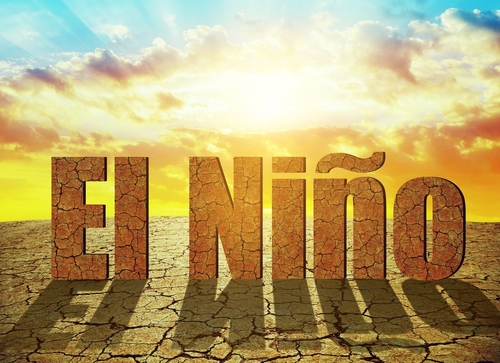
COMMENT: All of a sudden, El Niño is proof of global warming, just like the wildfires in Australia and California, as if these things never happened before. The sheep believe whatever the press tells them. That’s why you cannot stop the cycle, and 2032 is now not so far away.
HW
ANSWER: El Niño and La Niña are climate patterns in the Pacific Ocean that have impacted weather worldwide for centuries. This very intense cycle will increase the risk of famine in parts of the world from 2024 to 2025. Here is a chart of the temperaturesback to 1950. Look closely, and you will see that the cycle is very violent. It goes from hot and then plunges into a Panic Cycle type move immediately thereafter.
El Niño events are thought to have occurred for thousands of years, and only now are people claiming this is proof of humans changing the environment. It is believed that historically the Indians in Peru sacrificed humans to try to prevent the rains caused by a severe El Niño. Perhaps they might have had better success by offering politicians instead of virgins. These people latch on to anything and now with ZERO proof, they tell everyone that it is Climate Change that is making it hotter.
Perhaps we should just turn off the energy used by mainstream media and their propaganda as well as in Washington, and end taxes as Roman Emperor Tiberius did during an emergency. I would bet things will get a lot better and real fast.
QUESTION: Thanks for all the great information you share. I have a question regarding cryptocurrencies. Do you think all countries will try to abolish crypto or only certain countries (such as the US) in favor of a central bank digital currency? As of now, many countries appear much more accepting of crypto than the US. Thanks again.
JWM
ANSWER: This is a good question. Before the stupid sanctions imposed on Russia removed them from SWIFT, the IMF would threaten tax havens that if they did not turn over the people with accounts in their country, they would be removed from SWIFT. The sanction against Russia have backfired, so now we have China and Iran setting up their alternatives to SWIFT. I would have assumed that they would have threatened countries against the removal from SWIFT if they did not shut down cryptocurrencies, for they would provide an alternative to CBDC and thereby skirt their end goal of 100% control and taxation. In trying to sanction Russia, they have lost their absolute power to abuse SWIFT to threaten countries. Theoretically, the tax havens could switch to China’s CIPS and say screw you to the US and EU.
As I have said, an EMP could wipe out the entire financial system and neutralize even nuclear weapons capability. I do not see how these people will succeed in dominating the world. Their abuse of SWIFT to punish Russia has undermined their power and the entire world economy. This is most likely part of the 2032 collapse.
I would be concerned about cryptocurrencies making the transition to what lies beyond 2032. That is highly speculative. I would tend to rely on the tangle assets to make the transition to whatever the new monetary system will emerge post-2032.
Posted originally on the CTH on July 31, 2023 | Sundance
Italian Prime Minister Georgia Meloni sounds slightly less nationalist and slightly more globalist in this interview as she discusses the current challenges for Italy within the European Union. With a large focus on the African continent, mostly driven by root cause illegal immigration, Prime Minister Meloni outlines how supporting the African economic needs are a pragmatic solution to the outflow of migrants. {Direct Rumble Link} – WATCH:
I have created this site to help people have fun in the kitchen. I write about enjoying life both in and out of my kitchen. Life is short! Make the most of it and enjoy!
This is a library of News Events not reported by the Main Stream Media documenting & connecting the dots on How the Obama Marxist Liberal agenda is destroying America







 Centinel2012