Posted originally on Mar 6, 2024 By Martin Armstrong
The Biden Administration implemented a new rule that will cap credit card late fees at $8. The Consumer Financial Protection Bureau has praised the measure, estimating it will save Americans over $10 billion annually in late fees, or around $220 annually per person as 45 million Americans have experienced these fees within the last year, but this measure may be more harmful than helpful.
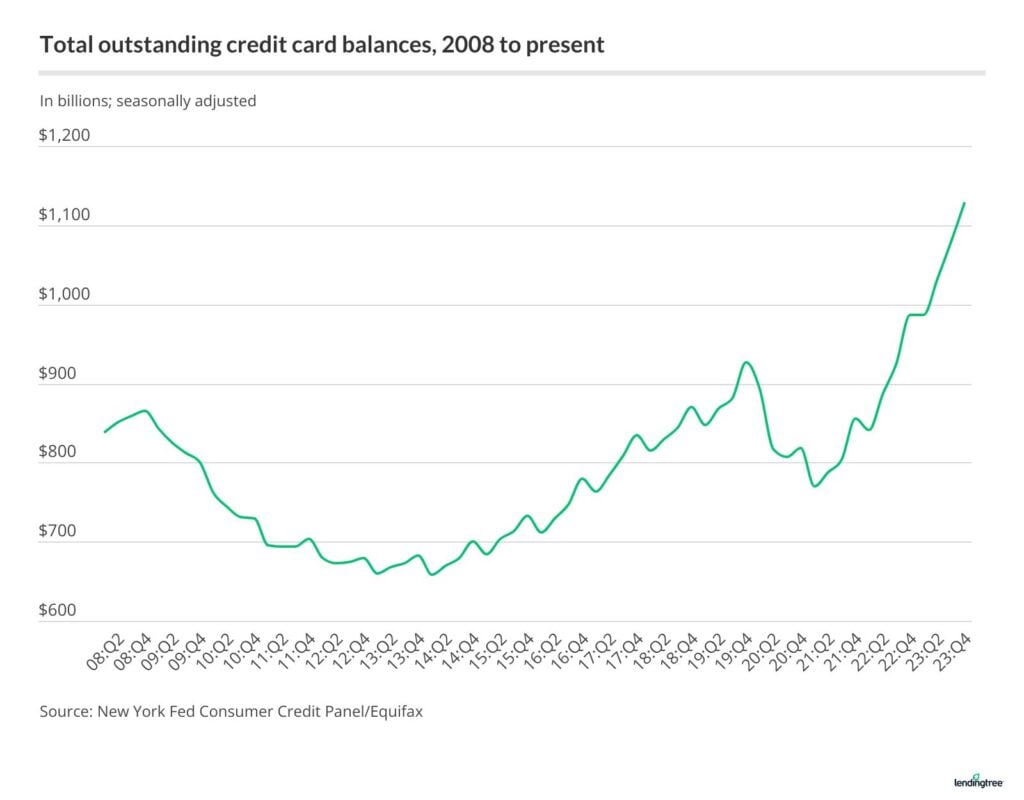
Credit card debt in America is at an all-time high of nearly $1.13 trillion and continues to rise as around 56 million Americans carry credit card debt. The typical late fee payment is around $32, but this is merely the fee for missing a payment and does not account for compounded interest. It seems like common sense, but one must realize that the average person is not financially literate. The concept of basic finance is not a mandatory requirement for the public education system, leading many people to live off debt, well beyond their means, with no chance of recuperating. America has the leading median level of credit card debt among all developed nations. There is a widespread belief that one can afford certain goods if they are approved for a line of credit, which only benefits the banks.
Now, the banks are certainly profiting on late fees, which account for about 15% of credit card profits based on the CFPB’s 2021 Consumer Credit Card Market Report. Do these fees deter reckless spending? A 2022 ABA-led survey found that 46% of respondents said they made it a priority to pay off their credit cards on time to avoid late fees. That particular study found that a fee of $10 was enough to redirect one’s attention to their financial obligations. Another study by the Harris Poll and NerdWallet found that Americans were more likely to make a payment of their cards if a $30 fee was implemented.
Again, one must understand that the average person cannot compute the cost of compounding interest. Borrowing money is not a legal right and should be done with the utmost caution. Simply forgetting or dismissing financial obligations has consequences.
The banks will find a way to profit off the people in other ways. It is the nature of banking. Rob Nichols, the president and CEO of the American Bankers Association, explained that other measures could be implemented that will hurt everyone. “The Bureau’s misguided decision to cap credit card late fees at a level far below banks’ actual costs willforce card issuers to reduce credit lines, tighten standards for new accounts and raise APRs for all consumers – even those who pay on time,” Nichols said. This is yet another Biden Admin policy favoring the financially irresponsible at the expense of others.
So, what is the CFPB recommending as an alternative? CBDC. The agency is first suggesting digitizing banking so that consumers have instant access to their credit scores and spending habits. Again, these numbers are disregarded by a portion of the population. The agency is patronizing all Americans by stating we are not intelligent enough to know when to pay off our monthly debts without digital notifications and reminders.
Financial literacy is desperately needed in America. So, while the Biden Administration is breaking its arm patting itself on the back for this surface-level win for the everyday man, the ruling does nothing to combat the growing personal debt crisis.
There are three types of scientific models, as shown in figure 1. In this series of seven posts on climate model bias we are only concerned with two of them. The first are mathematical models that utilize well established physical, and chemical processes and principles to model some part of our reality, especially the climate and the economy. The second are conceptual models that utilize scientific hypotheses and assumptions to propose an idea of how something, such as the climate, works. Conceptual models are generally tested, and hopefully validated, by creating a mathematical model. The output from the mathematical model is compared to observations and if the output matches the observations closely, the model is validated. It isn’t proven, but it is shown to be useful, and the conceptual model gains credibility.
Figure 1. The three types of scientific models.
Models are useful when used to decompose some complex natural system, such as Earth’s climate, or some portion of the system, into its underlying components and drivers. Models can be used to try and determine which of the system components and drivers are the most important under various model scenarios.
Besides being used to predict the future, or a possible future, good models should also tell us what should not happen in the future. If these events do not occur, it adds support to the hypothesis. These are the tasks that the climate models created by the Coupled Model Intercomparison Project (CMIP)[1] are designed to do. The Intergovernmental Panel on Climate Change (IPCC)[2] analyzes the CMIP model results, along with other peer-reviewed research, and attempts to explain modern global warming in their reports. The most recent IPCC report is called AR6.[3]
In the context of climate change, especially regarding the AR6 IPCC[4] report, the term “model,” is often used as an abbreviation for a general circulation climate model.[5] Modern computer general circulation models have been around since the 1960s, and now are huge computer programs that can run for days or longer on powerful computers. However, climate modeling has been around for more than a century, well before computers were invented. Later in this report I will briefly discuss a 19th century greenhouse gas climate model developed and published by Svante Arrhenius.
Besides modeling climate change, AR6 contains descriptions of socio-economic models that attempt to predict the impact of selected climate changes on society and the economy. In a sense, AR6, just like the previous assessment reports, is a presentation of the results of the latest iteration of their scientific models of future climate and their models of the impact of possible future climates on humanity.
Introduction
Modern atmospheric general circulation computerized climate models were first introduced in the 1960s by Syukuro Manabe and colleagues.[6] These models, and their descendants can be useful, even though they are clearly oversimplifications of nature, and they are wrong[7] in many respects like all models.[8] It is a shame, but climate model results are often conflated with observations by the media and the public, when they are anything but.
I began writing scientific models of rocks[9] and programming them for computers in the 1970s and like all modelers of that era I was heavily influenced by George Box, the famous University of Wisconsin statistician. Box teaches us that all models are developed iteratively.[10] First we make assumptions and build a conceptual model about how some natural, economic, or other system works and what influences it, then we model some part of it, or the whole system. The model results are then compared to observations. There will typically be a difference between the model results and the observations, these differences are assumed to be due to model error since we necessarily assume our observations have no error, at least initially. We examine the errors, adjust the model parameters or the model assumptions, or both, and run it again, and again examine the errors. This “learning” process is the main benefit of models. Box tells us that good scientists must have the flexibility and courage to seek out, recognize, and exploit such errors, especially any errors in the conceptual model assumptions. Modeling nature is how we learn how nature works.
Box next advises us that “we should not fall in love with our models,” and “since all models are wrong the scientists cannot obtain a ‘correct’ one by excessive elaboration.” I used to explain this principle to other modelers more crudely by pointing out that if you polish a turd, it is still a turd. One must recognize when a model has gone as far as it can go. At some point it is done, more data, more elaborate programming, more complicated assumptions cannot save it. The benefit of the model is what you learned building it, not the model itself. When the inevitable endpoint is reached, you must trash the model and start over by building a new conceptual model. A new model will have a new set of assumptions based on the “learnings” from the old model, and other new data and observations gathered in the meantime.
Each IPCC report, since the first one was published in 1990,[11] is a single iteration of the same overall conceptual model. In this case, the “conceptual model” is the idea or hypothesis that humans control the climate (or perhaps just the rate of global warming) with our greenhouse gas emissions.[12] Various and more detailed computerized models are built to attempt to measure the impact of human emissions on Earth’s climate.
Another key assumption in the IPCC model is that climate change is dangerous, and, as a result, we must mitigate (reduce) fossil fuel use to reduce or prevent damage to society from climate change. Finally, they assume a key metric of this global climate change or warming is the climate sensitivity to human-caused increases in CO2. This sensitivity can be computed with models or using measurements of changes in atmospheric CO2 and global average surface temperature. The IPCC equates changes in global average surface temperature to “climate change.”
This climate sensitivity metric is often called “ECS,” which stands for equilibrium climate sensitivity to a doubling of CO2, often abbreviated as “2xCO2.”[13] Modern climate models, ever since those used for the famous Charney report in 1979,[14] except for AR6, have generated a range of ECS values from 1.5 to 4.5°C per 2xCO2. AR6 uses a rather unique and complex subjective model that results in a range of 2.5 to 4°C/2xCO2. More about this later in the report.
George Box warns modelers that:
“Just as the ability to devise simple but evocative models is the signature of the great scientist so overelaboration and overparameterization is often the mark of mediocrity.”[15]
Box, 1976
The Intergovernmental Panel on Climate Change or IPCC has published six major reports and numerous minor reports since 1990.[16] Here we will argue that they have spent more than thirty years polishing the turd to little effect. They have come up with more and more elaborate processes to try and save their hypothesis that human-generated greenhouse gases have caused recent climate changes and that the Sun and internal variations within Earth’s climate system have had little to no effect. As we will show, new climate science discoveries, since 1990, are not explained by the IPCC models, do not show up in the model output, and newly discovered climate processes, especially important ocean oscillations, are not incorporated into them.
Just one example. Eade, et al. report that the modern general circulation climate models used for the AR5 and AR6 reports[17] do not reproduce the important North Atlantic Ocean Oscillation (“NAO”). The NAO-like signal that the models produce in their simulation runs[18] is indistinguishable from random white noise. Eade, et al. report:
“This suggests that current climate models do not fully represent important aspects of the mechanism for low frequency variability of the NAO.”[19]
Eade, et al., 2022
All the models in AR6, both climate and socio-economic, have important model/observation mismatches. As time has gone on, the modelers and authors have continued to ignore new developments in climate science and climate change economics, as their “overelaboration and overparameterization” has become more extreme. As they make their models more elaborate, they progressively ignore more new data and discoveries to decrease their apparent “uncertainty” and increase their reported “confidence” that humans drive climate change. It is a false confidence that is due to the confirmation and reporting bias in both the models and the reports.
As I reviewed all six of the major IPCC reports, I became convinced that AR6 is the most biased of all of them.[20] In a major new book twelve colleagues and I, working under the Clintel[21] umbrella, examined AR6 and detailed considerable evidence of bias.
“AR6 states that “there has been negligible long-term influence from solar activity and volcanoes,”[23] and acknowledges no other natural influence on multidecadal climate change despite … recent discoveries, a true case of tunnel vision.”
“We were promised IPCC reports that would objectively report on the peer-reviewed scientific literature, yet we find numerous examples where important research was ignored. In Ross McKitrick’s chapter[24] on the “hot spot,” he lists many important papers that are not even mentioned in AR6. Marcel [Crok] gives examples where unreasonable emissions scenarios are used to frighten the public in his chapter on scenarios,[25] and examples of hiding good news in his chapter on extreme weather events.[26] Numerous other examples are documented in other chapters. These deliberate omissions and distortions of the truth do not speak well for the IPCC, reform of the institution is desperately needed.”
Crok and May, 2023
Confirmation[27] and reporting bias[28] are very common in AR6. We also find examples of the Dunning-Kruger effect,[29] in-group bias,[30] and anchoring bias.[31]
In 2010, the InterAcademy Council of the United Nations reviewed the processes and procedures of the IPCC and found many problems.[32] In particular, they criticized the subjective way that uncertainty is handled. They also criticized the obvious confirmation bias in the IPCC reports.[33] They pointed out that the Lead Authors too often leave out dissenting views or references to papers they disagree with. The Council recommended that alternative views should be mentioned and cited in the report. Even though these criticisms were voiced in 2010, I and my colleagues, found numerous examples of these problems in AR6, published eleven years later in 2021 and 2022.[34]
Although bias pervades AR6, this series will focus mainly on bias in the AR6 volume 1 (WGI) CMIP6[35] climate models that are used to predict future climate. However, we will also look at the models used to identify and quantify climate change impacts in volume 2 (WGII), and to compute the cost/benefit analysis of their recommended mitigation (fossil fuel reduction) measures in volume 3 (WGIII). As a former petrophysical modeler, I am aware how bias can sneak into a computer model, sometimes the modeler is aware he is introducing bias into the results, sometimes he is not. Bias exists in all models, since they are all built from assumptions and ideas (the “conceptual model”), but a good modeler will do his best to minimize it.
In the next six posts I will take you through some of the evidence of bias I found in the CMIP6 models and the AR6 report. A 30,000-foot look at the history of human-caused climate change modeling is given in part 2. Evidence that the IPCC has ignored possible solar influence on climate is presented in part 3. The IPCC ignores evidence that changes in convection and atmospheric circulation patterns in the oceans and atmosphere affect climate change on multidecadal times scales and this is examined in part 4.
Contrary to the common narrative, there is considerable evidence that storminess (extreme weather) was higher in the Little Ice Age, aka the “pre-industrial” (part 5). Next, we move on to examine bias in the IPCC AR6 WGII report[36] on the impact, adaptation, and vulnerability to climate change in part 6 and in their report[37] on how to mitigate climate change in part 7.
IPCC is an abbreviation for the Intergovernmental Panel on Climate Change, a U.N. agency. AR6 is their sixth major report on climate change, “Assessment Report 6.” ↑
There are several names for climate models, including atmosphere-ocean general circulation model (AOGCM, used in AR5), or Earth system model (ESM, used in AR6). Besides these complicated computer climate models there are other models used in AR6, some model energy flows, the impact of climate change on society or the global economy, or the impact of various greenhouse gas mitigation efforts. We only discuss some of these models in this report. (IPCC, 2021, p. 2223) ↑
(Manabe & Bryan, Climate Calculations with a Combined Ocean-Atmosphere Model, 1969), (Manabe & Wetherald, The Effects of Doubling the CO2 Concentration on the Climate of a General Circulation Model, 1975) ↑
(McKitrick & Christy, A Test of the Tropical 200- to 300-hPa Warming Rate in Climate Models, Earth and Space Science, 2018) and (McKitrick & Christy, 2020) ↑
“The Intergovernmental Panel on Climate Change (IPCC) assesses the scientific, technical and socioeconomic information relevant for the understanding of the risk of human-induced climate change.” (UNFCCC, 2020). ↑
Usually, ECS means equilibrium climate sensitivity, or the ultimate change in surface temperature due to a doubling of CO2. but in AR6 sometimes they refer to “Effective Climate Sensitivity,” or the “effective ECS” which is defined as the warming after a specified number of years (IPCC, 2021, pp. 931-933). AR6, WGI, page 933 has a more complete definition. ↑
Confirmation bias: The tendency to look only for data that supports a previously held belief. It also means all new data is interpreted in a way that supports a prior belief. Wikipedia has a fairly good article on common cognitive biases. ↑
Reporting bias: In this context it means only reporting or publishing results that favor a previously held belief and censoring or ignoring results that show the belief is questionable. ↑
The Dunning-Kruger effect is the tendency to overestimate one’s abilities in a particular subject. In this context we see climate modelers, who call themselves “climate scientists,” overestimate their knowledge of paleoclimatology, atmospheric sciences, and atomic physics. ↑
In-group bias causes lead authors and editors to choose their authors and research papers from their associates and friends who share their beliefs. ↑
Anchoring bias occurs when an early result or calculation, for example Svante Arrhenius’ ECS (climate sensitivity to CO2) of 4°C, discussed below, gets fixed in a researcher’s mind and then he “adjusts” his thinking and data interpretation to always come close to that value, while ignoring contrary data. ↑
Posted originally on Feb 26, 2024 By Martin Armstrong
What happened to this world? Admiral Rachel Levine was appointed as the U.S. Public Health Service, Assistant Secretary for Health, U.S. Department of Health and Human Services under Biden’s diversity cabinet. Does this look like the face of health to you? A video is recirculating during Black History Month as a reminder that Black Americans are disproportionately affected by climate change health concerns.
This video should make your head spin if you live in reality. Unfortunately, this is a real video funded by the US government, and not AI or a comedy sketch. This utter nonsense was first touted by none other than the World Economic Forum (WEF). Ruma Bhargava, the WEF Mental Health Lead, declared last year that “the impacts of climate change vary greatly between countries and population groups. This climate crisis is a deeply unfair one, with the poor being disproportionately affected.” Bhargava is renowned for targeting women and children in poverty-stricken areas of India.
The Office of Environmental Justice (OEJ), another unnecessary department created under Biden-Harris that has no relevance to our reality, now seeks funding to save Black Americans from climate change. The Biden Administration is spending BILLIONS on climate initiatives like the Environmental Protection Agency, which is set to receive $12 billion in funding this year. That marks a 19% increase in spending from 2023 or $1.9 billion.
“EPA is at the center of President Biden’s ambitious environmental agenda and the FY 2024 Budget will ensure the Agency delivers bold environmental actions and economic benefits for all. Coupled with the President’s historic investments in America through significant legislative accomplishments, the Budget will advance EPA’s mission across the board, boosting everything from our efforts to combat climate change, to delivering clean air, safe water, and healthy lands, to protecting communities from harmful chemicals, and to the continued restoration of capacity necessary to effectively implement these programs,” said EPA Administrator Michael S. Regan. “Importantly, the Budget also supports our work to center environmental justice across all of the Agency’s programs, ensuring that no family, especially those living in overburdened and underserved areas, has to worry about the air they breathe, the water they drink, or the environmental safety of their communities.”
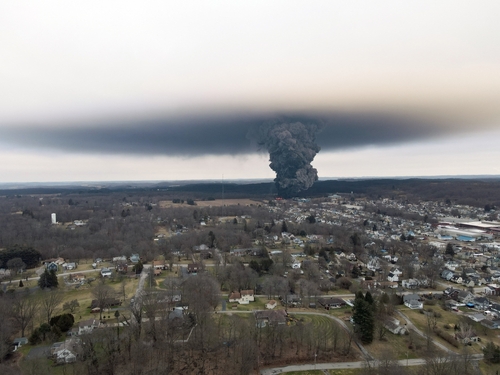
(Image of the train derailment in East Palestine, Ohio, and not a war zone)
Do you get it yet? They are lying to the public about climate change for funding and power. Where were the funds for Maui or East Palestine? There are places in the US, like Flint, Michigan, that still do not have clean drinking water for their residents. The victims of Maui received pennies in comparison to the migrants, Ukraine, and Israel, while Biden forgot the derailment in East Palestine even occurred until about a year later.
The Biden Administration does NOT care about the environment, disadvantaged citizens, or anyone else. Yellen even admitted that the Inflation Reduction Act, America’s largest spending package, was a trojan horse to fund climate initiatives. The only climate they want to change is your reality.
Posted originally on Feb 24, 2024 By Martin Armstrong
COMMENT: Mr. Armstrong: Nobody has sources like you. You warned that the West would create a false flag to start the war that they need. It took maybe one to two weeks for the news that Russia put nuclear weapons in space, and here, our leading politician came out and said there was going to be a sneak attack in Europe that would be our Pearl Harbor moment. I have come to understand why you are always right. It is because people do react the same way no matter what decade or century.
ačiū.
Thank you for the knowledge.
REPLY: Yes, we are approaching the ECM fate of May 7th, but also the ECM date on the Ukraine war – April 20, 2024. It is getting interesting from a research perspective but dangerous from a human perspective. If you really expected a Pearl Harbor Moment, which was also a deliberately created event to the US into WWII, you would think as head of state, you would seek peace rather than war. Nothing these people do anymore makes sense.
Posted originally on Feb 24, 2024 By Martin Armstrong
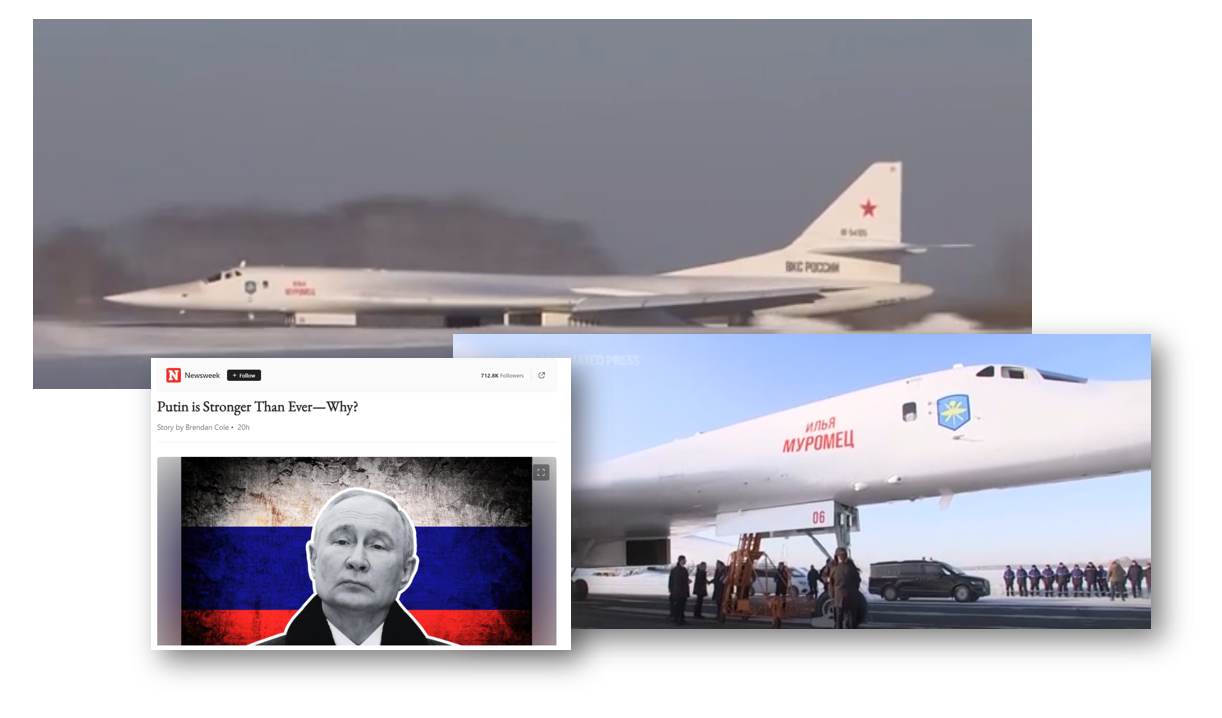
Russian President Vladimir Putin unveiled the new strategic long-range Tu-160M nuclear-capable bomber on Thursday, in a move likely to be seen in the West as a pointed reminder of Moscow’s nuclear capabilities. This is a new giant swing-wing type plane, where the pilots posted on the side “MY POMPEII,” referring to the destruction of Vesuvius. NATO has codenamed it “Blackjacks” but this bomber is what Russia would deploy in the event of nuclear war to deliver weapons at long distances.
What is very clear and acknowledged behind the curtain is that there has never been a time of worse relations between the world’s two biggest nuclear powers, including during the 1962 Cuban Missile Crisis. The West appears to be led by mindless politicians who do as they are told by the Neocons for nobody is interested in any peace negotiations. Former Russian President Dmitry Medvedev, now deputy chairman of Russia’s Security Council, has repeatedly warned of the risk of a nuclear conflict with the West since 2014. That seems not to bother any Western leader, for the Neocons keep swearing that it is just scare tactics and that Russia will never resort to nuclear weapons even as NATO invades Moscow. Nobody in any leadership role even seems to have common sense.
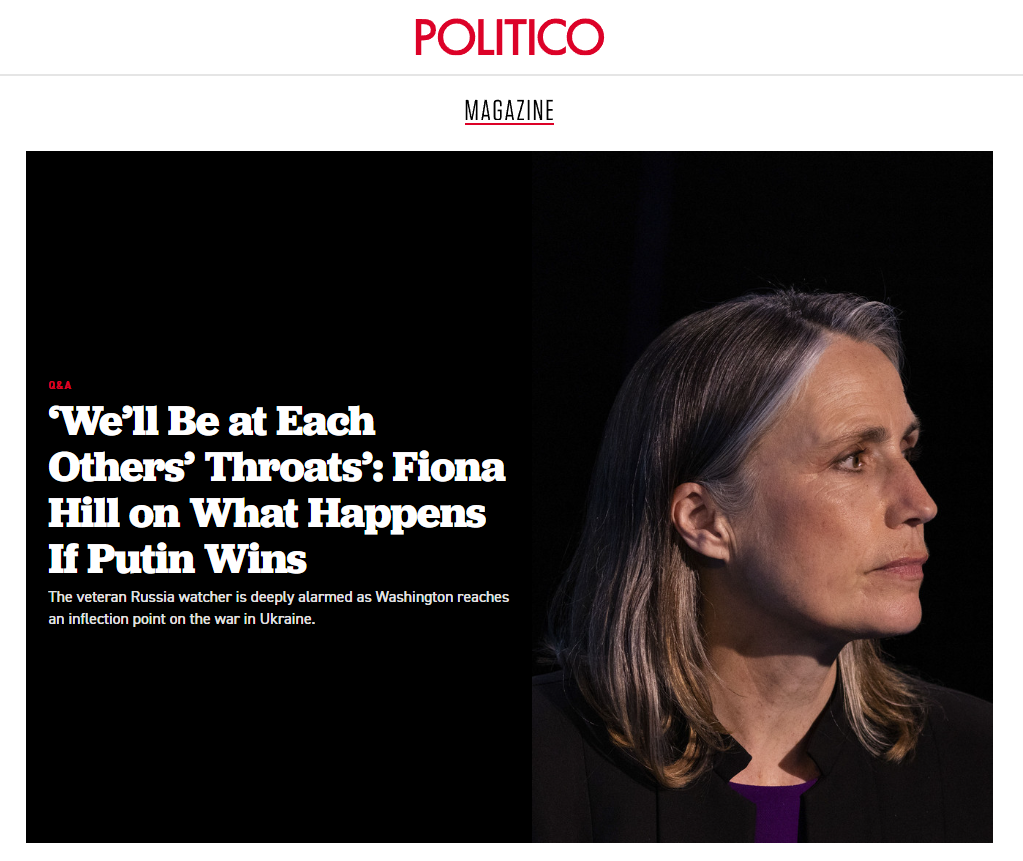
The Neocon who also is always pushing for war is Fiona Hill. Politico asked: “What happens to the West if Putin wins?” She responded:
We’ll be at each others’ throats. There’ll be no way in which this is going to turn out well. There’ll be a lot of frustration on the part of people who thought that this was the easier option when we reel from crisis to crisis. There’ll also be the shame, frankly, and the disgrace of having let the Ukrainians down. I think it would create a firestorm of recrimination. And it will also embolden so many other actors to take their own steps.
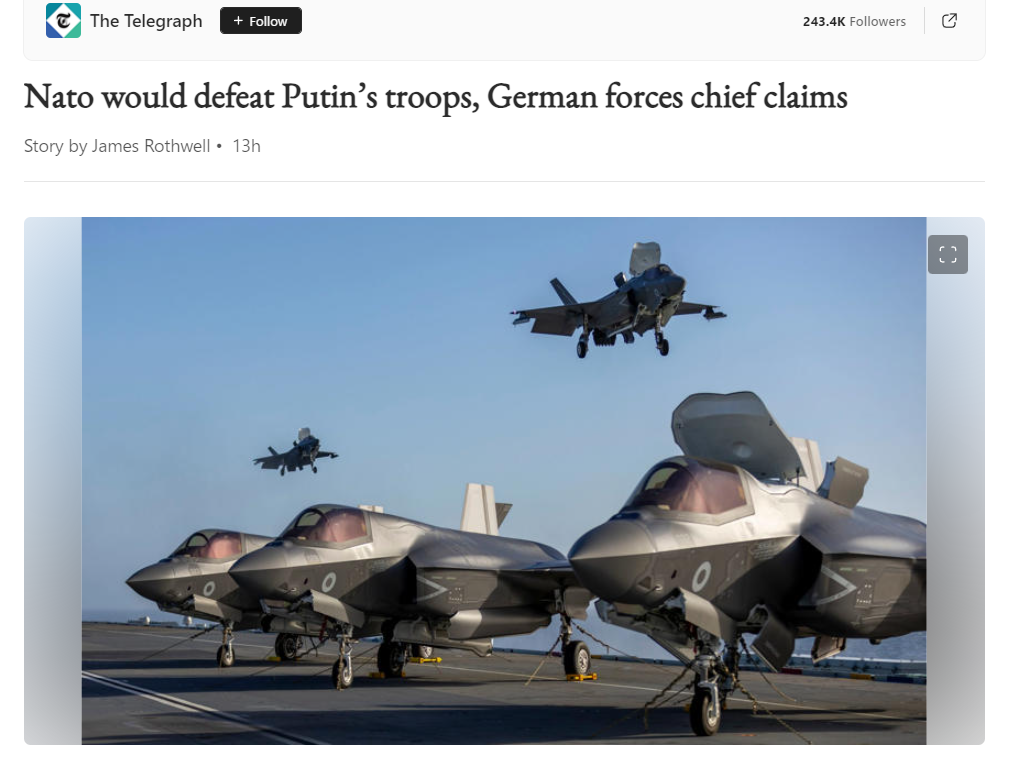
NATO is a highly dangerous organization whose only purpose is war. They were created to defend against Communism. When Communism fell, they never changed their position and maintained that Russia still wanted to conquer Europe. Of course, if that is not true, then we no longer need NATO. They must keep up beating their war drums, or else they lose their purpose and revenue as members divert it elsewhere.
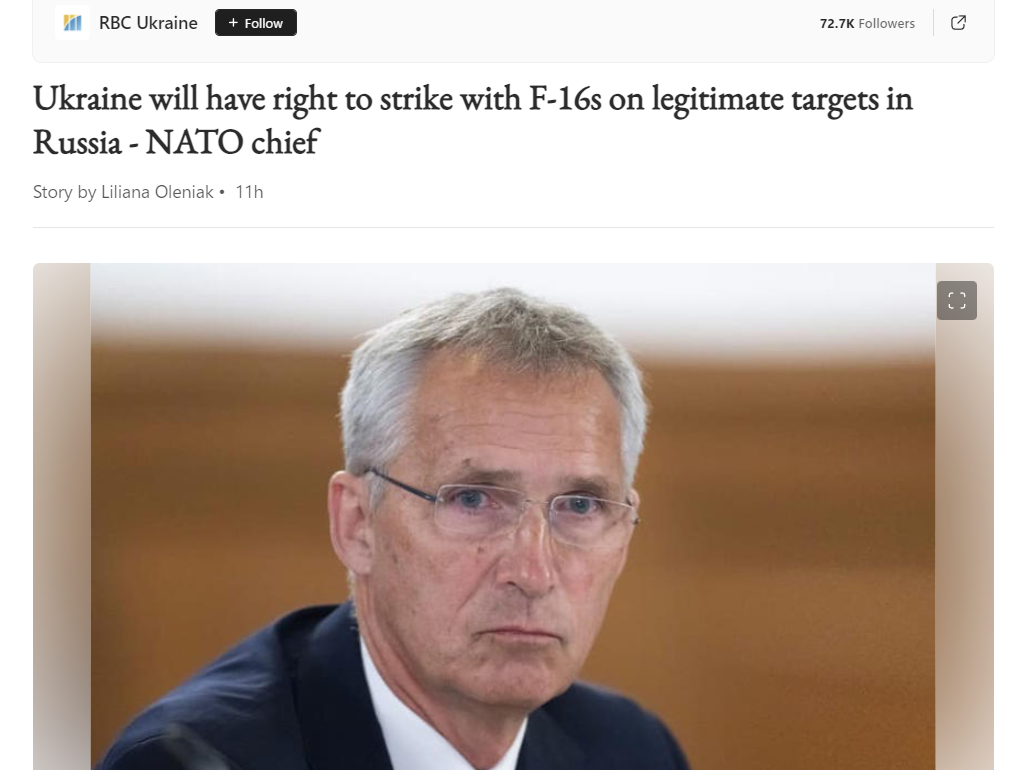
At first, we would provide F16s only to defend Ukraine. Now, after getting approval on those terms, they use the bail-and-switch routine as NATO now says Ukraine can fly directly into Russia to wage war as they pray for an excuse to start World War III. Even Newsweek has reported NATO grants Ukraine permission to invade Russia, knowing full well that Putin will be forced to respond. This is precisely what NATO wants – it is begging for Putin to PLEASE attack so we can start World War III ASAP. They want to create WWIII before the US election.
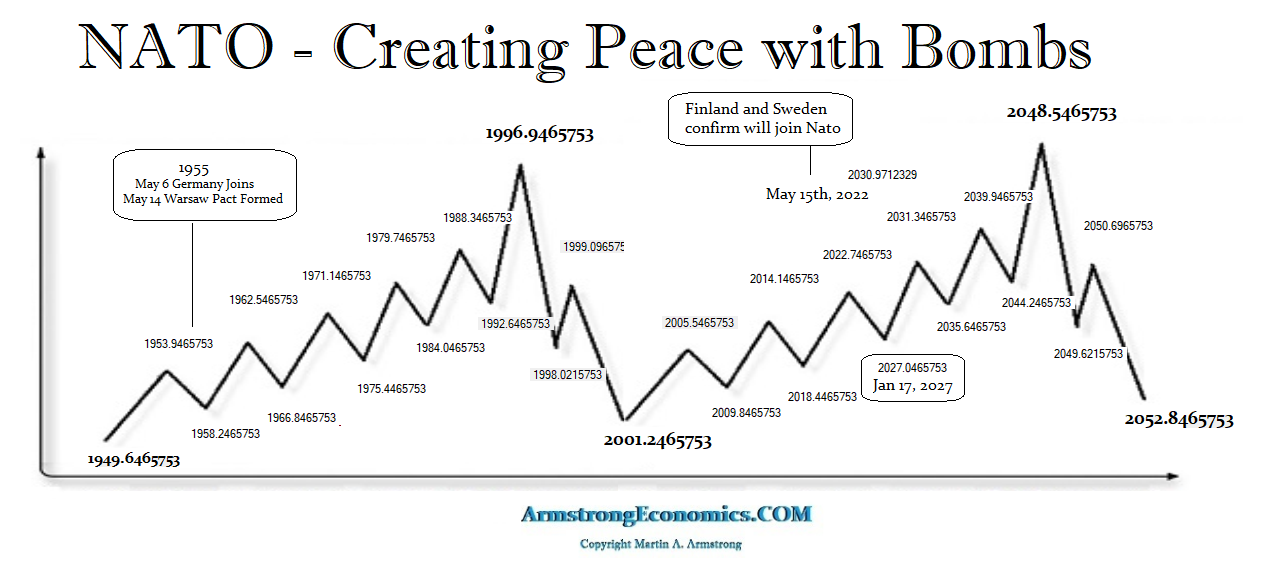
NATO is headed into a major crisis by January 17th, 2027. What is most interesting is that the turning point 2022.746 was precisely September 30th, 2022, which was the very day when Putin declared the annexation of four Russian regions of Ukraine that were supposed to have been under the Minsk Agreement, which was signed September 5th, 2021 that the West negotiated in bad faith. That was 73.1 years into the NATO ECM. The Minsk Agreement came in 2021, which was precisely on the 72-Year Revolution Cycle.
Nobody seems ever to ask, what if Russia loses? Medvedev made it very clear:
“Attempts to restore Russia’s 1991 borders will lead only to one thing – a global war with Western countries with the use of our entire strategic (nuclear) arsenal against Kyiv, Berlin, London, and Washington. And against all other beautiful historic places that have long been included in the flight targets of our nuclear triad.”
When we look at the duration of wars, we see that World War I (1914-1918) was just under four years. World War II lasted on two fronts, Germany and Japan, so the combined war effort was from 1939 to 1945. However, the war with Germany lasted 5.679 years, whereas the war with Japan lasted 3.691 years. The Korean War lasted 3.087 years.
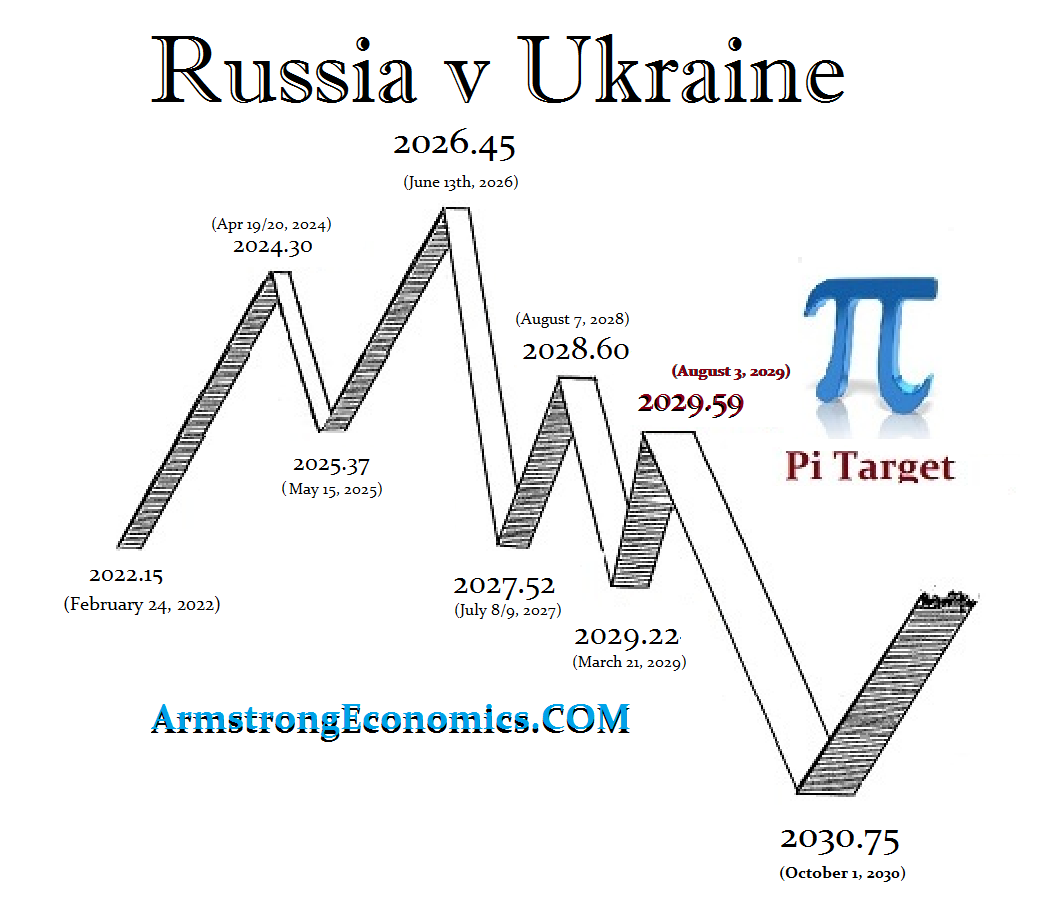
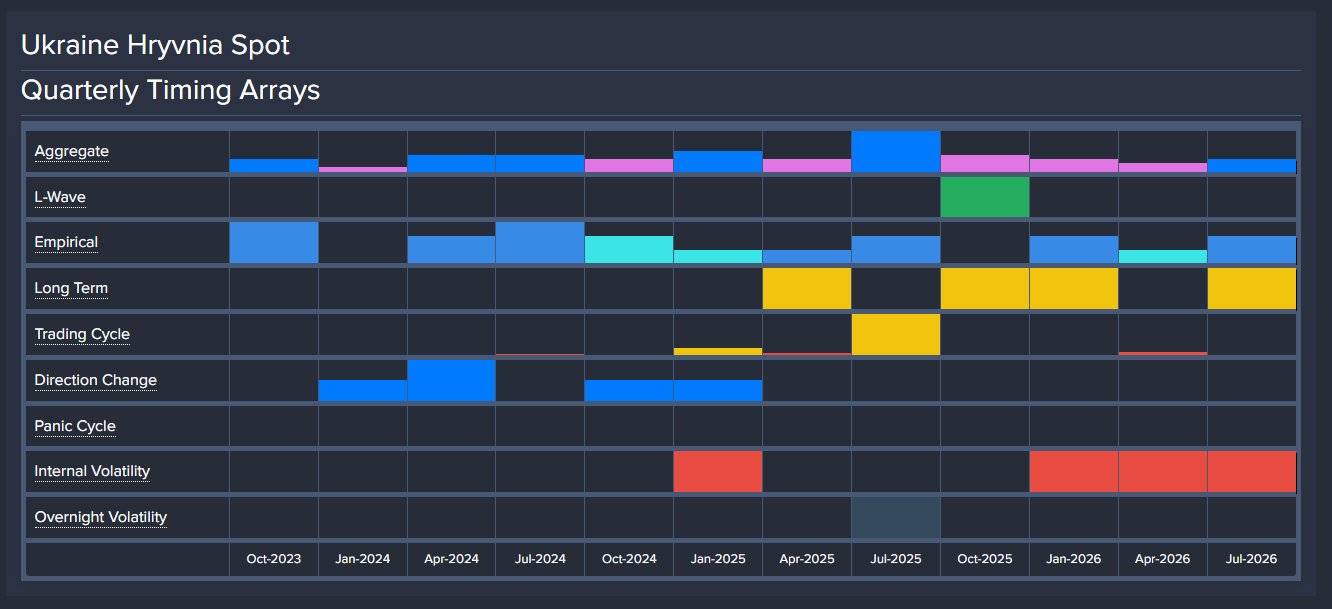
We have a Double Directional Change in April coinciding with the major ECM turning point of April 20th, 2024. There is no way Ukraine will defeat Russia. Indeed, behind the curtain, that has been known from day one. Ukraine has been used to weaken Russian forces for the ultimate confrontation with NATO. Nobody cares how many Ukrainians die—the more, the merrier, since that will serve as the justification for World War III. We will then commit countless people to die as revenge for Ukraine’s loss.
Even looking at a chart of the currency, the Greenback keeps rising. There is no hope for Ukraine long-term. The Neocons have lied to them, and now over 1 million are dead, and millions have fled to Europe.
I have created this site to help people have fun in the kitchen. I write about enjoying life both in and out of my kitchen. Life is short! Make the most of it and enjoy!
This is a library of News Events not reported by the Main Stream Media documenting & connecting the dots on How the Obama Marxist Liberal agenda is destroying America








 Centinel2012