Is military action eminent? The White House has informed national media there will be a Presidential Address tonight at approximately 9:00pm from the White House.
“A short time ago, I ordered the United States Armed Forces to launch precision strikes on targets associated with the chemical weapons capabilities of Syrian dictator Bashar al-Assad,” Trump said. “A combined operation with the armed forces of France and the United Kingdom is now underway.”
UPDATE 9:40pm EST – Airstrikes by combined forces from the United States, France and the U.K. have begun against elements of Syrian Bashir Assad forces in response to prior use of chemical weapons.
WHITE HOUSE – Today, President Donald J. Trump issued an Executive Grant of Clemency (Full Pardon) to I. Scooter Lewis Libby, former Chief of Staff to Vice President Richard Cheney, for convictions stemming from a 2007 trial. President George W. Bush commuted Mr. Libbys sentence shortly after his conviction. Mr. Libby, nevertheless, paid a $250,000 fine, performed 400 hours of community service, and served two years of probation.
In 2015, one of the key witnesses against Mr. Libby recanted her testimony, stating publicly that she believes the prosecutor withheld relevant information from her during interviews that would have altered significantly what she said. The next year, the District of Columbia Court of Appeals unanimously reinstated Mr. Libby to the bar, reauthorizing him to practice law. The Court agreed with the District of Columbia Disciplinary Counsel, who stated that Mr. Libby had presented credible evidence in support of his innocence, including evidence that a key prosecution witness had changed her recollection of the events in question.
Before his conviction, Mr. Libby had rendered more than a decade of honorable service to the Nation as a public servant at the Department of State, the Department of Defense, and the White House. His record since his conviction is similarly unblemished, and he continues to be held in high regard by his colleagues and peers.
In light of these facts, the President believes Mr. Libby is fully worthy of this pardon. I dont know Mr. Libby, said President Trump, but for years I have heard that he has been treated unfairly. Hopefully, this full pardon will help rectify a very sad portion of his life. (LINK)
Added by Centinel2012
This was long over due I’m very pleased that Trump did this!
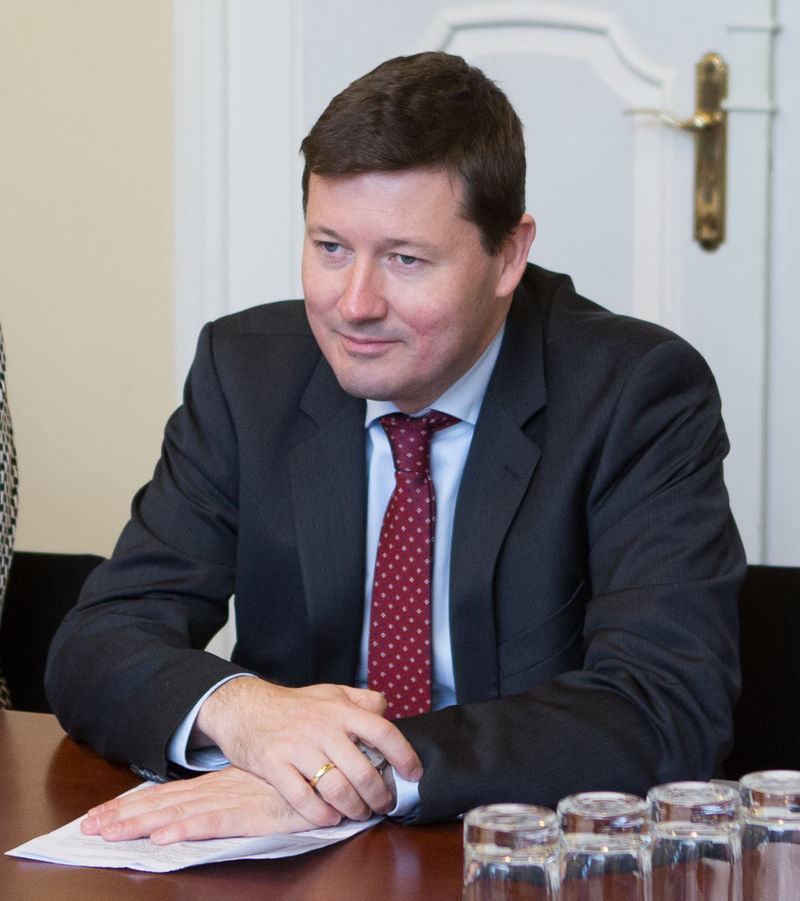
Martin Selmayr, nicknamed “the Monster” by colleagues because of his fearsome reputation, has become the new European Commission Director General – the man in charge of the European Commission. He has been one of Brussels’ most controversial EU officials and he was unexpectedly put in charge of the entire EU civil service. Selmayr, who was chief of cabinet to president Jean-Claude Juncker since 2014, replaces Alexander Italianer, who had announced he would be stepping down after three years in the job. But the rumors behind the curtain tell a different story. With the Hungary election, Italian election, BREXIT, and Catalonia, the handwriting is on the wall. The EU is crumbling from its undemocratic internal authoritarian power that refuses to yield concerning its European Project to federalize Europe. If the Euro goes, there goes Brussels. They refuse to even concede that they created a nightmare with the Refugee Crisis. Italianer left because he disagreed with the internal policies. Selmayr is known as the “Monster” and this is a desperate turn to force central power upon the whole of Europe
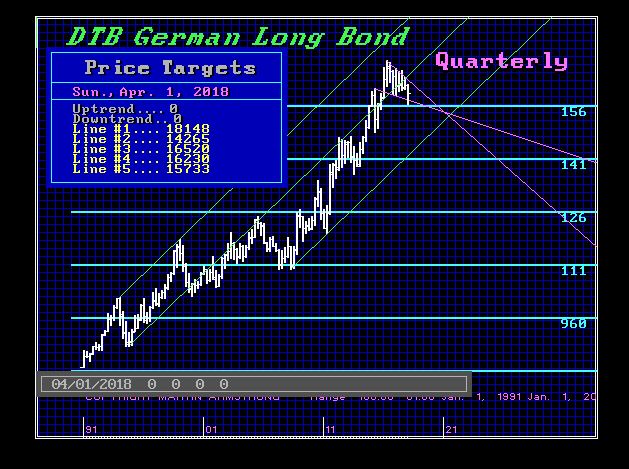
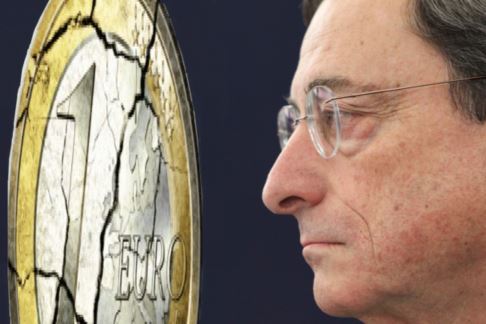
Mario Draghi is by no means going to stop his Quantitative Easing program. All my sources behind the curtain express fear what will happen when Draghi leaves. Who will buy the government debt and who will keep subsidizing the governments of the Eurozone? Draghi has not merely declined to end Quantitative Easing, he has pledged to continue to reinvest in debt which it matures because he knows there will be no bidders. The ECB is exceeding 40% of all Eurozone debt on its balance sheet. There will be no bid for Eurozone debt and even the German bunds are reflecting weakness.
Draghi has publicly even distanced the ECB from the monetary policy considerations of Austria’s central bank chief Ewald Nowotny, a board member. Nowotny told Reuters interview on that future of bond purchases would decline and possible interest rate moves to the upside were coming. The ECB came out and publicly stated that the views of Governor Nowotny did not represent the view of the Governing Council. This is confirming our sources which have been stating that Draghi realizes he is trapped and he is trying to hold it together until he leaves so he will not be blamed for the mess he has created in the world economy after he leaves in 2019. I hate to tell him, but I do not think he will win that race out the door before chaos hits.
An Eagle was soaring through the air. Suddenly it heard the whizz of an Arrow, and felt the dart pierce its breast. Slowly it fluttered down to earth. Its lifeblood pouring out. Looking at the Arrow with which it had been shot, the Eagle realized that the deadly shaft had been feathered with one of its own plumes.
Moral: We often give our enemies the means for our own destruction.
The United States economy is the Eagle; the shaft is Wall Street; the feather is the U.S. middle-class, and the archer is U.S. Chamber of Commerce President Tom Donohue.
Need proof? Please, don’t take my word for it, read:
Tom Donohue: Tonight feels like a gathering of old friends. Five years ago, I had the pleasure of being in this beautiful city to help start a hemispheric business dialogue, and I’m pleased to be back in Lima for this year’s CEO Summit of the Americas.
[…] I also want to talk a little about the priorities within our government. Because, as everyone knows, many of the policy decisions coming out of Washington today not only impact the U.S. economy and its businesses and workers, but indeed those across this hemisphere and around the world.
[…] The Chamber has helped lead the fight to protect the status of more than one million people who are at risk of deportation. It makes no sense to send one million talented workers back to their home countries when we don’t have enough labor to get the job done in our own. This includes the young men and women who were brought to our country as children through no fault of their own—known as “the Dreamers”—as well as hundreds of thousands of individuals who are working in the U.S. under temporary protected status.
Moreover, as the debate has unfolded in Congress, we have been fighting back against proposals that would further reduce legal immigration.
♦You get that? I cannot tell you the number of people who have argued with me, and CTH, about Tom Donohue supporting amnesty and open borders. Many of the voices who oppose truth are deep within CONservative media. I digress.
Donohue continues on the topic of trade:
[…] NAFTA “As many of you know, there several problematic U.S. proposals that have stalled progress toward a deal.”
[…] [The Trump administration sunset clause proposal] calls for an automatic termination date after five years unless the three parties agree to continue it. I don’t need to tell any of you as investors that this is untenable to anyone who intends to achieve return on his investment; the conversation should start at 20 years in order to provide the certainty in ROI that we all require.
•You get that? “Problematic U.S. proposals”… WTF? Wall Street, via The U.S-CoC is demanding no review of any new NAFTA deal for any period less than 20 years? Twenty.Fucking.Years. [Twenty years ago cell phones were shoe boxes.]
[…] Next, the U.S. has put forward a proposal introducing severe restrictions on Mexican and Canadian access to U.S. government procurement. While touted as a way to supposedly promote improved reciprocity, the U.S. proposals are likely to have the opposite impact.
U.S. companies have far more at stake in North American government procurement than our Canadian and Mexican partners. Hundreds of American firms in financial services, IT, education and beyond have literally billions of dollars in government contracts in Canada in Mexico.
•You get that? Wall Street, via the U.S-Coc, wants Mexican and Canadian companies to benefit from U.S. taxpayer expenditures on government contracts (ie. infrastructure spending etc.) Why? Because Wall Street has investment in Mexican and Canadian companies, that’s why.
[…] Finally, the U.S. has advanced a proposal on rules of origin for auto production that mandates increases in North American content.
I touch on this area last because it’s the controversial proposal that’s shown the most promise for a potential breakthrough. Negotiators are creatively looking at ways to introduce areas like vehicle design and research and developmentinto the content equation in a way that potentially limits disruption to production.
And there’s the key. Whatever solution they come to cannot disrupt the fully integrated North American supply chains that have made our continent’s auto sector the most competitive in the world.
•Your get that? Wall Street, via the U.S-CoC want to keep the flow of cheap Chinese and Asian parts into their investments in Mexican auto-plants. In an effort to hoodwink the details, Wall Street, via the U.S-CoC want to add the cost/value of designing a car into the content as if “design and research” was an actual physical component. See the scheme?
[…] As we heard at the recent meeting of AACCLA leaders in Miami that many of you attended, our regional partners view NAFTA as a bellwether for the fate of other agreements. Let’s not forget that all U.S. FTAs are slated to be reviewed, presumably once NAFTA 2.0 is complete. And twelve of our 20 FTA partners are in the Americas. Nearly half of all U.S. goods exports are bound for this region. … The U.S. Chamber will keep fighting for that outcome, here and in Washington, and for as long as it takes.” (continue reading)
Oh there’s more, much more, but you get the picture. There are trillions of dollars at stake and the U.S. CoC is committed to exploiting every single penny. President Donald Trump is an existential threat to these endeavors.
As you are probably aware President Trump cancelled his visit to the Summit of the Americas in Lima, Peru this week; preferring to send Vice President Mike Pence in his stead. U.S. Chamber of Commerce President Tom Donahue is in Peru and delivered the Wall Street positions on trade to the gathering. (More on that later).
It is critical to remember, at the epicenter of all political position is money. All support and opposition to POTUS Trump surrounds the money. Under the foundation of ideology are financial benefits and/or lack thereof. [Ex. Chuck Grassley’s presentation of a bill to support SC Robert Mueller is directly tied to his purchased Big AG lobby position on trade via UniLever, ConAgra, Monsanto, ADM etc.] The Wall Street coalition needs leverage against POTUS Trump to defend their financial positions. There are trillions at stake.
Directly related, today in the White House, President Trump -together with U.S.T.R Robert Lighthizer- met with an assembly of governors and congressional representatives to discuss trade and agriculture. Each of these state and federal officials is part of the Big AG corporate purchase of policy.
.
When POTUS keeps the cameras rolling, it’s beneficial to pay attention. Notice how President Trump is leveraging an agricultural benefit of ethanol against the financial influence of Big AG lobbyists who control the assembled politicians.
It’s a modern fact, albeit sickening in the big picture, that President Trump has to fight for the best outcome of America’s economic policy against special interests of U.S. politicians – who are purchased by lobbyist money to act against America’s best interests.
[Transcript] 11:07 A.M. EDT – THE PRESIDENT: So this is a group I like very much. We’re here to discuss agriculture — very important. And these are great people, great Americans, great patriots. And they’ve been treated very badly for a long time. And if you look at the farmer, it’s been, unfortunately, over a 12-year period, trending downward. Very much trending downward. So we’re changing things with respect to trade and trade with other countries.
A lot of times, the farmers sort of — they know what they have. But it’ll be very good when we get it all finished. It’ll be great. People are a little bit concerned going into that wild blue yonder, or, in our case, the wild red yonder. (Laughter.) But I will say that the farmers are going to be — they’re going to do fantastically well.
But they have been trending downward for a long period of time, and we’re not going to have that. A lot of it is because of bad trade deals.
So I’m pleased to be joined by several of our nation’s governors — very distinguished governors — and members of Congress to talk about trade and agriculture.
As you know, the recent investigation led by U.S. Trade Representative Bob Lighthizer — who’s with us today also — identified a pattern of chronic Chinese trading abuses, including theft of intellectual property and trade secrets, and forced technology transfers, which has cost this country hundreds of billions of dollars, and also, the targeting of American technology. It’s cost us untold hundreds of billions of dollars over the years.
Larry Kudlow is here and he’s shaking his head, approvingly — meaning, of what I’m saying.
KUDLOW: Yes, sir.
THE PRESIDENT: But disapprovingly of what they’ve done.
KUDLOW: Yes, sir.
THE PRESIDENT: As you are all aware, China has consistently treated the United States agriculture unfairly. I was very proud of something I did at Mar-a-Lago, in Florida. I had President Xi, who’s a friend of mine, who’s a very, very good man. And I don’t blame China; I blame our representatives that — our people over the past, our Presidents and negotiators and trade representatives — that they allowed this to happen.
But during a very brief conversation, I said, “President, the United States, we want to sell beef again to China.” Now, they hadn’t sold it in, what, 14 years or something. And he looked at me and he said, “Say it again.” I said, “We want to sell beef” — that’s a big industry — “in China.” And he said, “We will sell beef in China.” And we did other things too. But the one that really is the most interesting for the people at this table is beef.
And I think, Governor, that made a big impact, and they’re selling a lot of beef in China that hadn’t been — for 14, 15 years, they were not allowed to sell beef in China.
So we have the kind of a relationship that, I think, is going to be very aggressively sustained. Yesterday, as you know, President Xi made a very good speech, and he said he’s going to open up China. He’s going to open it up, take down a lot of the trade barriers — maybe all of them — but take down a lot of trade barriers.
And he’s going to get rid of a lot of the taxes or tariffs that they charge. Because, right now, if you have — and I use this example because it’s so easy — if we sell a car into China, number one, they won’t take the car; and number two, if they did take the car, it’s 25 percent tariff. Whereas we have no barrier, and when they sell a car into us, it’s 2.5 percent. So they have barriers, but when they don’t have barriers, it’s 25 percent versus 2.5 percent. That’s not a good way to make money. Chuck will tell you that. So we’re straightening that out.
We want to be reciprocal. So if they charge 25, we charge 25. If they charge 2.5, we charge 2.5. And maybe what happens is we both charge nothing, because I know we’d all like that. I think Ben would like that better than anybody, okay? That’s simpler than 25. Let’s save all the transfer of funds, right?
SENATOR SASSE: We need more trade.
THE PRESIDENT: So that’s what we want. We want more trade. We want no barriers. But the only way you can knock it down, you can’t just go in — for 25 years, Presidents have been trying to negotiate and they’ve been very unsuccessful, because they’d meet and they’d say, “Can we talk?” And the Chinese would say, “Yes, we can.” And that’s what they do — they talk for four years, then they’ll talk for another four years, and that would be the end of that. Nothing would happen. So nothing would happen. So we’re doing a job there.
NAFTA — we’re renegotiating NAFTA. It’s coming along great. I have no time. You know, I keep reading from the “fake news” media that we’re pushing it. I’m not pushing it; I don’t care. Oh, you’re laughing. That’s good, Chuck. See, Fox can smile because — (laughter) — you know, you do a very beautiful job.
But I keep hearing how we’re pushing NAFTA, we want it done. There’s no timeline. There’s no timeline. Now, in the meantime, nobody is moving into Mexico. Because as long as NAFTA is in flux, no company is going to spend a billion dollars to build an automobile plant.
So I say this — I’ve told it to the Mexicans: We can negotiate forever. Because as long as we have this negotiation going, nobody is going to build billion-dollar plants in Mexico, which is what they’ve been doing a lot. They have taken our auto industry by the throat. And so many jobs have been lost, so many massive plants have been built in Mexico. Top-of-the-line stuff. But it’s not happening now, and they’re coming back. Chrysler has moved back; a lot of them have moved back.
And the same thing with agriculture, which is going to be our predominant discussion today. So agriculture is okay with NAFTA. Not great. We’re going to make it great. We’re going to make it great. And we’re getting pretty close to a deal. It could be three or four weeks. It could be two months; it could be five months. I don’t care. In fact, if everybody in this room closed their ears, I’d say I’d rather terminate NAFTA and make a brand new deal, but I’m not going to do that because I want everyone to be happy in this room, okay? We’ll see how it goes.
But we’re going to make a fair NAFTA deal, much better than it is right now. NAFTA has cost this country hundreds of billions of dollars. It has been a disaster. We’ve lost 50,000 factories, millions of jobs. NAFTA has been a disaster.
So we’re going to either come up with a great NAFTA deal, and a fair one for this country, or we’re going to just do something else. And agriculture will be taken care of 100 percent.
So we’re going to have a discussion today and we’re going to talk about agriculture as it relates to trade, primarily. Again, we’re doing really well with China. I think we’re having some great discussions, and we’ll see what happens. We put a $50 billion tariff on, and then we put $100 billion tariff on. And, you know, at a certain point, they run out of bullets.
Remember what I said: When you’re $500 billion down, you can’t lose a trade war. And I won’t call it a trade war because it’s really a trade negotiation. But nobody ever negotiated from our side. Nobody ever did anything. All they did was talk. And in the meantime, we helped rebuild China because they took so much money — bridges, and airports, and military, and everything. They took so much — hundreds of billions of dollars out of our country.
So now we’re really negotiating, and I think they’re going to treat us very fairly. I think they want to. And again, I don’t blame my friend, President Xi. I blame our representatives, for years, that didn’t do a damn thing, and they allowed it to happen. I wish we could do what they did because that would make everybody at this table very happy. So perhaps we’re in the process of doing it.
The other thing is, if you look at the European Union — we’re talking to them — I don’t know if you realize it, but they have virtual barriers against even agriculture, from going in. So they sell us their Mercedes-Benzes, and they sell us their BMWs, and they sell all the different things. And we have no barriers whatsoever.
Hello, Pete. Good job you’re doing. Nebraska, folks. Doing a good job. He never liked me until we met. (Laughter.) Right? He was a Never Trumper. And his family.
GOVERNOR RICKETTS: No, that was my brother, Todd. (Laughter.)
THE PRESIDENT: No, the whole family. (Laughter.) And then I flew to Nebraska — a state I love — I made a speech, and he liked me. And from then on, he called his brother — he said, “Trump is good. Let’s be friends.” Then we became —
GOVERNOR RICKETTS: Well, remember in that speech, Mr. President, you vowed to open up the Chinese market to our U.S. beef. And you delivered on that promise.
THE PRESIDENT: And that’s what we’re doing, right? Did I deliver? I did that quickly.
GOVERNOR RICKETTS: Yeah.
THE PRESIDENT: In one conversation. So — good to see you, Pete.
So we are opening up the European Union or we’re not going to be very nice about it. At the European Union, we’ll lose about $151 billion this year. We lose with almost everybody. We lose with Canada. We lose with Mexico. We lose with the European Union. We lose with — certainly, we lose with China, Vietnam. I mean, no matter where you go, it’s very rare — very rare that our country has a surplus.
But we’re changing it. And, as Ben said, we want to have trade. And we want to have barriers taken down because the barriers, in many cases, are far worse than the tariffs. I mean, the tariffs can be bad, but the barriers are very bad.
So the European Union makes it very hard for agricultural products because their farmers don’t want you there. The farmers say, “We don’t want the American farmers.” But that’s not fair because we take all of their stuff. A lot of cars and lot of other things. So they’re going to have to take down the barriers because we can’t have it.
You know, when you think of European Union, you think so friendly, so nice. They’re very brutal to us in terms of trade. So we’re talking about that, too.
In the end, the farmers are going to be, I think, the biggest beneficiary from all of what’s happening. They are great people. We love our farmers. They were so good to me during the election, that whole — much more than center of the country. It’s a big group of people, Joni. Right?
But Sonny Perdue came, and he said, “Look at this.” And he hung up a map, and the whole thing is red. And those are those farmers, and we love those farmers. Right? We’re going to take care of the farmers. They haven’t been taken care of.
I mean, you just take a look at European Union. They virtually can’t do business. Take a look at China. Take a look at so many other places.
So we are going to finish off these trade deals. I’m going to ask Sonny, Secretary of Agriculture, to say a couple of words. I might ask Bob Lighthizer to say a couple of words, and maybe Larry Kudlow. And then we will get on with our meeting, and we’ll ask the media to head out of the room.
Sonny.
SECRETARY PERDUE: Mr. President, the people in this room, both in Congress and governors, represent some of the best people in America, and that is those people that you’ve used a word that I like to use about them. They’re “patriots” first. They’re Americans first.
THE PRESIDENT: Patriots.
♦SECRETARY PERDUE: They bring the hardworking ethics of the American spirit from their fields and farms and ranches across this country. And they support you. And they understand what you’re trying to do in calling the question — having the courage to call the question against people who have been cheating, both China and EU. The barriers that you describe actually punish American farmers more than a lot of other industries because the American farmer and rancher has been so productive. So they’re with you in that effort.
Obviously, from their livelihood perspective, we can understand their anxieties. And that’s what these people hear about on an ongoing basis. But I’ve been out last week on the road, assuring them what you told me, is that you are going to take care of the American farmer. You don’t expect them to be the only soldiers in this battle.
And, first of all, I think your point of what President Xi said over the weekend — I don’t think we’re in a battle yet. I think we have set the stage for a balanced negotiation that can happen. And that’s what all of us are hoping and praying for, that we get a good, sound, fair, balanced negotiation with all of these countries. And we applaud your leadership and courage in calling that question.
THE PRESIDENT: Well, that’s why I really called the farmers “patriots” — because they know what I’m doing. They had a group of 10 in one of the shows over the weekend, and they were farmers. “And do you agree what the President is doing with China?” And they all agreed. They all said, “Look, we may have to take a little bit of a hit.” I don’t even think they will. But in the end, the country is going to be much stronger; our country is going to be much stronger.
But more importantly, they’re going to be — everything is going to be better. Just everything is going to be better. And one of them said, “You know, most importantly, the country is going to be much stronger, but we’re going to make much more money.” They’re going to be doing much better.
And, you know, as an example, I’m working with Chuck Grassley, and with Joni, and with Deb, and — all of us, right? We’re all working together. And we’re working on the ethanol, and it’s really working out. I think it’s going to really work out. People have been talking about this for years. And we think we’re going to do something, I will say, early — and now this is no guarantee — but we’re going to raise it up to 15 percent, which makes a lot of people happy.
We’re going to go to 12 months, which makes a lot of farmers very happy — because we go from 8 months to 12 months, that’s a big difference. That was always unnecessary and ridiculous.
So we’re going to work out something during the transition period, which is not easy, very complicated, because we have to take care of our refineries. We have to take care of a lot of other people. But we’re working on transition now because there will be a two-year period of time that we have a little bit of complexity while things are happening, while things are being built.
But we’re going to be going probably — probably — to 15 [percent], and we’re going to be going to a 12-month period. So I think that’s going to be —
GOVERNOR RICKETTS : It’s a great deal.
THE PRESIDENT: Look at that big smile. All of a sudden, there’s a lot of smiles. (Laughter.)
SENATOR FISCHER: That’s good.
THE PRESIDENT: And you know what? It’s going to solve a problem. And we’re going to be helping also — we’re going to be also helping the refineries. So the refineries are going to be able to do much better, because right now there are a lot of them that are not doing well. So we have to help the refineries. So we’re very close to getting that done and we’ve worked hard on that, Joni.
SENATOR ERNST: We really have. We have.
THE PRESIDENT: But it’s coming along very nicely.
Could I ask Bob Lighthizer to say a few words, please?
♦AMBASSADOR LIGHTHIZER: Sure, Mr. President. I would say, first of all, we’ll get into details about things in the private session, as you asked. Just preliminary — one, I talk to a lot of people around this room a lot. Everybody — I hope you all realize that I’m available to talk. I know this is in-time information, and consulting is important.
And I haven’t talked to all of you, but most of you I talk to a fair amount. So I want you to know that I welcome to do it. I’m happy to do it.
THE PRESIDENT: He’s working about 23 hours a day, and he sleeps for one. Look at him. I mean, is this guy — (laughter) he’s like exhausted.
SENATOR THUNE: It shows.
THE PRESIDENT: That’s all right. That’s okay. You’re looking good. Go ahead.
♦AMBASSADOR LIGHTHIZER: I don’t look that bad, all right? (Laughter.)
So the second thing is, we tend to think a lot about agriculture as always on the defensive in all of these things. The fact is you can’t really find a serious market where we couldn’t do better in agriculture.
China, of course, we talked about the sales there, but they’re a fraction of what they should be — literally, a fraction. So we’re very much on the aggressive side as far as that goes.
Moving down quickly, of course, we’ve made enormous progress. People are aware of that. I feel — I agree with the President on everything, including we’re in no hurry on NAFTA. Having said that, we’re making progress on NAFTA.
Some of the people don’t focus on — we have 18 cases at the WTO where we are pursuing the interest of agriculture very — within the trading system, which is a very big part of what we do.
THE PRESIDENT: And we’re starting to get much better results at the World Trade Organization, WTO, because they know we’re not playing games anymore. You know, we’re going to get the results or they’re not going to be so happy. I mean, it was set up to hurt us.
I mean, if you look at it, 25 years ago, or whatever it was, it was really set up to take advantage of the United States, as far as I’m concerned. But we’re starting to get much better results, and that would make, I think, a lot of people very happy.
Go ahead.
♦AMBASSADOR LIGHTHIZER: I’ll just say, the final thing I had — and we’ll about this privately — but the China situation is a serious problem. Everybody realizes something has to be done about it. I’ll show you the numbers. They’re off the charts. It’s a real threat to our economy.
The President has a plan that you can draw, literally, back from June of 2016, where we talked specifically about what we would do. He ran on this issue. He has a mandate, and I’ll show you every moderate, reasonable, well-studied step we’ve taken — I’ll do this in private, of course — and you can see how we got here in a very moderate, reasonable way.
But it’s just not an issue that can be further kicked down the road. We expect to continue to do it that way, and you get a good result, Mr. President.
THE PRESIDENT: Good. Thank you very much, Bob. And you really are doing a great job. I appreciate it. But we want to see the end result — because it doesn’t matter what happens during the course, it’s the end result that counts.
I just — while we’re talking about China, we are getting along very well. I think we’re going to do some great things. But very importantly, they’re very much helping us at the border of North Korea and they’re continuing to. And, you know, they view it as something they should do. I think it’s certainly very beneficial to them. Getting rid of nuclear weapons is very good for them. Good for everybody.
But they have really been a great help to us at the border of North Korea, and maybe that all plays into what we’re doing because I think it does. I think everything does. But perhaps that’s one of the reasons that they are so helpful. They’ve been really terrific in helping us get to some kind of a settlement.
Meetings are being set up right now between myself and Kim Jong-un, who will be — I think it will be terrific. I think we’re going with a lot of respect, and we’ll see what happens. So we’ve come a long way. But China has really helped us at the border, and we appreciate it. Okay?
Larry Kudlow.
♦KUDLOW: Yes, sir. Thank you. Let me just add on. Trump economic policies have designed and succeeding now in promoting economic growth in the U.S. We’re already running over 3 percent growth from the last three quarters. People said we couldn’t, but we are. There may be a sloppy quarter in there someplace, but the trend is unmistakable.
I will say — you know me, I’m a growth guy — better economic growth helps everyone. Everyone. I don’t care what industry what sector, what state, what region. Growth helps everyone. The 155 million Americans are benefitting from growth. New businesses, existing businesses; new investments, existing investments. Getting rid of the tax burdens and the regulatory burdens help, and it’s paramount.
In connection with the President’s trade initiatives, these are designed to promote growth. If you lose sight of that, as we get into the various details, I urge you not to think of the worst case in every situation. I just urge you to do that. We’ve got one of the greatest negotiators on the planet. He’s laid out a menu of options. Everything is on the table. If he has to do it, he’ll do it.
But there’s also a positive side. As the President said, we’ve had good signals from China for change just in the past few days. The President signaled back. Great discussions are going on. The China initiatives, with respect to technology and barriers and autos and farming, this is all designed at the end of the process — I call it the end of the rainbow — to promote growth. There’s a pot of gold there. And if you open that pot, there will be better growth and more prosperity for every part of this country and every working person in this country. That’s the design, is not to punish; it’s to grow. We never talked about punishment.
And I spoke to a lot of House members and Republican (inaudible) just earlier this morning, and I said this, and I hope I don’t violate anything, sir: Stay with us while we go through this difficult process. Stay with us. And at the end, if the worst case has come out as the President said, you will be helped. That’s a promise. I echo that promise. But stay with us now. The next few months could be very, very important. And if we succeed — and I do believe he’s going to succeed — growth is the dividend of prosperity, and we haven’t seen it in over 20 years.
So this trade initiative, as part of our growth policies, folds very nicely into lower tax rates and lower regulations. And President Trump has ended the war on business, and that’s part of this. We grow at 4 percent — who knows. This is good stuff, even though it’s difficult in the process, it’s all aimed at growth. That’s a Kudlow message. I’ve been saying it for many decades. I’m still saying it. And these are the best growth policies I’ve seen since I was a kid working for Reagan.
THE PRESIDENT: Thank you, Larry, very much. Beautifully said.
Just to finish, we have some tremendous numbers coming out from companies. We have hundreds of billions of dollars pouring back into our country from our tax cut plan where money overseas is coming in, which, Larry, you often mention and talk about. Apple, as an example, is investing $350 billion in plants — which they don’t have too many of, but they will — and campuses and everything else.
Other companies are investing billions of dollars back in our country. So they’re bringing in billions of dollars, I would say ahead of schedule, even far ahead of schedule. And that’s going to create growth and jobs and everything else.
As you know, we had 32 solar plants, and of the 32, I think 30 were closed, Larry, right? There were — it’s a new industry, but they were getting absolutely killed by China and some others. And we put a tariff on those panels coming in, which were not nearly as good as the ones we make. And now we have two that are open. Can you imagine, of the 32, there were two that are — were just about limping along and barely open.
These two are now doing very well and they’re looking to open seven, eight, nine of the plants. Same thing with washing machines. They were dumping — if you can believe this — washing machines all over the country. Just dumping them. And we put a 30 percent tariff on, and now washing machine plants are expanding and opening in our country.
So I just want to use tariffs judiciously but it can certainly help. The steel and aluminum industry — 10 percent on aluminum. And you probably have seen, and I sort of thought this might happen, aluminum is down 4 percent since we put a 10 percent tariff on it. So someday, somebody is going to explain that to me. I didn’t think it would be that good; I thought maybe it would go up just a little bit.
Steel, we have taken the tariff off some countries when we’ve been able to renegotiate deals. For instance, in South Korea, when they heard they had to pay 25 percent tariff on steel coming in, they went absolutely crazy and we made a deal. The KORUS deal is now pretty much concluded. And we really made that, I would say, Bob, largely because of the fact that they did not like the fact that they were having to pay tariffs on steel.
So we’ve been able to — even the European Union, they’re not happy about the steel, and we’re negotiating with them. I don’t know that we would be negotiating without the steel. And I say, for them to hear, I couldn’t care less. They can hear it.
In some cases, people are paying tariffs and we’re taking in a lot of money for the country. Those tariffs are tremendous. We’re taking in a lot of money. Not so bad, either. But the tariffs have really helped us. When used properly, they really get people to the table. And that’s what we want. But I want people to the table, also, for our great American farmers for the ag industry. I love those people. We’re taking care of those people. And it’s working out really well.
So thank you all very much for being here. And thank you very much. Thank you.
◊Q Mr. President, is military action against Syria inevitable, sir? Is there any way to avoid it?
THE PRESIDENT: We’re having a meeting today on Syria. We’re having a number of meetings today. We’ll see what happens. We’re obviously looking at that very closely.
And I will be leaving here. I was there, and now I’ll be going back as soon as this meeting is over. But we’re looking very, very seriously, very closely at that whole situation. And we’ll see what happens, folks. We’ll see what happens.
It’s too bad that the world puts us in a position like that. But, you know, as I said this morning, we’ve done a great job with ISIS. We have just absolutely decimated ISIS. But now we have to make some further decisions, so they’ll be made fairly soon.
QUESTION: Marty; You so casually mentioned that Britain closed the share market during World War I and that such a risk exists in Europe. Can you elaborate on this at all?
Thank you for all you contribute to society
OD
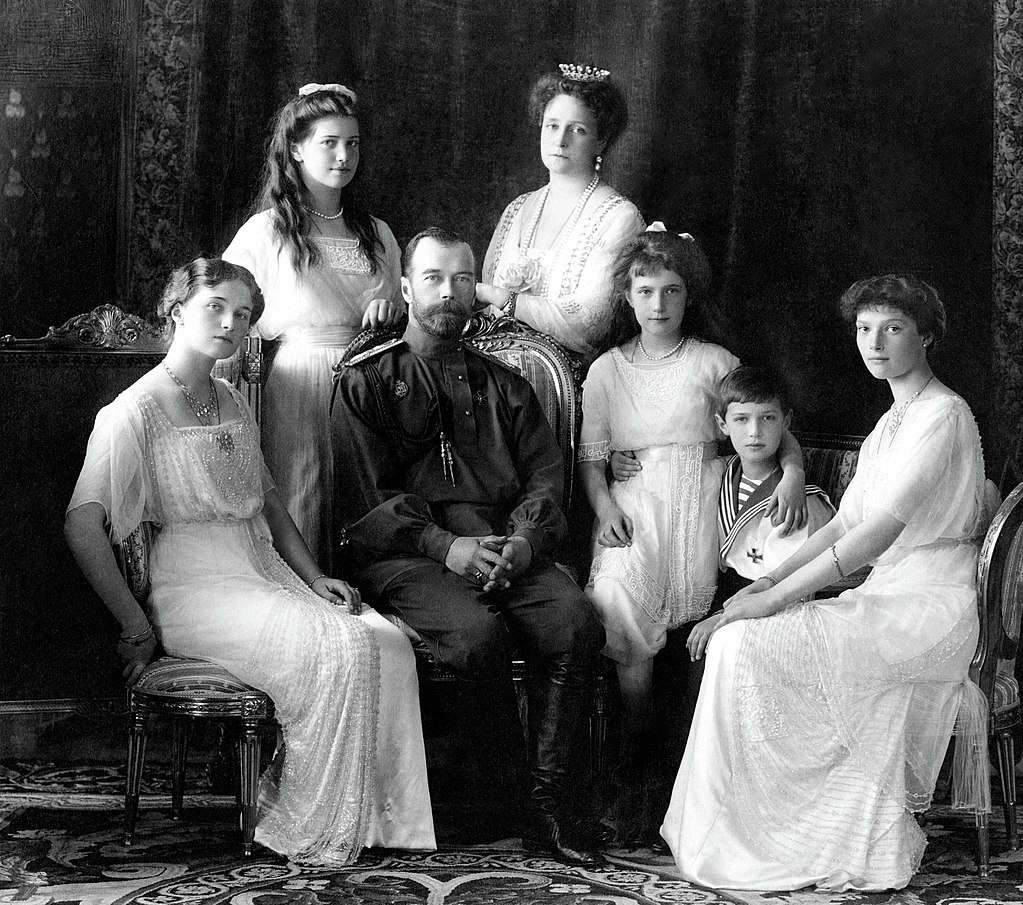
ANSWER: The entire period leading into World War I was a period of extreme socialism. This is when the world was enamored with Karl Marx. That lasted until the Russian Revolution in 1917 and the murder of the Czar and his family. The Romanov family were shot, bayoneted and clubbed to death in Yekaterinburg on the night of 16-17 July 1918. This demonstrated the hatred that Karl Marx unleashed upon the entire world. Only then did people in the West begin to look at this Marxist rebellion as something serious rather than a fashionable liberal change of mind.
Most people are ignorant about how the world economy functions no less its history. They assume that today this is a “Global Market” for the first time in history. That notion is completely wrong. Prior to World War I, the world economy was open and global. It was this openness of global financial markets prior to the war that led to the closure of stock markets. Europe will do the same so beware. It is important to understand what took place because history will REPEAT going forward in Europe.
Before World War I, financial capital was free to move from one country to another without exchange controls. All the major countries of the world were on the Gold Standard. People assume this meant that money was real and stable. That is just propaganda for the world currency markets were still arbitraged despite the gold standard. The differences in exchange rates were arbitraged back then through the buying and selling of international bonds that were listed on the world’s stock exchanges. Russia would issue a bond that was then listed on the St. Petersburg stock exchange as well as the major world stock exchanges in London, New York, Paris, Berlin, and Amsterdam. Differences in exchange rates between countries were arbitraged according to the shifts in CONFIDENCE with respect to nations by buying and selling bonds in different markets. In reality, this made European stock exchanges a single, integrated market which they claim they are trying to accomplish today with the Euro
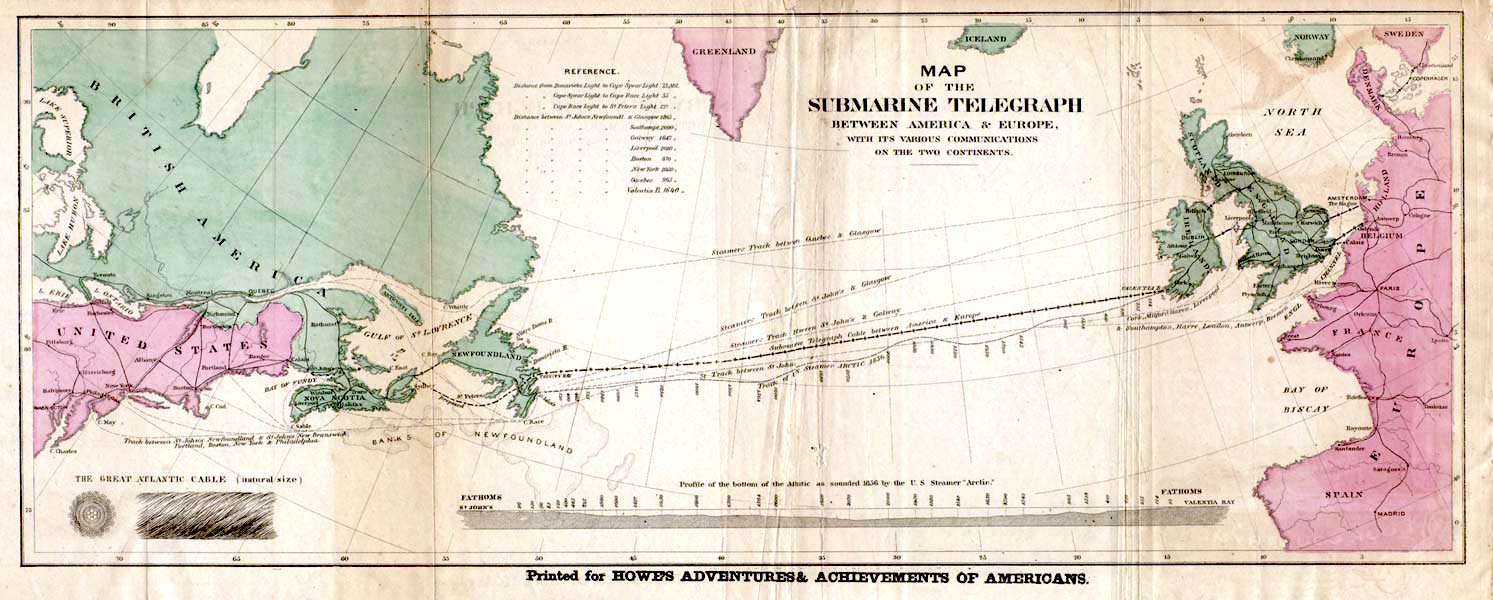
To the shock of most people, even back in 1914, currency flowed between countries with lightning speed thanks to the telegraph and international banking. Even during the Napoleonic wars, money moved, but it was slower in that physical metal and coin needed to be transported by ship or train from one country to another. By 1914, the Transatlantic cable stretched across the ocean connecting North America and Europe. This reduced the communication from 10 days to 17 hours with the first communication taking place on August 16th, 1858. By the Roaring ’20s Bull Market, stockbrokers were on ships so you could trade while traveling between New York and Europe.
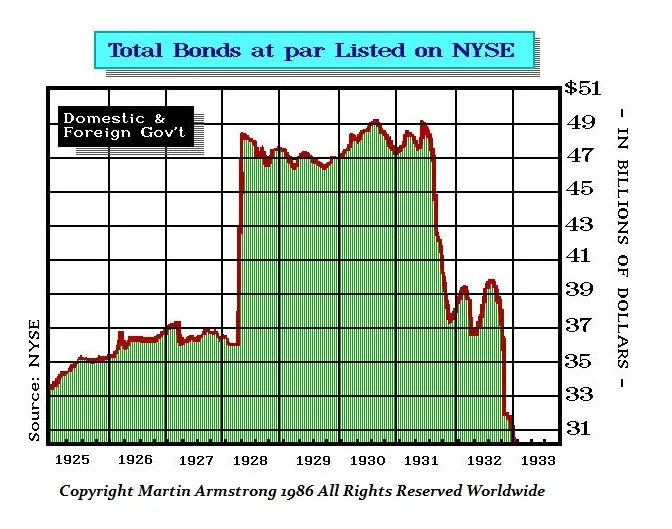
Therefore, arbitrage kept the currencies in check through the bond markets predicated upon CONFIDENCE. Because traders throughout the world could sell bonds and shares instantly, this is why the European governments shut down the markets. This was the check and balance based upon CONFIDENCE in their governments. On July 31st, 1914, the New York Stock Exchange closed its doors for the longest period in exchange history due to the political pressure for fear that European bonds would be sold there. The New York Stock Exchange remained closed until November 28th, 1914, when bonds began trading once again. Here is a chart of the bonds listed on the NYSE that crashed during the Sovereign Debt Crisis of 1931. That was the end of the formal bond arbitrage.
Europe feared massive selling and foreign investors would try to repatriate their money which would aid an enemy. Effectively, the free markets shut down and this was a political directive. In London at that time, individual trades were made on a daily basis, then carried until Settlement Day when trades were matched and crossed. Brokers would make up the surplus or deficit on their accounts by settling outstanding trades with cash. As long as there were no significant swings in stock or bond prices, brokers had sufficient capital to settle their accounts. However, since traders relied on credit, large swings in prices could and would bankrupt many of the brokers, worsening the financial panic. This was one more concern that the brokers themselves had fearing volatility and thus supported the closures during World War I. Trading became a black market off exchange.
We have the largest database ever constructed when it comes to the global economy. Research has been carried out with one simple rule – let’s see what happened. Instead of beginning with a predetermined theory, we approached the global financial history with a view to learning how it worked rather than trying to prove a point. Markets speak to us when we listen. They show the trend and are not arbitrary. We have all been connected globally for a very long time. Capital has moved around the world based on fear and opportunity from ancient times.
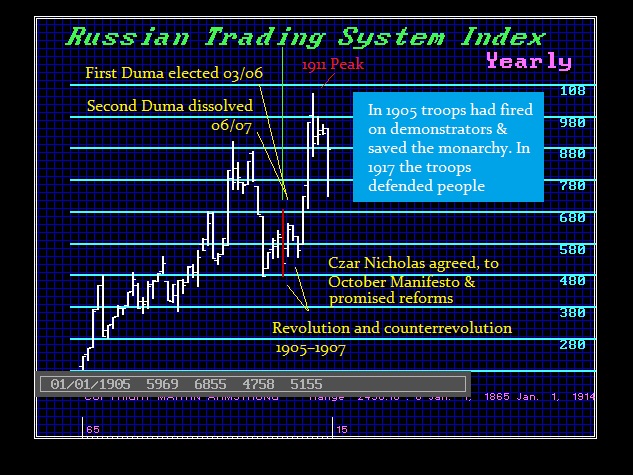
At this year’s WEC. we will be also looking at how the markets speak to us and what are they saying this time about the years just ahead. Here is a chart of the Russian share market where we have created an index to expose how capital functioned and behaved going into the Russia Revolution. There was a period of two years with compressed consolidation following the 1911 high in Russia just prior to the move with the second attempt at a Russian Revolution. The market always reveals what is to come.
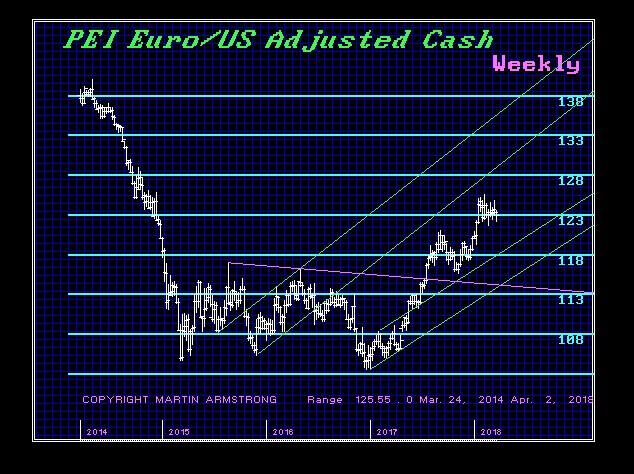
There have been persistent rumblings behind the curtain that the ECB has been “frowning” on anyone taking short positions on the Euro. They have already outlawed shorting government bonds and they are trying to wrestle the market in the Euro from London to bring it within their power and control. Up until now, they have been politely discouraging shorting the euro. The Brussels empire is crumbling before our eyes and with each and every step, the EU Commission is moving to eliminate free markets because they have been moving against the dreams of the EU Project to federalize Europe without federalizing all the debts of member states.
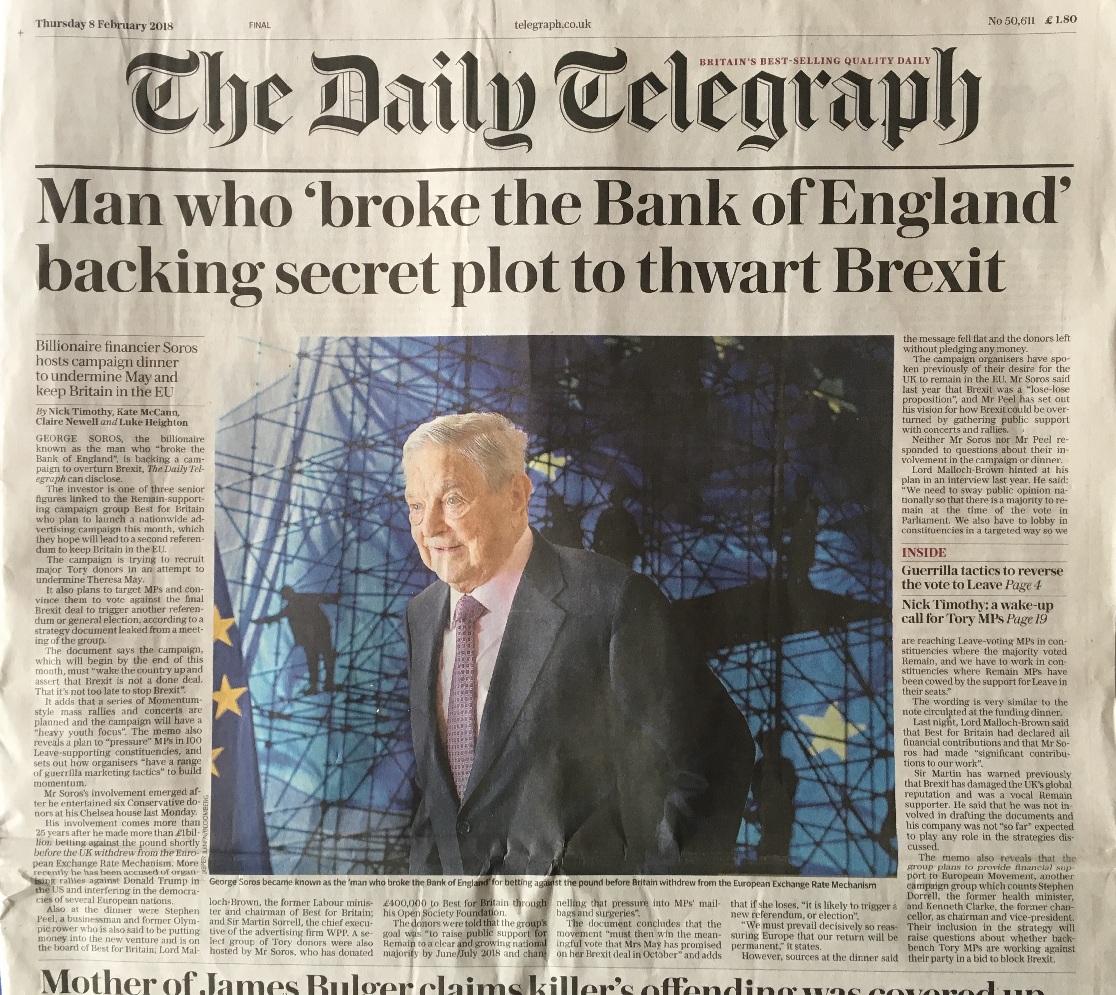
The Telegraph in London published a piece where they call the “remain” crowd supported by George Soros ‘remainiacs’ who are trying to halt Brexit and like those in Brussels, think the people are too stupid to understand what they even voted for. They obviously hate democratic votes when they go against their goals and this is why they want to go fully into the EU which has also eliminated democracy since their leaders are also all unelected running Brussels machine to subjugate all of Europe with the same goal of Napoleon and Hitler – to create the United States of Europe. They appropriately called the deal would keep Britain shackled in a ‘Hotel California’ Brexit – one where you can check out anytime but you just can’t leave?
The author was a historian and cultural anthropologist, and he applied those techniques to review the EU. He wrote: “By getting out now we may just avoid the cliff-edge of a major crisis in the EU. And the ‘remainiacs’ just don’t see it. If we apply a famous technique for analyzing the risk of collapse in complex societies to the EU, we find that it is squarely within the zone of that risk.”
He points out that even the last President of the Commission, José Manuel Barroso actually called it an empire. Indeed, our models agree that the EU must be seen as an empire and the member states are just vassals no different from the Soviet Union, the Athenian Empire (454–404 BC) and its the Delian League, or even the United States. Not a single empire has ever survived because centralized control and dictatorship is unable to comprehend the difference within the economic trends of its vassal state empire. It attempts to impose one rule upon the whole, which historically always fails.
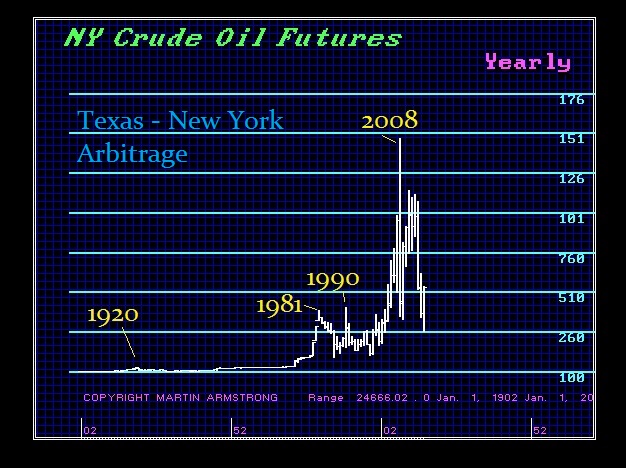
When the Federal Reserve was first established, it had 12 branches and each was autonomous. The structure recognized that there were regional differences based upon the economic dominance of each region. Some were oil based, others agricultural, and others leisure and still others were manufacture or financial. It was always the New York Texas Arbitrage because when oil was booming, inflation rose and when oil crashed stock markets and bonds rallied. Even in Canada, it was the Western commodity regions against the financial East of Toronto. To this day, we see rising separatist movement in Alberta all because of this same disease from trying to run an empire from a single central rule. One size does not fit all!
As pointed out in the Telegraph, the models used to analyze the risk of the fall of empires is surprisingly simple. The risk of collapse in empires is when the complexity of a central government reduces the benefits of individuals in a society. It emerges when the government sees itself as the sovereign nation and the people as the great unwashed economic slaves to be exploited. Indeed, this very simple analysis shows that even the United States is at risk of collapse. As I just explained, prosecutors are above the law and have absolute immunity. That is the essence of tyranny. Our model adds the economic backdrop and correlates this with the rest of the world and we see that historically people migrate economically when the costs rise, freedom declines, and the standard of living is in a bearish trend when even their children see their own future will be worse than their parents. This is why there was such a great migration to America from Europe. It is also why America was more isolationist. FDR had to plead for support in Boston to just send arms to Britain. That city was dominated by Irish who rejected sending their sons to battle to defend the English after their import restrictions on food for trade led to millions of Irish deaths.
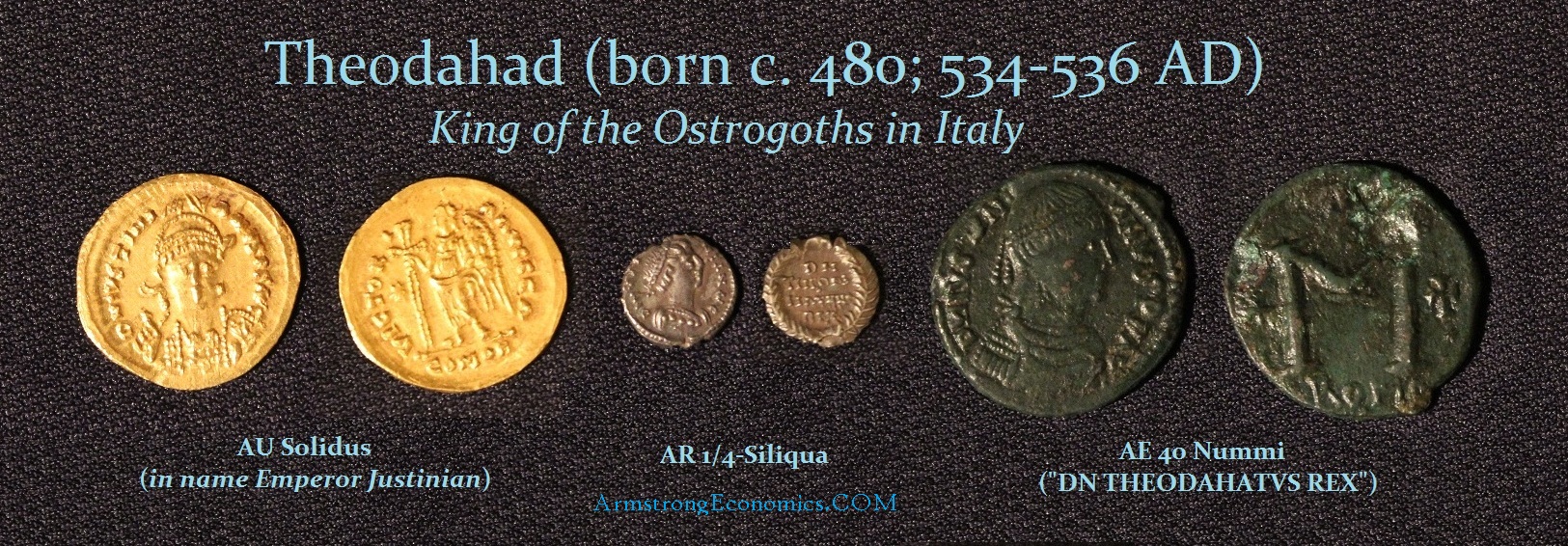
The refugee migration to Europe is economic. They see the opportunity for a better life. That is the very same reason the barbarians invadedRome. The Ostrogoths when they invaded Rome, wanted to be Roman. They issued coins imitating the Roman Empire after Rome fell in 476AD. They tried to pretend to be Roman but they failed in culture and management skills. This demonstrates that the invasion of Rome by the barbarians was economic. Even in the USA, the net migration from Illinois to Texas and Florida is economically driven. The Greek youth have been migrating because there are no jobs and they see no future in staying in Greece. These are the signs of how an empire crumbles into dust.
The entire project has been a con-job. They introduced the currency FIRST and believed they would gradually move to federalize Europe thereafter. The failure to consolidate the debts was devastating. They effectively wanted a free ride with leaving the garbage behind. Then, because the debts were not consolidated, they left each member state to also retain its central bank. Then they tried to enforce spending criteria on each state in one-size fits all policy. This has been the federalization of Europe on the cheap.
Nobody in their right mind would have begun a country with such a model. This is why the European Project is going down in flames and the very thing they convinced themselves was the real purpose, to end European wars, they have ignited the old hatreds that have existed within Europe for thousands of years.
All the manipulation tactics in the world will not save the Euro. They have made it illegal to short Eurozone bonds. The currency will be next. They are converting the Euro into the old Russian ruble drained of liquidity. Euro accounts are being charged 2.4% annually to have more than 100k in the bank. This is a tax on money.
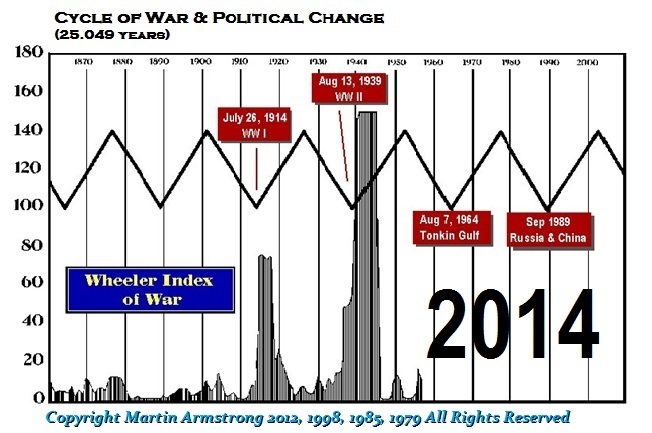
QUESTION: Mr. Armstrong; I find it amazing that you were the only analyst I found who consistently called the bull market in the Dow until January. You have forecast even weather. You have so many correct forecasts there is nobody who even comes close. Then there is your War Cyclethat turned up in 2014. You warned that 2018 is where it would start to pick up steam. You have also said it is in the west rather than with Korea. The newspapers are starting to talk about war with Russia. Is everything still on track?
MS
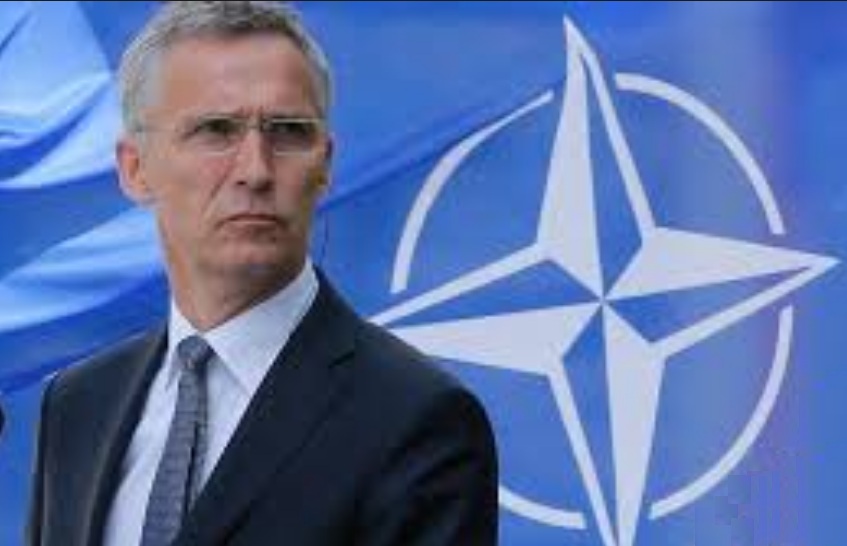
ANSWER: Unfortunately yes. The NATO Secretary-General Jens Stoltenberg has constantly been pushing for a confrontation with Russia, He has been moving military installations to the Russian border while Putin has been forced to pursue buffer zones around Russia. The European Member States have been instructed that they should construct roads and bridges that will allow tanks to freely move throughout Europe. Interestingly, it was the construction of the roads in Turkey that allowed Cyrus the Great of Persia to invade and conquered the entire Anatolia region. So what on the one hand would allow Europe to deploy tanks against Russia, would also allow Russia to take Europe much easier. Indeed, in Poland, there is a motorway leading east to the Ukrainian border that is rarely used.
What you must understand is that the West NEEDS a war desperately as a distraction from the collapse of Socialism. NATO has been looking for any excuse to turn this into a confrontation with Russia. The crazy thing is that war has changed. Neither side wants to “occupy” the other as was the case with Napoleon and Hitler. So why are we preparing for war? What is the objective?
Turkey needs a war and they are becoming much more aggressive because the currency is collapsing. Yet Turkey is a NATO member who is threatening Greece another NATO member. Turkey is strategically moving closer to Russia than Europe. At the Ankara summit, the impression was clear that Turkey was on his side of Russia. This has fundamentally changed the situation on the Black Sea and indirectly also in Eastern Europe. In the east of the Black Sea, that is also Russia’s southern border.
Russia had included the Crimea peninsula. It gave it to Ukraine when it was part of the Soviet Union. Russia took it back because it was strategic and you can bet that the USA would have done the same had Japan tried to take Okanowa. The Russian Black Sea Fleet has been located in Crimea for more than two centuries. There was no possible way Russia would have given that back to Ukraine. The West knew that and have used that excuse for sanctions against Russia knowing full well that they were turning up the heat that could easily lead to war.
NATO has signed numerous agreements with Ukraine providing it with arms and has in all but name made it a NATO member. NATO continues to portray Russia as an aggressor when it knows that Crimea was part of Russia until 1954 when it formally gave it to Ukraine to manage, But the dominant language spoke in Crimea remains Russian – not Ukrainian. NATO is also encouraging Romania and Bulgaria to create fleets to confront Russia using the Crimea crisis as justification.
Russia, unlike China, lacks a strong domestic economy for it has been much like the Middle East – counting on commodity exports. However, as commodity prices have declined, this has weakened the Russian economy and here too Putin will need a war to overcome the economic decline ahead. NATO is an organization that can no longer be defined and it seeks to hold onto old world philosophies to justify its existence. NATO needs a war to ensure its own funding. If Russia has no real designs to invade and occupy Europe, then why do we need NATO?
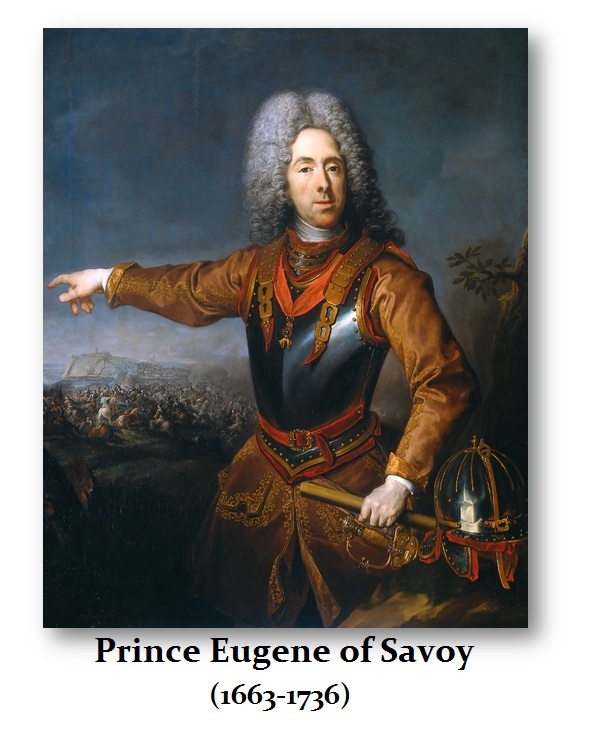
The Prince Eugene of Savoy (1663-1736) was considered even by Napoleon as one of the seven greatest strategists in military history. He was also plagued by a rumor that he was really the illegitimate son of King Louis XIV of France which he perpetually denied. Yet, Louis XIV was always ashamed of such offspring and he restrained Eugene’s ambitions as if he was perhaps his son so that after 20 years of living in Paris and at Versailles, he left France and offered his talent to the kings of Europe. He fought for Leopold I (1640-1705), Holy Roman Emperor who was fighting the Turks. He distinguished himself in the siege of Vienna in 1683 and his military career was born.
Yet the Prince of Savoy was a man who observed patterns. This helped in in military strategy, but it also allowed him to see the function of government. He came to comprehend that standing armies would be easily used. It was his observations that kings would go to war BECAUSE they had standing armies that they paid for even if they did nothing. The Prince explained that there should be no armies and that would reduce war by itself. He passed on this brilliant insight to Montesquieu, who the Founding Fathers of the United States understood and thus created the right to bear arms which became the Second Amendment to the United States Constitution which is under attack today. In Switzerland, you enter military service to be trained, and then you take your gun home ready to be called upon if there is an invasion.
Unfortunately, NATO by itself needs a war. As the budgets get tighter and tighter, funding is shifted to social programs. NATO will then layoff people and lose its power base. It needs to demonize Russia as much as possible and to even provoke a confrontation to justify getting more money. Of course, it seeks to provoke a confrontation for money but it assumes there will not be World War III because neither side desires to occupy the other. So exactly why do we need standing armies today is simply a political issue. However, maintaining such a military power also ensures that it will eventually be used.
If the reason for war is no longer occupation but more like a brawl between two drunks in a bar, they do we need standing armies especially when we can just push a button? It is sad to say that now we will see tensions rise from 2018 onward into the peak of the cycle.
I have created this site to help people have fun in the kitchen. I write about enjoying life both in and out of my kitchen. Life is short! Make the most of it and enjoy!
This is a library of News Events not reported by the Main Stream Media documenting & connecting the dots on How the Obama Marxist Liberal agenda is destroying America

 UPDATE 9:40pm EST – Airstrikes by combined forces from the United States, France and the U.K. have begun against elements of Syrian Bashir Assad forces in response to prior use of chemical weapons.





 Centinel2012