Repetitive Patterns in the Money Supply – Will Coins Become Extinct?


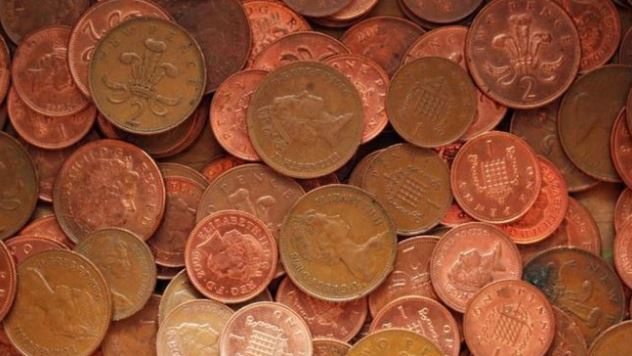
Inflation over time raises the cost of raw metal and we see that such coins vanish from the money supply. Britain is the latest in line to eliminate the 1 & 2 pence coins. They are costing more to produce than they are worth. I have written about the monetary reform Act of 1857 when the penny was drastically reduced in size. Canada eliminated the penny as well.
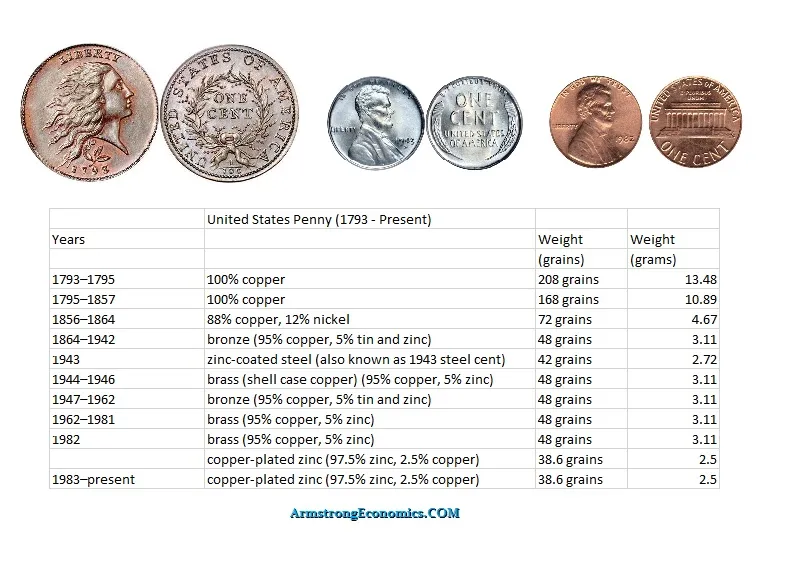
The United States dropped copper from the penny in 1982. Today, the penny is made of 97.5% zinc. It is copper-plated to give the appearance that it is still really copper. Throughout history, the supply of copper, gold, and silver, have all risen and fallen at different times based on their own cycle. Where the Persians had excess gold, the Greeks only had silver mines. The Romans had neither silver nor gold and began their monetary system with bronze.
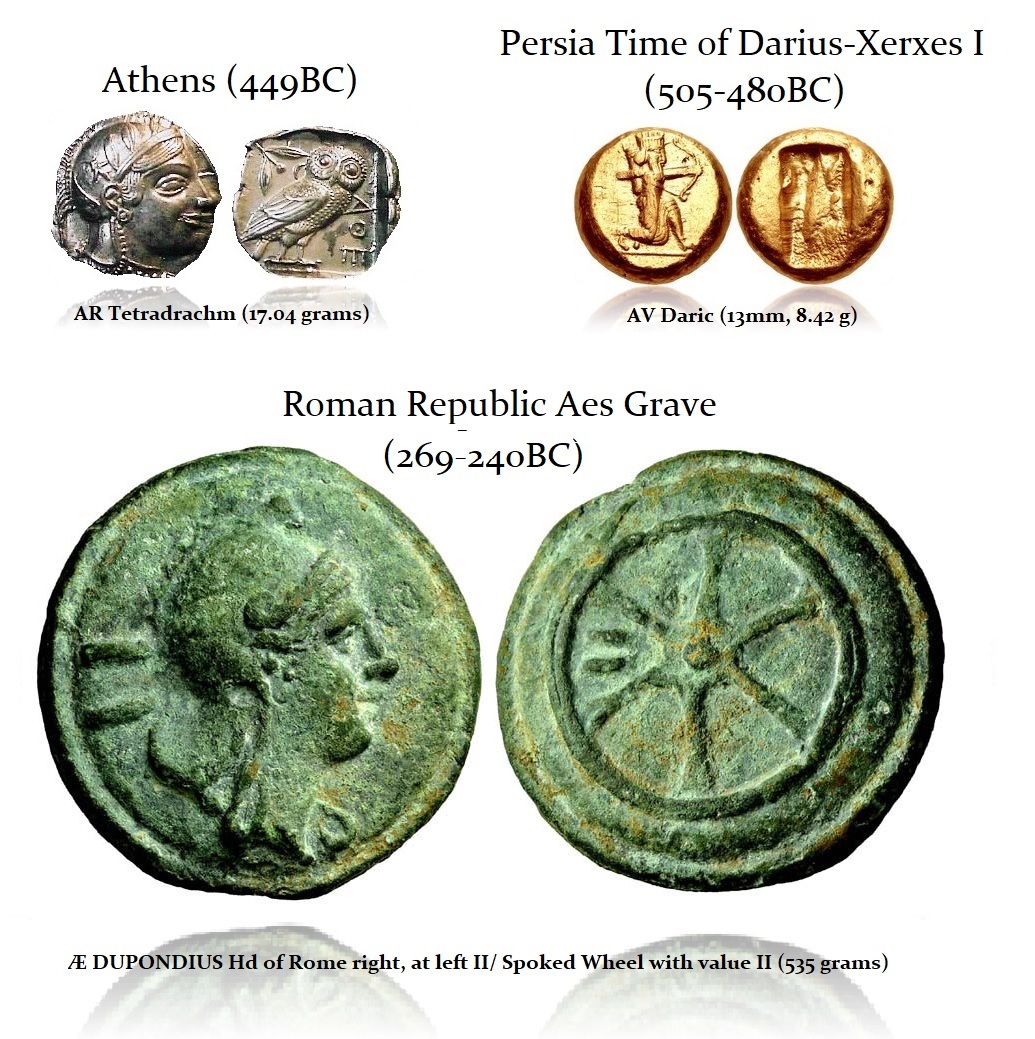
We can see how the three empires began with gold, then silver, and finally bronze and modern society turned to paper starting with the Chinese during the 13th century. The main coin of the Persians was known as the gold Daric, whereas the dominant coinage among the Greeks was the silver Athens tetradrachm known as the Owl. The Romans were the last to depart from the Bronze Age. Their coinage remained bronze until silver was introduced and struck in Greek denominations beginning in 280BC, which was just one 51.6-year wave from Alexander the Great (336-323BC).

As-Decline (1)


We can see the same process of the rising cost of copper that prevailed during the early Roman Republic. The Roman As drops from 280BC with a weight of 341 grams to 10.6 grams by the time of Augustus (27BC-14AD). The drastic decline was been 280BC and 115BC, which was about 19 waves of 8.6-years.
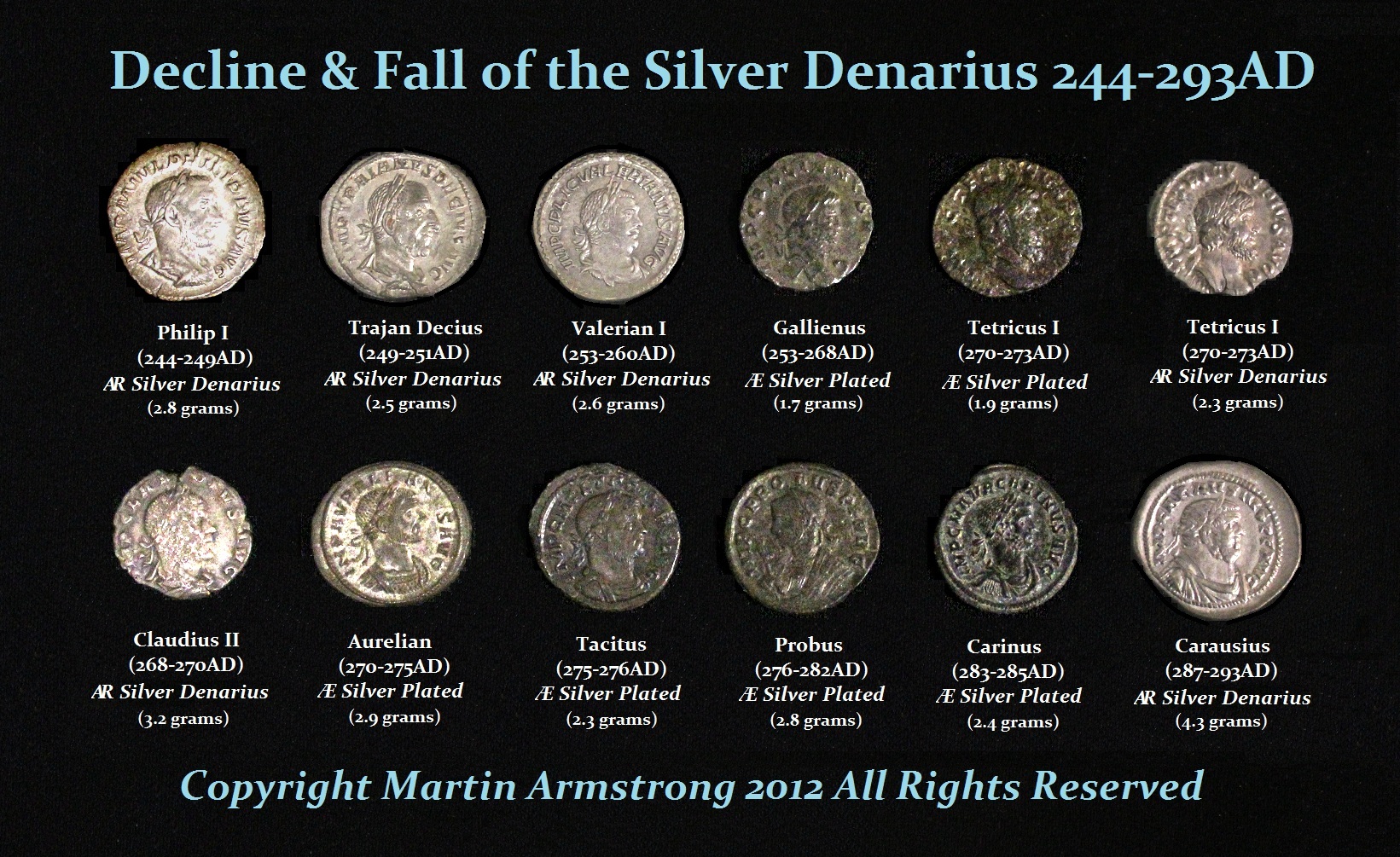
While we see the same process of a decline in Roman silver denarius into the 3rd century, what emerges is always the effort to reform. The Roman Emperor Diocletian (284-305AD) reintroduced silver coinage as well as bronze. Once again, we see the gradual reduction in the bronze coinage while the silver and gold were not affected.
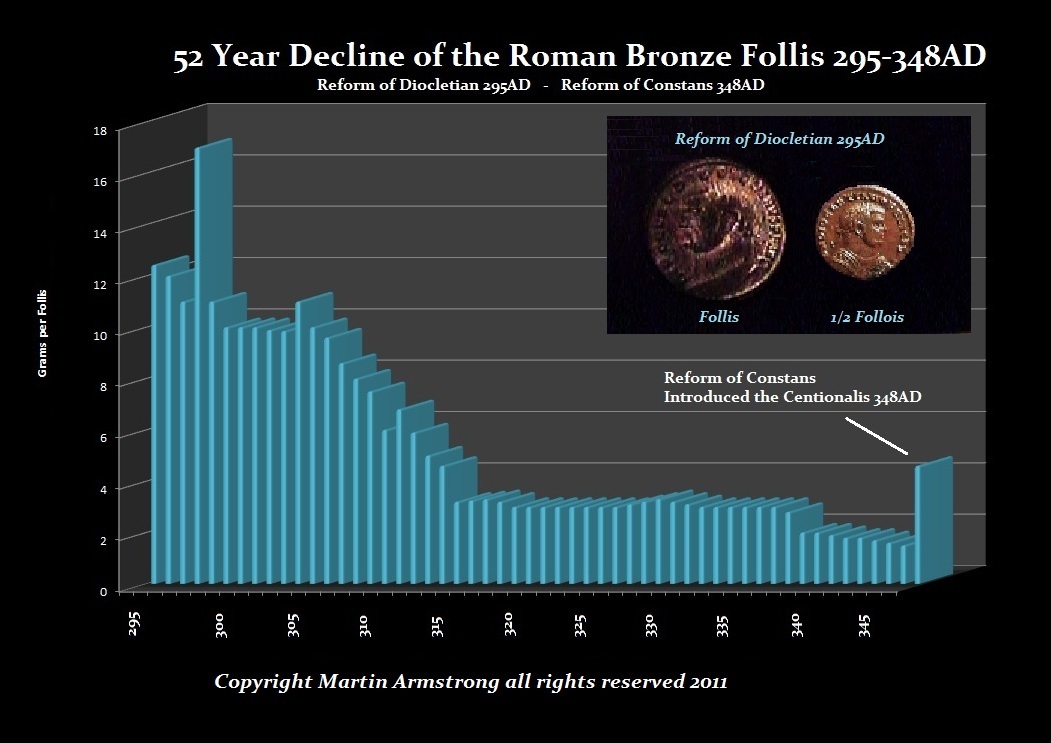
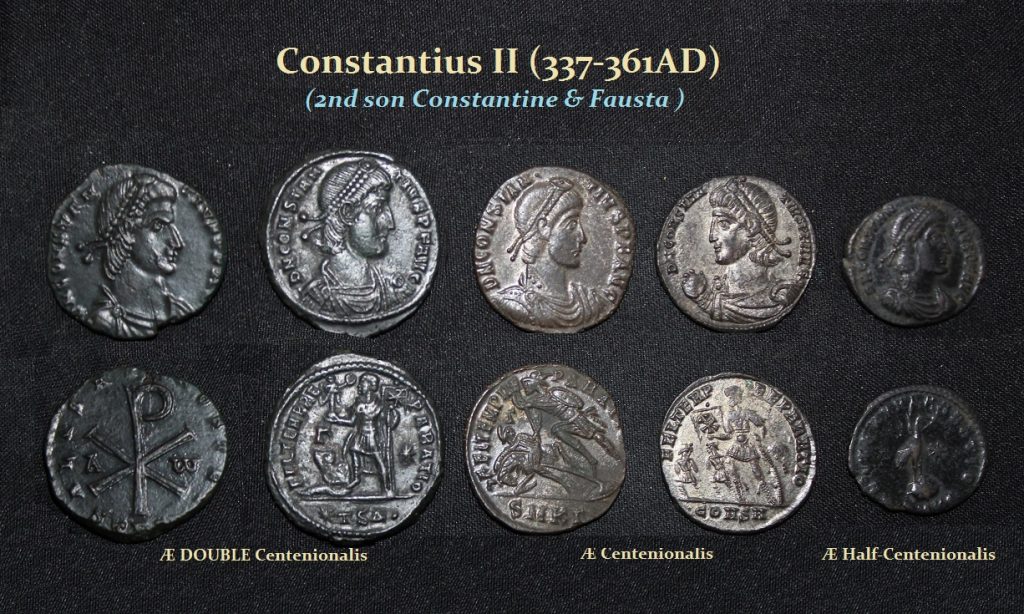
The bronze coinage simply keeps reducing as we see what is going on today. In 348 AD, a new bronze denomination was also introduced known as the “centenionalis” in a monetary reform carried out by Constantius II (337-361AD) with an initial weight of 6.6 grams. The weight almost immediately began to decline rapidly to 4.3 grams. He also introduced the half-centenionalis, which seems to continue to be produced and eventually becomes the standard until about 360AD. Despite the noble effort, the inflationary trend continued and the value of bronze kept rising forcing the discontinuation of this denomination 354 AD after just 6 years (one volatility cycle). This was then replaced by the reduced bronze denomination of about half the weight known today simply as the AE3 or half-centenionalis.

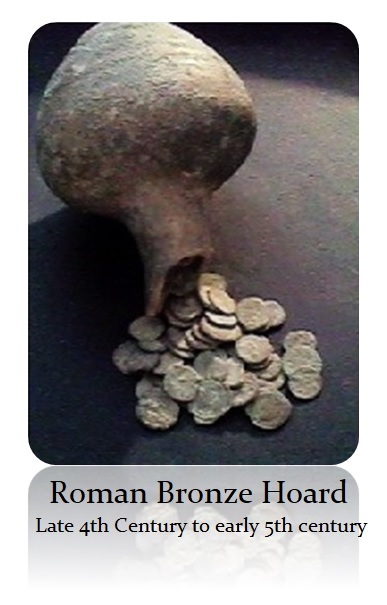
During the reign of Julian II (360-363AD), he attempts yet another monetary reform trying to restore the original Folles of Diocletian known as a Double Centenionalis or a Majorina. This new denomination bronze denomination was 28mm in diameter with a weight of 8 grams. This monetary reform lasted unmolested until about the reign of Arcadius (383-408AD). For about 19 years, the Double Centenionalis remained fairly true to its weight. When we see once again usurpers begin to rise in the West such as Magnus Maximus (383-388AD) in Britain and the usurper in Rome itself of Eugenius (392-394AD) where the bronze coinage is reduced to a tiny token with a weight of 0.94 grams.

From about 400AD until the final collapse of Rome in the West during 476AD, bronze coinage is poorly struck and typically only tiny 1 gram coins. Many emperors did not even strike bronze coinage. When the Vandals from North Africa invade and sack Rome3 during 455AD, the word today is still used “vandalize” which refers to the events at that time. Copper was scarce so the Vandals stripped the roofs of Roman buildings which had been adorn in copper to shine brightly as if it were gold.

Therefore, throughout history, the cycles between the three metals are significantly different and thus we see periods during which bronze if rarer than gold or silver and at times each metal comes into excess supply and shortages. This is one primary reason any attempt to establish fixed ratios has always failed without exception. We are following the same path. Soon, all metal will be worth too much to use for coins.

Why does the church keep the victory of the Crusades a secret? by Dr Bill Warner


Is Hillary Clinton Mentally Ill?


Hillary Clinton just can’t get over losing the presidency. Maybe she lost because she’s still calling half the country deplorable racists? The Right Angle team weighs in.

SAVING CALIFORNIA


“The problem with California is Californians.” So says Firewall host Bill Whittle, and he ought to know: he’s been one of them for thirty years. Is great comfort and great ignorance tied together? Why yes. Yes it is. Find out why in the latest edition of FIREWALL.

FBI Office of Professional Responsibility Recommends AG Jeff Sesssions Fire Andrew McCabe…


A very interesting dynamic today, with a motive that may not be as transparent as initially appears. The New York Times and Washington Post are both reporting the FBI’s internal Office of Professional Responsibility (OPR) has recommended to AG Jeff Sessions that FBI Asst. Director Andrew McCabe should be fired.

The reason for the recommendation surrounds the DOJ Inspector General discovering that FBI Asst. Director Andrew “Andy” McCabe intentionally leaked information about the Clinton investigation to the media, and coordinated the leaks therein.  The IG referred the issue to the FBI’s internal OPR for review and recommendation to the Attorney General. The Times and Post are leaking information of the determination by the OPR that Andrew McCabe should be fired.

(NYT) […] Now, Mr. Sessions is the final arbiter of Mr. McCabe’s dismissal, shortly before his retirement takes effect Sunday. Though no decision has been made, people inside the Justice Department expect him to be fired before Friday, a decision that would jeopardize his pension as a 21-year F.B.I. veteran. (link)

If AG Jeff Sessions fires McCabe for cause, the former FBI Deputy could, likely would, lose his pension and benefits.  McCabe is scheduled to retire with those benefits on March 20th, six days from now.

The dynamic is interesting.  An OPR recommendation for disciplinary firing puts AG Jeff Sessions into a box; he has two options:  Option #1 is fire McCabe.  Option #2 is set aside the OPR ruling and allow McCabe to retire.  Sessions has to take one of those two actions.

On one hand you could make an argument the Office of Professional Responsibility’s disciplinary recommendation is (Good Guys) trying to hit and punish McCabe at the last moment possible.  However, on the other hand you can look at this leaked disciplinary recommendation as Machiavellian characters (Bad Guys) within the FBI setting up AG Sessions, painting him into a corner, to create yet another controversial storyline.

My guess as to the FBI OPR motive is the latter, not the former, and here’s why.

First, the OPR recommendation is leaked.  We are all too familiar with the IC leaks to the New York Times and Washington Post being 100% constructed by illicit schemers within the intelligence community who are against the Trump administration.  This truism is transparent from the history of the leaking.  All leaks frame a narrative that only goes in one direction. All leaks are against the people’s president, Donald Trump.

Second, and perhaps more convincingly, the recommendation is coming from the Office of Professional Responsibility inside the FBI.  Think about that carefully.

If there was an actual OPR office – containing any semblance of professional watchdog intent – then where the hell were they over the past few years while the entire organization was engaged in brutally corrupt activity.

Now, only RIGHT NOW, the FBI-OPR has issues with McCabe et al?

Whiskey Tango Foxtrot!

Where was the OPR while the entire administrative apparatus of the FBI was leaking to the media, constructing false witness, assembling fraudulent investigative materials, conducting sham investigations with predetermined outcomes; blocking congressional oversight, and generally behaving like a rogue political intelligence apparatus?

Seriously, where was the FBI’s Office of Professional Responsibility then?

No.  Sorry.  Not even beginning to buy the angle of a decent department watchdog doing their level-best to bring justice upon the head of a corrupt FBI political operative, Andrew McCabe.  I’m not buying it.

The motive for this FBI watchdog leaked internal story today, and the OPR recommendation therein, is most likely to create yet another antagonistic controversy.  The FBI Machiavelli schemers are still doing their duplicitous crap.

If Attorney General Jeff Sessions fires McCabe, the controversial narrative is that he’s desperately doing the bidding of President Trump who has tweeted about McCabe being corrupt and unaccountable.

If Attorney General Jeff Sessions doesn’t fire McCabe, the controversial narrative is that Session’s is showing more evidence of his own weakness and motive to protect the swamp creatures; which will make Sessions seem like he is in alignment with McCabe and simultaneously anger the President and all his supporters.

The FBI-OPR has painted Sessions into a narrative of controversy either way…. and the leak about it seems to prove the FBI’s internal Machiavellian intent.

See how that works?

.

President Trump Visits Missouri for Business Roundtable – 4:00pm Livestream…


President Donald Trump is traveling to Missouri today to promote recent tax cuts and campaign for Republican U.S. Senate candidate Josh Hawley.  The president is scheduled to visit the Boeing plant in St. Louis where he will hold a round table with business leaders and workers, then plans to attend a fundraiser for the senate candidate.

The roundtable discussion with Boeing business leaders will be livestreamed at 4:00pm

WH Livestream LinkABC News Livestream Link

Solutions for Dealing with the Media: James O’Keefe and Bill Whittle


Published on Jan 2, 2018
At Turning Point’s Student Action Summit, James O’Keefe and Bill Whittle sit down to discuss their experiences in dealing with bad faith in the media.

Justice Department sues California for Harboring Illegal Aliens Defying Constitution


The Justice Department is suing the state of California for violating the Constitution by passing laws that shield illegal immigrants. Governor Jerry Brown is simply committing treason. It is interesting how he is sheltering illegal aliens which seems contrary to so many aspects even economically. I understand children that were brought here, grew up, and have married with children that are American. It is wrong to split up families. That stands in contrast to those who are adults who enter the country illegally. They cannot vote unless that is how Hillary beat Bernie in California.

Corruption & the Rule of Law


QUESTION: Today’s opinion section of the WSJ features an article on government’s intervention in AIG. The troublesome point concerns the possibility of a new precedent w.r.t. property rights in the USA, viz.:

“…the government may unlawfully deprive shareholders of their ownership and control of a company as long as it does not formally seize their shares”.

Well, I thought the rights that share ownership conferred were exactly those: an ownership stake in the company and a voice in its voting.

SC

ANSWER: The government plays with legal technicalities. They cannot seize a corporation and nationalize it without compensating the shareholders. However, it can seize a corporation and run it without formally taking the property. It is in a gray area like zoning regulations. The government can tell you what to do with your property short of taking it. However, in Youngstown Sheet & Tube Co. v. Sawyer, 343 U.S. 579 (1952), it was held that there was no authority to seize the steel mills because of a national strike. The court held: The Executive Order was not authorized by the Constitution or laws of the United States, and it cannot stand. The court wrote in the Syllabus:

To avert a nationwide strike of steel workers in April 1952, which he believed would jeopardize national defense, the President issued an Executive Order directing the Secretary of Commerce to seize and operate most of the steel mills. The Order was not based upon any specific statutory authority, but was based generally upon all powers vested in the President by the Constitution and laws of the United States and as President of the United States and Commander in Chief of the Armed Forces. The Secretary issued an order seizing the steel mills and directing their presidents to operate them as operating managers for the United States in accordance with his regulations and directions. The President promptly reported these events to Congress; but Congress took no action. It had provided other methods of dealing with such situations, and had refused to authorize governmental seizures of property to settle labor disputes. The steel companies sued the Secretary in a Federal District Court, praying for a declaratory judgment and injunctive relief. The District Court issued a preliminary injunction, which the Court of Appeals stayed.

The effective seizure of AIG was also illegal. Paulson let both Lehman Brothers and Bear Sterns fail but then rescues AIG without authority to save Goldman Sachs (see Timeline 2007-2009 Crash). The problem we have with is the government can do whatever it desires. The burden then falls on the citizen to go to court and spend hundreds of thousands of dollars or more to say his rights were violated. The Constitution is a complete FAILURE, for the courts have turned it upside down and they can do whatever they want and the burden is on you. The French system is much better. The government passes a law and then the high court rules if it is constitutional BEFORE it is enacted.

The damage our system inflicts upon citizens is off the charts. The government filed charges against Arthur Anderson and put the firm out of business. The case finally made it to the Supreme Court and they unanimously overruled what the government had done. Nonetheless, the firm was destroyed in the process. And guess what? The two prosecutors who charged Arthur Anderson with obstruction of justice and destroyed the firm illegally, are the left and right hand of Robert Mueller going after Trump – Andrew Weissmann and Michael Dreeben. In government, incompetence is rewarded. Dreeben argued that it was an aggressive case, but warranted. The Supreme Court unanimously overruled that position but it was too late to save the firm.


Supreme Court wrote:

Even “persuad[ing]” a person “with intent to … cause” that person to “withhold” testimony or documents from the Government is not inherently malign. Under ordinary circumstances, it is not wrongful for a manager to instruct his employees to comply with a valid document retention policy, even though the policy, in part, is created to keep certain information from others, including the Government.

Is it St Mark or Alexander the Great Buried in Venice?


QUESTION: I just returned from Venice and I was told that they stole the bones of St Mark from Egypt and built a church there for them. The four horses on the Church they stole from Constantinople. It seems a bit strange that they would go take relics from somewhere else. Do you have any comments on the Venetian Empire and their kleptomania?

JE

FourHorses

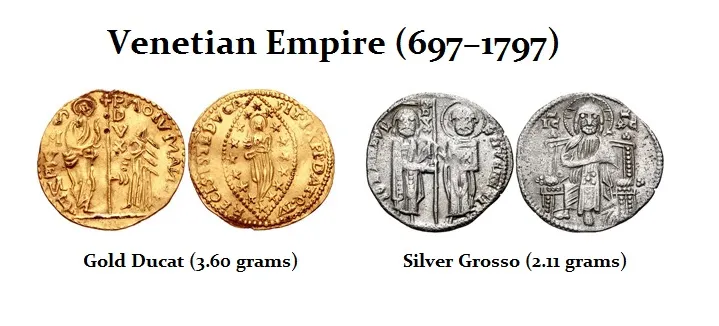
ANSWER: Venice had extensive trading connections with the eastern Mediterranean regions as well as an off/on relationship with the Ottoman Empire. Venice was the medieval center for the trade in antiquities as well as ancient coins. They loved history and it was a serious business in Venice. The Venetian gold ducat even rose to be an internationally accepted coin. This pictures St Mark standing giving a gonfalone to the kneeling doge (head of Venice). So indeed, St Mark was the center of Venetian culture. The four horses were from a chariot full size driven by Constantine which once stood in Constantinople before the Venetians conquered the city. They took just the horses back to Venice.

This interest in antiquities and relics first began in the Middle Ages and initially was focused on holy relics, which included removal of the bones of St. Mark from Alexandria in 828AD and moving them to what became known as St Mark’s Square. Most of the important early coin collections were actually formed through Venice. Andrea Loredan was a patrician of an old family of Venice dating back to the 12th century that occupied hereditary seats on the Great Council from 1297 onward. The family still exists today with the Palazzo Loredan Cini at Campo San Vio. Andrea Loredan was a serious coin collector who ordered an illustrated list of all his coins to be made in 1560 in order to help with their sale. A reproduction of that list has been produced by the American Numismatic Society – Irritamenta: Numismatic Treasures of a Renaissance.

With respect to the mummified body of St Mark, there is still a controversy that the remains are not that of St Mark, but Alexander the Great. Three early Christian sources stated that St Mark’s body was burnt after his death. As the story goes, the pagans seized Saint Mark in Alexandria, Egypt, when he was serving the Liturgy and beat him, dragging him through the streets and threw him in prison. On the following day, the crowd again dragged him through the streets to the courtroom, but along the way, Saint Mark died. The pagans were so angry and the Egyptian tradition was to preserve the body, so they wanted to burn the body in disrespect. It is said that when they lit the fire, everything grew dark, thunder crashed, and there was an earthquake. The pagans then fled in terror. Some Christians then took up the body of Saint Mark and buried it in a stone crypt on April 4th, 63AD.

During the year 310AD after Constantine, I the Great becomes Emperor in 307AD and two years before the Battle at Milvian Bridge on October  28th, 312AD, a church was constructed over the relics of Saint Mark. The Pope prayed a prayer on the grave of Saint Mark when the church was then a little chapel on the eastern coast containing bodies said to be of Saint Mark and some of his holy successors. The church was later enlarged in the days of Pope Achillas, who was the 18th Pope.

After the Siege of Alexandria in 641AD, the tomb of Saint Mark was no longer in Christian hands. The church was greatly ruined in 641AD when the Arabs invaded Egypt. Then in 680AD, Pope John III rebuilt the church. In 828AD a group of Venetian Christian merchants traveled to Alexandria and obtained the body of Saint Mark. As the story goes, these merchants used pork to prevent the Islamic authorities from inspecting what they were transporting. The Venetians and the body of Saint Mark managed successfully to make its way to Venice.  The church was destroyed again in 1219, during the time of the crusades, and was rebuilt once more. However, during the 16th century, the French explorer Pierre Belon mentions the founding of the church in 1547.

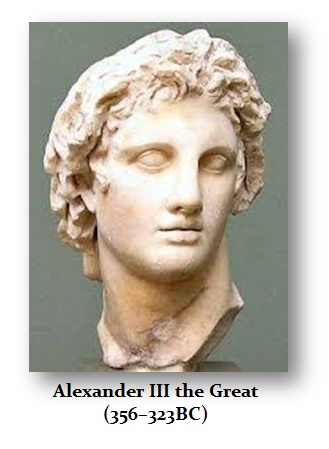
The other tomb of a mummified person in Alexandria was that of Alexander the Great. The location of Alexander the Great’s tomb has remained a great mystery. After the death of  Alexander in Babylon, the possession of his body became a subject of negotiations between his generals. Where to bury Alexander became a controversy. Aegae was one of the two originally proposed resting places. The body, however, was stolen en route by Ptolemy I Soter, the general who took Egypt. According to contemporary records for the years 321–320 BC, Ptolemy initially buried Alexander in Memphis. Sometime during the early 3rd century BC, Alexander’s body was transferred from Memphis to Alexandria, where it was reburied in a new tomb. It was this tomb that became a major tourist destination for hundreds of years.

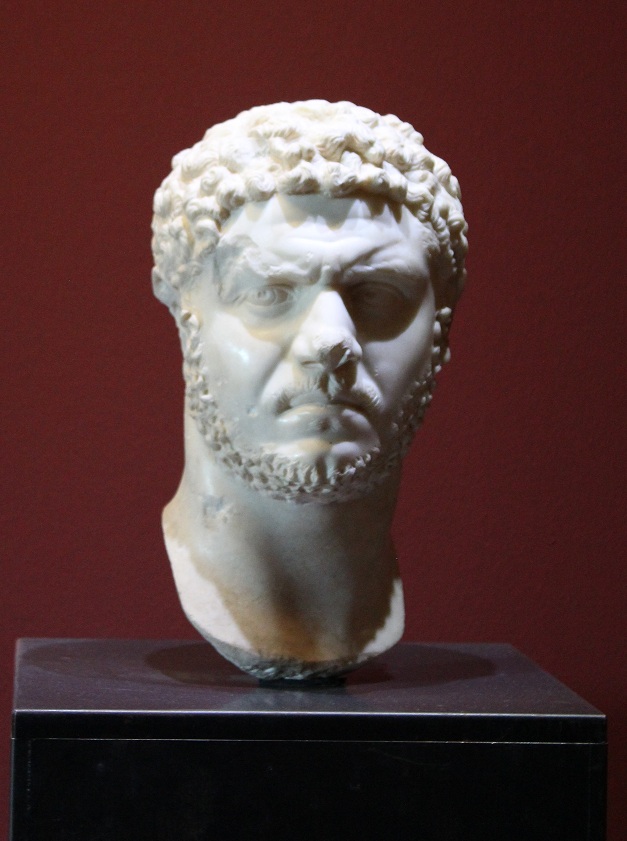
Caracalla-B1Julius Caesar paid his respects to the tomb of Alexander the Great. The first Emperor of the Roman Empire Augustus declined the opportunity to visit any tombs saying that he came to see a King and not a bunch of dead people. Emperor  Caracalla (198-217AD) had seen himself as the reincarnation of Alexander the Great. Caracalla even retraced Alexander’s route to Egypt however and in 215AD, Caracalla was warmly received when he visited Alexander’s tomb. For some unknown reason, he slaughtered many of Alexandria’s inhabitants shortly thereafter. It is known that Caracalla apparently left with a piece of Alexander’s body armor. According to chronicler John of Antioch, Caracalla removed Alexander’s tunic, his ring, his belt with some other precious items and deposited them on the coffin.
When John Chrysostom  (349 – 407AD), the Archbishop of Constantinople visited Alexandria in 400AD, he asked to see Alexander’s tomb and remarked, “his tomb even his own people know not”. Later authors claim to have seen the tomb during the 9th century.  Others claimed to have visited a sepulcher in the center of Alexandria that was still venerated as the resting place of Alexander. This seems to be unlikely given the fact that the Christians sought to destroy anything that was a Pagan worship. Therefore, credible historical references of Alexander’s tomb continued only until about 390AD, and then vanish.

It has been argued that two years after the last historical reference of Alexander’s tomb, another tomb in Alexandria seems to surface after 310AD. But it is not the tomb of Alexander, the tomb belongs to Saint Mark. Saint Mark had been dead for over 300 years. Some have suggested that the mummified body of Saint Mark could, in fact, be Alexander the Great. The missing link is the question that if the Christians did indeed rescue the body of St Mark from the pagans and it was not burned, then was it mummified in Egyptian tradition or simply buried? If in 828AD a group of Venetian Christian merchants took a mummified body, was it really St Mark? Could the pagans have rescued Alexander’s body from the Christians who would have certainly destroyed it in their rage and placed it  in a church pretending it was St Mark to protect it?

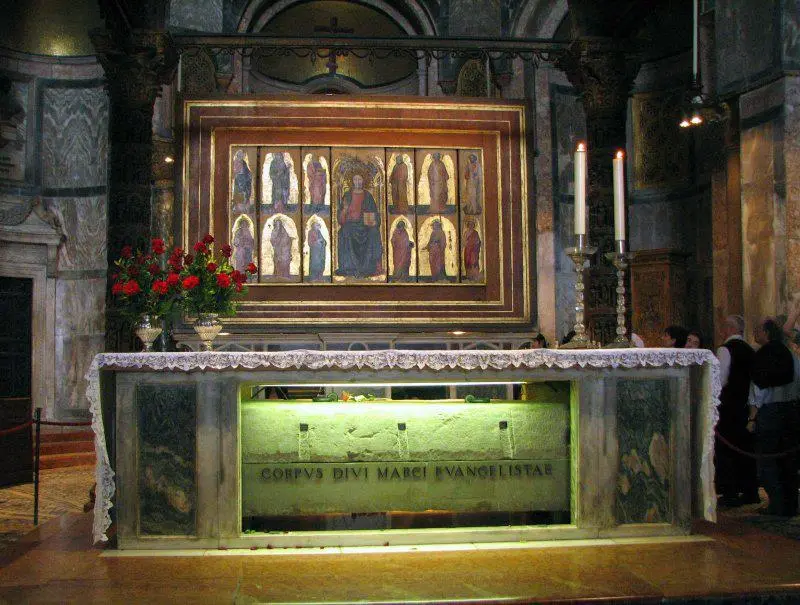
The Copts (Greek Orthodox Christians) believe that the head of St. Mark remains in a church named after him in Alexandria, and parts of his relics are in St. Mark’s Cairo’s Cathedral. Some believe that the rest of what are believed to be his relics are in the St Mark’s Basilica in Venice, Italy. However, back in 1063, during the construction of a new basilica in Venice, Saint Mark’s relics could not be found. According to legend, in 1094, the saint himself revealed the location of his remains by extending an arm from a pillar. The newly discovered remains were then placed in a sarcophagus in the basilica pictured here. There remain many questions about the body in the church. In Egypt, every year, on the 30th day of the month of Paopi, the Coptic Orthodox Church celebrates the consecration of the church of St. Mark and the appearance of the head of the saint in the city of Alexandria. This takes place inside St. Mark Coptic Orthodox Cathedral in Alexandria, where the saint’s head is said to be preserved.

The whereabouts of Alexander’s body remains one of the great mysteries yet to be resolved. Some argue it was buried in a remote community outside of Alexandria. A DNA test of the body in St Mark’s of Venice would resolve the issue and settle the question is the person of Greek or Semitic origin? Naturally, such a test would never be allowed for what if it showed it was the body of Alexander the Great? Can you imagine what that would do to Venice?