Michael Flynn Fires Lawyers – DOJ Files Documents Under Seal…


UPDATE (3:55pm EDT): The lawyer change (motion for leave) was denied by Judge Sullivan due to a technicality in the filing (no accompanying order, and failure to outline method of notification to Flynn). They are free to refile (probably will).

Previously: This is a very interesting development and may well indicate a change in strategy; or, even more interesting, the execution of a pre-planned strategy, for General Michael Flynn.  There is a possibility, with legal distance happening as a result of Weissmann and Mueller’s investigation concluding, that Michael Flynn may be shifting to offense.

Two separate court filings today show: (1) Lt. Gen. Michael Flynn has fired his legal team and retained new counsel; and, (2) the DOJ is filing the evidentiary documents (possibly Joe Pientka 302 and Kislyak transcript?) under seal.

The Daily Caller is reporting that an announcement from the new legal counsel will come out within the next few days:

Robert Kelner, a partner at Covington & Burling, said in a court filing Thursday that Flynn terminated their arrangement and has already hired new lawyers.

[…] It is not clear why Flynn is replacing Covington & Burling as counsel. Kelner declined comment. A source close to Flynn told The Daily Caller News Foundation a statement is likely to be released in the coming days. (link)

Additionally Techno Fog is noting there are new DOJ filings being presented to the court “under seal” (This could be the FD-302, from Flynn FBI interview, and/or the Kislyak transcript the DOJ previously would not provide the court in public record):

Additionally x 2, there is another motion by the DOJ (Van Grack, Jessie Liu) where previous filings under seal the government is now saying can be released.

My guess on the motion allowing ‘unsealing’ is that it could be connected to the Scope Memos provided by Rosenstein authorizing the targeting of Flynn; or it could be tied to the Flynn participation in the lobbying case.  Both would be pertinent to sentencing.

All of this is very interesting.

I hope this is connected to an intentional decision by Michael Flynn to stay in litigation long enough to outlast the Weissmann-Mueller probe.   CTH suspicion has always been that Weissmann-Mueller threatened Flynn with prosecution of his son, Flynn Jr., to coerce a plea agreement.

If our hunch has been accurate, Weissmann-Mueller held prosecution of Flynn Jr. as a sword of Damocles over the head of Flynn Sr. throughout the prosecution, plea and sentencing….  However, if that’s the case, with Weissmann and Mueller ending their investigation, Flynn would be out from under the threat.

This is a lot of supposition; but it would be extremely damaging to the DOJ if this view is accurate.  If a plea was signed under duress and threat, Judge Emmet Sullivan could dismiss the agreement.

Politically, this would also be extremely damaging to Mueller and crew.

Remarkable developments….

BACKSTORY…

On December 29, 2016, President Obama announced a series of sanctions against Russians who were located in Maryland. This was Obama’s carefully constructed response to provide additional validity to the Joint Analysis Report. After fueling the Russia conspiracy for several weeks the Obama administration knew this action would initiate a response from both Russia and the incoming Trump administration.

After the December 29, 2016, sanctions against Russia, the Obama IC were monitoring Kislyak communications and watching for contact with the incoming Trump administration.

Additionally, it is suspected Flynn may have been under a FISA surveillance warrant which seems confirmed by the Weissmann/Mueller report. The FBI intercepted, recorded, and later transcribed the conversation. [Notice how Judge Sullivan says: “and any other audio recordings”; ie he’s suspecting additional surveillance.]

In the January 2017 background, the media were continuing to follow the lead from the Obama White House, and Intelligence Community (writ large), by fueling a narrative that any contact with Russians was proof of collusion of some sort. In addition, the communications team of the Obama White House, DOJ, FBI and aggregate IC began pushing a narrative surrounding the obscure Logan Act.

The ridiculous Logan Act angle was promoted by Deputy Attorney General Sally Yates, and targeted to infer that any action taken by the Trump campaign prior to taking office was interference with the political Obama Russia action. Any contact with Russian government officials would be evidence of collusion. That was the plan. DOJ Deputy AG Sally Yates was in charge of pushing the Logan Act narrative to the media.

The first two weeks of January 2017 was a merging of two necessary narratives: (1) Russian interference; and (2) the Logan Act. Each deployed against any entity who would counter the Russia narrative story.

The media were running this dual narrative 24/7 against the incoming Trump officials and demanding repeated answers to questions that were framed around this story-line.

On January 3rd, 2017, the new congressional year began. SSCI Vice-Chair Dianne Feinstein abdicated her position within the Gang-of-Eight, and turned over the reigns to Senator Mark Warner. Warner was now the vice-chair of the SSCI; and a Go8 member.

On January 6th, 2017, the Obama White House published the Intelligence Community Assessment, and declared:

We assess Putin and the Russian Government aspired to help President-elect Trump’s election chances when possible by discrediting Secretary Clinton and publicly contrasting her unfavorably to him. All three agencies agree with this judgment. CIA and FBI have high confidence in this judgment; NSA has moderate confidence. (pdf link)

It is not coincidental the ICA was “high confidence” by Brennan and Clapper; and less confidence by Mike Rogers (NSA).

With the Flynn Dec. 29, 2016, transcript in hand, the DOJ and FBI began aiding the Logan Act narrative with Obama intelligence officials supporting the Russia Conspiracy claims and decrying anyone who would interfere or counter the official U.S. position.

On January 14th, 2017, the content of the communication between Flynn and Kislyak was leaked to the Washington Post by an unknown entity. Likely the leak came from the FBI’s counterintelligence operation; the same unit previously carrying out the 2016 campaign spying operations. [Andrew McCabe is highly suspected]

The FBI CoIntel group (Strzok, McCabe etc.), and the DOJ-NSD group (Yates, McCord etc.) were the largest stakeholders in the execution of the insurance policy phase because they were the epicenter of spygate, fraudulent FISA presentations and the formation of the Steele Dossier.

The media leak of the Flynn conversation with Kislyak was critical because the DOJ/FBI were pushing a political narrative. This was not about legality per se’, this effort was about establishing the framework for a preexisting investigation, based on a false premise, that would protect the DOJ and FBI. The investigation they needed to continue evolved into the Mueller special counsel. This was all insurance.

The Flynn-Kislyak leak led to Vice-President Mike Pence being hammered on January 15th, 2017, during a CBS Face the Nation interview about Trump campaign officials in contact with Russians. Pence was exceptionally unprepared to answer the questions and allowed the media to blend questions about campaign contacts with necessary, and entirely appropriate, transition team contacts.

Sunday January 15th, 2017 – VP-elect Mike Pence appears on Face The Nation. [Transcript Here]

JOHN DICKERSON: But there’s a distinction between that feeling about the press and legitimate inquiry, as you say, that the Senate Intelligence Committee is doing.

Just to button up one question, did any advisor or anybody in the Trump campaign have any contact with the Russians who were trying to meddle in the election?

MIKE PENCE: Of course not. And I think to suggest that is to give credence to some of these bizarre rumors that have swirled around the candidacy. (link)

*NOTE* The incoming administration was under a false-narrative siege created by the media. At the time (early Jan, 2017) ‘any contact’ with Russians was evidence of meddling/election-collusion with Russians. VP-elect Mike Pence poorly answered the question from Dickerson from a very defensive position.

The toxic media environment and Mike Pence speaking poorly during a Face The Nation interview now became a much bigger issue.

Once Vice-President Mike Pence made the statement that Flynn had no contact with anyone from Russia etc. any contradictory statement from Flynn would make Pence appear compromised. Michael Flynn is now contrast against Pence’s false point without clarification. As National Security Advisor Flynn was interviewed by the FBI on January 24th, nine days after Pence made his comments.

Tuesday January 24th – Lt. Gen. Mike Flynn was interviewed at the WH by the FBI.

During this ambush interview, disguised as a meeting, FBI Agent Peter Strzok and FBI Agent Joe Pientka were contrasting Vice-President-elect Pence’s statements to CBS against the known action of Mike Flynn. [Flynn has three options: either (1) Flynn contradicts Pence, or (2) he tells a lie; or (3) Flynn explains Pence misspoke, those were his options.]

How Flynn responded to the line of inquiry, and explained/reconciled the difference between Pence’s statement on Jan 15th and what actually took place on December 29th, 2016, is why the FBI ended up with the initial conclusion that Flynn wasn’t lying.

It is within this dynamic where the FD-302 reports, written by Strzok and Pientka, then became the subject of political manipulation by Asst. FBI Director Andrew McCabe.

The FBI knew the content of the Flynn call with Sergey Kislyak because they were listening in. The FBI were intercepting those communications. So when Pence said no-one had any contact on January 15th, the FBI crew IMMEDIATELY knew they had an issue to exploit.

We see the evidence of the FBI knowing they had an issue to exploit, and being very nervous about doing it, in the text messages between Lisa Page and FBI Agent Peter Strzok who would end up doing the questioning of Flynn.

The day before the Flynn interview:

January 23, 2017, the day before the Flynn interview, Lisa Page says: “I can feel my heart beating harder, I’m so stressed about all the ways THIS has the potential to go fully off the rails.” Weird!

♦Strzok replies: “I know. I just talked with John, we’re getting together as soon as I get in to finish that write up for Andy (MCCABE) this morning.” Strzok agrees with Page about being stressed that “THIS” could go off the rails… (Strzok’s meeting w Flynn the next day)

[We’re not 100% sure who “John” is, it is highly likely to be Johnathan Moffa; However, we know “Bill” is Bill Priestap, FBI Deputy Director in charge of Counterintelligence. And “Jen” is Jennifer Boone, FBI counterproliferation division]

So it’s the day before they interview Flynn.

Why would Page & Strzok be stressed about “THIS” potentially going off the rails?

The answer is simple: they knew the content of the phone call between Mike Flynn and Sergey Kislyak because they were listening in, and they were about to exploit the Pence statement to CBS. In essence they were admitting to monitoring Flynn, that’s why they were so nervous. They were planning and plotting with Andrew McCabe about how they were going to exploit the phone-tap and the difference in public statements by VP Mike Pence.

There’s a good possibility Flynn was honest but his honesty contradicted Pence’s national statement on CBS; and Flynn likely tried to dance through a needle without being overly critical of VP-elect Pence misspeaking. Remember, the alternative: if Flynn is brutally honest, the media now runs with a narrative about Vice-President Pence as a national liar.

Wednesday January 25th, 2017, – The Department of Justice, National Security Division, (at this timeframe Mary McCord was head of the DOJ-NSD) – received a detailed readout from the FBI agents who had interviewed Flynn. Yates said she felt “it was important to get this information to the White House as quickly as possible.”

Thursday January 26th – (morning) Yates called White House Counsel Don McGahn first thing that morning to tell him she had “a very sensitive matter” that had to be discussed face to face. McGahn agreed to meet with Yates later that afternoon.

Thursday January 26th – (afternoon) Sally Yates traveled to the White House along with a senior member of the DOJ’s National Security Division, “who was overseeing the matter”, that is Mary McCord. This was Yates’ first meeting with McGahn in his office, which also acts as a sensitive compartmented information facility (SCIF).

Yates said she began their meeting by laying out the media accounts and media statements made by Vice President Mike Pence and other high-ranking White House officials about General Flynn’s activity “that we knew not to be the truth.

According to Sally Yates testimony, she and Mary McCord presented all the information to McGahn so the White House could take action that they deemed appropriate. When asked by McGahn if Flynn should be fired, Yates answered, “that really wasn’t our call.”

Yates also said her decision to notify the White House counsel had been discussed “at great length.” According to her testimony: “Certainly leading up to our notification on the 26th, it was a topic of a whole lot of discussion in DOJ and with other members of the intel community.”

Friday January 27th – (morning) White House Counsel Don McGahn called Yates in the morning and asked if she could come back to his office.

Friday January 27th – (late afternoon) According to her testimony, Sally Yates returned to the White House late that afternoon. One of McGahn’s topics discussed was whether Flynn could be prosecuted for his conduct.

Specifically, according to Yates, one of the questions *McGahn asked Yates: “Why does it matter to DOJ if one White House official lies to another?” She explained that it “was a whole lot more than that,” and reviewed the same issues outlined the prior day.

[*If you consider that McGahn was trying to thread the needle between Mike Pence’s poorly worded response to CBS, and Michael Flynn’s FBI questioning that came after Pence’s statement, McGahn would see the no-win situation Flynn was in during that inquisition.]

McGahn then expressed his concern that taking any action might interfere with the FBI investigation of Flynn, and Yates said it wouldn’t: “It wouldn’t really be fair of us to tell you this and then expect you to sit on your hands,” Yates claims to have told McGahn.

McGahn asked if he could look at the underlying evidence of Flynn’s conduct, and she said they would work with the FBI over the weekend and “get back with him on Monday morning.”

Friday January 27th, 2017 – (evening) In what appears to be only a few hours later, President Trump is having dinner with FBI Director James Comey where President Trump asked if he was under investigation. Trump was, but to continue the auspices of the ongoing investigation, Comey lied and told him he wasn’t.

This why the issue of how the FBI agents write the 302 summary of the Flynn interview becomes such an important facet. We see that dynamic again playing out in the messages between Lisa Page and Peter Strzok; with Andrew McCabe providing the guidance.

Don’t forget, FBI Deputy Director Andrew McCabe was likely the person who leaked the content of the Mike Flynn phone call between Flynn and Russian Ambassador Kislyak to the Washington Post. A massive leak of highly classified information:

Within the case against Michael Flynn, prosecutor Brandon Van Grack later filed a cover letter attempting to explain the reason for the Flynn interview on January 24th, 2017, and a delay in the official filing of the interview notes (FD-302) on February 15th, 2017, and then another edit on May 31st, 2017.

To explain the FBI delay, Van Grack claimed the FD-302 report “inadvertently” had a header saying “DRAFT DOCUMENT/DELIBERATIVE MATERIAL” (screen grab)

What the special counsel appeared to be obfuscating was a process of deliberation within the investigative unit, headed by FBI Deputy Director Andrew McCabe, surrounding the specific wording of the 302 report on the Flynn interview. Likely how best to word the FBI notes for maximum damage.

In late 2018 Prosecutor Brandon Van Grack was attempting to hide the length of the small group deliberations within the FBI. In hindsight it seems he did not want the court to know Andrew McCabe was involved in shaping how the Flynn-302 was written.

However, we know there was a deliberative process in place, seemingly all about how to best position the narrative, because we can see the deliberations in text messages between Lisa Page and Peter Strzok: See below (note the dates):

The text message conversation above is February 14th, 2017.

The Michael Flynn FD-302 was officially entered into the record on February 15th, 2017, per the report:

The interview took place on January 24th, 2017. The FD-302 was drafted on January 24th, and then later edited, shaped, and ultimately approved by McCabe, on February 14th, then entered into the official record on February 15th.

It was a deliberative document from the outset. Thanks to the Strzok/Page text messages we know the cover letter from the Special Counsel is misleading. The Feb 15th, 2017, date was the day after McCabe approved it (three weeks after the FBI interview).

May 17th, 2017, Robert Mueller was assigned as special Counsel. Then, the FD-302 report was re-entered on May 31st, 2017, removing the header; paving the way for Mueller’s team to use the content therein.

This level of overt corruption, and corrupt intent within the special counsel, is one of the more brutally obvious reasons why authorizing Deputy AG Rod Rosenstein should be regarded as participating in a political framing against the Trump White House.

The FBI interpretation of the Flynn interview was the way the DOJ and FBI could control the interview content; and specifically because the only recourse Flynn would have to contradict that FBI interpretation would be to compromise the Vice President… Flynn cannot openly challenge the structure of the narrative within the 302 outline.

See what happened?

Does it all make sense now?

Do you see why there are reports of the second FBI agent, Joe Pientka, saying he didn’t believe Flynn lied to them in the interview. Likely because Flynn didn’t lie; but the McCabe crew jumped on the opportunity to frame a lose/lose. Either Flynn accepts a version of the 302 report where he lied; or, Flynn has to take the position that Vice President Mike Pence lied to the nation in the CBS Face The Nation interview.

See how that went down?

However, after Weissmann and Mueller enter the picture, they need to force Flynn to admit to the construct of the 302 as presented. For that they need some leverage.

The original authorization for the appointment of Special Counsel Robert Mueller was May 17th, 2017. The recently released Weissmann report shows there were two additional scope memos authorizing specific targeting of the Mueller probe. The first scope memo was August 2nd, 2017, OUTLINED HERE, and is an important part of the puzzle that helps explain the corrupt original purpose of the special counsel.

The second scope memo was issued by Rod Rosenstein to Robert Mueller on October 20th, 2017. The transparent intent of the second scope memo was to provide Weissmann and Mueller with ammunition and authority to investigate specific targets, for specific purposes. One of those targets was General Michael Flynn’s son, Michael Flynn Jr.

As you review the highlighted portion below, found on pages 12 and 13 of the Weissmann report, read slowly and fully absorb the intent; the corruption is blood-boiling:

This second scope memo allowed Weissmann and Mueller to target tangentially related persons and entities bringing in Michael Cohen, Richard Gates, Roger Stone and Michael Flynn Jr. Additionally this memo established the authority to pursue “jointly undertaken activity“.

The four identified targets within the original July 2016 investigation, “Operation Crossfire Hurricane”, were George Papadopoulos, Michael Flynn, Paul Manafort and Carter Page. (See HPSCI report):

General Flynn was under investigation from the outset in mid-2016. The fraudulent FBI counterintelligence operation, established by CIA Director John Brennan, had Flynn as one of the early targets when Brennan handed the originating electronic communication “EC” to FBI Director James Comey on/around July 31st, 2016.

The investigation of General Flynn never stopped throughout 2016 and led to the second investigative issue of his phone call with Russian Ambassador Kislyak:

Page #12 October 20th, 2017, Scope Memo:

The first redaction listed under “personal privacy” is unknown. However, the second related redaction is a specific person, Michael Flynn Jr.

In combination with the October 2017 timing, the addition of Flynn Jr to the target list relates to the ongoing 2016/2017 investigation of his father for: (1) possible conspiracy with a foreign government; (2) unregistered lobbying; (3) materially false statements and omissions on 2017 FARA documents; and (4) lying to the FBI.

This October 20th, 2017, request from Weissmann and Mueller aligns with the time-frame were special counsel team lawyers Brandon L. Van Grack and Zainab N. Ahmad were prosecuting Michael Flynn and cornering him into a guilty plea.

Getting Rosenstein to authorize adding Mike Flynn Jr. to the target list (scope memo #2) meant the special counsel could threaten General Flynn with the indictment of his son as a co-conspirator tied to the Turkish lobbying issue (which they did) if he doesn’t agree to a plea. Remember: “jointly undertaken activity“.

Forcing a plea for ‘lying to investigators‘ by threatening prosecution for FARA violations was the identical strategy used against both George Papadopoulos and Michael Flynn.

The October 20th, 2017, expanded scope memo authorized Mueller to start demanding records, phones, electronic devices and other evidence from Mike Flynn Jr, and provided the leverage Weissmann wanted. After all, Mike Flynn Jr. had a four month old baby.

The amount of twisted pressure from this corrupt team of prosecutors is sickening. A month later, General Flynn was signing a plea agreement:


President Trump and Emmanuel Macron Remarks Prior to Bilateral Meeting (Video and Transcript)…


Following the D-Day anniversary memorial, President Trump and First Lady Melania traveled to Caen, France for a bilateral meeting with French President Emmanuel Macron. Prior to the meeting the leaders held a press availability [Video and Transcript].

.

[Transcript] PRESIDENT MACRON: I will say a few words in English, and I will repeat them exactly what I say. And I wanted first to thank you, President Donald Trump, for your presence here in this place. And thanks to your country, your nation, and your veterans.

This morning, we paid this tribute to their courage. And I think it was a great moment to celebrate, and celebrate these people.

PRESIDENT TRUMP: It was.

PRESIDENT MACRON: And I think your presence here to celebrate them, and their presence, is, for me, the best evidence of this unbreakable links between our two nations.

From the very beginning of the American nation and all over the different centenaries, I think this message they conveyed to us, and our main tribute, is precisely to protect freedom and democracy everywhere. And this is why I’m always extremely happy to discuss with you in Washington, in Paris, or everywhere, in Caen today, because we work very closely together. Our soldiers work very closely together in Sahel, in Iraq, in Syria. Each time freedom and democracy is at stake, we work closely together and we will follow up.

So, thanks for this friendship. Thanks for what your country did for my country. And thanks for what we will do together for both of us and the rest of the world.

PRESIDENT TRUMP: Thank you very much. Well, thank you very much. And I will say we’ve had great success working together, too — whether it’s the caliphate, or whether it was a couple of other things we did militarily. And you know what I’m talking about. And your military is excellent. My people report back; they say it’s absolutely excellent. But they work very well together.

This was a very special day, and I want to thank you for inviting me. This was something that was — we read about it all our lives: Normandy. And there was — there are those that say it was the most important ever, not just at that time, but ever. And to be a part of it and to have number 75 — 75 years — was very, very special.

So we very much appreciate it. We met some great people today, some tremendous people. Some very brave people. And I look forward to coming back. We’ll be coming back. Hopefully, over the years, we’ll be coming back. But it’s a very special place. It’s an amazing place. And it’s somewhere — when you think of those places of great importance, this is certainly one of the top. In the eyes of some, it’s the top because of what it meant in terms of the turnaround of a very, very bad situation. That was the big turn.

So I really enjoyed it. Seeing it firsthand was something. And we’re going to be now discussing, first of all, this beautiful place where we ended up. I hope everybody can appreciate. I’d love you to maybe tell some of the folks in the media just quick, like you did me, how it started with Napoleon. It’s a very interesting place that we’re in.

And, as you know, France has many interesting places. But we’ll be discussing, to me, just as interesting as trade and military, and all sorts of things. So we’re going to spend a little time together.

And then I’ll be going back probably tomorrow morning or tomorrow afternoon. We’ve pretty much finished up. We’ve had a very hectic schedule. Most of you had been with us from the beginning, but it’s been a beautiful schedule.

Got to know the Queen. The Queen is a great woman, as you know. And we had a very, very good talk with the United Kingdom and a lot of good talks on trade. And you know what’s going on over there. It’s a complex subject because of Brexit. Nobody knows where it ends up, but I know it’s going to end up very well.

And then we came here, and a lot of people are anxious to see what we’re going to be doing together. Because, as you know, we know what a lot of other people don’t know. We’re doing a lot together. And the relationship between you and I, and also France and the United States, has been outstanding. I don’t think it’s ever been maybe as good. It’s been good sometimes, and sometimes it hasn’t been. But, right now, it’s outstanding.

So the relationship that we’ve had together has been really terrific, and I appreciate it very much. Thank you, Mr. President.

Q Mr. President, what were the two of you talking about in the cemetery? You looked animated at one point. Then you turned away from us. We were trying to read your lips.

PRESIDENT TRUMP: I just — you know, we were talking about the depth and the number of people killed. You know, we had a — they call them the “guides.” And they were guiding us. They were telling us what happened and when. And they talked about the first wave came in, and 92 percent of the people in the first wave were killed. And then the second wave came in, and it was 80 percent were killed. And then third wave and fourth wave. And then, I guess, they said the sixth wave they broke through. It’s like a dam. They broke through.

And it was so incredible and so fascinating. And then you talk about bravery, but when you think 92 percent of the people were killed in the first wave.

So it kept going down, down, down, and then they break through. And it’s a lot of courage and a lot of heartbreak, but an incredible victory. Just one of the most important victories, wouldn’t you say? So you might want to respond.

PRESIDENT MACRON: No, I — you’re perfectly right. We had a lot of discussions indeed, and all these events were described. And I think what is a very important thing, especially for our young generation, having shared this world with these actual heroes — these veterans — is that a lot of things probably we take for granted were precisely (inaudible), or protected by these guys. And lot of these veterans — and, I mean, I think you told it during the speech — came back for the very first time after the war. And they came here. They took a lot of risks. They put their life at risk for our country and for liberty.

And I think, for our young generation in the U.S. and in France, it’s extremely important to see these veterans are — as actual heroes — are those precisely thanks to all these maneuvers and these actions allowed our country to be free.

Q In 2004, George W. Bush said here in Normandy, “We would do it again for our friends.” Would you say that, too?

PRESIDENT TRUMP: Yeah, sure. I would.

Q (Speaks French.) (No translation provided.)

PRESIDENT TRUMP: I would certainly recommend that, definitely. Look, this was a great, unifying situation. There’s probably been — seldom in history has there been anything like it. But especially when you heard about the waves of people coming in — knowing they were going to be killed, most of them — it’s just an incredible thing.

And then the result was — as many people died, the result was so important because it — we have what we have today because of things like that. And it’s very sad, but I would absolutely be right there. I would be right there.

We have a very good partnership. We really have a — “partnership,” I guess, maybe is the best word. They talk about “allies” and they talk about many different words you could use. But we have a great partnership — France and the U.S.

Q Mr. President, when will you decide whether to impose additional tariffs on China?

PRESIDENT TRUMP: Additional tariffs on China?

Q (Inaudible) that you were looking at $300 billion.

PRESIDENT TRUMP: Well, you mean when am I going to put the extra 325 billion dollars’ worth of tariffs? I will make that decision, I would say, over the next two weeks — probably right after the G20. One way or the other, I’ll make that decision after the G20. I’ll be meeting with President Xi, and we’ll see what happens. But probably planning it sometime after G20. Okay? Thank you.

PRESIDENT MACRON: (Speaks French.) (No translation provided.)

Q Do you support Brexit? Is it a good way — do you support Brexit? Is it a good way to ensure Europe is at peace and strong?

PRESIDENT TRUMP: Well, that’s really going to be between the UK and the European Union. And they’re working very hard. I know they’re working very hard together. It doesn’t seem to be working out, but, at some point, something will happen. One way or the other, it’ll all work out.

But I’m interested to find out how it happens also. Very big will be who’s going to be the new prime minister over in the UK. That’s going to be a very big thing. That’s happening now. So I think, before you can think in terms of Brexit for the next few weeks, you’re going to have to find out what happens — who’s going to be the new leader. And that’s a very interesting situation taking place.

I found it to be a very — sort of an amazing period of time, especially having spent so much time with the Queen, who I think is an incredible lady. But I spent so much time, and, you know, there’s a lot of question marks as to who’s going to be leading. And so it was very interesting talking to her, being with her for so many hours, actually. For so many — I feel I know her so well. And she certainly knows me very well right now. But we have a very good relationship also with the United Kingdom. But it’ll all work out.

Q Mr. President, you two leaders have had differences over Iran in the past. Do those differences remain? And will you be talking about them today?

PRESIDENT TRUMP: Well, I don’t think we have differences over Iran. I don’t think that the President wants to see nuclear weapons, and neither do I. And that’s what it’s all about. He doesn’t want to see them having nuclear weapons, and I don’t want to see them having nuclear weapons. And they won’t have nuclear weapons. With that being said, you know, let’s see what happens with Iran.

But when I became President — it’s hard to believe two and a half years ago; now more — Iran was a true state of terror. They still are, but they were undisputed champions of terror, and that’s a bad thing. And we had 14 different locations where they were fighting (inaudible), between Yemen and Syria, but many other locations and many other battle sites.

And it was all about Iran. They were behind every one of them. They’re not doing that anymore. They’re doing very poorly as a nation. They’re failing as a nation. And I don’t want them to fail as a nation. They can — we can turn that around very quickly.

But the sanctions have been extraordinary how powerful they’ve been, and other things. I understand they want to talk. And if they want to talk, that’s fine. We’ll talk. But the one thing that they can’t have is they can’t have nuclear weapons. And I think the President of France would agree with that very strongly. I think that he would agree that they cannot have nuclear weapons.

PRESIDENT MACRON: I think we do share the same objectives on Iran. What do we want to do? First, you want to be sure they don’t get nuclear weapon. I mean, we had an instrument until 2025. We want to go further and have full certainty on the long run. Second, we want to reduce ballistic activity. And third, we want to contain the regional activity.

I mean, these three approaches — these three objectives are important. We have, as well, a fourth common objective: peace in the region. So, we have to deliver together these four objectives.

This a point. This is a point. And all the other debates are about technicalities. In order to build that, you need to start a negotiation, and I think the words pronounced by President Trump is that they are very important. We need to open a new negotiation in order to build and to get these four objectives.

Thank you.

PRESIDENT TRUMP: Thank you very much.

[END Transcript]

President Trump Speech in Commemoration of D-Day…


Re-Posted from The Conservative Tree House on by

Earlier today President Donald Trump delivered remarks to an international audience gathered to commemorate the 75th anniversary of D-Day, the beginning of the allied liberation of Europe (Video, Transcript and Pictorial):

.

[Transcript]  THE PRESIDENT: President Macron, Mrs. Macron, and the people of France; to the First Lady of the United States and members of the United States Congress; to distinguished guests, veterans, and my fellow Americans:

We are gathered here on Freedom’s Altar. On these shores, on these bluffs, on this day 75 years ago, 10,000 men shed their blood, and thousands sacrificed their lives, for their brothers, for their countries, and for the survival of liberty.

Today, we remember those who fell, and we honor all who fought right here in Normandy. They won back this ground for civilization.

To more than 170 veterans of the Second World War who join us today: You are among the very greatest Americans who will ever live. You’re the pride of our nation. You are the glory of our republic. And we thank you from the bottom of our hearts. (Applause.)

Here with you are over 60 veterans who landed on D-Day. Our debt to you is everlasting. Today, we express our undying gratitude.

When you were young, these men enlisted their lives in a Great Crusade — one of the greatest of all times. Their mission is the story of an epic battle and the ferocious, eternal struggle between good and evil.

On the 6th of June, 1944, they joined a liberation force of awesome power and breathtaking scale. After months of planning, the Allies had chosen this ancient coastline to mount their campaign to vanquish the wicked tyranny of the Nazi empire from the face of the Earth.

The battle began in the skies above us. In those first tense midnight hours, 1,000 aircraft roared overhead with 17,000 Allied airborne troops preparing to leap into the darkness beyond these trees.

Then came dawn. The enemy who had occupied these heights saw the largest naval armada in the history of the world. Just a few miles offshore were 7,000 vessels bearing 130,000 warriors. They were the citizens of free and independent nations, united by their duty to their compatriots and to millions yet unborn.

There were the British, whose nobility and fortitude saw them through the worst of Dunkirk and the London Blitz. The full violence of Nazi fury was no match for the full grandeur of British pride. Thank you. (Applause.)

There were the Canadians, whose robust sense of honor and loyalty compelled them to take up arms alongside Britain from the very, very beginning.

There were the fighting Poles, the tough Norwegians, and the intrepid Aussies. There were the gallant French commandos, soon to be met by thousands of their brave countrymen ready to write a new chapter in the long history of French valor. (Applause.)

And, finally, there were the Americans. They came from the farms of a vast heartland, the streets of glowing cities, and the forges of mighty industrial towns. Before the war, many had never ventured beyond their own community. Now they had come to offer their lives half a world from home.

This beach, codenamed Omaha, was defended by the Nazis with monstrous firepower, thousands and thousands of mines and spikes driven into the sand, so deeply. It was here that tens of thousands of the Americans came.

The GIs who boarded the landing craft that morning knew that they carried on their shoulders not just the pack of a soldier, but the fate of the world. Colonel George Taylor, whose 16th Infantry Regiment would join in the first wave, was asked: What would happen if the Germans stopped right then and there, cold on the beach — just stopped them? What would happen? This great American replied: “Why, the 18th Infantry is coming in right behind us. The 26th Infantry will come on too. Then there is the 2nd Infantry Division already afloat. And the 9th Division. And the 2nd Armored. And the 3rd Armored. And all the rest. Maybe the 16th won’t make it, but someone will.”

One of those men in Taylor’s 16th Regiment was Army medic Ray Lambert. Ray was only 23, but he had already earned three Purple Hearts and two Silver Stars fighting in North Africa and Sicily, where he and his brother Bill, no longer with us, served side by side.

In the early morning hours, the two brothers stood together on the deck of the USS Henrico, before boarding two separate Higgins landing craft. “If I don’t make it,” Bill said, “please, please take care of my family.” Ray asked his brother to do the same.

Of the 31 men on Ray’s landing craft, only Ray and 6 others made it to the beach. There were only a few of them left. They came to the sector right here below us. “Easy Red” it was called. Again and again, Ray ran back into the water. He dragged out one man after another. He was shot through the arm. His leg was ripped open by shrapnel. His back was broken. He nearly drowned.

He had been on the beach for hours, bleeding and saving lives, when he finally lost consciousness. He woke up the next day on a cot beside another badly wounded soldier. He looked over and saw his brother Bill. They made it. They made it. They made it.

At 98 years old, Ray is here with us today, with his fourth Purple Heart and his third Silver Star from Omaha. (Applause.) Ray, the free world salutes you. (Applause.) Thank you, Ray. (Applause.)

Nearly two hours in, unrelenting fire from these bluffs kept the Americans pinned down on the sand now red with our heroes’ blood. Then, just a few hundred yards from where I’m standing, a breakthrough came. The battle turned, and with it, history.

Down on the beach, Captain Joe Dawson, the son of a Texas preacher, led Company G through a minefield to a natural fold in the hillside, still here. Just beyond this path to my right, Captain Dawson snuck beneath an enemy machine gun perch and tossed his grenades. Soon, American troops were charging up “Dawson’s Draw.” What a job he did. What bravery he showed.

Lieutenant Spalding and the men from Company E moved on to crush the enemy strongpoint on the far side of this cemetery, and stop the slaughter on the beach below. Countless more Americans poured out across this ground all over the countryside. They joined fellow American warriors from Utah beach, and Allies from Juno, Sword, and Gold, along with the airborne and the French patriots.

Private First Class Russell Pickett, of the 29th Division’s famed 116th Infantry Regiment, had been wounded in the first wave that landed on Omaha Beach. At a hospital in England, Private Pickett vowed to return to battle. “I’m going to return,” he said. “I’m going to return.”

Six days after D-Day, he rejoined his company. Two thirds had been killed already; many had been wounded, within 15 minutes of the invasion. They’d lost 19 just from small town of Bedford, Virginia, alone. Before long, a grenade left Private Pickett again gravely wounded. So badly wounded. Again, he chose to return. He didn’t care; he had to be here.

He was then wounded a third time, and laid unconscious for 12 days. They thought he was gone. They thought he had no chance. Russell Pickett is the last known survivor of the legendary Company A. And, today, believe it or not, he has returned once more to these shores to be with his comrades. Private Pickett, you honor us all with your presence. (Applause.) Tough guy. (Laughter.)

By the fourth week of August, Paris was liberated. (Applause.) Some who landed here pushed all the way to the center of Germany. Some threw open the gates of Nazi concentration camps to liberate Jews who had suffered the bottomless horrors of the Holocaust. And some warriors fell on other fields of battle, returning to rest on this soil for eternity.

Before this place was consecrated to history, the land was owned by a French farmer, a member of the French resistance. These were great people. These were strong and tough people. His terrified wife waited out D-Day in a nearby house, holding tight to their little baby girl. The next day, a soldier appeared. “I’m an American,” he said. “I’m here to help.” The French woman was overcome with emotion and cried. Days later, she laid flowers on fresh American graves.

Today, her granddaughter, Stefanie, serves as a guide at this cemetery. This week, Stefanie led 92-year-old Marian Wynn of California to see the grave of her brother Don for the very first time.

Marian and Stefanie are both with us today. And we thank you for keeping alive the memories of our precious heroes. Thank you. (Applause.)

9,388 young Americans rest beneath the white crosses and Stars of David arrayed on these beautiful grounds. Each one has been adopted by a French family that thinks of him as their own. They come from all over France to look after our boys. They kneel. They cry. They pray. They place flowers. And they never forget. Today, America embraces the French people and thanks you for honoring our beloved dead. Thank you. (Applause.) Thank you. Thank you.

To all of our friends and partners: Our cherished alliance was forged in the heat of battle, tested in the trials of war, and proven in the blessings of peace. Our bond is unbreakable.

From across the Earth, Americans are drawn to this place as though it were a part of our very soul. We come not only because of what they did here. We come because of who they were.

They were young men with their entire lives before them. They were husbands who said goodbye to their young brides and took their duty as their fate. They were fathers who would never meet their infant sons and daughters because they had a job to do. And with God as their witness, they were going to get it done. They came wave after wave, without question, without hesitation, and without complaint.

More powerful than the strength of American arms was the strength of American hearts.

These men ran through the fires of hell moved by a force no weapon could destroy: the fierce patriotism of a free, proud, and sovereign people. (Applause.) They battled not for control and domination, but for liberty, democracy, and self-rule.

They pressed on for love in home and country — the Main Streets, the schoolyards, the churches and neighbors, the families and communities that gave us men such as these.

They were sustained by the confidence that America can do anything because we are a noble nation, with a virtuous people, praying to a righteous God.

The exceptional might came from a truly exceptional spirit. The abundance of courage came from an abundance of faith. The great deeds of an Army came from the great depths of their love.

As they confronted their fate, the Americans and the Allies placed themselves into the palm of God’s hand.

The men behind me will tell you that they are just the lucky ones. As one of them recently put it, “All the heroes are buried here.” But we know what these men did. We knew how brave they were. They came here and saved freedom, and then, they went home and showed us all what freedom is all about.

The American sons and daughters who saw us to victory were no less extraordinary in peace. They built families. They built industries. They built a national culture that inspired the entire world. In the decades that followed, America defeated communism, secured civil rights, revolutionized science, launched a man to the moon, and then kept on pushing to new frontiers. And, today, America is stronger than ever before. (Applause.)

Seven decades ago, the warriors of D-Day fought a sinister enemy who spoke of a thousand-year empire. In defeating that evil, they left a legacy that will last not only for a thousand years, but for all time — for as long as the soul knows of duty and honor; for as long as freedom keeps its hold on the human heart.

To the men who sit behind me, and to the boys who rest in the field before me, your example will never, ever grow old. (Applause.) Your legend will never tire. Your spirit — brave, unyielding, and true — will never die.

The blood that they spilled, the tears that they shed, the lives that they gave, the sacrifice that they made, did not just win a battle. It did not just win a war. Those who fought here won a future for our nation. They won the survival of our civilization. And they showed us the way to love, cherish, and defend our way of life for many centuries to come.

Today, as we stand together upon this sacred Earth, we pledge that our nations will forever be strong and united. We will forever be together. Our people will forever be bold. Our hearts will forever be loyal. And our children, and their children, will forever and always be free.

May God bless our great veterans. May God bless our Allies. May God bless the heroes of D-Day. And may God bless America. Thank you. (Applause.)

Thank you very much.

[Transcript End]

Could the Great Depression Have Been Prevented?


QUESTION:

Dear Martin,

I appreciate all you share. I watched a series on the Great Depression and they talk about how socialism saved capitalism. If true, is this part of a healthy cycle between the two? Could anything have been done to prevent the Great Depression?

Thank you!

LB

DJ3242-m Warren


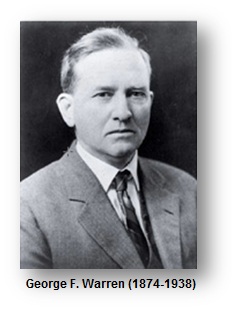
ANSWER: It was not socialism that saved capitalism, it was a shift in the understanding of money itself. George Warren convinced Roosevelt to devalue the dollar and end AUSTERITY, as Germany imposes on Europe today, which reversed the economy.

The Dust Bowl was the primary cause of the rise in unemployment to 25%. In 1900, 41% of the civil workforce was in agriculture. The invention of the combustion engine began to displace jobs as the internet has done recently. Tractors replaced workers in fields, so there was a huge transition in the labor force. Then the Dust Bowl took place and that created the hobos.

There was nothing the government could have done to prevent the Great Depression. The best that one can hope for is to understand the business cycle and prepare for the downturns. In that manner, it becomes more like Joseph warning the Pharaoh of 7 years of plenty to be followed by 7 years of drought. If we accept that the business cycle is complex and not a single source that can be controlled, then we will live with the cycle and understand it.

FDR’s programs came in 1935. The economy had already bottomed and turned up from July 1932. I find the argument that socialism saved capitalism as self-serving for the socialists, but the timeline does not agree

Trump v Federal Reserve – Why?


QUESTION: Good afternoon Martin,

Do you gander that President Trump is aware that a higher dollar will cream the economy and is doing all he can to fight that trend?

Maybe he is reading AE but like other politicians still thinks he can manipulate the economy?

Trump is battling the Fed over interest rates. What does it mean for your money?

MDC

ANSWER: Trump does realize that there has been a flight to the dollar. I believe his bashing the Fed to lower rates is inspired by the hope of keeping a lower dollar for trade. I do not believe higher rates are on his radar with respect to the markets. He is probably seeing briefings of the rise in rates and what is taking place with the national debt.

As far as what does it means for your money: the trend from public debt to private will be accelerated by this trend. I believe that the Fed will try pegging rates with caps rather than engaging in QE as Europe has don

Forget the F-22 or F-35: Why Sixth-Generation Jet Fighters Could Be Revolutionary


Published on Aug 24, 2018

The American development and deployment of Fifth-Generation stealth aircraft like the F-35 Lightning is one of the central stories of today’s security zeitgeist. But behind the scenes, several countries are already looking ahead to the design of a Sixth-Generation jet. The relentless pace of research is arguably driven less by combat experience—of which there is little—and more by a sober assessment that development of a successor will take multiple decades and is better started sooner rather than later. The Sixth-Generation fighter developers can be divided into two categories: the United States, which has developed and deployed two stealth fighter types, and countries that have skipped or given up on their attempt to build Fifth Generations jets. These latter countries have concluded that doing so is so time-consuming and expensive that it makes more sense to focus on tomorrow’s technology than try to catch up with today’s.

Birth of a Black Hole 4K


Premiered 16 hours ago

This show was converted to 4K/UHD using an AI program. What do you think? For the best collection of 4k Space-Science content, go to…

Mike Pence Outlines Tariffs Will Commence Until Mexican Behavior Improves….


Re-Posted from The Conservative Tree House on by

During brief press remarks following a USMCA speech in Pennsylvania, Vice President Mike Pence outlined the current status of “talks” between the U.S. and Mexican officials.

The vice-president affirms several times that President Trump is “firm in his position” to see Mexico step-up and do more to stop the mass migration of illegal aliens from Central America.  If you think about it, against the context of the USMCA, the Trump position to confront Mexico is absolutely the right approach.

Mexico wants the USMCA trade agreement, and they want to be united with the U.S. and Canada on trade and collaborative economic benefits.  However, simultaneously Mexico has repeatedly said it will not join the “Safe Third Country” agreement held by the United States and Canada, where asylum seekers must apply for refuge in whichever country they first arrive in, as each is considered safe.

.

[It’s worth noting that Pence is likely under a lot of pressure from Tom Donohue and his friends within the U.S. Chamber of Commerce. Pence deserves credit for standing up to his traditional tribe.]

The Riddle of AntiMatter


Published on Aug 19, 2011

This SpaceRip video is brought to you by MagellanTV https://magellan.tv/spacerip

There’s No Such Thing As An Unregulated Market


Published on Nov 16, 2017

We all want the safety and dependable quality that “regulation” is supposed to provide. Government can provide it to some extent, but markets can do it better, if we let them. Howard Baetjer of Towson University explains.