The study of the behavior of humans, their ethics, and how they structure their society and their government is a field of study that goes back to the very roots of our recorded history. Originally it was called philosophy, then moral philosophy, then ethics, and now the subject is split into so many unrelated branches that the original purpose may well have been totally lost. Today I would say that there are five basic original sources for the study of human behavior. Although there are many sub classes and other beliefs, they can all be safely ignored as they don’t represent significant portions of the world’s present population.
1) Classical Greek 2) Indian 3) Asian: Chinese and Japanese 4) Islamic 5) Atheist (the only view that rejects God)
This paper will be focusing on the Classical Greek views and how the Classical Greek view transitioned into Contemporary Philosophy and the Progressive Atheist belief structure starting just before the change from the 19th century to the 20th century. This was, of course, when Marxism took hold of (pseudo) intellectual thought. Those two, Contemporary and Progressive Atheist, belief systems currently make up most of what we call Western Civilization. The first tree Chapters are very important and all else is derived from what is presented there. If you can not at minimum agree that my proposition is possible then there would be little advantage to read the rest of the book. Western Civilization is in a period that will either end it or transform it into something unknown; these these kinds transition rarely go without major conflicts. According to reliably sources I know we will be though this period by mid century. Below is an motif image I created representing the universe we live in, its explained in detail in chapter two of the book.
The link below will allow you to download the paper, if you want, and at no cost.
Posted originally on Jan 1, 2024 By Martin Armstrong
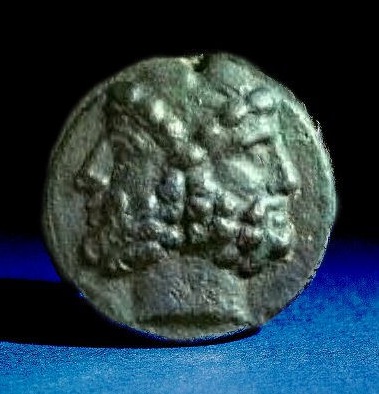
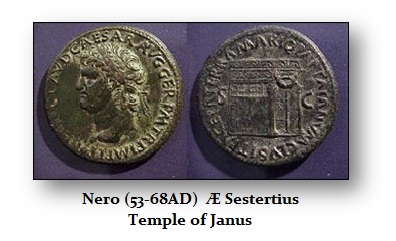
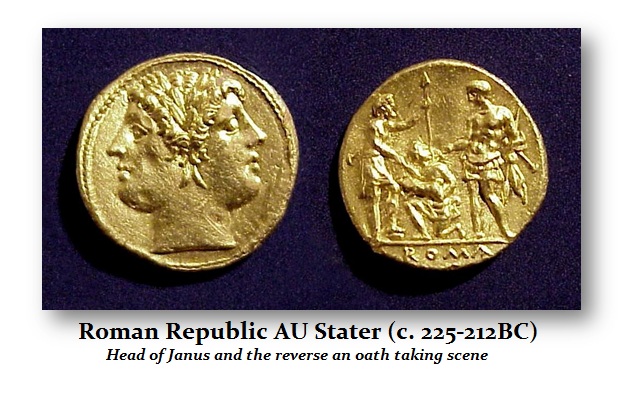
Believe it or not, on New Year’s Eve, we still celebrate the ancient Roman religion/myth of Janus, who presided over the beginning and end. So one face looked at the past and the other the coming new year. In fact, January is named after Janus. He also represented the beginning and end of the conflict. In ancient Rome, the Temple of Janus stood in the Roman Forum with doors on both ends and inside was a statue of Janus, who is always represented as the two-faced god. The doors of his temple were open in times of war and closed to mark peace. This represented that things could change politically during a war.
Janus, therefore, represented war and peace. This may be particularly true as the Neocons are determined to usher in World War III. They are scheming to create war BEFORE the election just in case Trump wins overwhelmingly to trap him into a war that he cannot negotiate his way out of. The critical periods in 2024 will be January, April, and July/August 2024.
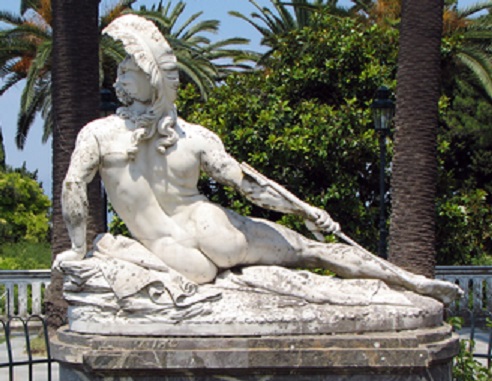
So when we celebrate New Year’s Eve, we say goodbye to the past and look forward to the future, a concept stemming from Janus. So much of today is traditions extending back thousands of years and terms like your Achilles’ Heel, named after the Greek warrior who died at the battle of Troy. It was said that when he was born, his mother dipped him in a sacred river to protect him but held him by his heel, which the water never touched. He was shot in his heel with an arrow and died. This statue shows him pulling the arrow from his heel as he died.
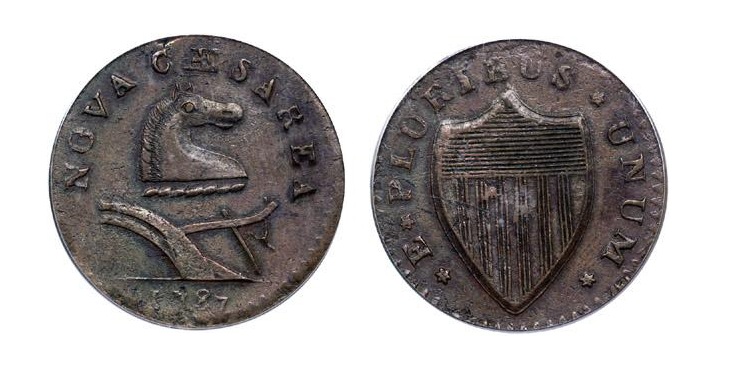
The Greeks were masters in creating stories handed down through the centuries—even the state of New Jersey in Latin in Nove Caesaria – the land of the new Caesar. Even Christmas Day, December 25th, was the feast day of the ancient sun god – Sol.
Our Republican comes from Rome, and Democracy comes from Athens. Legal Codes go back even before Babylon.
So when we celebrate New Year’s Day, let us hope the doors are slammed shut rather than wide open.
Posted originally on Dec 22, 2023 By Martin Armstrong
COMMENT: You overlook all the civilians being killed in Ukraine and in Palestine.
LS
ANSWER: As they say, history is written by the victor. I do not know what planet you are from, but I have said MANY times that typically, an equal amount or more civilians die in war than soldiers. It does not matter what war you want to talk about. How many millions of Vietnamese died? How many Iraqis died to get one man? The American Civil War using census data, the demographic historian Dr. J. David Hacker published “A Census-Based Count of Civil War Dead” in the scholarly quarterly Civil War History, reported a more accurate estimate of Civil War deaths is about 750,000, with as many as 850,000 dead. This is based on the census data – not death on the battlefield. The civilian deaths were most likely in the neighborhood of 200,000+ dead.
Civilians ALWAYS die in war. It is estimated that over 200,000 died in Hiroshima and Nagasaki. Starting a war with Russia will result in countless civilian deaths and the destruction of most of the monuments of Europe. All of this for what?
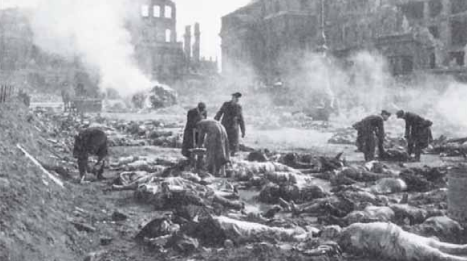
The Dresden Massacre – February 1945
I am sure you have never heard of the Dresden Massacre carried out by the Allies that killed an estimated 250,000 German civilians. Japan overshadowed Dresden in August 1945. Some accounts claimed 500,000 civilians died in Dresden. About 600,000 refugees from the had hidden in Dresen, joining an estimated 600,000 inhabitants. After the waves of bombers had passed in the night, they dropped phosphorus bombs on Dresden, which burned people alive.
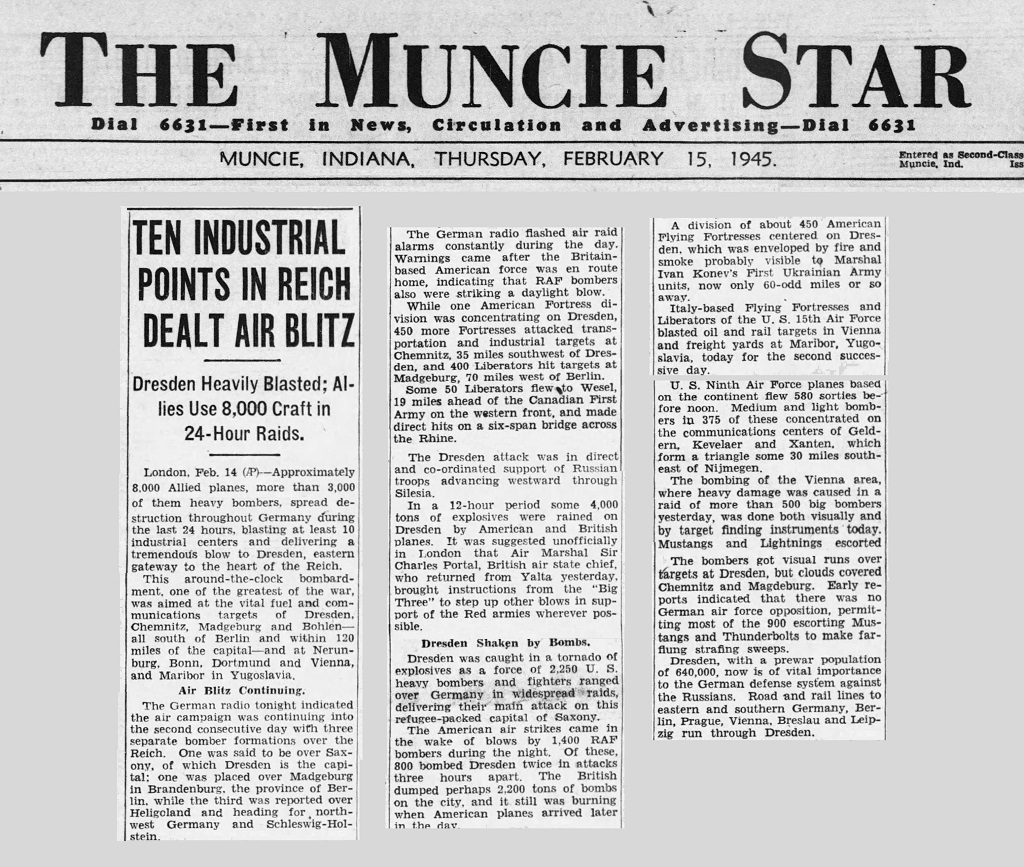
Then, in daylight, low-flying aircraft mowed down visible survivors running in the streets. The Western press did not report the civilian massacre, just that 8,000 aircraft flew to destroy Dresden with 3,000 bombers. The phosphorus bombs were dropped on Dresden without any regard for civilians since they were Germans who deserved death for being born German. It was akin to the dropping of Napalm (liquid fire) on Vietnam, burning civilians alive then as well.
During the American Civil War, General Sherman told his Troops at Vicksburg – War is hell.
Posted originally on Dec 22, 2023 By Martin Armstrong
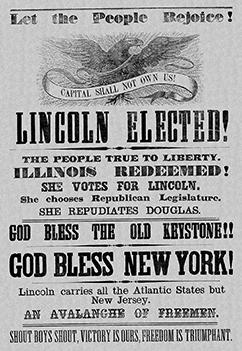
Did you know Abraham Lincoln was also absent from the ballot in 1860? Ten Southern states failed to issue ballots on behalf of the Republican candidate because he was opposed to slavery. When that was not enough to prevent a Lincoln victory, his opponents had him assassinated.
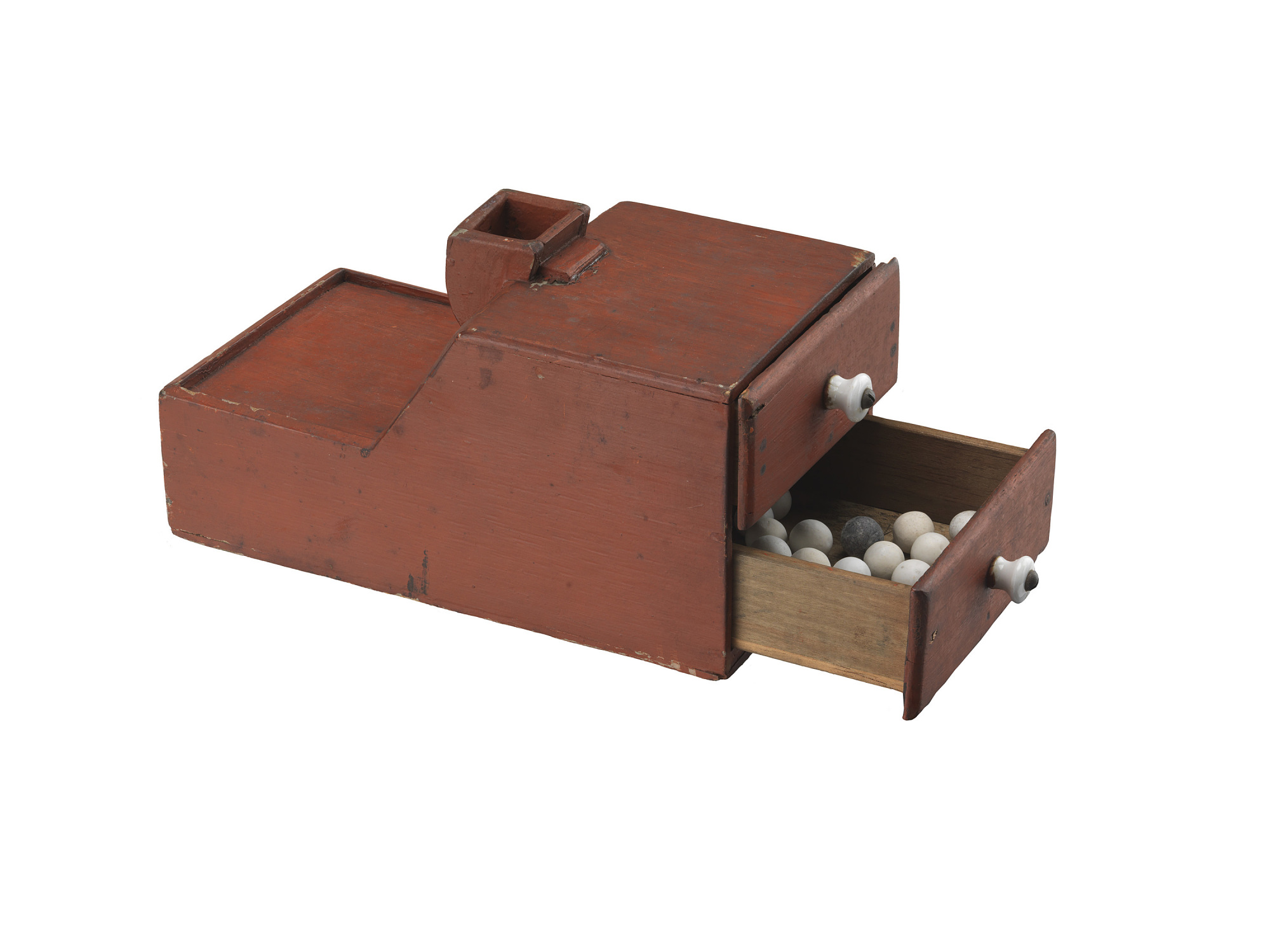
Now back then political parties issued ballots across the states. The word “ballot” comes from the Italian word “ballotta” meaning “little ball.” Some member of Washington would cast votes by placing a clay marble in a wooden box corresponding with their candidate of choice.
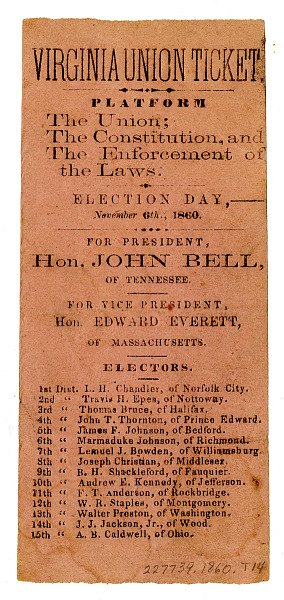
During Lincoln’s time, voters would occur on physically printed paper. States would determine the parameters of the paper (size, thickness, etc.), but the political parties were left to determine the rest, which naturally led to voter manipulation. Voters would receive pre-printed ballots, often depicting various party symbols or portraits of candidates. Since the parties could select how to produce their ballot, some resorted to using different colored paper so that everyone could see exactly who you were supporting. For example, the Virginia Union issued their ballots on bright pink paper to clearly indicate if someone was in support of their party. This effectively kept many people from casting votes in fear of violence as the nation was on the cusp of the Civil War.
Lincoln was not exactly barred from the ballot, but his party did not issue ballots in 10 states: South Carolina, North Carolina, Mississippi, Florida, Alabama, Texas, Georgia, Louisiana, Arkansas, and Virginia. In fact, he did not receive any votes from the states that would later form the Confederacy besides Virginia where Republicans secured 1% of the votes.
Women were not permitted to vote until 1920 – 60 years later. The husband would cast a vote on behalf of the household. Black men were not permitted to vote until 1870, as the future Confederacy wanted to maintain their free workforce.
History repeats time and time again. Tensions were rising to new heights in the nation during that time, with neighbors turning against neighbors. The US Civil War broke out one year later in 1861. The nation is once again moving to intimidate voters as your candidate selection could cause you trouble depending on where you live. No one accepted the results of the 1860 election. Lincoln won but he could not govern the Confederacy as they refused to accept him as their president.
The White House press secretary, Karine Jean-Pierre, confirmed that the administration does not believe aliens are involved. “There is no indication of aliens or extraterrestrial activity with these recent takedowns,” she said. What is interesting is all of a sudden we are now facing alien encounters.
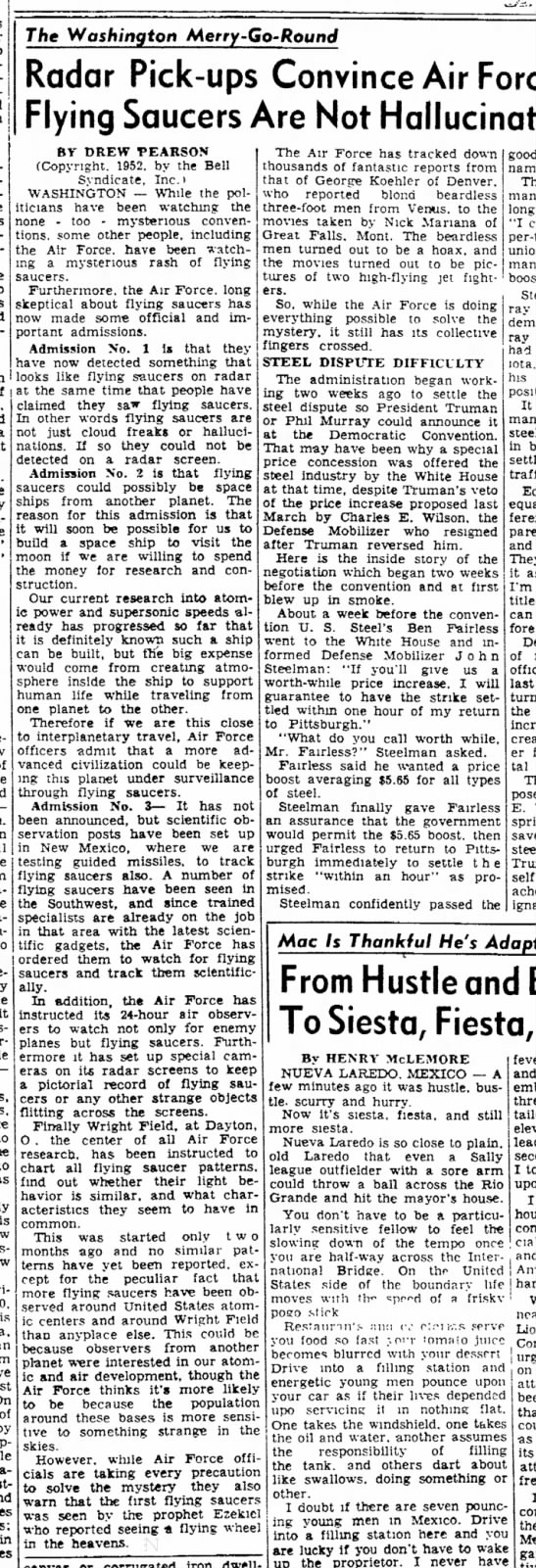
When I was in 9th Grade, in public speaking class I was handed the subject of UFOs to deliver a speech to the class. There was the famous 1952 incident when Washington, DC was buzzed by UFOs. As part of my preparation, I had an uncle who was in the Air Force. He told me that pilots were reporting flying saucers all the time. They would fly around the planes and were obviously a lot faster.
There have been counterless encounters and most likely, many are real. But what are they? Are they aliens from another planet? Or are they something from the future observing history?
Time Travel is entirely possible. There seems to have a strange correlation between UFO sightings and historical periods of time. While if they were exclusively aliens, one would think that they would have made some formal contact by now. The other possibility is that they are from our own future. There were a lot of sitings around WWII and we may be witnessing a rising encounter of sighting as we head into 2032. If this is true, then perhaps it is our posterity coming back to witness the stupidity of our era. That to me would make more sense since the computer is projecting that this idea of a totalitarian state rising with Schwab’s Great Reset will fail.
QUESTION: I found it fascinating that you were able to calculate the funding of the war that Cleopatra provided Mark Antony. Have you done similar work to look at the funding of Julius Caesar to cross the Rubicon?
WT
ANSWER: Yes. Where the Battle of Actium was a proxy war instigated by Cleopatra to try to seize control of Rome following the assassination of Julius Caesar. The best estimate I could make was that Mark Antony struck at least 25 million legionary denarii up to 35 million. Likewise, the coinage of Julius Caesar provides us with evidence of the cost of revolution as well, which is not recorded among contemporary historians. They were more interested in the reasons and biases of the time, not in the economics of the events.
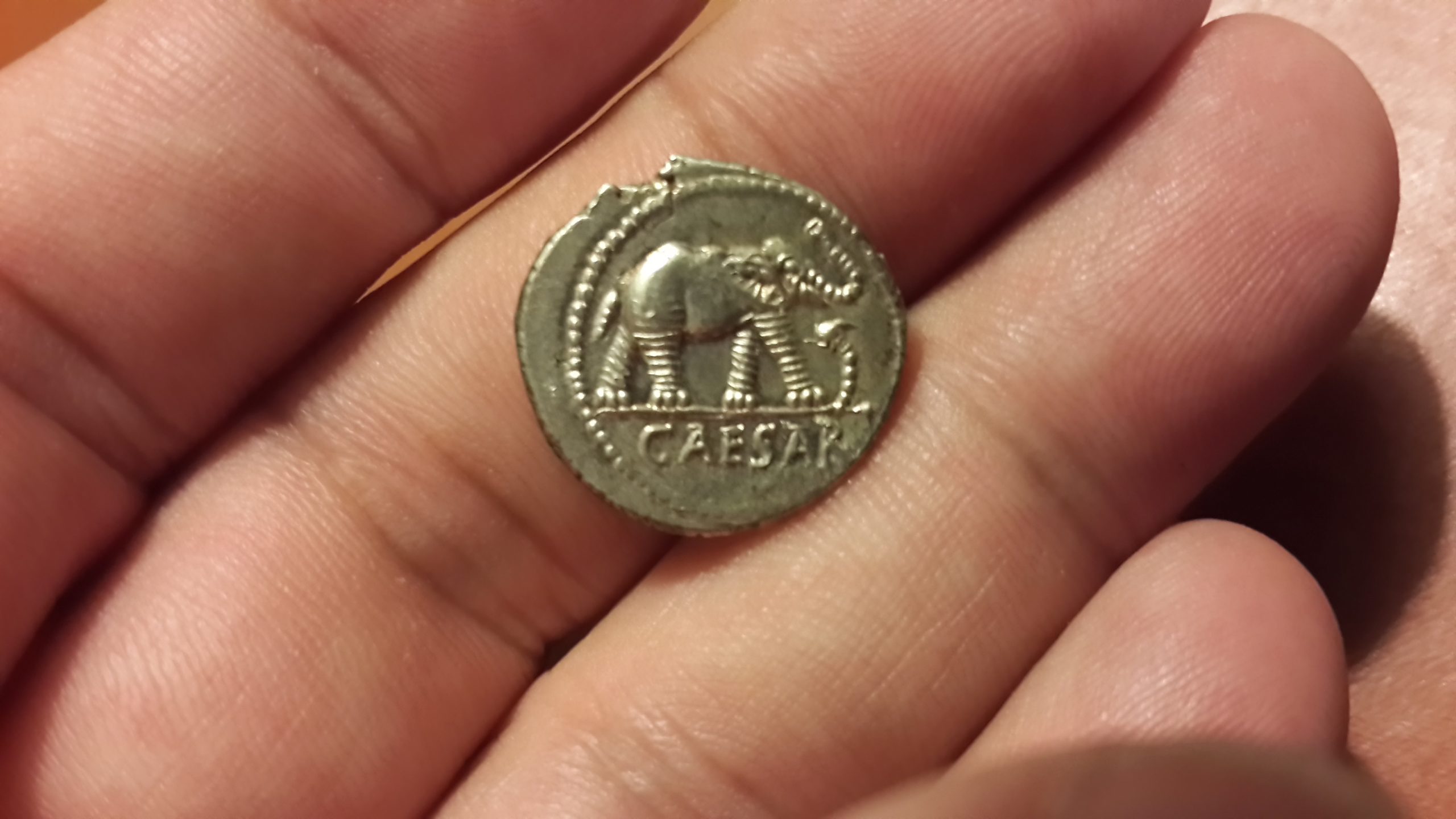
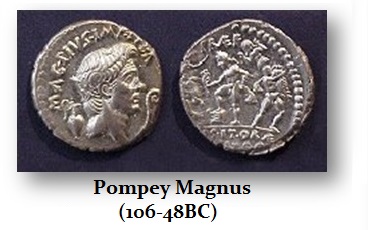
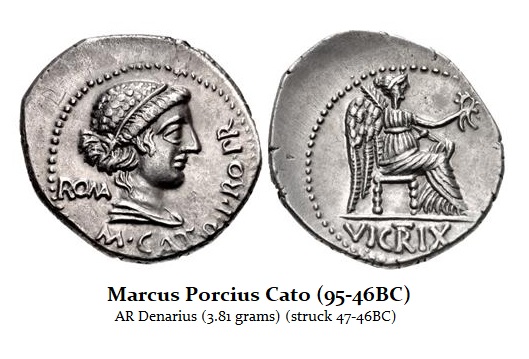
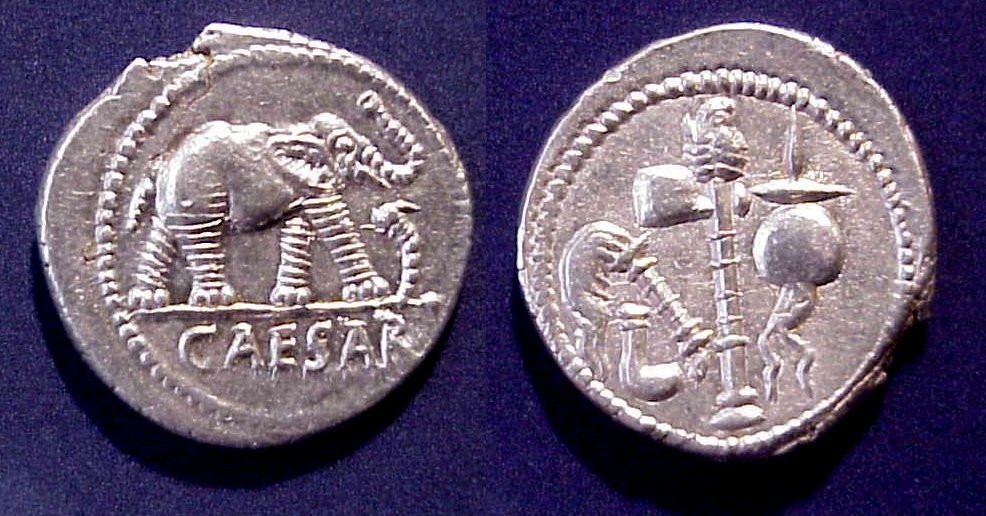
Julius Caesar struck his Rubicon Coinage with the image of an elephant crushing a dragon-snake which represented the corrupt Senate. Some tried to claim that the snake represented Pompey the Great. Caesar had married Pompey to his daughter. He was greatly upset when the Egyptians beheaded Pompey and gave him his head as a gift. It is unlikely that the snake was ever a personal representation of Pompey. It was, in my mind, the Senate where the instigator of the civil war was none other than the vile and corrupt Cato. It was Cato who was the leader of the Opimates who controlled the Senate and tried to strip Caesar of all power which effectively forced him to cross the Rubicon.
It is most likely that this coinage commenced in Gaul, as part of Caesar’s preparations for invasion, in order to pay his troops. The number of dies suggests that this issue was also huge exceeding 25 million denarii. It most certainly was expanded when he acquired the reserves of the Roman Treasury that were left behind by the panic-stricken Senators, Optimates, when they fled Rome because the people never supported the likes of Cato or Cicero for that matter.
Elephant walking right, trampling on dragon-snake the head of which rears up before him, CAESAR in exergue. On the reverse, we see the emblems of the pontificate — simpulum, aspergillum, axe, and apex.
The coinage opens an economic window that allows us to understand the real motives and costs behind the events in history. This Rubicon Coinage reveals something far more politically significant than what the contemporary writers revealed. Caesar actually took personal responsibility for the production of this coinage which was obviously unconstitutional at the time. Typically, there was a treasurer also known as a moneyer who issued the coins. There is no moneyer on this coinage so Caesar is taking PERSONAL responsibility absent the possession of a qualifying magistracy appointed by the Senate.
This is why I call this the Rubicon Coinage for Caesar was declaring war on the Senate of Rome in this time of national crisis. The very creation of this coinage without a moneyer sanction by the Senate was a declaration of civil war. The symbolism of the obverse can hardly be anything other than the triumph of good over evil, whilst the reverse alludes to Caesar’s possession of the office of pontifex Maximus and he ended the corruption of bribing the high priests to extend the calendar to avoid elections. Hence, today we have the Julian calendar.
This issue of the Rubicon Coinage clearly funded the crossing of the Rubicon. How long this important type remained in issue after Cato and his corrupt Senators fled and the war with Pompey began is hard to say. It was most likely struck right up to the time of the final campaign leading to the Battle of Pharsalus which took place August 9th, 48 BC, and the defeat of Pompey. It was on January 10th, 49 BC when Julius Caesar crossed the Rubicon.
It took just 19 months to bring down the Republic or 82.3 weeks from Caesar crossing the Rubicon to the defeat of Pompey at the Battle of Pharsalus in the Greek region of Thessaly. Thereafter, Caesar now consolidated his power He was elected as consul (normally a one-year term) in 48, 46, 45, and 44BC. Because of the political crisis and the corruption of the Senate which did not want to yield any power to the people, the new Senate thus waived the traditional requirement that a consul had to wait 10 years between terms. Caesar was also granted the title and office of Dictator which was a political position in times of crisis during the years 49, 48-47, and 46-44. Traditionally, the office of the Dictator was confined to just six months and he would be granted special powers to one man for a limited period to escape the bureaucracy to get things done. This was the means to deal with an emergency that threatened the state.
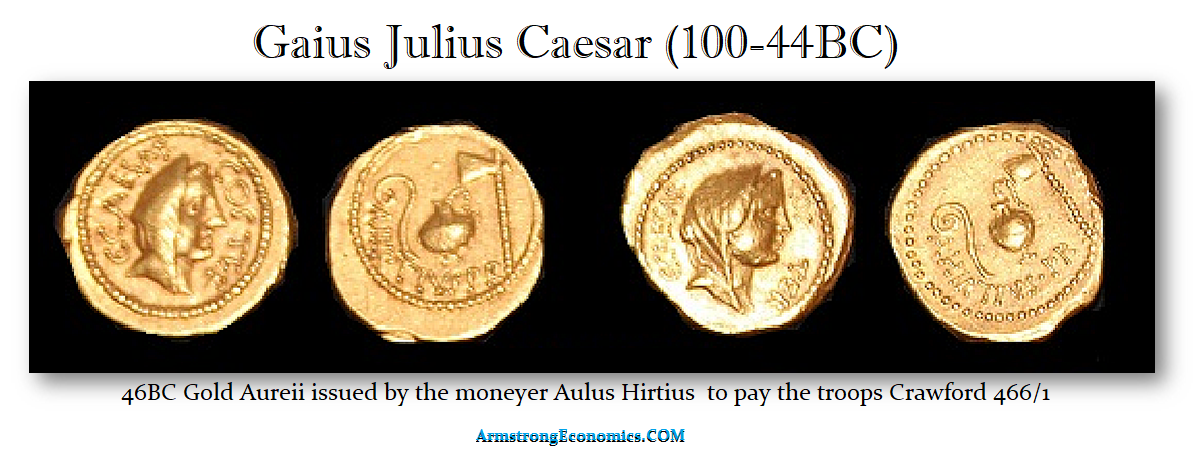
To meet the Republic’s urgent need for cash, Caesar resumed coinage of gold, which had not been struck by Rome since the dictatorship of Sulla (82-81 BCE). Most of Caesar’s aurei (about eight grams) are crude in design and workmanship in 46 BC. The moneyer was Aulus Hirtius who was a key supporter of Caesar. He served as one of Caesar’s legates in Gaul from about 54 BC and was an envoy to Pompey in 50 BC. He served Caesar loyally during the Civil War against Pompey and his successors in 48-45 BC. Hirtius was appointed as Caesar’s mintmaster in Rome in 46 BC, and it was at this time as a moneyer when he struck the first truly large issue of gold aurei from the spoils of Caesar’s campaigns. These aurei were poorly designed and executed with a veiled female head on the obverse, often appearing as a male, with priestly implements on the reverse. They were used to pay Caesar’s soldiers after the great triumphal parade.
Following Caesar’s assassination, Hirtius initially supported Marc Antony, but, after taking over as Consul in 43 BC, he raised an army against Antony at the instigation of Cicero and Octavian. His army defeated Antony at Mutina in April of 43 BC, but Hirtius was killed in the fighting. He left that political stage leaving Octavian and Antony masters of Rome. Hirtius was a loyal supporter of Caesar for he preserved and edited Caesar’s Commentaries on the Gallic and Civil Wars.
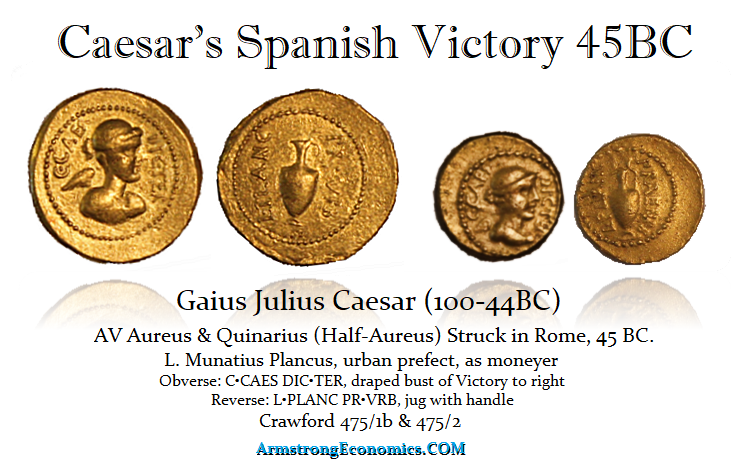
It was during the latter part of 45BC when this particular series of Aureii was produced for Caesar’s Spanish triumph in October of that year. Indeed, that the obverse type of the winged goddess Victory clearly refers to Caesar’s victory at Munda against Roman adversaries. Caesar was a Populares, a man of the people, who was not shy to express his increasing disdain for the factions of the aristocracy – the Optimates led by Cato. Caesar even celebrated a triumph in the capital, an unprecedented commemoration of victory over other Romans illustrating he regarded the Optimates as the enemy of the people. The presence within the issue of a gold half-aureus, or quinarius, makes it almost certain that this type was minted specially for the Spanish triumph since the denomination was typically associated with the distribution of largess at public celebrations.
Lucius Munatius Plancus, whose name appears on the reverse of this coin, was one of the Urban Prefects appointed by the dictator in 46 BC to administer the capital while he was on campaign. After this prominent issue of aurei was minted under his name, he rose to the position of governor of Transalpine Gaul in 44 BC where he founded the colony of Lugdunum, and later was appointed consul in 42 BC. Although he supported Marc Antony in the tumult which followed Caesar’s assassination, he eventually became an adviser to Octavian and according to Suetonius he dissuaded the princeps from assuming the name of Romulus as a ‘second founder of Rome’ (Suet. Aug. 7) and instead on 16 January 27 BC he formally proposed that the title ‘Augustus’, meaning ‘revered one’ be granted to the young princeps.
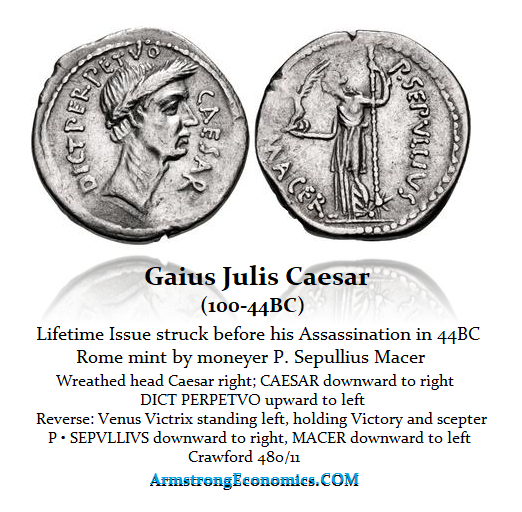
It was not until Caesar received the unprecedented title of “Dictator in Perpetuity” (DICT PERPETUO on the coinage) early in 44 BCE, conservative Romans were horrified. To them, this was akin to a monarchy. Here is a coin struck before his assassination with the title DICT PERPETUO issued by the moneyer Macer.
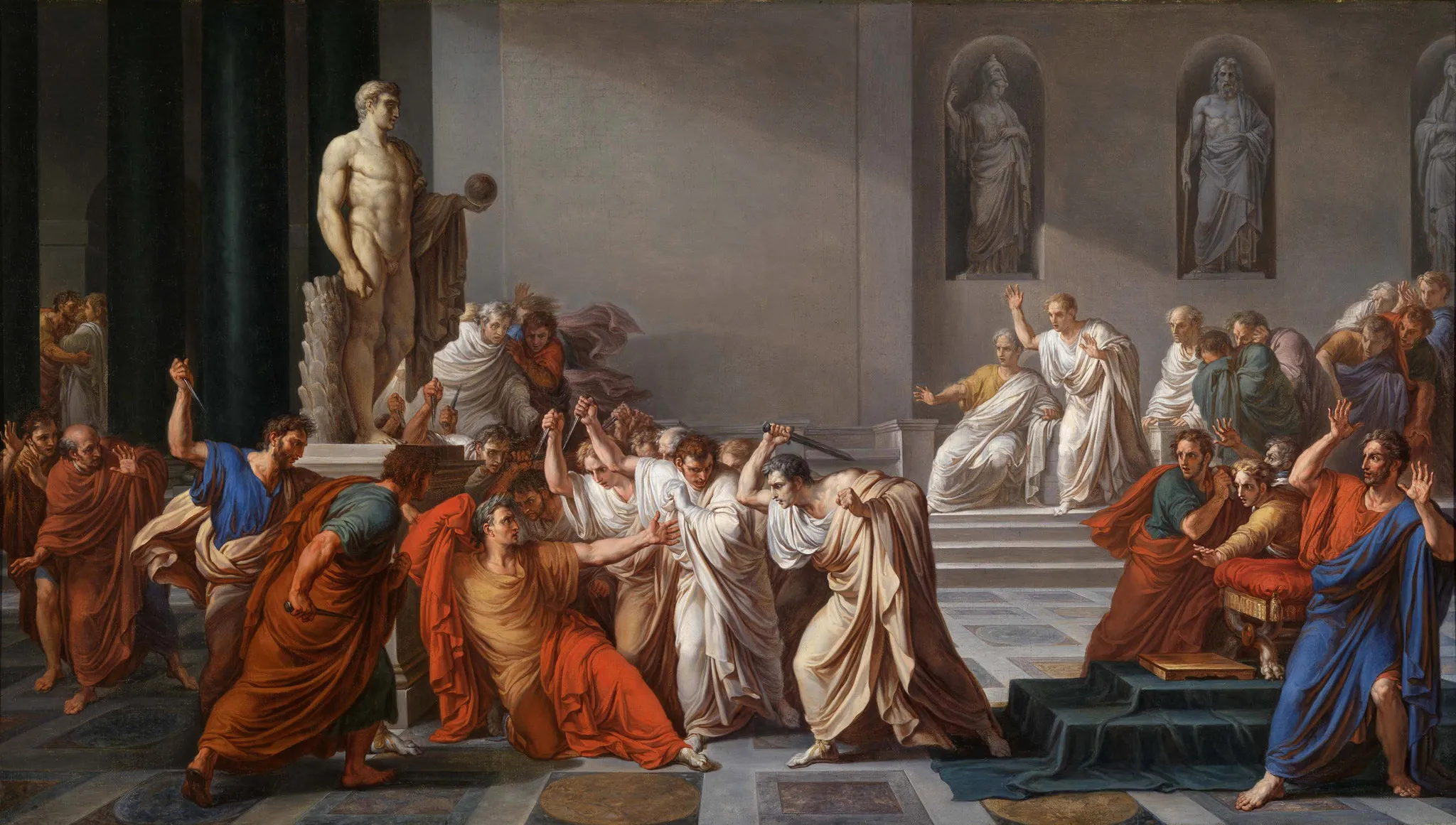
They assassinated Caesar on the Ides of March – the 15th. Therefore, coins with the portrait of Caesar with the legend “DICT PERPETUO” had to have been struck for only a few weeks. He was granted that title between January 26th, 44BC and February 15th, 44BC. It was on February 15th when Rome celebrated the festival of the Lupercal, which we call today Valentines’s Day. That was when Mark Antony twice presents Caesar with a royal diadem, urging him to take it and declare himself king. He refuses this offer and orders the crown to be placed in the Temple of Jupiter. It was most likely at this time when Caesar took the title “DICT PERPETUO” as the alternative. Curiously, it was 30/31 days later when he was assassinated – Pi?
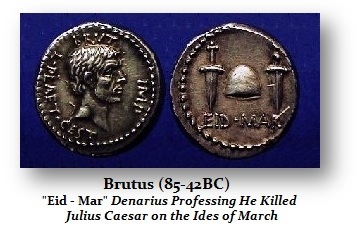
The conspirators who again fled Rome, also began to issue coins pretending they are defending the Republic, championed by the fake news of Cicero,. This is even when Brutus issues silver and gold coinage bragging that he killed Caesar on the EID MAR – 15th of March.
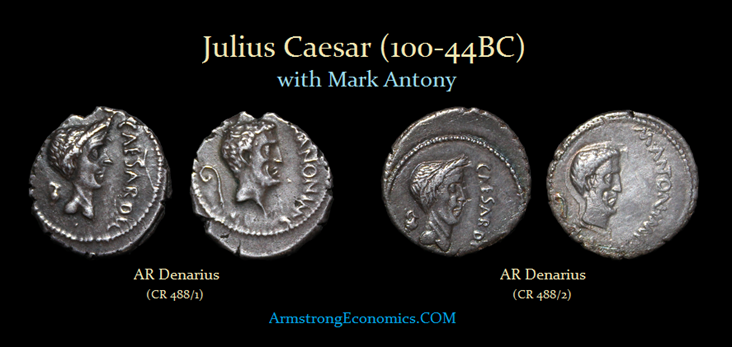
When Caesar was assassinated, that is when we see the coinage change. Mark Antony starts to issue denarii with his picture on one side and Caesar’s on the other.
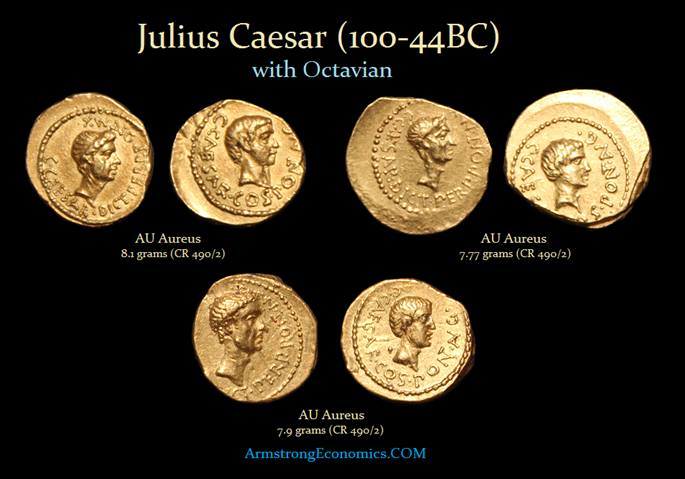
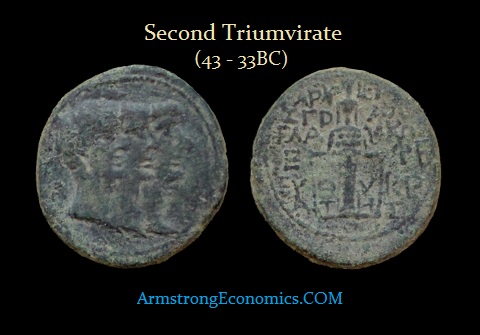
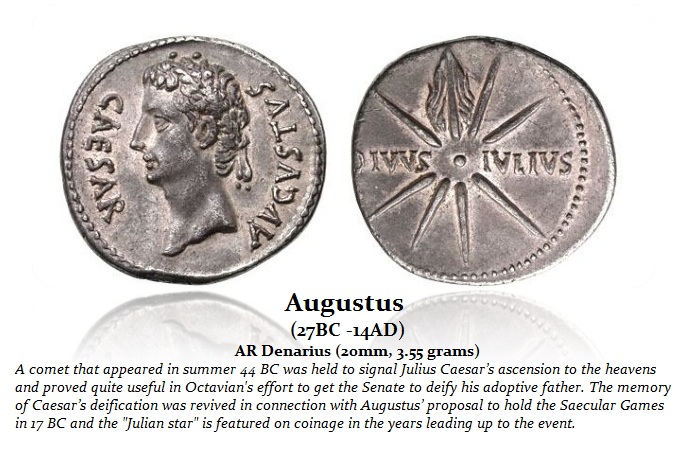
We also see Octavian issuing even gold aurei with his image on one side and Caesar on the other. They even issued coins announcing their Triumvirate against the corrupt Polulares. We even see Augustus, after he defeats Cleopatra and Mark Antony, issuing coinage showing the comet in the sky that people took as the omen that Caesar was now a god.
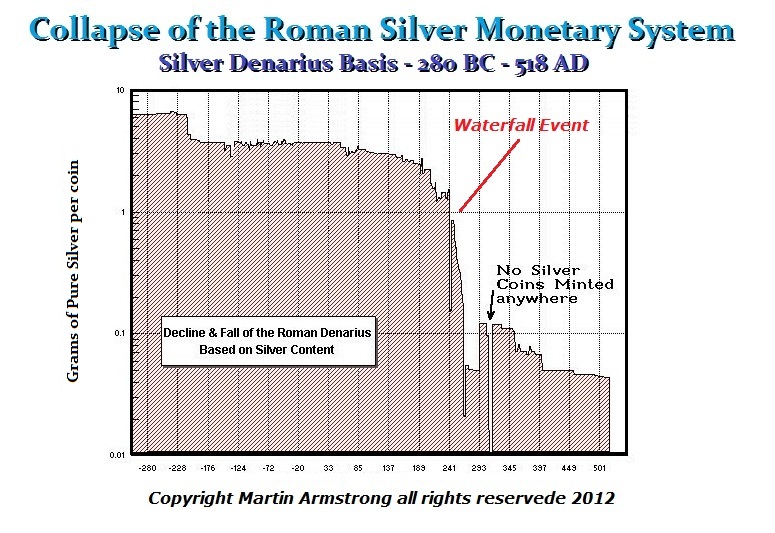
The coinage documents events written by contemporary writers at the time. This was the basis of Shakespeare’s play – Julius Caesar. The coinage has both confirmed history but also opened the door to establish answers to important economic trends. One with the coinage was it possible to answer the question of how fast did Rome really fall. By imputing this data, it became possible for the computer to even correctly forecast the fall of communism and the Berlin Wall in 1989. It is fascinating how it takes a finite amount of time to bring down a nation-state. When it starts to fall, it does so in a Waterfall type event. Rome fell in just 8.6 years.
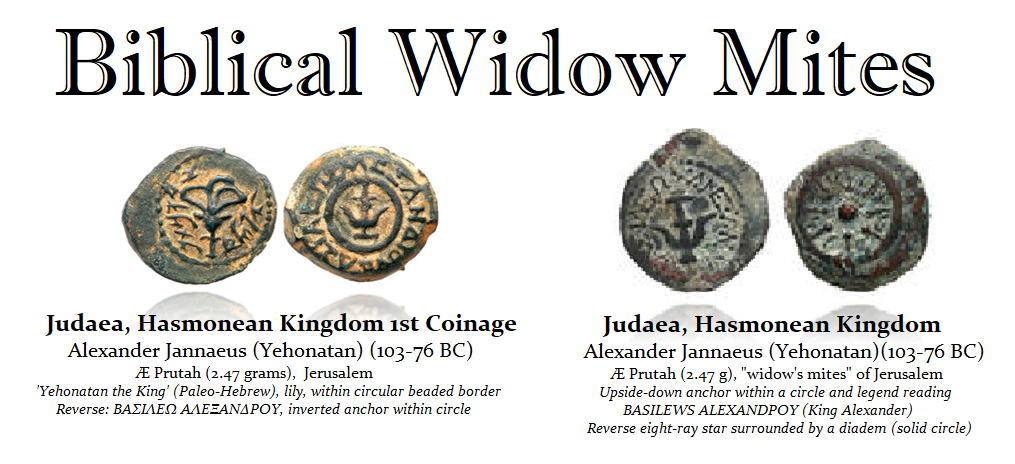
Mark 12:41-44: “And Jesus sat over against the treasury, and be beheld how the people cast money into the treasury:k and many that were rich cast in much. And there came a certain poor widow, and she threw in two mites, which make a farthing. And he called unto him his disciples, and saith unto them, Verily I say unto you, That this poor widow hath cast more in, than all they which have cast into the treasury: For all they did cast in of their abundance; but she of her want did cast in all that she had…”.
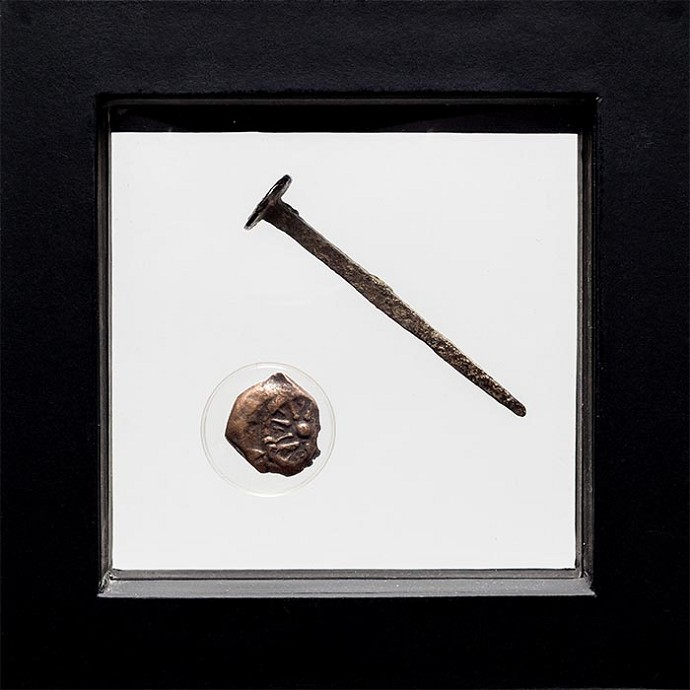
A lot of people are asking if I have any more biblical Widow Mites I could put together. The answer is yes, but I will have to see what I have left. For those who want the unusual showpiece, we can frame a Widow’s Mite with a Roman Nail documented from the 1st century at the time of the Crucifixion. While most of the nails were retained by the museums after the discovery, a small portion was allowed to be sold privately.
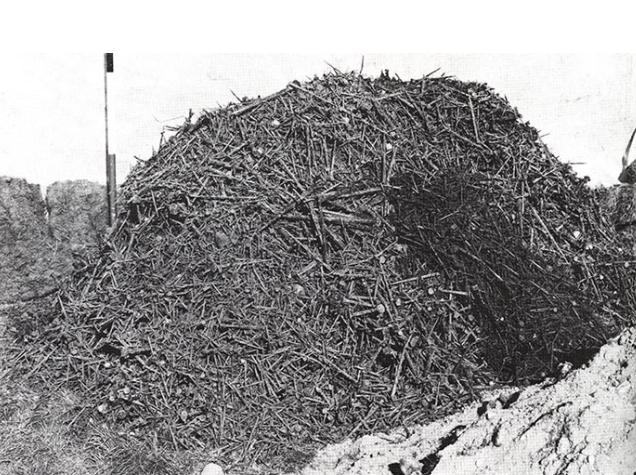
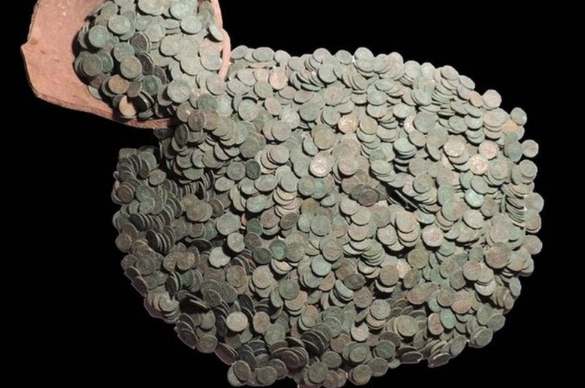
Roman nails were made of iron. This hoard was buried to prevent others from finding them from which they would make weapons and shields. Iron was a valuable metal to many of the barbarian tribes. Hence, this hoard was a remarkable find from the 1960s. They finally allowed some to be sold only in 1999.
Those interested in such a unique gift, send an email. Obviously, we would need to know how many people really want to have them framed up.
The price would be $125 for a Roman nail and a Widow Mite framed
QUESTION: Why do you buy hoards? It is interesting. Just curious.
JY
ANSWER: The coinage is the ONLY way to truly confirm the history. Much of the most important periods like the 3rd century AD, the fall of the Republic, or the Revolution during the Debt Crisis of the 1st century BC known as the Social War, can only be properly understood through the coinage lacking really detailed accounts of financially what was taking place. By recreating the monetary system using coinage, I was able to answer the question – How did Rome Fall? Gradually? Or Catastrophically? By assembling all the coinage, and testing it out, I could establish what nobody else could due using documents or archaeological digs. Rome collapsed in just 8.6 years.
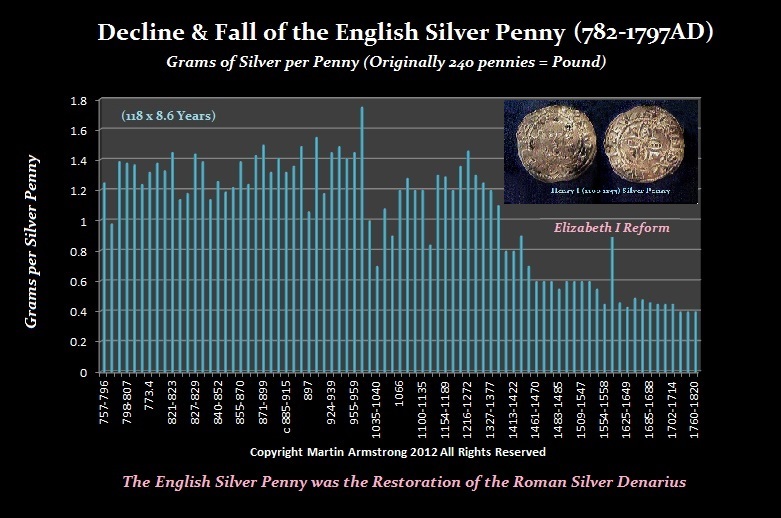
That was then observed in testing and using the same methods around the world. The collapse of the English coinage that inspired Gresham’s Law, bad money drives out good, also took just 8 years.
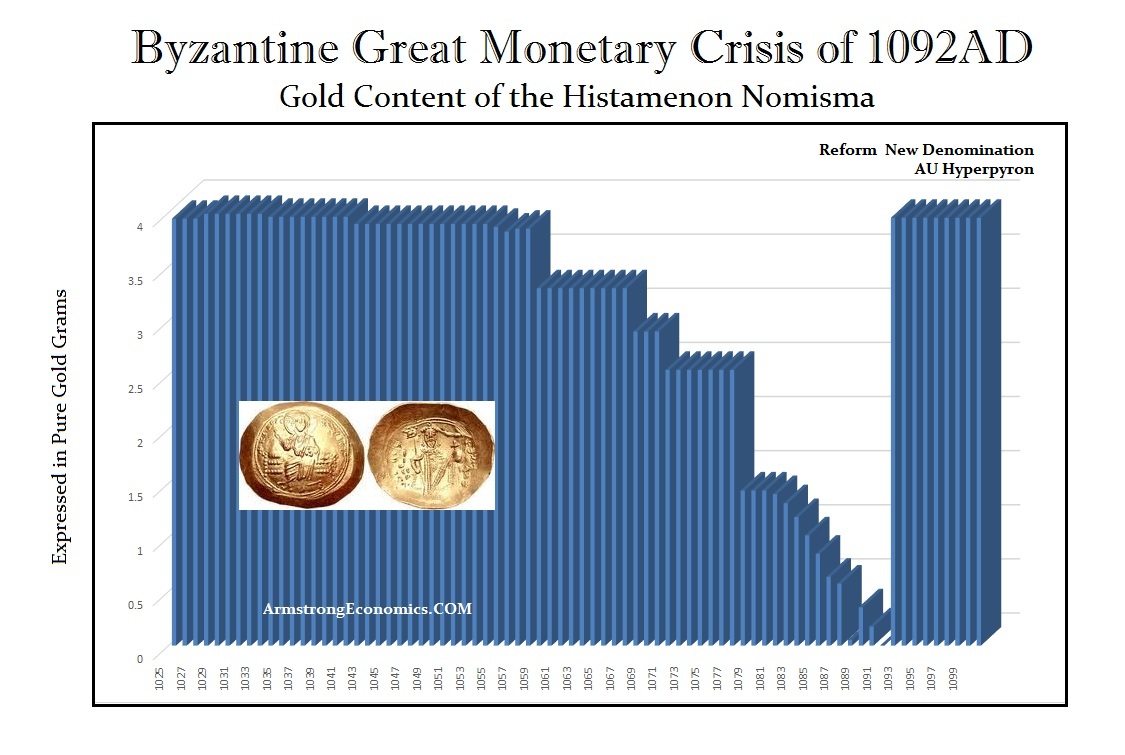
The Great Monetary Crisis of 1092 saw the gold content collapse also in just 8 years. The same pattern has unfolded time and time again. History repeats NOT because of wars or abstract theories. It repeats simply because human nature never changes – on technology.
The computer was about to forecast the fall of Communism in 1989.95 and it spread and took down the Berlin wall a few months after Tiananmen Square. People attributed that to modern communication. That was nonsense, The Roman Republic fell in 509 BC, and in the same few months in Athens, they too overthrew their tyrants, and Democracy was born.
The question is NOT how fast the information spreads. It could have traveled from Rome to Athens in a few days. The real question is how long does it take to filter through society to create political change?
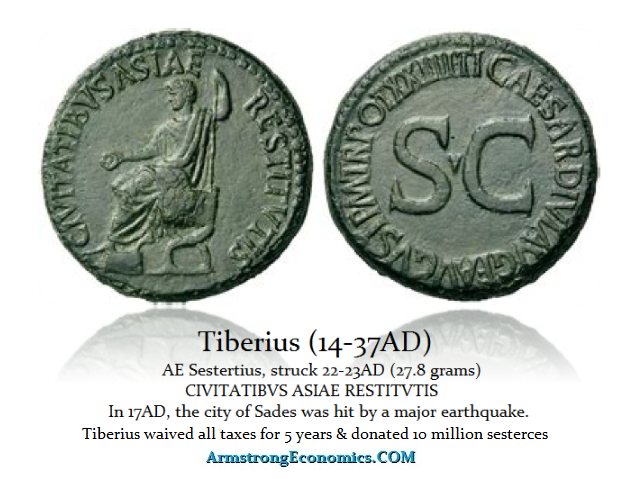
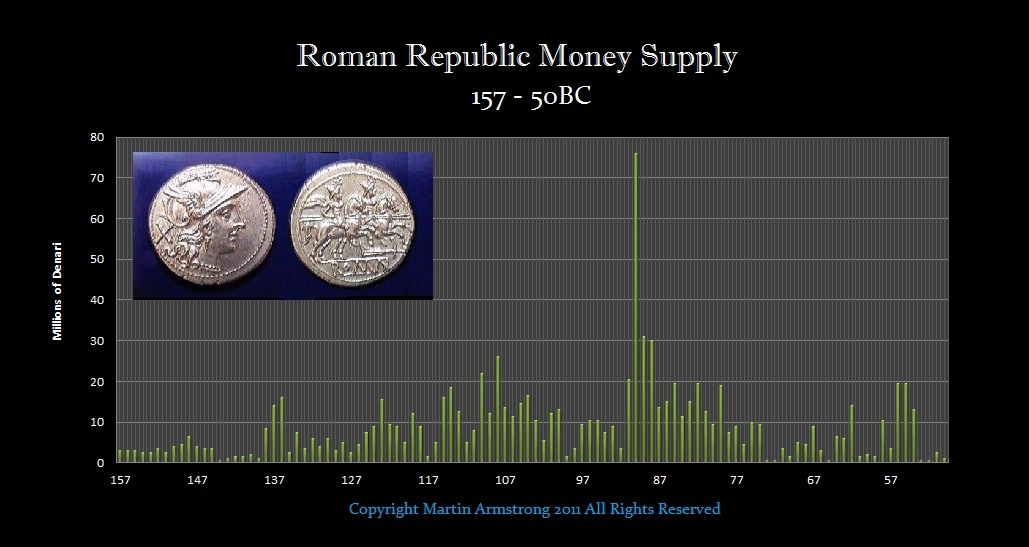
Therefore, assembling the number of coins by examining hoards and the number of different dies multiplied by 15,000 will give us a good idea of the money supply at that time as illustrated above. Granted, this research project cost tens of millions of dollars to produce. Nonetheless, it has yielded a wealth of information that enabled us to see specifically what took place economically. Human nature has not changed. When Rome burned, Nero did visit the victims. Tiberius issued coins for the aid of Asia when a major earthquake devasted the region we call Turkey today.
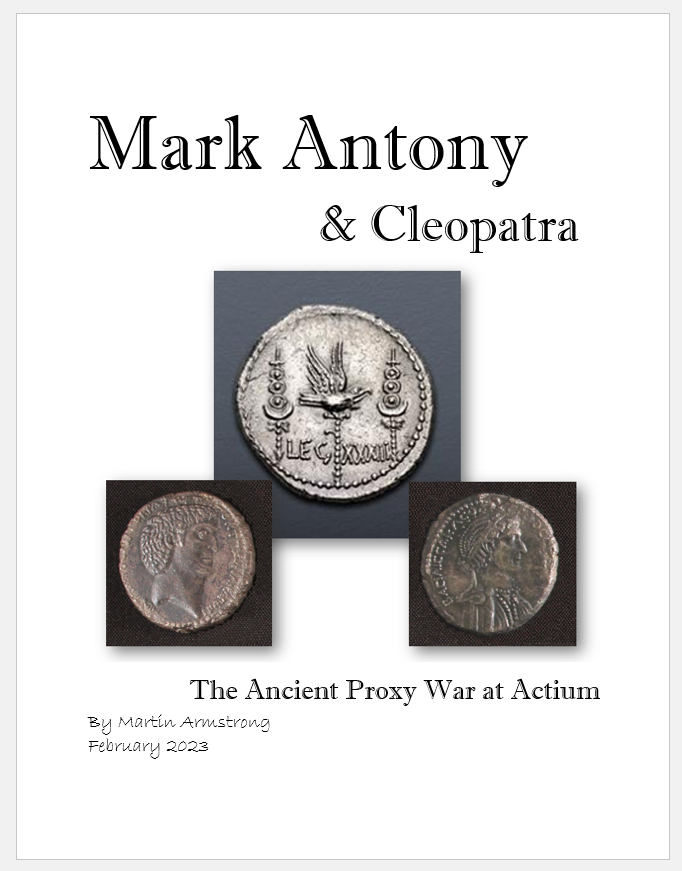
I am finishing a book on the famous Battle of Actium where Mark Antony lost to Octavian giving birth to Imperial Rome. The number of dies and the amount of coins issued by Antony demonstrates that the entire wealth of Egypt was at his disposal and it was really an Egyptian proxy war against Rome. The number of silver denarii struck had to be at least 25 million. The sheer massive amount of the increase in the money supply thanks to Egypt was huge. Antony’s coins remained in circulation for decades, although very work. They were the most common coin found in hoards at Pompeii in 79AD about 100 years later. Hoards enable us to see the cost of that war and how it changed Egypt and Rome.
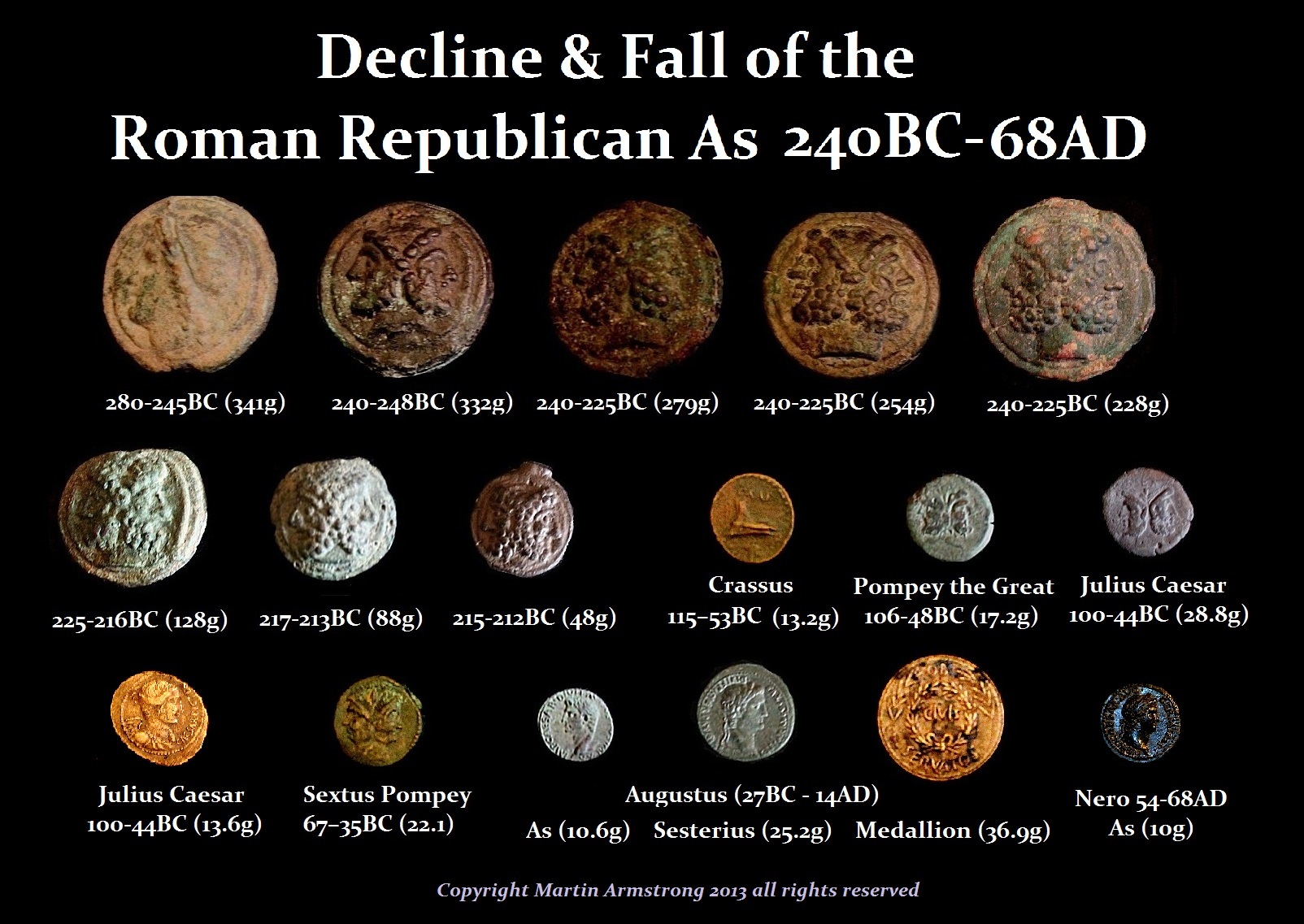
Where Rome began with bronze as its monetary unit and one pound was known as a Roman As, we can see that the price of the Punic Wars as what was one pound of bronze consistently declined. Here we found it was six waves of 51.6 years which are in themselves six waves of 8.6 years, that produced the major wave of 309.6 years. So if we look from the beginning of the Roman As being 341 grams in 280 BC, by the time we get to Nero in 54AD, the Roman As was about only 10 grams.
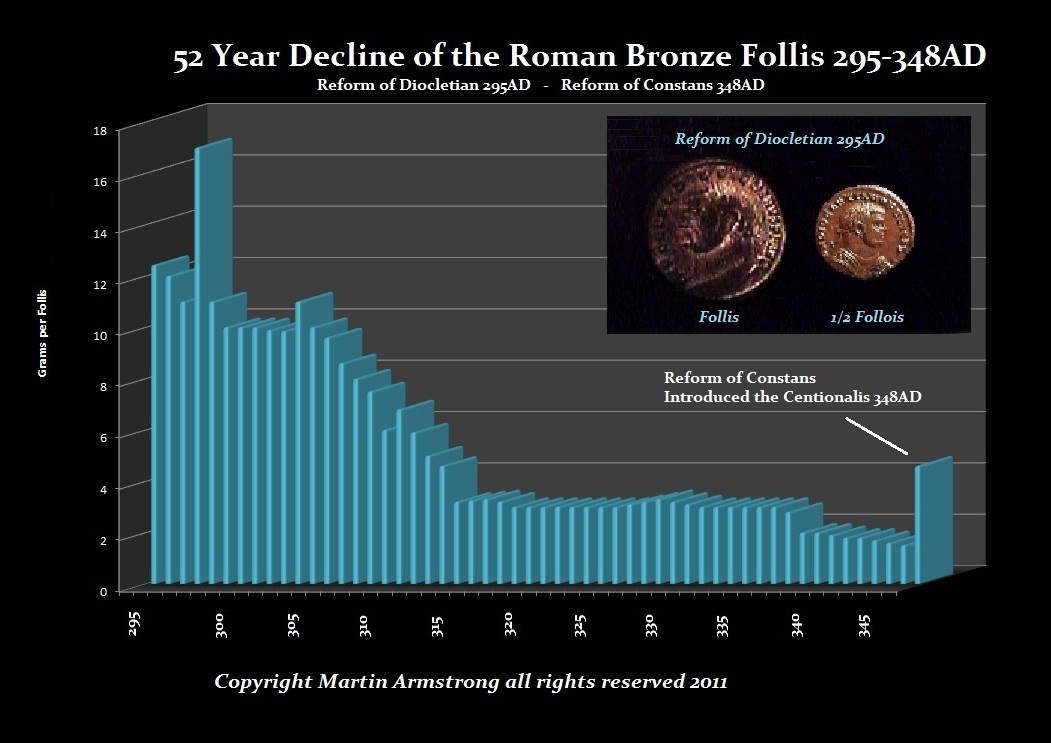
Even looking at the reforms of Diocletian in 295AD, his introduction of the follis declines remarkably also following the six waves of 8.6 years. I have looked at the monetary systems of Asia, the Middle East, Europe, and the Americas. they have conformed to the Economic Confidence Model confirming that this is a cycle that clearly incorporates everything from war to climate change.
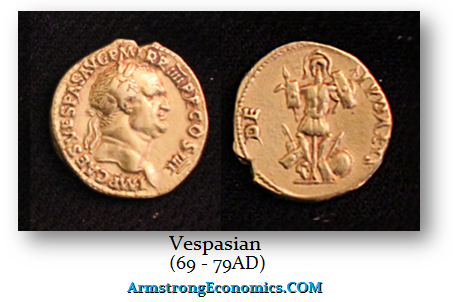
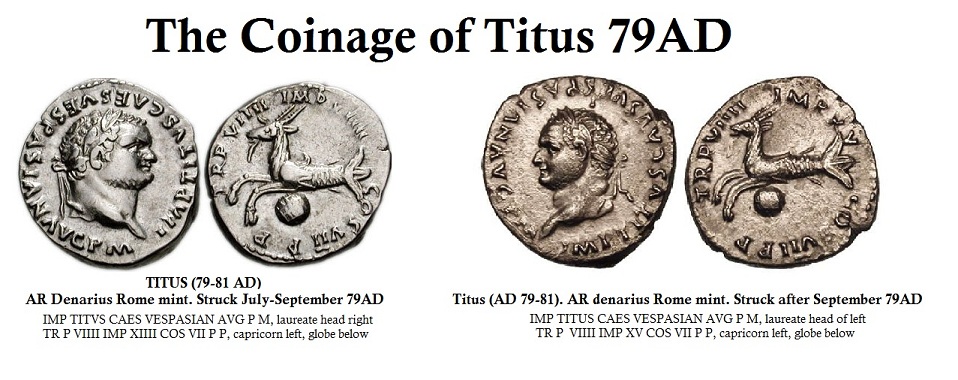
Even though Emperor Titus’ (79-81AD) reign was marked by a relative absence of military and political conflicts after his father, Vespasian (69-79AD) had defeated Judaea was defeated, there were several disasters during his brief leadership. On October 24 in 79 AD, Mount Vesuvius erupted and almost destroyed the cities and resort communities around Naples. The cities of Pompeii and Herculaneum were buried under stones and lava in 79AD shortly after Titus (79-81AD) came to power. Titus made all efforts to help the victims of the volcano and donated large amounts of money from the imperial treasury. The emperor visited Pompeii right after the tragedy happened.
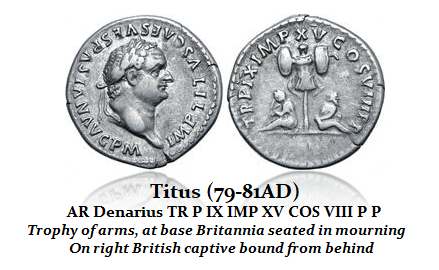
A single silver denarius was discovered in 1974 among the 180 silver coins buried in Pompeii. When it was cataloged, it overturned history. Titus’ father died on June 24th, 79 AD. Therefore, any coin of Titus as emperor would have to have the very first recording of his power “IMP VIIII” or 8th Imperator, which was a title that meant ‘leader of the army’ to the Romans. The coin discovered in Pompeii had the legend “IMP XV,” which was granted to Titus for the war in Britannia. Titus sent Gnaeus Julius Agricola who pushed further into Caledonia and managed to establish several forts there as recorded by Tacitus (Agricola 22). Therefore, Titus received the title of Imperator for the fifteenth time for this event, according to Cassius Dio (Roman History LXVI.20). This took place we know in September 79 AD about 3 months after becoming emperor following his father’s death. Obviously, if any coin was discovered in the ruins of Pompeii with “IMP XV” in its legend, then this provides absolute proof that the date for Vesuvius of August 24th, 79 AD cannot be correct.
Archeologists in Pompeii have discovered a remarkable inscription written in charcoal which has survived the catastrophe confirming that the eruption of Mt Vesuvius indeed took place in October 79AD as confirmed by the coin discovered and ignored by historians. The charcoal writing, discovered on the wall of a villa during a new phase of excavations, adds weight to a theory that the volcano destroyed the town in October 79AD rather than August of that year in line with Cassio Dio and the denarius of Titus. The date of August 24th, 79 AD, came from a letter addressed by Pliny the Younger to the Roman historian Tacitus, originally written some 25 years after the event.
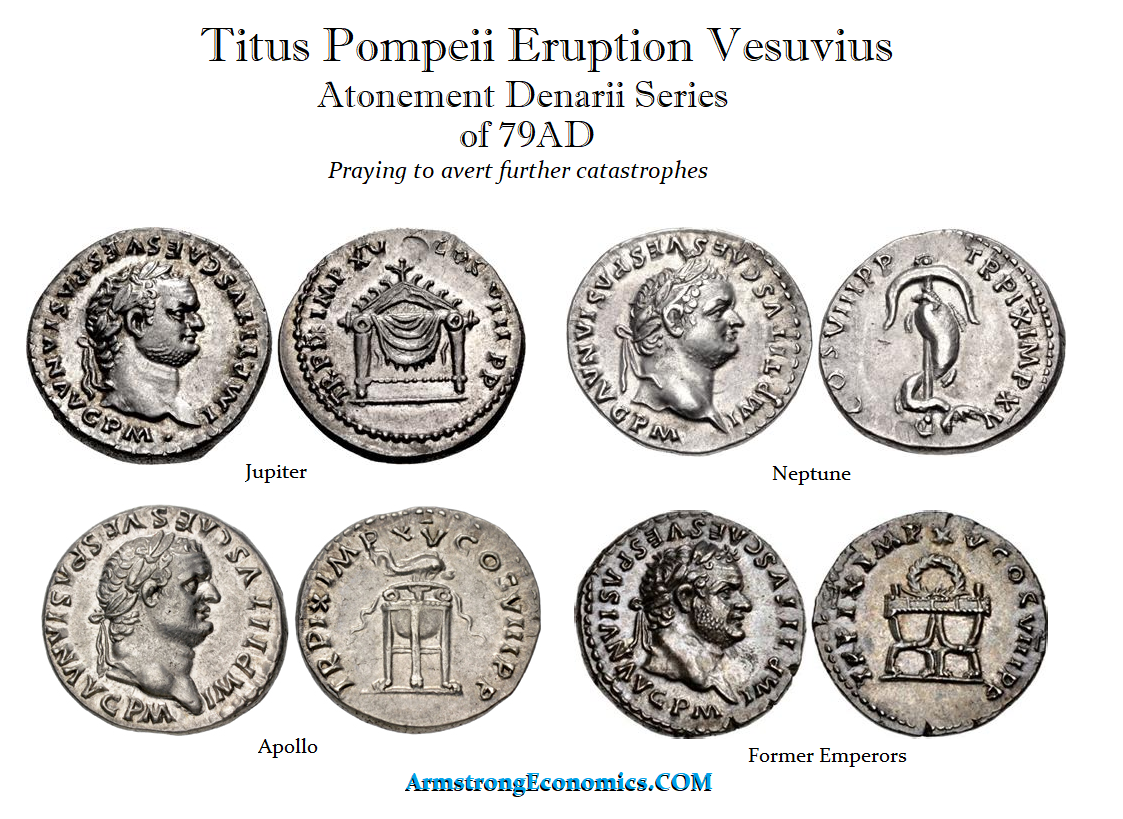
Titus devoted much of his silver coinage of Atonement to the gods for the disaster of Pompeii. There were four main Atonement issues commemorating the services of prayer and propitiation through which the emperor attempted to address the public alarm over the disaster. People often attributed such events to the gods being angry. The coinage showed emblems seeking the approval of Jupiter, Neptune, Apollo, and the deceased former Emperors to watch over the Roman people.
News actually spread rapidly around the Roman Empire. There were formal boards where notices would be posted in which important news and major events would be informed to the people much like such a board in a big company with notices to the employees. These boards were called the Acta Diurna and they were designed to inform the Roman people thereby avoiding fake news. We could call them ancient billboards in modern terms and even government officials would walk up and pin a written notice and the crowds would rush to see what is news. Thus, everyone knew of Pompeii in a matter of days. It did not take long for information to circulate.
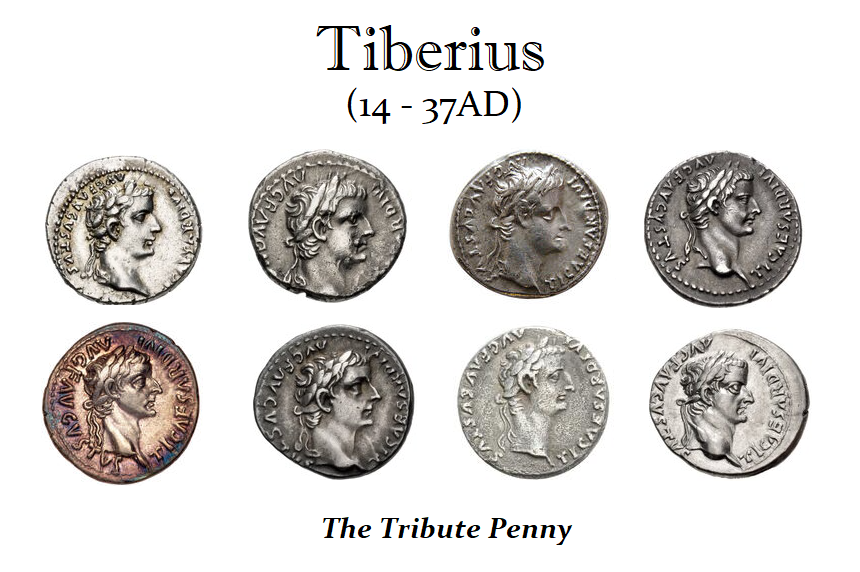
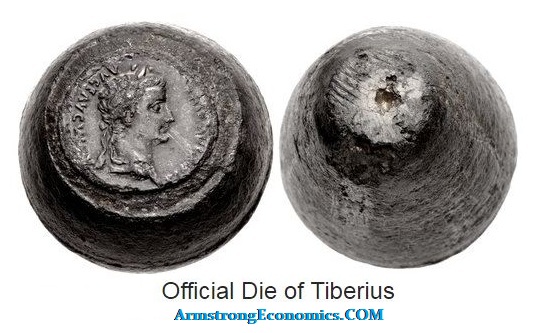
Because the coin dies back then were hand carved, we are able to identify the number of dies in use during a given year because each is unique. Just look at these portraits on the famous Tribute Penny of Tiberius (14-37AD). It all depended upon the artistic ability of the engraver.
The coin itself has taken its name because Jesus, referring to a denarius, which the English translated to “penny” because that was their silver coin, asked: “Whose is this image and superscription?” When answered that the likeness was Caesar, He replied; ”Render therefore unto Caesar the things which are Caesar’s and unto God the things that are God’s” (Matthew 22:20-21). Thus, the coin has been called the tribute penny meaning that was how you paid your taxes.
Hoards have enabled me to (1) see what was in circulation at that point in time for the hoard can be dated to around the most recent coin in the hoard. (2) I also have a number of ancient Roman dies like this one of Tiberius. Studies creating modern dies to test how many coins could be struck from such a die before it cracked provides a picture of about 15,000 coins.
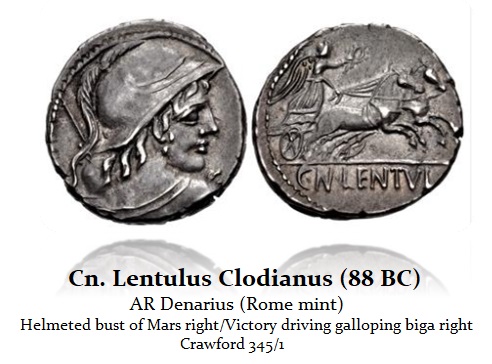
By completing die studies quantifying how many were in use, it then becomes possible to estimate the money supply. Here we can see that during the Social War of 90-87BC, there is a drastic increase in the quantity of coinage issued obviously to pay for soldiers. However, conducting metal testing on the coinage of this period, we find that Rome also debased the coinage slightly adding up to 10% copper to the silver. Therefore, studying hoards allows one to actually ascertain the extreme of monetary affairs.
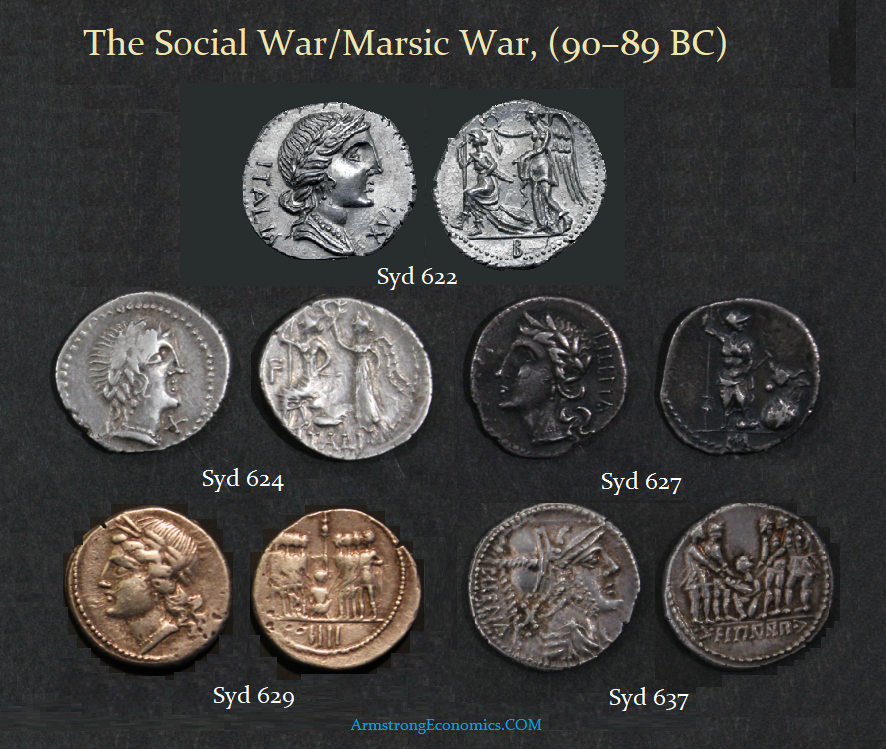
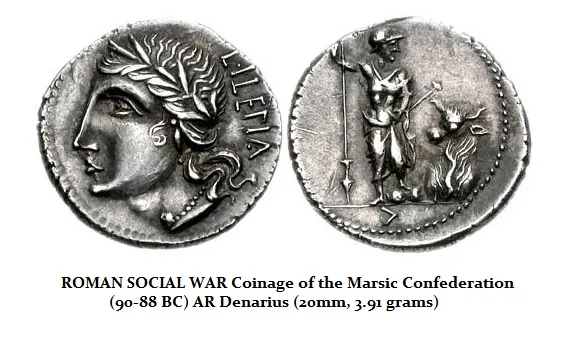
The Social War of the First Century BC was a failed Revolution against the corrupt Republic. The rebellion was waged by ancient Rome’s Italian allies (socii) who were denied equal rights with the Romans, despite the fact that they also fought alongside Romans in battle. They were seeking to separate and thus they fought for independence. Here are the coins of the rebels. They are very rare. You can see the theme celebrating the female head of Italia.
The allies in central and southern Italy had fought side by side with Rome in several wars and had grown restive under Roman autocratic rule, wanting instead Roman citizenship and the privileges it conferred. In 91 BC, the Roman tribune Marcus Livius Drusus proposed granting them Roman citizenship. The arrogance of the Senators erupted into a heated opposition. They went as far as to even Drusus for daring to propose such a decree. That resulted in the revolution.
When I dug deeper, the coinage with the debasement also reveals that there was a financial crisis. In all honesty, it was the Debt Crisis that ended the Roman Republic. There was a Sovereign Debt Crisis during the Roman Republic period that resulted in a dictatorship and a debt default. The Roman Debt Crisis of the 1st century BC has left behind a vivid account of what took place. The volume of gold and silver in Italy had increased dramatically during the late 2nd century BC following the Punic Wars. We have the first real gold coins issued by the Roman Republic at that time.
However, this concentration of wealth, which was akin to the United States after World War I and II, was absorbed by commercial expansion and investment in Gaul and Asia. A period of excessive concentration of money and large profits came to an end with the rise of the Social War of 91-88BC which was a war waged between the Roman Republic and several of the other cities in Italy (no taxation without representation), which prior to the war had been Roman allies for centuries. The war was begun by the Picentes because the Romans did not want to afford them Roman citizenship, thus leaving the Italian groups with fewer rights. The war resulted in a Roman victory and genocide against the Samnites. However, Rome granted Roman citizenship to almost all of its Italian allies, including the Samnites, to avoid another war. Therefore, we find that the debt crisis was correlated with a separatist movement – which we are beginning to see worldwide starting in Europe, but will eventually become a contagion in the United States as the conflict between left and right erupts after the November elections.
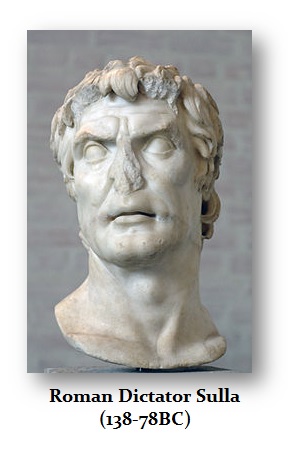
The Social War led to the complete state bankruptcy of the Roman State. We can see the dramatic rise in the money supply created during this time of war. This turmoil was then followed by the dictatorship of Sulla who then imposed an attempt to control the debt crisis capping interest rates at 12%. The previous legal rate was capped at 8.5%, but obviously, the market had exceeded that limit and Sulla had to confront that reality in 88BC. The debt crisis continued and then in 86 BC, the government was compelled into default. This is when the Valerian Law came into play. The State debts were defaulted on and thus reduced to 25%.
COMMENT: Martin, Just a quick note to thank you for sharing your excellent knowledge on world and ancient coins. Your two recent blogs on “Hoards in History” and “18th Century Copper Riots and Private Money”, were insightful. While I appreciate your daily blog on world affairs and the economy in general, I find I am now starting to collect Ancient Greek and Roman coins! Can’t wait until you consider writing a book on world and ancient coins that is more than just a simple catalogue of prices. Best regards, TK
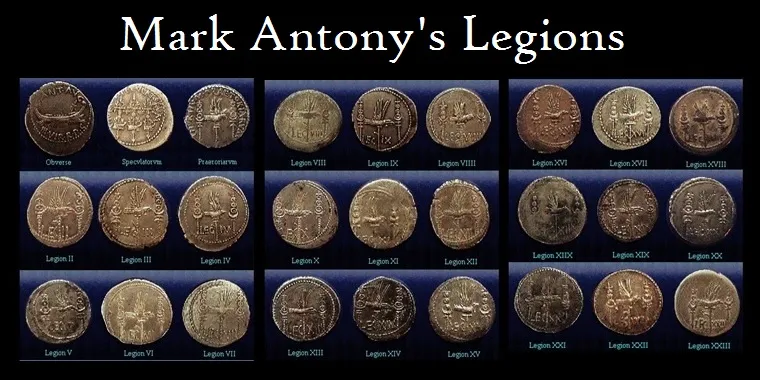
REPLY: I had no idea that so many people have become interested in ancient coins. I listed some and we have been swamped with orders. Most should be out by next week. My assistant, as I have teased her, has suddenly become a coin dealer. I am doing a book on the legions of Mark Antony. In matters of war, as I have said, you always have both sides putting out their propaganda. Every article you read in West Russia is losing and about to collapse. Russia has not used its strategic weapons because they understand that the US and NATO have been using Ukraine to get a glimpse of Russia’s real capability. Its most advanced aircraft have not been used as Putin now understands this is really a proxy war and Ukraine is just the pawn. Putin is keeping those weapons in check to prevent NATO and the USA from getting a preview.
The battle of Actium is what was the birth of Imperial Rome with the victory of Augustus over Antony and Cleopatra. As part of Anton’s propaganda war, he issued coins for every legion he had and then some in an effort to project that he had more support than Octavian.
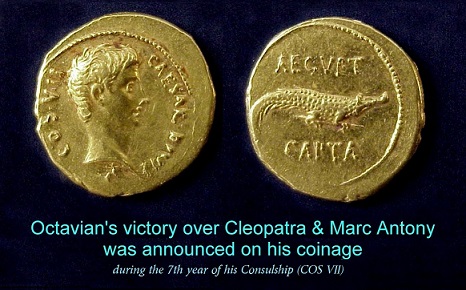
In turn, Octavian’s propaganda was that Cleopatra was manipulating Mark Antony and this was really a proxy war between Egypt and Rome. When Antony and Cleopatra were defeated, Octavian was awarded the title Augustus and his coinage announced his victory, but he did not mention Mark Antony. The coinage reflected his propaganda that it was really Cleopatra and Egypt who was waging war against Rome.
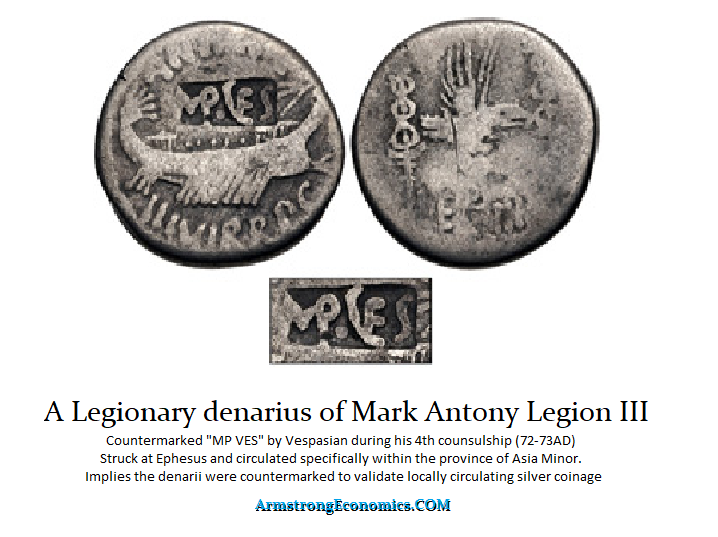
Yet this issue of coinage by Mark Antony is reflective of the current proxy way that the United States is carrying out against Russia using Ukraine just as Cleopatra used Mark Antony. What is even more fascinating is that clearly, Cleopatra funded Antony on a massive scale. It is estimated around 30 million denarii were struck. They were the most common coin found in Pompey which was buried in 79AD which was about 110 years latter. Here is a worn example countermarked “IMP VES” meaning Vespasian during the civil war that followed the death of Nero in 68AD.
No other Roman coin was struck in such quantity reflecting the about of sheer funding that Cleopatra provides to conquer Rome. It is the Ukraine of Ancient Times.
This is a fascinating story that can ONLY be provided from the coinage. This should be going to press next month.
I have created this site to help people have fun in the kitchen. I write about enjoying life both in and out of my kitchen. Life is short! Make the most of it and enjoy!
This is a library of News Events not reported by the Main Stream Media documenting & connecting the dots on How the Obama Marxist Liberal agenda is destroying America









 Centinel2012