The Threat of Protectionism


QUESTION: Marty:

I read you every day and I am one of the fortunate people to have a financial advisor that attends your Conference every year in the US.

I am wondering how Airbus will be affected in the future as the Euro further declines.

Thanks, RM

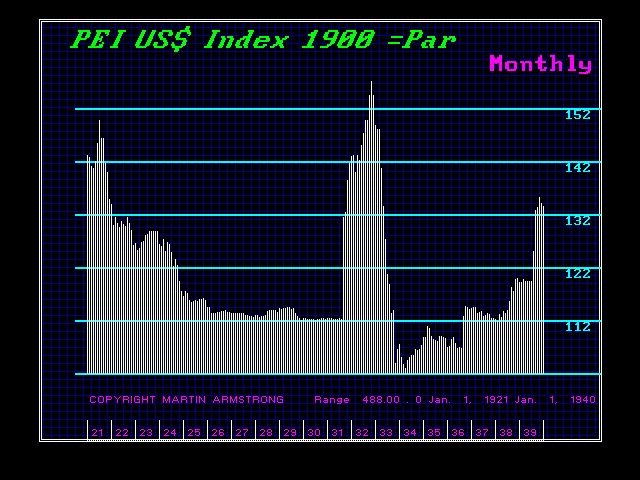
ANSWER: This is one of the aspects that caused the protectionism during the 1930s. As the turmoil in Europe unfolded, capital fled to the dollar pushing it higher. This invoked protectionism also propelled by the decline in commodity prices. The protectionism began with the agricultural sector and then spread to other areas.

As the dollar is pushed higher, we will see protectionism rise again probably 2021-2022. European companies that do not have professional hedging departments will suffer greatly.

Are we Heading into a Food Shortage?


COMMENT: Mr. Armstrong, I find it really distasteful that you laid out events well in advance and then everyone copies you without ever giving you credit. There are articles now appearing about the coming food shortage. The degree of plagiarism is unbelievable. It must be dishearting. I certainly begin to distrust these people and organizations for they certainly even know who you are.

LMS

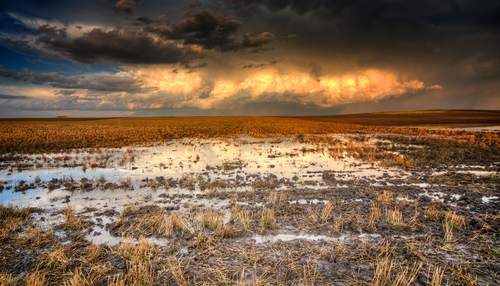
REPLY: That is life. They are trying to sell something so they have to pretend to do the research to make money by getting people to read. The flooding wiped out stockpiles. Now the planting season is already behind on schedule because of the weather. As I have warned, the computer has been forecasting colder winters and shorter-summers. The planting season will decline and thus the danger of a serious food shortage as we head into 2024.

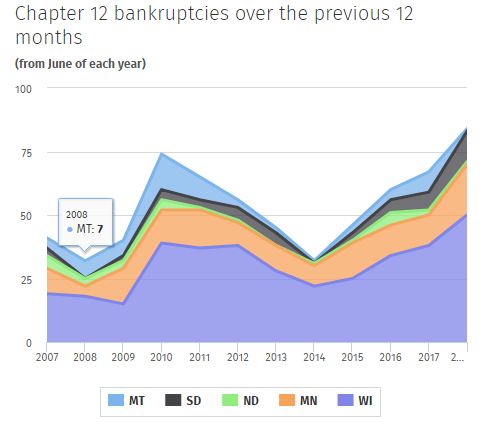
I previously wrote about the soaring bankruptcies among farmers and combine this with the flooding that continues, I believe the computer will be on point. I also wrote about how this year, the Russian wheat crop failed has failed because of the bitter cold with even April coming in as the coldest in more than 140 years. To make matters worse, our computer warns that the weather will not improve. The next 4 years will put even more financial pressure farmers. Even in Australia, the drought is sending the “roos” invading the cities and they like to feed precisely during Rush Hour.  The drought is so bad in Australia, that animals are dying for lack of feed crops.

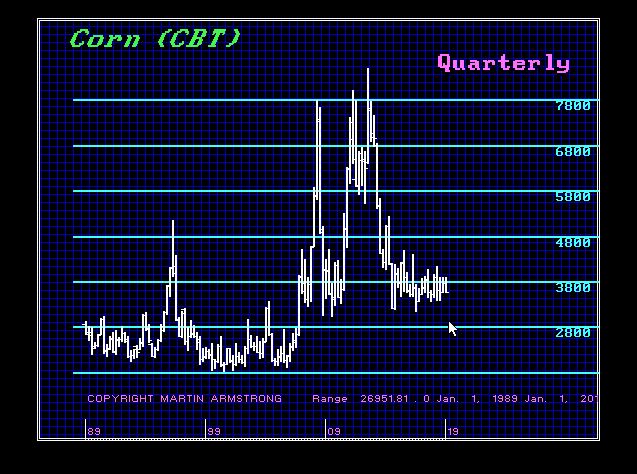
In the USA, four states are well behind on the planting schedule – Illinois, Minnesota, Indiana, and South Dakota. These four states combined to produce nearly 40% of the corn in the U.S. The charts are not yet responding to the fundamentals. This should begin to change next year. Nevertheless, we are building bases at higher levels. I have written plenty of times that any continuation of the weather beyond this season warns of a continued cooling trend. When our model is showing Global Cooling and 2019 has broken so many records, then there is a risk of a pending bull market in the price of food. This is something rather important enough to put on the agenda but governments prefer to listen to the Global Warming crowd to justify taxes.

Moving from QE to Just Monetizing Government


QUESTION: Mr, Armstrong; Why the push for lower interest rates again in developed markets? You have stated the QE has been a total failure. Are they incapable of doing anything else?

KE

ANSWER: We are switching from QE to a new reality of budget management. If interest rates rise on government bonds, the budget blows out. At this stage, the Fed is toying with the idea of setting benchmark rates for 2 to 10-year instruments. This will be different than QE. It will be the collapse of government bond markets on a global scale.

ETF v Mutual Fund


QUESTION: Are ETFs really better than a mutual fund for tax purposes?

HS

ANSWER: The primary difference between mutual funds and ETFs (exchange-traded funds) is that while an open-end mutual fund is priced once based upon the market closing, ETFs as well as a closed-end mutual funds trade all day. This actually goes back to the Panic of 1966 when mutual funds were open-ended but traded on the exchange and were bid up and down based on emotion rather than net asset value. The crash took place because mutual funds were at times selling well above net asset value.

If we look at the reforms post-1966, investors in mutual funds buy or sell them directly from the mutual-fund companies themselves. That creates a different tax structure than an ETF in which purchases go to the market and the ETF is simply created by purchasing the underlying basket.

Mutual funds and most ETFs are governed by the Investment Company Act of 1940. Therefore, this legislation treats them like a pass-through company. When a mutual-fund investor wants to sell, the fund sells shares of appreciated stock to generate cash which creates a taxable capital gain. Since most funds operate as simple pass-through vehicles, those tax liabilities from the gains accrue to all investors in the fund including those who have not sold any holding.

ETFs actually do avoid that type of tax issue. ETFs are not direct buyers or sellers of shares as a mutual fund. The ETF is created by a market maker with a special contract with the ETF provider. The investor has the newly created ETF share which is created by purchasing all of the holdings in the underlying ETF. This basket of shares is given to the ETF issuer thereby creating the ETF shares.

Because an ETF is not a direct buyer of the underlying shares as in a mutual fund, the ETF itself is not a buyer or seller. The basket of shares are swapped and are therefore in-kind transactions, thus there is no pass-through capital-gains tax bill. This is the tax advantage of an ETF over a mutual fund.

Creating the Euro & Germany Was Denied the Right to Ever Vote to join the Euro


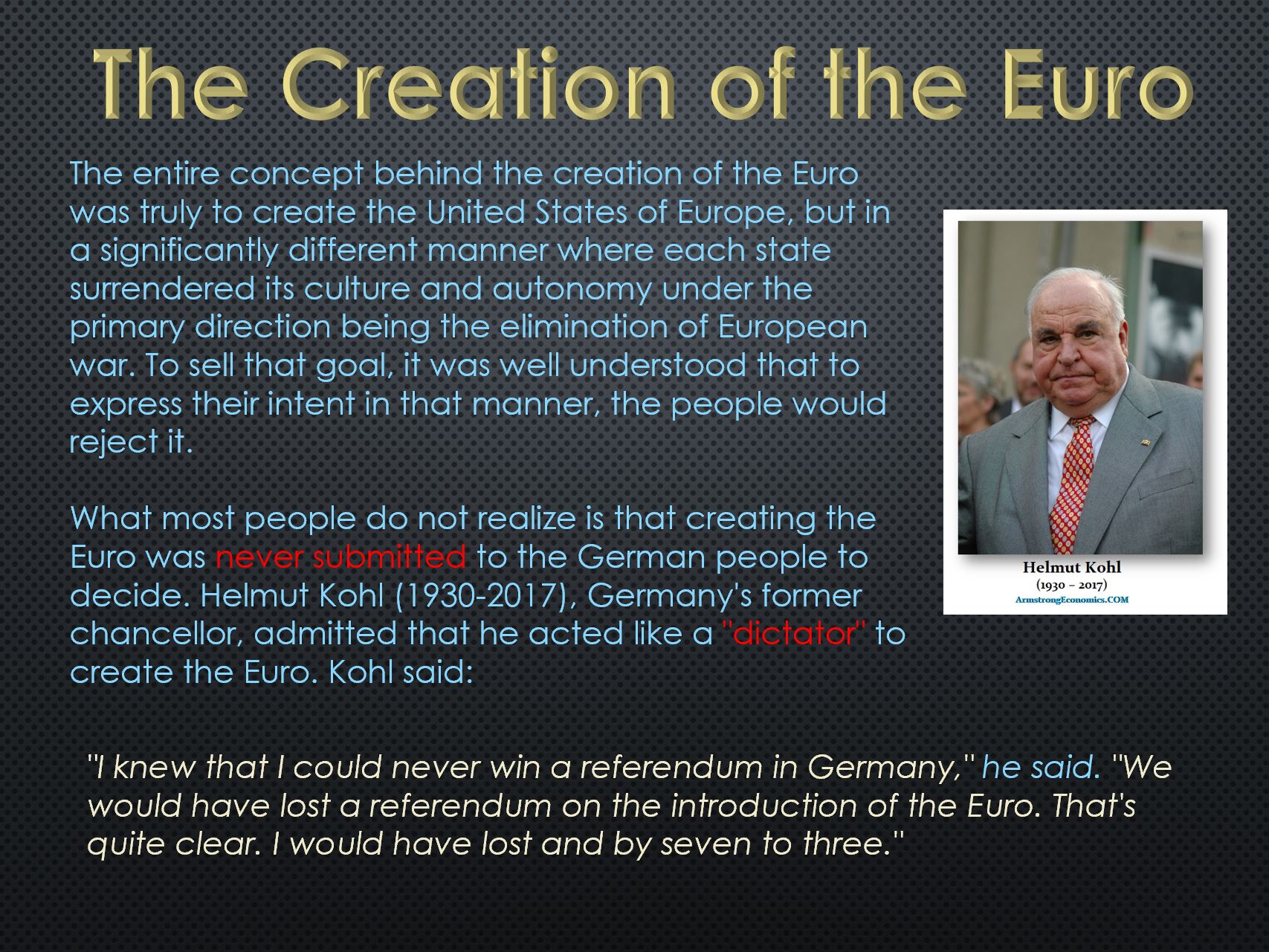
COMMENT: Marty; I just wanted to say that this WEC in Rome was one of your best, NOt that Nigel Farage was there calling you the alternative to Davos, but you really do your research and your contacts behind the curtain become self-evident. Nobody in the audience every knew that the German people were denied the right to vote on joining the euro. The most important economy was denied any democratic process.

See you in Orlando

PG

ANSWER: Yes, I was amazed at how even the central bankers who attended were unaware of that fact. This is part of the reason for the rise in the AfD in Germany. From the outset, the theory has been to federalize Europe to prevent a world war. They assumed the people would never vote for it so they hide the real agenda. The people are not those who create wars – it is always those in power.

What they have done is to fuel the flames of history that remind people of the differences that are culturally embodied within the languages.

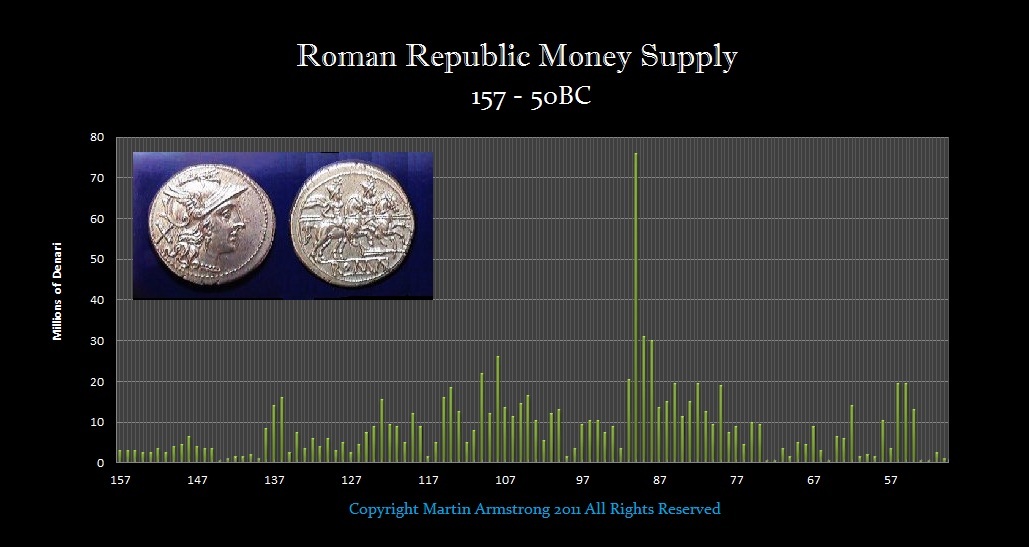
How Did Rome Put Money into Circulation with no Central Bank?


QUESTION: How were ancient coins placed into circulation?

DR JB

ANSWER: That is actually a very interesting question. As the legend goes, the Gauls (French) attempted to invade the city of Rome quietly, but had frightened the sacred flock of geese that made a lot of noise. This alerted the Romans to the surprise attack giving us the word “monere” meaning in Latin to warn. The Temple of Juno then became popularly known as the Temple of Juno Moneta. Since this is where the coins were minted, we now arrive at the word “money” that springs from the origin of this legend and place that was an ancient mint.

Our term such as capital flow is also derived from the Latin word “currere” meaning “to run” or “to flow” and this is where the money flowed from giving us the word “currency” meaning the flow of money. This is why Juno Moneta is pictured on Roman coins as holding the balance scales in one hand and a cornucopia in the other symbolizing endless bounty or wealth. This is the birth of the term money and currency.

Now, since Rome had no national debt and no central bank, we immediately wonder how on earth did this function? The government-owned the mines and thus they coined money to meet their expenses.  Unlike our modern governments, they did not have a huge welfare state. They did subsidize food. But the coinage was used to pay the troops and government expenses and thus this is how the money was put into circulation. They would increase the output in times of war and decreased it in times of peace for the most part.

Concrete Buildings Create C02?


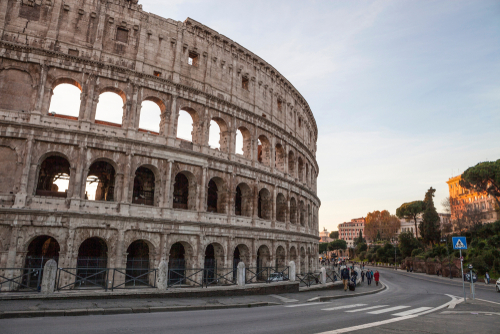
The latest thing now is that constructing office buildings out of concrete and steel is now claimed to account for 5% to 8% of total greenhouse gas. They are now proposing to construct skyscrapers out of wood that are 35 to 40 stories high. They now argue that concrete structures are huge contributors to greenhouse gases. Of course, concrete was invented by the Romans and it is why the Colosseumis still standing as well as the Pantheon. Roman concrete or opus caementicium was invented during the late 3rd century BC when builders added volcanic dust called pozzolana to mortar made of a mixture of lime or gypsum, brick or rock pieces, and water.

Roman concrete was used from the late Roman Republic until the end of the Roman Empire. They used it to build monuments, large buildings, and infrastructures such as roads and bridges. The quality of the concrete was excellent and the buildings and monuments that are still standing today are a testament to the strength of their construction. Today, they argue that cement is one of the primary producers of carbon dioxide and it causes damage to the topsoil. Concrete creates hard surfaces which contribute to surface runoff causing soil erosion, water pollution, and flooding according to the Greens.

However, then there are studies that claim that concrete actually absorbs greenhouses gases and is good for the environment. Cement is the building block of civilization since ancient times and may eventually suck some of that carbon dioxide (CO2) enough to actually cancel nearly a quarter of the gases released making cement, according to a new study.

Of course, Wildfires emit carbon dioxide and other greenhouse gases that will continue to warm the planet well into the future. They damage forests that would otherwise remove CO2 from the air. And they inject soot and other aerosols into the atmosphere, with complex effects on warming and cooling. If we construct buildings all out of wood and they catch fire, that creates a major threat of greenhouses gases. Wildfires are estimated to produce 5% up to 10% of annual CO2 emissions.

Guess the only solution is to exterminate all human life. No more studies to contradict one day eggs are bad for you and the next they are no problem. Be sure to visit the Colosseum before an environmentalist blows it up to save the planet.

The End of Keynesian-Monetarist Theory


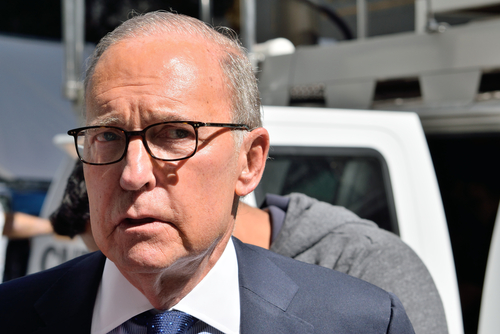
QUESTION: Thank you for your great work. I have read this article where Kudlow says: White House economic adviser Larry Kudlow predicted that it is possible the Federal Reserve won’t hike interest rates again during his lifetime: My question is do you think he is right? And what will the consequence be if the interest rate remains where it is – For example, the next 10 or 20 years?
P.S. Of natural causes, we do not know how long time Kudlow lives.
Best regards
L/Sweden

ANSWER: Perhaps he got bad news from his doctor or it is a political statement that is just absurd. What he is really saying is that Quantitative Easing has so destroyed the Keynesian model that there is now no other alternative for central banks to control the economy. If they raise rates, the budget explodes. We are witnessing the end of Keynesian.Monetarist theory.