A Technical Study in the Relationships of Solar Flux, Water, Carbon Dioxide and Global Temperatures, June 2019 Data


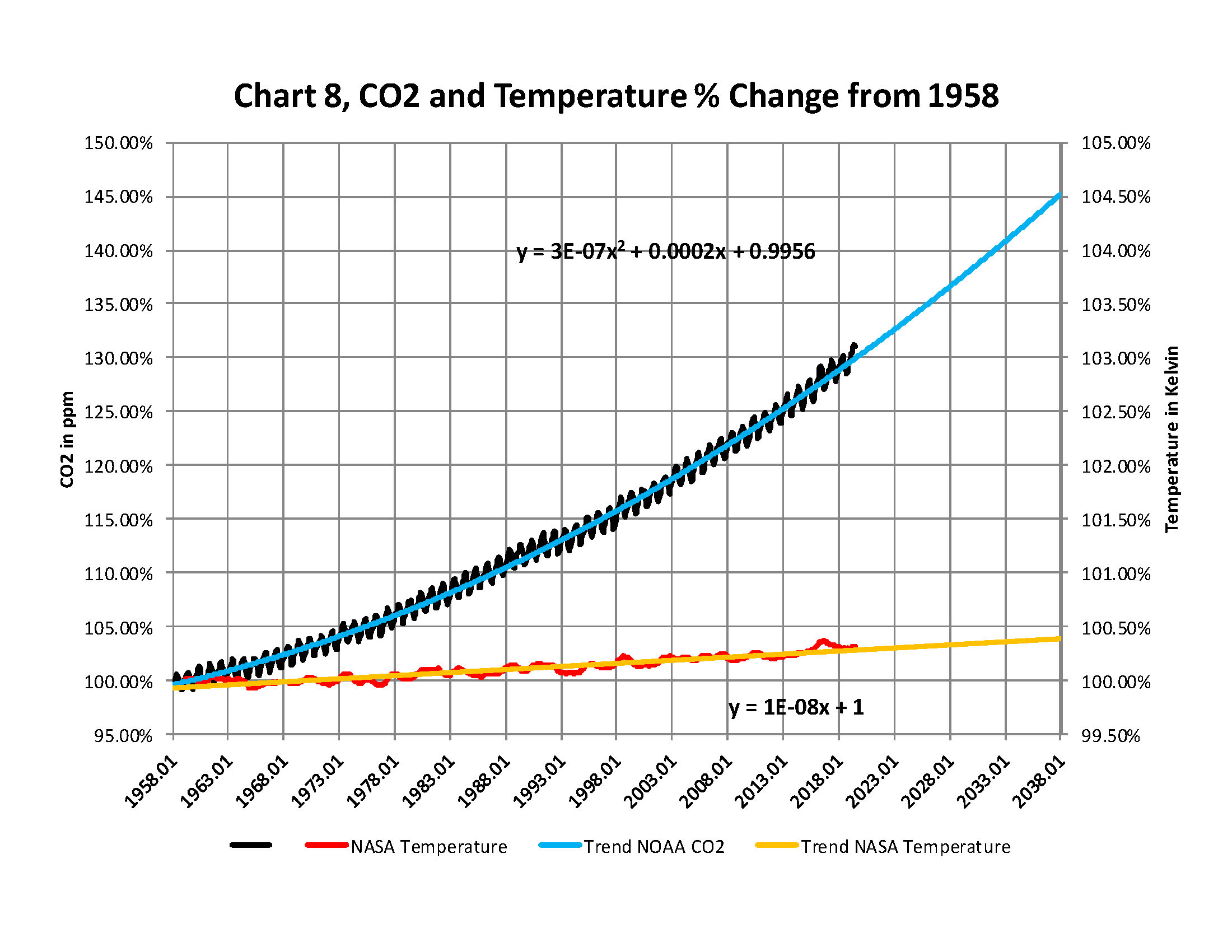
From the attached report on climate change for June 2019 Data we have the two charts showing how much the global temperature has actually gone up since we started to measure CO2 in the atmosphere? To show this graphically Chart 8 was constructed by plotting CO2 as a percent increase from when it was first measured in 1958, the Black plot, the scale is on the left and it shows CO2 going up a bit over 30.0% from 1958 to June of 2019. That is a very large change as anyone would have to agree.  Now how about temperature, well when we look at the percentage change in temperature from 1958, using Kelvin (which does measure the change in heat), we find that the changes in global temperature (heat) are almost un-measurable. The scale on the right side had to be expanded 10 times (the range is 40 % on the left and 4% on the right) to be able to see the plot in the same chart in any detail. The red plot, starting in 1958, shows that the thermal energy in the earth’s atmosphere increased by .30%; while CO2 has increased by 30.0% which is 100 times that of the increase in temperature. So is there really a meaningful link between them that would give as a major problem? The numbers tell us no there isn’t.

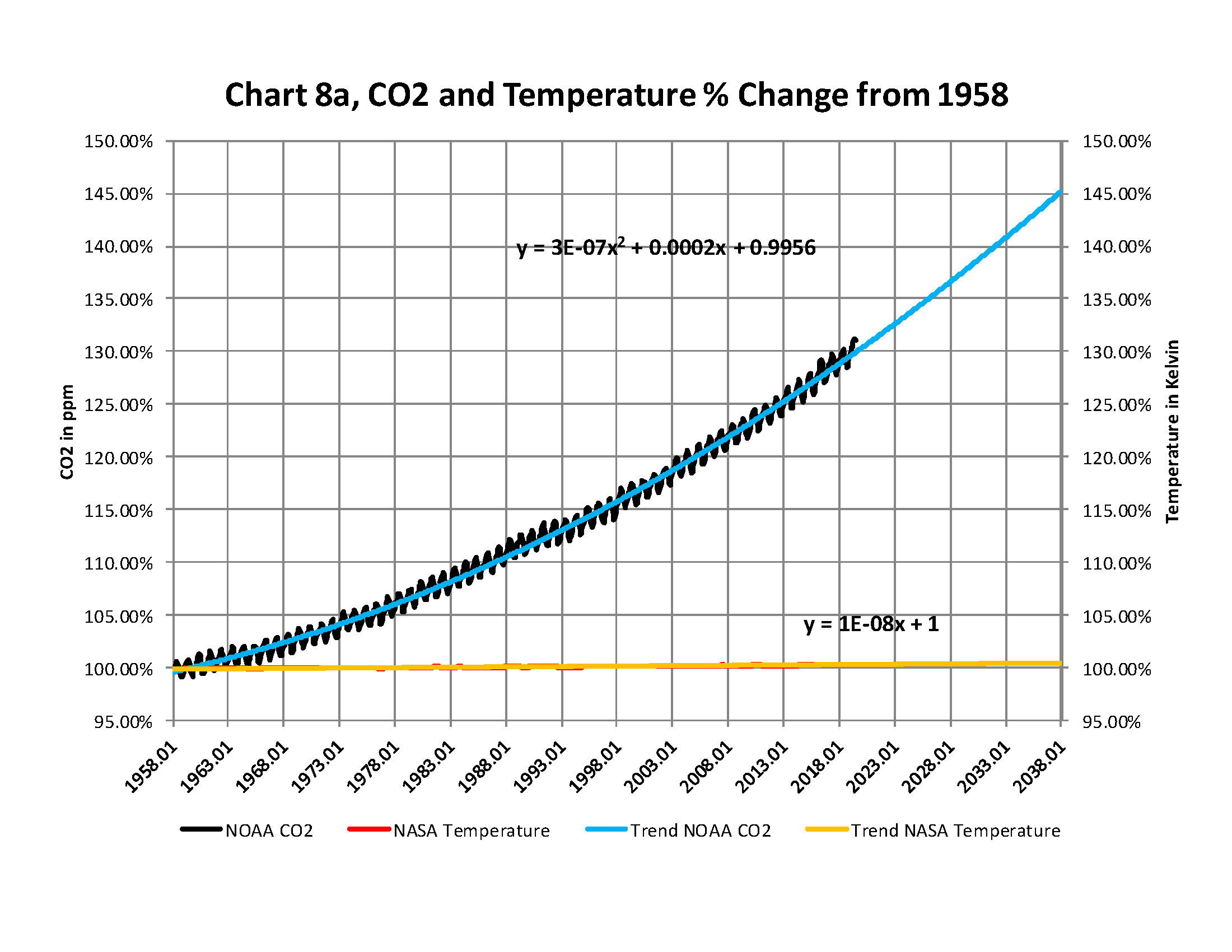
The next chart is Chart 8a which is the same as Chart 8 except for the scales which are the same for both CO2 and Temperature. As you see the increase in energy, heat, is not visually observably in this chart hence the need for the previous chart 8 to show the minuscule increase in thermal energy shown by NASA in relationship to the change in CO2. Based to these trends, determined by excel not me, in 2028 CO2 will be 428 ppm and temperatures will be 15.0o Celsius and in 2038 CO2 will be 458 ppm and temperatures will be 15.6O Celsius. This is what the data shows no matter what the reasons are, so I have no idea how the IPCC gets to predict that the world will end in ten or even twenty years.

The full 37 page report explains how these charts were developed and why using NASA and NOAA data are used without change to prove that The New Green Deal is not required and any attempt to compliment that plan will be a worldwide disaster.

Click on the link below for the full report that you can download.

BLACKBODY TEMPERATURE 2019-06

When did Trading Begin? Were Free Markets the Key to the Rise of Empires?


QUESTION: Mr. Armstrong; I figured there is nobody more qualified to answer the question of where and when did markets first begin to trade? Did markets have anything to do with the rise of nations you write about?

KD

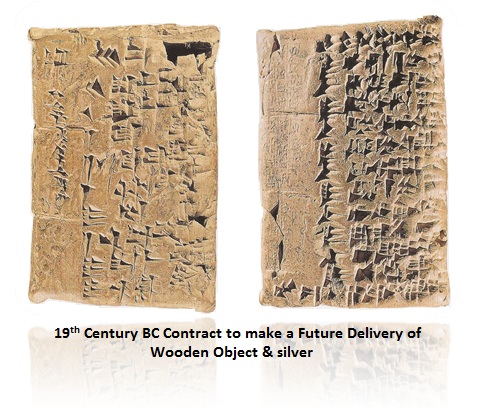
ANSWER: Only those societies that developed financial markets ever rose to greatness. Those who bash markets fail to understand that without them, most people would still be digging for potatoes. The evidence supports the first markets were futures markets which traded in Babylon, at least during the 19th century, since we have futures contracts from that period which have survived. All of the research I have conducted clearly demonstrates that economic growth is linked directly to the expansion of financial markets. Once there is a marketplace, then people will invest and economic growth will expand provided they know that if they needed to raise capital, they can sell their investments. Therefore, my research reveals that it takes CONFIDENCE in order to expand an economy and that translates into liquidity. Just look at this from your own perspective. You will buy a share in some company ONLY because you think you can make a profit. But how is that profit even attainable? The potential for a profit exists ONLY if there is a liquid market.

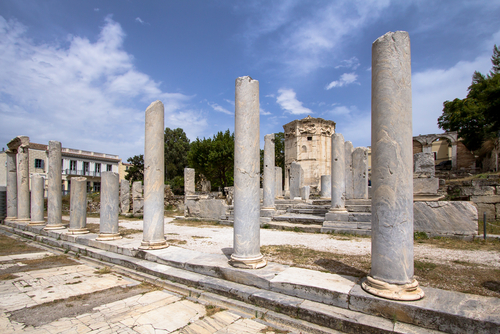
Agora, Athens

The Athenian economy had a financial marketplace in the Agora. There were bankers as well as insurance companies. Aristotle wrote about the people who made money from money. As the Athenian economy began to expand because of the introduction of financial markets, there was a transition of which Aristotle wrote about in his “Politics.” Aristotle believed that the Athenian economy was changing from what I call the Villa Model (Agricultural) of self-sufficient enclaves to an economy of market-driven incentives which encourage the production of excess for the purpose of trade giving rise to a Market Economy Model. Similarly, this was the same transition period emerging from feudalism. Once a financial marketplace emerges, then people will produce more if there is a marketplace where it can be sold.

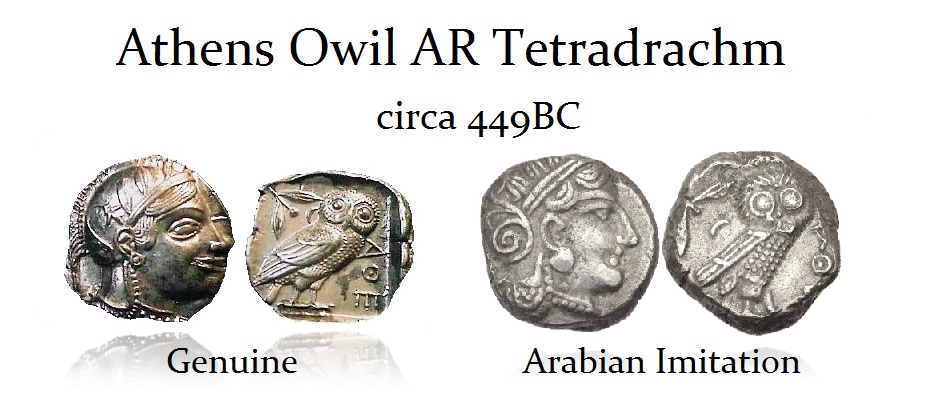
There are academics who have tried to breakdown the Athenian economy with such detail that they could not see the forest while focusing on the bark of just one tree. They read Aristotle’s “Politics” but missed the whole point of his concern — the transformation of Athens into the financial capital of the ancient world which even predated China. Some have argued that the ancient Greek word oikonomiais the root of our modern English word “economy,” but it is not synonymous with our definition of “economy” as we perceive it today. They argue that today “economy” refers to a distinct sphere of human interactions involving the production, distribution, and consumption of goods and services; oikonomia meant “household management” because it was guide written by Xenophon — how to manage your Villa Economy. They then mix in the political system of Greek Democracy and claim family activity was subsumed into traditional social and political institutions. They then go as far as to degrade the Greek monetary system, admitting that they produced and consumed goods, engaged in various forms of exchanges including long-distance trade among nations, and developed monetary systems employing coinage. This is all discounted by many academics arguing that they did not see such activities as being part of a distinct institution which we call the “economy.” I really see these arguments as gibberish where they have had way too much time to think and produce nothing. Instead, they get lost in their own thoughts. They lack a complete knowledge of the monetary history and fail to comprehend that Athens’ coinage was so dominant in the ancient world it was imitated in the north by the Celts, Slavic people, Asians, and even down in Arabia. That would never have taken place if it was so de minimis as they have tried to portray.

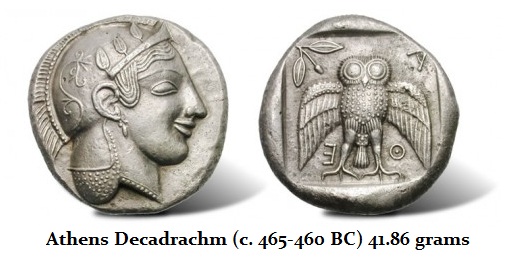
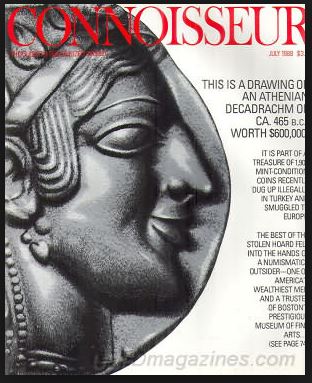
Athens produced the Decadrachm (10 drachmas) with a weight of nearly 42 grams. These coins would have been like 10,000 bills. They are very rare. Again, some academics tried to claim these were merely commemorative issues. They lack sufficient understanding of the world monetary system for these coins have rarely ever been discovered in Greece. Treasure hunters near the village of Elmali in southern Turkey unearthed a trove of ancient coins that included the rarest and most valuable Greek coins ever found. The coins, it said, were smuggled out of Turkey and sold to William I. Koch and two partners. It was the hoard of the century.

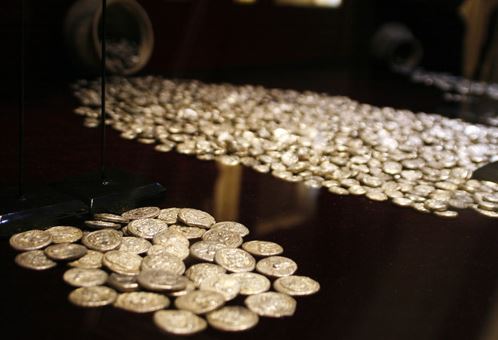
The Elmali Hoard was discovered around April 1984 containing nearly two thousand ancient Greek and Lycian silver coins. Turkish authorities contacted Interpol seeking international assistance to find and arrest the traffickers. In 1984, the consortium OKS Partners, which included Koch, purchased almost 1,700 of these coins for about $3.2 million. They began to sell the coins in 1987 and that is when the lawsuit was filed. The hoard was eventually returned to Turkey.

The significance of this hoard establishes that the Athenian Decadrachms were high denomination coins used in international trade. They are not found in Athens, but in ancient port cities around the Mediterranean coast. Some scholars claimed that the Athenian decadrachm is comparable to the more abundantly produced Syracusan decadrachm, which was minted around the same time. However, the Syracuse decadrachm was also minted for celebratory and practical purposes. The Syracuse minted their decadrachms in response to their defeat of the Carthaginians and they attempted to try to argue this was the same reason behind the Athenian decadrachms.

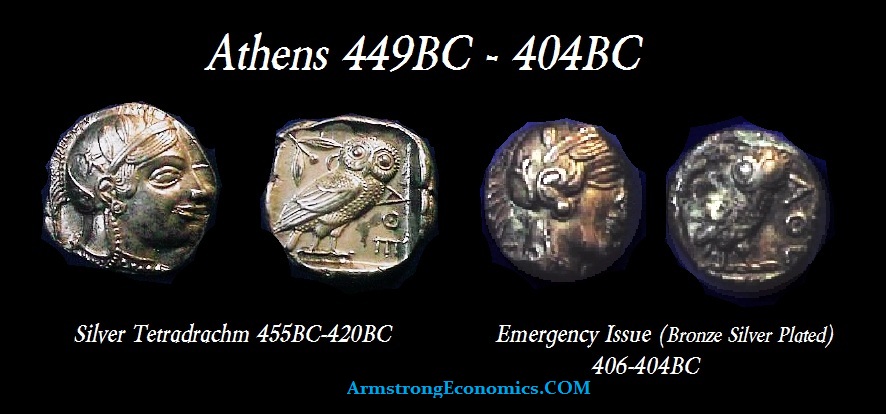
Numismatists have identified 24 separate reverse dies used for one issue of Syracusan decadrachms by created by the artist Euaenetus. This suggests that a minimum original circulation of just this issue would have been between 240,000 and 360,000 coins with a modern survival rate ranging between .08% and .25%. The Athenian decadrachm was used in international trade when they were attaining timber and metals from the Near East. The majority of Athens was composed of farmers who would never have a need for a decadrachm.  The decadrachm became obsolete by the time of Pericles and Democracy for Athens was losing its supremacy and lost in war to Sparta. In fact, during the Peloponnesian War (431–404 BC), Athens lost its silver resources and began to issue its coins merely silver plated.

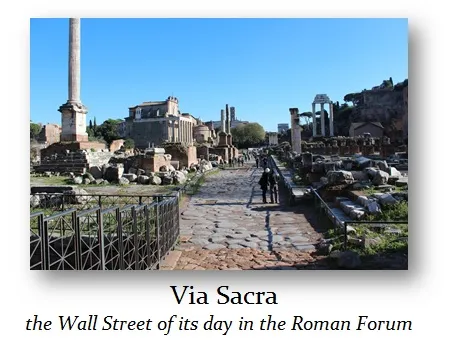
Therefore, both the Athenian and Roman economies began to expand into sophisticated agricultural-based economies only with financial markets. This is how the economies emerged from a Villa Model of self-sufficient enclaves as was also the case in feudal times into a integrated market economy which led to international trade and the birth of Mercantilism. Rome did not have a national debt nor did it possess a central bank. Consequently, there was a deep financial market which would also take place in the Roman forum along the Via Sacra — the Roman version of Wall Street.

Most people assume that the invention of corporations really began with the East India Company since it was the first share to begin trading in the 1500s. However, there were plenty of early examples of markets which were similar to stock markets. Even during the 1100s, France had a system where courretiers de change managed agricultural debts throughout the country on behalf of banks. This can be seen as the first major example of financial exchange because the men effectively traded debts — bonds. Later, the merchants of Venice were credited with trading government securities as early as the 13th century. Post-Dark Age, the first trading in any type of financial marketplace was confined to debt instruments rather than corporate shares.

What is typically overlooked is that the first public corporation concept is truly attributed to also the same man who gave us the word “economics” from the title of his book, “Oikonomikos” meaning actually how to regulate the household – Xenophon (431 – 350 BC). Xenophon was a student of Socrates. He became a mercenary and was the leader of the famous “Ten Thousand” (of recent movie epic). He was opposed to extreme democracy that sentenced Socrates to death. His last writing in 355 BC was his “Ways and Means” that advocated peace rather than war that destroyed the economy (yes, Congress’ committee is named after his work – Ways & Means Committee). Xenophon was not a philosophic intellectual, but rather a practical man of action who wrote from experience.

Xenophon proposed a public corporation for a bank that would be formed by shares subscribed to by all the Athenian people. Commerce was seen as more important than even agriculture. Xenophon proposed a public bank that would lend at interest to expand the economy. He proposed that the profits would be used to pay for public works. During the reign of Augustus (27 BC-14 AD) in Rome, there was such a public loan bank, but not subscribed to by individual members of society. This public bank provided loans to the poor without interest and it was funded by the confiscation of property from those alleged to be criminals, which would include political dissents as well. Collateral was required at twice the amount being borrowed. These types-of public banks aided the purchases of land.

The word “corporation” derives from corpus, the Latin word for body, or a “body of people.” By the time of Justinian (527–565 AD), Roman law recognized a range of corporate entities under the names universitas, corpus or collegium. These included the state itself (the Populus Romanus), municipalities, and such private associations as sponsors of a religious cult, burial clubs, political groups, and guilds of craftsmen or traders. Therefore, these bodies of people commonly had the right to own property and make contracts. They could also receive gifts and legacies, to sue and be sued. They could perform legal acts through representatives as well. Private associations were granted designated privileges and liberties by the emperor and these are the origins of corporations.

Roman knights of the republic did invest in small business and they would receive a share of the profits. These were contracts which could be resold to someone else, but they did not trade on an open exchange. Likewise, senators would also invest in land and gain a portion of the harvest as their return on investment. Trading in shares of corporations really materialized in the 1500s, but the Roman and Greek systems would be more like venture capital and private placements.

3,000 People Died in French Heatwave of 2003


Back in 2003, about 3,000 people died in France of a heatwave when high temperatures swept across Europe. It was found that nearly 180 people were dying of the heat in hospitals because of the lack of air conditioning. More people want to blame people driving to work rather than investigating the cyclical nature of our climate long-term. The longer this thinking persists, the greater the risk of being totally unprepared for the threat of famine and disease.

Coming Political Change


Cycles of the past
lead to future predictions

By Dinah Wisenberg Brin
The Associated Press Philadelphia


The political upheaval of 1994? They saw it coming two years ahead of time. The devastating Japanese earthquake? They’d been expecting it, albeit a year earlier….President Herbert Hoover … might be pleased with board Chairman Martin Armstrong’s prediction of the extinction of the Democratic Party after 2020.

In late 1992, Armstrong accurately predicted either “a sweeping Republican victory on Capitol Hill” or a victory for a independent party in 1994.


QUESTION: Mr. Armstrong, I found an article from February 21, 1995, in the Associated Press that you had also correctly forecast the elections back in 1994 which became known as the Republican Revolution and warned that the Democratic Party could ride off into the sunset. Your forecast on Trump and BREXIT also show your computer is on to something. Will you be doing the elections in 2020 at the Orlando WEC?

CM

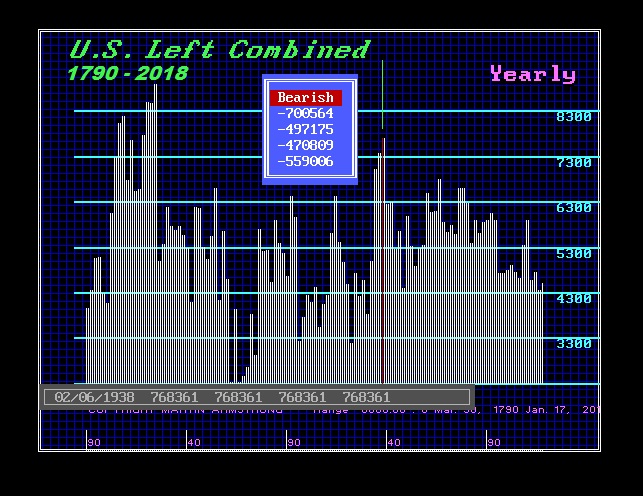
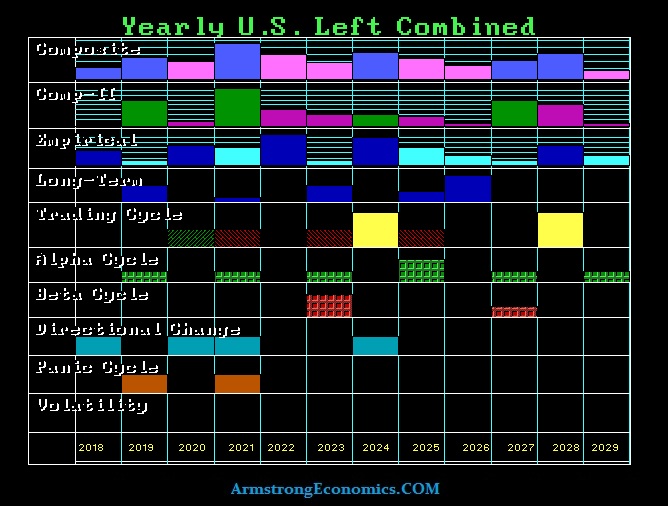
ANSWER: People do not understand that it is not the cycle by itself; it is a reflection of the trend of the whole. The crisis in the Democratic Party is reflected in the turmoil from the Squad of Four who are receiving all the press and painting the Democratic Party as the extreme left. Then you have Bernie Sanders and Elizabeth Warren. They are just not in the center, to say the least. This raises the potential for a major shift in the political system as we saw with Trump wiping out career politicians in the Republic Party. You can see the Array on the Democrats (Combined Senate/House) showed a Panic Cycle in 2019 which gave them the House, but the big turning point will be the 2020 elections with a Panic Cycle due there as the result in 2021.

Yes, we will be doing political forecasts at the WEC.

Antarctica Use to Have no Ice?


Research is surfacing that shows Antarctica may have been without ice during the Medieval Warming Period some refer to as the Medieval Climate Anomaly (MCA) which took place between 1000–1200 AD. Mapping the MCA across the Antarctic region based on the analysis of published palaeotemperature proxy data from 60 sites has revealed something which defies the global warming hysteria. They have used ice core data, temperature proxy records from marine and terrestrial sediment cores, as well as radiocarbon dating. They have discovered that there was in fact warming of Antarctica contrary to the belief that if the ice melted we would all drown.
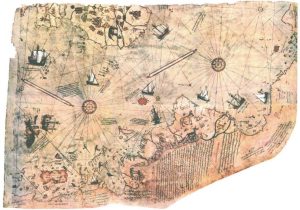
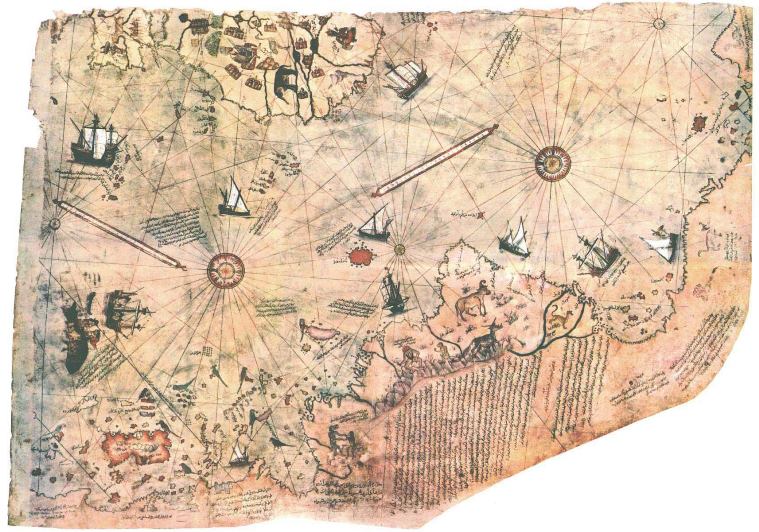
Back in 1773, the well-known explorer James Cook passed through the Antarctic circle for the first time. Cook officially discovered Antarctica which was generally believed to have been unknown. Later in 1929, a map was discovered in Istanbul that suggested it had been known before and has subsequently raised confirming evidence that Antarctica, at least in the West, was without ice and was noted as being a warm climate.

The chart was originally discovered in Istanbul while the German theologian Gustav Deissmann was cataloging the contents of Istanbul’s Topaki Palace’s library. He came across bundles of maps and charts that had been hidden within piles of disregarded materials. He was apparently stunned after realizing the staggering importance of this find for it was long understood that even Christopher Columbus possessed maps from the ancient world whose last capital was Constantinople – Istanbul. Constantinople fell to the Turks in 1453 and the scholars fled to Europe and to Russia and began teaching lost knowledge. This is what inspired Columbus to set sail in 1492.

Deissmann understood the importance of this map and he immediately brought it to an expert. The map was identified as the Piri Reis Map, taking its name from the medieval cartographer Piri Reis, who signed the bottom. The Piri Reis Map was astonishing for it apparently identified Antarctica at least 200 years before Cook’s discovery.

The Piri Reis Map is a world map compiled in 1513 from military intelligence. Only about one-third of the map has survived displaying the western coasts of Europe and North Africa as well as the coast of Brazil with reasonable accuracy. There are also various Atlantic islands, including the Azores and Canary Islands. Naturally, academics tried to call it a fake because it disturbed their idealized linear timeline of discovery. Nonetheless, Gregory McIntosh, who is a historian of cartography, examined the map in detail in his book “The Piri Reis Map of 1513″ (University of Georgia Press, 2000). McIntosh was able to discover the sources for much of the map in Columbus’s writings. There were some errors, such as the Virgin Islands in two locations which he attributed to the use of multiple maps as sources. Nevertheless, McIntosh traced the accuracy of the depiction of the Antarctic coast. He noted that there were two errors insofar as the coast was shown perhaps hundreds of kilometers north of its proper location and that the Drake Passage was completely missing.

Of course, with Google Maps, people have uncovered what they are claiming are man-made pyramids in Antarctica, claiming that it was once inhabited perhaps 6,000 ago and a polar shift changed the landscape of the world. This is an interesting theory, but it remains just speculation. Sure, something like that could have happened. However, there is no way to prove such a theory at this point in time, leaving it as a plot for a speculative movie.
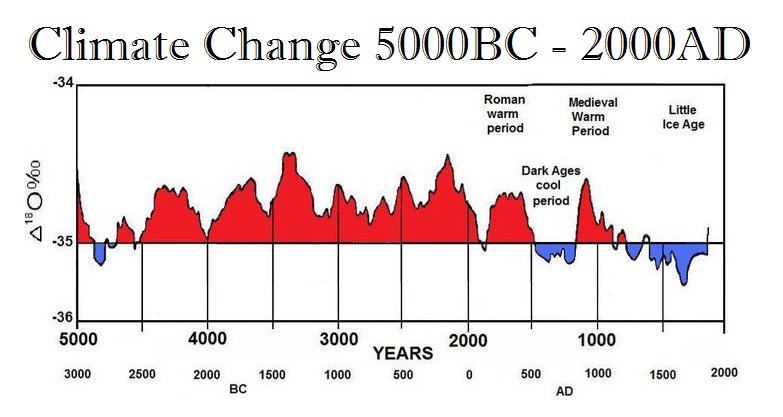
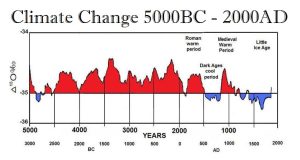
Still, the Piri Reis Maphas baffled many because it stands in direct contrast with our perception today that the Antarctic is frigid but the notes on the map describe the region as having a warm climate. However, the map corresponds to the Medieval Warm Period that followed the Dark Ages and the Black Plague which wiped out about 50% of the population during the cold period.

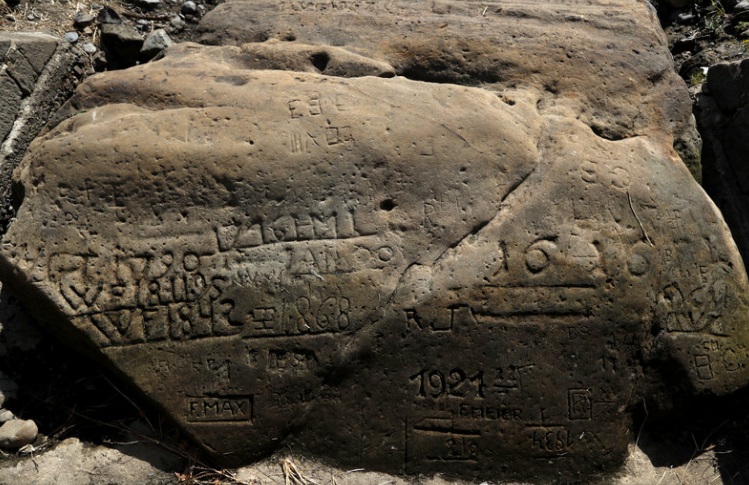
However, the extreme swings from heat to extreme cold (Panic Cycles) appear to be indicative of a precursor to Climate Change. Another piece of historical evidence for the Medieval Warming Period which has been ignored by the Global Warming crowd is known as the Hunger Stones. Pictured here is a Hunger Stone from 1616 which has been exposed by the low level of water in the Elbe River in 2018. This is at Decin, in the Czech Republic. Throughout the centuries, there have been these cycles of extreme heat followed by extreme cold. Such events have been recorded when drought has resulted in the low level of water in the Elbe river.

Then there is what many call the Christopher Columbus Map which is undated, but there are clues it was created in 1491: The Smithsonian reported that the map quotes a book published that year, and Christopher Columbus may have consulted the map (or a copy) before his great voyage. When he landed in the Bahamas, he believed he was close to Japan, for this map did not show the Americas. The map, made by a German working in Florence named Henricus Martellus, has been another map which has been ignored by academics.

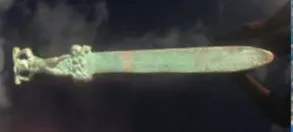
Scientists at Yale University have been using multispectral imaging on this 15th-century map believed to have been used by Christopher Columbus. They have uncovered hundreds of place names and more than 60 written passages. I have written before that roman-swordRoman artifacts have been discovered also in Canada. This clearly establishes that the ancient Romans may have sailed across the Atlantic long before Columbus or the Vikings. This discovery in Canada has created a storm for it rewrites history. The unquestionable discovery of a Roman sword in Canada is rather stark evidence that history is different from what academics believed. Yet Roman coins have been also discovered in Japan. Then there was the discovery of the Cocaine Mummies from Egypt which have confirmed there was trade between Africa and South America, although it could have been through the Pacific to India and off to Egypt.
Only two historical cases of pre-Columbian contact are widely accepted among the scientific mainstream. They have accepted maritime explorations by Norse peoples from Scandinavia during the late 10th century which led to the Norse colonization of Greenland and of L’Anse aux Meadows in Newfoundland which predate Columbus’ arrival in the Americas by some 500 years.

From China, we have historical evidence that the Roman Emperor Marcus Aurelius sent a diplomat envoy to establish contact with China, which they were long trading with through intermediaries on what was called the Silk Road. The history of Rome that it claimed to rule the world (orbis terrarum) stood at the opposite end of the globe from the strikingly similar Han Dynasty (206BC-220 AD) in China, which also claimed to have ruled the world (tianxia). There is the History Book for Tang-Dynasty in China covering the period 618-907 AD. Yet the text mentions 17 times what appears to be the Roman Empire. It also describes an envoy that was sent by the Roman Emperor to China. The Roman Emperor was recorded to have been “Anton.” The account of such an envoy who visited the older Han Dynasty predates the Venetian traveler Marco Polo (1254-1325) by more than 1,000 years. This envoy has been attributed to 166 AD during the reign of Marcus Aurelius Antoninus (121-180 AD). It is the death of Marcus Aurelius that has marked the peak in the Roman Empire and the turning point that begins the Decline and Fall of the Roman Empire where the monetary system collapses just 72 years thereafter. This envoy established diplomatic contact at the peak in the Roman Empire from which a disastrous decline begins. Any political-economic aspirations to further such a relationship would then die with Marcus Aurelius. Yet also, both empires would suffer the same fate of barbarian invasions. The Han Dynasty falls in 220 AD from which emerges the chaotic period known as the Three Kingdoms (220-280 AD ) – the division of the once unified Chinese Empire.
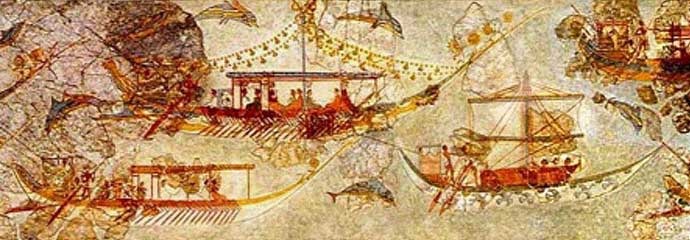
The Minoan society began the Bronze Age. To make bronze, they needed tin. Low and behold, the Minoans traded with the British of Stonehenge Age period prior to 1650 BC, sailing into the Atlantic and they too must have created maps of the areas they sailed to. It was essential to sail into the Atlantic for trade giving birth to the Bronze Age.

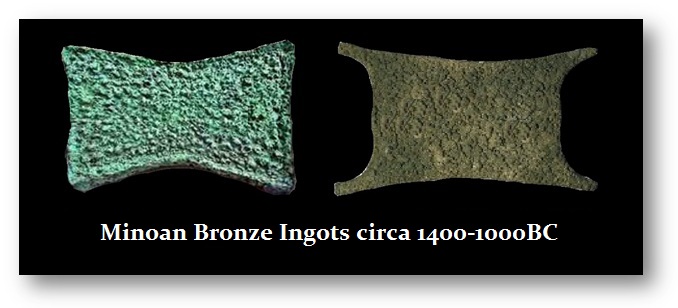
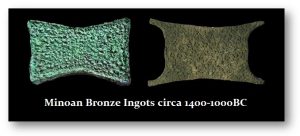
The Minoans were perhaps the first International Economy. They traded far and wide even with Britain seeking tin. Their civilization was of the Bronze Age rising civilization that arose on the island of Crete and flourished from approximately the 27th century BC to the 15th century BC. Their trading range and colonization extended to Spain, Egypt, Israel (Canaan), Syria (Levantine), Greece, Rhodes, and of course to Turkey (Anatolia). Many other cultures referred to them as the people from the islands in the middle of the sea. However, the Minoans had no mineral deposits. They lacked gold as well as silver or even the ability to produce large mining of copper. What has survived are examples of copper ingots that served as MONEY in trade.
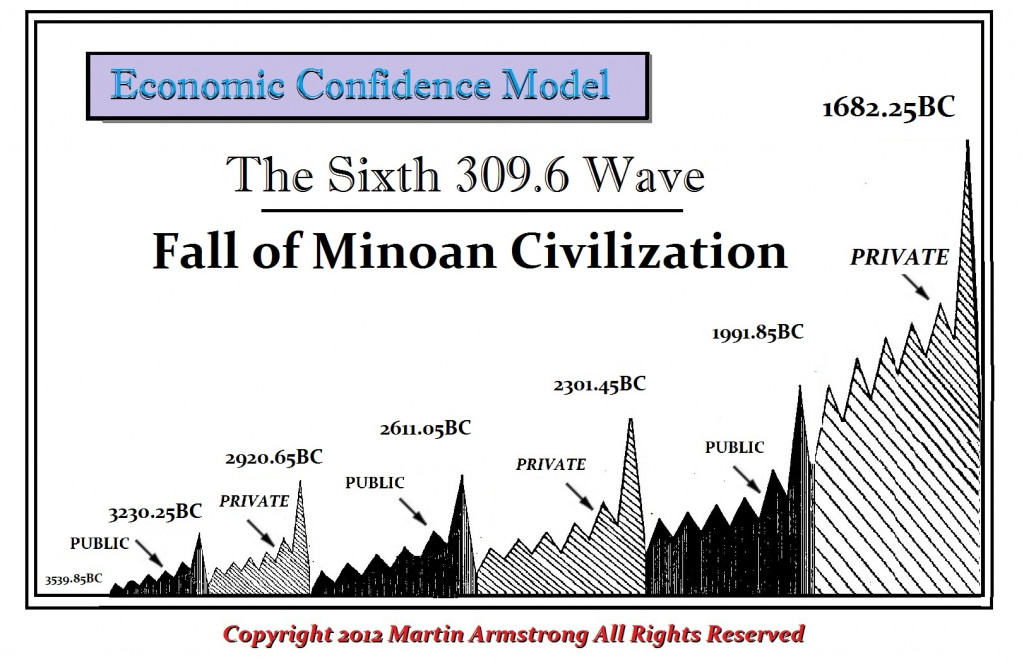
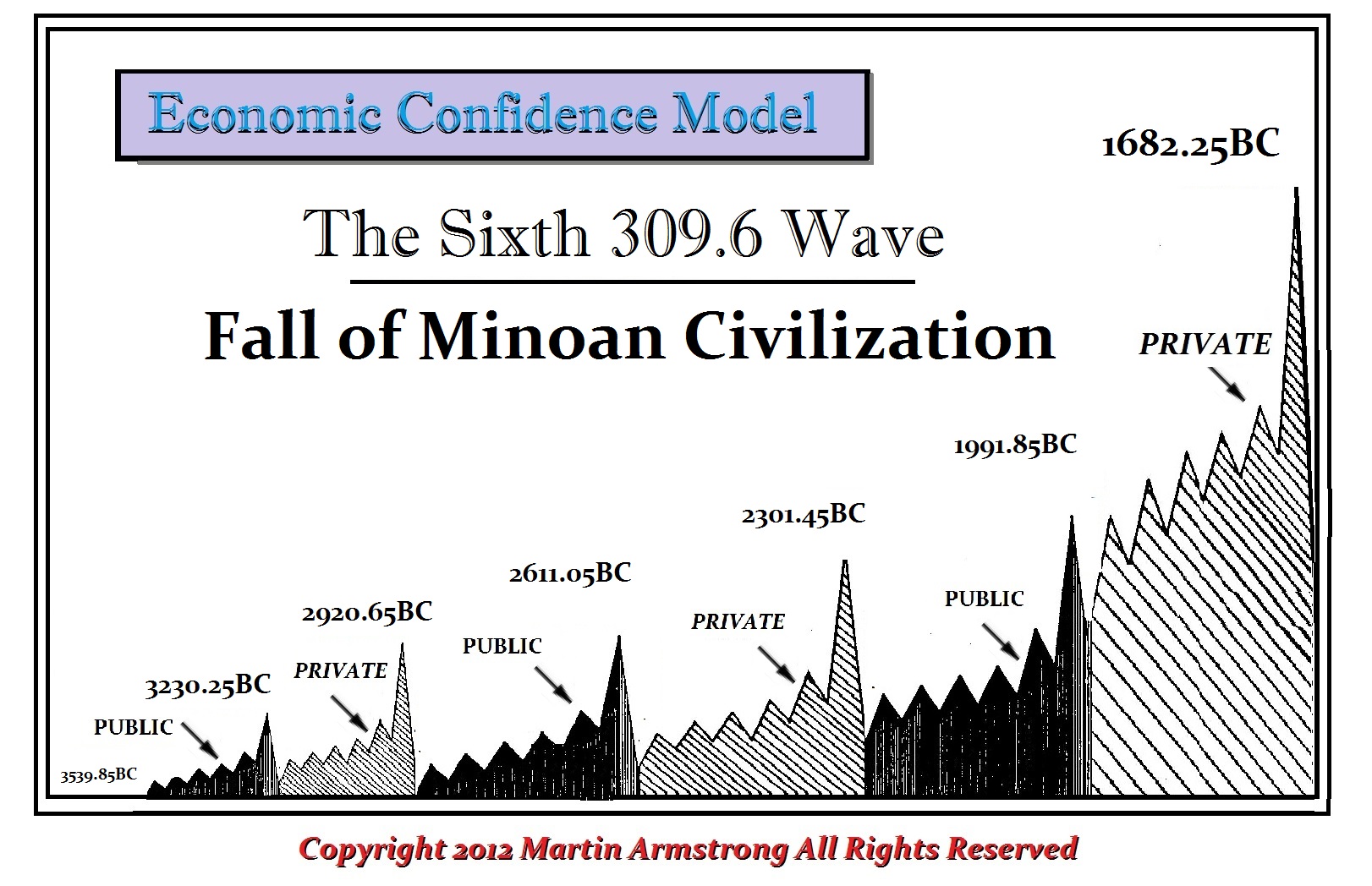
The fall of the Minoan Civilization coincided with the eruption of Thera (today it is known as Santorini). This destroyed their ships and commerce and allowed the barbarians, then the Greeks from Mycenae, to plunder their society and also that of Troy before collapsing into a Dark Age due to climate change and global cooling. What is very clear is that there must have been maps which long predated the Piri Reis Map which apparently relied on numerous maps which had previously existed.

The latest is again they assumed the ice will all melt and the seas level will rise by 25 meters. They claim that if emissions don’t start to fall until 2030 and the world does not abide by the 2015 Paris Agreement, where anyone who disagreed was not allowed to present anything or speak, then the sea level will rise by 25 meters by 2050. This all opinion and no proof or historical evidence has ever been presented to show what would happen.

 

Economics of the Green New Deal | Robert P. Murphy


Published on Jul 20, 2019

SUBSCRIBE 80K
Recorded at the Mises Institute in Auburn, Alabama, on 17 July 2019. Mises University is the world’s leading instructional program in the Austrian school of economics. Mises.org/MU1


Has the Ice in the Arctic Ever Melted Before?


QUESTION: Martin,
Been reading you for years, starting when the SDNY wrongly jailed you and basically destroyed your constitutional rights, s/b a movie… what a great service you do for human kind…hope some of it sticks..lucky for all readers we have you for now to help us face the future,”thank you” !!!
Our question concerns climate change, all the nay-sayers who will not listen to any reasonable argument against their view…The big question that gets thrown at me all the time is: “has the artic ever melted before and has it happened several times over the course of time?
Thank you for all you do,
CL

ANSWER: The North Sea Passage opened in 1817 after the Little Ice Age. From a cyclical perspective, the Arctic freezes and then opens. Before the Little Ice Age, there is evidence that Norwegian Vikings sailed as far north and west as Ellesmere Island, Skraeling Island, and Ruin Island for hunting expeditions and trading with the Inuit and people. Modern explorers attempted to find a passage during the 15th century , and it was attempted again during the 19th and 20th centuries. We have this account from 1817 which discusses how the ice has melted to allow ships to pass and therefore proves that this is cyclical and the melting of ice has nothing to do with human use of fossil fuels.

THE ARCTIC IS MELTING

“It will without doubt have come to your Lordship’s knowledge that a considerable change of climate, inexplicable at present to us, must have taken place in the Circumpolar Regions, by which the severity of the cold that has for centuries past enclosed the seas in the high northern latitudes in an impenetrable barrier of ice has been during the last two years, greatly abated….

(see additional*)

….. this affords ample proof that new sources of warmth have been opened and give us leave to hope that the Arctic Seas may at this time be more accessible than they have been for centuries past, and that discoveries may now be made in them not only interesting to the advancement of science but also to the future intercourse of mankind and the commerce of distant nations.” A request was made for the Royal Society to assemble an expedition to go and investigate.

President of the Royal Society, London, to the Admiralty, 20th November, 1817, Minutes of Council, Volume 8. pp.149-153, Royal Society, London. 20th November, 1817.(from) http://www.john-daly.com/polar/arctic.htm

Humans Occupy Less Than 3% of the Surface of the Earth


Now the save the planet crew is demanding that 50% of all landmass be void of humans. The real fact is that 95% of the world’s population lives on less than 10% of the land. Obviously, these people really do not understand math. Most of the planet’s surface is covered in water in the form of oceans. The remaining landmass on Earth amounts to approximately 29% of the surface. Of this remaining 29%, deserts of all types constitute an estimated 33% or one-third of Earth’s total landmass. That means humans occupy less than 3% of the surface of the planet.

It is just curious how these people think we even possess the capability to change the climate. Now they want laws that say we cannot occupy 50% of the landmass when we only occupy less than 3%. I’m not sure if they flunked math class.