Posted originally on Apr 26, 2025 by Martin Armstrong |
COMMENT: Martin,
Had to laugh here’s a comment about Janice Stein and Mark Carney.
As my father in law always said, “in the valley of the blind the one eyed man sees the most.”
The world is full of Academics that have no clue, too many people playing business and politics with other people’s money and lives!
“Janice Stein Endorsed Carney . Canada’s Leading, Most Respected Political Scientist and International Affairs Expert Janice Stein saying “Mark Carney is the “World’s Leading Economist” and Could very well lead the “Whole World” through the Trump Crisis, let alone Canada.” Stein isn’t just a leading voice in Canada—she’s recognized worldwide for her expertise in conflict resolution, global governance, and international relations. When someone of her global standing says this, it’s a big deal! Janice Gross Stein is Canada’s leading, most respected political scientist and international affairs expert.”
When a third of the country works for the Government, and a third is living off the Government, it sure makes it hard for the other third to vote for a Government.
Unfortunately, this Monday, Canada will witness another Liberal win, which will confirm your forecast that Canada will split!
It’s just time!
Jim M
REPLY: Carney was a key player in this Net-Zero nonsense, and he has lied about everything and acts like he is running against Trump – nobody else. I have not yet confirmed that the coup at the WEF was also in hopes of supporting Carney to claim he is not truly linked to Schwab, since he is no longer there. Trudeau resigned to avoid a NO CONFIDENCE vote, which would have led to the loss of power for the Liberals. Every step of this game is to retain power for the LEFT.
Carney is the instrument of Canada’s demise, for the LEFT will always burn down their own houses to protest against the RIGHT. Carney offers nothing that will benefit Canada, and the joke that Canada will replace the USA as the new leader of the world is laughable. Canada is highly socialistic, so the “income inequality” is lower, just like Communist Russia and China, which ultimately caused their demise. The productivity of the US compared to Canada explains the cost of the more regulations that Canada adopts, following Marx’s socialist philosophy.
United States: $76,643
Canada: $56,316 The U.S. GDP per capita is about 36% higher than Canada’s in nominal terms.
The U.S. indeed has higher inequality, so that median income disparities may be less pronounced. The U.S. generally has higher labor productivity due to greater investment in innovation and technology. The U.S. population (332 million) is nearly 9x larger than Canada’s (38 million), the US economy accounts for 25% of the entire world’s consumer spending, which is why the US is the reserve currency of the world because everyone has to sell whatever products for export to Americans – not Canadians.
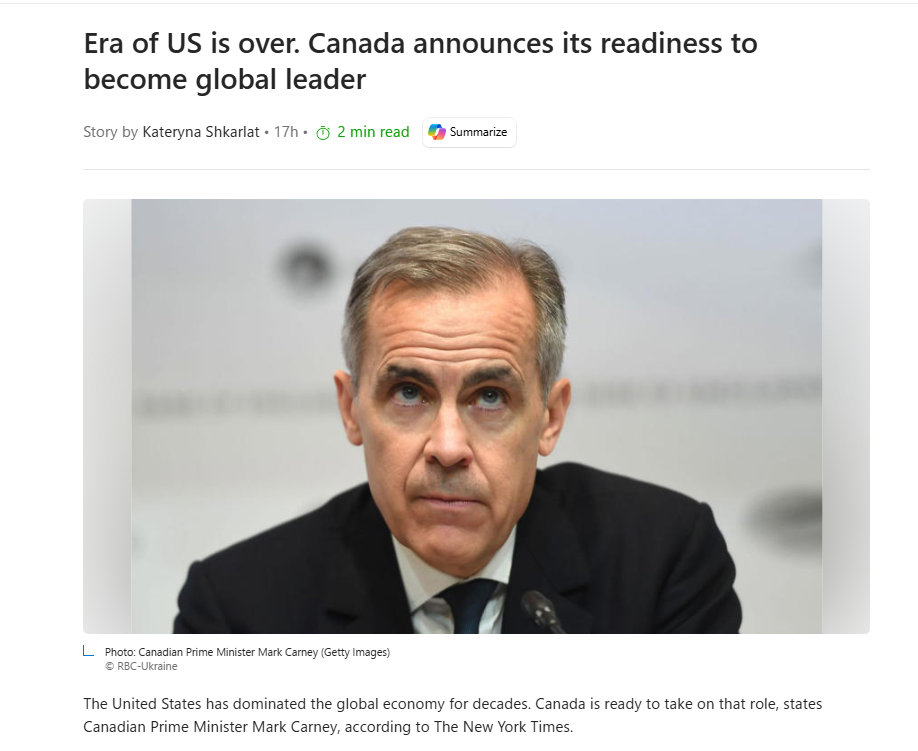
Carney’s Vision of Replacing the United States as New World Leader
There has been a coup at the World Economic Forum because these very LEFTIST views and agendas are collapsing. So, Carney wants to lead the world on a sinking ship? As one reader put it.
“It appears from here, at first glance, that the WEF is repainting its storefront in an effort to stay in business while narrowing its attacks on the global food supply chain to taking control of the water supply. Same depopulation goal, new coat of paint.”
FA in Arkansas
Military:
The US has one of the largest militaries globally, with approximately 1.3 million active-duty personnel, with 800,000 reserves, which is the highest globally at $877 billion (2023), about 3.5% of GDP.
Canada has around 68,000 active personnel and 27,000 reserves, which cost $26.5 billion (2023), roughly 1.3% of GDP.
The US military is a global powerhouse with unmatched scale and technology, while Canada’s smaller force emphasizes specialized roles, alliances, and domestic/Arctic security. Their cooperation through NATO and NORAD underscores a strategic partnership, with Canada often leveraging US capabilities for broader defense needs. Yet, Carney is claiming that Canada will now lead the world? Differences in budget and scope reflect distinct national priorities.
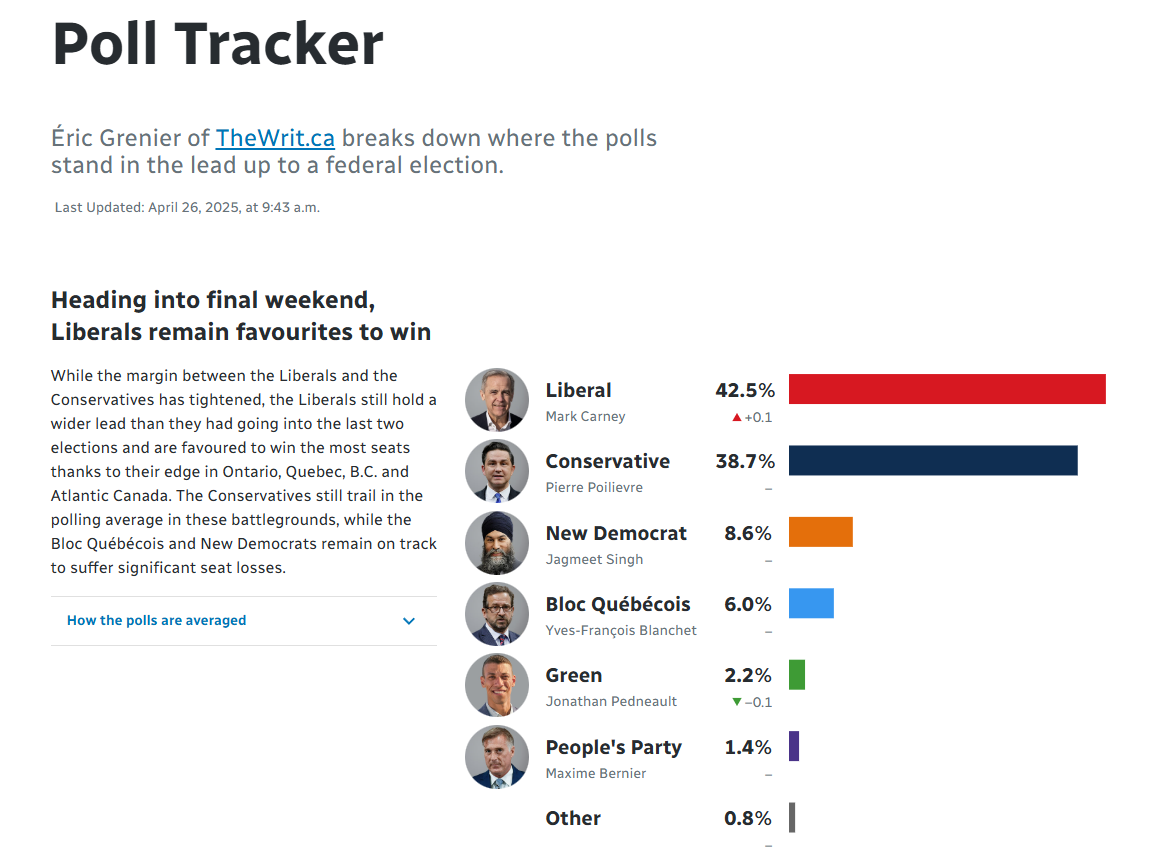
The 2025 Canadian federal election will be held on April 28 to elect members of the House of Commons to the 45th Canadian Parliament. The problem with Canada is that the Parliamentary System does not allow the people to vote for who should lead the country. Carney would never become president in the United States, where 42% would be the loser. The problem is that governments are cobbled together with coalitions, and this is what prevents any true economic progress for the future.
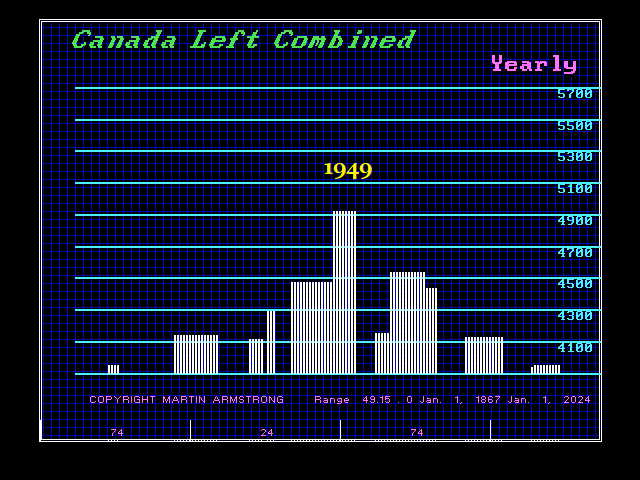
The LEFT has been declining since its high in 1949, necessitating coalition governments to remain relevant. Trudeau only won 32.62% of the vote in 2021. Carney should beat that since the 2021 election was most likely the bottom of a 72-year cycle. Additionally, the higher percentage of the workforce employed by the government in Canada naturally gives them an edge over conservatives. The rate of the US workforce employed in government is 13.8%, compared to 18.6% in Canada. This is what has lowered the Marxist view of “income equality” in Canada vs the USA.
We will do an Update on the threat of Canada Splitting soon.
Posted originally on Apr 26, 2025 by Martin Armstrong
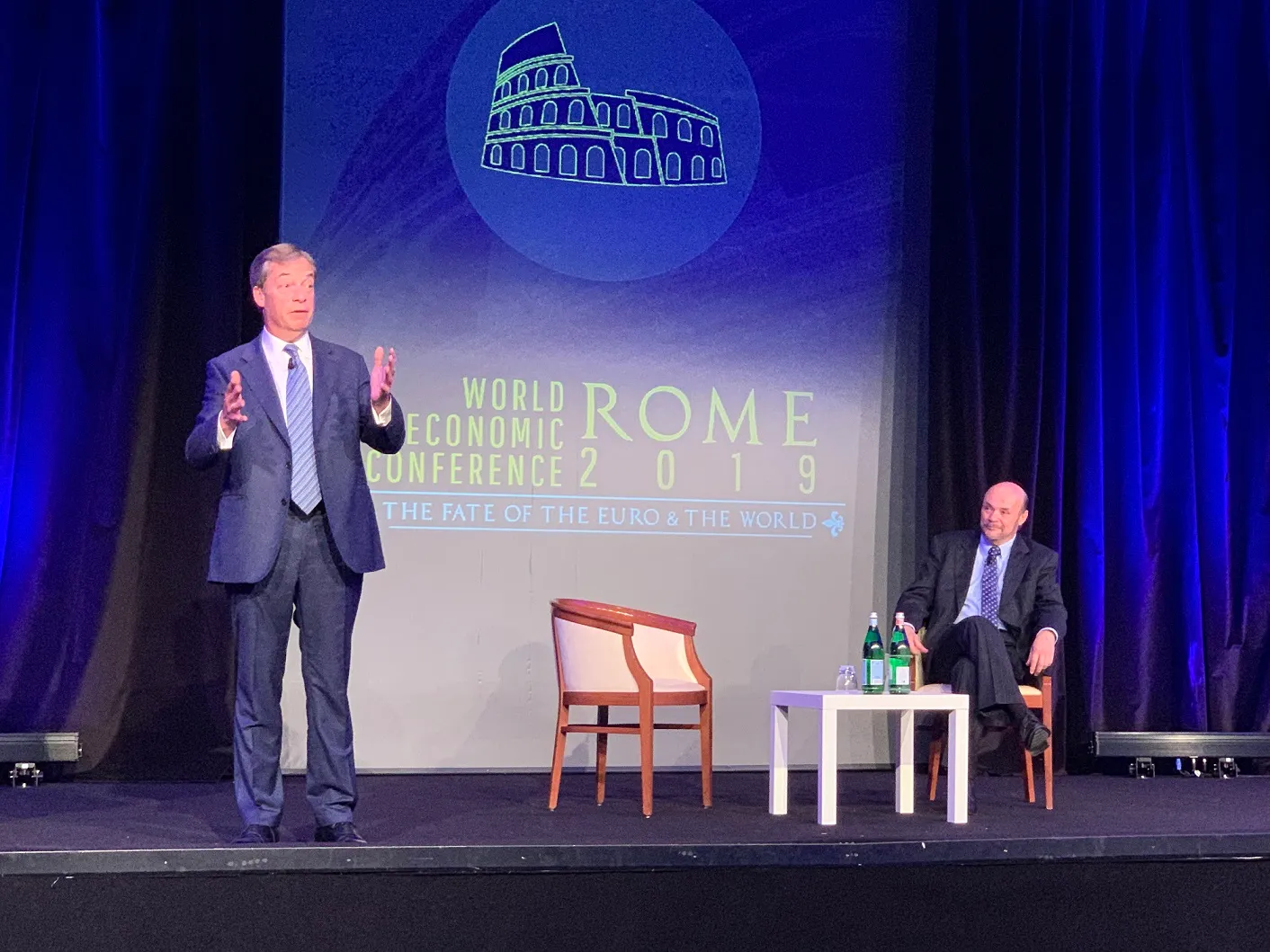
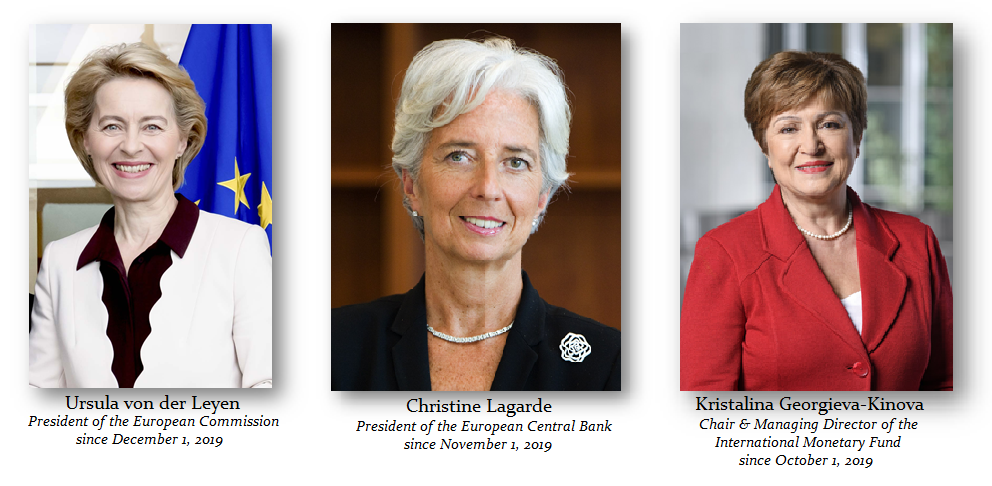
COMMENT: Nigel Farage said that your WEC events were the “alternative to Davos,” but you also don’t gouge people as Schwab does. He charges between 500,000 and 700,000 CHF to be a member and 27,000 CHF to attend Davos. Your forecasts come true, theirs never do. Our firm did not renew for 2025 after Trump won the election. Our board follows your projections, not those of the World Economic Forum (WEF). You’re correct, you went there only for political connections, not for the forecasts. Their failure to achieve Agenda 2030 is apparent. Schwab’s board members have been placed in high positions, from the ECB and the EU, as well as with the gullible like Trudeau and Carney in Canada.
Nigel’s Reform Party is now also in first place. This is because he shares your philosophy, not Schwab’s.
You are the only real forecaster and the genuine alternative to Davos.
DH
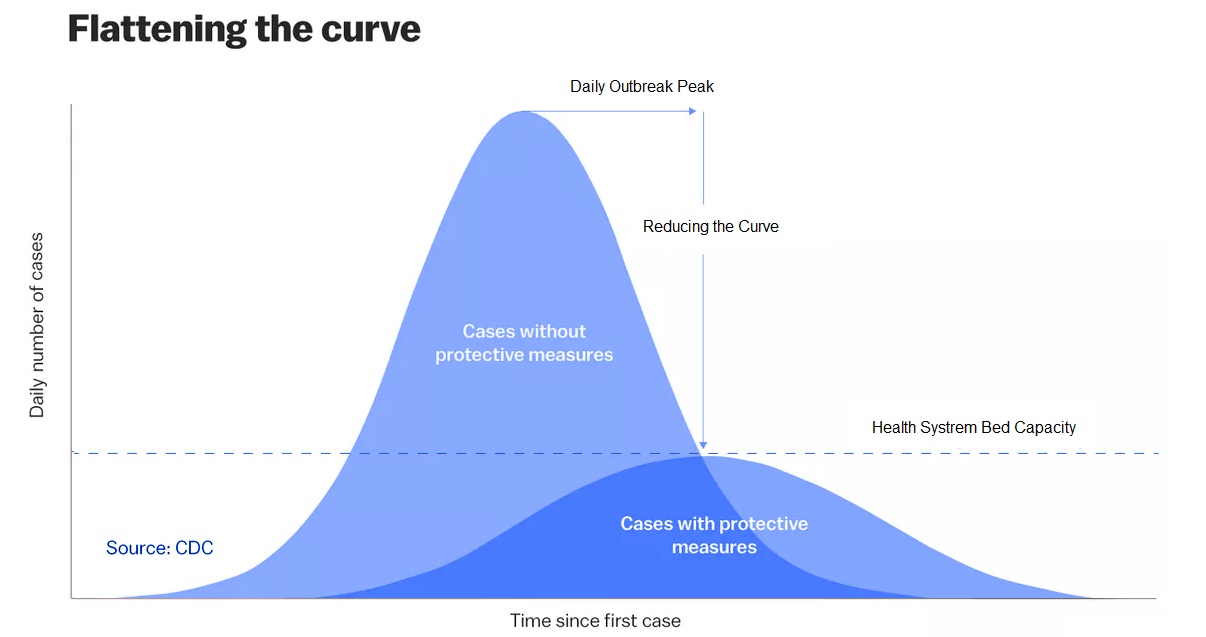
REPLY: Thank you. In all honesty, Schwab was never right because he is an academic caught up in the Marxist theory that the government has the power to control and alter the direction of the economy and society. Nobody has ever been able to change the business cycle, let alone “flatten the curve” of a virus.
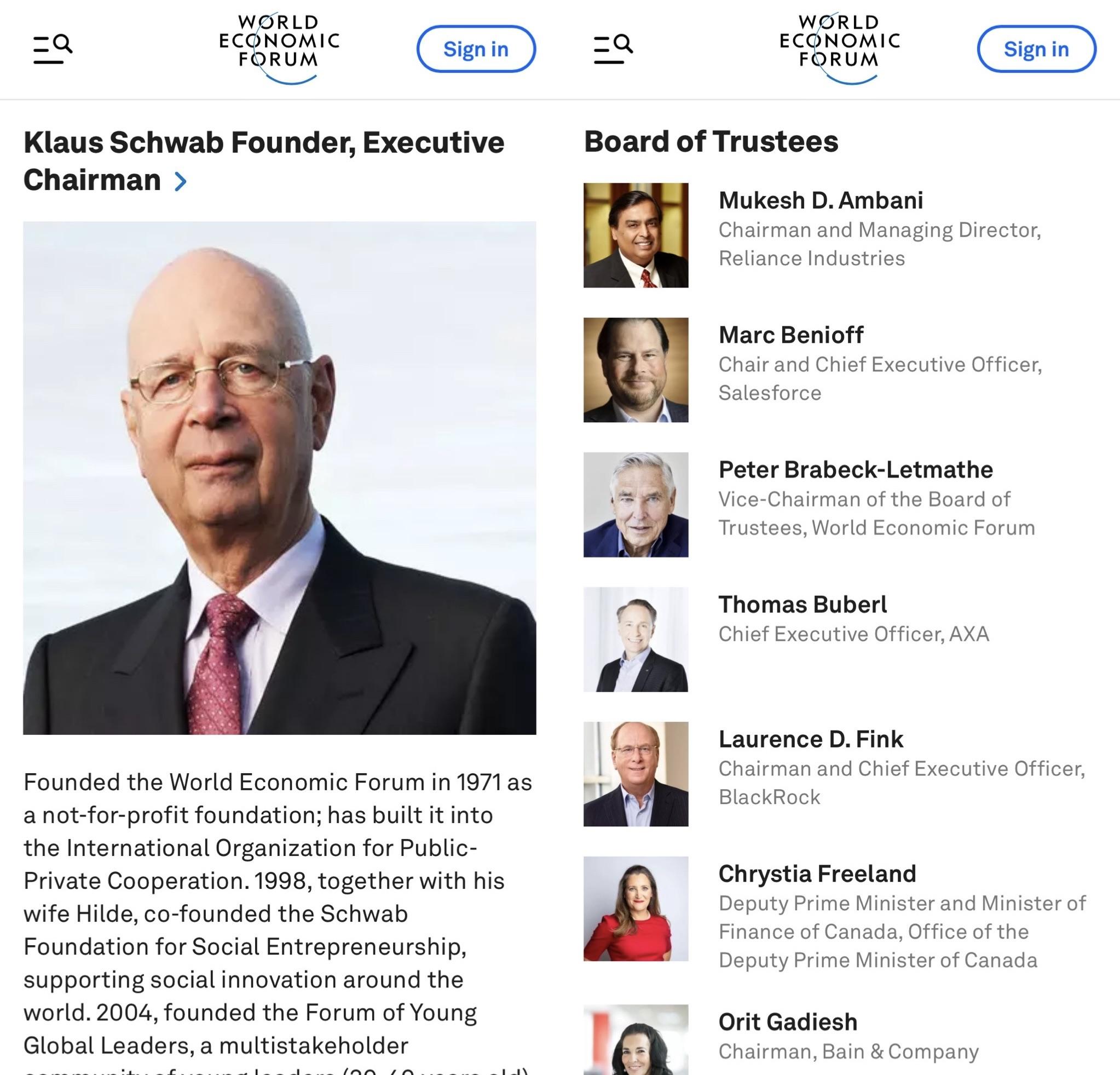
He stuffed political positions with his star pupils and bragged about infiltrating so many cabinets, especially those of the Liberal Party in Canada and in New Zealand.
The lockdown destroyed the economy because these people only look at a single issue and cannot understand that (1) we are all connected, and (2) the lockdown failed to reverse the climate change nonsense, which was the fundamental objective, nor did it stop the virus that comes back seasonally. The WEF was proud of the lockdowns.
What they just did to Schwab is consistent throughout history: the LEFT is always the most violent. They always view themselves as the victims of the RIGHT because they work for their money and get ahead. The LEFT revolutions of 1848 and the early 20th century have killed hundreds of millions. Nothing will ever change in this regard.
Posted originally on Apr 25, 2025 by Martin Armstrong
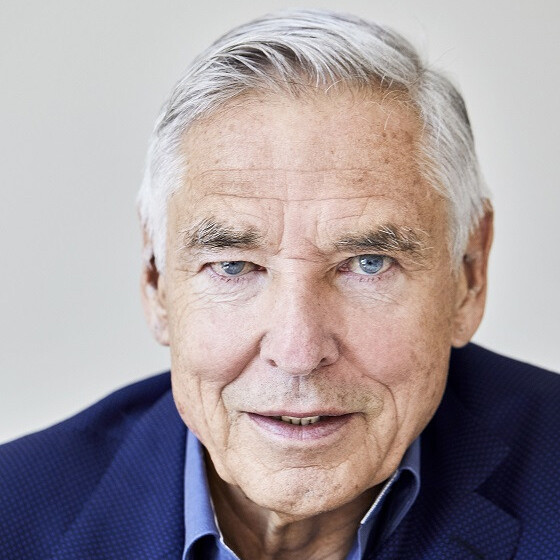
Peter Brabeck-Letmathe has replaced Klaus Schwab as the acting CEO of the World Economic Forum in what appears to be a stage coup. The 80-year-old Austrian businessman spent his career working for Nestle, moving through the ranks from 1968 to 1997 when he was appointed CEO, a position he held until 2008. He remained at Nestle as a chairman until 2017, when he was appointed as Chairman Emeritus.
Brabeck-Letmathe held board memberships with Credit Suisse, Roche, Exxon Mobil, L’Oréal, and Salt Mobile SA. He was the founder and chairman of the 2030 Water Resources Group (WRG), a public-private partnership within the World Bank.
The 2030 Water Resources Group (2030 WRG) is a global multi-stakeholder partnership that brings together governments, the private sector, and civil society to address the growing challenges of water scarcity and water management worldwide. This program was first launched at the WEF’s Davos in 2008, and naturally, Nestle is a major partner as well. Demand for water will outweigh supply by 2030, the group insists, and its goal is to manage the world’s water supply.
Nestle extracts free-flowing water, bottles it up in plastic containers, and marks it up for a profit. The company has acquired water extraction rights across North America, permitting it to extract large volumes of water from public lands, springs, and aquifers, often siphoning far more than the law permits. The company effectively found a way to privatize access to water. Many communities have gone without water due to the company’s control over the water supply. The company has no concern for the environment or human rights, and this is merely the tip of the iceberg in terms of their corrupt practices.
What better way to control the masses than to control the water supply? Remember, the World Economic Forum has strongly advocated banning independent farming and gardening. Everything they ban is under the premise of protecting the climate, but as you can see, the new WEF CEO has never cared about the environment.
The WEF partnered with the United Nations to encourage “global policy coherence” and increased investment to manage the world’s water supply. It is no conspiracy – globalist entities are scheming ways to manage our water usage. These unelected entities believe they can deem what constitutes essential and non-essential water usage. Brabeck-Letmathe believes 98.5% of freshwater used for farming and agriculture should be classified as an economic good that is priced according to reduce waste. Controlling the water supply will permit them to also control the food supply.
Peter Brabeck-Letmathe has spent a lifetime studying methods for privatizing water. In the video above, Brabeck-Letmathe said that Klaus Schwab asked him why he wanted to focus on water over CO2 and the Earth’s warming. “I think our real problem is more urgent—it’s on the water side.” He later noted that governments must first believe that they have a water crisis and then partner with the private sector to solve this new problem. Agenda 2030 did not die with Schwab’s departure. There is a new leader at the helm and a new focus to usurp ultimate control over the global population.
There has been a Coup at the WEF for nefarious Reasons,, which we will discuss separately on the weekend
Posted originally on Apr 24, 2025 by Martin Armstrong
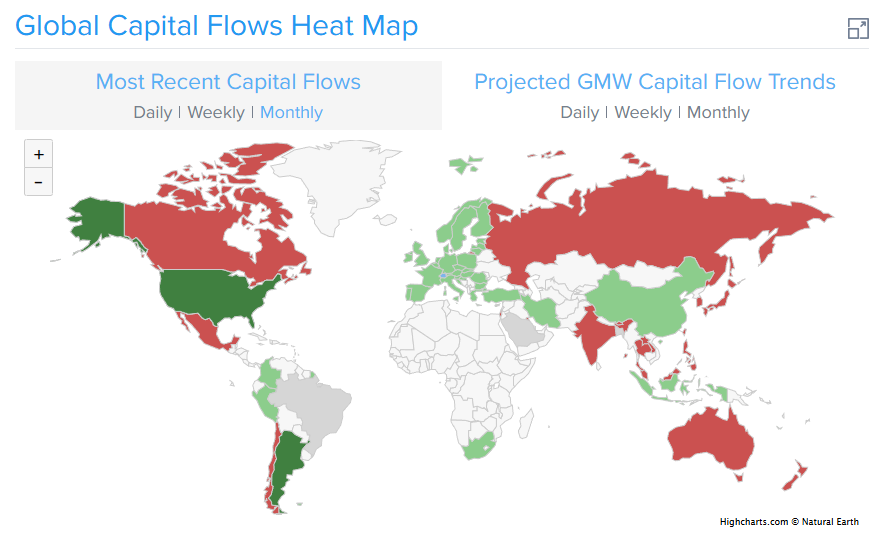
QUESTION: A recent analysis by Allianz economists claimed that, ordinarily, when yields on Treasuries rise, the U.S. dollar strengthens as foreign capital pursues those higher yields. However, the dollar weakened as yields rose. They said that in this instance, it “suggests major holders were not only selling Treasuries but also converting the proceeds into currencies – possibly reallocating to European markets.”
This does not seem to be correct. It looks like an opinion. Could you comment on this, please?
Thank You
Greg
ANSWER: I think a lot of people fail to appreciate the stark difference between the US markets and Europe. The NYSE is worth MORE in total capitalization than all of Europe COMBINED! The US consumer spending on a bad day is still 25% of global consumer spending. Europe accounts for $1.20 out of every $10 spent. Europe CANNOT be a reservoir for big capital. It is so socialistic, it is a joke. We invented capital flow analysis, and we have the actual data.
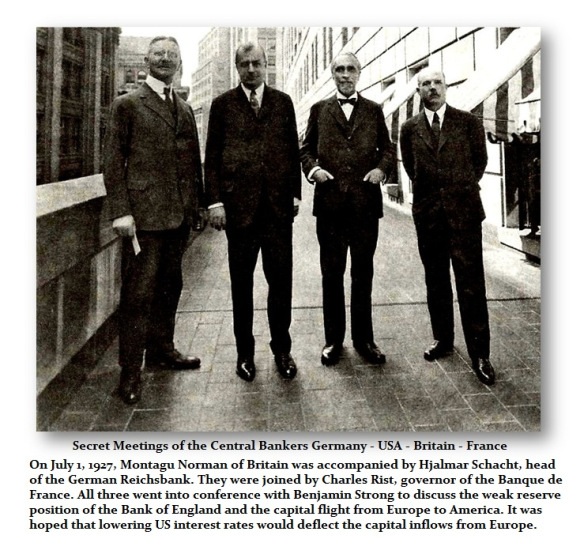
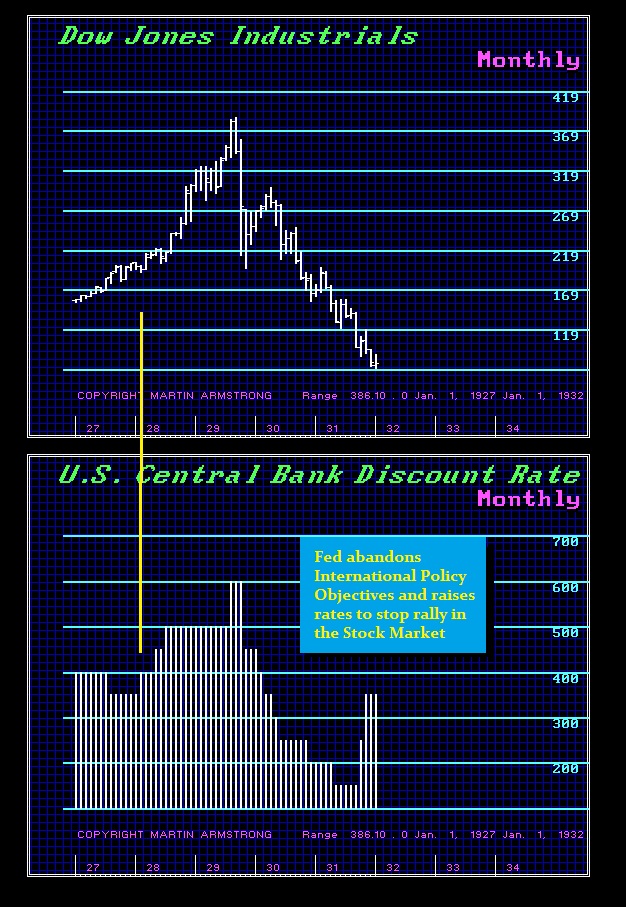
This idea is not original about interest rates and capital flows. This is the typical academic theory they still teach in schools today. In 1927, that was the FIRST G4 meeting where Britain, France, and Germany petitioned the NY Fed to lower interest rates in hopes that that would send capital back to Europe. When they did that, it CONFIRMED that there was a debt crisis, and even more money poured into the USA.
The Fed cut rates in the US to help Europe, and the markets continued to rise as capital flows into the US intensified. The money was pouring into the US equities, and the Dow more than doubled as the Federal Reserve raised rates from 3.5% to 6%.
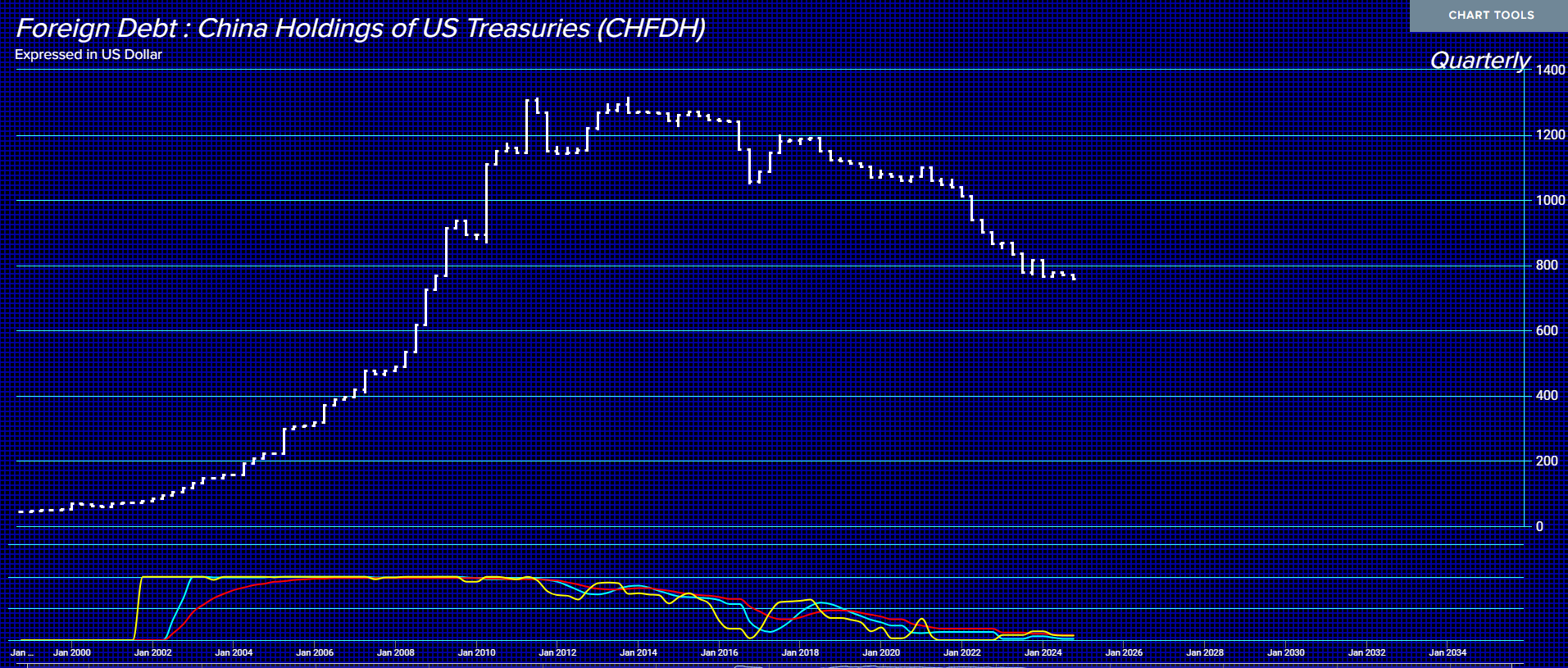
China has been reducing its holdings of US debt ever since the 2014 Ukrainian War began and the Biden Administration threatened China with sanctions if it helped Russia. This is what I have spoken about the BRICS is all about: geopolitical theater, not economics. China saw removing Russia from SWIFT as using the world financial system as a geopolitical tool. The Biden Administration was run by the Neocons, who do not care about the people or the economy, only their myopic desire to destroy Russia.
This is why FOX News or any mainstream news organization would NEVER invite me because I rain on their parade. This is all about feeding people the narrative they agree with. This is never about news.
BLOOMBERG
Bloomberg has crossed to the dark side of propaganda; They are more concerned about hating Trump than they are about reporting just the facts, ma’am. They reported:
“The rotation by investors out of American assets will go on for years if President Donald Trump persists with his global trade war.”
“The Trump administration has arguably opened the door for the country’s financial dominance to be challenged, with the dollar and Treasury bonds losing appeal in what may be a dire shift of fortunes for America. US equities also have been underperforming global peers this year amid fear that Trump’s strategy of tariff chicken will damage growth and stoke inflation.”
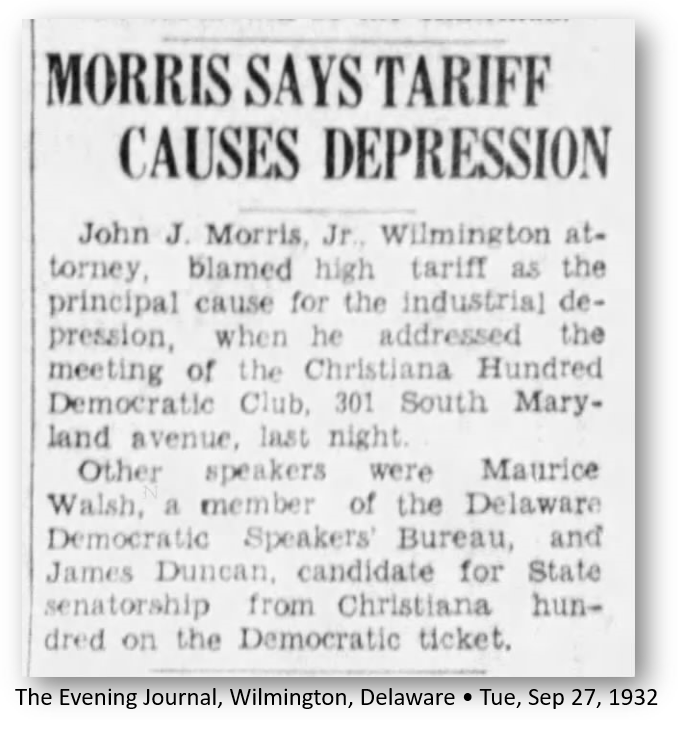
This is all based on the Democrats’ propaganda during the 1932 presidential election. As I have said, there is no serious economist I have ever heard blame the Great Depression on the tariffs, which did not come into effect until June 1930, and they were a response to Europeans raising taxes 33 times after World War I.
By the way, Japan and China have also been dumping European Debt. With Europe pushing for World War III, you have to be insane to buy European debt. European shares hold the risk of capital controls, and you will not get your money out when the first bullet is fired.
So, people are selling US shares and debt and moving to Europe as a safe haven? They must be the same people who are still driving alone in their car with a mask on to feel safe.
The fragmentation of Canada is bubbling beneath the surface, as we see in the United States as well as in Europe. There is a huge divide between LEFT and RIGHT politics, and never since the late 19th Century to the 1920 period has there ever been such a stark political divide.
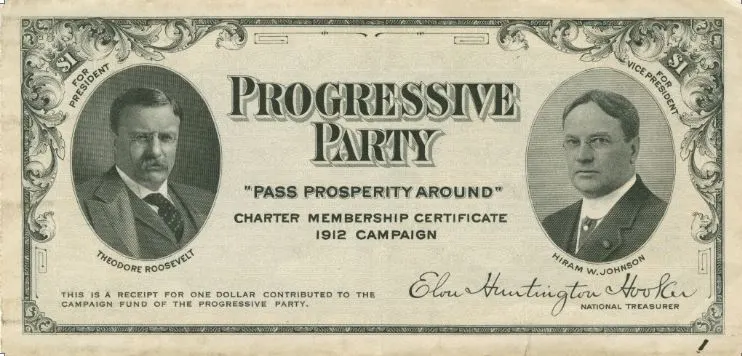
There was such a rise in Progressive Socialism that Teddy Roosevelt abandoned the Republican Party, splitting off to create the Progressive Party, also known as the Bull Moose Party, in 1912 following a split within the Republican Party.
There was an ideological split with President William Howard Taft, and these ideas led to the Income Tax in 1913. Roosevelt, a progressive Republican, grew disillusioned with Taft’s conservative policies, such as his support for the Payne-Aldrich Tariff (which raised rates and angered progressives) and his handling of the Ballinger-Pinchot Affair (a dispute over conservation that portrayed Taft as anti-environmental). Roosevelt believed Taft had abandoned progressive reforms
Roosevelt sought the Republican presidential nomination in 1912 but lost to Taft at a contentious convention. Alleging corruption and delegate theft, Roosevelt and his supporters walked out, forming the Progressive Party to continue his Marxist-style agenda. His Progressive Platform was called the “New Nationalism” platform, advocating for:
Strong federal regulation of corporations and monopolies.
Women’s suffrage.
Workers’ rights (minimum wage, workers’ compensation).
Direct election of senators.
Primary elections to reduce political corruption, with candidates selected as in Parliamentary systems.
Social welfare programs (e.g., pensions, child labor laws).
The party aimed to unify reformers and address growing public demand for economic fairness and government accountability during the Progressive Era. It was launched in August 1912 at the Chicago convention, where Roosevelt was nominated for president. The split in Republican votes between Roosevelt (27%) and Taft (23%) handed victory to Democrat Woodrow Wilson, who signed the income tax into law in 1913. Despite losing, the Progressive Party’s ideas influenced later reforms, such as the New Deal and Progressive Era amendments (e.g., direct Senate elections, income tax).
The party dissolved by 1916, but its platform left a lasting mark on U.S. progressive politics. Roosevelt’s campaign highlighted the power of third-party movements to shift national discourse, even in defeat.
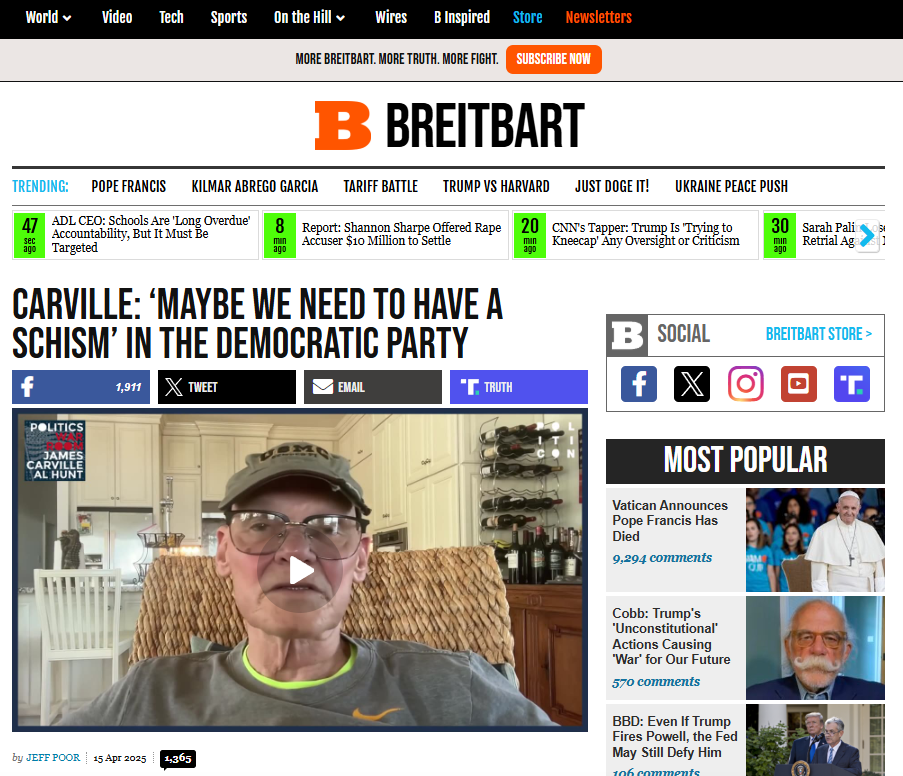
We have reached the critical 112-year half-cycle of FAR-LEFT Progressiveness. It is going crazy everywhere. Now, the famous Democratic Advisor James Carville has come out and said the Democratic Party should split. They lost as Teddy Roosevelt lost, and they are taking the Democratic Party with them. We see the same in Canada with Carney. Europe has also gone extreme to the left, censoring free speech to maintain its ideas.
Throughout History – it is ALWAYS the Left that Destroys Civilization
Posted originally on Apr 15, 2025 by Martin Armstrong
The United States has about 330 million people, and one in every $3 spent in world trade is by American Consumers. Europe has 450 million people, but it still clings to Marxism, is highly regulated, and is very anti-entrepreneurial. Trump fails to grasp here that trade wars will NOT even the score. The global consumer market seems to be ignored. As I have explained, the Current Account, which people call the trade account, also includes all interest and dividends on stocks, bonds, and investments. In theory, if China bought 100% of the US national debt, then the perceived trade deficit from interest of $1 trillion would flow to China, and this has nothing to do with jobs or manufacturing anything.
Let’s clarify trade. The United States has the largest economy in the world, so it’s the top contributor to global consumer spending. China would be next, followed by countries like Japan, Germany, the UK, India, and so on. Note that China is already the #2 consumer-based economy. Europe is far too Marxist, and it still clings to the old theories of Mercantilism. The average German has less net wealth than an Italian, yet they are the biggest economy.
In recent years, the global GDP has been around $100 trillion. Depending on the economy, consumer spending typically makes up about 60-70% of a country’s GDP. So, if we take 65% of $100 trillion, that’s about $65 trillion in global consumer spending annually in theory. Now, breaking this down by country. The US GDP is around $25 trillion. If US consumer spending is about 68% of GDP, that would be roughly $17 trillion. Therefore, the US share would be 17/65, approximately 26%. That means we have a US consumption-driven economy.
China’s GDP is around $18 trillion. However, consumer spending as a percentage of GDP is lower, maybe around 40%, because their economy is more investment—and export-driven. So 40% of $18 trillion is $7.2 trillion. That would be about 11% of the global total ($7.2T / $65T).
Let’s compare this to Japan’s GDP, which is about $4.9 trillion. Consumer spending there is higher as a percentage, maybe around 55%, so $2.7 trillion. That’s roughly 4.15% globally.
Germany’s GDP is around $4.2 trillion. With consumer spending at around 50% of GDP, that’s $2.1 trillion, so 3.2% globally.
India’s GDP is approximately $3.4 trillion. Consumer spending accounts for a larger part, maybe 60%, so the total is $2.04 trillion, which is about 3.14% of the global total.
The UK’s GDP is about $3.1 trillion. Consumer spending at 60% would be $1.86 trillion, so around 2.86%.
France’s GDP is $2.9 trillion. Consumer spending at 55% gives $1.6 trillion, about 2.46%.
Brazil’s GDP is $2.0 trillion. If consumer spending is 60%, that’s $1.2 trillion, so 1.85%.
Italy’s GDP is $2.1 trillion. Consumer spending at 60% would be $1.26 trillion, around 1.94%.
Canada’s GDP is $2.0 trillion. Consumer spending at 57% gives $1.14 trillion, which is 1.75%.
South Korea’s GDP is $1.7 trillion. Consumer spending at 50% is $0.85 trillion, so 1.3%.
Russia’s GDP is around $1.8 trillion. If consumer spending is 50%, that’s $0.9 trillion, about 1.38%.
Australia’s GDP is $1.6 trillion. Consumer spending at 55% would be $0.88 trillion, 1.35%.
Consequently, the total for these top countries is around 59.65%, leaving about 40.35% for the rest of the world. This is all based on rough estimates. Then we also have nominal GDP vs. PPP (Purchasing Power Parity). However, consumer spending in nominal terms is usually what’s used for such global comparisons, further complicating our exercise.
Another consideration: The figures I used for consumer spending as a percentage of GDP might not be accurate for each country. For example, China’s consumer spending as a percentage of GDP has been increasing but was historically lower. According to the World Bank, in 2022, China’s household final consumption expenditure was about 38% of GDP. The US was around 68%, Japan about 55%, Germany 52%, India was around 59%, UK 63%, France 54%, Brazil 64%, Italy 61%, Canada 57%, South Korea 48%. So my initial estimates were somewhat close but may need adjustment.
US: 25T GDP * 68% = 17T
China: 18T * 38% = 6.84T
Japan: 4.9T * 55% = 2.695T
Germany: 4.2T * 52% = 2.184T
India: 3.4T * 59% = 2.006T
UK: 3.1T * 63% = 1.953T
France: 2.9T * 54% = 1.566T
Brazil: 2.0T * 64% = 1.28T
Italy: 2.1T * 61% = 1.281T
Canada: 2.0T * 57% = 1.14T
South Korea: 1.7T * 48% = 0.816T
Russia: 1.8T * 52% = 0.936T (assuming 52%)
Australia: 1.6T * 55% = 0.88T
Spain: 1.4T * 58% = 0.812T
So total consumer spending from these 14 countries is approximately $41.389 trillion out of about $65 trillion globally.
Now, converting each country’s consumer spending to a percentage of global:
US: 17 / 65 = 26.15%
China: 6.84 / 65 ≈ 10.52%
Japan: 2.695 / 65 ≈ 4.15%
Germany: 2.184 / 65 ≈ 3.36%
India: 2.006 / 65 ≈ 3.09%
UK: 1.953 / 65 ≈ 3.00%
France: 1.566 / 65 ≈ 2.41%
Brazil: 1.28 / 65 ≈ 1.97%
Italy: 1.281 / 65 ≈ 1.97%
Canada: 1.14 / 65 ≈ 1.75%
South Korea: 0.816 / 65 ≈ 1.26%
Russia: 0.936 / 65 ≈ 1.44%
Australia: 0.88 / 65 ≈ 1.35%
Spain: 0.812 / 65 ≈ 1.25%
Others: 36.3%
Please remember that these percentages are estimates of global consumer spending by country based on GDP and consumption patterns. The United States is the largest consumer-based economy in the world, and about 26% of total world spending involves the American consumer. China is only 10.5%, and Japan is at 4.1%. Europe comes in at around 12%.
In summary, China is actively trying to build a more consumer-based economy, with policies and trends supporting this shift. However, structural and demographic challenges might slow this transition into 2028. The progress is evident, but it’s a work in progress. After 2032, they hold the potential to surpass the United States as the financial capital of the world. The problem in the United States is that the Democrats keep trying to oppress the economy like Europe, imposing socialistic goals that are not economically efficient.
Key Evidence of China’s Transition:
Rising Consumption Share of GDP:
Household consumption contributed 53% of GDP in 2023, up from ~35% in 2010. While still lower than the U.S. (~68-70%), this marks significant growth.
Services and high-tech industries are expanding, reflecting demand for healthcare, education, and entertainment.
Policy Shifts:
“Dual Circulation” Strategy:
Emphasizes domestic consumption (internal circulation) alongside international trade, reducing reliance on exports.
Social Reforms:
Efforts to strengthen social safety nets (pensions, healthcare) aim to lower household savings rates, freeing income for spending.
Urbanization and Middle-Class Growth:
Over 60% of China’s population now lives in cities, fostering a consumer class with higher disposable income.
E-Commerce and Digital Economy:
China leads globally in e-commerce (e.g., Alibaba, JD.com) and digital payments, facilitating consumer spending. The digital economy accounts for ~40% of GDP.
Challenges to a Consumer-Driven Model:
Structural Imbalances:
Investment and exports still dominate (e.g., state-led infrastructure, real estate). Transition requires rebalancing toward the private sector and services.
Household debt
has risen to ~62% of GDP (2023), potentially constraining spending.
Demographic and Social Factors:
Aging Population: By 2035, 30% of citizens will be over 60, likely increasing savings and reducing consumption.
Income Inequality: Rural-urban gaps and uneven wealth distribution limit broad-based consumption growth.
Geopolitical and Economic Risks:
Trade tensions and global demand volatility (e.g., post-COVID, U.S.-China decoupling) pressure China to prioritize domestic demand.
Real estate sector
Slowdowns could dampen consumer confidence.
China is deliberately building a consumer-based economy through policy reforms, urbanization, and digital innovation, rejecting the European mercantilist economic philosophy. While progress is evident, structural hurdles, such as reliance on investment aging demographics, mean the transition will be gradual but ongoing. The government’s success in addressing these challenges will determine the pace and sustainability of this shift. China’s economy remains a hybrid model, blending consumption growth with traditional drivers like state investment.
The current account is a key component of a country’s balance of payments, recording international transactions in goods, services, income, and transfers. It consists of four main components:
Trade in Goods (Visible Trade):
Exports and imports of tangible products (e.g., machinery, vehicles, electronics).
The balance of trade in goods is often referred to as the “merchandise trade balance.”
Trade in Services (Invisible Trade):
Exports and imports of intangible services (e.g., tourism, financial services, education, consulting, transportation).
Combined with trade in goods, this forms the trade balance (goods and services).
Primary Income (Income Flows):
Cross-border income from investments and employment:
Investment income: Dividends, interest, profits from foreign investments (e.g., dividends from overseas stocks).
Compensation of employees: Wages, salaries, or benefits earned by workers in a foreign country (e.g., remittances from expatriates).
Secondary Income (Current Transfers):
One-way transfers where no goods, services, or assets are exchanged in return:
Remittances: Money sent by migrants to their home country.
Foreign aid/grants: Government transfers (e.g., disaster relief, development aid).
Pensions, gifts, or donations: Transfers between individuals or organizations.
A Trade War based on just the gross of the Current Account does NOT reflect our trade deficit or surplus.
Foreign investors overall own roughly 10-20% of Manhattan’s high-end residential properties (e.g., condos), with Europeans constituting a significant but minority share of this group. For example, if Europeans account for 30-40% of foreign-owned properties, their stake might be 3-8% of Manhattan’s luxury residential market. While exact figures are elusive, Europeans likely own 3-7% of Manhattan’s total real estate, with higher concentrations in luxury residential and prime commercial sectors. This is only an estimate and not definitive. Any income, such as rents, on that property will flow out through the current account and will appear as a trade deficit when it has NOTHING to do with trade.
As of 2023, approximately 23-24% of the total U.S. national debt is held by foreign entities. This calculation is based on foreign holdings of around $7.4 trillion out of $31.4 trillion at the time. Therefore, of about $1 trillion in interest expenditures. Thus, about $230+ billion is flowing out through the current account that has nothing to do with trade. The major holders of US national debt include Japan, China, and the United Kingdom.
Understanding these components is now CRITICAL in the middle of a trade war. The sale of US debt will go through the capital account, but it will reduce the interest paid to foreigners that go through the current account, creating the illusion of a trade deficit. I disagree with Trump’s formulas, and the risk of a permanent trade war with China is now assured unless he gets on a private phone call. You cannot make public demands against China for then they cannot back down based on their culture.
Posted originally on Apr 14, 2025 by Martin Armstrong
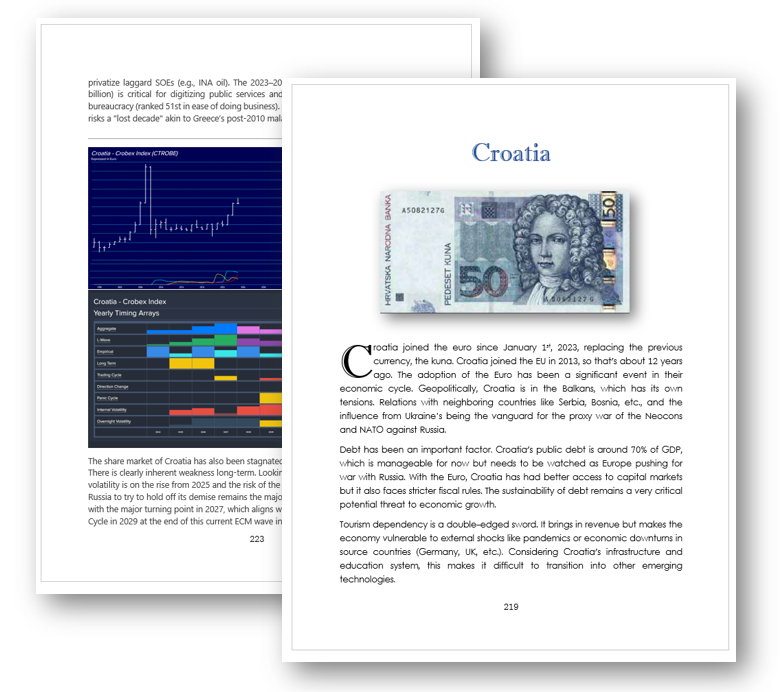
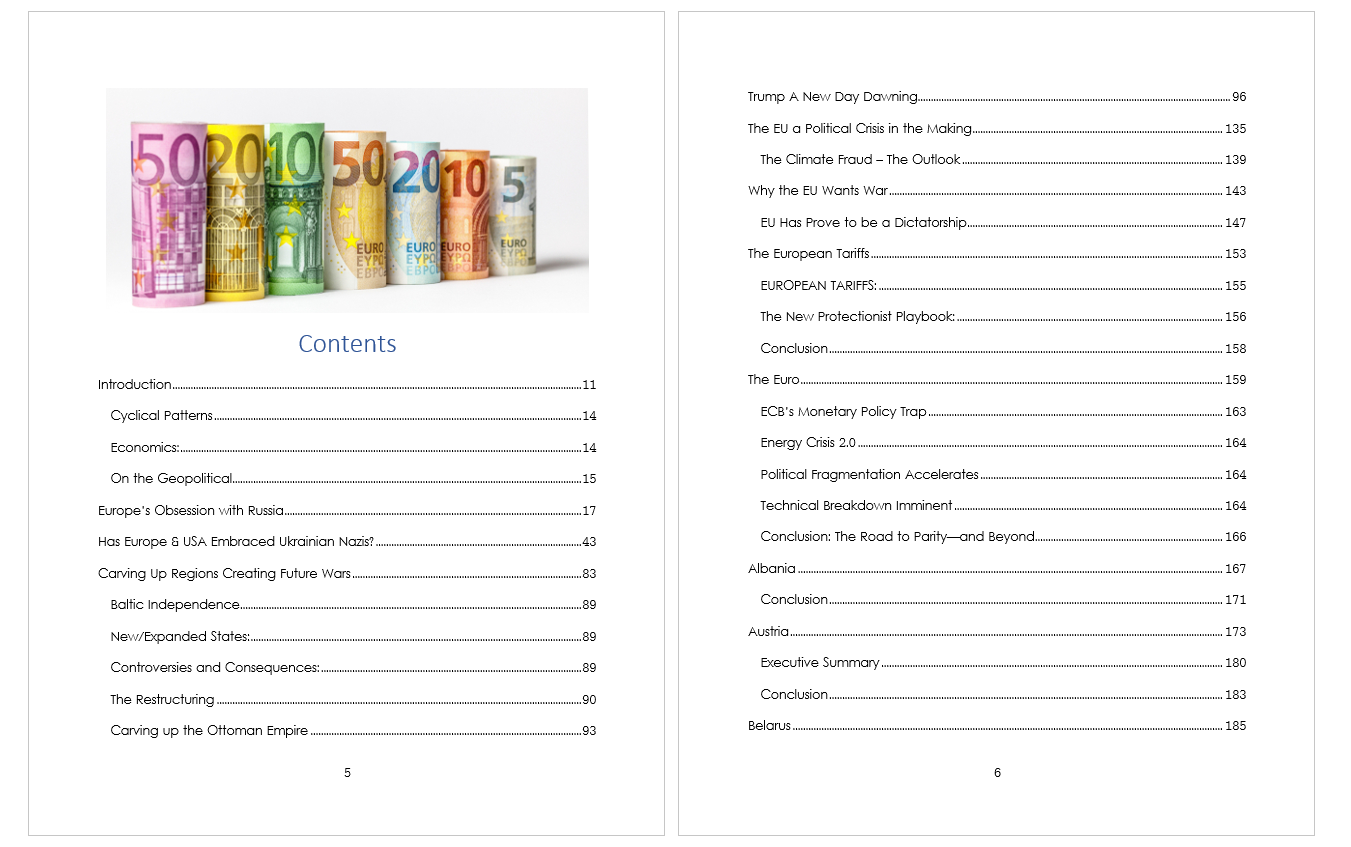
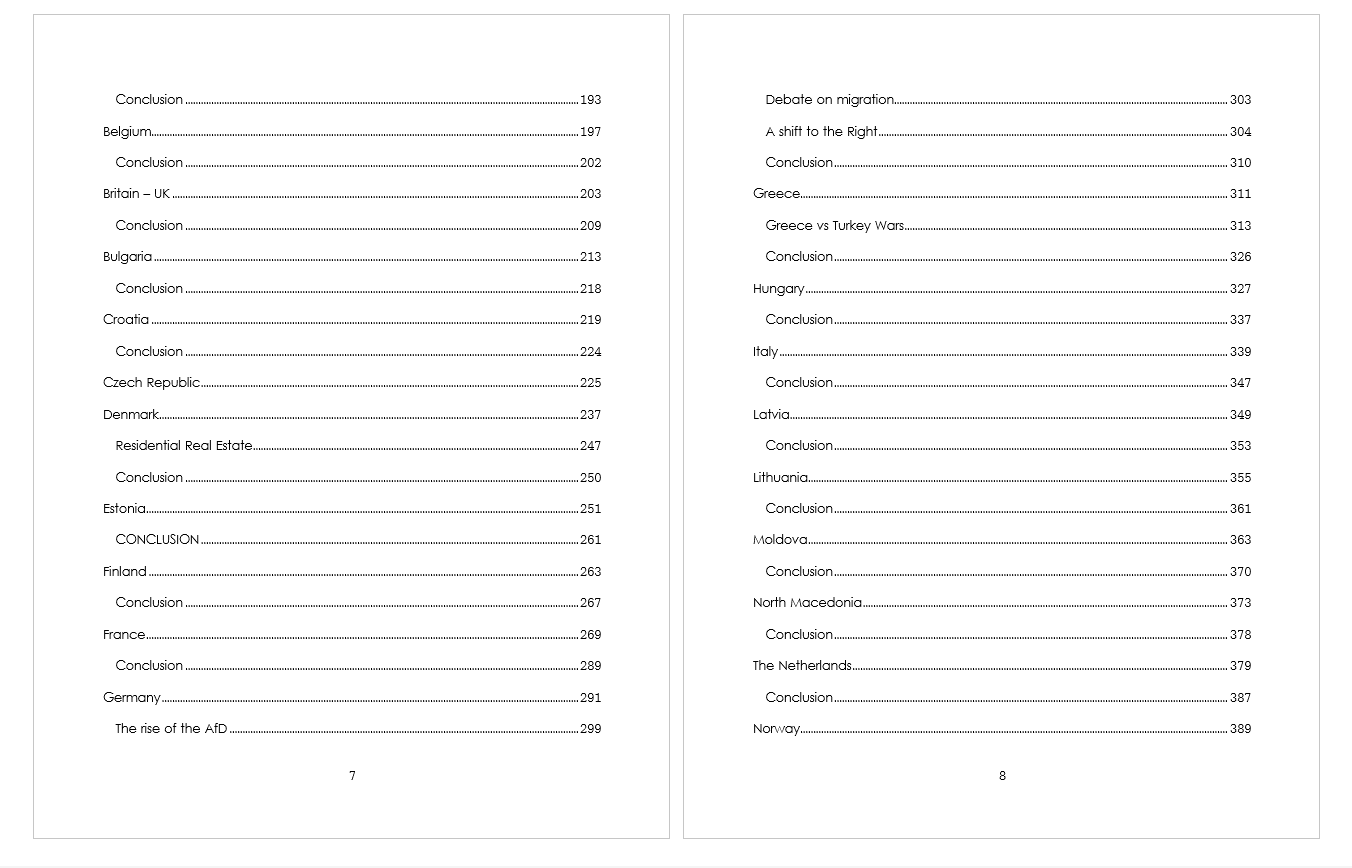
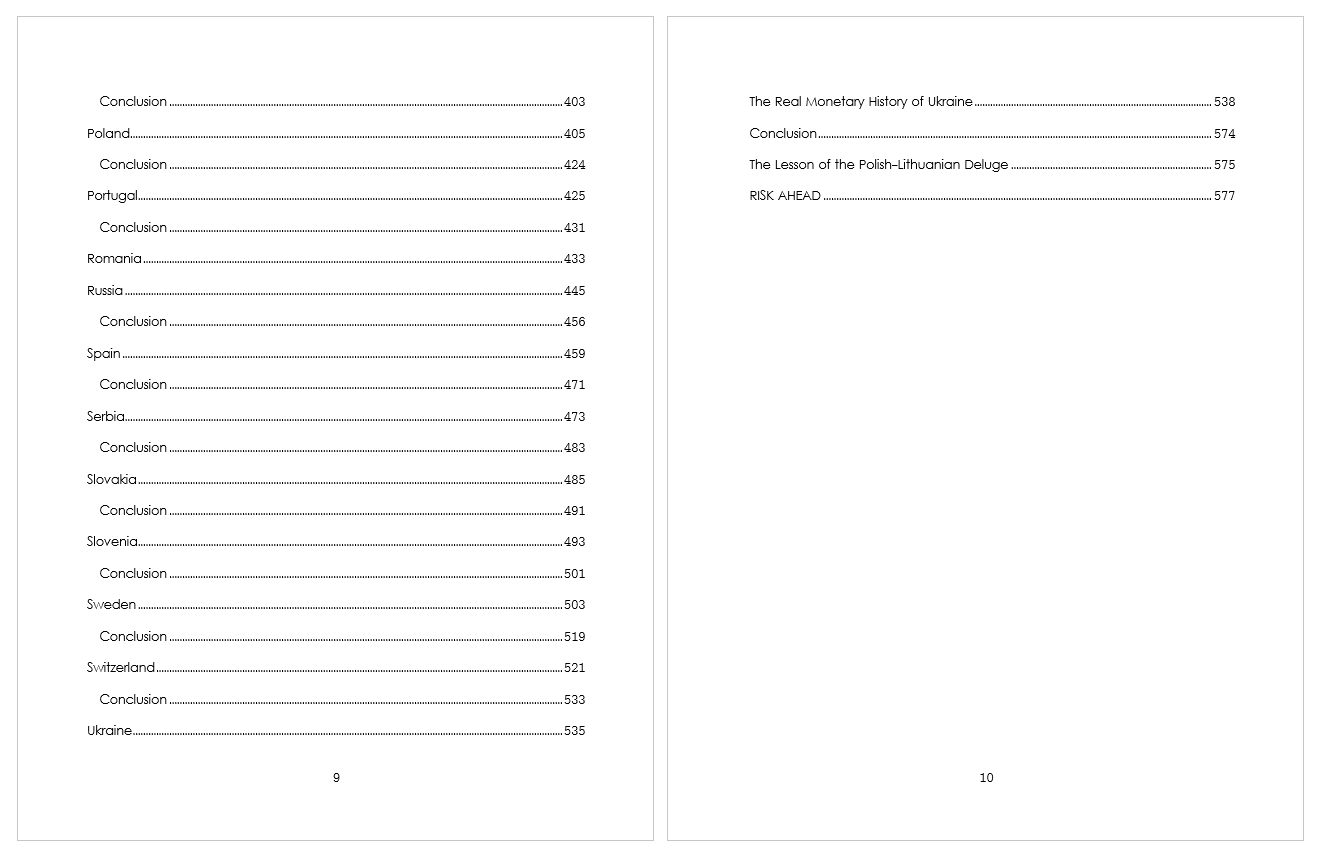
Our Institutional Report covering Europe’s countries with their forecasts generally out to 2032 has been a monumental effort. We greatly appreciate your patience, but this is vital for the decision-making for future investment in Europe. Things are certainly different from the past. Countries like Sweden and Switzerland, which had been neutral during previous world wars, have surrendered their neutrality and will not prove a safe harbor for capital during this conflict. Sweden has joined NATO and even sent jets to Poland. Switzerland gave up all foreigners with accounts and seized over $8 billion of accounts belonging to Russians, abandoning its historic traditions.
This report covers countries that nobody else even covers.
This also addresses the War with Russia & The eventual breakup of the EU itself
577 Pages fully illustrated with Charts and Arrays Per County, covering Currency and share markets
This Report is massive, and the price is $10,000 per institution.
(Please email to let us know how many reports you may need)
I have created this site to help people have fun in the kitchen. I write about enjoying life both in and out of my kitchen. Life is short! Make the most of it and enjoy!
This is a library of News Events not reported by the Main Stream Media documenting & connecting the dots on How the Obama Marxist Liberal agenda is destroying America














 Centinel2012