Real Estate & the Financial Crisis


Financial Crisis

QUESTION: Hello Armstrong, Thank for you the great post “The Future – Putting it All Together”. It helps a lot to get a good overview, considering everything is connected. One question, you say “Real estate is nice for some part of a cash holding, but it is taxed to hold it and it is not liquid.” regarding where to put your money when it all comes crashing down with the Sovereign debt crisis. Is this just for risk management, considering we are currently in a long wave down from 2015.75 to 2032 in real estate? Referring to your forecast on the real estate market. Also is this model for the US only, or global?

Thank you!

ANSWER: There are two types of investment – the hedge and the speculation. The overall real estate is in a decline. A friend of mine in the business said more than 33% of the houses in New Jersey would all come on the market if prices ever got back to 2007 levels. The areas that has risen sharply when looked at closely are those attracting foreign capital. This is the hedge trying to get off the grid. They are often buying places and not even renting them out as in Scandinavia. We even see some of that in Dubai. This is money simply parking.

The real estate cycle peaked and it is headed down in terms of appreciation. This is the general market and not the high-end, although that has begun to turn down in many places often due to taxation of rising regulation as in Miami or Sydney Australia.

However, because of the Sovereign Debt Crisis, we will begin to see this surface with the Obama-Boehner Debt Crisis Crisis that pushed off into 2017 when they would not be accountable. As this starts to become more and more aware to the general public, that is when the confidence in currencies begins to drop. That appears to be on schedule for 2018.

All tangible assets will rise in value according to the decline in a currency. This will be “currency inflation” that is expressed by the old joke a man is frozen until a cure is found and he can be revived. He put his $1 million into stocks and calls his stock brokerage house upon his revival. They say his portfolio is worth $50 million. He jumps for joy until the operator breaks in and says he owes $1 million for the next 3 minutes.

When we swap to a new currency, then tangible assets will make that transition in value. It is not that you will make a profit, the name of the game is that you just break-even.

There are still some areas where there will be profit opportunities. Stay tuned for those

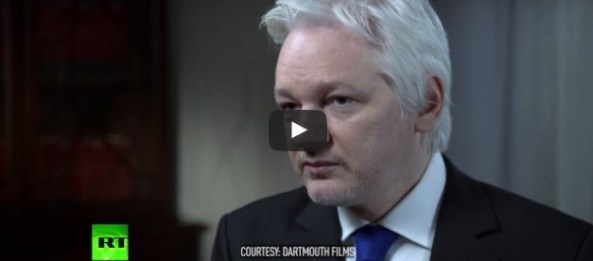
‘Clinton And ISIS funded by same money’ – Assange interview w/John Pilger (Courtesy Darthmouth Films)


There is little doubt than any of this in not 100% true.

When Spies Are Out Of Control


Tyler Durden's picture

Authored by Gregory Clark via The Strategic Culture Foundation,

The U.S. spy community – those nice people who told us they were certain the Iraq of President Saddam Hussein was holding weapons of mass destruction – have now made it known they are certain the Russian ambassador to the United States is Moscow’s top spy. But these people, even if they do not know much about WMD, must know what a top spy does. They do it themselves.

First, there is the messy and time-consuming job of finding information-loaded officials. Then there is the problem of maintaining contacts with those officials at secret rendezvous. So a senior ambassador, and former deputy Russian foreign minister, is able to do all this while going to cocktail parties, hobnobbing with the national elite, running a large embassy and studying the politics of the nation to which he is accredited?

I suggest U.S. top spies go back to doing their real work instead of inventing fairy tales.

I have seen the spies at work, on both sides of the Iron Curtain.

On the Soviet side they were not a very attractive breed. Their idea of a hard day’s work was constant snooping on the few Russian-speaking foreigners in their midst and relentless interrogation of any Soviet citizen who spoke to a foreigner, together with the occasional attempt at blackmail or compromise.

In the process they created a generation of Western policymakers deeply prejudiced against their people and their nation. Not a bad result for their decades of hard work, especially since the Western hostility they helped generate guaranteed their continued employment till well into the future.

Almost all their successes were “walk-ins”— people who for money or ideology wanted to provide information. Those volunteers would probably have provided more if they were not disgusted by the crudity of the people they had to deal with.

Spies sent to work abroad were usually of better quality. But they always had cover, as private citizens or mid-rank embassy officials at best.

Much the same in reverse was going in the West. To some extent it is still going on. In Japan the spies are almost out of control. Even though Russia has granted Japanese diplomats there the freedoms now enjoyed by Western diplomats in Russia, the Japanese spies continue to behave as in Soviet days. Like dogs chasing a bone (according to one victim), they are so crudely persistent and obtrusive that even ordinary diplomatic work becomes impossible. And these “dogs”think this will help them get their Northern Territories back?

I once played host to a prominent Western critic of U.S. Vietnam War policies. Thuggish Japanese spies camped outside my apartment for days.

These people are not the suave, romantic James Bonds of film fantasy. For the most part they are what we used to call “second elevens”— a cricket analogy for people rejected for the top team. Failing to enter the diplomatic service they make do by joining a spy network. One result is a burning desire to get ahead by undercutting the “first eleven”diplomats and by using largely bogus information to get close to the people in power. Hence the WMD information failure and the Iraq disaster, opposed by most Western diplomats with Middle East experience.

When U.S. President Donald Trump visited the CIA headquarters in Washington he was upbraided for failing to respect a “sacred” memorial wall devoted to the 90-odd CIA officers who have died while on duty. Maybe he was looking for the wall devoted to the 900,000 or so Iraqis who died as a result of CIA failures. Even Trump had the sense to turn against that dreadful war.

I once worked for two years as a diplomat in the Soviet Union. On return to Australia I went through the usual spy-agency debriefing, partly because I had reported some KGB stunts against our embassy there. Suddenly the debriefer jumped to his feet waving a report which I had written saying that the Odessa hotel where I was staying was close to the local KGB headquarters. Leaning ominously over the table he demanded to know how I knew the KGB location. I had to educate this stalwart and grossly overpaid defender of Australian security that in Soviet Union the KGB was a public organization with a large brass plate on its buildings reading Komitet Gosudarstvennoy Bezopasnosti, or Committee for Government Security.

Later, because I also spoke Chinese and had also opposed the Vietnam War, I was subjected to one of their stunts (our usual term for spy operations) to persuade me that a Soviet Embassy official wanted to meet me urgently. They made a bad mistake; the telephone operative they had employed spoke pre-revolutionary Russian (Australia has many White Russians, mostly people fleeing to China following the Russian Revolution). There was no way he could have been working for the Soviet Embassy. It seems that little detail passed completely over the heads of our Australian security interest defenders — the people who decide whether we can be trusted with secrets. Nor were they very happy when I was able publicly to expose the stunt.

The current anti-Russian hysteria in the U.S. media is fueled by similar ignorance. Various Trump officials and appointees are being persecuted relentlessly by leaks accusing them of talking to the Russian ambassador. But anyone who knows anything about diplomacy knows that such informal talks can be crucial to policymaking.

I admit to having joined secret talks with the premier and foreign minister of the Soviet Union in a fat-headed 1964 Australian attempt to have the Soviet Union join with the West in Vietnam to stop Chinese “aggression.” Because there were laws against revealing state secrets I sat on that important story for more than 20 years.

Today when the West is bent on equally fat-headed efforts to stop alleged Russian “aggression”(read the 2015 Minsk Two agreement if you want to know who really is the aggressor), talks with Moscow’s ambassador really are needed. And the spies who want to leak that information to embarrass their own government really should go to jail.

*  *  *

Sunday Talks “Budget” – OMB Director Mick Mulvaney…


Source: Sunday Talks “Budget” – OMB Director Mick Mulvaney…


Where to Keep Your Money


Hiding Money Matress

QUESTION: Mr. Armstrong, I am 82 years old and ask the question which is much on my mind—- Where is the best place to park cash in this very difficult time. Right now almost all of my cash is in money market funds with the returns very low, yet there is still risk of loss. I simply do not know what to do—I am too old to take big losses, not enough time to recover.

ANSWER: Right now stay in cash. We will most likely see a change come May.

KOMMONSENTSJANE – TIME TO CRACK OPEN THE NUTS


I hope he can actually do what he wants.

kommonsentsjane's avatarkommonsentsjane

The Horn News

Jeff Sessions has big plans for these Obama pals

March 10, 2017

After eight years of scandal and lawlessness, it looks like the beginning of the end may finally be coming for former President Barack Obama’s cronies.

Appearing on Hugh Hewitt’s radio show Thursday, Attorney General Jeff Sessions told the conservative talk show host that a special prosecutor may be appropriate — and soon be needed — to investigate Obama-loyalists Eric Holder and Loretta Lynch.

Sessions was asked about the IRS targeting scandal, the “Fast and Furious” case, former Secretary of State Hillary Clinton’s email servers, and other Obama-era scandals that were swept under the rug by the former administration, and Hewitt suggested some kind of outside counsel could be appropriate because they’d have the “authority to bring charges if underlying crimes were uncovered.”

Sessions seemed open to the idea, promising he was “going to do everything…

View original post 228 more words

KOMMONSENTSJANE – HELP TRUMP DRAIN THE SWAMP WITH TERM LIMITS


Term Limits are required if we are going to straighten out this mess.

kommonsentsjane's avatarkommonsentsjane

March 11, 2017

TIME FOR CHANGE:
Help Trump drain the swamp with term limits.

From the Senate Conservatives Fund

Career politicians in Washington are destroying our country. The longer they are in office, the more they lose touch with the voters who elected them and the more they serve special interests.

And sadly, the longer they are in office, the higher they climb in leadership and the more control they have over our lives.
We must demand term limits now!!

Americans support term limits by wide margins and now we have President Donald Trump on our side.

We have a once-in-a-lifetime opportunity to pass a constitutional amendment limiting the number of terms politicians can serve in the House and Senate, but we must take action.

Please help us drain the swamp by signing the national petition to demand term limits.

The power of incumbency must be broken.

Over the last…

View original post 181 more words

Why Canada will come to regret its embrace of refugees


Seems like a good deal… lol

Sunday Talks – Secretary Wilbur Ross Discusses Trade and Economic Priorities…


Source: Sunday Talks – Secretary Wilbur Ross Discusses Trade and Economic Priorities…

Global Leaders Rattle Their Sabers As The World Marches Toward War


Tyler Durden's picture

Authored by Michael Snyder via The Economic Collapse blog,

Iran just conducted another provocative missile test, more U.S. troops are being sent to the Middle East, it was just announced that the U.S. military will be sending B-1 and B-52 bombers to South Korea in response to North Korea firing four missiles into the seas near Japan, and China is absolutely livid that a U.S. carrier group just sailed through contested waters in the South China Sea.  We have entered a season where leaders all over the globe feel a need to rattle their sabers, and many fear that this could be leading us to war.  In particular, Donald Trump is going to be under the microscope in the days ahead as other world leaders test his resolve.  Will Trump be able to show that he is tough without going over the edge and starting an actual conflict?

The Iranians made global headlines on Thursday when they conducted yet another ballistic missile test despite being warned by Trump on numerous occasions…

As tensions between the U.S. and Iran continue to mount, the semi-official news agency Tasnim is reporting that Iran’s Revolutionary Guard has successfully conducted yet another ballistic missile test, this time from a navy vessel.  Called the Hormuz 2, these latest missiles are designed to destroy moving targets at sea at ranges up to 300 km (180 miles).

Reports on the latest test quotes Amir Ali Hajizadeh, commander of the IRGC’s Aerospace Force, who confirmed that “the naval ballistic missile called Hormuz 2 successfully destroyed a target which was 250 km away.”

The missile test is the latest event in a long-running rivalry between Iran and the United States in and around the Strait of Hormuz, which guards the entrance to the Gulf. About 20% of the world’s oil passes through the waterway, which is less than 40 km wide at its narrowest point.

So how will Trump respond to this provocation?

Will he escalate the situation?  If he does nothing he will look weak, but if he goes too far he could risk open conflict.

Elsewhere in the Middle East, things are already escalating.  It is being reported that “several hundred Marines” are on the ground in Syria to support an assault on the city of Raqqa, and another 1,000 troops could be sent to Kuwait to join the fight against ISIS any day now.  The following comes from Zero Hedge

While the Trump administration waits to decide if it will send 1,000 troops to Kuwait to fight ISIS, overnight the Washington Post reported that the US has sent several hundred Marines to Syria to support an allied local force aiming to capture the Islamic State stronghold of Raqqa. Defence officials said they would establish an outpost from which they could fire artillery at IS positions some 32km (20 miles) away. US special forces are already on the ground, “advising” the Kurdish-led Syrian Democratic Forces (SDF) alliance according to the BBC.

The defence officials told the Washington Post that the Marines were from the San Diego-based 11th Marine Expeditionary Unit, and that they had flown to northern Syria via Djibouti and Kuwait. They are to set up an artillery battery that could fire powerful 155mm shells from M777 howitzers, the officials said. Another marine expeditionary unit carried out a similar mission at the start of the Iraqi government’s operation to recapture the city of Mosul from IS last year.

Meanwhile, China is spitting mad for several reasons.  For one, the Chinese are absolutely furious that South Korea has allowed the U.S. to deploy the THAAD missile defense system on their soil…

China is lashing out at South Korea and Washington for the deployment of a powerful missile defense system known as the Terminal High Altitude Area Defense system, or THAAD, deposited at the Osan Air Base in South Korea on Monday evening.

The deployment of THAAD follows several ballistic missile tests by North Korea in recent months, including the launch of four missiles on Monday, three of which landed in the sea off the coast of Japan. Though THAAD would help South Korea protect itself from a North Korean missile attack, China is vocally protesting the deployment of the system, claiming it upsets the “strategic equilibrium” in the region because its radar will allow the United States to detect and track missiles launched from China.

Of course the U.S. needed to do something, because the North Koreans keep rattling their sabers by firing off more ballistic missiles toward Japan.

But it is one thing to deploy a missile defense system, and it is another thing entirely to fly strategic nuclear bombers into the region.

So if the Chinese were upset when THAAD was deployed, how will they feel when B-1 and B-52 bombers start showing up in South Korea?

Earlier this week, trigger-happy Kim pushed his luck once more when he fired off four ballistic missiles into the seas near Japan.

Now US military chiefs are reportedly planning to fly in B-1 and B-52 bombers – built to carry nuclear bombs – to show America has had enough.

South Korea and the US have also started their annual Foal Eagle military exercise sending a strong warning to North Korea over its actions.

A military official said 300,000 South Korean troops and 15,000 US personnel are taking part in the operation.

The Trump administration has openly stated that all options “are on the table” when it comes to North Korea, and that includes a military strike.

It has been more than 60 years since the Korean War ended, but many are concerned that we may be closer to a new Korean War than we have been at any point since that time.

And of course our relationship with China is tumbling precariously downhill as well.  Another reason why the Chinese are extremely upset with the Trump administration is because a U.S. Navy carrier battle group led by the USS Carl Vinson sailed past islands that China claims in the South China Sea just a few weeks ago.

In China, the media openly talks about the possibility of war with the United States over the South China Sea.  Most Americans are not even aware that the South China Sea is a very serious international issue, but over in China this is a major focus.

And the U.S. military has recently made several other moves in the region that have angered the Chinese

Also in February, the U.S. sent a dozen F-22 Raptor stealth fighters to Tindal AB in northern Australia, the closest Australian military airbase to China, for coalition training and exercises. It’s the first deployment of that many F-22s in the Pacific.

And if that didn’t get the attention of the Chinese government, the U.S. just tested four Trident II submarine-launched ballistic missiles during a nuclear war exercise, sending the simulated weapons 4,200 miles from the coast of California into the mid-Pacific. It’s the first time in three years the U.S. has conducted tests in the Pacific, and the first four-missile salvo since the end of the Cold War.

I can understand the need to look tough, but eventually somebody is going to go too far.

If you are familiar with my work, then you know that I believe that war is coming.  Things in the Middle East continue to escalate, and it is only a matter of time before a great war erupts between Israel and her neighbors.  Meanwhile, U.S. relations with both Russia and China continue to deteriorate, and this is something that I have been warning about for a very long time.

We should hope for peace, but we should also not be blind to the signs of war that are starting to emerge all over the planet.  Relatively few people anticipated the outbreak of World War I and World War II in advance, and I have a feeling that the same thing will be true for World War III.