60% of Canadians Face Rising Mortgage Payments by 2026


Posted originally on Jul 18, 2025 by Martin Armstrong 

Housing

Canadians with a mortgage renewal in the near future are facing trouble ahead. The Bank of Canada released a new report detailing that around 60% of outstanding mortgages are set to renew in 2025 or 2026, and those homeowners are highly likely to see a rise in monthly payments.

Most borrowers went into a five-year, fixed-rate mortgage when rates were significantly lower. The average monthly mortgage payment for those renewing in 2025 is expected to rise by 10% compared to December 2024. Those set to renew in 2026 should anticipate a 6% monthly increase in comparison to the same time period. However, this is all dependent upon the type of product purchased. The central bank noted that those who selected a variable rate payment may actually see a decline of between 5% to 7%. Those with a five-year, fixed-rate payment could see an increase of up to 15% to 20%. Of the 60% of mortgage holders facing renewals, around 75% of those facing increases hold a five-year, fixed-rate mortgage.

Five-year, fixed-rate mortgages account for 40% of all outstanding mortgages in the nation. The central bank’s report notes that 20% of these holders with mortgages renewing in 2026 will experience an increase.

The variable rate surpassed its peak years ago, but the renewal rates vary drastically. At the top, 10% of those renewing in 2026 could experience an increase of over 40%, while at the bottom, around 25% may see a decrease of at least 7%. Principal payments made since origination is one of the primary factors. Those who chose or had the ability to increase monthly payments to cover principal and interest are less likely to experience a dramatic price increase at renewal compared to those in negative amortization. These loans face rising interest that is added to the principal when the monthly payment is unable to meet the initial interest.

Around 80% of those with variable loans who renewed prior to March 2022 have repaid beyond their contract, leading to only 5% of that group holding a higher principal balance in February 2025 compared to the previous renewal or origination.

The central bank has deemed that this will not cause severe stress to the Canadian economy. Yet, the central bank is counting on borrowers having a higher income at renewal.

“Overall, we do not expect upcoming mortgage renewals to lead to a severe worsening of financial stress for affected borrowers, holding everything else constant. Indeed, most borrowers will likely have higher income at renewal and should face interest rates below what they were stress-tested for. That said, some borrowers with higher payments at renewal will face challenges. Many of them will need to change their spending to manage higher mortgage payments. And some may struggle to meet their other financial obligations.”

This is an optimistic analysis that relies on the economy strengthening at a time when the indicators are not there. Households cannot necessarily absorb these rate hikes, as we are looking at around 60% of renewals experiencing an uptick in monthly payments. The models show rising tension across Canadian banks and mortgage-backed assets into Q1 2026. This is not about a bubble bursting. It’s about a slow, structural compression.

US Secures $15B Energy Deal with Italy


Posted originally on Jul 18, 2025 by Martin Armstrong 

Oil Tanker

Italy has finalized a major energy deal with the United States, which will reform energy trade between the two nations. Unlike other European countries that are hesitant to rely on the US under Trump, Italy’s Giorgia Meloni has sought to strengthen ties with the world’s leading economy in mutually beneficial trade agreements. The $15 billion 20-year deal will provide two million metric tons of American natural gas to the European nation.

Venture Global and Italian energy giant Eni solidified the deal. State-controlled energy company Eni has never issued the US a long-term liquefied natural gas (LNG) contract, and stated that the portfolio will expand to 20 million tons of LNG annually by 2030. The United States is essentially replacing Russia as Italy’s energy supplier.

Energy exports to Italy from the US have dramatically increased in the years since the Russian war, followed by Russian sanctions. Over 20% of Italy’s total LNG imports came from the US in 2022, tripling the amount imported from 2021 prior to the Russia-Ukraine war.  Two-thirds of Italy’s energy is provided through fossil fuels, with 35.7% coming from natural gas and 37% from oil. The notable distinguishing feature of this plan is the duration, as Italy is counting on the United States to remain a stable ally.

Venture Global announced in June that it would begin supplying additional US gas to a German-based distributor as well. In fact, the United States has essentially replaced Russia as the European Union’s largest energy importer. In 2024 alone, the US provided the EU with 45% of its LNG needs.

There is mixed sentiment over Europe becoming reliant on American energy. European institutions are still attempting to uphold the Green Deal and implement environmental and climate regulations. They expect the US to meet their asinine methane emission rules. Other nations with US-skeptic leaders are wary of trade leverage. Eliminating Russian energy was essentially Europe shooting itself in the foot. While cautious, European leaders know that they need a new source of energy, and the capitalists leading America will happily supply it to them.

UK to Permit 16-Year-Olds to Voteoriginally onUK to Permit 16-Year-Olds to Vote


Posted originally on Jul 18, 2025 by Martin Armstrong 

Vote.UK_.Election

Teens in the United Kingdom were recently deemed too irresponsible to use social media and user-generated online content. Yet, the government has deemed it appropriate to now permit teens to begin voting in elections at the age of 16.

The Labour Party has been pushing legislation to permit 16-year-olds to vote. Coupled with digital IDs, teens will be permitted to apply for proper credentials as the UK moves toward an “increasingly automated voter registration system.”

“For too long public trust in our democracy has been damaged and faith in our institutions has been allowed to decline,” Deputy Prime Minister Angela Rayner said. “We are taking action to break down barriers to participation that will ensure more people have the opportunity to engage in UK democracy, supporting our plan for change, and delivering on our manifesto commitment to give 16-year-olds the right to vote.”

Young voters are the least likely demographic to cast a vote. In the UK’s 2024 general election, voter turnout for the 18-24 year-old demographic was only 47%. Yet, the youth tend to favor the Labour Party, leading many to believe this measure is an attempt to buy votes. As Winston Churchill famously said, “If you’re not a liberal when you’re young, you have no heart; if you’re not a conservative when you’re old, you have no brain.”

The government forces this demographic to pay taxes on earnings over £12,570. They must pay into the National Insurance fund from age 16 if they earn above the limit, with the government currently taking £242 per week. Teens as young as 15 years and 7 months may join the Army, and those 16 years of age of older may begin basic training with parental consent. However, they cannot serve in active armed operations until they turn 18.

Are 16 and 17-year-olds responsible enough to vote? If the government deems they responsible enough to begin training to fight and pay taxes, then perhaps the youth should be permitted to select who will lead them into war and dip into their pockets. Better yet, stop sending kids off to die in foreign wars and dissuading the youth from seeking out entry-level roles with taxation. If they’re responsible enough to select the leader of their nation, they should be able to access the internet freely and be exposed to a wide range of voices and opinions, rather than what the government labels as information or misinformation.

While the World Was Distracted by Epstein


Posted originally on Jul 17, 2025 by Martin Armstrong 

Power Grab 2

While the world was distracted by the Epstein debacle, legislators introduced the GENUIS Act that would permit the US government to regulate stablecoins. The GENUIS (Guiding and Establishing National Innovation for U.S. Stablecoins Act), primarily sponsored by Senator Bill Hagerty (R-Tennessee), permits the government to oversee, regulate, and define the $250 billion stablecoin market.

Now, stablecoins differ from cryptocurrencies as they are pegged to a stable asset such as a fiat currency or commodity. Cryptocurrencies are allegedly allowed to freely operate on the market based on supply and demand. The GENIUS Act will peg stablecoins to the US dollar and require issuers to maintain a 1:1 reserve ratio in short-term treasuries or cash.

Issuers holding over $10 billion in outstanding stablecoins will be subject to federal regulation under a newly created oversight agency. These issuers will now be deemed financial institutions and required to meet the traditional banking regulations as well. Stablecoins can no longer pay interest or act as an alternative to bonds. Perhaps most notably, issuers must not meet anti-money-laundering (AML) regulations, which are set to provide the government with unlimited access to payments.

So essentially, the government is turning the stablecoin into a digital dollar of sorts. The concern here is that this could delve into digitizing all currency and creating a CBDC. The act specifically provides the government with the authority to “block, freeze, and reject specific or impermissible transactions.”

“A permitted payment stablecoin issuer shall be treated as a financial institution [and]…shall be subject to all Federal laws applicable to a financial institution located in the United States including…policies and procedures to block, freeze, and reject specific or impermissible transactions that violate Federal or State
laws, rules, or regulations…”

CBDC Cover

This provision is not intended to protect the world against drug smugglers and thieves. This provision is intended to grant government unlimited control over how people spend stablecoins. The government could have easily frozen the accounts of those who refused the COVID-19 vaccination, for example, and the Biden Administration admittedly weaponized existing financial institutions to spy on Conservative Americans through their payment histories.

“Stablecoins are the bait and switch for direct-issued government CBDCs,” Bitcoin Magazine editor Mark Goodwin said, “Stablecoins can be programmed. Exactly like how we fear CBDCs will be programmed. They’re exactly the same tokenized mechanism… They can be taken out of your wallet. Your wallet can be blacklisted. A lot of the things that we fear about CBDCs are totally available within the tool set of Stablecoins.”

The GENIUS Act has received bipartisan support. Although Republican Hagerty championed the bill, he had bipartisan co-sponsors, including Senators Kirsten Gillibrand (D-NY), Angela Alsobrooks (D-MD), Tim Scott (R-SC), and Cynthia Lummis (R-WY).

I warned that governments would NEVER allow any cryptocurrency or stablecoin to compete with their own currency. I long warned that government was merely tolerating these alternative currencies in the past as they posed no real threat. But now the government needs the ability to tax everything to support its perpetual spending. Every digital transaction is traceable. Every digital currency is controllable—the ultimate power grab.

One of Donald Trump’s main campaign promises was the prevention of CBDC. The headlines are enraged over his failure to release the Epstein files, but the GENUIS Act is a far deeper betrayal of the American people that has the ability to usher in a new monetary system.

EU Proposed €2 Trillion Defense and Climate Budget – Another Crack in the Bloc


Posted originally on Jul 17, 2025 by Martin Armstrong 

EU Break up

The European Union has just proposed a staggering €2 trillion budget over seven years, with a major focus on military defense spending. Once again, Brussels is proving that when governments face internal collapse, they do not turn toward reform. Rather, they turn toward militarism.

The war cycle is intensifying. The proposal would allocate 2 trillion euros ($2.31 trillion USD) over the next seven years into 2028—a pivotal year on the war cycle. Of that figure, 131 billion euros will go toward militarization. This budget is five times the current amount the EU is spending on defense.

“This is a budget for the realities of today, as well as the challenges of tomorrow,” European Commission President Ursula von der Leyen said during a press conference. Around 35% of the budget will go toward climate and biodiversity projects, she said.

The “challenges” von der Leyen is referencing are the looming sovereign debt crisis. They are not actually concerned about Russia invading Europe. Militarization is a political too,l and climate initiatives are the most lucrative tax grab. Brussels sees that it is failing amid a rising wave of nationalism. The net-zero climate change agenda has failed, along with the attempted globalization from the World Economic Forum. The people have lost confidence in their government, and as history goes, leaders will arm up before they step aside.

Von_der_Leyen_new_NATO_head

Socrates has been forecasting this exact shift. The war cycle is peaking into 2027–2028, with the effects being truly felt in 2028. Europe should be more concerned about internal conflict among EU member states than foreign enemies. Brussels forced members to abandon domestic objectives. They’re feeling it now with the energy crisis, migrant crisis, and looming military conscription. Taxes must rise to pay for these failing policies, and member nations must continually contribute more to both the EU and NATO. Confident leaders are beginning to realize that they’ve lost control of the reins on this runaway horse, but those are the leaders who are being silenced and demonized. Civil unrest, separatist movements, and loss of confidence in government will erupt across the continent.

March 2028 marks the beginning of a major shift in the Economic Confidence Model that may signal the start of the sovereign debt crisis in Europe. From 2028 to 2032, confidence in Western governments will completely collapse. The European Union will fragment once the debt crisis hits and it becomes clear that the unity was an illusion.

The Stripper Index


Posted originally on Jul 17, 2025 by Martin Armstrong 

Sex Worker

One company has been looking to one of the world’s oldest professions to gauge the state of the economy—sex work. “The ‘stripper index’ is an unconventional economic indicator that correlates changes in sex work revenue, such as escort pricing, strip club tips, and related search interest, with broader economic cycles,” Erobella states on its website. “It operates on the premise that sex work, being a discretionary luxury, is among the first sectors to feel the pinch during economic downturns.”

Now this is a bit tongue-in-cheek, but everything does, in fact, operate on a cyclical basis. We have those who look at the pizza index for signs of geopolitical turmoil in Washington, and lo and behold, there is some form of a correlation.

Oddly, the creators believe that “economic confidence” is directly tied to the price men are willing to pay for these services. They claim that there was a downturn in searches for sex work ahead of the 2022 downturn, and yet another downturn in searches for “escort” around New York City ahead of the 2008 crash. “Sex work is the ultimate discretionary spend,” it notes. They also stated that cash payments are the primary driver of this industry, causing the industry to be particularly sensitive to downturns ahead of the headlines.

The creators of this unconventional gauge believe that June’s data indicates signs of trouble ahead, with all sex worker-related metrics declining. They found that escort pricing across the UK has declined, and Google searches for “escort” are notably down. Sadly, there is an increase in new hires in the industry as well.

The New York Post also noted that websites such as OnlyFans experienced a decline in revenue during 2022 at the height of inflation.

I would not use this index as a gauge for the economy; it’s more of an interesting concept. Indeed, discretionary spending is the first item to decline ahead of economic downturns. This is one of countless signs that confidence is declining, and consumers are not willing to spend frivolously on extracurricular items to say the least.

Judge Rules Medical Debt Must Appear on Credit Reports


Posted originally on Jul 16, 2025 by Martin Armstrong 

Debt Burden

The Consumer Financial Protection Bureau (CFPB) may no longer remove medical debt from credit scores, a federal judge has ruled. This is yet another example of political cycles dictating economic policy, as the Trump-era judge dismissed the Biden-appointed mandate. Today, regulators expand; tomorrow, courts shrink. Millions of Americans will be affected by this ruling.

The Biden Administration was not attempting to wipe out medical debt; rather, the ruling would have changed how medical debt impacted credit scores. U.S. District Judge Sean Jordan, a Trump appointee, argued that the Fair Credit Reporting Act does not permit the CFPB to decide what debt it will and will not report.

Consumer advocates see this as punishment for those who fall ill to no fault of their own. The credit industry believes that payment is due when it is due. The medical industry would likely demand upfront payments, which has become a more common practice. None of this addresses the root cause—healthcare costs are obscene in the United States. Yet, lobbyists continue to line the pockets of politicians, and meaningful change never occurs despite politicians on both sides acknowledging the growing problem.

Currently, one in 12 adults living in the United States has medical debt exceeding $250. Over 14 million Americans, 6% of all adults, owe $1,000, while 3 million people, or 1% of the adult population, have medical debt exceeding $10,000. Medical debt is the leading cause of bankruptcies in America. As of late 2024, Americans were collectively behind on $220 billion worth of medical debt. Around 66.5% of all bankruptcy filings are a direct result of medical bills, affecting over 550,000 Americans annually.

The stop‑start volatility undermines both consumer confidence and market stability. The law is subject to change with each regime change, and the people are unprepared for the rug pull that happens with each new administration. The root of this issue has been entirely ignored and will contribute to the consumer debt crisis facing the nation, which spills into the overall economic growth of the nation.

Ca

US Inflation Rises in June


Posted originally on Jul 16, 2025 by Martin Armstrong 

Inflation up

Core inflation’s mild “only” 2.9% annualized rise is not cause for relief. Government agencies, central banks, and regulators all react to data. The Fed, having held rates steady since May, will now sit on its hands until reports confirm if inflation gets a firm grip. Jerome Powell has come out once more to state that the FOMC would have lowered rates if not for Trump’s tariffs. Trump is in opposition with the Fed as fiscal policy blames monetary policy, and no one opens their eyes to see the underlying problem.

A massive systemic risk looms on the horizon as consumer stress intensifies. Medical services, shelter, apparel, food, and everything else have been significantly more expensive since the pandemic, although the trend began five years ahead of COVID. These structural moving parts are more than mere statistics, as they are a sign of social stability and confidence.

Core inflation rose 0.2% for the month, representing a 2.9% annualized increase. The consumer price index rose by 0.3% in June, bringing the 12-month inflation rate to 2.7%.

I’ve repeatedly warned that the inflationary trend, which has become stagflation, would be blamed on Trump’s policy. “In effect, we went on hold when we saw the size of the tariffs and essentially all inflation forecasts for the United States went up materially as a consequence of the tariffs,” Powell said at the European Central Bank forum in Sintra, Portugal.

I’ve said it once, and I will say it again– Prices have simply not returned to what they once were before the global economy came to a standstill during COVID. Every nation has been affected. The lockdowns and supply chain cracks were exacerbated by a massive increase of government spending. Then the government doubled down on green policies, causing energy prices to rise, and lit the situation ablaze amid the Ukraine war and Russian sanctions. The world was already amid a sovereign debt crisis before COVID, and in fact, the Economic Confidence Model clearly stated that the landscape would permanently change after the Big Bang target of October 1, 2015 (2015.75)—the peak in government confidence.

The Council of Economic Advisers (CEA) has even issued a report that found PCE consistent across core goods, excluding energy, over the past three years. The CEA found “no clear break” in trend despite the headlines. Inflation has been above target for years and the Fed simply cannot control the trend.

Expect a cautious Fed. And expect politicians to blame their opponents, as always, rather than seeking the actual cause. Those politicians merely turn to academics who do not understand how the economy functions at its core and rely on outdated concepts that do not reflect the current landscape. The real culprit is cyclical history repeating itself—trade policy swings, inflationary follow-through, central bank reaction, and then economic slowdown.

Socrates is already flagging this cycle rising. And in 2026, we’ll look back and see that June 2025 was merely the early tremor of a system-wide shift.

Japan & MNRA Studies


Posted originally on Jul 16, 2025 by Martin Armstrong 

Child Vaccine

Some people are reporting that Japanese researchers were able to obtain vaccine and death records for 21 million people, and determined that those who died from MNRA came in “death waves” that took place 3-4 months after the injections, not right away. The data also reveal how long it takes for your death risk to return to normal, following a covid jab. This does not appear to be verifiable.

Data from Japan has been elusive.  They definitely have the information infrastructure, seen in publications with amazing detail for population studies.  It is a country of ~125M, and ~1.6M die every year.  So 21M would be ~13 years worth of death data.  I think it’s plausible that a researcher gets that much data.  I’ve seen shoddy population-wide mortality calculations before, but my guess is Japan would grant access to someone with the necessary experience.  And Japan has been under a decent amount of pressure to reveal details of its excess mortality:

Okada and Nishiura had a preprint released earlier this year with significantly smaller numbers for life expectancy in 2022 compared to 2021 or 2020. A paper chock-full of pandemic awareness, and notably, the one word most conspicuously absent: “vaccine.”

Also, out of the Japanese Medical Association (JMA) Journal: “Although Japan recorded the world’s highest rate of COVID-19 messenger ribonucleic acid (mRNA) vaccination doses per capita, COVID-19 cases and deaths exploded after the emergence of the Omicron variant, followed by a significant increase in excess deaths in 2022 and 2023. Although several hypotheses have been proposed to explain these phenomena, the truth remains to be established because sufficient studies and data disclosures have not been conducted to adequately investigate the possible contribution of mRNA vaccines.”

And another in BMJ comparing pre/post mortality: Excess mortality during and after the COVID-19 emergency in Japan: a two-stage interrupted time-series design

Unvaxxed_sperm_in_demand_by_hopeful_moms_Toronto_Sun

Even I must to admit, I received inquiries when some heard I refused to be vaccinated to my surprise. I am cautious even with my dogs. Traditional rabies vaccines have been effective for decades, but advancements in biotechnology are introducing new options.

1 Waiting Dogs

One such innovation is the mRNA-based rabies vaccine for dogs, which enhances protection and improves production. Why change something that has worked for decades if it is not broken? Make more money? Rabies in dogs has been largely eradicated in the United States. Yet the producers of vaccines have succeeded in making it a law that dogs must be vaccinated. I demand to know who makes any vaccine before they inject my dogs.

Reagan Trust but verify

Categories:

UK Data Use and Access Act – Digital Wallets Coming


Posted originally on Jul 15, 2025 by Martin Armstrong 

Digital ID 2

The Data (Use and Access) Act, also known as the DUA Bill, has provided the UK government with the ability to roll out a series of programs that will eventually force citizens to participate in a digital ID program. The law was enacted with the premise of reinforcing security and providing convenience for businesses and individuals, with the true goal of surrendering all data and control to government authorities.

The UK government has eased the public into the concept by launching digital verification services. Phase one enabled citizens to voluntarily create a digital identity to streamline the right to work and the right to rent procedures and provide access to age-restricted products. Phase two will create a foundation for Digital Verification Services (DVS) and government oversight of digital identities. Approved services will receive a trust mark to note that they have been verified by the government. The program is currently in a pilot phase but the government plans to move full speed ahead by the end of the year.

“This independent certification process has given lots of organisations across the UK economy the confidence to start accepting digital identity. In some parts of the economy though government or businesses need extra assurance, beyond the requirements in the trust framework, before a digital identity can be used,” the government noted, later adding, “We estimate that hundreds of thousands of right to work, right to rent and disclosure and barring checks each month are now taking place using digital identity services providers; but that’s just the small step towards a much bigger transformation we want to enable through our work.”

In two years, after people are accustomed to creating and using their digital identity, the government plans to launch a digital wallet (GOV.UK Wallet) that will store citizens’ official government-issued documents. The Home Affairs Committee launched an inquiry into the risks associated with this digital ID, with industries and watchdog services raising a red flag over concerns regarding government overreach and surveillance. Critics are also concerned about the true security measures a centralized database could offer as data breaches and unauthorized access are possible. The initial attempt to create GOV.UK failed and cost the government £200 million and there is no currently publicly disclosed total cost of the plans to create a new version.

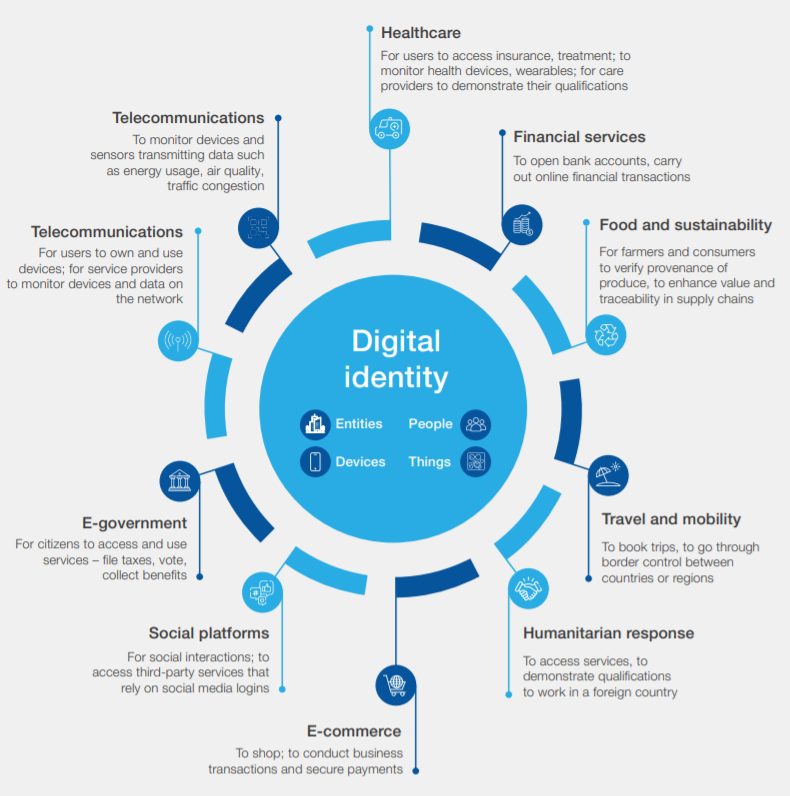
Digital Identity Chart

Government never implements a policy without expansion. There are already discussions of incorporating tax information into GOV.UK in the future, for example. Digital ID is not about convenience. It’s about CONTROL. The entire agenda is to monitor everything you do, say, and spend in real-time. They need Digital IDs to enforce CBDCs. Without it, they can’t control how you spend money. Every nation will attempt to create its version of a digital ID before they are combined into one centralized database, per United Nations guidelines. There will be public resistance toward these systems as government trust erodes. The plan will never be voluntarily repealed once implemented and overreach will expand until all freedoms are forcibly surrendered.