Posted originally on the CTH on January 2, 2023 | Sundance
A rather remarkable poll from Rasmussen [Full Data Here] shows some remarkable public polling outcomes about the COVID-19 jab.
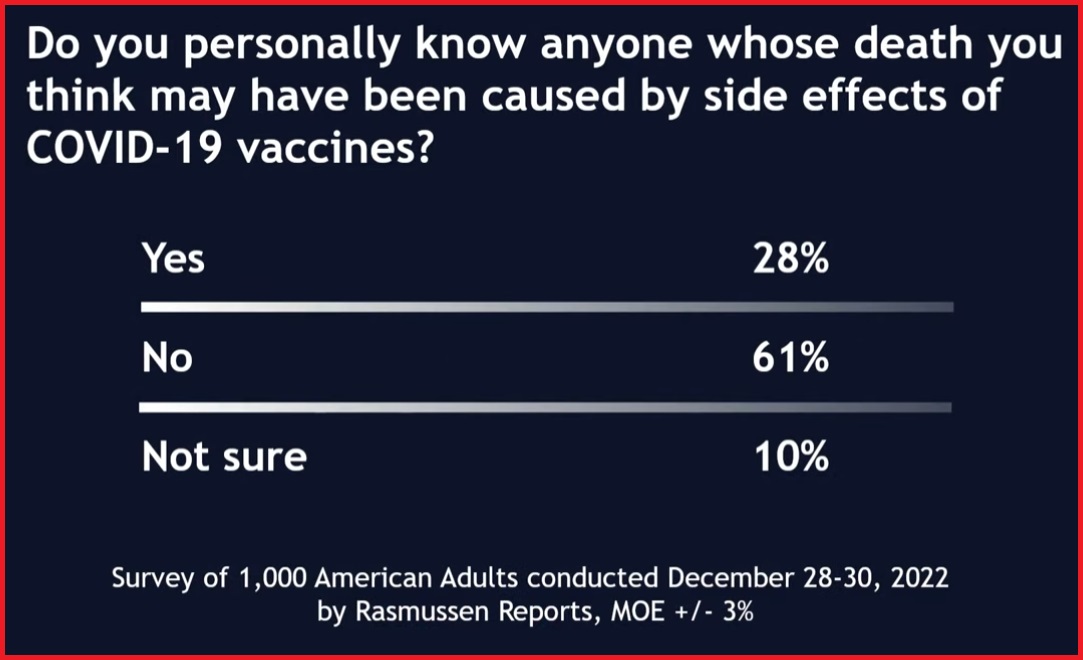
According to the survey of 1,000 Americans, 28% of the polled respondents know someone personally who died as a side-effect of the COVID-19 vaccination. The results cut across all cultural and political boundaries as reflected in the data. According to Rasmussen, “Twenty-eight percent (28%) of adults say they personally know someone whose death they think may have been caused by side effects of COVID-19 vaccines, while 61% don’t and another 10% are not sure.”
There have been very few surveys of Americans (or other country citizens) for their impression and knowledge of the vaccine side effects. However, this random poll is likely to trigger additional, albeit perhaps defensive, inquiry. If over one-in-four Americans believe they know someone who likely died as a result of the vaccination, that is an alarming outcome.
The Rasmussen survey aligns with a recent report that only “15% of people eligible for the Covid booster shot that targets the omicron variant have gotten it … according to a recent poll by the Kaiser Family Foundation” {link}, and would certainly explain why 85 out of every 100 people who took the initial jab have refused further vaccination efforts.
Forty-eight percent (48%) of Americans believe there are legitimate reasons to be concerned about the safety of COVID-19 vaccines, while 37% think people who worry about vaccine safety are spreading conspiracy theories. Another 15% are not sure. (more)
The head pollster for Rasmussen, Mark Mitchell, appeared with Steve Bannon to discuss the alarming survey result.
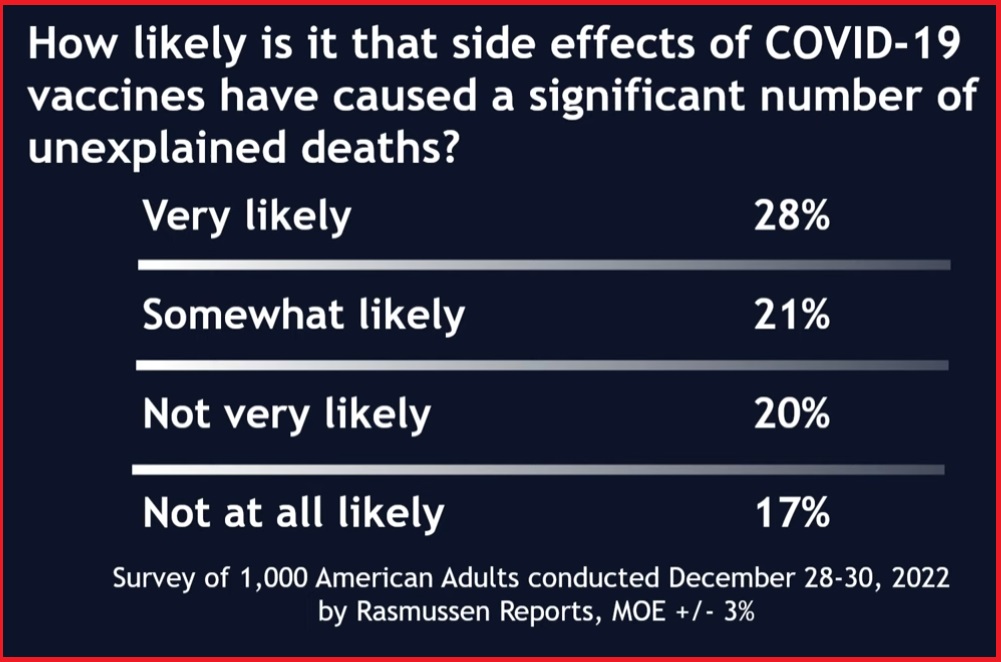
Some screengrabs of the results below: “More Democrats (85%) than Republicans (63%) or those not affiliated with either major party (64%) have been vaccinated against COVID-19. More Republicans (60%) than Democrats (44%) or the unaffiliated (43%) think there are legitimate reasons to be concerned about the safety of COVID-19 vaccines. However, there is less political difference in the number who suspect someone they know might have died from vaccine side effects – 33% of Democrats and 26% of both Republicans and the unaffiliated.”
Here is Mark Mitchell breaking down the survey results and explaining the methodology:
Posted originally on the CTH on January 2, 2023 | Sundance
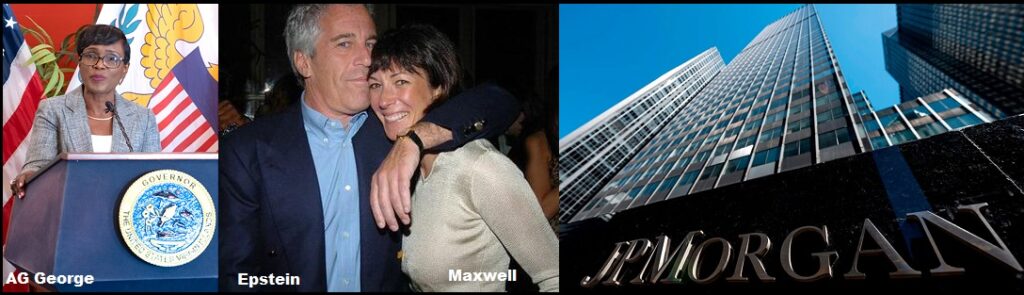
After successfully settling a $105 million lawsuit against the estate of Jeffrey Epstein in early December, U.S. Virgin Islands Attorney General Denise N. George then filed a lawsuit against JPMorgan Chase saying the “bank knowingly provided and pulled the levers through which recruiters and victims were paid.”
(US Virgin Islands) – Attorney General Denise George was terminated on Saturday after serving four years with the Bryan administration, the Consortium can confirm.
The decision by Governor Albert Bryan to fire the A.G. came just days after Bloomberg News revealed that Ms. George in her capacity as V.I. attorney general had filed a lawsuit against JPMorgan Chase — the largest bank in the United States and the world’s largest bank by market capitalization — without first informing Governor Bryan of such a major action, said a person with knowledge of the matter.
The lawsuit claims JPMorgan Chase facilitated convicted felon Jeffrey Epstein’s abuse of women and girls, alleging that the bank should have known about Epstein’s illegal activity and as part of its anti-money laundering procedures, should have reported their client to authorities.
George accused the bank of turning a blind eye to the sex trafficking operations that went on on Epstein’s private island in the USVI, Little St. James. (read more)
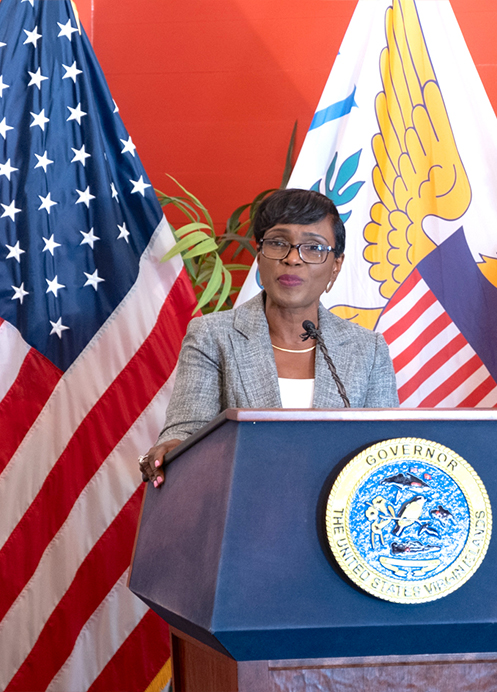
AG George is fired from her position as USVI AG after filing a lawsuit against JPMorgan. Where did Joe Biden go on vacation? The U.S. Virgin Islands.
BACKSTORY: It would appear the Attorney General for the U.S. Virgin Islands, Denise N. George, has a strategic map to target those institutions and entities associated with Jeffrey Epstein. AG George appears to be following the money, building her cases, and sequentially targeting the system that enabled Epstein.
Earlier this month USVI AG Denise George announced a $105 million settlement with the estate of Jeffrey Epstein [link]. The USVI case against Epstein was based on anti-criminal enterprise, sex trafficking, child exploitation and fraud laws of the Virgin Islands. We can assume AG George gained a lot of information in the discovery phase deep inside the Epstein finances that ultimately led to the settlement.
Following the settlement with the estate of Epstein, Attorney General George now announces a lawsuit against JPMorgan Chase for “knowingly” enabling the sex trafficking operation of Jeffrey Epstein. AG George is specifically saying JPMorgan Chase was fully aware of what Epstein was doing.
NEW YORK – The U.S. Virgin Islands on Tuesday filed a lawsuit against banking giant JPMorgan Chase, accusing the Wall Street corporation of turning a “blind eye” toward the conduct of the late disgraced financier Jeffrey Epstein.
Virgin Islands Attorney General Denise George said in a complaint filed in a Manhattan District Court that JPMorgan Chase facilitated the trafficking of minors for sexual abuse at the hands of Epstein.
The bank knowingly “provided and pulled the levers through which recruiters and victims were paid,” George wrote.
George further alleged in the complaint that the banking giant ignored red flags for years as it provided banking services to Epstein and his affiliated companies and entities, often benefiting from deposits into accounts.
The attorney general said JPMorgan Chase was “indispensable to the operation and concealment of the Epstein trafficking enterprise.”
“Upon information and belief, JP Morgan turned a blind eye to evidence of human trafficking over more than a decade because of Epstein’s own financial footprint,” George alleged, “and because of the deals and clients that Epstein brought and promised to bring to the bank.”
The attorney general’s office filed three counts against the banking firm, including a charge of participating in sex trafficking, and is asking for a jury trial. (read more)
Very interesting approach being taken…. Following the money.
...”Attorney George served as an Assistant Attorney General and trial attorney in the criminal, civil, family, juvenile, White Collar and public corruption divisions of the Virgin Islands Department of Justice for a period of over 18 years. During her tenure, she successfully prosecuted a full spectrum of violent crimes, including murder, manslaughter, rape, domestic violence, sexual assault, and child abuse. As a member of the Child Abuse Task Force, she co-authored the Virgin Islands’ first criminal child abuse and neglect statute. In the Civil Division, she represented the V.I. government in civil lawsuits filed against and on behalf of the government.
Attorney George also served for several years as the Director of the White Collar Crime and Public Corruption Division. During that time, she managed the division and successfully prosecuted complex white collar crimes of embezzlement, forgery, fraud, racketeering and public corruption.” (more)
Many emails have come in asking if the January target is going to be geopolitical. Holidays are a favorite time to launch attacks. Remember the Yom KippurWar, also known as the Ramadan War? Of course, during Vietnam, President Richard Nixon ordered major bombings to begin on Dec. 18 when North Vietnamese walked out on peace talks. The bombings did not use Christmas as a tactic, but the Troops called it the “11 Days of Christmas.”
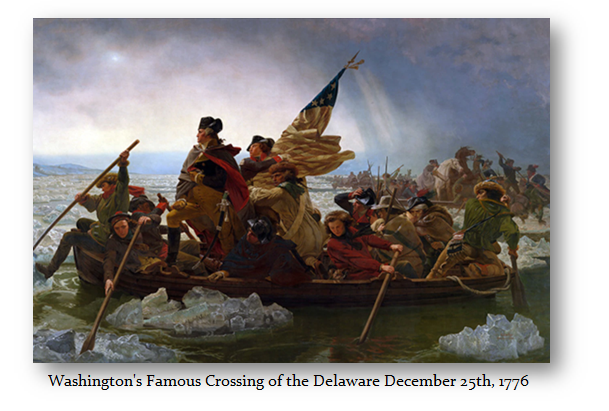
Bet you did not know that in the Famous Battle of Trenton, New Jersey, and Washington’s Crossing the Delaware he used Christmas day to take the British off guard. He crossed the Delaware Christmas night and at dawn on December 26th, 1776, about 2,400 Continental troops pushed into Trenton, and they did indeed surprise the enemy, who surrendered within an hour and a half.
During the American Civil War, the Union tried to use Christmas to attack Fort Fisher but failed. They packed a warship with explosives and blow up the fort’s walls. The ship blew up and only warned the Confederates of the holiday attack. Then on Christmas Eve, the Union started bombarding the fort with heavy cannon fire. That fell short and missed its target. Then on Christmas morning, they shelled the fort and sent in the troops. But the heavy artillery was completely untouched and they had to retreat.
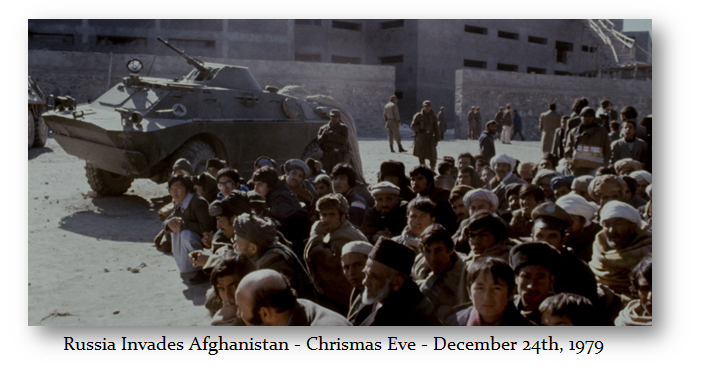
Russia invaded Afghanistan on Christmas Eve 1979, not because the Afghans were celebrating, but because the entire West was taken by surprise.
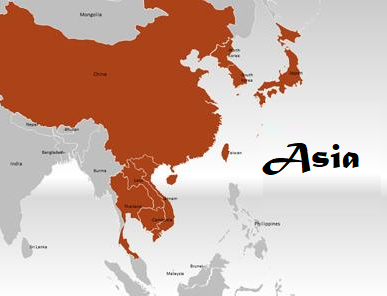
This Christmas has been another opportunity to catch the West off-guard. Absolutely the entire East Asian region has exploded with geopolitical tension. China, Taiwan, Japan, North, and South Korea have all raised their military readiness to their MAX. China strategically sent 7 ships and 71 aircraft of which the majority, at least 43, had entered Taiwan’s air defense zone. This is a NEW RECORD. What I have been warning about is that China, North Korea, Iran, and Russia will all join together because of this insanity coming from the Biden Administration.
North Korea simultaneously entered the Airspace of South Korea which, up to now, was unprecedented! The military leadership of South Korea was forced to come out and publicly apologized to the people for this violation of their Airspace by the North Korean drones. Reports are surfacing claiming that they remained there for at least 3 hours and perhaps some up to 7 hours.
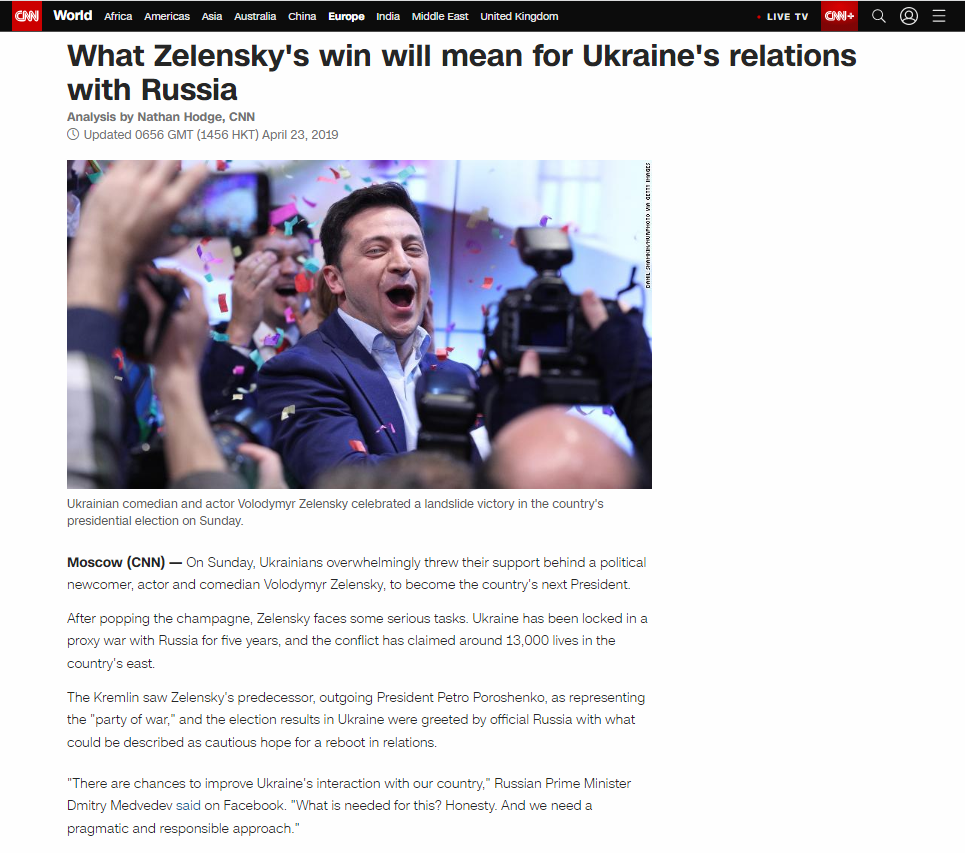
Iran’s staged a major military exercise on Friday ahead of New Year in the coastal area of the Gulf of Oman and near the strategic Strait of Hormuz. This was reported by state TV in Dubai. ABC News reported that they were testing their attack drones. Russia launched a major attack on New Year’s Eve and Zelensky still refuses to accept peace and let the Donbas go which is occupied by Russians. All Zelenskydoes is plead for endless money and Patriot missiles to attack Russia directly and engulf the entire world in this chaos. Zelensky is willing to sacrifice his entire country for this hatred of Russians. He said:
“For me, as the president, ‘just peace’ is no compromises as to the sovereignty, freedom, and territorial integrity of my country, the payback for all the damages inflicted by Russian aggression,”
It was Kyiv that started the war by sending troops to attack the Donbas in 2014 and that was the West’s installed “temporary” government that started the war – not any elected Ukrainian government. He was elected promising to pursue peace and end corruption. So much for campaign promises, They always say whatever they need to win, and then do the exact opposite.
OrthodoxChristmasDay for the year 2023 will be observed on Saturday, January 7th, 2023. Strangely, most of the markets are showing turning points the week of January 2nd and/or 9th even with some markets showing Panic Cycles the week of the 9th following Orthodox Christmas.
QUESTION: Didn’t gold decline from 1980 to 1999 because of all the dumping of gold by central banks?
WV
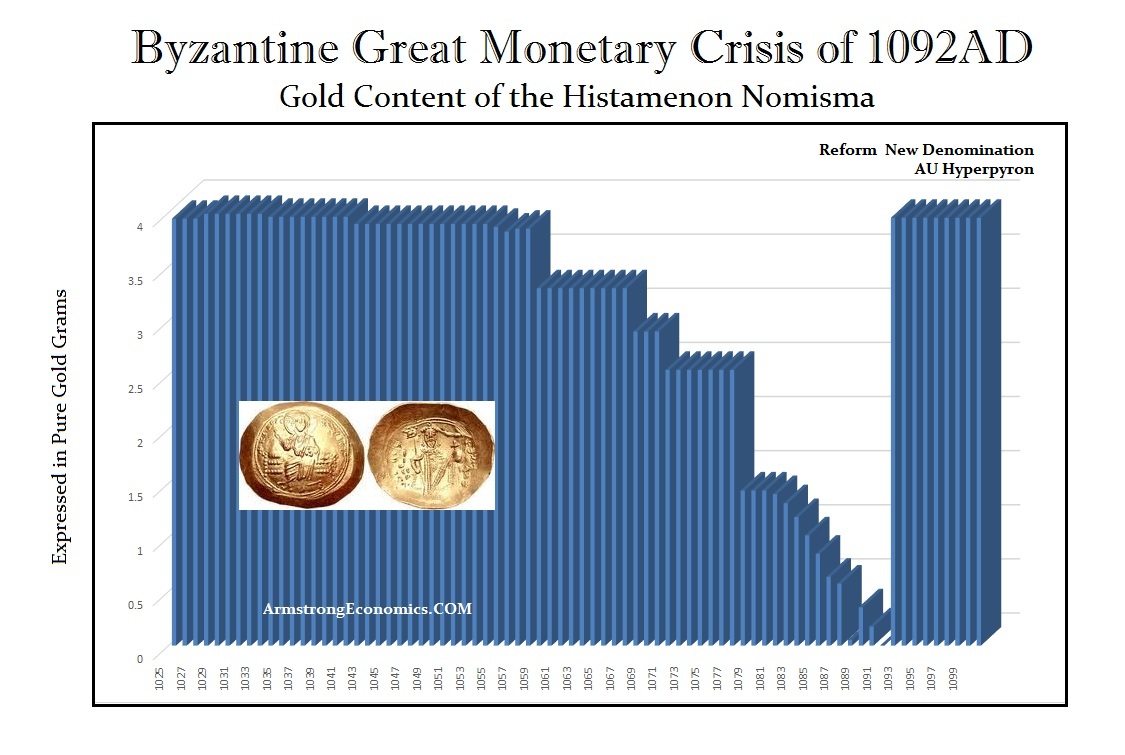
ANSWER: I understand that the quantity rise, in theory, makes sense that the price would decline. But historically, there is no evidence that supports that theory on a consistent basis. There are times when the supply has increased and so has the price. During the Byzantine Empire, confidence in the government began to collapse especially during the monetary crisis of 1092. As people hoarded their gold, the government was forced to debase the coinage even more. When people do not trust the future, they will hoard their wealth. You must understand that all things NEVER remain equal.
This is also why the silver-to-gold ratio fluctuates. NOTHING is ever permanent. We must remember that because it is when the collapse in government takes place, an increase in supply will never satisfy the demand.
Posted originally on the CTH on January 1, 2023 | Sundance
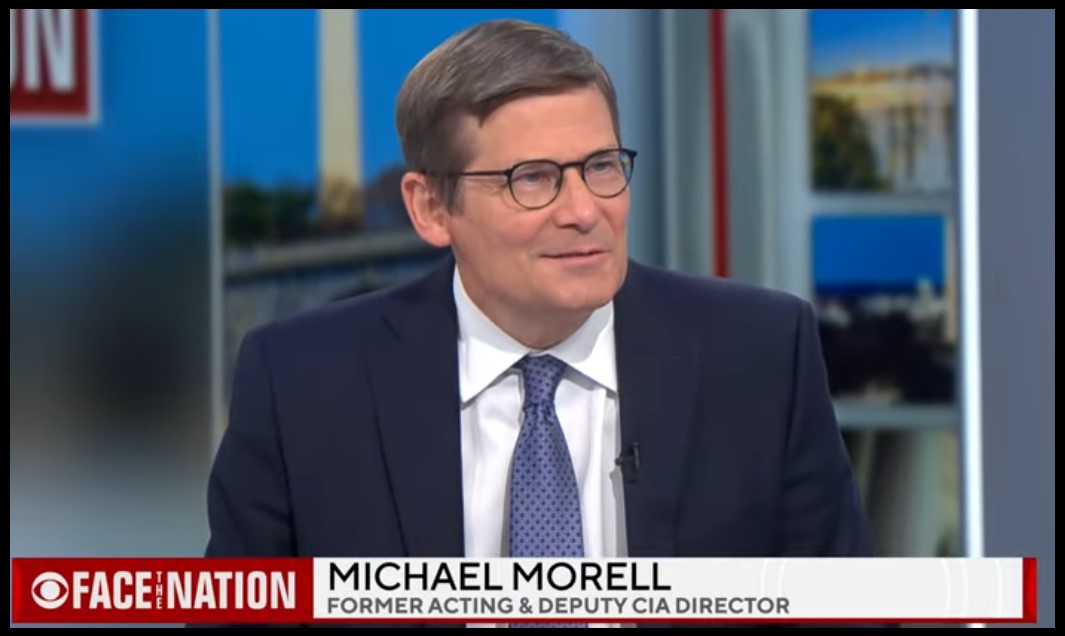
Abraham Lincoln once said, “No man has a good enough memory to make him a successful liar.” Lincoln somewhat underestimated the Mike Morell types of the world, who have become liars as a profession. {Direct Rumble Link}
Mike Morell was the former acting CIA director in the aftermath of Benghazi when General David Petraeus was removed from the position. Morell is a Clinton crony who not only constructed the infamously fabricated talking points used by Susan Rice to blame the Benghazi attack on a YouTube video, Morell was also the guy moved into position to protect Clinton in the aftermath of the terrorist attack, and then years later in July 2016 the same Mike Morell penned the first Trump-Russia thesis in the New York Times.
After successfully doing his job to protect Clinton in the aftermath of Benghazi, Mike Morell was hired by CBS President David Rhodes. Obama’s Deputy National Security Advisor Ben Rhodes is David’s brother. Mike Morell now continues to work for CBS and today he declared a likelihood that a “U.S. or western interest” is likely to be attacked by an al-Qaeda affiliate in 2023.
Posted originally on the CTH on January 1, 2023 | Sundance
This is an interesting interview in that International Monetary Fund Globalist Director Kristalina Georgieva seems to be laying the landscape for some truthful economic news to surface on the geopolitical level; albeit keeping up the globalist pretenses around western collective energy policy.
One of the more important points Mrs. Georgieva hits on is the reopening of China, from district level COVID bubbles as a containment feature, and the likely impact it will have on global supply chains. Mrs. Georgieva is correct on this issue.
China continued operating their industrial manufacturing base (despite COVID) because they built strict covid isolation bubbles around their industrial sectors geographically. However, with China lifting those isolation bubbles, there is a great potential for the manufacturing sectors to be hit hard by short to medium term virus outbreaks. This could/will have the potential ripple effect of global supply disruptions.
In an ironic twist, ‘deglobalization’ is now a 2023 catchphrase as various nations realize having their supply chains both dependent and interconnected is not good when there are interruptions. A new discussion centering around being dependent on China is the specific issue now being raised. However, the globalists are isolating their viewpoints only to raw material resourcing and development. WATCH:
[Transcript] -MARGARET BRENNAN: I want you to take us around the world and kind of us give us that global view. Let’s start in China. China has been this hub of cheap manufacturing for the world, we are all so dependent on it but right now it looks like COVID cases are exploding as they start pulling back those zero COVID restrictions. What will that mean for the global economy Longterm and short-term?
GEORGIEVA: In the short term, bad news. China has slowed down dramatically in 2022 because of this tight zero COVID policy. For the first time in 40 years China’s growth in 2022 is likely to be at or below global growth. That has never happened before. And looking into next year for three, four, five, six months the relaxation of COVID restrictions will mean bush fire COVID cases throughout China. I was in China last week, in a bubble in the city where there is zero COVID. But that is not going to last once the Chinese people start traveling.
MARGARET BRENNAN: Because they also- they don’t have an effective vaccine right now.
GEORGIEVA: The- the vaccinations fall behind. They have not worked on anti-viral treatments and how that can be offered to people, and so they will go through this tough time. If they stay the course, and this is our advice, stay the course, over time they would be able to catch up with the rest of the world, both in terms of focusing their vaccinations, bringing mRNA vaccines into China, expanding antiviral treatment, and the economy would function. But for the next couple of months, it would be tough for China, and the impact on Chinese growth would be negative. The impact on the region would- would be negative. The impact on global growth would be negative.
MARGARET BRENNAN: Because this is the second-largest economy in the world, and we’ve learned how dependent the world is on the Chinese supply chain. So do you expect then, a domino effect? Will inflation get worse, because all of a sudden there aren’t workers healthy enough to go to factories in China?
GEORGIEVA: We expect that there would be counterweight from the sheer opening of the economy, because up to now, the biggest impact on global value chains came from restrictions due to COVID. When you close down a big city or a big port, the repercussions for the economy is- are significant. Now, we would have the impact of people getting sick, not going to work, but the economy would be open. So the expectations we have for China is to gradually move to a higher level of economic performance, and finish the year better off than it is going to start the year. But you’re absolutely right, the world has relied on China’s growth for a long, long, long time. Before COVID, China would deliver 34, 35, 40% of global growth. It is not doing it anymore. It is actually quite a stressful for the- for the Asian economies. When I talk to Asian leaders, all of them start with this question, what is going to happen with China? Is China going to return to a higher level of growth?
MARGARET BRENNAN: You’ve said that you fear that we are sleepwalking into a world that is poorer and less secure because of a split in the global economy between the US and China. What do you mean by that? Do you see efforts here in Washington to stop it?
GEORGIEVA: It is very easy to reflect on the benefits of the world being more integrated. When we look back over the last three decades, the world economy tripled because of this reliance on an integrated world economy. Who benefited the most? Emerging markets and developing economies, they quadrupled. But rich countries also benefited, they doubled in size of the economy. So we have to be careful not to throw the baby out with the bath water. Yes, the way we have operated created excessive dependency in global chains. We were too focused on costs, how can we make products cheaper. And COVID and then the senseless war Russia started against Ukraine has shown that this is not enough. We cannot just concentrate on what is cheaper. We have to think of the security of supplies and that means diversify the sources of products that make the economy function well, lifting up the level of cost. That economic logic is not only appropriate, it is a must to follow. But we shouldn’t go beyond. We shouldn’t say, okay, we break the world into blocks, one works here, the other one works there because the costs are very, very high. We calculated that just trade, limiting trade into two blocks, would chop $1.5 trillion from the global GDP year after year after year.
MARGARET BRENNAN: If you tried to separate the US and China?
GEORGIEVA: You separate- you separate them, there is an excessive cost. So the logic should be where for security reasons there has to be careful recalibration of supply chains, do it, but don’t go beyond- don’t go into benign areas of products that have no strategic significance but they benefit the US consumer, they benefit the world economy. And this is what we are arguing for, don’t go in a direction in which this separation would make everybody poorer and the world less secure.
MARGARET BRENNAN: So you’re telling Beijing and Washington, figure it out. You can’t be in conflict.
GEORGIEVA: What we have seen in Bali is an indication that this rationale–
MARGARET BRENNAN: You’re talking about the G20 meeting–
GEORGIEVA: The G20 meeting in Bali, when the two presidents, President Biden and President Xi Jinping, met, they spent three and a half hours discussing exactly that. Where is the point of contact that makes both countries better off? And where is that- that there are differences that cannot be bridged and therefore we have to keep them–
MARGARET BRENNAN: The US is trying to block some Chinese technology companies from doing business here. They’re taking measures that are drawing some pretty bright lines between the US and China. Is that tolerable?
GEORGIEVA: We always prefer countries to seek their common interest in economic integration. And when you start breaking the interactions that are based on fair trade, you harm your own people, you not only harm the- the Chinese and therefore it has to be thought through very carefully. Again, I want to be very clear, some diversification of supplies for the security of supply chains is necessary. COVID taught us this lesson, the war taught us this lesson. So the U.S. is right to look into some areas where strategically they need to guarantee the functioning of the U.S. economy without interruptions. But do that keeping in mind the interests of the American people that would like to still have prices moderating, and actually, when we think about prices, one good news we have for 2023 is that towards the end of the year, we do expect inflation to trim down. So don’t take actions that may be contrary to that trend.
MARGARET BRENNAN: But you are predicting inflation to slow to six and a half percent from about 7%. Is that right?
GEORGIEVA: Well, towards the end of the year, we- we project it would go even further down towards the end of 2023, provided central banks stayed the course. Our big worry is that with the economy slowing down globally, we are projecting global growth to go down to 2.7%, maybe even lower next year. Remember, 2021, it was 6%. It dropped to 3.2 this year, 2022. And it will continue to drop down if central banks get the cold foot and say, ‘oh, my god, growth is slowing down, let’s slow down the fight against inflation.’ We risk then inflation to be more persistent. So our message is to central banks, you have to see credible decline in inflation and only then you can think about re-calibrating rate policy.
MARGARET BRENNAN: One of your IMF researchers gave a pretty dire prediction. Overall this year, shocks will reopen economic wounds that were only partially healed post-pandemic. In short, the worst is yet to come and for many people, 2023 will feel like a recession. What do you need to brace for?
GEORGIEVA: The- this is- this is what we see in 2023. For most of the world economy, this is going to be a tough year, tougher than the year we leave behind. Why? Because the three big economies, U.S., E.U., China, are all slowing down simultaneously. The US is most resilient. The U.S. may avoid recession. We see the labor market remaining quite strong. This is, however, mixed blessing because if the labor market is very strong, the Fed may have to keep interest rates tighter for- for longer to bring inflation down. The E.U. very severely hit by the war in Ukraine. Half of the European Union will be in recession next year. China is going to slow down this year further. Next year will be a tough year for China. And that translates into negative trends globally. When we look at the emerging markets in developing economies, there, the picture is even direr. Why? Because on top of everything else, they get hit by high interest rates and by the appreciation of the dollar. For those economies that have high level of that, this is a devastation.
MARGARET BRENNAN: And I want to- I want to come back to you on that. And just to explain that for some of our listeners, a stronger dollar, it’s good for Americans when they go shopping abroad. It’s not good for poor countries who have taken out loans, for example, and borrowed money in dollars. And according to the IMF, 60% of low income countries are in distress because of this- this debt. So what does that look like? Do you- do you see governments collapsing with defaults? Does that bleed into the global financial system? I mean, how much of a contagion does this become?
GEORGIEVA: So far the countries that are in that distress are not systemically significant to trigger a debt crisis. Let’s just look at the map, which are these countries? Chad, Ethiopia, Zambia, Ghana, Lebanon, Surinam, Sri Lanka, very important for their people that we find the resolution to the debt problem, but the risk of contagion is not as high. However, if that list continues to grow, and let’s remember, 25% of emerging markets are trading in distressed territory, then the world economy may be for a bad surprise. And this is why at the IMF, we are working very hard to press for debt resolution for these countries and we have engaged the traditional creditors, the Paris Club, the non-traditional creditors, China, India, Saudi Arabia. I would call this very simple: urgency, we have to act. When I look at the- the debt of the world. Yes, we have to be concerned. During COVID, what did we do? Everywhere governments borrowed, rightly so, to help their people.
MARGARET BRENNAN: Money was cheap.
GEORGIEVA: Money was cheap, and we prevented a collapse of the world economy. That was the right thing to do. But once Russia invaded Ukraine and that added impetus to inflation, money is not- not cheap anymore. So what is the advice we give to governments? Focus on your budgets, make sure that you have sufficient revenues to collect and that you spend very wisely.
MARGARET BRENNAN: That’s good advice, but it’s not always easy politics to follow that advice, as you know–
GEORGIEVA: Of course it is not.
MARGARET BRENNAN: And so that’s why I want to- if- if you can explain for our viewers. You know, we spoke to the CEO of JPMorgan Chase, Jamie Dimon, recently, and he said he sees the global risk as explosive right now. He was saying things like migration, energy, national security, liquidity in the banking system, war, these are all the knock on effects of a government not being able to pay its bills and not being able to deliver for its people. Is that what you are seeing too?
GEORGIEVA: Well, what we’re seeing is the world has changed dramatically. It is a more shock prone world. The lessons we learned from the last couple of years are that no more we operate with relative predictability of what the future would bring. And these shocks COVID, the war, costs of living crisis, they compound their impact. What does that mean for governments? First and foremost, it means that we need to change our mindset towards more resilience, more precautionary actions. And at the IMF, this is what we tell our members. Act early, don’t wait until the problems deepen. And for those who need help, this is why we exist for the developing countries. The fund is a source of resilience and I am- I am very pleased that many of our members are coming to us. Just since the war started we got 16 countries coming for programs to the IMF, $90 billion in support for these countries. And right now we have 36 requests. So that acting early, when you see trouble, look for ways to strengthen your fundamentals, to have buffers to protect you and your people. This is the advice we give to governments. For those who don’t know the IMF, we were created from the ashes of the Second World War to stabilize the world economy. And at a moment like this, we come strong to help our members. My message, don’t think that we are going to go back to pre-COVID predictability. More uncertainty, more overlap of crises wait for us. Rather than crying for the time we had, we have to buckle up and act in that more agile, precautionary manner I described.
MARGARET BRENNAN: I want to make sure I get to Ukraine because I know we’re running out of time. You’ve said- excuse me- you’ve said the single most negative factor in the global economy is the war in Ukraine. And Vladimir Putin says this is going to go on for some time. President Zelensky said they need $55 billion in foreign support next year. He expects $20 billion from the IMF, is he going to get it?
GEORGIEVA: We are working on providing support for Ukraine. So far, out to the international financial institutions, we have provided the largest amount of financing for Ukraine, $2.7 billion in emergency financing, and we are working for 2023 to be a significant part of the support for Ukraine. I expect that sometime early in the year we will go to our board with the request. We have assessed the needs of Ukraine to range somewhere between three and five billion dollars a month. What Putin did with destroying critical infrastructure in Ukraine, this is horrific, and it means that in the next months the country would be more on the high end of this range because it is put in an awful position to have to restore access to electricity, to heat, to water. I have relatives in Ukraine. What I- what I know from them is it is cold, it is dark, and it is scary. Bombardments of civilian areas continue. What I also want to say is that Ukraine has proven to be remarkably resilient. Ukrainian economy is functioning. Pensions are being paid. When there is bombardment, restoration of energy, water, heat is done very quickly and we see revenues collected in Ukraine in a very disciplined manner to support the functioning of the country.
MARGARET BRENNAN: So the government’s not going to collapse?
GEORGIEVA: The government is very well functioning under incredibly difficult circumstances. No, they’re not going to collapse. And then the other thing that is so remarkable is actually the world has proven to be more resilient than we feared, a year in the beginning of the year. We look at the response to the energy shock in Europe, and Europe is moving towards independence from Russia decisively. Yes, there will be a tough winter, maybe the next one would be even tougher, but freedom from dependence on Russia is coming. It is going to be there.
MARGARET BRENNAN: I want to ask you two questions before we go. How do you describe the state of U.S. economics and politics?
GEORGIEVA: The US economy is remarkably resilient. Decision making in the US because of the way the political set is at the moment, it is more difficult. But nonetheless the US has taken some very important steps that are helping to the US economy. Like the child tax-
MARGARET BRENNAN: The tax credit. It expired.
GEORGIEVA: The credit that is it. It is contributing so significantly to reducing poverty in the US, like the infrastructure bill, like the Inflation Reduction Act. These are things that are bringing more dynamism in the US. Good for the US, good for the world. And of course staying on that course is going to be more challenging. But I do hope that the US is not going to slip into recession despite all these risks. We expect one third of the world economy to be in recession. And yes, as you said, even countries that are not in recession, it would feel like recession for hundreds of millions of people. But if that resilience of the labor market in the US holds, the US would help the world to get through a very difficult year.
MARGARET BRENNAN: And as I let you go, my final question is what leaves you hopeful in 2023?
GEORGIEVA: What leaves me hopeful is that I know when we work together, we can overcome the most dramatic challenges. In 2020, the world came together in the face of tremendous threat and was able to overcome this threat. In 2023 we have to do the same. And in this world of ours, of more frequent and devastating shocks, we have to hold hands, we have to work together. And my institution is there to bring together economic policymakers so we can be wise and persistent in the face of truly dramatic challenges we face.
MARGARET BRENNAN: Madam managing Director, thank you for your time this morning.
Posted originally on the CTH on January 1, 2023 | Sundance
The New Year brings a look of forward-looking economic perspectives from major financial institutions. Unfortunately, if the perspective of Bank of America Chief Economist Michael Gapen is reflective of the larger institutional analysis, the financial pretending is anticipated to continue.
[Side Note: Notice how they will all start talking about ‘deglobalization’ in 2023. There’s a reason for that that I will touch on in the IMF interview to follow]
Appearing on Face the Nation Gapen accurately indicates the U.S. housing market is already in a steep economic recession, housing prices falling rapidly with a considerable amount of distance to go (-30% range), and the overall housing market will likely be in this situation for around two years. On a macro level the Bank of America indicators line up with the general housing trajectory. From a lending standpoint, Gapen would have specific insight.
Beyond the housing sector, Mr. Gapen starts to get sketchy. He anticipates inflation taking 24 to 36 months to lower to the norm 2% range. That is generally in line with CTH expectations; however, nowhere in the analysis does Gapen even mention energy costs and the overall impact to the economy from energy policy. You will note this absence will be present in almost all financial punditries. Mentioning “energy policy’ as a cause of economic pain is a third rail amid his peer group; it is simply not permitted.
Astute readers will note the great financial and economic pretending that surrounds the Build Back Better and Green New Deal climate change agenda will not be discussed by anyone, ever. The massive price impacts, the supply side inflation pressures, are baked into the western global economic outlooks. It is strictly verboten to talk about climate change policy being stopped, modified, reversed or even, well, gasp, removed. WATCH:
[TRANSCRIPT] – […] BANK OF AMERICA CHIEF ECONOMIST MICHAEL GAPEN: Happy New Year as well. Thank you for having me on.
MARGARET BRENNAN: You know, a majority of voters polled by The Wall Street Journal say that the economy is going to look and feel worse in 2023. What is your forecast?
GAPEN: So I think that’s probably true. I think we’re in a situation where the risk of recession is high, may not be a deep and prolonged one. But we’re in a situation where the economy has recovered very rapidly from- from COVID, and it’s come with a lot of inflation. And the Federal Reserve is trying to slow down the economy, to bring inflation down. And in the past, more often than not, that’s coincided with some sort of recession in the US economy and the U.S. labor market. It’s not baked in. It’s not for certain. We may be able to avoid it, but I would agree that the outlook by most people who sit in the position that I do think 2023 could be a difficult year for the U.S..
MARGARET BRENNAN: So we may be able to avoid recession?
I have created this site to help people have fun in the kitchen. I write about enjoying life both in and out of my kitchen. Life is short! Make the most of it and enjoy!
This is a library of News Events not reported by the Main Stream Media documenting & connecting the dots on How the Obama Marxist Liberal agenda is destroying America