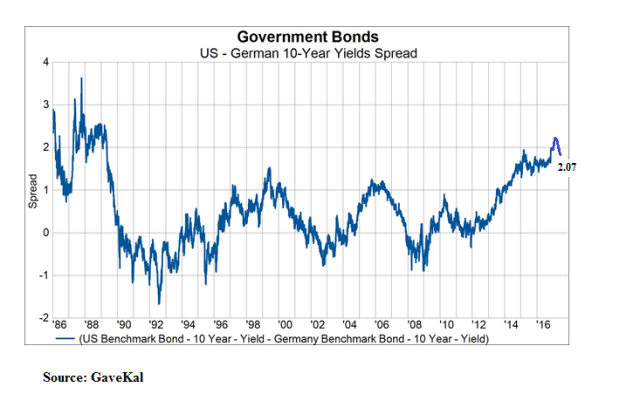
The Broken Bond Market – All Noise, No Signal


Tyler Durden's picture

Via Global Macro Monitor blog,

The Fed tightens on Wednesday and bonds rally.  What the hay?

GaveKal, Jeff Gundlach,  and Jim Bianco nailed it in that every spec and their mother are/were short 10-year Treasuries.
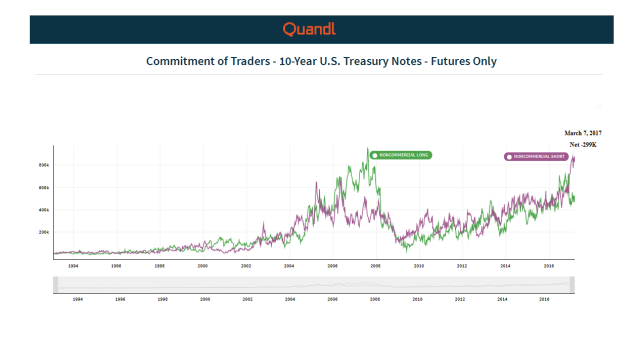
Source: Quandl (see here for interactive chart)

But this is only a small part of the story:  The global bond markets are broken.

There are no signals, there is no noise.  Trying to infer any sense of economic or financial information from bond yields is futile.

QE Distortion

The intervention into the bond markets by central banks through quantitative easing (QE) in the big four sovereign bond markets – U.S., Japan, Eurozone, and UK – has created a structural shortage of risk-free instruments and distorted the most important price in the world — the yield on 10-year hard currency sovereign bonds.

Furthermore, past QE in the U.S, coupled with the recycling of foreign capital flows back into the U.S. bond market, has, in particular, created an acute structural shortage of longer-term Treasury securities.  The totality of short positions of the fast money in both the cash and derivatives market are probably a much larger proportion of the effective float of longer-term marketable Treasury securities than what the market currently perceives.  Hence the stickiness of U.S. bond yields.

Fed and Foreign Ownership of the U.S. Yield Curve

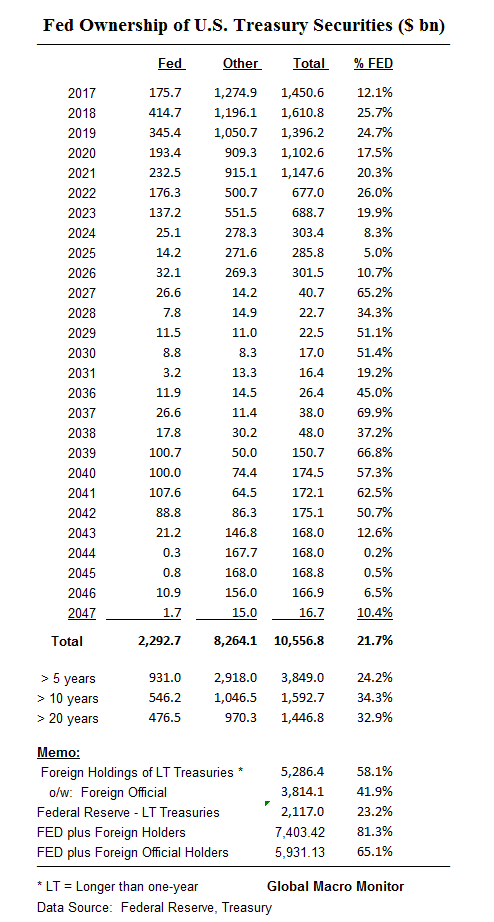
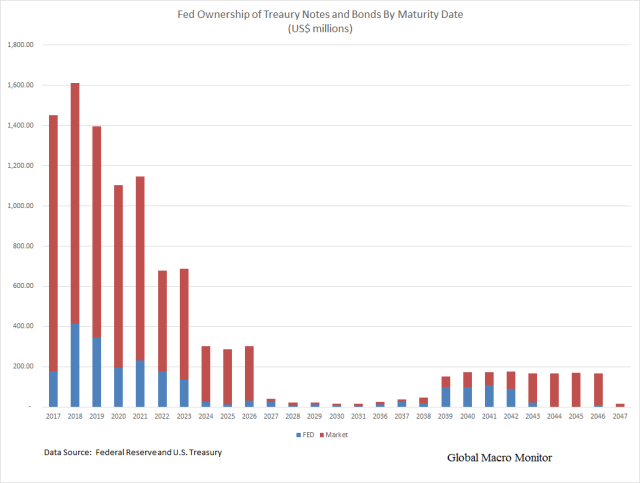
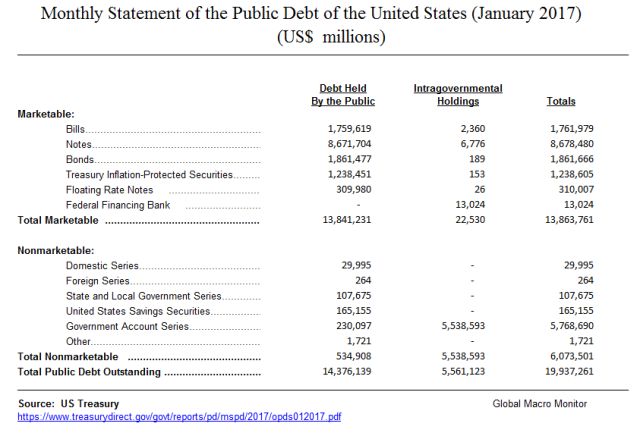
The table and chart below illustrate just how small the actual float of longer-term marketable U.S. Treasury securities is available to traders and investors.  The data show the Fed owns about 35 percent of Treasury securities with maturities 10-years or longer.  Note the data only include notes and bonds and excludes T-Bills.

The Fed’s holdings combined with foreign ownership of longer maturities — more than 1-year — exceeds 80 percent of marketable Treasuries outstanding.   The Fed combined with just foreign official holdings, mainly, foreign central banks,  is 65 percent of maturities longer than 1-year.  Thus, almost 2/3rds of tradeable Treasuries longer than 1-year are held by entities with no sensitivity to market forces.

Note, the Treasury International Capital  (TIC) data does not break down foreign holdings by year of maturity, only by short-term and long-term – that is, greater than 1-year.
.

.
Foreign Holding of Treasuries

We hear a lot these days about a 1994 bond market debacle.  We lived through that bond bear and it wasn’t fun.   However, the microstructure of the Treasury market  is entirely different today than it was back then.

First,  the Fed did not hold long-term Treasuries.   Second,  foreign holdings of Treasuries were only about 15 percent of the outstanding debt versus around 50 percent today and everybody, including, Ross Perot, who said the trade was “a no brainer”,  were levered long riding the yield curve – short short-term, long long-term.

Foreign inflows,  mainly the result of the recycling of U.S. current account deficits,  resulted in Alan Greenspan’s bond market conundrum and the Fed losing control of the yield curve just prior to the 2007-08 financial crisis.

In this environment, long-term interest rates have trended lower in recent months even as the Federal Reserve has raised the level of the target federal funds rate by 150 basis points. This development contrasts with most experience, which suggests that, other things being equal, increasing short-term interest rates are normally accompanied by a rise in longer-term yields.

…In the current episode, however, the more-distant forward rates declined at the same time that short-term rates were rising. Indeed, the tenth-year tranche, which yielded 6-1/2 percent last June, is now at about 5-1/4 percent. During the same period, comparable real forward rates derived from quotes on Treasury inflation-indexed debt fell significantly as well, suggesting that only a portion of the decline in nominal forward rates in distant tranches is attributable to a drop in long-term inflation expectations.

– Alan Greenspan,  Feb 2005

A paper published by the Federal Reserve Board (FRB) in 2012 estimated the impact on interest rates of the capital flow recycling into the U.S. bond market,

We find that a $100 billion increase in foreign official inflows into U.S. Treasury notes and bonds lowers the 5-year yield by roughly 40 to 60 basis points in the short run. However, our VAR analysis shows that in the long-run, when we allow foreign private investors to react to the effects induced by a shock to foreign official holdings, the estimated effect is roughly -20 basis points per $100 billion. Putting these results into context, between 1995 and 2010 China acquired roughly $1.1 trillion in U.S. Treasury notes and bonds. A literal interpretation of our long-run estimates suggests that if China had not accumulated any foreign exchange reserves during this period, and therefore not acquired these $1.1 trillion in Treasuries, all else equal, the 5-year Treasury yield would have been roughly 2 percentage points higher by 2010. This effect is large enough to have implications for the effectiveness of monetary policy. – FRB

Extrapolating the above analysis to the current stock of foreign official Treasury holdings of around $4 trillion leads to nonsensical results, such as the 5-year yield should be 800 basis points higher than it is today.   Obviously, the analysis should truncate the dependent variable – 5-year note yield — and ceteris paribus (other things being equal) does not hold in the real world.

But we should not miss the article’s main point that market interest rates would be much higher if not for foreign central bank interventions into their FX markets and the recycling of those reserves back into the Treasury market.    We take the above analysis seriously but not literally and wonder if the Trump Administration considers it when they rail on “so-called” currency manipulators.

The Yield Curve During Monetary Tightening

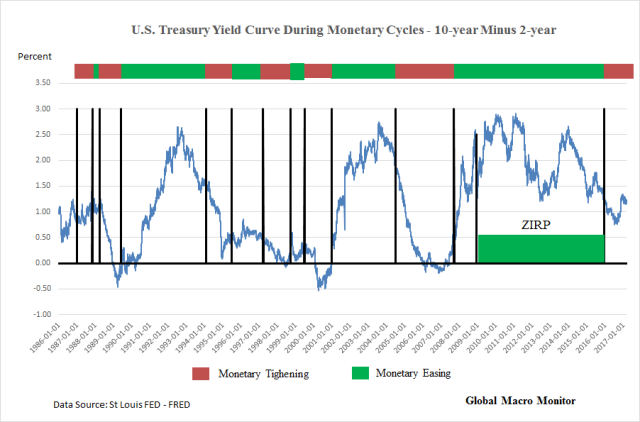
We have looked at the data and constructed some charts that show that in monetary tightening cycles in the U.S. the yield curve (10-2 years) usually flattens.
.

In only two of the past six prior tightenings did the 10-year bond rise in yield from the day of the first tightening to the day of the first easing.  This is entirely possible due to the fact the Fed often “tightens until something breaks” and the bond market front runs the expected easing cycle.

During the 2004-07 tightening cycle,  the era of the Greenspan bond market conundrum,  for example, the 10-year yield managed to rise only a maximum of 64 bps during the entire cycle from a beginning yield of 4.62 percent to a cycle high yield of 5.26 percent.   This as Greenspan raised the fed funds rate by 4.25 percent, from 1.0 percent to 5.25 percent.

Was the market forecasting the coming financial crisis?   Hardly.

Alan Greenspan blames the Fed’s loss of control of the yield curve, mainly due to the recycling of capital flows by foreign central banks,  as a major cause of the housing bubble.  Notice the importance of the 10-year yield on the allocation of resources and on how its distortion can be at the root of financial and economic bubbles.

This Time Is Different

Those dreaded words, “this time is different.”   We should warn readers that this time is truly different, however.   When the Fed first raised interest rates in December 2015, for example, the 10-year yield was at 2.24 percent and more than 50-75 percent lower than at the beginning of any other monetary tightening cycle over the past 30 years.  There are many “unprecedents” in this cycle and therefore more uncertainty.

.

Forecasting With The Yield Curve

Given the technical distortion of the bond market, we find it kind of silly with statements such as “what is the bond market telling us?”   Nothing!

There is no price discovery.  Given the intervention and distortion to bond yields caused by the Fed and foreign central banks, who knows what the right interest rate is for longer-term Treasury securities.

We will never forget the words of a prominent market strategist when rates were super depressed.

“ We’re in a depression. That is what the bond market is telling us.”

Even at the Friday close,  we hear equity traders are worried about why the 10-year yield is so low and fell after Wednesday’s Fed tightening.

Information Feedback Loops

One of just many dangers of the lack of price discovery in the bond market is the potential formation of positive feedback loops, where other markets fail to discount these distortions and act accordingly.   That is, for example, the equity markets sell off because they freak out interest rates are declining when they should be rising.  Or the private sector fails to invest in CapX as they wrongly anticipate an economic downturn because of falling or excessively low bond yields.   Their actions thus become a self-fulfilling prophecy.

A flatter than normal yield curve could also adversely affect bank lending.  Look at how financial stocks have been underperforming recently as the yield curve has flattened about 7 bps this year.

Conclusion

Welcome to Bond Market Conundrum 2.0.

Asset prices are artificially elevated and foreign exchange rates are distorted due to the repression of the risk-free interest rates because of lack of supply.   Capital has been misallocated and the Fed has once again lost control of the yield curve simply by the very fact it owns the yield curve.

Monetary policymakers probably won’t regain control of the yield curve until they begin to reduce their balance sheets and the supply/demand balance moves closer to equilibrium.

That’s when we suspect everybody and their mother will front run the central bank selling and we will have the real bond market debacle some in the market have been expecting. Will or can that day ever come?  We don’t know.

Of course,  governments could go on a tax cut/spending binge and increase the primary supply of government bonds.   Possible but doubtful and a longer term story,  if any.

Until then?   We still believe bonds are in a slow bleed bear market, which will see fits of massive nutcracking short covering, as interest rates slowly drift higher.

Remember,  there are no signals, there is no noise.   Here’s to hoping the markets understand that.

A Few Caveats

The data points presented above should be taken as rough, but good, approximations.  The dates of each source of data may differ and the same is true for the different data sources.

Furthermore, we may be entirely wrong in our conclusions.

Abraham Lincoln used to tell a story as a young Illinois circuit court lawyer when trying to convince the jury to render a verdict in his favor.

The story goes that Lawyer Lincoln was worried he had not convinced the jury during the closing argument of a civil case against a railroad.   The jurors had gone to lunch to deliberate.  Lincoln followed them and interrupted their dessert with a story about a farmer’s son gripped by panic,

“Pa, Pa, the hired man and sis are in the hay mow and she’s lifting up her skirt and he’s letting down his pants and they’re afixin’ to pee on the hay.” “Son, you got your facts absolutely right, but you’re drawing the wrong conclusion.”

The jury ruled in Lincoln’s favor.

Similarly, when looking at data and charts — the facts —  we often draw the wrong conclusion about future direction.

Stay tuned.

Data Appendix
Morgan Stanley: “Only One Thing Will Allow Central Banks To Keep The Party Going”


Tyler Durden's picture

Last week, we presented readers with the latest note from SocGen strategist. Albert Edwards, who explained why after so many years of false rate hike starts, the market not only responded to last week’s hike in a dovish manner – interpreting last Wednesday’s 0.25% hike as a 0.25% rate cut- but as Goldman Sachs showed previously, the dovish reaction was one of the strongest ones since the financial crisis, in other words: “the market no longer believes the Fed.” This is what Edwards said, citing his FX colleague Kit Juckes:

[T]he Fed’s reluctance to send an aggressive tightening signal, instead preferring to again shuffle upwards its dots just slightly, has disappointed markets. But to be fair, the problem isn’t really with the famous dots. It’s with the market, which just doesn’t believe the Fed will tighten as fast as they say they plan to (see left-hand chart below). If the market took the FOMC at their word and discounted a 3% Fed Funds rate at the end of 2019 and beyond, then we’d probably have a 3% nominal 10-year Treasury yield by now.”

That said, a 3% Fed Funds rate would also lead to steep selloff in risk assets as the dividend yield on the S&P, currently at about 2%, would be about 1% below the risk free rate, leading to a wholesale “great rotation” out of stocks.

And while the market may not believe the Fed is ready – and willing – to push rates that high, the relationship also cuts both ways.

As RBC also noted last week, explaining that while the Yellen put is alive and well, the market will simply not tighten financial conditions on its own, forcing Yellen to aggressively hike further… which the Fed may be reluctant to do.

That is the argument in a note released late last week by Morgan Stanley’s credit strategists, who note that while the party is still going strong, some 93 months into the current cycle, it may not continue should the Fed engage in an aggressive rate hike scenario. This is what they say:

At 93 months, the current cycle is already longer than all but two post-war recoveries (out of 12 total). We could certainly debate why this expansion is already longer than normal, but strong growth is clearly not the reason. In fact, quite the opposite – a lackluster economic backdrop for years, leading to massive central bank support,has likely kept the cycle going more than anything else. Last year is a good example. As we show below, early in the year, with oil collapsing and the economic data rolling over, recession risks were seemingly rising. As Exhibit 3 shows, central banks across the globe responded. Even the Fed provided stimulus (verbally) by allowing the market to go from pricing in almost three rate hikes at the end of 2015 to almost zero rate hikes in summer 2016. Markets recovered, and the economic data followed.

What is Morgan Stanley’s conclusion? Simple: for the party to continue, not only must the Fed revert back to its quasi-dovish mode, but for that to happen the recent economic “rebound” has to end (the sooner the better), extinguishing any reflationary impulse, removing the impetus for Yellen to hike aggressively further, and allowing the Fed to remain on hold for an indefinite period of time.  In short: “In our view, for the cycle to last another several years, we want to see more of the same – a continued environment of ‘ok’ growth and low inflation, which allows central banks to keep the party going.”

Hopefully Trump, whose policies threaten to upstage this delicate balance benefitting the 1%, has read the memo.

KOMMONSENTSJANE – FEAR, HOPE AND DEPORTATIONS


This is going to be a tough battle to fix the mess the Democrats have made and who refuse to help fix that disaster.

kommonsentsjane's avatarkommonsentsjane

Fear, hope and deportations

Rosa Maria Ortega near her home in Grand Prairie, Tex., outside Fort Worth. “I voted like a U.S. citizen,” she said. “The only thing is, I didn’t know I couldn’t vote.”

A Texas woman ‘voted like a U.S. citizen.’…

This is a joke – this women is playing dumb – why didn’t she ask at the voting table?

It is time to have a cut off date for “anchor” babies.
The Washington Post

Mary Jordan, Kevin Sullivan

VALLEY VIEW, Tex. — At 4:30 a.m. on a windy Monday, Tamara Estes swallows vitamin B12 for energy and krill oil for her arthritic fingers. Even with her nightly Ambien, she is always up before the sun, getting ready for a job that reminds her of what infuriates her about America.

She drives a school bus on a route that winds through a North Texas neighborhood filled with undocumented…

View original post 2,828 more words

KOMMONSENTSJANE – The ILLUMINATI: REVISITED — Arlin Report


Kommonsentsjane is 100% right

kommonsentsjane's avatarkommonsentsjane

http://www.bibliotecapleyades.net/sumer_anunnaki/reptiles/reptiles115.htm Not an anyone can join membership. They pull new members from around the globe. Global is a popular word for the Illuminati; it’s what they are about; and achieving one ruling class globalization is their goal. They really love celebrities, The Madonnas, Beyoncé, Clooney, Gaga Yes they go gaga over Hollywood […]

via The ILLUMINATI: REVISITED — Arlin Report

Reblogged on kommonsentsjane/blogkommonsents.

It is time for America to put them in their place – they are not elected for any position.  It is of their own making in which they consider themselves so important.  The money they are using for this globalization has been stolen somewhere down the line – one hint is they cheated on their taxes or if they worked for the government – it was through corruption and money gained illegally.

We have to learn to dismiss them, especially the Hollyweeds!

kommonsentsjane

View original post

Sunday Talks: Press Secretary Sean Spicer Interview With Howard Kurtz…


Source: Sunday Talks: Press Secretary Sean Spicer Interview With Howard Kurtz…

Sunday Talks: OMB Director Mick Mulvaney…


Source: Sunday Talks: OMB Director Mick Mulvaney…

Melting Snowflakes?


Its going to be hard but the budget does need to be cut down.

KOMMONSENTSJANE – IS JUDGE AND OBAMA IN THE SAME HAYSTACK #2


It is strange how things work out with Obama isn’t it.

kommonsentsjane's avatarkommonsentsjane

OBAMA WENT JUDGE SHOPPING AND IS STILL WORKING TO HURT THE AMERICAN PEOPLE.

Obama and his shadow government rushes to Hawaii and guess what – his judge roommate at Harvard –  who lives in Hawaii –  rules against the American people’s order by President Trump to keep our country safe.  He did not rule by the Constitution but by Obama, the shadow government, and the judge’s ideology and working against the American people.

Again, as I stated –  we have found that Obama and this judge in Hawaii were friends and room mates at Harvard.  This judge and the judge in Maryland need to be impeached.  Their ruling WAS NOT based on the four corners of President Trump’s order but HEARSAY FROM THE CAMPAIGN AND on Obama’s urging and complicit backing to hurt the American people.

It is time for Congress to do their job and impeach these to two…

View original post 708 more words

Ann Coulter on The Mark Simone Show (3/17/2017) – YouTube


The Coming New Schism within the Catholic Church?


Pope Francis


Just when you though the chaos of the 2016 Elections in the States was unusual, we are witnessing the fragmentation of society at every level and around the globe. There is a trend toward the end of one of these Private Waves and that is the polarization of groups. Yes Democrats and Republicans always fought on Capitol Hill, but the people accepted the election and moved on. This time, there are funds being raised and Obama has refused to leave Washington waging war against Trump and Jarrett is his commander and chief. Europe is polarized between left and right and the French system has completely collapsed so it has become to impossible to forecast a party since they have disintegrated into a free-for-all.

During the 3rd Century, that is when Christianity really took off as well as the Christian Persecutions. There were pagans who blamed the Christians for making the gods mad and they were thus punishing the Romans. The Christians argued that the pagans were praying to false gods. Even religion went into this polarization phase. We are witnessing that between the extreme Muslim sects and Christianity right now, but we are also witnessing this trend within each religion.

The Catholic Church is no exception. Pope Francis has caused a polarization among Catholics that is starting to bubble to the surface. On the one had, Pope Francis has divided the Church not furthered its existence. He has kick-started the polarization directly within the Catholic world dividing into warring political camps as we see in politics. The Pope is seen as a hero by progressive Catholics and a scourge of of the Earth by conservatives. His political statements have done far more damage to religion than most people are even willing to look at.

Pope Francis is regarded by conservatives as a very dangerous man for he is embracing Marxism and the socialist agenda that subjugates the individual freedoms elevating the state first, people second. The Pope has spoken against globalized capitalism and he has even written a major encyclical on the environment. He has championed migrants in Europe only fueling the crisis within Europe and sending conservatives away from attending church. The Pope has seriously distorted being charitable with forced state action, which is not unjustified and a denial of basic freedoms. He has been embraced by socialists seeking to ex-appropriate other people’s money for their version of what the world should be. Pope Francis has emerged as the champion of “progressives” clearly in the camp of Karl Marx. This has begun to cause the Catholic Church to be identified with the progressive left and that has led to conservatives feeling they just do not fit in the Catholic Church. His comments are crossing the line between Church and State.

Pope Francis seems to desire overturning the Catholic doctrine saying that the faithful who are divorced and civilly remarried lacking an annulment must refrain from receiving holy communion. In this area, he is also very progessive but has not quite crossed that line to make it official. Many fear that the Pope is looking to overturn Catholicism’s ancient and countercultural teachings on sexual ethics. This is adding wood to the fire that some see the beginning of a new schism within the Church in the future.

Back in 2014, Pope Francis fired the German bishop for spending too much on his private residence of about $43 million. Bishop Franz-Peter Tebartz-van Elst became known as the “bling bishop” for being extravagant. Pope Francis fired him for he was not in alignment with his vision of a “poor church for the poor.”

Marx Cardinal_ReinhardThe Vatican announced Wednesday the pontiff had accepted the resignation of Bishop Franz-Peter Tebartz-van Elst, who had reportedly spent some 31 million euro ($43 million) on a new residence and complex in his Limburg diocese in western Germany while at the same time reducing salaries for staff in the name of financial austerity.

Cardinal Reinhard Marx in Germany effectively said that Catholics could not vote for the AfD. The Cardinal has helped to unbalance the Catholic Church going so far as basically offering support to Chancellor Angela Merkel, who created this refugee crisis to further her own political standing when she was criticized for being harsh of Greece. What many are not looking at is there has been a decline in Christianity became many see this an political and hypocritical on far too many levels.

Pope Francis has admitted that there is a “hemorrhage” of priests and nuns from the Catholic church. There has been a loss in clergy. The Pope commented on how nuns and priests have just quit claiming that modern society discourages lifelong commitments as in the soaring divorce rate. He further said that people conduct their lives based on “a la carte” choices. But there has been a decline in attending church that is not restricted to just the Catholics.  This is a trend which is infecting Christianity as a whole, and is reflected in the Podesta emails revealed the Democrats disliked Catholics and Evangelical Christians. Hillary’s staff said Catholics are “severely backwards” and further demeaned them saying they don’t know “what the hell they’re talking about.”Then you have Democratic leader Nancy Pelosi who recently said: “They pray in church on Sunday and then prey on people the rest of the week.”


Some are attributing this to a new Age of Populism. Pope Francis seems to have embraced being a populist: plain-spoken, with little regard for fusty rules and institutions, and occasionally vicious with political adversaries. Strangely, these are attributes one sees in modern politicians. Will his legacy simply be that he is part of the populist insurgency we see around the world? Pope Francis has criticized Trump for his anti-immigration bans. However, if Trump is a populist, and career politicians try to dismiss, is Pope Francis a populist to the opposite side?