Steve Bannon: “This Is Nothing But The Francis And The Deep State Of The Church Rolling With The Happy Face Of Prevost”


Posted originally on Rumble By Bannon’s War Room on: July 9, 2025, at 9:00 pm EST

Episode 4618: Start Of The Third World War; Deep State Lives


Posted originally on Rumble By Bannon’s War Room on: July 9, 2025, at 1:00 pm EST

Former UK Prime Minister Returns to Goldman


Posted originally on Jul 10, 2025 by Martin Armstrong 

Sunak Rishi

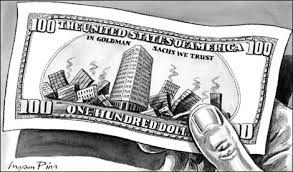
The door continues to revolve at Goldman Sachs as former UK Prime Minister Rishi Sunak announced he is returning to the firm as a senior advisor. Goldman Sachs has successfully penetrated governments globally. The revolving door is deep, systemic, and a clear conflict of interest that will never be addressed.

“I am excited to welcome Rishi back to Goldman Sachs in his new capacity as a Senior Advisor,” David Solomon, chairman and CEO of Goldman Sachs, said in a statement. “In his role, he will work with leaders across the firm to advise our clients globally on a range of important topics, sharing his unique perspectives and insights on the macroeconomic and geopolitical landscape,” he added. Rishi formerly worked for Goldman before entering the UK parliament in 2015. He then went on to hold numerous positions of power, including acting as the nation’s finance minister. In fact, Rishi is STILL a member of the UK parliament even though he stepped down from his role as the leader of the Conservative Party.

Rishi attempted to return to Goldman this past May but a government watchdog agency insisted he wait a year as his advise could “overlap” with his political obligations and his “appointment could be seen to offer unfair access and influence within the UK government.”

That is how Goldman operates. The Revolving Door Project created an Independent Federal Agencies Leadership Tracker to show how often government employees swing back and forth between their positions at Goldman and the government. This is a global issue that spans across party lines.

GoldmanSachs

There has NEVER been any investigation of former Goldman Sachs people who take strategic government positions and alter policy only to leave. Robert Rubin ushered through the repeal of Glass-Steagall and resigned. Hank Paulson saved AIG, whose default would have taken down Goldman, while he eliminated two top Goldman competitors over who had the authority to bailout Lehman and Bear. There was no authority to bail out an insurance company operating in London, no less, to skirt US regulation. Even the seizure of our former company, Princeton Economics, was run by a court-appointed receiver who was a full-time board member of Goldman Sachs – Alan Cohen.

Yet, the burning question is simple. Is Goldman or its people going just too far? Their “former” people seem to be controlling the world financial system. Why is that so many people come from the same firm? Nobody will investigate because Goldman is simply one of the too big to jail and otherwise known as the Untouchable.

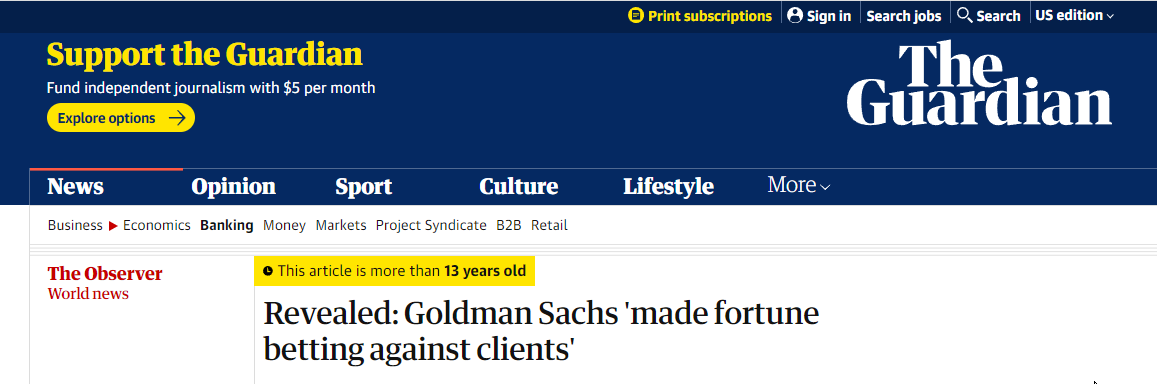
Goldman traded against clients

It would be very nice if someone simply conducted an investigation to see what perks these people collect after they leave government service. But why should anyone do that? Everyone in Washington and the Department of Just Us dreams of getting a job at Goldman. Every charge filed against Goldman has been dropped or paid off. They not only control the politicians but also every regulatory agency.

Again, Goldman has infiltrated every single government. It helped in structuring the euro, for example, and was accused of hiding the debt of Greece to permit it to enter the EU. Luckily Petros Christodoulou worked for the nation’s public debt management agency and led the National Bank of Greece after working for Goldman Sachs.

Mario Draghi, former PM of Italy, President of the European Central Bank, and Governor of the Bank of Italy worked as the Vice Chairman at Goldman Sachs International. Former Prime Minister of Italy and EU Commissioner Mario Monti was an international adviser at Goldman. Again, another former Italian Prime Minister, Romando Prodi, worked for Goldman and later became the President of the European Commission.

Revolving Door

Former European Union leader José Manuel Barroso went back and forth from Goldman to politics. Canada’s Mark Carney is a former employee. In the US, you have Robert Rubin, Gary Gohn, Steve Mnuchin, Jon Corzine, Jim Himes, Steve Bannon – the list goes on.

Germany’s Alice Weidel is called far-left and anti-establishment for being the head of the AfD but she too is a former Goldman employee. Malcolm Turnbull, who previously headed Goldman Sachs Australia, later became the Prime Minister of Australia and Minister for the Environment. Montenegro’s PM Milojko Spaijic is Goldman, as is Sweden’s Minister of Finance Erik Asbrink and Nigeria’s Minister of Finance Olusegun Agana. The head of international affairs at Goldman, Robert Zoellick, even went on to become the President of the World Bank and US Trade Representative, Deputy Secretary of State.

The revolving door is never-ending. It seems like it’s only a matter of time before the conspiracy theories finally give up on bashing the Rothschilds and open their eyes to who really has the power to be a mover and shaker.

Ancient Rome’s Migrant Crisis


Posted originally on Jul 8, 2025 by Martin Armstrong 

GothMigration

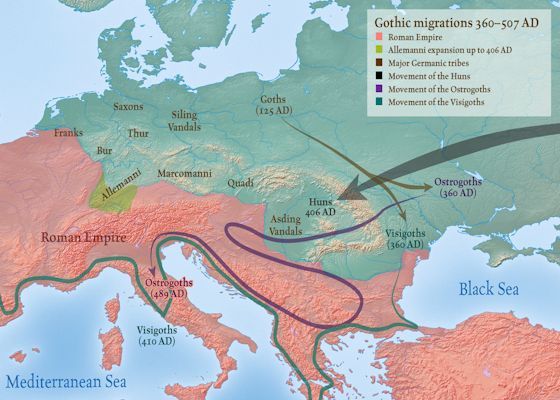
The globalists refuse to declare the migrant crisis an “invasion,” but we have history’s guidance to show us what happens when an unsustainable number of people enter a nation. The Goths, a non-military group considered migrants, are a perfect example. These men, women, and children sought refuge within the Roman Empire. This was not an invading army but rather a fleeing population seeking safety from the Huns. The Goths, long-time foes of the Romans, appealed to be admitted to Roman territory due to the threat they faced and needed to seek asylum. This event led to significant consequences and marked a turning point in the history of the Roman Empire.

The great Gothic migration involved hundreds of thousands of men, women, and children. While, to some degree, the growing unrest in the East pushed them southward, there is also little doubt that the border defenses of the Roman Empire had also been seriously weakened by the political instability and economic pressures that were building within Rome itself. Of course, the rumor of great plunder and riches available in Roman territory acted like a magnet much in the same way as the rumors of streets paved in gold in America prompted great European migrations during the 19th and early 20th centuries or the outdated stereotype of the American Dream.

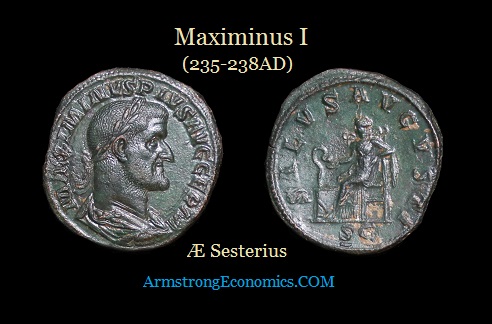
Maximinus I 235 238AD AE Sesterius R

By 238 AD, the Gothic position was so threatening to the Roman Empire that Emperor Maximinus was forced to pay them vast amounts of tribute, similar to how countries currently pay all expenses for migrants. While his aim may have been to buy time, this demonstrated weakness on the part of the Romans, who were still in the middle of internal political struggles for power. Internal imperial rivalries ultimately defeated Maximinis. Within less than four years thereafter, the Goths began a series of raids along the Danube.

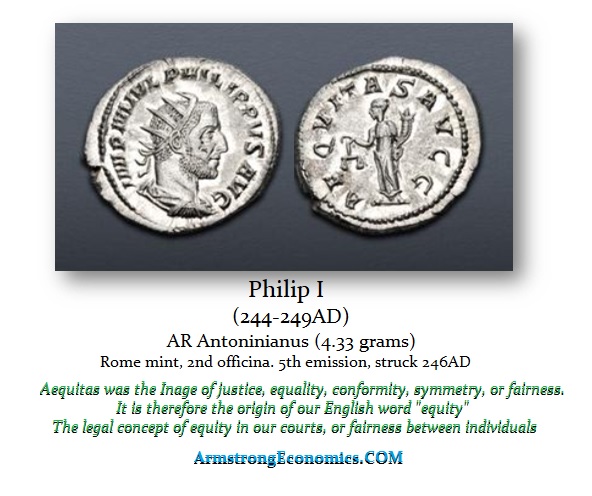
PHILIP I AR Antoniniany Aequitas

A decade later and Philip I attempted to quell the influx of migrants, but died while battling his successor, Trajan Decius. Rome was simply decaying gradually from internal struggles, which weakened the economy and constantly pitted one legion against another in a struggle for power. We see internal struggles today throughout the West as politics continue to divide the people. The Romans did not consider the Goths to be a force that would threaten the entire Empire, but rather more as a barbarian force looking for plunder rather than power.

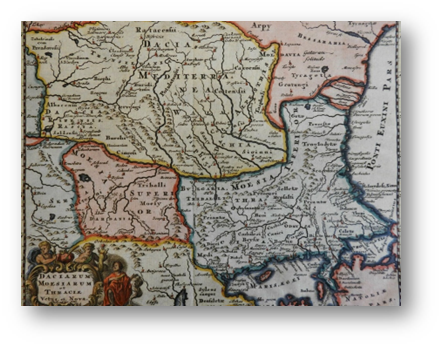
Dacia Map

Trajanus Decius declared the Goths an enemy and attempted to force them out of the empire, only for the masses to return a year later. The Goths were prepared this time and formed several strategic alliances with enemies, such as the Dacian Carpi. This led to a full-scale invasion, and the Roman Empire suddenly found itself besieged as war raged on in Moesia, Dacia, and even in Thrace, while the main body of the Gothic invasion was preparing a descent into the region of the Black Sea.

After many battles, the Goths emerged as the new masters of the entire Danube territory, all the way to the Black Sea. Trebonianus Gallus emerged as the new Emperor who could do nothing to reverse the Empire’s humiliating defeat. The Goths now turned to Illyricum and Thrace, burning and plundering their way across the region. By 253 AD, the Goths set sail along the Black Sea, headed straight for Asia Minor, which was wide open and waiting to be plundered.

Aurelian Walls 2

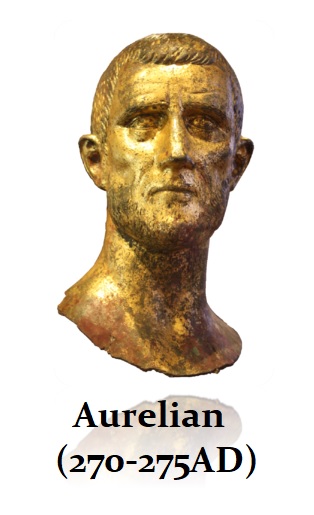
The Roman Empire was declining until Emperor Aurelian came to power and began restorative efforts, including anti-immigration policies. He not merely launched defensive measures, he moved on the offensive against the Goths and demolished them through a series of battles. The Goths were driven out of the Balkans and into Dacia. Aurelian also greatly restored the Black Sea defenses, which helped those regions rebuild their economies as well. However, Aurelian failed to pursue the barbarians into the Roman province of Dacia, pulling back and establishing the new border once again along the natural border as originally defined by Augustus – the Danube.

Aurelian Gold Bust

Aurelian’s decision to redraw the borders left Dacia in the hands of the Carpi and the Goths. Once the Goths were contained, they began to divide into two distinct groups – Ostrogothic and Visigothic kingdoms. These groups would evolve into powerful states that would ultimately bring down the Roman Empire in the West.

Those in favor of the Gothic migration stated that the newcomers would increase tax revenue and benefit the Roman economy. It was a humanitarian crisis and Rome’s responsibility to solve. Instead, the unsustainable influx of Gothic refugees contributed to the eventual fall of the Western Roman Empire. The event marked a turning point in Roman history and was part of a period in which the Roman Empire nearly collapsed under the combined pressures of invasion, civil war, plague, and economic depression. History always repeats.

Deep State vs World


Posted originally on Jul 6, 2025 by Martin Armstrong 

I have stated that I know Bill Kristol. His father, Irving Kristol, founded the Neocons. I had direct conversations, and I can confirm that this has been an agenda dealing with Iran that has always been about regime change. I was told that removing the dictators and overthrowing Iran would somehow bring peace to the Middle East. We drew their borders, and they see themselves more as tribes than as citizens of a state. I agree with Jeffrey Sachs. Our Neocons swear that whoever they oppose at this instant, intends to attack the USA, so they always propose to attack them first, and they act dishonestly and claim their hated opponent wants to do the same. This is no different than if I punch you in the face because I know who really wanted to hit me first, and I call it self-defense.

LT. MANUEL CASAS: “The Mass Invasion Of Illegal Invaders Was Completely Out Of Control.”


Posted originally on Rumble By Bannon’s War Room on: June 30, 2025, at 2:00 pm EST

Canadian Government Rescinds Digital Services Tax, Requests to Resume Trade Talks Again


Posted originally on CTH on June 29, 2025 | Sundance 

“Elbows up” and knees bent. As expected given the nature of their dependency, the Canadian government has rescinded the digital services tax against U.S. tech companies.

The June 30th collection is halted and the Canadian government led by Mark Carney will be bringing legislation to rescind the tax entirely.

CANADA – […] Minister of Finance and National Revenue, the Honourable François-Philippe Champagne, announced today that Canada would rescind the Digital Services Tax (DST) in anticipation of a mutually beneficial comprehensive trade arrangement with the United States. Consistent with this action, Prime Minister Carney and President Trump have agreed that parties will resume negotiations with a view towards agreeing on a deal by July 21, 2025.

The DST was announced in 2020 to address the fact that many large technology companies operating in Canada may not otherwise pay tax on revenues generated from Canadians. Canada’s preference has always been a multilateral agreement related to digital services taxation. While Canada was working with international partners, including the United States, on a multilateral agreement that would replace national digital services taxes, the DST was enacted to address the aforementioned taxation gap.

The June 30, 2025 collection will be halted, and Minister Champagne will soon bring forward legislation to rescind the Digital Services Tax Act. (LINK)

In the bigger picture Canada has a serious problem.

Canada is entirely dependent on the USA; there is no part of the Canadian economic system that can survive without total dependence on the USA.  The Canadian economy is currently stagnant and their leftist government is desperate to find a way to collect revenue somehow, any way possible.   Additionally, President Trump is going to end the USMCA trade agreement and shut down a majority of the benefits Canada has been extracting.

The most remarkable aspect to this reality is the denial within Canada.  There are maybe a handful of honest Canadian economists, financial types and/or pundits who understand economic matters that are willing to outline and explain the details of Canada’s vulnerability…..

…. The rest are in denial, shouting ‘elbows up’ as if that is going to change the inevitable.  The pretending is strong amid the snow Mexicans. Their denial is a mass formation psychosis. Stunningly so.

[Background Context]

“Not One District Court Judge Can Think They’re an EMPEROR!”


Posted originally on Rumble on Bright Bart News Network on: June 28, at 2:00 pm EST

Pam Bondi: You Endorsed Joe Biden and Want to Lecture About COMPETENCE?!


Posted originally on Rumble on Bright Bart News Network on: June 28, at 1:00 pm EST