China Moving to Take the Lead in Technology


China is moving rapidly to advance and take the lead in technology from the United States and they will accomplish that in the years ahead. China is moving very fast on every front. China is moving faster on quantum communications and computing and they are embracing real Artificial Intelligence that is being ignored by the powers that be in the US government.

We were granted our business license in China BECAUSE of our technology while the USA keeps trying to suppress technology advancement in our field. That means the government even had to review the conflicts with the USA and dismissed them as all other nations as being “stitched up” as one put it in Europe.

The regulators in the USA have one policy – if the big boys do it it’s OK. They are Too Big to Fail, Too Big to Jail, but big enough to hire government employees. Anyone else has to be regulated when the regulators do not even understand what they are doing. The bottom-line policy at the US regulators – if they do not understand it, regulate it out of existence. You are not allowed to compete against New York City.

In the United States, there remains over regulation because the government is clueless about technology. The next crisis will be really worse than 2007-2009 because they have chased so many from the marketplace with fines and regulations that make no sense. The SEC has had to announce strengthening rules for their own people in trading on inside information. The more regulators we have the more corruption that exists. I have stated before, when I was managing positions for the Onassis estate in commodities, I had the larges physical position in Platinum. It took six months to get permission to trade at that level way beyond exchange limits and when I picked up the phone the first time, everyone already knew the size of my position. So much for regulators. Today, positions of managers over $100 million in assets must be reported to the SEC. You can bet that i8nfo is handed out under the table.

In quick succession, China in recent months has utilized a quantum satellite to transmit ultra-secure data, inaugurated a 1,243-mile quantum link between Shanghai and Beijing, and announced a $10 billion quantum computing center. The USA cannot even compete with this level of technology yet. We have been a full green light on our systems. There is no question that China will be the dominant economy after 2032.

New Zealand to Foreigners – Get Out!


The New Zealand Prime Minister that took the country back into Marxism, has fired its first shot across the bow.  The Labour party have formally signed a coalition agreement, introducing all new policies focusing on climate change, regional development, and poverty which translates into hunting the hated rich. Thirty-seven-year-old Jacinda Ardern, a member of the New Zealand Labour Party, became the world’s youngest female leader. Hillary must be crying in her martini.

Nevertheless, PM Ardern has just fired the first shot across the bow and this is a serious warning that foreign investment better cross New Zealand off the list of places that will be up-and-coming.  She has banned foreigners from buying property in New Zealand. The first proposal was to ban any migration to New Zealand as well. That they had to back off of given the refugee impression and that would have agreed with Trump – OMG!

She thinks banned foreign property ownership will cool off the property market. The problem will be, a property crash. When home values decline, people feel they lost money and they spend less. With rising property values, people feel they are better-off and spend more assu8ming they have equity even if they do not borrow against it.

She may be the youngest female leader in the world, but she also is clueless about economics.

Diamonds replacing Gold?


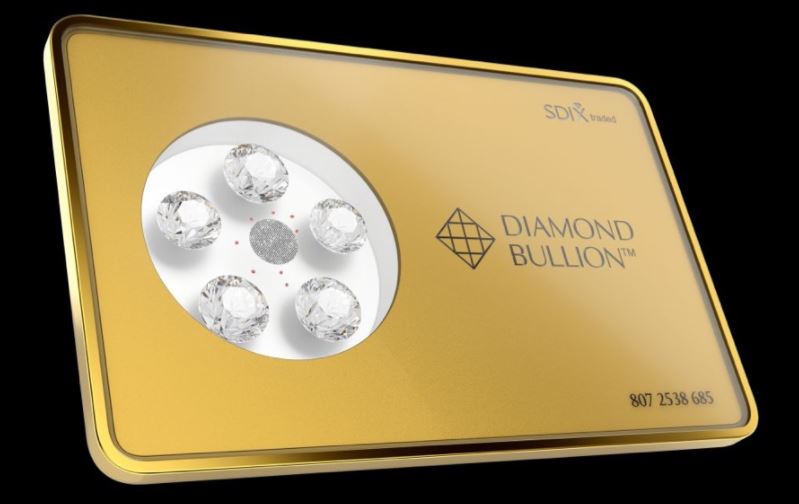
There has been an effort to use diamonds in place of gold since you can travel with them without setting off metal detectors. But the real problem has been the untrained eye can easily be fooled. The Singapore Diamond Investment Exchange (SDiX), has launched a new product they hope to compete with gold. Perhaps this may have some traction, but again, it is hard to see how this will really compete with gold unless someone is trying to move money from one country to another.

Saudi Arabia in Search of Cash


QUESTION: I read your blog about the Saudi’s potentially selling a large private equity position from China in Aramco rather than accessing the public markets. You have pointed out the need for the Saudi’s to modernize their economy to be less dependent on oil income and to monetize that resource for capital improvements/diversification, but how do they do that without giving away to much control over their oil resources to China?  Wouldn’t a single significant stake by a private investor (country in this case) give up to much control over their single greatest resource (at least for the immediate future)?  I’m thinking of the disaster that is Venezuela as an example of the poor employment of foreign investment.
ANSWER: I fully understand your point. However, the Saudi’s need money. They spent too much money expecting oil to be $200 forever. They are now starting to issue bonds. Saudi Arabia has peaked economically and looks at UAE and sees the diversification. But Saudi Arabia would have to relax their religion. Here is a picture I took on the beach in Abu Dhabi. They are tolerant of Western Culture. You cannot create a world economy without separation of church and state.
Venezuela has always been a ruthless dictatorship. The wealth from oil never made it to the people.

Is Europe Repeating the 1930s?


Europe is now replicating the 1930s and the mistakes it made with austerity back then as well outside of Germany. Of course, Merkel has imposed the German view of austerity based on their experience but has ignored the opposite experience of the rest of Europe that led to the 1931 Sovereign Debt Crisis and mass defaults.

It was the year of 1925 when then chancellor of the Exchequer, Winston Churchill, returned Britain to the gold standard. Britain was trying desperately to reestablish itself as the financial capital of the world as if nothing had taken place. Returning to the gold standard resulted in wages being forced down to compete with America.John Maynard Keynes at the time pleaded that this was madness. The pound was overvalued against the dollar by 10% trying to reestablish confidence in Britain but the net result crippled exports and unemployment began to rise and workers engaged in strikes for having wages reduced even though the pound was worth more officially.

Churchill acted in an effort to restore Britain but he was dead wrong. Keynes proved to be correct and this lesson has still been ignored by Europe today. The overvalued pound led to deflation and ultimately forced the economic collapse in 1931. The capital was fleeing Britain and bankers were pleading for austerity to retain bond values. The Labour government collapsed and a coalition national government was formed. They ignored the pleas of the bankers and abandoned the gold standard overnight. The pound fell from $4.85 to $3.40 against the dollar.
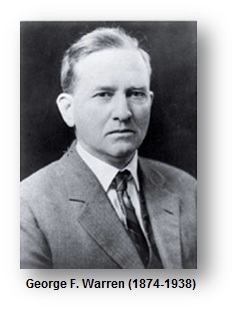
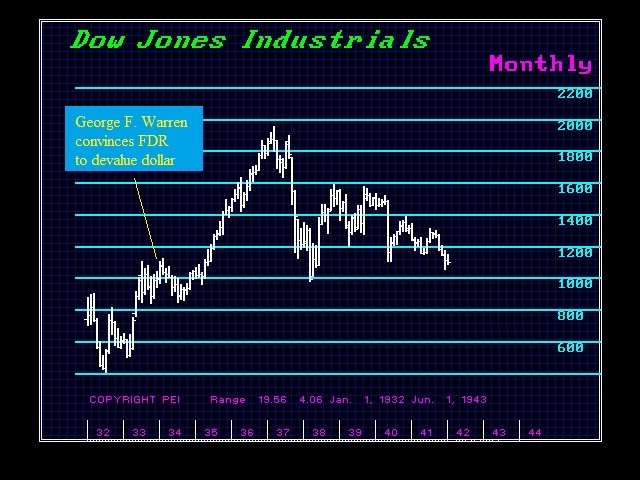
Warren-3NEVERTHELESS, despite the dire forecasts of ultimate catastrophic consequences if Britain abandoned the gold standard, the economy held and began to recover. There was no revolution in the streets as predicted. The devaluation of the pound actually stimulated the economy and the austerity crowd proved to be completely wrong. Within just four years, the British industrial production had risen by 25% and unemployment fell from 3 million to 2 million. It was this experience that provided the support for the economist George Warren (1874-1938) who convinced Roosevelt that austerity was wrong and devaluation would also kick-start the American Economy. None of Roosevelt’s Brains Trust was ever experienced in economics. Most were simply lawyers trying to get around the Constitution. They too argued for austerity as Merkel does today. However, Roosevelt looked at the events of 1925-1931 in Britain and listened to Warren. The dollar devaluation is what turned the economy around at that moment in time.
dj3242-m-warren

The USA share market began to recover from the depths of the Great Depression. History repeats, but I have stated it is like a Shakespeare play – the plot remains the same, but the actors change over hundreds of years. The lessons of history, therefore, repeat over and over again albeit by the same foolhardy reasoning.

Europe is trapped in similar orthodoxy to that of their prewar forebears. In Germany, they hold the firm belief that inflation is the greatest evil to inflict humankind. Yet the ECB has mastermind the greatest monetary expansion in history without success of stimulating anything. The policy of quantitative easing has been done only at the government level as taxes and tax enforcement has risen and thereby the people and consumption have been totally ignored for fear of inflation. This approach has created an economic nightmare that actually threatens to bankrupt the ECB. Unlike the US Federal Reserve which has the power to create elastic money, the ECB needs authority from government.

They do not flinch even when a quarter of high street shops close. They are like doctors laying the sick in the snow to see who will survive. Yet they hurl cash at friendly bankers and watch it vanish into the maws of directors and offshore speculators. And they dole out billions to prop up a euro of which they are not even members.

Keynes was right in 1925 – and proved right in 1931. Flexible exchange rates are a more painless way of forcing down labor costs and promoting trade than government austerity. Inflation is a better way of easing debt. The remedy for depressed demand is increased demand, simple as that. The risk of inflation in Britain at present is trivial compared with that of deflation and recession. And at least Britain’s currency can float. Imagine if it were part of the euro and trade had to cope with a pound probably 20% higher in value than now.

Hardly a month passes without another euro crisis and more imposed austerity. It is as if Keynes had never lived. Yet water still refuses to flow uphill. Heavily indebted countries certainly need to restructure their public sectors in the long term – and have plausible plans to do so – but they cannot repay debt, short or long term when they are in recession. Increasing unemployment and suppressing demand impedes growth and is no use to anyone.

Worse, Europe’s drawn-out austerity is undermining the very authority required to enforce it. When governments fall, no package can be enforced. Greece was forced last month into de facto default. Who would now buy a Spanish bond? What is the value of a Dutch finance minister? What price Nicolas Sarkozy’s signature on a bailout deal? As long as the euro shackles the continental economy in austerity it will never achieve political stability or a return to growth.

The euro was a Locarno dream. It was the last cry of the 20th century, envisaging a brave new order in which bankers and businessmen, workers and peasants, would stand arm in arm, singing Ode to Joy. All labor costs would become equal. There would be fiscal and regulatory integration across the entire continent. The euro would unlock the door of united states of Europe. Ireland and Greece would be to Germany what Nevada is to New York. The euro would squeeze and stretch the peoples of Europe until they were one.

This concept of a union must rank among the great mistakes of history. Like other pan-continental visions, it has proved no match for the crooked timber of European mankind. Its acolytes cannot bear revisionism or tolerate dissent. They have driven Greece into chaos and Spain into severe depression, with half its youth now unemployed. The Eurocrats do not care. Their incomes are secure. They dance only round the euro and claim its blood sacrifice. They will do anything but admit they were wrong.

The one salvation on the horizon is a true democracy. Last week the French electorate said no to more austerity and the Dutch government fell for the same reason. Spain faces a similar crisis, and the streets of Athens hold untold dangers. Even in Britain polls suggest an electorate unconvinced by the longevity of what by any standards is mild austerity. The peoples of Europe have had enough. The prospect of imposing on its nations the budgetary disciplines required for more German bailouts is unthinkable.

The Six Groups of Investors and Traders


The recent report by the Commodity Futures Trading Commission (CFTC), shows that the professional investors have continued to bet on falling Dow Jones “short” as private investors are starting to bet heavily on rising prices ( “Long”). Professional investors remain suspicious of a further rise in the US stock market. The private investors’ view is exactly the opposite. The question is; Who will be right?

There have been plenty of times that the professional is dead wrong and the average person on the street has actually outperformed the professionals. Reuters reported that 69% of hedge fund investors expected the second half of 2017 to be worse than the first half. So why are the professionals so pessimistic?

When you live and breath the market every single day, it is hard to get a grip on vertical markets. The professionals, more so that even the average street investor, tends to do worse in such markets because it makes them uncomfortable. Then there is the self-gratifying notion that the market is over when the retail invest comes in. But they tend not to look at the fact that there is a huge difference between the average retail investor and the person who has never invested who rushes in to join the party at the top simply be everybody else if there.

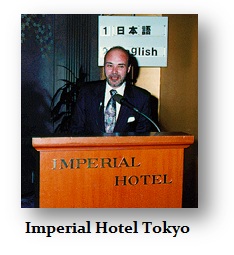
I have told the story before how I was doing an institutional only seminar in Tokyo at the Imperial Hotel. This individual bribed someone in the hotel to get in. He came up to me and apologized offering to pay. He said he just had to speak to me. I asked him what was the problem, He explained he had bought the Japanese share market on the very day of the high and now it was crashing. His investment was $50 million. But the intrigue came when he said it was the first time in his life he had purchased any stock. He then had my attention since I was talking to the guy who bought the high.

I asked him what made him buy that day for the first time in his life? He said brokers had called him every year saying the Nikkei rallied on average 5% every January with the New Year. He watched it for 7 years and then finally bought the high. That is what I mean as the difference between the average retail investor and the fool who rushes in at the end because everybody else is there. It is when that final group of people rush in that marks the end of the market – not when simply average investors buy who follow the market generally.

We have four actual groups:

  1. smart strategic big money (long-term portfolios)
  2. professional short-term traders
  3. the day trader who thinks he is limiting his risks
  4. program traders who try to arbitrage ticks
  5. the average retail investor
  6. the fool who rushes in at the last minute

In most real good vertical markets, it is the professional short-term traders who keep trying to sell the new highs. This has been the group that has been bearish ever since 2009. They never saw new highs coming, and they still will try to sell every new high today. They falsely believe that they are “professional” and so they will be right and the average investor is the fool. But the average investor sees the trend for what it is, goes with the trend, while the short-term “professional” keeps trying to beat the market.

Usually, the day trader who thinks he is limiting his risks and the program traders who try to arbitrage ticks will typically get caught when they suddenly find the lack of liquidity traps than in a position they cannot get out of.

Catalonia is not Just About Spain – it is About Brussels!!


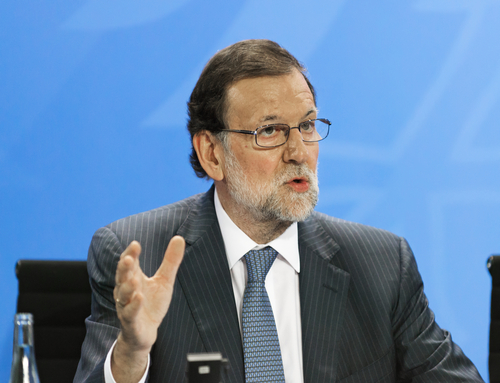
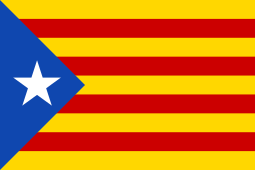
There are of course those in Spain who side against Catalonia. Others write who are in Catalonia yet disagree with the separatists. Let me make this very clear. It is the government of Rajoy who has acted abusively, and this is all about protecting Brussels and federalizing Europe behind everyone’s back.

Rajoy should have allowed a fair referendum and then negotiate if they won. Canada allowed two refferendums in Quebec and Britain allowed the Scottish referendum. This nonsense that the Constitution does not allow any democratic process is pure TYRANNY. That was the same argument in America by England and in France that led to revolution.

Had Rajoy NOT played the hardline tactics, allowed the referendum to take place, then many who voted for independence may have not done so.  This is about political power – not the dignity, right, or freedom of the people. This is basically stating the people mean nothing and you will obey or else.

This is a political power play that centers around the EU not just Spain.

If Texas or California want a referendum to separate from the USA, it is a human right to take such a vote. There can be no exceptions!!!!!

Trump to Release Secret Files on JFK?


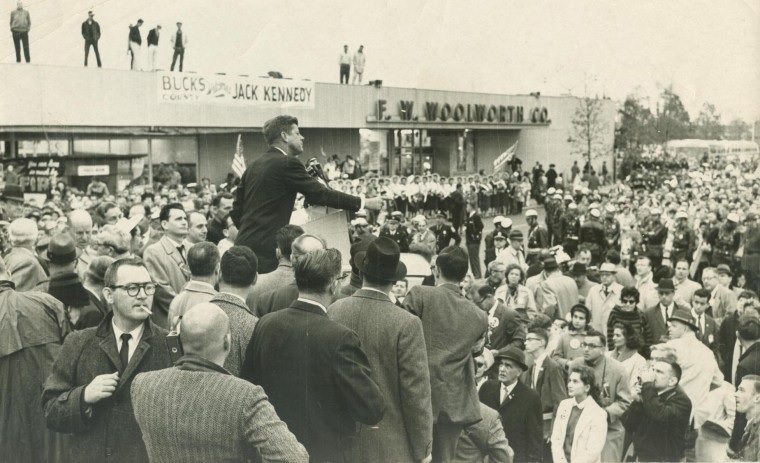
I have often been called the Forest Gump of finance. I have tended to meet so many people surrounding so many events it is often funny. I actually met President John F. Kennedy and shook his hand as a kid in Willingboro, New Jersey on Oct. 16, 1960. (I did not want to become president like Bill Clinton). Then years later, I bought a house on the beach in Loveladies, New Jersey. To the north of my beach house in Loveladies, is where Richard M. Nixon vacationed as well as Billy Joel. Nixon had rented in Loveladies a 5,000 square foot home designed by Malcolm Wells and built in 1970.  Due to its large base tapered upward to a triangular roofline, it was known simply as the Pyramid House.  It was torn down in 2009 to make room for the next generation of modern homes. To the south of me, was the house owned by none other than Senator Arlen Specter (1930–2012).

It was Arlen Specter who was a staffer (later a United States Senator from Pennsylvania), on the Warren Commission who is credited for coming up with the single bullet theory (magic bullet theory) known as “Warren Commission Exhibit 399”, that caused all the wounds to the governor and the non-fatal wounds to the president. Even his son would stop by my house. He would never admit to me personally that the theory was just an excuse.

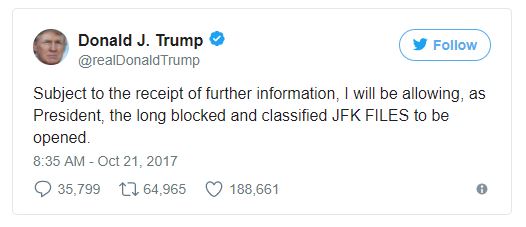
Now US President Donald Trump wants to release the long-hidden secrets of the assassination of John F. Kennedy. Trump announced his intention to disclose the more than 3000 documents on the presidential murder on Twitter. The concern deals with the assassination of November 22nd, 1963. There are some tens of thousands of other documents which have never been published. Trump wants to release them when the legal secrecy expires on October 26th, this week! The CIA is urging that Trump should not release the documents claiming they will endanger the survivors or informants of CIA and the FBI. That seems to be a real BS excuse if I ever heard one. What they may really incriminate is other people.

The official investigation came to the conclusion that JFK was shot by the (magic bullet) single-killer Lee Harvey Oswald in Dallas, who in turn was then killed two days later by the nightclub owner Jack Ruby. Then Ruby dies and nobody ever concludes just how was Oswald assassinated in the middle of the police station in front of policemen, security forces, FBI, CIA and journalists with TV cameras no less.

The official version of the assassination of Kennedy was repeatedly questioned around the world and it has never been believed in so many circles. The main “conspiracy theory” has been that it was an internal coup by the CIA. If there is no “conspiracy theory” then release the files once and for all. The argument to keep them hidden is what keeps these accusations alive.

Rajoy Continues to Act in the Spirit of Franco Warning Spain Cannot be Trusted?


Spain is showing that it truly remains a fascist state in the spirit of Franco and Rajoy plans to just seize Catalonia. Meanwhile, the Catalan citizens’ movement, Assemblea Nacional, is calling on all Catalans to withdraw all their money as much as possible from one of the five largest Spanish banks to increase pressure on Madrid, These include Caixa Bank, Bankia, Sabadell, BBVA and Santander. Americans supporting Catalonia are also urged to withdraw all funds from Santander in the USA.

Behind closed doors, many are becoming very disturbed by the action of Madrid. They fear this is spilling over as a contagion within Europe for populist movements. The election in the Czech Republic with the overwhelming vote against the EU many fear will be repeated next year in Italy and much of the finger-pointing behind the closed doors our sources are calling Rajoy a “f**king idiot” to directly quote some political sources.

Macron’s Call to Federalize Europe


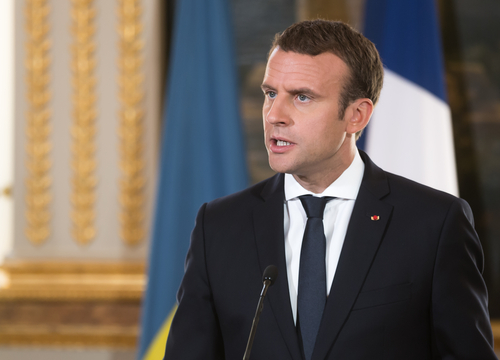
France’s President Emmanuel Macron is calling for a radical restructuring of the whole EU. Macron has presented his map for the EU into 2024. He is proposing that the Eurozone budget must include a joint force for military operations. Macron intends to finance this new budget with its tax – the “EU tax” he calls it.

Macron has looked at the numbers and see that France will go the way of Greece if something is not changed and soon. Macron hopes just to throw all the rotten eggs into one basket and hope nobody will notice. It’s the Three Musketeers – All for one; One for All just times 28.

Germany is still dominated by its misunderstanding of the Hyperinflation. Former Greek finance minister Yanis Varoufakis supports Macron’s federalist proposals on the euro single currency but believes only a real threat could make Germany budge on the issue. It has been Germany that opposed the consolidation of the debts to form the Euro. They are trying to remain isolated in their austerity posture refusing to budge on the debt consolidation, while at the same time they want the single currency to facilitate German exports eliminating foreign exchange risk among other members. They just cannot have it both ways.

The extent of Macron’s plan goes beyond just an EU Tax.  He also says that Europe is moving at “different speeds” and that those states which fall behind should not stand in the way of his proposals. He is calling for a European defense budget and a standard minimum rate for company taxes.

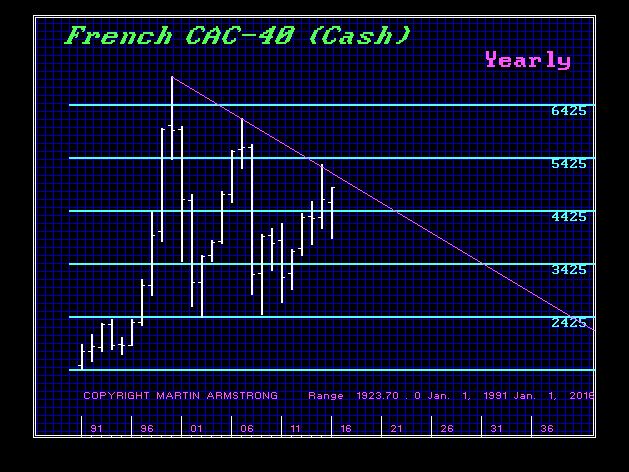
Macron has noted the high cost of taxing the rich. The Socialist agenda under Hollande imposed a wealth tax which drove 10,000 people with about 35 billion euros to flee the country. And that is just what they admit publicly. The tax was imposed on personal assets of more than 1.3 million euros is part of Macron’s reform, but the socialists are demanding they be taxes even more until they all leave one must assume.  As promised by President Emmanuel Macron in the election campaign, the tax will now only apply to real estate, meaning other forms of wealth such as shareholdings in companies will be exempted. Macron realizes that the French share market has one of the worst performance in Europe next to Greece. While the world is worried about bubble markets, Macron is concerned that new lows will unfold on the next crisis.

“When someone leaves the country because of the wealth tax… collectively all French lose.” But the Socialists just refuse to stop their hatred of the rich. Macron has abolished the wealth tax and the socialists are calling him the “President of the rich” and remain oblivious to reality.
More than fifty years ago, back in 1965, it was the French President Charles de Gaulle who withdrew his ministers from the Council of the EU, thereby constituting a de facto veto over all decisions, which became known as the “Empty Chair Crisis.” There were several issues regarding European political integration led to The Empty Chair Crisis. There was a push at that time to create the quasi-federalization of Europe. De Gaulle believed that national governments should move towards integration, but he did not agree with the Commission’s attempt to create some new super central state or a federalized Europe, extending powers of the EU beyond national borders as we have today, which Margaret Thatcher also opposed.
President Charles de Gaulle has proposed the Fouchet Plan was a plan back in 1961 to create a new grand design for Europe. Charles de Gaulle wanted to develop a three-power directorate, consisting of France, Britain and the United States. The idea was to form a new ‘Union of States’, as an alternative to the European Communities (EC). De Gaulle feared a loss of French national influence in the EC as there was a drive to federalize Europe back then.
After the failure of the Fouchet Plan and De Gaulle’s veto of the United Kingdom’s application for EC membership, the Commission attempted to move towards integration by proposing an idea that would combine the Common Agricultural Policy (CAP), the European Parliament, and Commission. De Gaulle supported the creation of the CAP and favored its enactment. However, he disagreed with the Parliament’s new role, the Commission’s strength, the shift towards federalization and a super central state, and the budget proposals for financing the CAP. De Gaulle made it a condition that majority voting with a right to veto must exist if France was to participate in the EC. When de Gaulle was denied a more intergovernmental Commission or voting and veto rights, the French representative left the Council of Ministers thereby creating the Empty Chair Crisis.
The Luxembourg Accord was an agreement reached in January 1966 to resolve the “Empty Chair Crisis” which had caused a stalemate within European Economic Community. Then on June 21, 1966, de Gaulle withdrew France in a shocking move taking its troops from the North Atlantic Treaty Organization (NATO). This decision led by French president Charles de Gaulle complicated relations between the U.S. and Europe amidst clashing American and Communist spheres of influence. Though France remained politically in NATO, its actions cast doubt on the organization’s future as a counter to Soviet military power and control back then.
Disagreement within the EU is by no means something new. We may yet see a political breakdown as the economy continues to spiral lower and the ECB bond-buying program has been transformed from an economic stimulus to simply life-support for government debts to try to keep interest rates from exploding and no bid for government debt.

Apart from the new EU tax, Macron did not make any funding proposals for his very far-reaching program. The FT reported his “wish list” and presented the most desired demands of Macron:

  • EU intervention group and budget by 2020
  • a European Intelligence Academy to train spies
  • a European civil protection group for responding to disasters
  • a European prosecutor for terrorism and organized crime
  • a European asylum seeker for the joint processing of claims, common procedures
  • a European border police
  • a carbon dioxide tax levied on imports into the EU
  • a European innovation agency for the investigation of artificial intelligence
  • EU subsidies to support the development of electric vehicles
  • Taxation of US tech companies with a tax on sales, rather than on profits
  • a larger EU budget to finance investments and dampen economic shocks
  • Review of agricultural policy and the new EU Food Authority
  • accelerated harmonization of corporation tax bases
  • gradual harmonization of corporation tax rates and social security contributions
  • a guaranteed minimum wage for each country
  • all young Europeans will be able to spend six months as a student or trainee in another EU country
  • Creation of European universities on the basis of networks of institutions
  • six-month series of national and local conventions to discuss the future of Europe
  • half of MEPs to EU Parliament is to come from EU-wide lists until 2024
  • a much smaller European commission, only 15 commissioners
  • a Europe of different speeds, to which Great Britain could also return
  • a new European prosecutor ensures that the competitors comply with the EU rules
  • a Franco-German cooperation agreement focusing on the harmonization of company regulation