August 16, 2023 | Sundance
There really is no other phrase that seems to adequately describe the future for online life in the United States than to describe it through the prism of the previously discussed shadow banning that takes place on the X-platform for specifically wrong-thinking users.
It is important to begin with the end in mind. Perhaps some people are unaware that internet services, meaning the actual experience of using the internet for communication and commerce, are not the same in every nation. In fact, it is quite a different experience depending on where on the globe you are located. The differences are driven by internal controls, the intranet of the regional internet per se.
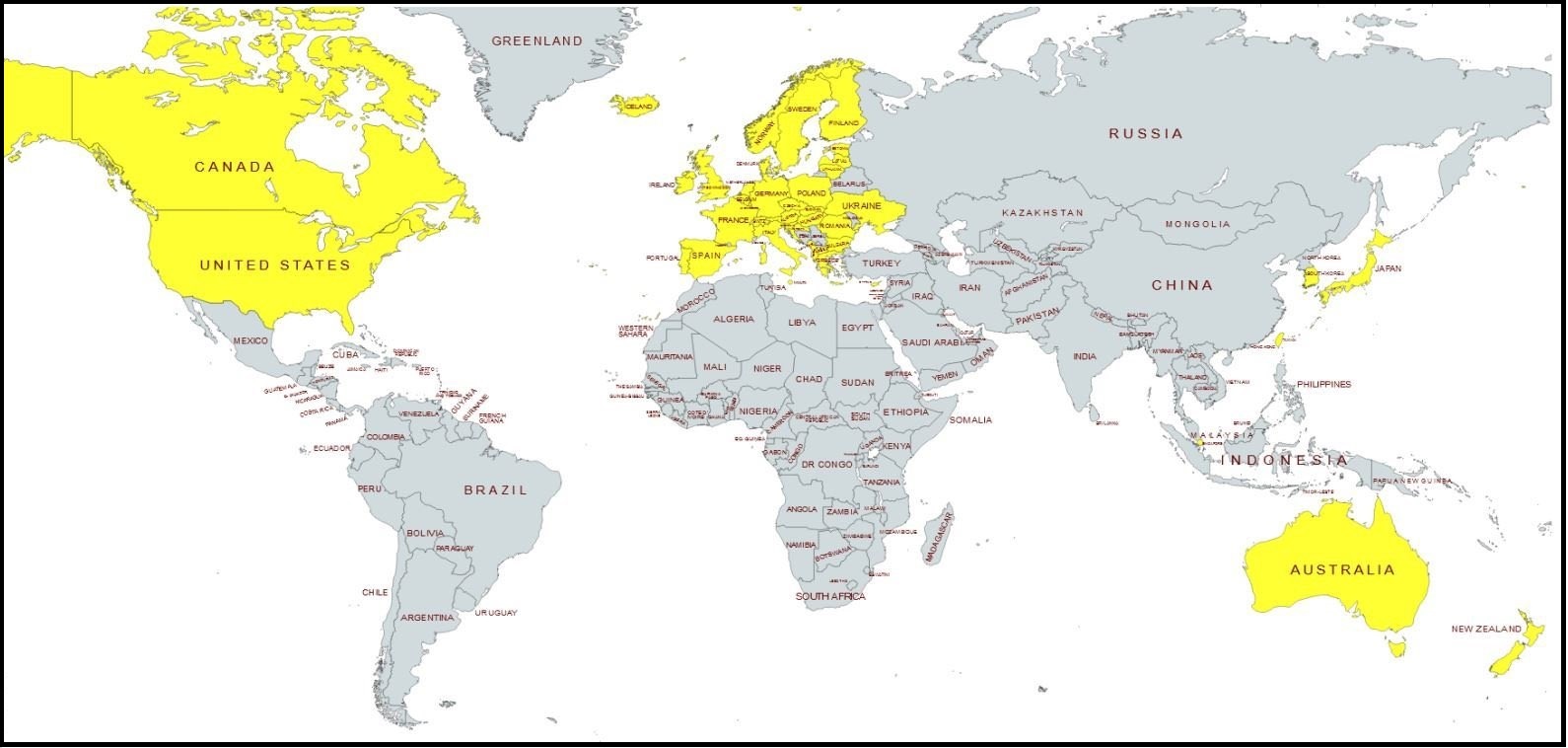
The internet in China is not the same as the internet in Europe, which is not the same as the internet in Australia, which is not the same as the internet in North America, which is not the same -at all- as the internet that now exists within Russia. Even in some continents, the internet traffic flows are controlled at different levels within each nation. The “world wide web” is a format, but when you get down to the national level, things change.
This baseline helps to understand that internet freedom is defined by access to information and commerce.
To the extent the information or commerce is defined as against the interests of the authority structure, or potentially a threat to the national security interest of the government therein, the internet content is filtered, modified, censored, removed or just simply blocked from view. This is one layer in the information control system.
Another layer is the flow of commerce that floats atop the flow of information. This is where advertising, product sales, purchasing and general e-commerce takes place. This layer represents another option for control; therefore, this e-commerce layer should be considered running in parallel to the information, albeit perhaps indirectly attached.
When western government applied economic sanctions against Russia via financial restrictions writ large, the layer of internet commerce control merged with the information and national security control systems of the internet.
Russian citizens were blocked from e-commerce access, specifically from western nations in alignment with the sanctions, and the mechanisms of online purchasing were restricted. However, the entire world did not participate in the sanctions, and there is a massive amount of e-commerce that takes place, even with the systems of western control financial blocks in place.
Additionally, there is a large black-market system for commerce and financial transactions that started organically in the aftermath of the Russian sanctions. Crypto currency, as a financial transaction mechanism, was predictable; however, over time people became even more strategic and alternate transfer systems were created. You can purchase advertising in Russia, but are you really purchasing advertising – or are the purchasers really just transferring funds? Think about it.
I share that Russia example, because I do not want people to get too disheartened in what is going to happen here in the United States. There will always be a market for information, regardless of the control systems that are created to stop it. Additionally, there will always be smart rebellious people who think of ways to subvert the intents of the control mechanisms. Freedom may be diminished from a raging fire to a small burning flame, but it will never be fully extinguished. WE just need to learn to adapt.
It took me over two years to assemble The Benghazi Brief, because the background story was so large and complex that it took time, research and retrospection to appropriately contextualize the truth of the issue. The Benghazi attack was a small, albeit deadly outcome, of a much larger story. The brief walks through everything in context.
In a similar construct, the Shadowbanning of The United States internet is a big and complex story, and I am only about halfway through the assembly of all the data to put context to it. However, as time becomes critical, it is important for me to push the information forward – because many of the timelines in the construct are likely to surface before I am complete with the fully assembled story.
I am going to drop some links that will help serve as a flashlight into the rabbit hole. Each story may seem initially disparate or disconnected. However, I would encourage you to think big picture with each of the puzzle pieces that are presented. This is likely to become a series, and I will create a new “Internet” category on the side bar where I will tag any future elements.
Please keep in mind, the issues of e-commerce: ie. information monetization, advertising, deplatforming and debanking, are not disconnected from the issues of information control. The same larger national security system that has mandated (and will mandate), information blocks, content censorship, content restrictions, content removal and various platform control elements, is all part of one interconnected compliance system. Electronic Commerce and Electronic Information are all subject to the online control process. This is a public-private partnership on the internet.
The origin of the public-private partnership goes all the way back to the origin of the tech system in relationship to the DARPA programs and government sponsored research labs. The outcome of the modern partnership is evident in the Dept of Homeland Security (DHS) collaboration with the various communication platforms or pipes of information. Systems like the Global Internet Forum to Counter Terrorism’s (GIFCT) database, are simply outcomes of the partnership. There are hundreds more.
There is a rush now to provide context because Artificial Intelligence (AI), or smart data systems, are launching into the United States internet control mechanisms almost daily. We are close to the time when AI will be triggered to help control the content of the internet under the guise of national security.
The timeline for full deployment of the modern United States internet control system, is likely around late fall and early winter this year, in advance of the 2024 U.S. election cycle.
Everything will change. Every route of online traffic including Internet Service Providers (ISP’s) to filters and rerouting on Domain Name Systems (DNS), to the Internet Protocol (IP) itself will be subject to change in the form of background shadow banning. If the DHS partnership is successful, you will not initially notice – much like a shadow banned platform user doesn’t notice their new defined status. The shift will become more obvious over time.
One odd outcome will be a regional targeting system. Depending on where you are in the USA, your online experience will be different. There will also be enhancements to your internet travel based on your profile. Good thinking users will have benefits that enhance the experience of the user and supports the interests of the national security guardians.
♦ Deployment of a Virtual Private Network (VPN) is irrelevant in this construct. A VPN is like you renting a car without a license plate. You travel past all the Automatic License Plate Readers, arrive at your destination, leave the keys in the ignition and just abandon the car. Your personal travel was essentially invisible to the APLR system. However, when the internet roads are controlled by the national security state, and there is no longer an offramp to the destination, your VPN use is irrelevant – you cannot reach your destination. That’s part of the shift.
You will notice I use the term “definition” quite often. That is because the root of every control mechanism is grounded upon defining things. When you accept the terms ‘disinformation’, ‘misinformation’, and/or ‘malinformation’, you are buying into the process that permits definitions to determine your travel. Those who define both you and your destination, ultimately control your online experience.
Now, before getting to a recent example of this construct as it is being built, it is important to return to the e-commerce aspect and overlay the Diversity, Equity and Inclusion (DEI) index into the world of online commerce.
♦ Right now, you can physically boycott Bud Light by choosing another brand. However, for total goods and services the amount of online purchasing is now exceeding the amount of purchasing in real life (brick and mortar shopping). Overlay the economic control system (think Russian sanctions approach) with the national security requirements for DEI, amid all online commerce, and apply that layer of analysis. In the e-commerce world, choosing not to buy Bud Light will become a little more difficult; and those who do support the boycott become subject to the previously mentioned “definitions”.
I’m jumping ahead, because today there was a big development. As you read this, do not think small as presented – think bigger. Think beyond the use of AI moderation on a platform, and think of AI moderation on the U.S. Internet System. Online moderation conducted by AI:
OPEN AI – […] GPT-4 is also able to interpret rules and nuances in long content policy documentation and adapt instantly to policy updates, resulting in more consistent labeling. We believe this offers a more positive vision of the future of digital platforms, where AI can help moderate online traffic.
[…] Content moderation demands meticulous effort, sensitivity, a profound understanding of context, as well as quick adaptation to new use cases, making it both time consuming and challenging. Traditionally, the burden of this task has fallen on human moderators sifting through large amounts of content to filter out toxic and harmful material, supported by smaller vertical-specific machine learning models. The process is inherently slow and can lead to mental stress on human moderators.
We’re exploring the use of LLMs to address these challenges. Our large language models like GPT-4 can understand and generate natural language, making them applicable to content moderation. The models can make moderation judgments based on policy guidelines provided to them. (read more)
Do you remember me telling you about what I noticed in the most recent Google spider crawls?
“The Alpha/Google spiders are not crawling around with their enhanced AI looking for words, phrases or content issues. Enhanced Artificial Intelligence (AI) has given the spiders the ability to look for context. The new Alpha/Goog AI spiders are crawling the internet looking for information provided with a detrimental and accurate context. Those who are applying truthful context are the subversive voices that must be targeted. Keep this in mind.”
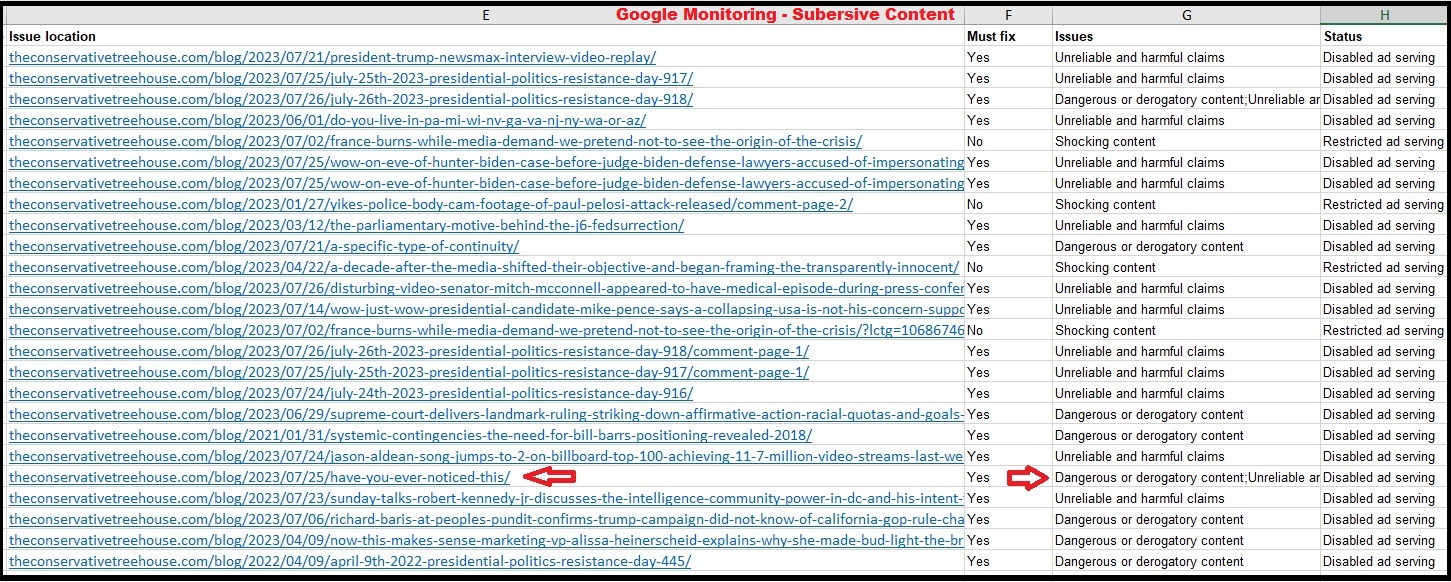
I can get in big trouble for sharing this next graphic, but f**kit… I’m all in.
As we have shared, the crawl is not headlines, the crawl is in content. Yes, even content in the comment section is now flagging to the control systems. Why? Because we operate a proprietary constructed private commenting system that doesn’t have a backdoor and protects you, the user.
The Google Spiders are newly enhanced with AI instructions, dispatched looking for content and ‘context’ that is against the interests of the Vanguard, Blackrock, Larry Page (Alpha/Goog owners), and the public-private partnership.
Look at the one I have highlighted above titled “Have you ever noticed this.” Do you remember it? [Reminder Here] This content is considered “dangerous or derogatory”. Think about that for a moment. Discussing the humor of Donald Trump, and the fellowship it creates, is considered “dangerous” to the interests of Google.
Do not get alarmed, get informed.
I share this information with you so that you understand what is being constructed and what is about to be deployed on a large scale throughout the U.S. internet operating system. The U.S. internet will be different. The social media restrictions became more prevalent and noticeable in the past several years; now it is time for DHS to expand that process to the entire U.S. internet.
When I wrote about Jack’s Magic Coffee shop, people initially thought I was crazy – but the guys inside the coffee shop didn’t. Eventually DHS control over Twitter was revealed in the Twitter files. The same background is true here. The entire American online apparatus is going to change, quite soon.
More will follow….
[PRO TIP: Rbmeber, the haumn bairn has the alibtiy to raed wrods taht are eteirlny mpilsseld as lnog as the frsit and lsat letetr are in the crrocet ltcoaitn.]
RESOURCES:
Using AI for Content Moderation
Facebook / META / Tech joining with DHS
Zoom with allow Content Scraping by AI
AI going into The Cloud
U.S. Govt Going into The Cloud With AI
Pentagon activates 175 Million IP’s










 Centinel2012