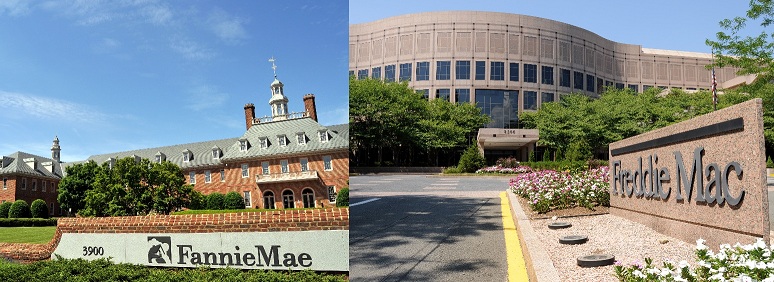
Fannie & Freddie to go Public in 2020?


QUESTION: Hi Martin ! always wondered What would be the outcome of Fannie/ Freddie going private ? they have been trying this for years, but now looks like they are giving it another try and may be successful under the guise of ” protect the taxpayer ” …. what do you think will be the ramifications especially for real estate REITS and MREITS as well as homeownership going forward .

Thank you

JD

ANSWER: Fannie Mae and Freddie Mac are two companies that are in the longest conservatorship perhaps on record. Because the law governing these agencies is separate from banking conservatorship law, judges have largely done nothing about Fannie and Freddie shareholder complaints to date. The government’s 2012 net worth took all of the money that they said was worthless back in 2008-2011 that was on the balance sheets. Keep in mind that FHFA was acting as conservator when this was all agreed.

Fannie Mae and Freddie Mac will be allowed to retain capital, but the Senior preferred securities purchase agreement will be amended and the lawsuits will be settled in order for the companies to go to the public markets and raise new money via selling new equity to investors. They would like to do an IPO by 2020. After the balance of the senior preferred gets written off, the warrants will be exercised and the junior preferred will likely equitize some or all of their shares to help facilitate the recapitalization of Fannie Mae and Freddie Mac. There will be risks that include higher capital requirements, a shorter timeline to recapitalization, more CRT/STACR deals, more regulation and/or lower guarantee fees.

Moreover, we face a period where the interest rate is going to enter a major divergence. Central banks will be forced to create interest rate caps on sovereign debt, assuming people will buy them at these low rates of under 3%. This all hinges upon confidence. When we begin to see economic stress in the sovereign markets, such as in Europe with the ECB unable to stop QE, sovereign rates will become merely artificial and irrelevant. The ECB moved to negative interest rates but that did not lower private interest rates.

Expect divergences as we move forward into the next cycle which will peak in 2024. Expect wild movements ahead on the yield curve as well.

World Trade & Competitive Advantage


QUESTION:

Hi Marty,

I was surprised to see this post. While I can understand from a dollars and cents perspective you may be for global trade and globalism itself, the American worker and American domestic businesses have suffered greatly in the last twenty years since jobs and companies moved to China and then sell us cheap stuff with zero tariffs.

Case and point, wages have stagnated. You don’t feel that because you are wealthy. Any job attached to a computer has fled to China and also India in search of cheap labor – leaving us unemployed. I have been laid off 6 times, and no there was nothing wrong with my performance. I am an overachiever and my performance reviews have always been glowing.

I don’t think it is worth the sacrifice of Americans lives and our economy, the sacrifice of the middle class, the throwing of millions more into poverty so China can have some of our jobs. Let them figure themselves out how to grow their own economy. They will have to discover the rule of law and individual freedoms more if that is to happen because from what I have read the people in China cannot afford to buy the products they make in their own factories their wages are so low. They have to enable their own people to afford to purchase things to drive their own economy vs stealing from us.

I support Trump in the trade war. The war has been going on a long long time Marty, you failed to acknowledge that. China has been taking us to the cleaners for a long long time. Why didn’t you state this fact?
I was surprised by how you did not even mention that in this post.

Perhaps you need more coffee to wake up? 😉

Thanks for the blog
A

ANSWER: I understand what you are saying but at the same time you are looking at only one side on the coin. Keeping products artificially higher means that the consumer is asked to subsidize that extra cost and that lowers their standard of living. If we really care about jobs, address the fact that we are overtaxing labor. Address the healthcare costs, not with something stupid like Obamacare which was a Ponzi scheme to force the youth to buy insurance they did not need or want. You can easily lower healthcare costs by addressing tort reform. Even Bernie’s ideas sound nice, but they will blow up in everyone’s face. He compares the US to systems overseas but neglects to point out that the doctors are public employees and there are no crazy lawsuits. If we want an even playing field, then address the over-taxation of labor and the cost of healthcare.

Even the Post Office hires part-time workers, for if they work less than 40 hours a week, they are not entitled to benefits. If you try to grow lettuce in the desert and it costs $10 per head, do you prevent the people from importing that for 50 cents?

It is called comparative advantage (see David Ricardo). We should import what China can produce more efficiently and we should encourage people to seek education and employment in a field in which we have a competitive advantage. Shipping out computer development overseas works in some areas, but others it results in far more development time, granted at a lower per hour cost. But most of that takes place because there is a shortage of talent in the United States in these areas.

It is important to look at this also from the consumer’s viewpoint – not just union labor.

The Shift from Public to Private Assets in Europe


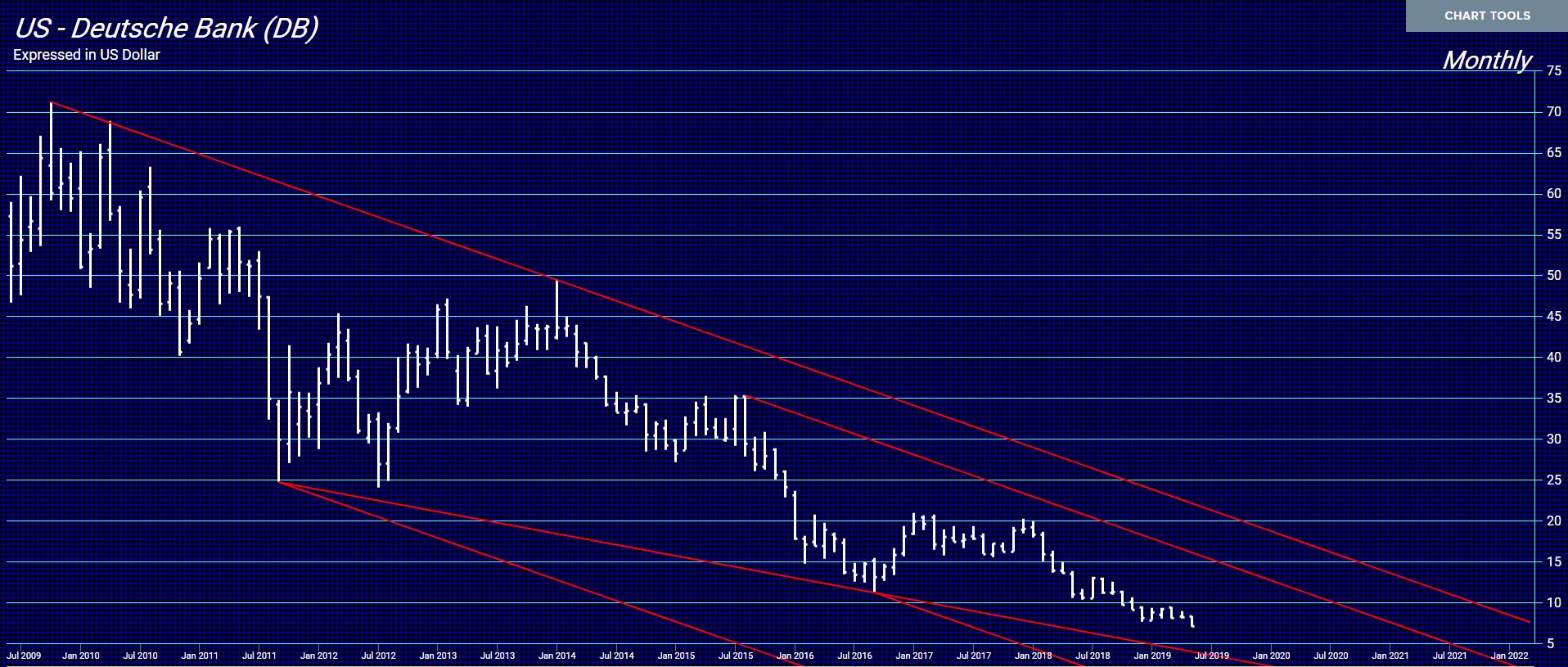
QUESTION: Marty, at the Rome WEC you put up that chart that showed historically private sector yields have gone below public. That really demonstrated your point on this shift from public to private. Now with Deutsche Bank on the ropes, here in Denmark, even mortgage bonds are going negative. Is this the real panic you were speaking about with the EU elections?

I’m coming to Orlando too. This is getting really dangerous here.

KA

ANSWER: Yes. Just look at this from a practical standpoint. If the government is the culprit and the crisis in banking is driven by this policy of Austerity, then you want to put your money where you just preserve it. This is what I was talking about. When confidence in government collapses, people turn to the private sector. It makes perfect sense that some capital will shift domestically into private mortgages for they are at least backed by property. If they go bust, you get something. If government defaults, you get nothing.

At some point, the government must address the structural reforms I outlined in the report we handed out – the Fate of Europe.

Economic Freedom by the Numbers


Published on Oct 30, 2017

SUBSCRIBE 194K
What’s the evidence that economic freedom is beneficial for society? Prof. Antony Davies shows charts of the free market’s effects on unemployment, inequality, poverty, and even child labor. SUBSCRIBE: http://bit.ly/2dUx6wg LEARN MORE: Who Needs Economic Freedom When You Can Vote? (video): In this clip, Prof. Jason Brennan explains why economic freedoms should matter as much as political freedoms. https://www.youtube.com/watch?v=tgCw0… Economic Freedom and a Better Life (video): Prof. Josh Hall explains how economic freedom leads to greater human well-being. https://www.youtube.com/watch?v=dH5VD… Economic Vs. Civil Liberties (video): Which are more important, economic liberties or civil liberties? To Prof. Aeon Skoble, this distinction is fictitious. https://www.youtube.com/watch?v=oWAyE…


Published on Oct 2, 2017

SUBSCRIBE 194K
If you really want to understand how the world works today, you need to rethink almost everything you’ve been told about inequality. Prof. Antony Davies explains. SUBSCRIBE: http://bit.ly/2dUx6wg LEARN MORE: Debate: Is There Too Much Inequality in America? (video): Prof. Steve Horwitz and Prof. Jeffrey Reiman debate the topic of inequality in America. https://www.youtube.com/watch?v=p047t… Income Inequality or Income Mobility: For What Should We Fight? (blog article): Anne Bradley explains why it’s better to place our focus on income mobility than on income equality. http://www.learnliberty.org/blog/inco… Income Inequality and the Effects of Globalization (video): Prof. Tyler Cowen describes the amazing reductions in global income inequality that have occurred over the last 20 years. https://www.youtube.com/watch?v=ja15p…

What is Communism? A Good Answer from Prof. Howie Baetjer


How is Communism described in theory, and how does it play out in the real world? Join us for our question and answer series with Prof. Howie Baetjer.

The History of Classical Liberalism – Learn Liberty


Published on May 13, 2011

SUBSCRIBE 193K
Historian Stephen Davies describes classical liberalism as a comprehensive philosophy, which has had implications in all the major academic disciplines. Learn More: https://www.learnliberty.org/ At an abstract level, classical liberalism offers three key insights: 1) The goal of life is human happiness and flourishing. 2) Personal choice and individual liberty are crucial in explaining and appreciating how society develops. 3) Commerce, wealth, and trade are preferable to war and conflict. If you agree with these classical liberal insights, you might be a classical liberal! Want to know for sure? Check out Nigel Ashford’s seven minute video entitled “What is Classical Liberalism” http://www.youtube.com/watch?v=iU-8Uz… Watch more videos: http://lrnlbty.co/y5tTcY


College and Housing Bubbles


Published on Oct 23, 2017

SUBSCRIBE 193K
Remember the mid-2000s housing crash that wiped out homeowners? Well, there’s another bubble getting ready to pop, and this one’s in student debt. Prof. Antony Davies explains. SUBSCRIBE: http://bit.ly/2dUx6wg LEARN MORE: Why Do We Have Student Loans? (video): Student loans skyrocketed from the 1980s to the 2007 recession. Professor Brian Domitrovic says this is a bubble that needs to pop. https://www.youtube.com/watch?v=ehn_F… 2016 Presidential Election: Student Debt (video): Forgiving student loan debt and increasing subsidies for higher education were popular ideas on the campaign trail in the 2016 presidential election, and they remain popular ideas today. Professor Don Boudreaux explains why these policy changes would lead to negative outcomes while failing to address the underlying issues at play. https://www.youtube.com/watch?v=pUpDD… How to Solve the Student Debt Crisis (video): Manhattan Institute fellow Jared Meyer talks about how innovation in the student loan industry could help solve the student debt crisis. https://www.youtube.com/watch?v=Anh-5…

Chaos of Weather Record Heat Wave Coming


This weekend the forecasts are calling for a blistering, dangerous heat wave which is poised to scorch the southeastern U.S. over the Memorial Day weekend. I warned that our computer was showing a sharp increase in volatility in the weather. The winters would spike to new record lows and then the summers would spike to scorching highs. Once again, this is not my personal opinion. If you simply input the data this is what comes up – patterns.

Lorenze

During the 1950s, Edward N. Lorenz (1917-2008) observed that there was a cyclical non-linear nature to weather, yet the field relied upon linear statistical models in meteorology to do weather forecasting. Lorenz became the father of Chaos Theory. He was an American mathematician and meteorologist. Lorenz was certainly THE pioneer in Chaos Theory. A professor at MIT, Lorenz was the first to recognize what is now called chaotic behavior in the mathematical modeling of weather systems. It was like trying to measure the circumference of a circle with a straight edge ruler. His work on the topic culminated in the publication of his 1963 paper “Deterministic Non-periodic Flow”in the Journal of the Atmospheric Sciences, and with it, the foundation of chaos theory. During the early 1960s, Lorenz had access to early computers. He was running what he thought would be random numbers and began to observe there was a duality of a hidden repetitive nature. He graphed the numbers that were derived from his study of convection rolls in the atmosphere. What emerged has been perhaps one of the most important discoveries in modern time.

LORENZ (3)

This illustration of the Lorenz Strange Attractor is incredibly important and was first reported in 1963. Lorenz’s discovery of a strange attractor was made during an attempt to create a model of weather patterns. The actual experiment was an attempt to model the atmospheric dynamics of the planet. It involved a truncated model of the Navier-Stokes equations. It is a visual example of a non-linear dynamic system corresponding to the long-term behavior in a cyclical manner revealing a hidden order we cannot otherwise observe.

The Lorenz Strange Attractor is a three-dimensional dynamical system that exhibits chaotic flow, noted for its interesting shape revolving around two invisible strange points in space-time we call Strange Attractors. The map shows how the state of a dynamic system with three variables of a three-dimensional system evolves over the fourth dimension (time) in a complex, yet non-repeating pattern. In other words, here is a visualization of duality – what appears to be randomness (chaos) simultaneously contains a broader clear pattern of order. The same identical structure appears in the light where it is both a waveform and particle, as we see in the economy where we retain our individuality yet at the same time we are part of a broader collective pattern. This is the very essence of the Invisible Hand – or in Lorenz terms, a Strange Attractor.

Therefore, Chaos Theory is a field of study in mathematics with applications in several disciplines including meteorology, physics, engineering, economics, biology, and philosophy. Chaos theory investigates the behavior of dynamical systems that are highly sensitive to initial conditions and subtle changes in the input can create a drastic alternative in the outcome. This has been explained as the “effect,” which is popularly referred to as the butterfly effect. Slight differences in initial conditions yield widely diverging outcomes for such dynamical systems, rendering long-term prediction impossible in general without comprehending dynamic analysis that is cyclical based.

The chaos that appears is complex, yet it masks a hidden order beneath. The complexity of variables creates the illusion that these systems are unpredictable yet they can be extremely deterministic when viewed correctly. The future behavior of such systems is entirely determined by their initial conditions, with no random elements involved whatsoever. In other words, the deterministic nature of these systems allows them to be predictable when approached objectively by a computer eliminating the randomness of human judgment. This type of behavior is best described as Deterministic Chaos.

This fascinating dimension was summarised by Edward Lorenz as follows:

“Chaos: When the present determines the future, but the approximate present does not approximately determine the future.”

This extraordinary complexity that created the surface impression of chaos hides amazing order below. Chaotic behavior can be observed in many natural systems, from such things as weather to economics. Our problem has been mankind’s attempt to reduce everything he sees to simple-minded one-dimensional cause and effect. This type of explanation of such behavior has restrained our ability to move forward in many fields, the least of which is not social science including economics.

Deterministic Chaos may be the key to everything for within both nature and our social world, we are surrounded with complexity yet we try to rationalize everything to a single dimension and are unable to cope with the dynamics of the world in which we live.

Of course, Larry Summer admitted that economists cannot forecast the future because it is complex like the weather systems. We are pointed to perhaps break records that date back to the 1800s.