The climate change psy-ops has simply gone too far. Schwab’s World Economic Forum has become like a cult declaring our last days are ahead unless we abide by asinine laws. Those promoting the Great Reset have said countless times that WE will begin to eat bugs to save the planet, and meat will no longer be available to us. Now Tyson Foods announced it acquired a minority stake in the bug protein startup company, Protix.
According to the company’s website:“Protix is the world leader in insect ingredients. We believe that feeding the growing world population should go hand in hand with protecting our beautiful planet. A huge challenge! Fortunately, the solution lies in nature itself: insects provide low-footprint proteins and other nutrients that can be processed into more sustainable feed and food.”
The website goes on to claim:“Why do we love insect ingredients? Because they’re the answer to many of the problems the world is facing today. Insect ingredients have a lower footprint than many of the ingredients commonly used in feed and food. Our insects need very little room to grow, making for far less land use than traditional ingredients. They also need less water and have lower CO₂ emissions. Plus… insects are nature’s greatest ‘upcyclers’ and thus a natural solution to the huge problem of food waste.”
Tyson said it will begin to normalize the consumption of bugs by placing it in pet food, aquaculture, and livestock production. The company will “upcycle food manufacturing byproducts into high-quality insect proteins and lipids.”So they even want to fill the animals we eat with insects and change their diets as well. Grand View Research stated that insect protein consumption will grow by 27.4% by 2028, a half cycle before 2032, when the people rise up and demand change. Governments want us sick and helpless.
Posted originally on the CTH on February 6, 2023 | Sundance
John Boyd Jr., President of the National Black Farmers Association appears on Newsmax TV to discuss the ongoing issue of higher farm input costs. Energy costs, fertilizer costs, fuel costs as well as all packing and distribution costs that are associated with petroleum manufacturing, are continuing to drive farm costs throughout the supply chain.
After a review of the current farm output status, there is a very strong possibility we will see the fourth wave of food inflation hit this spring, in combination with several manufacturing and production facilities. Again, the lack of consumer spending on durable goods has moderated the price in hard goods (supplies up, demand down); however, the highly consumable products like food, fuel and energy continue to experience upward price pressure as a direct result of Biden energy policy. WATCH:
.
If consumers could eat missiles and weapons, the U.S. government would be offsetting the costs. Unfortunately, for actual farming products, there is no government attention, policy or support. Apparently, food is still not considered a national security issue.
Posted originally on the CTH on January 30, 2023 | Sundance
This is a topic we have covered extensively, and it is great to see Tucker Carlson questioning the sudden alignment of various elements that are creating a very real food insecurity problem.
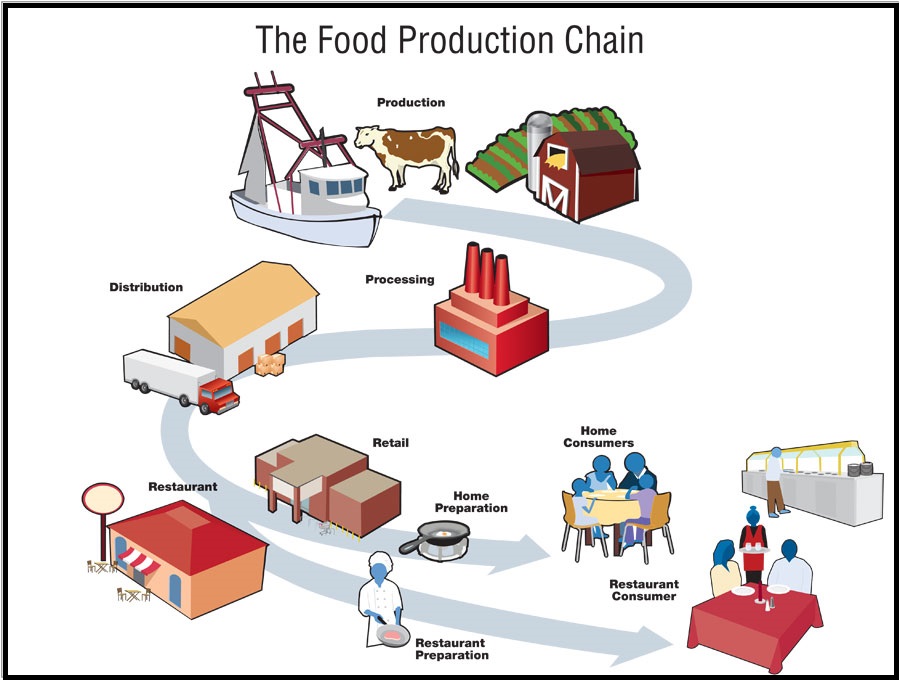
The #1 factor in the shortage of food production is the newly emboldened ‘western energy policy‘ and the impact energy has on everything from field (fertilizer) to fork (distribution). Other factors include government policy that blocks food development (Dutch, Irish and Sri Lanka Farmers), a sudden uptick in food facilities having major fires and damage, and a series of issues with the feed that goes into the production of proteins.
This is all happening as the advancement of insects as a more “sustainable” protein replacement is being advanced by the same western governments. However, if you happen to notice that all of the issues travel in the same direction, you are a conspiracy theorist, or something. WATCH:
We have been watching the predictable outcomes surrounding the western government shift to change energy policy for almost two years. Approximately a year ago we first said, “the absence of food will change things.”
As energy resources like natural gas were curtailed the resulting price increase and subsequent shortage of fertilizer was discussed in great detail well in advance.
Now, we are starting to see exactly what those warning voices were talking about.
An interesting article in ZeroHedge Saturday [SEE HERE] draws attention to how the media can no longer try to ignore the created global food crisis.
ZeroHedge – People on the other side of the planet are dropping dead from starvation right now, but most people don’t even realize that this is happening. Unfortunately, most people just assume that everything is fine and dandy. If you are one of those people that believe that everything is just wonderful, I would encourage you to pay close attention to the details that I am about to share with you. Global hunger is rapidly spreading, and that is because global food supplies have been getting tighter and tighter.
If current trends continue, we could potentially be facing a nightmare scenario before this calendar year is over. (read more)
The article then goes on to detail the issues and food shortages in Pakistan, India and the entire African continent. Factually, according to media reports on the region, the worst food crisis in history is happening – yet most U.S. and European Union media are avoiding it. The famine is happening in almost complete western silence.
Keep in mind, none of this is unexpected. In fact, the G7 countries discussed the pending problem in mid 2022, yet no one took any steps to avoid it.
Vladimir Putin’s military action against eastern Ukraine had nothing to do with the severe food shortages and inflation in Sri Lanka {link}. Nor did Russia have any influence over the Dutch government trying to stop food production {link}. Additionally, Putin had no control over Justin Trudeau’s decision to limit harvest yields by blocking the use of nitrogen-based fertilizer {link}. More importantly, it was not Vladimir Putin who forced all the western politicians to sign up for a new ‘climate friendly’ energy program that is destroying the ability of western farms to generate higher yield crops.
You do not need to be a farmer to understand that nitrogen/phosphorus-based industrial fertilizer has been the reason why farm yields have generated massive amounts of food on a global basis. The United States, Canada, the U.K. and places like the Netherlands have massively increased their ability to generate food for export, in large part due to the success of improved fertilizer and crop saving modern pesticides. Take those farming advancements away under the guise of climate change and you get Sri Lanka, Pakistan and now the African Continent.
Those western climate and energy policies create downstream consequences. The decision to chase a new global energy policy under the name “Build Back Better,” in combination with short-sighted EU sanctions against Russia, and you get food shortages.
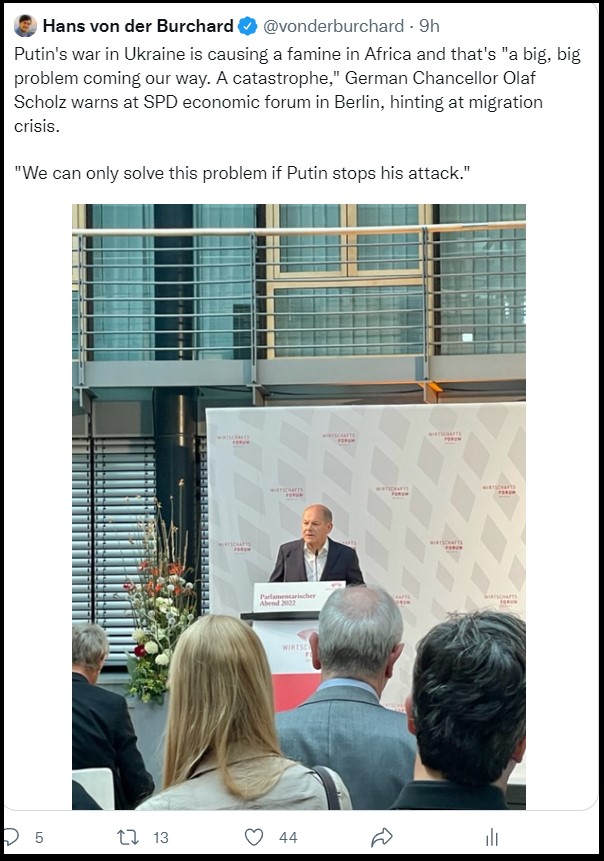
It was not Vladimir Putin who told British Prime Minister Boris Johnson and German Chancellor Olaf Scholz their proactive recommendation to switch from crop-based biofuels to human food would be blocked. That G7 decision was made by Justin Trudeau and Joe Biden. {link} Even more significantly, it was not Russia who threatened the multinational energy companies about investing in Africa for expanded natural gas supplies for their fertilizer needs. That threat came from the same western government alliance, per their instructions from the World Economic Forum group {link}.
It was predictable {JUNE 21st} {June 30th} and {July 6th} that western government leaders would seek to avoid responsibility for the food crisis they created, and throughout the latter part of 2022 we saw western media trying, desperately, to frame Russia for global food shortages in order to protect western politicians.
I said this in July of last year and as the consequences now surface it is even more critical to understand.
Joe Biden, NATO, the G7, the European Union, the World Bank, USAID, and every western leader in the United States and Europe stated in early and mid 2022 there will be food shortages in 2023.
They did not say there might be shortages; their statements were emphatic, there will be shortages.
Accept this basic cornerstone. Then ask why not a single proactive step has been taken by any of the aforementioned institutions or governments to alleviate what they declare is a certainty. Why?
Simple question, “why?”
If all of the western nations, non-govt organizations and heads of state, are aware of a coming food crisis, why is there no proactive response?
It is a question that even the most hardcore leftists will not answer, because there is only one answer. No action is being taken because they do not want to take action. No effort to avoid the crisis is being done, because they do not want the crisis avoided.
Peel all the layers of obfuscation and causation away, and what we find is the epicenter of the food shortage is directly the result of the Build Back Better agenda. A post-pandemic western government deliberate decision to radically change global energy development. In succinct terms, the climate change agenda.
However, regardless of how you feel about the validity of “climate change,” the cause of diminished food supplies is purposeful. It is not climate change causing food shortages. It is the purposeful action taken under the guise of mitigating climate change that is causing the shortage of food.
The collective Build Back Better energy policy of western governments’ is the reason for massive increases in energy costs, massive oil price jumps, gasoline price increases, significant increases in chemical costs, increases in diesel fuel costs, shortages of fertilizer created using natural gas, and the end result is lower crop yields, higher farming costs and eventually, food shortages. They knew this.
All of the organizations and government who have been decrying the future shortage of food, know it is the radical shift in energy resource development that is creating the crisis. This acceptance of reality begins the framework to understand just how entrenched and committed these western leaders are toward their beloved climate change agenda.
We are only just now beginning to see the first aspects of the food shortage. However, once the issue becomes unavoidable the western leaders will not and cannot accept the blame for what they have done. They will blame-cast, excuse and justify what is surfacing.
Food shortages will be blamed on the Ukraine conflict, Russian aggression, climate change and any various iteration of justification that does not identify the true cause, their energy ideology.
I’m not so sure that people fully understand what the entire system of western government would be willing to do to avoid being blamed for avoidable death on a potential scale that is quite alarming. All of the western leaders, institutions and governments are on the same boat. They are all in this together.
(June 22, 2022) – (Reuters) – The European Union is divided on how to help poorer nations fight a growing food crisis and address shortages of fertilizers caused by the war in Ukraine, with some fearing a plan to invest in plants in Africa would clash with EU green goals.
The need for food “clashes with EU green goals.”… Let that sink in.
Posted originally on the conservative tree house on October 22, 2022 | Sundance
Last week we discussed the announcement of a $24.6 billion merger deal between Kroger and Albertsons supermarkets {Go Deep}. The majority stockholders in both companies are institutional investment groups, Blackrock, Vanguard and Cerberus.
The merger would consolidate the second and third largest food retailers in the U.S. and would certainly dilute the competitive dynamic amid the supermarket industry. Concern over price controls and decreased competition has now arrived on the desks of DC legislators who are reviewing the deal.
(Reuters) – […] U.S. Democratic Senator Amy Klobuchar and Republican Senator Mike Lee were quick to say that they would hold a hearing to discuss the merger. A European interloper could make deal plans even harder.
Frans Muller, Chief Executive of Stop & Shop owner Ahold Delhaize (AD.AS), has made no secret of his desire to consolidate U.S. grocers. The Netherlands-based firm is already the fourth largest grocery chain. If it managed to cobble together a better offer than Kroger’s bid for Albertsons, it would become the second largest supermarket. Plane spotters tracked two Albertsons jets next to Ahold Delhaize’s U.S. base in Massachusetts in early August. Ahold declined to comment.
Ahold can also afford a chunky deal. The Dutch grocer has debt of just 2 times its $6.7 billion of EBITDA estimated for this year, according to Refinitiv. That’s 50% less than the average. If investors reckoned there was merit in a deal, Muller could also use equity to beef up the offer. At more than 12 times, Ahold’s price-to-earnings ratio is a fifth higher than Albertsons’, giving it currency.
Aspects of the deal might make it easier for antitrust authorities to get comfortable, too. Kroger and Albertsons would have a combined market share of 13%, whereas a deal with its Dutch rival gives much less of the pie. Ahold focuses on the East Coast of America whereas Albertsons has a big presence on the West Coast. So regulators wouldn’t have to worry about a larger Kroger shutting down competing Albertsons stores.
[…] U.S. senators who scrutinise antitrust issues expressed “serious concerns” about grocery company Kroger’s plan to buy rival Albertsons, and said they would hold a hearing in November on the $25 billion deal.
The announcement by Democratic Senator Amy Klobuchar, chair of the Senate Judiciary Committee antitrust panel, and Republican Senator Mike Lee confirmed a previous report by Reuters.
A Kroger spokesperson said the company looked forward to the hearing. “We welcome the opportunity to outline how this transaction will benefit America’s consumers by expanding access to fresh, affordable food,” the company said in a statement.
The Federal Trade Commission is expected to review the deal to ensure it complies with antitrust law. (read more)
This might be one of those rare times when a legislative and regulatory review may actually be beneficial to the outcome for the consumer.
(DCBusinessDaily) – […] Scott Rasmussen Number of the Day shows 76% of voters have seen their grocery prices go up in the last month. The poll also found 60% of voters believe prices will continue to rise. Additionally, 54% of voters say gas prices have gone up in the last month and 59% believe gas prices will continue to go up. Ballotpedia’s poll methodology surveyed 1,200 registered voters from Oct. 6-8. According to the Ballotpedia website, the poll was lightly weighted by geography, gender, age, race, education, internet usage and political party to reflect a fair balance of voters across the country. The margin of sampling error is +/- 2.8 percentage points.
The U.S. Bureau of Labor Statistics issued its latest Consumer Price Index (CPI) summary for the nation on Oct. 13, which found that the rate of inflation over the last 12 months stands at 8.2%. It rose 0.4% in September. In the last year, food costs have risen by 11.2%, energy costs have increased by 19.8%, gas prices have risen by 18.2% and the cost to purchase a new vehicle has increased by 9.4%. (more)
Posted originally on the conservative tree house on October 14, 2022 | Sundance
Not that long ago, I would have said to allow the free market to decide if a merger or acquisition was valuable for the consumer. However, in the era where massive multinational corporations, investment groups and financial institutions have now used corporatism to merge their interests with government, the massive multinationals need scrutiny.
Two major food retailers, Kroger and Albertsons, have announced their intent to merge into one massive company in a deal valued at $24.6 billion. The majority stakeholders in Kroger are institutional investors Vanguard ($3.72 billion/11.29%) and Blackrock ($3.02 billion/ 9.17%). The majority stakeholder in Albertsons is institutional investment group Cerberus ($3.90 billion/28.54%).
In the past few years, food has surfaced as a growing national security issue. Foreign companies and large multinationals continue to expand their control over U.S. farm production and export U.S. farm products (Big Ag). A major retail level move like the merger of Kroger and Albertsons creates a weaker competitive environment and gives a larger potential footprint to price control.
CBS – […] Together, the companies will have more than 710,000 workers and operate nearly 5,000 stores, along with roughly 4,000 pharmacies. Kroger, based in Cincinnati, Ohio, operates 2,800 stores in 35 states, including brands like Ralphs, Smith’s and Harris Teeter. Alberstons, based in Boise, Idaho, operates 2,220 stores in 34 states, including brands like Safeway, Jewel Osco and Shaw’s.
“Albertsons Cos. brings a complementary footprint and operates in several parts of the country with very few or no Kroger stores,” Kroger CEO Rodney McMullen, who will lead the expanded company, said in a statement.
Kroger will pay $34.10 for each share of Albertsons stock, a 19% premium from the closing price on Thursday. As part of the purchase, Albertsons will issue a cash dividend of up to $4 billion to its shareholders, which the companies said is expected to be about $6.85 per share. (read more)
Sometimes bigger is just bigger and more controlling, not better.
That said, with economic volitivity continuing to increase, the food sector is a safe harbor for massive investment shifts.
Posted originally on the conservative tree house on October 12, 2022 | Sundance
The “Producer Price Index” (PPI) is essentially the tracking of wholesale prices at three stages: Origination (commodity), Intermediate (processing), and then Final (to wholesale). Today, the Bureau of Labor and Statistics (BLS) released September price data [Available Here] showing another 8.5% increase year-over-year in Final Demand products at the wholesale level. However, that’s not the bad news in this data.
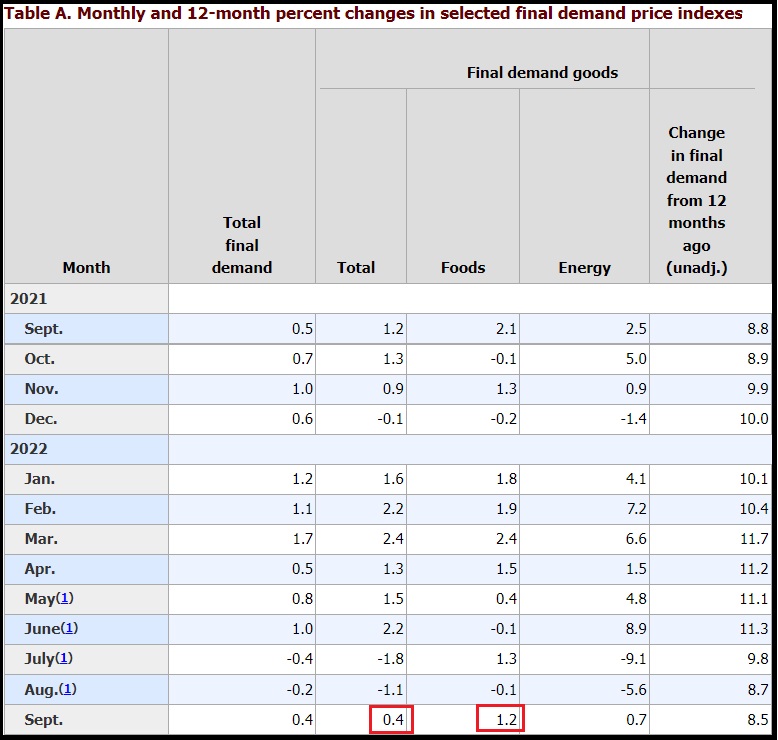
While the overall September PPI was higher than expected at 0.4%, the Final Demand Producer Price for food products in September was a whopping 1.2% (14.4% annualized).
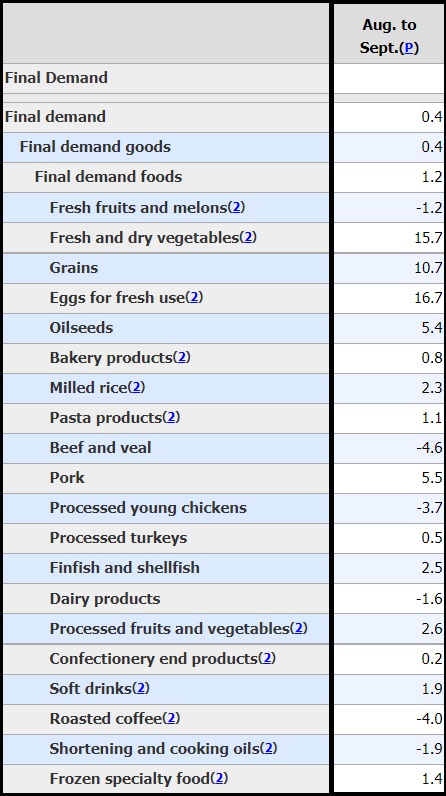
The BLS notes the driver by saying, “a major factor in the September increase in prices for final demand goods was a 15.7-percent advance in the index for fresh and dry vegetables. Prices for diesel fuel, residential natural gas, chicken eggs, home heating oil, and pork also moved higher.”
That’s a 15.7% increase in price, in one month, for fresh and dry vegetables. Annualized that’s a rate of price increase of 188.4% for vegetables. Remember the warning about farm costs (energy, fertilizer, fuel) driving field to fork inflation at harvest? This is the leading edge of that third wave of food price increases.
I have modified BLS Table-2 to focus specifically on food costs. The data is on left.
You will note that ‘row crops’ are the big drivers along with grain and seed products. This is exactly as we predicted it would be because those specific farming costs are the ones with greatest increase from energy, fuel, fertilizer, weed and insect control, and diesel costs.
All of those higher costs have been growing in the fields and will now surface at harvest. The higher farm costs transfer from the field to the fork via the food supply chain. This is only the leading edge of the price increase.
In October 2021 we first warned of the food price increases coming in distinct waves. The first was Jan, Feb and March 2022. The second wave was May through July 2022. This third wave will be bigger than the first two and starts arriving this month, October 2022.
People laughed at me when I said in late 2022 eggs were going to reach .50¢ EACH ($6/doz).
Well, in September the price of fresh eggs jumped 16.7% in a single month. That’s an annualized rate of price increase for eggs over 200%.
With hindsight you can clearly see the three waves of food price increases (BLS Table A):
Get ready and shop smart.
The October, November and December price increases in the grocery store are going to make the prior fresh food increases look small, as the full increased costs of farming operations starts to arrive at the supermarket. Unfortunately, this will coincide with a wave of gasoline price increases, and the prices of natural gas are already skyrocketing.
Edge of Wonder Published originally on Rumble on September 20, 2022
Bill Gates buys up farmland across the United States, big corporations get grants instead of companies that need it, and farmers are MAD. What is the World Economic Forum pushing that’s been going on since the ‘70s? What fear mongering is making the rising food costs seem like something we can’t escape from?
I have created this site to help people have fun in the kitchen. I write about enjoying life both in and out of my kitchen. Life is short! Make the most of it and enjoy!
This is a library of News Events not reported by the Main Stream Media documenting & connecting the dots on How the Obama Marxist Liberal agenda is destroying America










 Centinel2012