The banking crisis continues and it is impacting funds that have been buying bonds. Allianz, a subsidiary of Pimco, is writing off countless millions with Credit Suisse bonds. The banking crisis has been the result of artificially low-interest rates for far too long and banks were used to free money and buy long-term bonds all because they were making their money on the spread. Now that rates are rising, their risk management was effectively nonexistent, and thus the losses and widespread.
The Allianz subsidiary Pimco is one of the largest asset managers in the world. They have to now write off a loss in Credit Suisse bonds and it’s ain’t over yet as we head into April 10th.
COMMENT #1: Marty; Thank you so much for your warning at the WEC that we would now face a banking crisis with rising rates into 2024. You are always so far ahead of the pack. Live forever – please!
KQ
REPLY #1: Thank you, but that would sentence me to perpetual taxation indefinitely. No thanks.
COMMENT #2: Hello. I read your FREE blog because I am poor. Would you please stop posting PRIVATE stuff and post stuff that us peons can read?
Thank you kindly.
Ms. Terri
REPLY #2: My concern is since we forecast this last year, they will only blame me. That blog is only $15 a month, but it is blocked by Google so it is more free speech if you get my drift. I simple MUST be guarded in what I say publicly because they simply always view me as having too much influence.
I will offer this recommendation (publicly) for my ear is turning red from all the phone calls. As for the Biden Administration, if they DO NOT heed my warning, our forecast will be devastating. The Biden Administration MUST stand behind ALL deposits – not the $250,000 FDIC limit. If they do not, small businesses will pul; excess cash from banks, switch to 30-day T-Bills at a brokerage house, and say screw the FDIC and the Biden Administration’s anti-rich (small business which employs 70% of the workforce).
The compromise here is that we need a shotgun wedding where a larger bank takes over SVB at the raw price of the deposits. The shareholder loses, but ALL depositors are covered. Any value of the shares should be attributed to tangible assets only, not goodwill. You will penalize your “hated rich” and even the small businesses will be saved. If not, you will wipe out numerous businesses that cannot even pay employees. That will set off a contagion as you try to uphold your hatred of the “rich” while you pour money into the most corrupt government in the world at the real expense of taxpayers.
Of course, SVB can simply declare they “identify” as a Ukrainian Bank and then everything would be covered right down to the pensions of the CEO.
Posted originally on the CTH on March 11, 2023 | Sundance
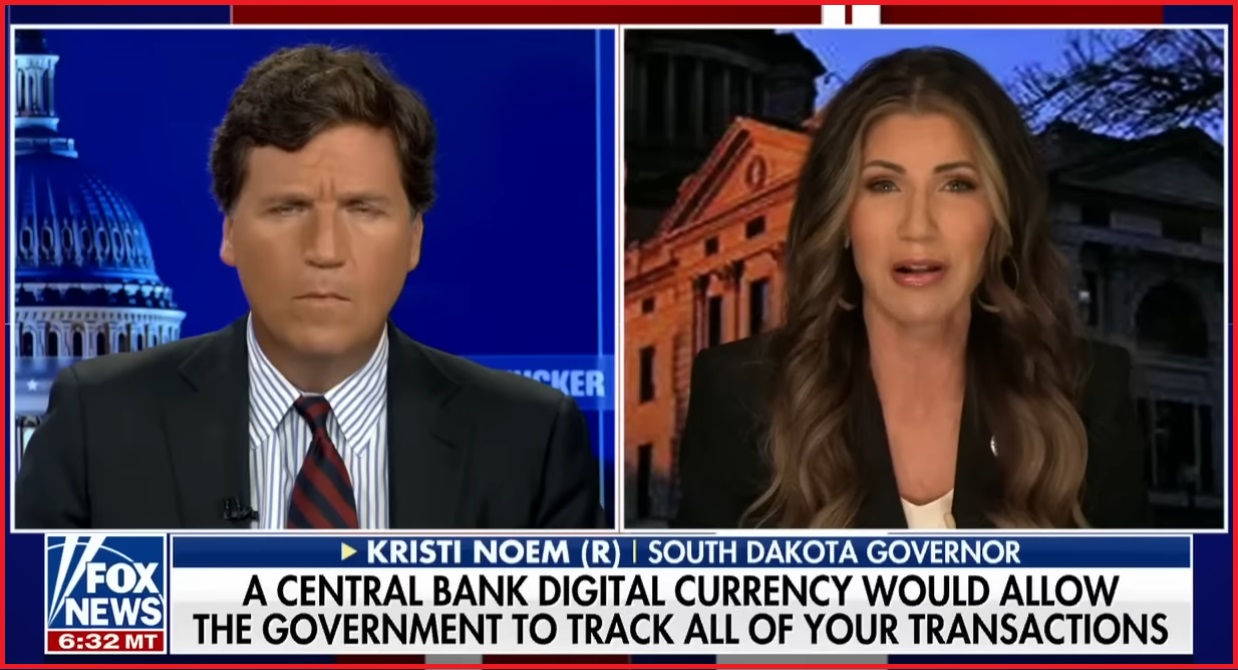
South Dakota Governor Krisi Noem appeared on Tucker Carlson’s television broadcast last night to send a warning to fellow governors. According to the background story, the South Dakota legislature passed a bill redefining currency and creating rules for a Central Bank Digital Currency (CBDC) that would block all other digital currencies from being used in the state. Governor Noem vetoed the bill.
When asked why her legislature would do this, Noem responded the state politicians likely did not read the bill as it was constructed by lobbyists. Noem is exactly correct and hits on a subject we have discussed here frequently {GO DEEP}. However, one of the more alarming aspects to Noem’s discussion of the issue is that around 20 other states are considering similar legislation. WATCH:
Posted originally on the CTH on February 2, 2023 | Sundance
This is so critically important to the understanding of the core, central element where the globalism atom splits and the resulting destruction begins, that I must pause all personal recovery efforts -immediately- and explain. This is an incredible example of where corporations and government merge. This is the atom split. This is the root, the nub, the place where “trillions at stake” takes context.
Strong HatTip to Gateway Pundit for this exceptional video and example {Direct Rumble Link Here}. The understanding comes via a Canadian dairy farmer, who, like thousands of other farmers around the world, is a private business under government control. This example is about dairy, specifically milk, however, the underlying premise goes much further.
This is modern corporatism, the nexus of govt intervention, regulations and the multinational exploitation of industry. This is also the globalist example that shows how the concepts of “capitalism” and “free markets” have been destroyed. First, watch the video:
What you are witnessing in that video is something we have talked about at length for years.
Influential people, politicians (rules) and corporate leaders (profits), both with vested financial interests in the process, have sold a narrative that global manufacturing, global sourcing, and global production is the inherent way of the future. The same voices claimed the American economy was/is consigned to become a “service-driven economy.”
What was always missed in these discussions is that advocates selling this global-economy message have a vested financial and ideological interest in convincing the information consumer it is all just a natural outcome of economic progress.
It’s not.
It’s not natural at all. It is a process that is entirely controlled, promoted and utilized by large conglomerates, lobbyists, purchased politicians and massive multinational corporations.
To understand who opposes President Trump, Jair Bolsonaro, or any economic nationalist, specifically because of the economic leverage against multinational corporations their policy creates, it becomes important to understand the objectives of the global and financial elite who run and operate the institutions. The Big Club.
Understanding how trillions of trade dollars influence geopolitical policy we begin to understand the three-decade global financial construct they seek to protect. That is, global financial exploitation of national markets.
FOUR BASIC ELEMENTS:
♦Multinational corporations purchase controlling interests in various national outputs (harvests and raw materials), and ancillary industries, of developed industrial western nations. {example}
♦The Multinational Corporations making the purchases are underwritten by massive global financial institutions, multinational banks. (*note* in China it is the communist government underwriting the purchase)
♦The Multinational Banks and the Multinational Corporations then utilize lobbying interests to manipulate the internal political policy of the targeted nation state(s).
♦With control over the targeted national industry or interest, the multinationals then leverage export of the national asset (exfiltration) through trade agreements structured to the benefit of lesser developed nation states – where they have previously established a proactive financial footprint.
For three decades economic “globalism” has advanced, quickly. Everyone accepts this statement, yet few actually stop to ask who and what are behind this – and why?
Every element of global economic trade is controlled and exploited by massive institutions, multinational banks and multinational corporations.
Institutions like the World Trade Organization (WTO), World Bank and International Monetary Fund (IMF), control trillions of dollars in economic activity. Underneath that economic activity there are people who hold the reins of power over the outcomes. These individuals and groups are the stakeholders in direct opposition to principles of America-First national economics.
The modern financial constructs of these entities have been established over the course of the past three decades. When you understand how they manipulate the economic system of individual nations you begin to understand why they are so fundamentally opposed to President Trump.
In the Western World, separate from communist control perspectives (ie. China), “Global markets” are a modern myth; nothing more than a talking point meant to keep people satiated with sound bites they might find familiar; but the truth is ‘global markets’ have been destroyed over the past three decades by multinational corporations who control the products formerly contained within global markets. This is the function of the World Economic Forum.
The same is true for “Commodities Markets.” The multinational trade and economic system, run by corporations and multinational banks, now controls the product outputs of independent nations. The free market economic system has been usurped by entities who create what is best described as ‘controlled markets’.
Bulletpoint #1:♦ Multinational corporations purchase controlling interests in various national elements of developed industrial western nations.
This is perhaps the most challenging to understand. In essence, thanks specifically to the way the World Trade Organization (WTO) was established in 1995, national companies expanded their influence into multiple nations, across a myriad of industries and economic sectors (energy, agriculture, raw earth minerals, etc.).
This is the basic underpinning of national companies becoming multinational corporations.
Think of these multinational corporations as global entities now powerful enough to reach into multiple nations -simultaneously- and purchase controlling interests in a single economic commodity.
A historic reference point might be the original multinational enterprise, energy via oil production. (Exxon, Mobil, BP, etc.)
However, in the modern global world, it’s not just oil; the resource and product procurement extend to virtually every possible commodity and industry. From the very visible (wheat/corn) to the obscure (small minerals, and even flowers).
Bulletpoint #2 ♦ The Multinational Corporations making the purchases are underwritten by massive global financial institutions, multinational banks.
During the past several decades national companies merged. The largest lemon producer company in Brazil, merges with the largest lemon company in Mexico, merges with the largest lemon company in Argentina, merges with the largest lemon company in the U.S., etc. etc. National companies, formerly of one nation, become “continental” companies with control over an entire continent of nations.
…. or it could be over several continents or even the entire world market of Lemon/Widget production. These are now multinational corporations. They hold interests in specific segments (this example lemons) across a broad variety of individual nations.
National laws on Monopoly building are not the same in all nations. Most are not as structured as the U.S.A or other more developed nations (with more laws). During the acquisition phase, when encountering a highly developed nation with monopoly laws, the process of an umbrella corporation might be needed to purchase the targeted interests within a specific nation. The example of Monsanto applies here.
Bulletpoint #3 ♦The Multinational Banks and the Multinational Corporations then utilize lobbying interests to manipulate the internal political policy of the targeted nation state(s).
In underdeveloped countries the process of buying a political outcome is called bribery. Within the United States we call it lobbying. The process is exactly the same.
With control of the majority of actual lemons the multinational corporation now holds a different set of financial values than a local farmer or national market. This is why commodities exchanges are essentially dead. In the aggregate the mercantile exchange is no longer a free or supply-based market; it is now a controlled market exploited by mega-sized multinational corporations.
Instead of the traditional ‘supply/demand’ equation determining prices, the corporations look to see what nations can afford what prices. The supply of the controlled product is then distributed to the country according to their ability to afford the price. This is essentially the bastardized and politicized function of the World Trade Organization (WTO). This is also how the corporations controlling WTO policy maximize profits.
Back to the lemons. A corporation might hold the rights to the majority of the lemon production in Brazil, Argentina and California/Florida. The price the U.S. consumer pays for the lemons is directed by the amount of inventory (distribution) the controlling corporation allows in the U.S.
If the U.S. lemon harvest is abundant, the controlling interests will export the product to keep the U.S. consumer spending at peak or optimal price. A U.S. customer might pay $2 for a lemon, a Mexican customer might pay .50¢, and a Canadian $1.25.
The bottom line issue is the national supply (in this example ‘harvest/yield’) is not driving the national price because the supply is now controlled by massive multinational corporations.
The mistake people often make is calling this a “global commodity” process. In the modern era this “global commodity” phrase is particularly nonsense.
A true global commodity is a process of individual nations harvesting/creating a similar product and bringing that product to a global market. Individual nations each independently engaged in creating a similar product.
Under modern globalism this process no longer takes place. It’s a complete fraud. Massive multinational corporations control the majority of production inside each nation and therefore control the global product market and price. It is a controlled system.
EXAMPLE: Part of the lobbying in the food industry is to advocate for the expansion of U.S. taxpayer benefits to underwrite the costs of the domestic food products they control. By lobbying DC these multinational corporations get congress and policy-makers to expand the basis of who can use EBT and SNAP benefits (state reimbursement rates).
Expanding the federal subsidy for food purchases is part of the corporate profit dynamic.
With increased taxpayer subsidies, the food price controllers can charge more domestically and export more of the product internationally. Taxes, via subsidies, go into their profit margins. The corporations then use a portion of those enhanced profits in contributions to the politicians. It’s a circle of money.
In highly developed nations this multinational corporate process requires the corporation to purchase the domestic political process (as above) with individual nations allowing the exploitation in varying degrees. As such, the corporate lobbyists pay hundreds of millions to politicians for changes in policies and regulations; one sector, one product, or one industry at a time.
These are specialized lobbyists.
EXAMPLE: The Committee on Foreign Investment in the United States (CFIUS)
CFIUS is an inter-agency committee authorized to review transactions that could result in control of a U.S. business by a foreign person (“covered transactions”), in order to determine the effect of such transactions on the national security of the United States.
CFIUS operates pursuant to section 721 of the Defense Production Act of 1950, as amended by the Foreign Investment and National Security Act of 2007 (FINSA) (section 721) and as implemented by Executive Order 11858, as amended, and regulations at 31 C.F.R. Part 800.
The CFIUS process has been the subject of significant reforms over the past several years. These include numerous improvements in internal CFIUS procedures, enactment of FINSA in July 2007, amendment of Executive Order 11858 in January 2008, revision of the CFIUS regulations in November 2008, and publication of guidance on CFIUS’s national security considerations in December 2008 (more)
Bulletpoint #4 ♦ With control over the targeted national industry or interest, the multinationals then leverage export of the national asset (exfiltration) through trade agreements structured to the benefit of lesser developed nation states – where they have previously established a proactive financial footprint.
The process of charging the U.S. consumer more for a product, that under normal national market conditions would cost less, is a process called exfiltration of wealth. This is the basic premise, the cornerstone, behind the catchphrase ‘globalism‘.
It is never discussed.
To control the market price some contracted product may even be secured and shipped with the intent to allow it to sit idle (or rot). This is where the dumping of the milk comes into play. None of this is a market driven outcome. All of this is being controlled by guiding hands of politicians, rule makers, and the partnership with the private sector corporations.
It’s all about controlling the price and maximizing the profit equation. We are discussing food and agricultural production, but the issue (the process of control) covers far more than just food, farming and Ag in general. It’s everything folks. Everything.
To gain the same $1 profit a widget multinational might have to sell 20 widgets in El-Salvador (.25¢ each), or two widgets in the U.S. ($2.50/each).
Think of the process like the historic reference of OPEC (Organization of Petroleum Exporting Countries). Only in the modern era massive corporations are playing the role of OPEC and it’s not oil being controlled, thanks to the WTO it’s almost everything.
Again, this is highlighted in the example of taxpayers subsidizing the food sector (EBT, SNAP etc.), the multinational corporations can charge domestic U.S. consumers more.
Ex. more beef is exported, red meat prices remain high at the grocery store, but subsidized U.S. consumers can better afford the high prices.
Of course, if you are not receiving food payment assistance (middle-class) you can’t eat the steaks because you can’t afford them. (Not accidentally, it’s the same scheme in the ObamaCare healthcare system)
Agriculturally, multinational corporate Monsanto says: ‘all your harvests are belong to us‘. Contract with us, or you lose because we can control the market price of your end product.
The downside is that once you sign that contract, you agree to terms that are entirely created by the financial interests of the larger corporation, not your farm. Additionally, the rule makers (govt), are working hand in glove with the corporations who control the outcome.
The multinational agriculture lobby is massive. We willingly feed the world as part of the system; but you as a grocery customer pay more per unit at the grocery store because domestic supply no longer determines domestic price.
Within the agriculture community the (feed-the-world) production export factor also drives the need for labor. Labor is a cost. The multinational corps have a vested interest in low labor costs. Ergo, open border policies. (ie. willingly purchased republicans not supporting border wall etc.).
This corrupt economic manipulation/exploitation applies over multiple sectors, and even in the sub-sector of an industry like steel. China/India purchases the raw material, coking coal, then sells the finished good (rolled steel) back to the global market at a discount. Or it could be rubber, or concrete, or plastic, or frozen chicken parts etc.
The ‘America First’ Trump-Trade Doctrine upsets the entire construct of this multinational export/control dynamic. Team Trump focus exclusively on bilateral trade deals, with specific trade agreements targeted toward individual nations (not national corporations).
‘America-First’ is also specific policy at a granular product level looking out for the national interests of the United States, U.S. workers, U.S. companies and U.S. consumers.
Under President Trump’s Trade positions, balanced and fair trade with strong regulatory control over national assets, exfiltration of U.S. national wealth is essentially stopped.
This puts many current multinational corporations, globalists who previously took a stake-hold in the U.S. economy with intention to export the wealth, in a position of holding contracted interest of an asset they can no longer exploit.
Perhaps now we understand better how massive multi-billion multinational corporations and institutions are aligned against President Trump. In essence, Donald Trump is the anti-WEF weapon of the American people.
They will even organize a western corporate war against Russia to stop anyone from blocking their financial goals.
Posted originally on the CTH on December 11, 2022 | Sundance
Stellantis is a multinational automaker contracted for the electric version of the Jeep Cherokee. Citing high costs to produce electric vehicles, on Friday Stellantis announced a decision to idle the Belvedere, Illinois plant starting on Feb. 28, 2023, and notified 1,350 workers of the layoffs.
(Via Fox) […] “This difficult but necessary action will result in indefinite layoffs, which are expected to exceed six months and may constitute a job loss under the Worker Adjustment and Retraining Notification (WARN) Act. As a result, WARN notices have been issued to both hourly and salaried employees,” it said. “The company will make every effort to place indefinitely laid off employees in open full-time positions as they become available.”
Hundreds of workers are expected to be laid off when automaker Stellantis closes an assembly plant in northern Illinois early next year, citing the challenge of rising costs of electric vehicle production.
The company, which employs about 1,350 workers at the plant in Belvidere, Illinois, said the action will result in indefinite layoffs and it may not resume operations as it considers other options.
Stellantis said the industry ‘has been adversely affected by a multitude of factors like the ongoing COVID-19 pandemic and the global microchip shortage, but the most impactful challenge is the increasing cost related to the electrification of the automotive market.’
The Belvidere plant, produces the Jeep Cherokee SUV, will be idle starting on February 28, 2023, Stellantis said. The plant in Toluca, Mexico will now produce the vehicles. (read more)
One aspect of this move that deserves additional attention is the U.S. and Canada focus on new energy policy, against the backdrop of Mexico telling the Biden administration the USMCA partner was going to continue development of traditional oil, coal and natural gas energy production.
Should Mexico continue to maintain a more traditional energy policy, they will likely create a greater cost incentive for all manufacturers. With electricity rates skyrocketing in the U.S. and Canada, any energy dependent manufacturer would see an additional advantage to production in Mexico.
It will be worthwhile watching this dynamic closely and seeing what type of pressure the Biden administration will apply to Mexican President Andres Manuel Lopez-Obrador to fall in line.
Posted originally on the conservative tree house on October 26, 2022 | Sundance
During a White House announcement today, Joe Biden pledged to have all agencies in the federal bureaucracy begin to target private industry for charging service fees, or what the administration calls “junk fees.” The junk fees relate to everything from bank overdraft charges, to hidden cleaning fees on car rentals, to hotel resort fees and even fees on airlines for seats with more legroom.
According to the White House, the junk service fees disproportionately impact marginalized communities, minorities and low-income households. The airline fees are particularly racist because the airline prices for more comfortable seats have a “disparate impact” (legal term for federal intervention) on protected categories of people.
Poor people cannot afford bigger seats. Poor people are disproportionately minority. Ergo a higher percentage of minority people cannot afford the comfortable seats. That makes charging more for comfortable seats an illegal practice according to the legal theory of ‘disparate impact.’ WATCH:
[Transcript] – […] Some airlines, if you want six more inches between you and the seat in front, you pay more money. But you don’t know it until you purchase your ticket.
Look, folks, these are junk fees. They’re unfair, and they hit marginalized Americans the hardest, especially low-income folks and people of color. They benefit big corporations, not consumers, not working families. And that changes now.
You know, we’ve been working on this for a while. I know it’s been a tough few years. But from day one, my administration has been laser-focused on easing the burden facing working-class families and giving them, as my dad would say again, just a little breathing room.
And because of the steps we’ve taken, the United States is in a stronger position today than any other country in the world, economically.
Jobs are up. People are back to work. American manufacturing is roaring back.
As a matter of fact, I’m going to be heading up to Syracuse, New York — that area — where a U.S. company, Micron, is going to be investing $100 billion. I think I go day after tomorrow or the day after tomorrow. Manufacturing computer chips will put tens of thousands of Americans to work.
Working hard to tame inflation with policies to bring down the cost of gasoline, home energy bills, and prescription drugs. (read more)
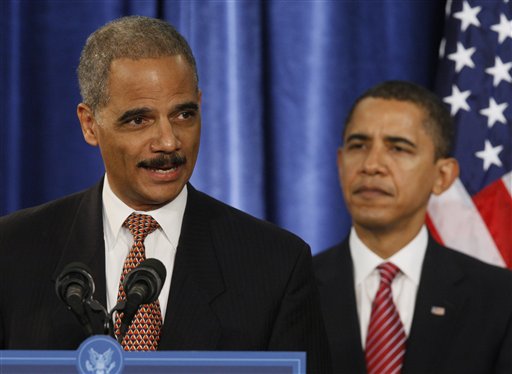
The justice department’s use of the legal theory behind “disparate impact” was an outcome of Barack Obama and Eric Holder taking office.
The Disparate Impact outlook then became part of the regulatory and compliance system within every agency of the federal government, including the Dept of Labor.
Essentially, it is a progressive legal theory advanced by the long-term members of Lawfare, and it carries inherent conflict with existing law. Take this example…..
The Dept of Labor states that businesses cannot discriminate in employment law based on legally protected categories of person, like race, marital status, nationality, sex, gender, pregnancy, or sexual identity. Simultaneously, it is also unlawful for businesses to hire illegal aliens as workers. When businesses used social security systems to check employment eligibility, they ran afoul of the ‘disparate impact’ rule.
A higher percentage of Mexican nationals were disqualified from employment because a higher percentage of Mexican nationals in the U.S. used fake documents. Because the percentage of disqualified Mexicans for employment exceeded the percentage of Mexicans in the population, the use of the SSI system for employment eligibility was originally unlawful under the rules of ‘disparate impact.’
It sounds crazy, but that’s the way this legal term is used within the federal bureaucracy.
Disparate Impact is the underlying premise behind the regulatory authority Joe Biden is stating today in his approach toward “junk fees.”
This is the larger legal framework behind Social Justice, Economic Justice and Equity.
This is a reminder of why I warn against listening to the talking heads. Unlike advanced AI software, these mouthpieces speak from a biased perspective. On March 11, 2008, Jim Cramer told his audience on CNBC’s “Mad Money” that “Bear Stearns was fine!” At the time, the stock was going for $62 before crashing down to $2 only five days later.
When a viewer wrote in to Cramer to ask about Bear Sterns experiencing a liquidity crisis, Cramer shouted: “NO, NO, NO! BEAR STEARNS IS FINE! DO NOT TAKE YOUR MONEY OUT! If there’s one takeaway, Bear Stearns is not in trouble.” He added, “I mean, if anything, they’re more likely to be taken over. Don’t move your money from Bear. That’s just being silly. Don’t be silly.”
Cramer later tried to claim he never said to buy the stock, but was simply discussing the banking sector. He was trying to prevent a panic, he claimed. In reality, this man has repeatedly made poor calls, yet still remains on air. His screaming tirades are interrupted by commercials and his show is nothing more than the QVC of stocks.
Cramer is an entertainer. Even if I were to go on TV and make forecasts solely from my own viewpoint, I would be doing a disservice to my audience. If you’re looking for true analysis, then there is only one tool that is unbiased and capable of tracking every market around the world.
Washington acts perplexed as to why recruitment is nearing a record low. Food inflation is on the rise across the world, increasing 10.9% in the US over the last year. This marks the largest 12-month spike in food prices since 1979. The food at home index spiked 15.8%, cereals and bakery goods rose 15%, and dairy products rose 14.9% in the past year alone. Service members who rely on government pay, not adjusted for inflation, are struggling.
This may come as a surprise – the Pentagon believes 24% of enlisted personnel are food insecure. How on Earth could the US expect to maintain a strong military when nearly a quarter of members cannot provide their families with food? The military budget is certainly not hurting for funds.
The US Army is now recommending that service members apply for food stamps. So, instead of using the funds from the military budget, the government wants to take those funds from a program designed for low-income individuals.
Grinston goes on to recommend resources for managing debt, spending, and taxes. Soldiers can request to receive a 6% interest rate cap on debts incurred prior to serving. This includes credit cards, loans, and mortgages. Take advantage of this service and any military benefits if you have the opportunity.
It is a shame that the men and women fighting for our country are surviving on food stamps. Maybe instead of paying off military contractors, sending endless funds to foreign nations, and “10% to the big guy,” the US government can help those who risk their lives to serve and protect our diminishing freedoms.
Yet another head of the financial system is coming out and warning that a recession is inevitable. Deutsche Bank CEO Christian Sewing echoed the words of BoE’s Governor Andrew Bailey and blamed the coming recession on the war in Ukraine. “We will no longer be able to avert a recession in Germany. Yet we believe that our economy is resilient enough to cope well with this recession — provided the central banks act quickly and decisively now,” Sewing said.
Going a step further, Sewing blamed China along with Russia. “When it comes to dependencies, we also have to face the awkward question of how to deal with China. Its increasing isolation and growing tensions, especially between China and the United States, pose a considerable risk for Germany,” he warned. Around 12% of German imports and 8% of exports come and go from China. Sewing would like to see a declining dependency on China rather than strengthening their relationship.
Neither China nor Russia are to blame for Germany’s situation. Russia was simply a diversion to draw attention away from the collapse of the European economy. Negative interest rates beginning in 2014 wiped out pension funds and proved that the central bank was not thinking long-term. COVID restrictions killed the supply chain, and Germany’s insistance in backing Ukraine eliminated what could have been a lucrative pipeline. Had the pipeline gone through, Europe would not have an energy crisis! Ever since COVID, we have witnessed a rising trend of civil unrest. Politicians have been working hard to create war with Russia deliberately, all cloaked in their real objective of controlling the planet.
When the energy crisis is unavoidable for the average person and the standard of living declines, the politicians will point to Russia and China. The decline began long before Russia lined the border of Ukraine, and China is demonized for simply existing. They would never blame their fiscal mismanagement or detrimental policies for the undoable damage they have created. If Germany falls, all of Europe will follow.
Posted originally on the conservative tree house on September 8, 2022 | Sundance
Energy inflation continues to pummel all western nations as they chase the climate change agenda. Today, the European Central Bank has raised interest rates to support the goal of lowered economic activity. Lowering economic activity lowers energy use.
Absent of any desire to raise energy supply and/or energy production, monetary policy can support the goal of lowering energy use by driving down all economic activity.
In the big transition picture, the economies within the western alliance must be reduced until they match the energy output of windmills and solar farms.
FRANKFURT—The European Central Bank raised interest rates by the largest amount since the early days of Europe’s currency union, moving aggressively to combat record inflation even as an energy crisis puts Europe on the brink of recession.
The bank said in a statement that it would increase its key rate to 0.75% from zero—its second hike this year following a 50-basis-point rise in July—and signaled that further rises were likely over the coming months.
At a news conference, ECB President Christine Lagarde warned that inflation was spreading beyond energy to a range of products. She said the ECB was ready to increase rates aggressively over the next several meetings.
“We want all economic actors to understand that the ECB is serious” about combating high inflation, Ms. Lagarde said. (read more)
A few months ago, amid all of the headline warnings about inflation and prices of essential products, CTH noted that if we were to continue waiting about six months, we would see a massive backlog of unsold goods and as a consequence the prices of non-essential durable goods would begin a rapid decline. That exact scenario is unfolding. Keep watching.
Keep in mind, this is not necessarily a collapse of total global economic activity; what we are seeing is a collapse of western nation economic activity that is impacting the rest of the world. A great economic fracturing is taking place as the western nations intentionally shrink their economy. The supplier nations are feeling the consequences.
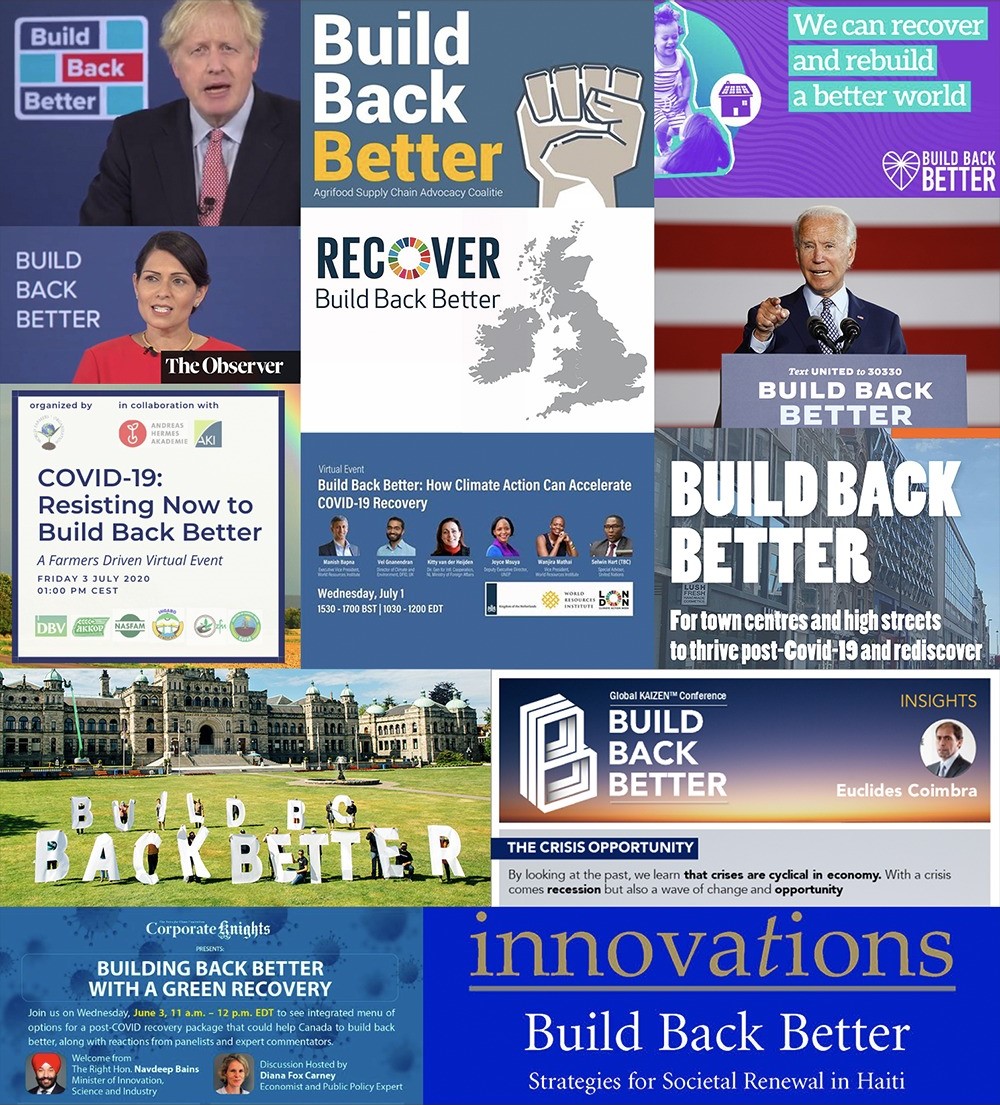
All of this economic turmoil is running on an identical track -on a global basis- because the entire western plan was coordinated and followed. What we are seeing right now is the outcome of the “Build Back Better” roadmap. The “global inflation” is the outcome.
Joe Biden is blocking domestic energy production as he follows through with the agenda of the Green New Deal. In Europe, not coincidentally demanded by Biden, a similar outcome comes from the sanctions and blocking of Russian energy resources.
One could make a reasonable argument that the team behind Joe Biden specifically wanted the EU sanctions against Russia, because the U.S. crew wanted to keep both industrial economies mirroring each other as the U.S. energy system was dismantled. It would make sense to avoid a spotlight on the U.S. economic collapse, by forcibly pushing the EU economy into the same situation.
Taking that line of geopolitical and economic consequence one step further, and that would be part of the strategy -albeit undiscussed- behind having a consistent global cap on the price that any nation could pay for Russian oil. That approach is not about punishing Russia, it is to make all of the economic pain and problems equal amid all western nations. Globalists, and the central bankers, are good at creating economic systems to deliver equitable misery.
I have created this site to help people have fun in the kitchen. I write about enjoying life both in and out of my kitchen. Life is short! Make the most of it and enjoy!
This is a library of News Events not reported by the Main Stream Media documenting & connecting the dots on How the Obama Marxist Liberal agenda is destroying America












 Centinel2012