Something that now seems ordinary, until you think about it historically – and realize it is actually, stunningly, extraordinary, is the level of transparency President Trump has delivered to his administration. Citizen government by a person who understands the value of the camera and the opportunities of the microphone.
Here President Trump frames a cabinet meeting with the media for over 20 minutes while outlining initiatives and objectives. No prior president has ever allowed even a small percentage of the deliberative access delivered by President Trump. POTUS keenly dominates the narrative; outlines the milestones; establishes the expectations and summarizes the issues.
About mid-way through this video is just captivating, really. Must Watch:
.
If you stand back and think about it, what President Trump is doing is remarkable. POTUS has lulled us into seeing this as commonplace, it’s not; it is anything but common.
President Trump will sign a trade-section 232 proclamation today to elevate Steel and Aluminum manufacturing to be of national security status. The overall trade initiative which stems from the 232 proclamation will be a 25% trade tariff on imported steel and a 10% trade tariff on imported aluminum. POTUS Trump will control exemptions.
The trade announcement is anticipated at 3:30pm in the White House today.
♦Three days ago (March 5th, 2018) South Korean National Security Adviser Chung Eui-yong met with North Korean leader Kim Jong-un in Pyongyang. ♦Earlier today Chung Eui-yong met with President Trump’s National Security Adviser H.R. McMaster and briefed other senior members of the Trump administration. ♦Moments ago President Trump told the media to anticipate a “big announcement from South Korea” at 7:00pm EST.
Given the time of day for the announcement, it must be very good news for Team Trump and likely surrounds discussions between the South Korean officials and the DPRK about denuclearization talks. [7:00pm EST is 5:00am Friday in South Korea.]
(Above and below) South Korea National Security Chief Chung Eui-yong visiting the White House earlier today, for a briefing with HR McMaster. –source–
…. This follows South Korean chief delegator Chung Eui-yong meeting with North Korean leader Kim Jong-Un on March 5th, 2018, during their meeting in Pyongyang, North Korea. (pictured below) –source–
The Latvian Financial Supervisory Authority is concerned announcing a resolution plan for the crisis bank ABLV that is threatening a contagion risk of further closures of financial institutions in the country with a predominantly foreign customer base. There is a serious risk of a contagion unfolding that will also force consolidation and mergers in the industry as a whole. The financial system of the Baltic country has seen a run with customers withdrawing about 500 million euros in deposits in recent weeks. There are about ten banks in Latvia who have been serving primarily foreign customers. Concerns and a decline in confidence unfolding in Europe as a whole over the banking system as a whole may force a change in the business model of Latvian banks where they must return to a reliance upon domestic deposits rather than foreign.
Latvia’s third largest financial institution, ABLV, is about to collapse after being accused by the US of being involved in money laundering by customers from neighboring Russia and Ukraine. The bank denied the allegations but simply making those allegations by New York prosecutors can have a devastating impact upon foreign banks. A run on the bank began after the allegations were made public. The European Central Bank (ECB) came to the conclusion that the bank was facing collapse. The European Agency for the Settlement of Marged Banks (SRB) classified the bank as non-systemically important and left it to its fate. In Latvia, loans are provided mainly by Scandinavian banks located in Sweden. Many Latvian banks have specialized in financing themselves mainly through deposits of foreigners rather than domestic Latvian citizens. The crisis brewing stems from the fact that about 40% of Latvian bank deposits come from abroad. Allegations of money laundering by the US authorities have been sending foreign depositors into a state of panic.
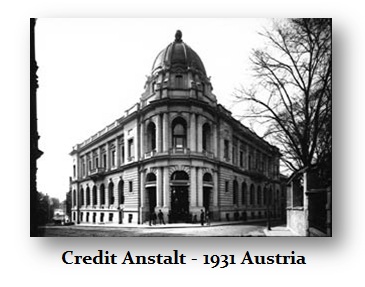
The risk that this presents is self-evident from the Banking Crisis of 1931. The failure of Credit Anstalt, which was partly owned by the Rothschilds, sent a wave of panic throughout the entire banking system. Once the rumor was that the Rothschilds had failed, all banks began to get hit. This resulted in the Sovereign Default of 1931.
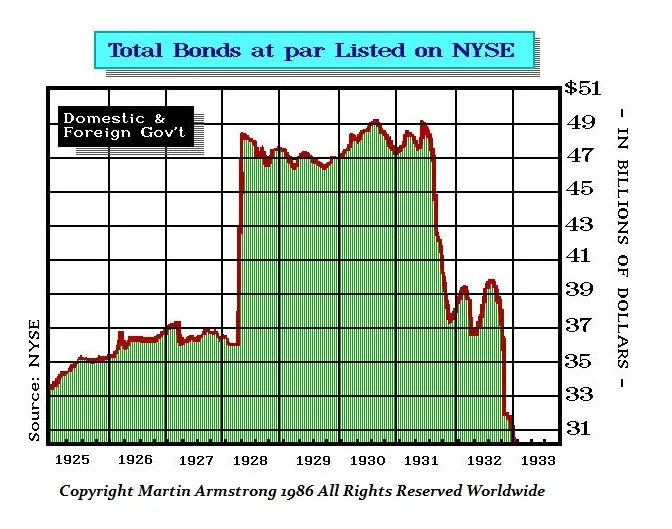
We can see here looking at the foreign bonds that were listed on the New York Stock Exchange and how they just defaulted going to zero. Therefore, the question is not whether the Latvian banks are essential to the country, a collapse can still have a profound contagion impact simply because people are losing confidence in the banking system as a whole.
There is no such thing as letting these banks go because they are “not essential” with respect to Latvia.
We are dealing with a matter of PUBLIC CONFIDENCE that is just not something that is very solid right now.
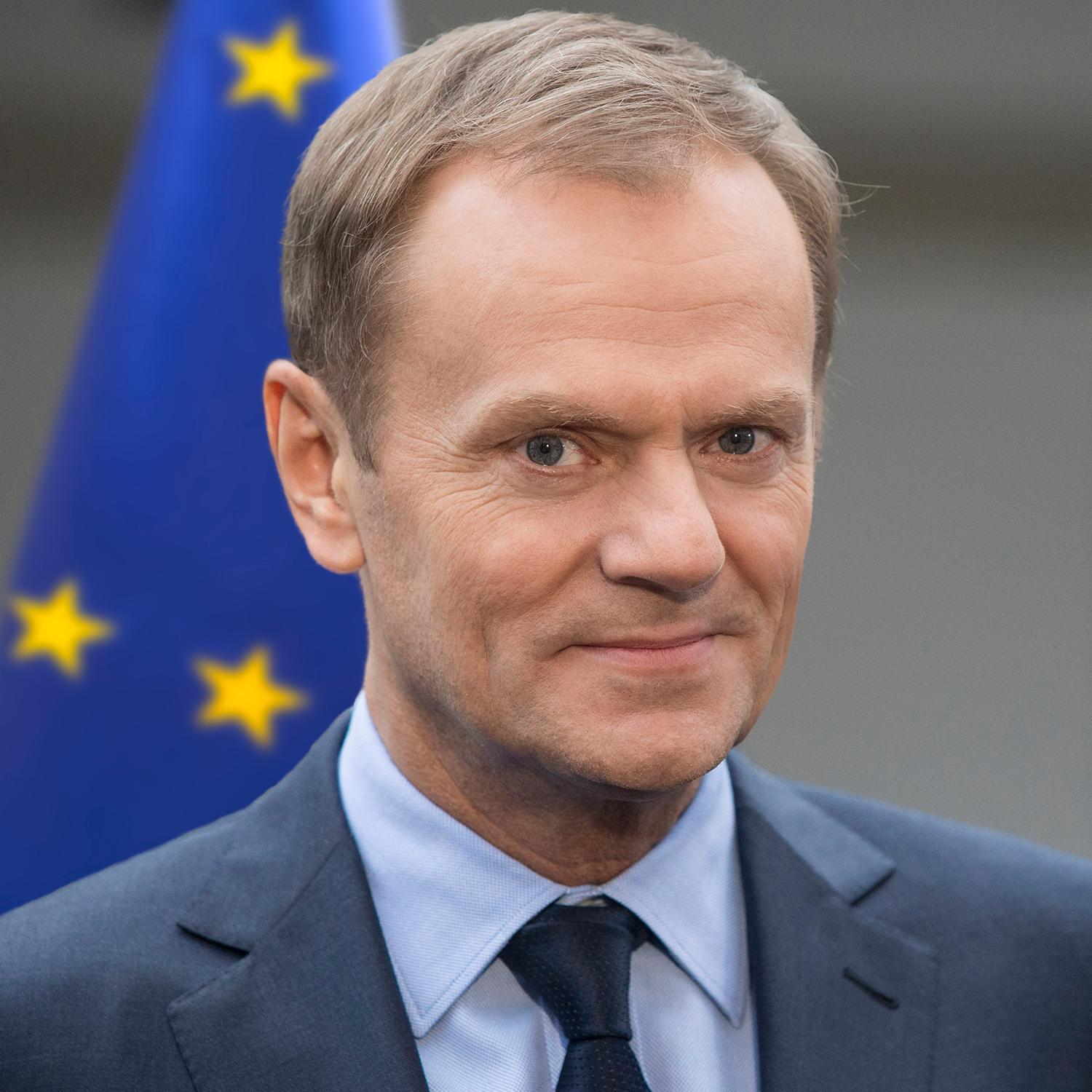
The man who is killing the Euro as a viable currency is none other than Donald Franciszek Tusk who is a Polish politician who has been the President of the European Council since 2014. He is the living example why politicians MUST be prohibited from making any decisions whatsoever regarding economics and finance. These people have ZERO qualifications in the field yet rise to the top of politics and then assume positions based entirely upon politics – not economics.
The crisis that is pending for the Euro is all about political control. The desire of British banks to achieve free access to the European Single Market even after Brexit and this was rejected by the EU. Council President Tusk spoke out against maintaining the British-European financial center in London after Brexit. He fails to comprehend that NEITHER the French nor the Germans possess the infrastructure no less the expertise to maintain global markets in the Euro.
Tusk claims that Britain is trying to be like Norway which has free access but pays dues as a member of the EU for free access. On the other hand, Tusk characterizes British desires and trying to blend the Canadian position, which only has a free trade agreement, with full access like Norway but pays no dues like Canada. Meanwhile, France is taking the position that they want to fill the shoes of the London financial markets who have never been able to create deep markets.
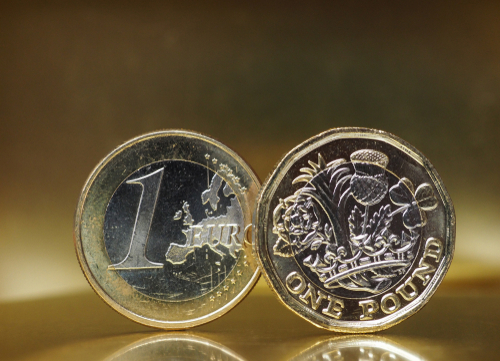
This hardline position against the financial markets of Britain remaining as the core trading center for the Euro is extremely dangerous. The Euro holds a minimal position among the reserves of central banks. The exact composition of the foreign-exchange reserves of China is a state secret. Nevertheless, based upon reliable sources, about two-thirds of Chinese foreign-exchange reserves are held in U.S. Dollars. The rest is composed of Japanese Yen, British pounds with less than 15% residing in Euros.
Brussels is far more interested in punishing Britain than in securing a strong and viable market for the Euro. With respect to a banking center, the primary competitors running second and third are Switzerland and Luxembourg. Never the less, France and Luxembourg are seeking to gain from blocking Britain as they seek to strengthen their positions against Britain. Luxembourg has the EU President Jean-Claude Juncker in their corner, who traditionally has a good relationship with the banks in his home country of Luxembourg. Ironically, while Germany is the largest economy within the Eurozone, by contrast, it relies heavily on trade in goods and financing rather than banking. We have a conflict of interests here where Germany actually need the free market in London for trade deals whereas France and Luxembourg are more interested in capturing business from Britain.
Meanwhile, Brussels needs control so they can maintain the outlawing of shorting government bonds and make no mistake about it, they will prohibit shorting the Euro when it goes against them as well. The danger of politics making the decision over such an issue is that any free market in the Euro will suffer. This is becoming a high stakes financial poker game. Even the President of the Swiss bank UBS, Axel Weber, has come out warning against a withdrawal of the euro clearing from London. “We have to be very careful that we do not shoot any own goals on the subject of Brexit.”
If the EU blocks Britain from euro clearing, this will be the end of the Euro. Politics will present far too great a risk for the Euro to survive going forward.
As part of CCA III: The Sixties, Mary Eberstadt, author of An Anxious Age: The Post-Protestant Ethic And The Spirit of America, gives a lecture at Hillsdale College on the Sexual Revolution.
Commerce Secretary Wilbur Ross talks about the importance of trade “reciprocity”. As Wilburine outlines phase-2 MAGAnomics is only just beginning the reciprocity discussion.
Additionally, Secretary Ross talks about the issues with Chinese steel trans-shipment and the reason for Steel and Aluminum tariffs to be global in order to address China’s use of proxy nation states to continue dumping. In this interview Ross begins to outline the fine points behind the pending 2018 trade negotiations. It is going to take a lot of repeated effort to awaken the larger U.S. electorate to the issues.
Why ship directly to the U.S., or manufacturer inside the U.S., when you could just assemble in Mexico and Canada and use NAFTA to bring your products to the ultimate goal, the massive U.S. market?
From the POTUS Trump position, NAFTA always came down to two options:
Option #1 – renegotiate the NAFTA trade agreement to eliminate the loopholes. That would require Canada and Mexico to agree to very specific rules put into the agreement by the U.S. that would remove the ability of third-party nations to exploit the current trade loophole. Essentially the U.S. rules would be structured around removing any profit motive with regard to building in Canada or Mexico and shipping into the U.S.
Canada and Mexico would have to agree to those rules; the goal of the rules would be to stop third-party nations from exploiting NAFTA. The problem in this option is the exploitation of NAFTA currently benefits Canada and Mexico. It is against their interests to remove it. Knowing it was against their interests President Trump never thought it was likely Canada or Mexico would ever agree. But he was willing to explore and find out.
Option #2 – Exit NAFTA. And subsequently deal with Canada and Mexico individually with structured trade agreements about their imports. Canada and Mexico could do as they please, but each U.S. bi-lateral trade agreement would be written with language removing the aforementioned cost-benefit-analysis to third-party countries (same as in option #1.)
All nuanced trade-sector issues put aside, the larger issue is always how third-party nations will seek to gain access to the U.S. market through Canada and Mexico. [It is the NAFTA exploitation loophole which has severely damaged the U.S. manufacturing base.]
The U.S. has to look upstream, deep into the trade agreements made by Mexico and Canada with third-parties, because it is possible for other nations to skirt direct trade with the U.S. and move their products through Canada and Mexico into the U.S.
Additionally, with Canada now joining TPP it has become impossible for the U.S. to remain in NAFTA and simultaneously conduct trade negotiations with TPP nations.
EXAMPLE: If the U.S. remained in NAFTA all TPP nations would engage in trade discussion knowing there was a Canadian and/or Mexican option to gain access to the U.S. market. Therefore, despite the size of our market, we could never negotiate a better trade agreement than the deal existing between Canada, Mexico and their TPP partner nations.
President Trump, Commerce Secretary Wilbur Ross, Trade Adviser Peter Navarro and U.S. Trade Representative Robert Lighthizer well understand this structural problem. ONLY Trump, Ross, Mnuchin, Navarro and Lighthizer are willing to confront this problem. If Trump had lost the 2016 election, Clinton would have joined the multinationals and U.S. workers would have suffered greatly.
Lastly, the issue of Canada and Mexico making trade agreements with other nations (especially China), while brokering/leveraging their NAFTA position with the U.S. as a strategic part of those agreements, is a serious issue that cannot adequately be resolved while the U.S. remains connected to NAFTA.
At the conclusion of Round #6, this was the direct issue at the heart of a very frustrated U.S.T.R. Lighthizer’s strongly worded response to Canada:
[…] In another proposal, Canada reserved the right to treat the United States and Mexico even worse than other countries if they enter into future agreements. Those other countries may, in fact, even include China, if there is an agreement between China and [Canada]. This proposal, I think if the United States had made it, would be dubbed a “poison pill.” We did not make it, though. Obviously, this is unacceptable to us, and my guess is it is to the Mexican side also. (read full remarks)
I have created this site to help people have fun in the kitchen. I write about enjoying life both in and out of my kitchen. Life is short! Make the most of it and enjoy!
This is a library of News Events not reported by the Main Stream Media documenting & connecting the dots on How the Obama Marxist Liberal agenda is destroying America