Wheat & the Drought Cycle


QUESTION: Interesting that $1.3T US spending bill was enacted on March 23, 2018, exactly 31.459 years after passage of US Tax Reform Act of 1986:

Also, the 86 year cycle in drought conditions in the midwest US seems to approach – is this why Marty thinks wheat will bottom this year?

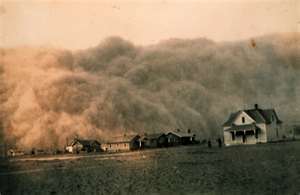
The below Wikipedia link mentions a “short drought” in 1890 in the US Great Plains, and then a dust storm on November 11, 1933, in South Dakota (43 years later). Wikipedia also mentions that the US Great Plains entered an unusually dry era in the summer of 1930 (a little more than 86 years ago), with droughts coming in 1934, 1936 and 1939-1940.

Kansas is having drought conditions currently:

Poor winter wheat condition worrying Kansas farmers

I wonder if this is the year to go long wheat, especially since Marty forecast a bottom for this year?

Best,
J

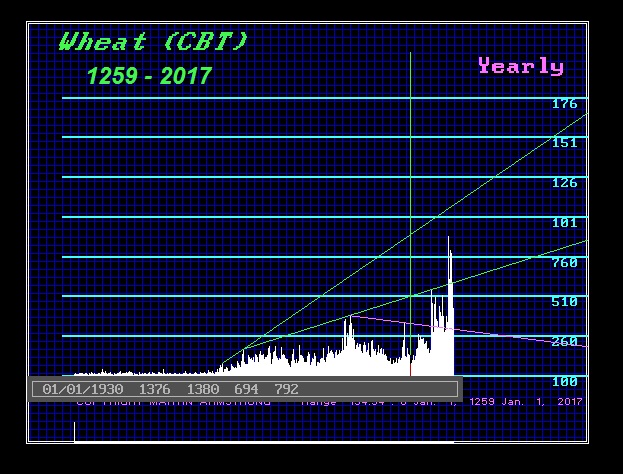
ANSWER: Here is a chart of Wheat from 1259 to 2017 with the currency converted to dollars from British pounds using the conversion rate at the beginning of the US dollar extending it back in time. Here we can see the overall trend. Yes, there is an influence with respect to weather. However, the Dust Bowl was a local event.

What our computer is warning about begins next year with a Directional Change in Wheat. This cycle appears to be impacted by (1) significant climate change, and (2) the War Cycle. The combination of both is pointing to a bull market in nominal dollar terms.

Monetary Policy is a Complete Failure? Will Shutting Down the Fed Solve All the Problems?


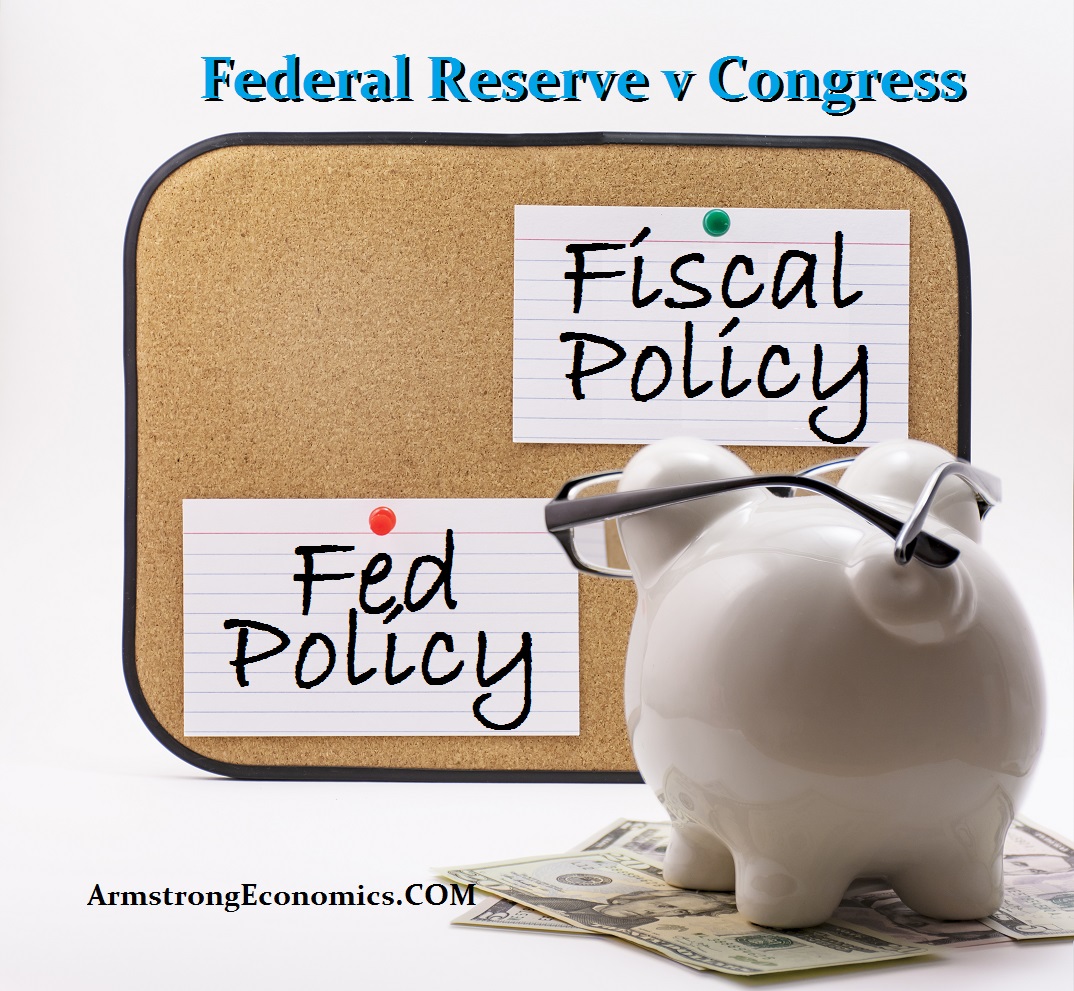
I recently did an interview and was asked about the Federal Reserve. There is so much absolute nonsense sophistry that circulates where people think that ending the central bank will somehow cure everything. I really just laid it out plain and simple. The Fed’s balance sheet is a tiny fraction of the economy or the real money supply. Everyone blames the Fed for everything and they NEVER bother to look at (1) the fiscal policy of Congress, and (2) the banking system as a whole.

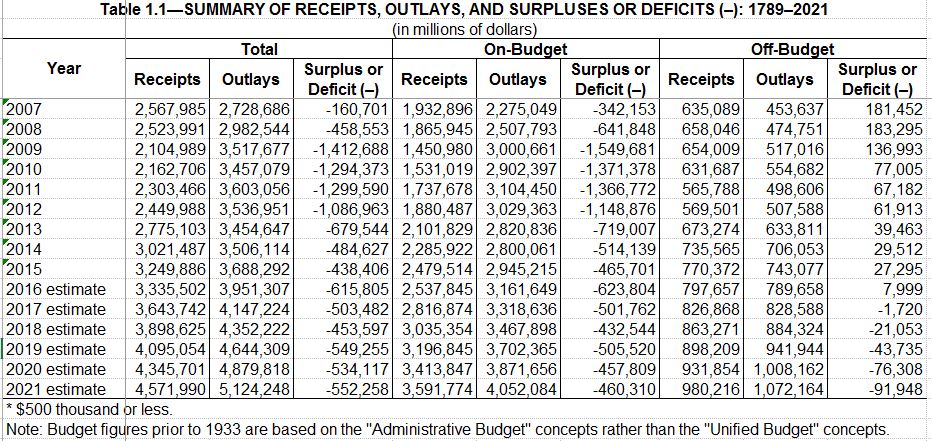
Even if you want to scream from the top of every hill that $4 trillion worth of Fed’s Quantitative Easing was pure evil and should have created hyperinflation (which it did not), the deficits created by Obama topped $1 trillion per year and those never die whereas the Fed’s QE evaporates as they do let the debt they bought mature and expire without rebuying it again, whereas Draghi and the ECB have conceded they will reinvest their holdings. Look at 2009-2012. Obama created $5.4 trillion that will never expire but will be rolled until there are no more buyers.

So let’s do the math. The entire Federal Reserve QE program was equal to 1/5th of the national debt. The ECB bought 40% of all public debt and the Bank of Japan bought 75% of new debt coming to the market. Yet all we get is dollar bashing and people actually have called the yen the safe-haven play. I really do not know if I am arguing is drunks, people with dementia, or just con-artists. All these people pushing the end of central banks because they are clueless about how the real world functions.

I have been trying to explain to the world that monetary policy using interest rates to impact the balance of payments is really voodo economics. The Australian even wrote an article back in 1989 about the advice I was given to governments. No matter how long I have been at this, trying to overcoming manipulating interest rates to try to control the economy is just totally insane. It reminds me of the skit in Blazing Saddles where the Black guy puts a gun to his own head and say if anybody moves, the black guy gets it. How can a central bank raise interest rates to fight inflation when the government is the biggest borrower in the system? The government deficits will rise because their interest expenditure will rise perpetually because they continuously roll their national debts and never pay anything off. The central banks have lost all control and the press is just too stupid to even understand the problem.

The Australian wrote about our recommendation: “He firmly believes the worldwide obsession with monetary policy, namely the use of interest rates to regulate inflation and demand, is misguided, and in a recent circular to clients described it as “voodoo” economics.”


We are hopelessly lost and the idiots who bash the Fed are doing so much harm to society it is not even funny. The bulk of the real world money supply is created by lending on a leveraged basis. It is not money created by the Fed and it goes well beyond that even created by the Congress.

AT the end of 2017, total household debt exceeded $13 trillion. Total non-financial business debt stood at $6.1 trillion at the end of 2017. The Fed’s balance sheet was $4.4 trillion of which $2.4 is US Treasuries. The national debt stood at $20.5 trillion at the end of 2017. If we look at this perspective, that means the money supply is $41.6 trillion just using the debt. If we then add M2 (all accounts _ money market accounts) which stood at $13.8 trillion at the end of 2017, this brings us to a liquid money supply of $55.4 trillion. The Fed’s balance sheet does not even reach 10% of that figure. Now let us add the stock market, which is liquid. That reached $30 trillion by the end of 2017. Therefore, the liquid assets/cash position stood at $85.4 trillion at the end of 2017. Now let us add total personal real estate (homes) in the United States which stood at $31.8 trillion. If we include illiquid real estate, now we are up to  $117.2 trillion. So how will shutting down the Fed and theoretically eliminate $4.4 trillion solve all the problems?

Will Coins Survive The Monetary Crisis?


QUESTION:  Hi Armstrong,
I continue to read your blog for 2 years I say and find it educational.
I wanted to know what will happen to U.S. coins like pennies and nickels when the base metals are worth more than the coin value.
Will the U.S. allow hoarders/collectors to exchange them for spot metal value or melt value? either one would be of course more than 0.01 for the penny and more than 0.05 for the nickel.
I hope to hear my answer on the blog

A

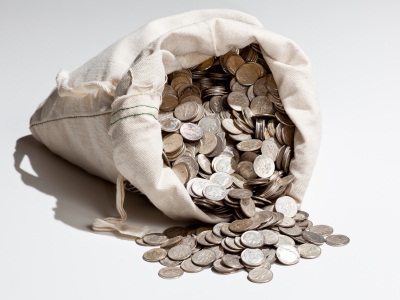
ANSWER: When silver was removed from the coins after 1964, at first it was illegal to melt the coins down. The FBI were prosecuting people for melting the coins they called defacing. However, that quickly faded out as the law did not support their theory of defacement. $1,000 bags of US silver coin traded even on the futures market in New York.

This time around, it is not likely that we would see confiscation. We could once again see bags of coins trading as was the case even into the later 1970s.

The Noah Coinage of Phrygia


QUESTION: Dear Mr. Armstrong,
I have a question please, taking the lead from your recent article in your blog “Noah’s Ark Commemorated on Roman Coins”
Question: Do you happen to have found a copy of the Apion Treatise (answers to Josephus) in your historical searches? (Apion — Historian from Alexandria)
Background: Titus Flavius Josephus, born in 37 AD in Jerulasem, 160 years before Septimus reign introduced to the Roman elite to the Jewish mythology of the Bible thru his writings. The historian Apion from Alexandria wrote a treatise answering to the historical claims of Josephus. Josephus also responded with his treatise – Against Apion, which has survived. Apion’s Treatise is not published or found (lost??), according to the results of my searches.
Can you please enlighten me.
Thank you Kindly,

DGP
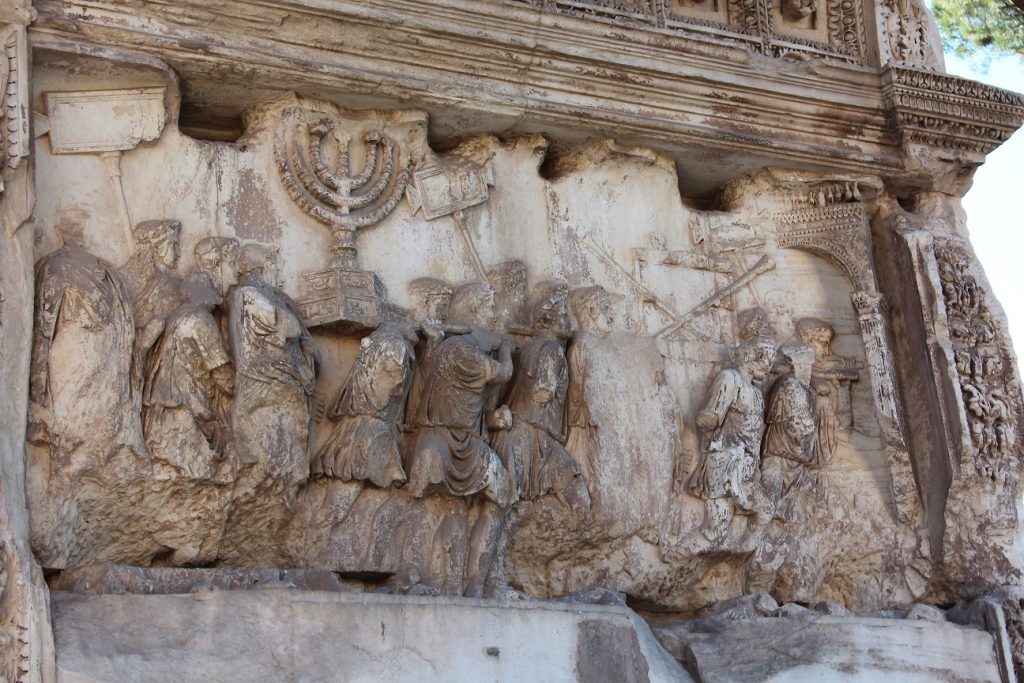
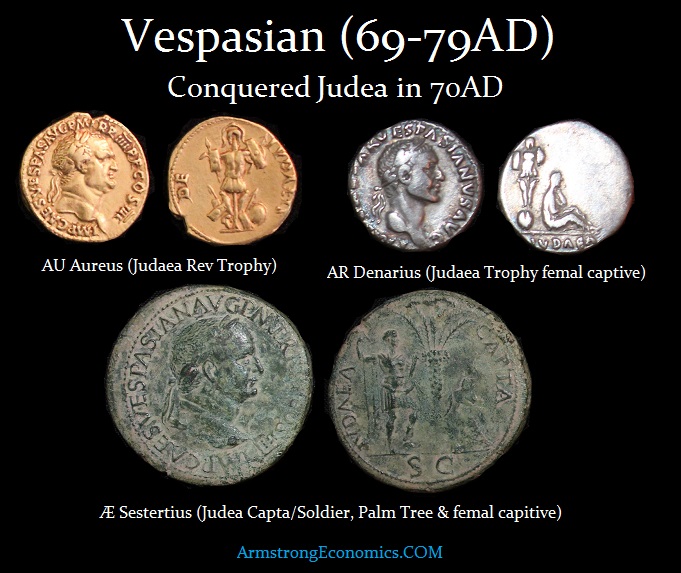
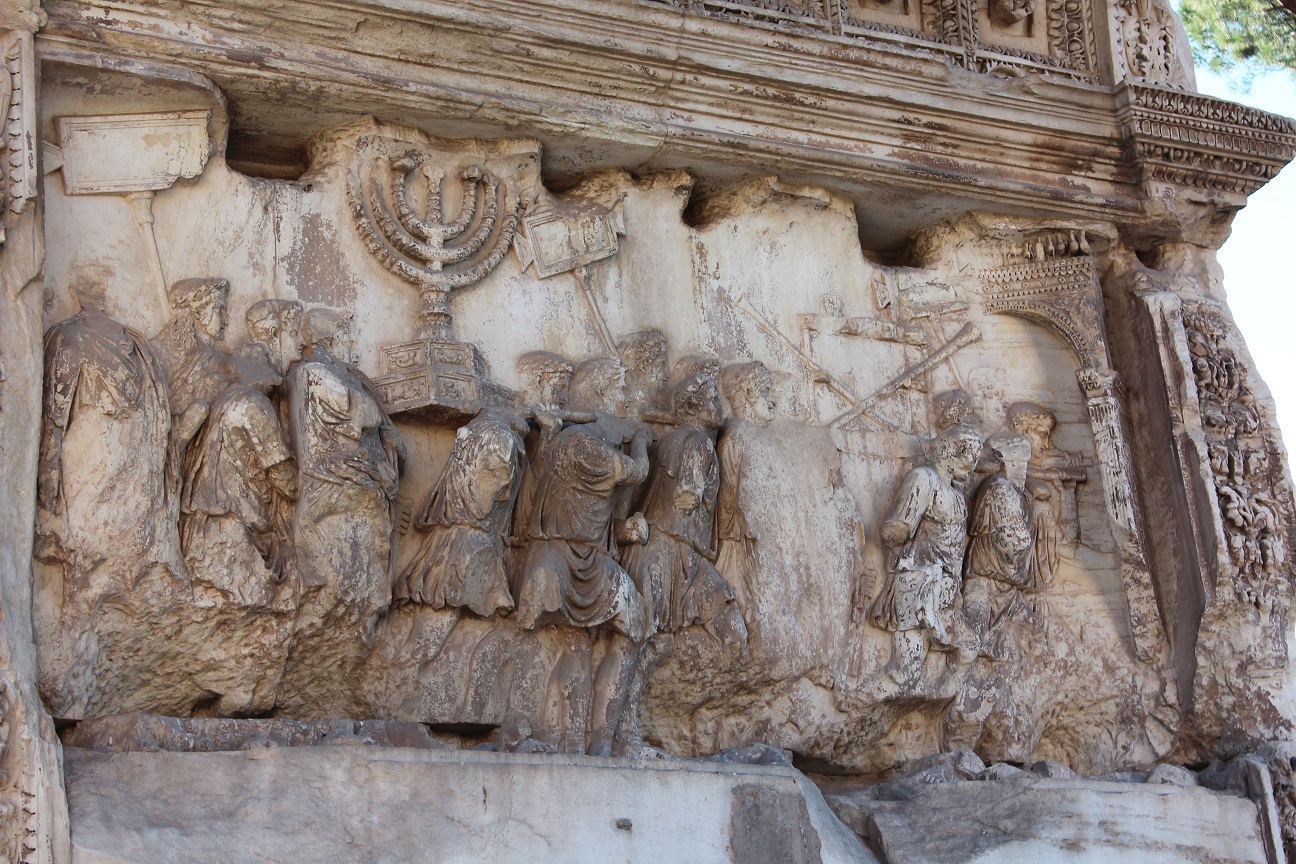
ANSWER: Josephus has been a contemporary historical source with respect to the conquest of Judaea by the Romans under the command of Vespasian (69-79AD). It is also true that he became an adviser to Vespasian’s son Titus (79-81AD). However, most of his writings appear to be really trying to redeem himself among his fellow Jews. In the Preface to Jewish Wars, Josephus actually criticizes historians that misrepresented the events of Roman-Jewish War. He wrote: “they have a mind to demonstrate the greatness of the Romans, while they still diminish and lessen the actions of the Jews.”

The Jewish War was a very big and profound event. It came after the death of Nero (54-68AD) and the empire was plunged into civil war. Vespasian (69-79AD) was vying to be emperor and the Jews looked at this opportunity to seek independence from Rome. However, like Catalonia in Spain, if they are allowed to just leave, this threatens not just Spain but would encourage others to leave the EU. This is precisely the same set of facts that existed following the death of Nero in 68AD.
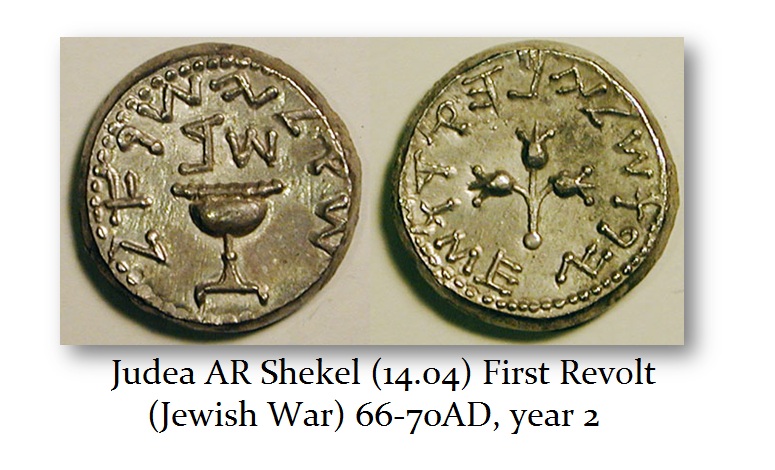
If Judaea was allowed to just leave, other provinces would have done the same. They even issued their own coinage. Thus, the punitive actions of Vespasian against the Jews must be understood within this context. We have the victory over the Jews appears on coins of Vespasian of every denomination.

It is highly unlikely that the other works of Josephus were widely read by Romans. Josephus’s Against Apion is a two-volume defense of Judaism as classical religion and philosophy. Josephus stressed its antiquity and suggested that the Greek religions lacked that ancient tradition and were more modern. Josephus attacks the Greek writer Apion and his anti-Judaic allegations. So once again, this appears to be a work that may be also out of guilt that he supported the Romans to pick the winning side.

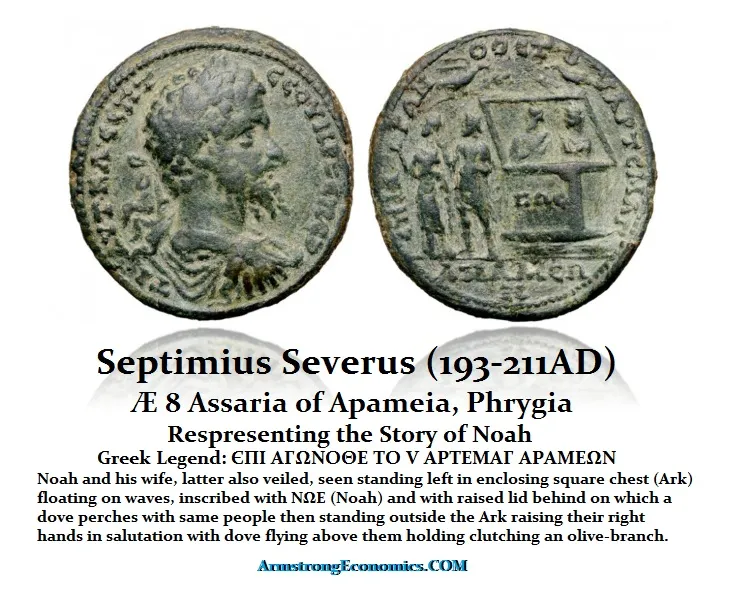
The bronze coin pictured above of Apameia was struck for Septimius Severus (192-211AD). The reverse legend mentions the city’s AGONOTHETES (chief organizer of the games) or chief magistrate, ARTEMAS, who probably was Jewish. Noah’s name, given in Greek as NOE, which appears on the ark. The subject matter does appear to be very popular and it may be entirely attributed to Jewish magistrates. Apameia was a city in Phrygia, which during the 3rd century AD, was under Roman rule. The Noah coin design must have been very popular since it was struck for the emperors even after Septimius Severus such as Severus Alexander (222-235AD), Gordian III (238-244AD), Philip I (244-249AD), and Trebonianus Gallus (251-253AD), over the course of 61 years.
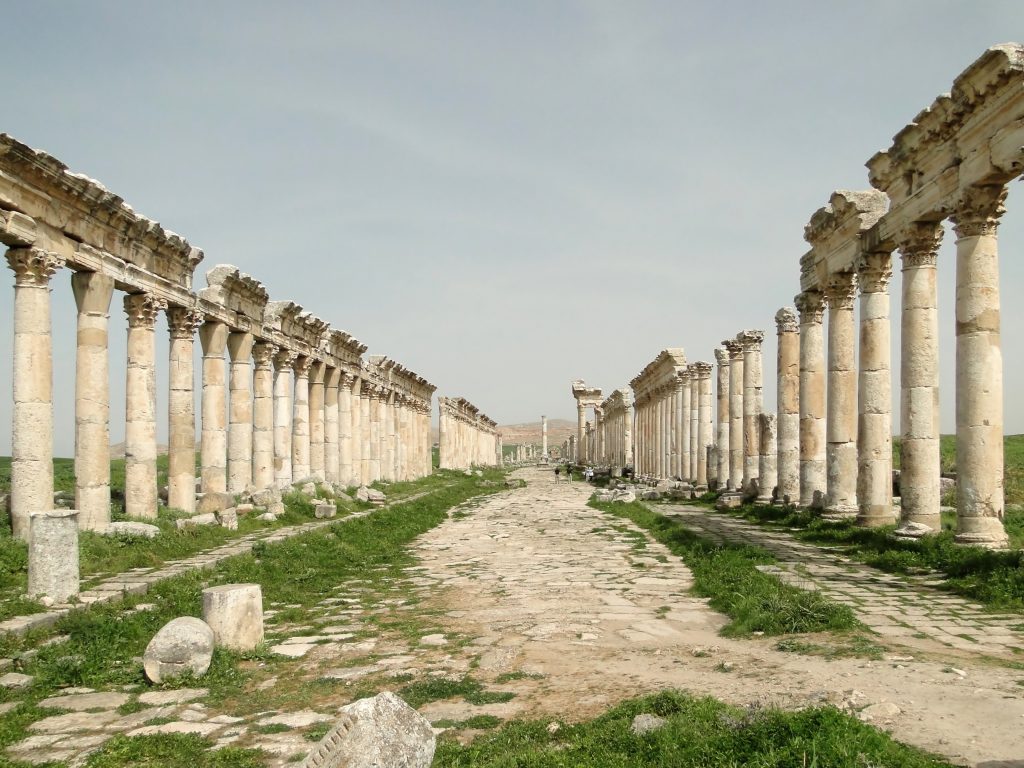
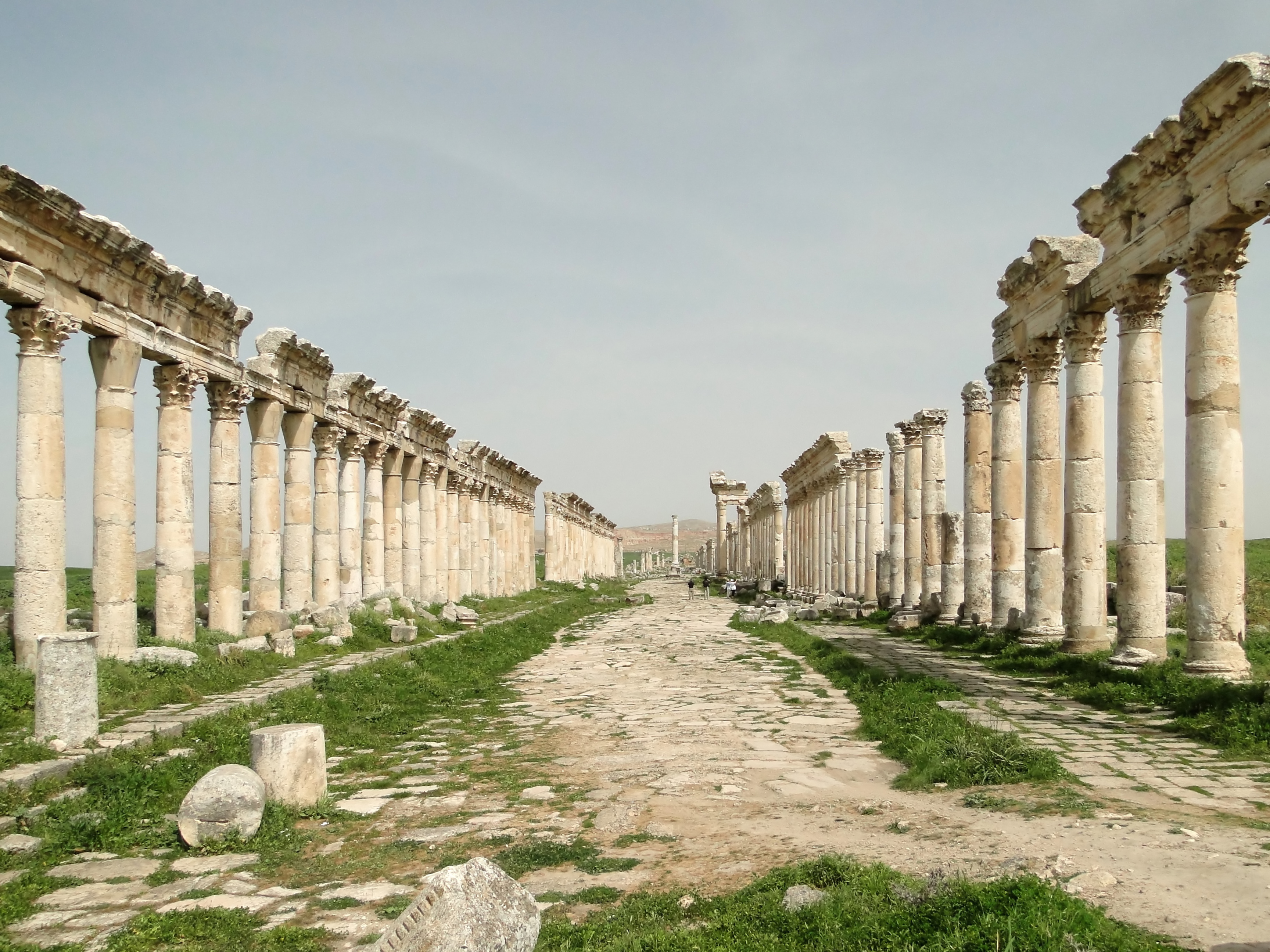
Apameia was a merchant city (today Dinar in western Turkey) whose ruins remain to this day. It was a very prosperous city during Roman times. It was a trade/commercial center that was connected to Asia by caravans carrying silks, spices, incense, perfumes, and medicines. The population of the city was very much like London and New York; very cosmopolitan with a mixture of Phrygians, Lydians, Cappadocians, Pisidians, Greeks, Romans and Jews. The common bond was mercantilism. They were a society composed of traders.
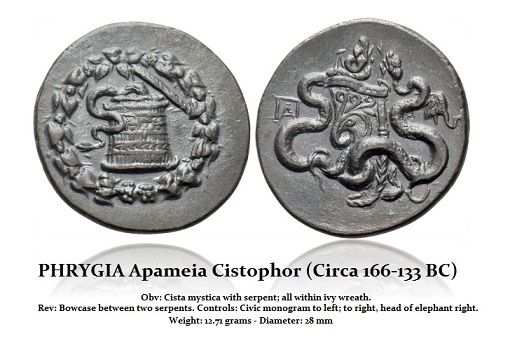
The origin of the city was founded by Phrygians prior to 1,000 BC and it was named Celaenae. It was located in a well-watered oasis at the source of the Meander River. Its coinage from the 2nd century BC shows an elephant head which is a clear symbol of its connection with Asia through trade. This city sat on the ancient old ‘Royal Road’ from the Middle East to the Aegean Sea that was originally constructed by the Persians some 500 years before this coin was struck. The location afforded Apameia control over all the caravan routes from Asia. Even when Alexander the Great invaded this region, he made the city one of his military bases.
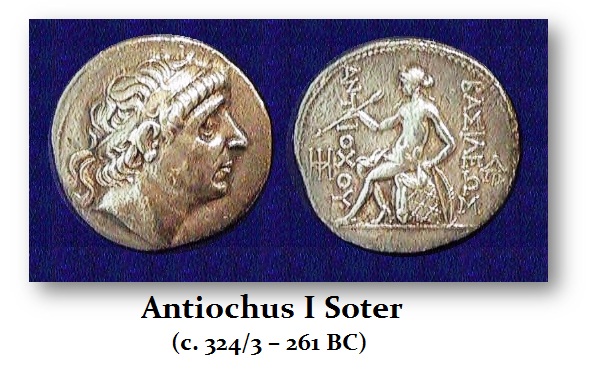
Following the death of Alexander, it fell to the control of Antiochus I Soter (280-261BC)(meaning Savior) of the Syrian/Seleukid Empire. Antiochus I built a new city in 270BC below the citadel of Ceaenae and named it Apameia after his mother. Then Antiochus brought Babylonian Jews to serve as garrison soldiers, civil servants and royal administrators in his new city. This is most likely the connection why we ultimately find Noah coins being struck in this city. Some argue this was a punishment because the Jews had resisted Alexander’s conquest of Babylon where they lived at that point in history.
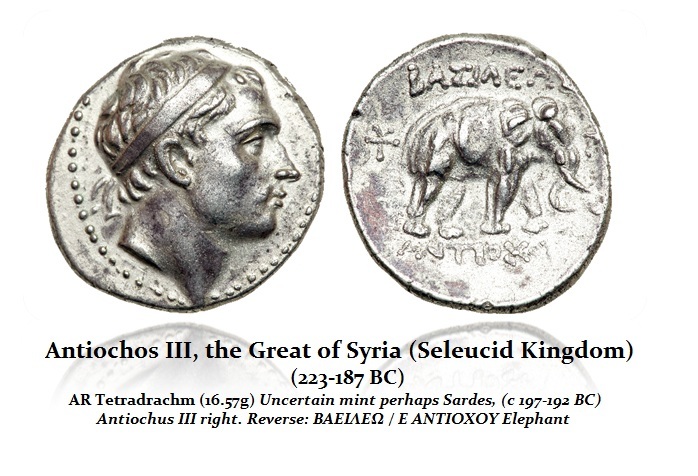
The Antiochus III (223-187BC), the Great, brought another large group of Persian Jews to Apameia in 188BC. Josephus in his work, ‘Antiquities of the Jews’ said that Antiochus III settled 2,000 Jewish families from Babylon in Lydia and Phrygia. Josephus goes on to say that these Jews were given special privileges including tax exemptions for ten years and were permitted to adhere to their own customs, laws, and religion. (Antiquities, Book XII, iii.4). These settlers may account for the large communities of Jews that suddenly emerged in the ancient Asian cities of Antioch, Apameia, Delos, Ephesus, and Sardes.

It is clear that by the time we reach Septimus Severus at the end of the 2nd century AD, the Jews had risen to high political positions in the city. Therefore, the Noah coins are unique to this city and are a reflection of the cosmopolitan culture that existed thanks to commerce. The ark is portrayed as a kibotos, which was an Apameian packing case used in trade with a lid. This is, therefore, blending the trade of the city with the Jewish parable.

 

Our Proprietary US Share Market Index Measuring the degree of Overbought Securities


QUESTION: Where does your overbought index stand on the stock market?

KL


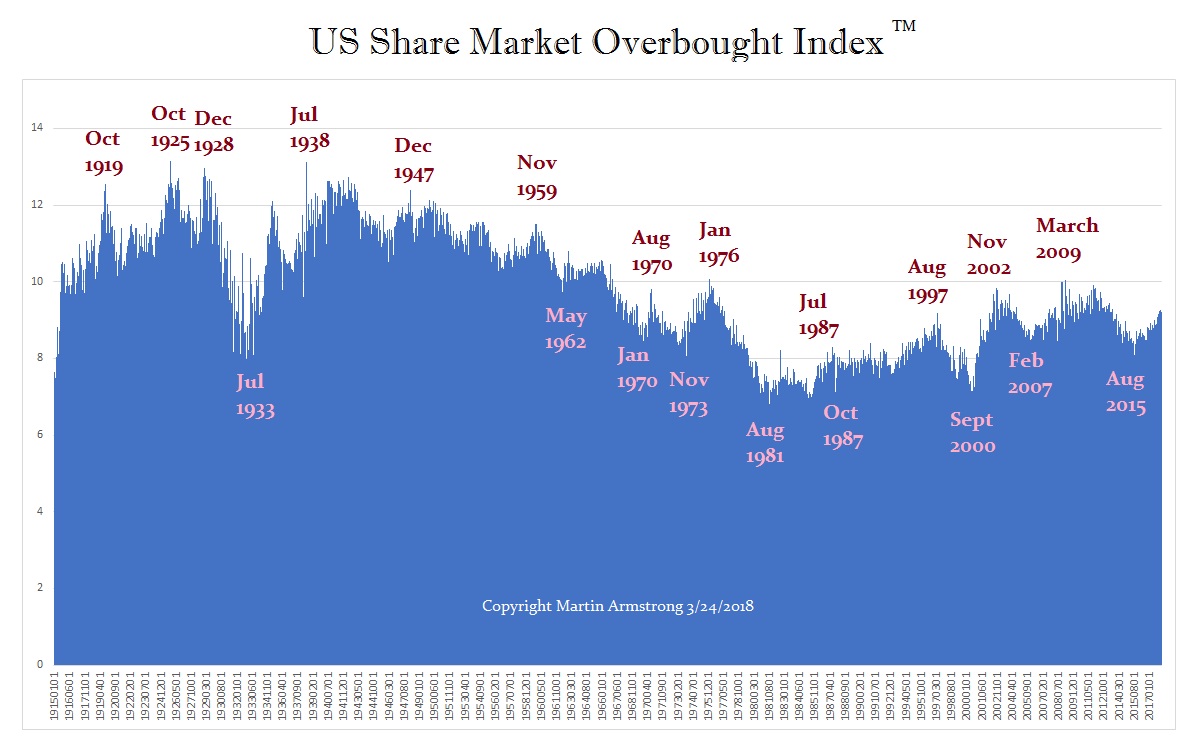
ANSWER: This Index is proprietary. It peaked at 12.55 during October 1919 as capital had flowed to the United States due to World War I. The Index then declined thereafter into the August 1921 bottom at 10.40. From this point, the Index rallied into October 1925 peaking at 13.16, fell back for 15 months bottoming again in October 1927. The final rally lasted 14 months peaking at 12.95. The bottom came in July 1933 about 13 months after the actually low in nominal dollar terms during June 1932.

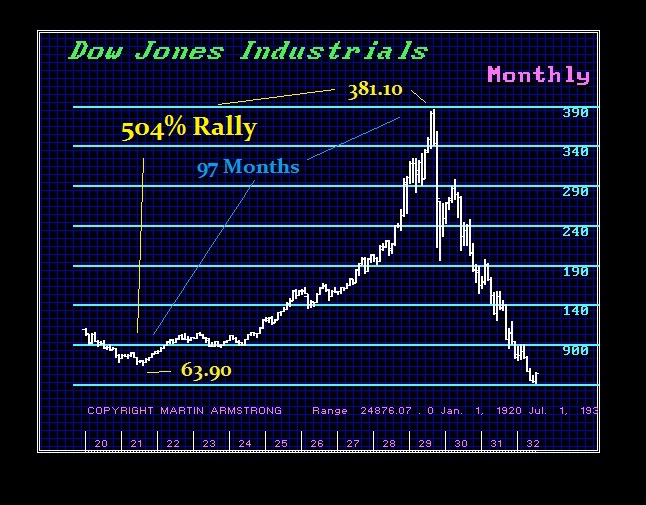
In nominal terms, the Dow tested the 1,000 level in 1966, 1968, and 1973 and again in 1980. We can see the shift in trend that came following the historical low in 1981. The core of this index is capital flows so it tends to reflect just how capital flees and concentrates moving relative to US assets. Looking at the most famous bull market of the Roaring ’20s, the duration was 97 months which we exceeded from the 2009 low in April 2017. The 2009 low was 6469.95 and the January high was 24,741.70. which was a rally of only 282% – not anywhere close to the Roaring ’20s.

This index is proprietary and it affords us a look at the asset class from a global perspective. This is part of the reason we have been warning that the bull market is by no means overbought and the bulk of forecasting out there has made this the most hated bull market in history because they look only at the nominal index without placing it within its global context.


The Economic Confidence Model began with Recorded History


QUESTION: How far back have you tested your Economic Confidence Model?

GP

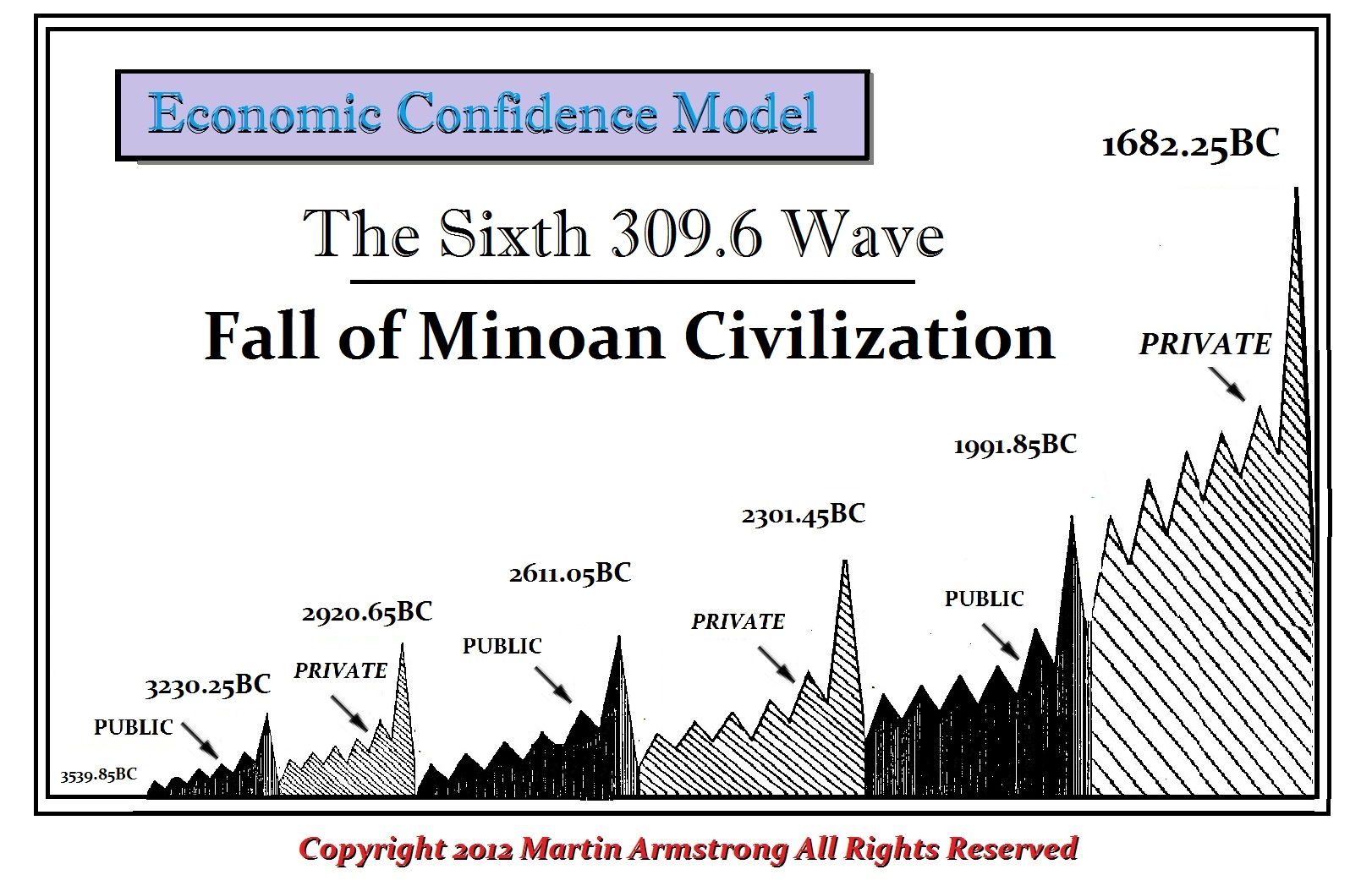
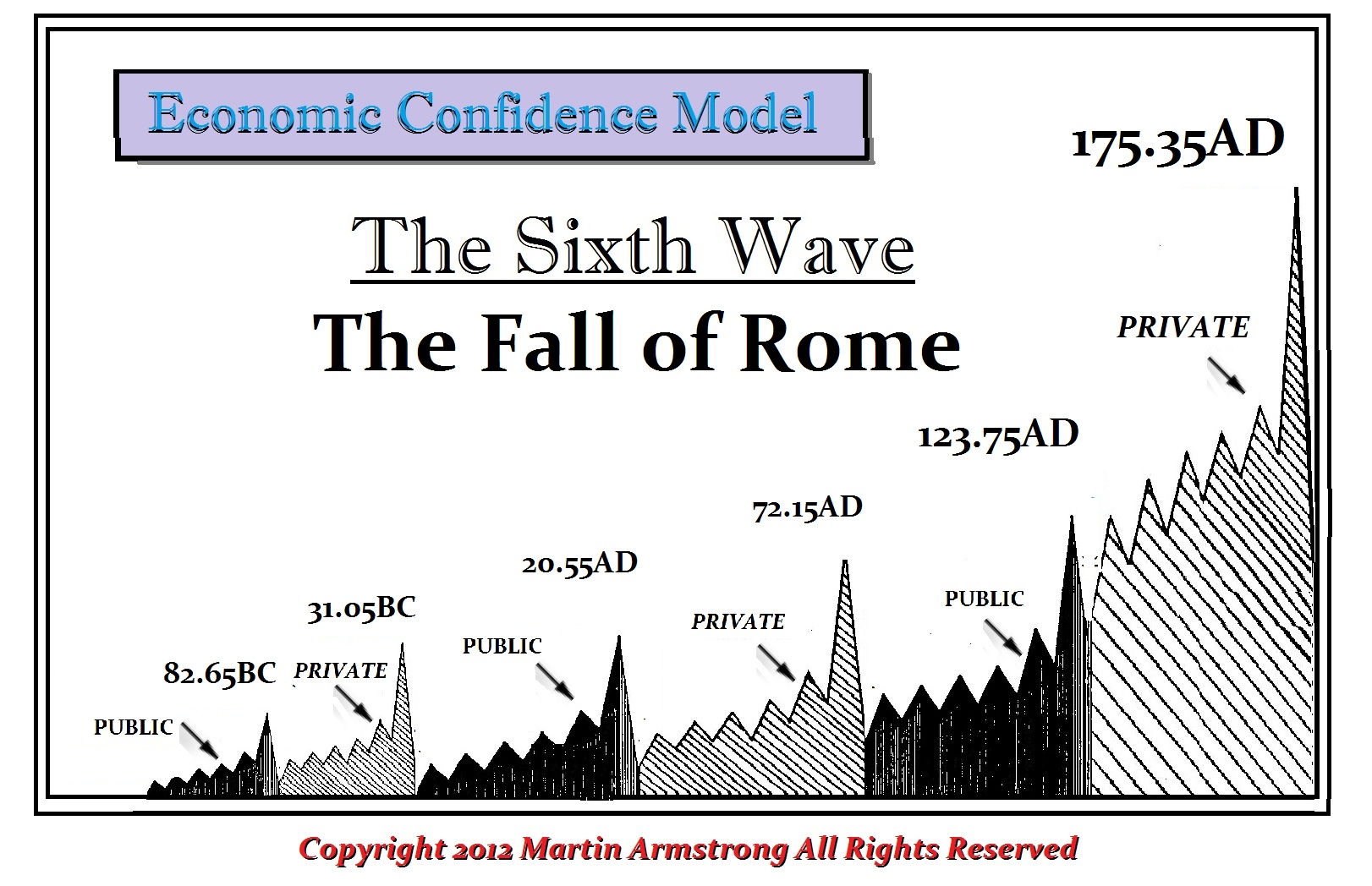
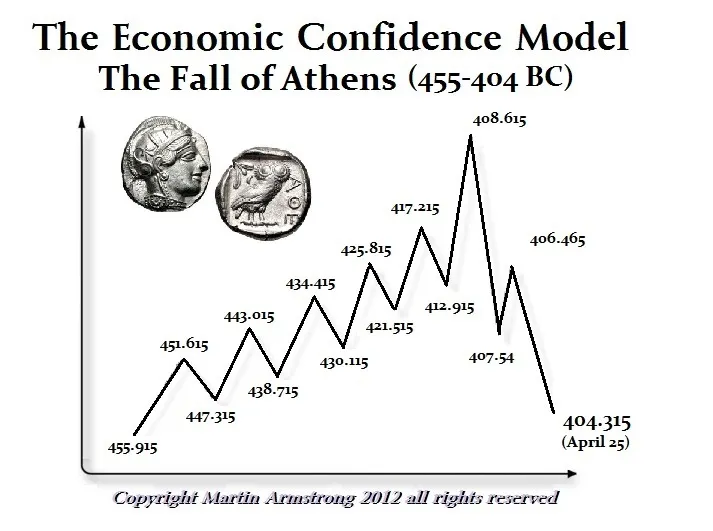
ANSWER: To the start of recorded history. Each wave has been identified and numbered. It is very remarkable how history conforms cyclically to this frequency.


It has been tested on every culture and empire from Asia to Europe.

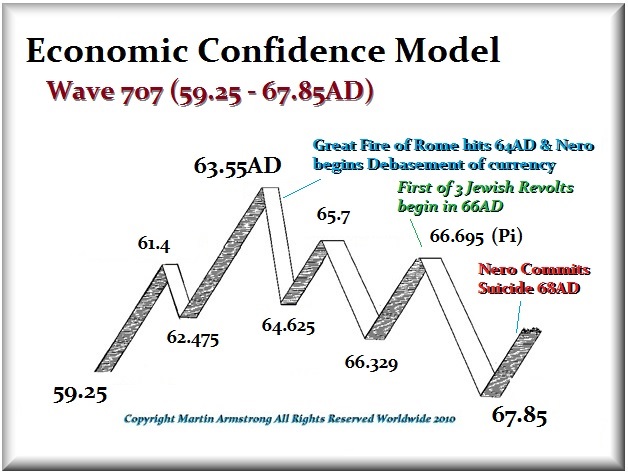
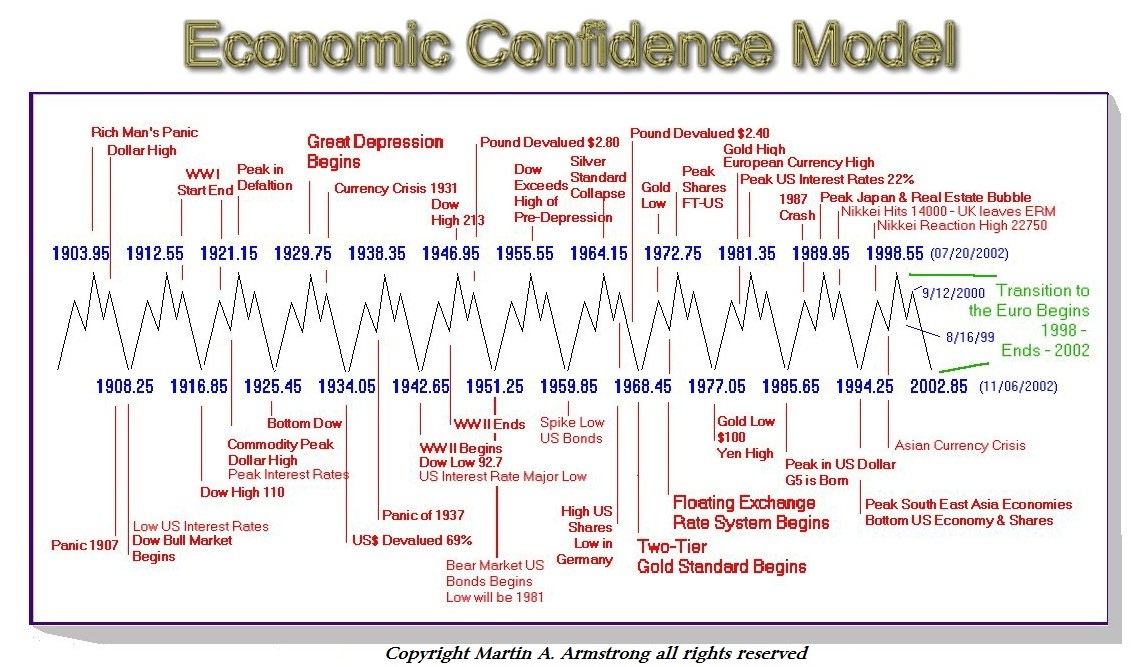
Here is a more modern perspective on the various events that took place.

When will North Korea Rise to Overthrow Kim Jung Un?


QUESTION: You said that Kim Jung Un was at risk of being overthrown and therefore he would have to shift direction or go to war. When do you see North Korea falling?

PP

ANSWER: When Korea was split in 1945 into communist North against the South, the terrain has always dictated the situation. About 65% of Korea’s heavy industry was located in the north, but, due to the harshness of the terrain, only 37% of its agriculture existed in the North. This is why the North often has bouts of famine.


ECM-Dynamic


I have warned that the Economic Confidence Model has three distinct components. There is the main wave frequency based upon Pi of 8.6 years which builds into 6 waves forming the major wave of 51.6 years which seems to be the generational shifting wave that manifests in political changes between public and private trends.

Then there is the Volatility Wave component. This is what causes one 8.6 year wave to be more pronounced than another. The volatility component has a frequency of 6 years which is a slower moving wave taking 12 unit waves to build into the ultimate volatility peaks of 72-year intervals.

The Schema Frequency I do not reveal. To put this in context, it is the DNA wave of a coded pattern throughout time. This will be the last thing I ever reveal if I decide to do so. The jury is still out. This is what everyone has tried to get from me for so long. It is the key to the interaction of waves.

On August 8th, 1945 (1945.602), the Soviet Union declared war on Japan. Soviet troops advanced and the US government feared Russia would occupy the whole of Korea. On August 10th, the US government proposed the 38th parallel division.

Therefore, the 72-year of volatility began during the summer of last year – 2017.602 (August 7th). Communism fell on its 72-year cycle (1917-1989). The Soviet Union broke up 2 years into that cyclical event. This places the same timing risk cor North Korea going into 2019-2020.

The 51.6-year cycle from 1945 (1997.202) marked the start of the 1997 Asian Currency Crisis. Kim Jung Un was conducting missile tests that began on February 12, 2017, last year, which was just a KN-15 Pukguksone type. Thereafter tests took place on March 6th, March 22nd, April 5th, April 16th, April 29th, May 14th, May 21st, May 29th, and June 8th. The intercontinental ballistic missile tests began with the Hwasong 14 on July 4th, probably because of the American Independence holiday. That is when the attention began to really turn to North Korea and that began almost to the day of the 72-year turning point.

The entire world is going to go nuts 2031/2032. There will not be a country that is spared from political and economic events. The risk a serious famine in North Korea which could result in the people rising up will arrive in 2023. That pressure will begin here this year 2018.70 – which will be September 13th, 2018. This appears to the turning point that is not just concerning North Korea. It is appearing around the world in many markets. The risk for political change in North Korea comes into play as soon as 2019/2020.

Why Syria has ALWAYS been Strategic


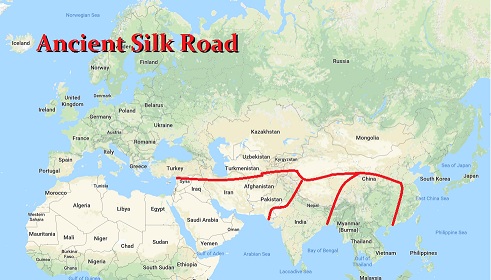
Syria has always been strategic throughout recorded history. You had to pass through it between Babylon and Egypt. However, as world trade began to emerge, the connections between China and the ancient Roman Empire were fully developed through the Silk Road. Spices were always worth their weight in gold and even during the Middle Ages, bankers were called “pepper-men” because pepper was more valuable than gold by weight.

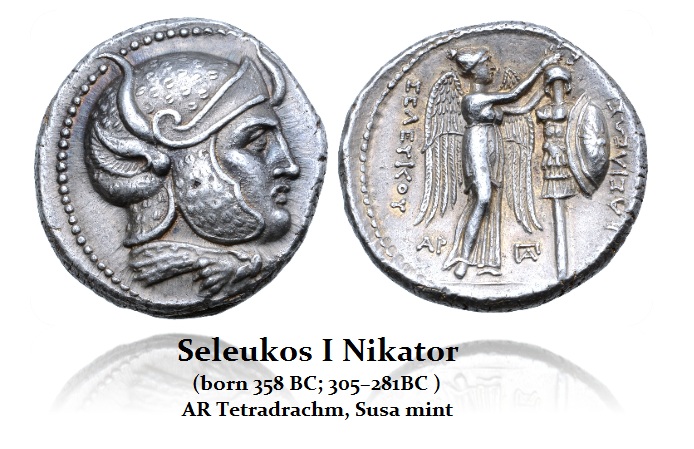
Following the death of  Alexander the Great in 323 BC, his generals divided up the territory he had conquered. After the Battle of Ipsus in 301 BC, Seleucus I Nicator (458-281BC) won the territory of Syria. Seleucus founded four cities in northwestern Syria, one of which was Antioch. He named this city in honor of his father Antiochus or perhaps his son who was named after his grandfather. It was founded on a site chosen through ritual means. Reportedly, an eagle, the bird of Zeus, had been given a piece of sacrificial meat and the city was founded on the site to which the eagle carried the offering. Seleucus did this on the 22nd day of the month of Artemisios in the twelfth year of his reign, which in modern terms was May 300 BC.

Antioch quickly rose to become the Syrian capital. Antioch flourished due to trade. Caravan merchants began to bring goods from China to the marketplace in Antioch. This was the beginning of the Silk Road in ancient times. Antioch benefited from Roman rule. The Historia Augusta mentions a great fire in Antioch, implying that the emperor Antoninus Pius (138-161AD) offered help to restore the city because it had become the gateway to a fabled great empire in the East. This legend of a great Empire in China had even inspired Alexander the Great to attempt to reach it giving up in India.

Antioch became an extremely important port of trade in the ancient world. It flourished and any major natural disaster would send financial panic down the banking street in Rome – Via Sacra. When the city sometimes suffered earthquakes as recorded during the reigns of Tiberius (14-37AD), Caligula (37-41AD), Hadrian (117-138AD), and Diocletian (284-305AD). Its governor Pescennius Niger (193-194AD) proclaimed himself emperor, he lost the war against his rival Septimius Severus, (193-211AD) who temporarily took away its independence of Antioch, giving it to Laodicea to control as punishment.

During the 3rd century, Antioch was the city of innovation. Street lighting appears also in this city during the 3rd Century AD as Saint Jerome (345-420AD) commented in his writings that the capital of ancient Syria was lit up at night by oil lamps hung over ropes that were strung over the streets. By 371AD, this invention spread to Caesarea in Turkey. China, on the other hand, was reported to be lighting up its streets using natural gas supplied through bamboo pipes by Medieval times.

China throughout history became rich by trade with the Roman Empire. Yet the history of Rome that claimed to rule the world (orbis terrarum) stood at the opposite end of the world from the strikingly similar Han Dynasty (206BC-220AD) in China, which also claimed to have ruled the world (tianxia). There is the History Book for Tang-Dynasty in China covering the period 618-907AD. Yet the text mentions 17 times what appears to be the Roman Empire . It also describes an envoy that was sent by the Roman Emperor to China. The Roman Emperor was recorded to have been “Anton.

The account of such an envoy who visited the older Han Dynasty predates the Venetian traveler Marco Polo (1254-1325) by more than 1,000 years. This envoy has been attributed to 166AD during the reign of Marcus Aurelius Antoninus (121-180AD). It is the death of Marcus Aurelius, that has marked the peak in the Roman Empire and the turning point that begins the Decline and Fall of the Roman Empire where its monetary system collapses just 72 years thereafter. This envoy established diplomatic contact at the peak of the Roman Empire from which a disastrous decline begins. Any political-economic aspirations to further such a relationship would then die with Marcus Aurelius. Yet also, both empires would suffer the same fate of barbarian invasions. The Han Dynasty falls in 220AD from which emerges the chaotic period known as the Three Kingdoms (220-280AD) – the division of the once unified Chinese Empire.

There is hard evidence that demonstrates that there was direct contact between Rome and China going back to the period of 180AD. The connection point has ALWAYS been Syria. China is also backing Syria with money. The Chinese are looking to build on the old world power position of the historic Silk Road (One belt, one road). China has never actively participated in the war militarily but has ensured financing their goals. Syria maintains close economic relations with Russia and China because of the stupidity of the West, which began with stopping a pipeline to compete with Russia. Likewise, despite being a member of NATO, Turkey is flirting with the expansion of Turkish-Chinese relations in addition to it historical ties with Russia.

As strange as it might sound, China has more skin-in-the-game with Syria than Russia. The Russians had to intervene after it became apparent that the international and Islamist mercenaries were heading for the Russian military base in Latakia. Russia and China clearly complement each other on the worldwide stage of politics. Both suffered Communist revolutions and they are the most important security players in that part of the world. China has provided the economic security while Russia provides the military security.

Syria is the focal point in the Middle East. It is where all the power meets for economic reasons. This seems to be the way for thousands of years.

Will the Euro Survive by 2021?


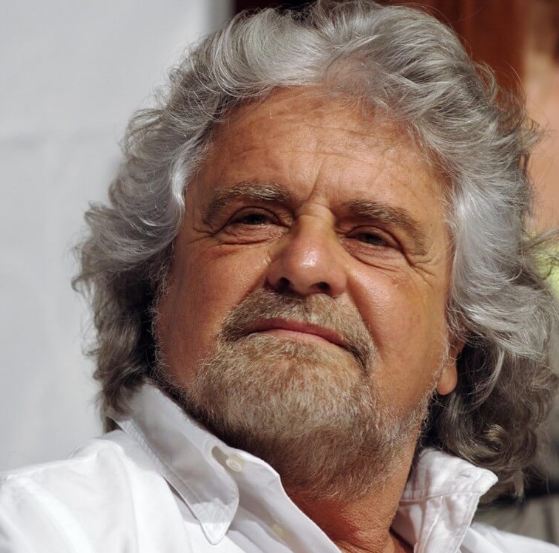
The results of the Italian election is just starting to sink in. The rise of comedian Beppo Grillo to Italy’s most successful politician, who won 32.7% of the popular voted compared to Merkel winning 32.8% in the German election.  Following the election on March 4th, Grillo’s “five-star” party took by far the first place. Brussels is still in shock and trembling as its mood has changed from he is just a joke to “OMG! This threatens the very existence of the EU”.

Grillo’s party sharply criticizes the EU, and above all, it questions the very purpose of Euro. The skepticism in the EU’s founding country Italy where they signed the Treaty of Rome, is rather amazing that those still focused on domestic issues in the USA are clueless about the threat to the Euro.

The threat Italy poses to the Euro stems from Brussels’ refusal to aid Italy with the refugee crisis and the outrageous demands that the increased expenditure for the refugees must be deducted from other expenditures to stay within the EU demanded guidelines, This has maintained a serious deflationary atmosphere in Italy and Brussels simply ignores the economic impact of what their policies have imposed. Italy’s public debt amounts to €2.2 trillion, and the risk of this debt going into crisis undermines the entire existence of the Euro. This is the direct result of the failed structure of the Euro I have warned about from the outset. (see 1996 reports)

Brussels tries to blame the misconduct of banks and takes no responsibility for the failed design of the Euro or for EU legislators and the European Central Bank, which have also played a profound role is turning Italy against Brussels. Swapping the old debt into Euro that then doubled in value, created a massive wave of deflation that 10 years of flooding the economy with money by the central bank has produced nothing but undermined then the pension system throughout Europe.


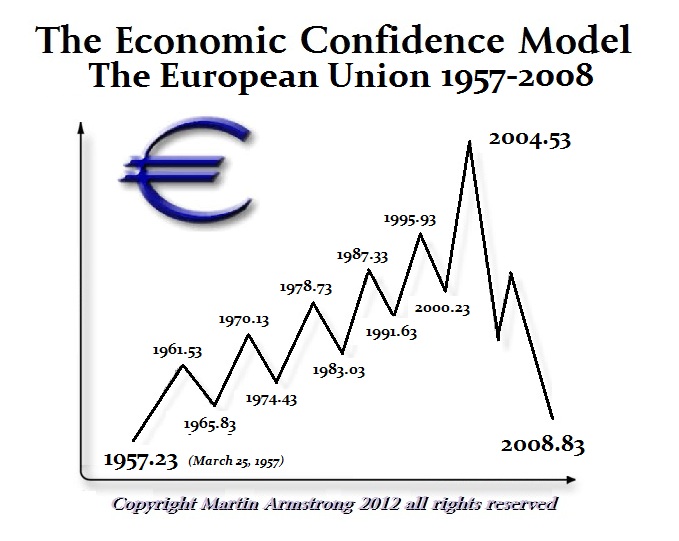
The world is lost, yet politicians fail to even understand that they are lost in their misconceptions of economics. The peak in the Euro came precisely in 2008 and ever since we have witnessed the erosion of economic confidence. The peak of the first 8.6-year wave into this new cycle for Europe came 2013.13 and then the low was 2017.43. We are now in a wave due for its peak in 2021.73 and by that turning point, we will see the Euro under tremendous pressure if it can even survive. There is no doubt that by 2030.33, that the Euro will probably not exist. The complete failure of the design is a profound mistake that is tearing Europe apart

How Do We Really Forecast the Future?


QUESTION: Mr. Armstrong; It is obvious that you have indeed been behind the curtain for your knowledge of even global politics is amazing. Kim Jong Un is here in Beijing. You said he would back down. You said the risk of war lies in the Middle East, not Korea. Your model calls the markets. You said the Dow would bounce for two days and then turn down. Even that took place today. Where do you begin and the computer ends?

UGH

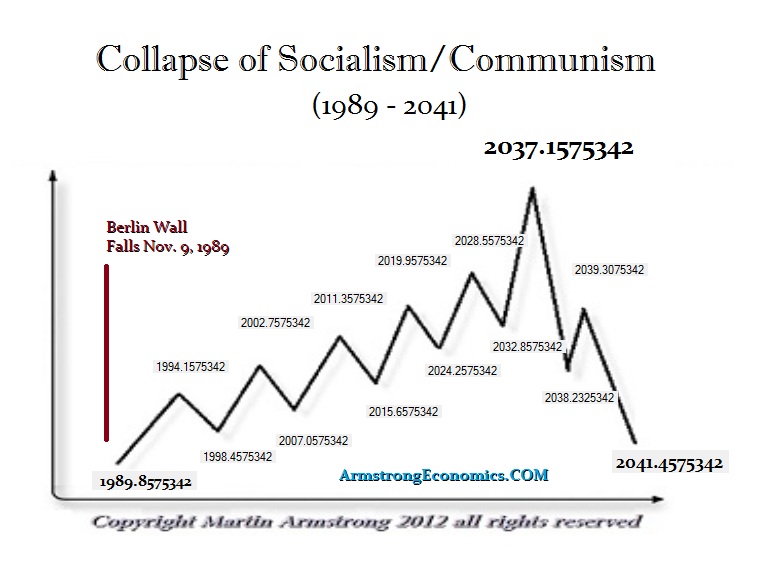
ANSWER: That is a hard question to answer. The computer can show me the region for conflict. That is determined by cyclical trends for each region yet at times it is augmented by a combination of capital flows. Picking things like the fall of communism back in 1989 and picking when the Berlin Wall would fall were based cyclically on the outcome of that trend. That was 72 years from the Russian Revolution of 1917. That was the perfect target for the volatility models within the ECM. Both converged so it made it really a piece of cake.

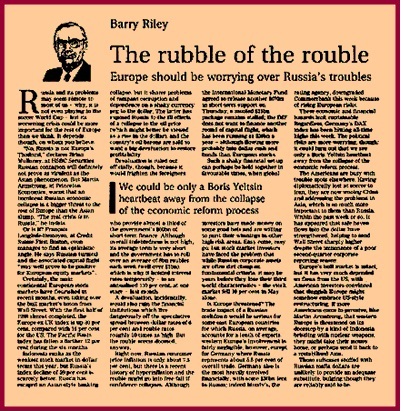
The collapse of the Soviet Union came in 1991, that was a simple 2-year reactionary process all within a cyclical forecast. Now, the collapse of the Russian bond market which set in motion a major contagion and the Long-Term Capital Management debacle was determined from a capital flow and cyclical perspective. That came 8.6 years following the fall of the Berlin Wall. When that forecast made the front page of the second section of the FT, that is when even the CIA came. They suddenly realized that our model could forecast the rise and fall of nations. But that is also when the bankers began to complain to the CFTC and SEC that I was “manipulating” the world economy because they were all long Russian bonds and blamed me for their losses using the FT article as proof. They said I had too much “influence” rather than consider the possibility that just maybe we were able to forecast events that they thought bribing politicians would prevent.

The above chart is calculated from the day the Berlin Wall fell – November 9th, 1989. Our forecast for the fall of the Russian financial system in 1998 was 8,6 years from the fall of the Berlin Wall. But look at the dates beyond that 2002 (low in the US market post-DOT.COM Bubble), 2007 (the peak in the world economy & start of real estate meltdown), 2015 (Russia invade Syria, Refugees welcomed into Europe by Merkel, start of the rise in interest rates at the Fed), and the dates to come are 2019, 2024, 2028, and 2037.

This is the collapse of socialism which is the collapse of pensions and will result in a new monetary system. We will see 2019 as a financial crisis and 2024 as a rise in commodity prices.

Each domino is set in motion by the previous. Yes, my experience behind the curtain allows me to understand the real risks, but the model defines where they are and the computer will continue to write reports when I am gone.