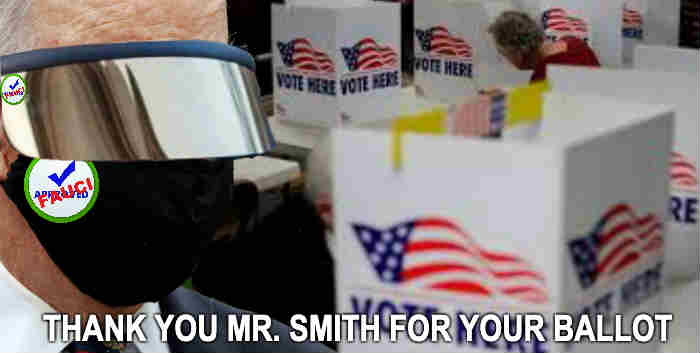
More Frightening Than Covid-19: Dems Stealing 2020 Election Through Mail-In Vote


Americans will wake up after election to a world much worse than Covid-19 and its accompanying lockdown because they will wake up to the living nightmare of socialism

Judi McLeod image

Re-Posted from the Canada free Press By  —— Bio and ArchivesAugust 1, 2020

More Frightening Than Covid-19: Dems Stealing 2020 Election Through Mail-In Vote

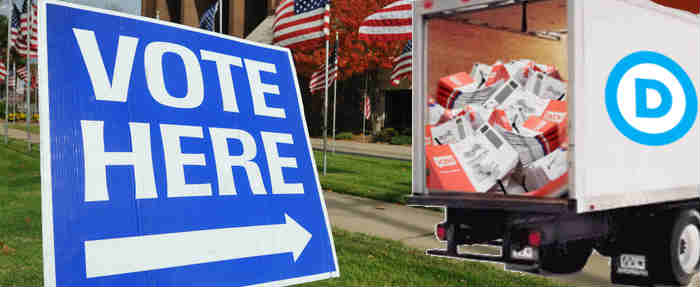
President Donald Trump is doing what the mainstream and social media are failing to do: warning the nation that November will bring “the greatest election disaster in history” if the Democrats get away with making Election 2020 a complete MAIL-IN VOTE!

The media is hellbent for leather to dominate the news with Covid-19 scaremongering stories— knowing that it is fear of Covid-19 that will will keep the masses from getting out to voting booths.

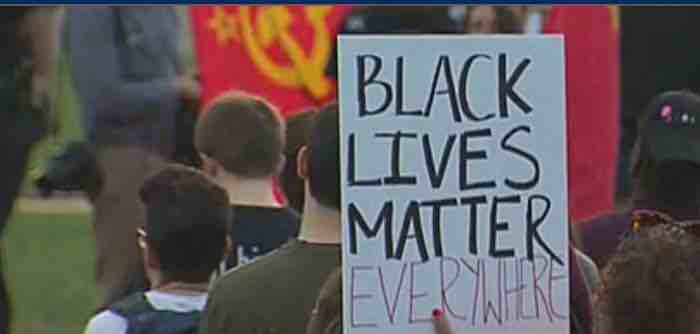
In fact, given their aiding and abetting their mayors and governors in denying protection to citizens in blue cities and states currently under attack from the violence of Black Lives Matter and antifa, the MAIL-IN VOTE is the only way Democrats can be elected.

Even Fox News seems in on the impervious side of this clear and present danger to the Republic

The president is up against it far more now than he was when Adam Schiff worked through Congress trying to Impeach him, is in far more hot water now than he was when 99 percent of the media were blaming him for colluding with the Russians to “steal” the 2016 election from Hillary Clinton.

When it comes to fighting off the Democrats stealing the election through the Michelle Obama-run Mail-In Vote via her absurdly described “non-partisan” efforts with her ‘When We All Vote’ project, President Trump stands alone.

Where are the Republicans?

Mainstream and social media seem not to know or do not care about the high risk of fraud that comes with a total mail-in vote.

Even Fox News seems in on the impervious side of this clear and present danger to the Republic:

“President Trump doubled down Friday on his warnings surrounding expanded mail-in ballots, declaring November will bring the “greatest election disaster in history” a day after he controversially suggested delaying the vote. (Fox News, July 31, 2020).

A day after he controversially suggested delaying the vote?

They are two separate issues, and surely mail-in-ballots have enough “news” gravitas on their own.

“They think they’re going to send hundreds of millions of ballots all over the United States and it’s gonna come out,” he told reporters at the White House following a meeting with members from the National Association of Police Organizations. “You won’t know the election result for weeks months, maybe years after. Maybe you’ll never know the election result. That’s what I’m concerned with – it’ll be fixed. It’ll be rigged. People oughta get smart.” (Fox News)

“He suggested people vote in person or submit absentee ballots.

“This is going to be the greatest election disaster in history,” he continued on Friday. “And by the way, you guys like to talk to about Russia and China and other places? They’ll be able to forge ballots, they’ll forge them. They’ll do whatever they have to do.”

“The president has repeatedly raised concerns involving broad mail-in voting, which is expected to be more widely used in the November election out of concern for safety given the COVID-19 pandemic. Republicans have drawn a distinction with standard absentee ballots given the process in place to obtain one.

“But on Thursday, Trump caused a firestorm when he floated the idea of delaying the election until it could be conducted in person. Trump has no authority to do so, as the Constitution gives Congress the power to set the date for elections, and even Republicans pushed back at the suggestion.

“You’re sending out hundreds of millions of universal mail-in ballots. Hundreds of millions. Where are they going? Who are they being sent to? It’s common sense,” Trump said. “I want an election, and a result, much more than you. I think we’re doing very well. … I don’t want to see a rigged election.”

“On Friday, he insisted he wants the election to take place, and even said, “I wish we’d move it up, okay?”

“He said officials are working to fix the issue, but said the government was “not prepared for an onslaught of millions of ballots pouring in.”

“Absentee ballots, great. Going to the polls, great,” he added. “If you do universal mail-ins with millions and millions of ballots, you’re never gonna know what the real result of an election is. It’s gonna be a very, very sad day for our country.”

“Trump cannot change the election date without the approval of Congress, and policymakers in both parties have largely made clear they would oppose such a move.

“Earlier this month, NAPO endorsed Trump for president, after endorsing then-Vice President Joe Biden in both the 2008 and 2012 elections.

“In announcing NAPO’s support for Trump, President Michael McHale wrote Trump’s support is necessary “during this time of unfair and inaccurate opprobrium being directed at our members by so many.”

“We particularly value your directing the Attorney General to aggressively prosecute those who attack our officers,” McHale wrote in the letter.

‘Donald Trump: ‘China Must Be Very Happy’ Democrats Using Coronavirus to ‘Screw Up’ Election’ (Breitbart, July 31, 2020)

“President Donald Trump said Friday that China was likely delighted Democrats were trying to implement mail-in voting in the 2020 election, which he said would lead to a “catastrophic” result.

“They’re using the China virus, China must be very happy about it, because they hit us with a virus and now they screw up an election like you will never see,” Trump said about the Democrats.”

Meanwhile, while the mainstream and social media seem to be studiously avoiding the topic;  if no way can be found to stop the Democrats from transforming the the election from in-person and absentee voting to a universal mail-in vote,  Americans will wake up after election to a world much worse than Covid-19 and its accompanying lockdown because they will wake up to the living nightmare of socialism—the one thing Democrats and the media won’t be able to blame on President Donald Trump.

Why Your Kid Is A Communist


There may not have been a communist behind every bush like Joe McCarthy had us believe, but take a look now. Old Joe was right after all

Ray DiLorenzo image

Re-posted from the Canada Free Press By  —— Bio and ArchivesAugust 1, 2020

Why Your Kid Is A Communist

No, I am not saying that every parent’s child is a communist. What I am saying is that there are enough young people out there with either an affinity or a sympathy for the communist system to make us all very concerned. The polls show it, the rioting proves it.

According to a 2019 Gallup poll, 51% of adults, 18 to 29 view socialism positively, while 49% view capitalism positively.

Parents, especially of strong Christian faith, can hardly believe what comes out of the mouths of their children. College-age young adults go into university as bright eyed, eager-to-learn fledglings and come out bitter, angry, under achievers.

Why so much of our youth has turned to Communism/Socialism

Why so much of our youth has turned to Communism/Socialism is a story of the last 100 years. Please, don’t give me that Democratic-Socialist drivel. It’s just another Leftist slogan to misdirect.

A group of Marxist intellectuals in the 1920s got together in Germany with the purpose of spreading the Russian Communist Revolution in the West, especially in America. This group of Marxists founded the Institute for Social Research in Frankfurt to study ways and methods to spread communism. It became known as the Frankfurt School.

At the same time, Hitler was running roughshod over Germany with his fascism, much of it copied from Mussolini in Italy. Although fascism and communism are kissing cousins, each had a different scapegoat. Communism used class, fascism used race. In any case, Hitler wasn’t going to have it. He wanted no competition.

By 1933, Hitler had those who were involved in the Frankfurt School deported. They found a welcome home at Columbia University in New York City. They realized early on that what worked in Russia was not going to be accepted in the West, certainly in the United States, because of its strong Judeo-Christian roots and its vast middle-class…the group of people who were not rich, but definitely not poor. The middle-class had little reason to revolt. They had cars, homes with white picket fences, and were clinging to their guns and religion.

These subversives decided, brilliantly, that breaking down the culture was needed for the populous to accept communism. It included breaking down the Christian foundation, destroying the family structure, feminism, sex education, promoting atheism, hedonism, free sex, abortion, homosexuality, mass migration, globalism, multiculturalism, environmentalism, you name it. They advanced anything that would destroy the traditional family, culture and our moral foundation. Their goal was to set people free to drift, leaving generations of people with no anchor with which to tie on to accept the promise of a collectivist utopia.

It spread to every major university, junior college, high school, middle school, elementary school, and in many cases, preschool. There is an Institute for Social Research in almost every major university in the United States. Their teaching has been disguised in subjects like Critical Theory, a tool to demonize Christianity, capitalism, and Western civilization. Every student in almost every school today is being exposed to this trash, and in a positive light. Considering the basement level of morality now taught in our schools, Hollywood, and in many modern homes, it is no wonder so many of the young are breaking windows, shooting cops, destroying private property, knocking down statues of people their teachers taught them to hate and some they don’t even know.

The education system in America today has the stench of almost 100 years of indoctrination akin to re-education camps in communist filth

The education system in America today has the stench of almost 100 years of indoctrination akin to re-education camps in communist filth. Several generations lost to ignorance and degradation. Disneyland has LGBTQ Day, teachers are being fired or subject to a Reign Of Terror for being conservative, resisting the new morality, the new normal. Students are punished academically and socially for not joining in the sedition. Many libraries and even some U.S. embassies fly the homosexual flag. Most students are not taught anything close to the American history we were taught. And when they are taught our history, it is in a negative context.

Those political leaders whose lust for power has overruled their desire for public service has now taken over a major part of our political and judicial system, and almost an entire political party. These are the 60s terrorists and their children, and students. They watch quietly with approval as people are murdered and cities are torn apart as they scheme how to use the crisis to their advantage. Only mere pockets of sanity are left. Meanwhile the people in the media, Hollywood, and the Deep State, having attended the same miserable schools, equally indoctrinated, give their blessing. And all the while the church in America says and does what it has done for generations…nothing.

There may not have been a communist behind every bush like Joe McCarthy had us believe, but take a look now. Old Joe was right after all.

Ayn Rand – What is Capitalism?


Jim Jordan Confronts Dr. Anthony Fauci on Disparate COVID Concerns….


Ohio representative Jim Jordan does a good job in this testimonial segment contrasting the political hypocrisy within the COVID shutdowns and decrees.

The political elite can assemble without issue at the funeral of John Lewis, but don’t you dare try to have a funeral for your loved-ones because it’s not allowed.  Within that contrast the fuel for COLD ANGER rages in the veins of ordinary Americans.

Jim Jordan gives voice to some of the most ridiculous aspects of the COVID political rules.

.

Somebody get this guy away from national public policy; he’s destroying the economy, and it looks to me like Dr. Fauci-Mengele is doing it intentionally.

Fauci’s type of over-the-top gibberish is identical to other statements made during this crisis which we first noted on March 17, 2020..

There’s been a debate about possible political motives surrounding the panic he has created; the massive economic damage he has inflicted; and the conflicting assertions of National Institute of Allergy and Infections Diseases (NIAID) Director Dr. Anthony Fauci.

CTH identifies the motives as sketchy. He appears to use his position to advance theories and yet position himself to avoid scrutiny.

Sometimes within a 24 hour period Fauci will make a statement, then contradict the initial assertion, then attempt to cloud his own conflict with obtuse and wordy explanations. After watching for several weeks, we called it out HERE.

Perhaps one way to help see through the professional obfuscation, and identify just exactly how political Dr. Fauci is, would be to: compare and contrast Dr. Fauci under President Obama in September 2009 after 3,000 to 4,000 H1N1 deaths in the USA -vs- Dr. Fauci under President Trump in March 2020 after 200 to 300 COVID-19 deaths. WATCH:

.

Now, to better absorb the information…. According to the CDC final estimate of 2009 U.S. H1N1 cases (published in 2011): from April 12, 2009 to April 10, 2010 approximately 60.8 million U.S. cases, 274,304 U.S. hospitalizations, and 12,469 U.S. deaths occurred due to H1N1. That’s the empirical data.

After: (1) watching that 2009 video; and (2) comparing the 2009 H1N1 response to the current 2020 COVID-19 response; and (3) reviewing the empirical data; we must admit to ourselves there is a VERY BIG difference. So now, with the baseline established, we look for why such a big difference; and to do that we (4) evaluate the politics:

(LINK)

A few months later:

(LINK)

Now, pause for a moment – reread that again – don’t skip past it. Think about what type of mindset would send such a letter and communication. Apply common sense. Trust your instincts…

Would a person of reasonable disposition send such a letter or email to anyone in their professional network? Would you ever consider writing a letter to your employer, or the family of your employer, declaring your undying love and devotion toward them?

“rarely does a speech bring me to tears”?… “please tell her I love her more than ever”?.. “please tell her that we all love her”… etc.

Seriously…. think about it. If you have ever engaged in a large system, large business, or large network of professionals, how would you react to a person inside that organization who was sending such non-professional communication? What exactly does that say about the emotional stability of such a person?

And this person, right now, with this inherent sensibility, has the most consequential and direct influence over the decision-making for the worlds most powerful nation. Stunning.

Perspective: We are in Fort McHenry…


The battle of Fort McHenry was a critical point in the War of 1812.  Many people know that our national anthem stemmed from the valiant defense of Fort McHenry by American troops who refused to concede Baltimore harbor and withstood 27 hours of continual bombardment by British naval forces beginning Sept 13, 1814.  The short story is HERE

Two-hundred-six years later, there is a lesson to be learned.

[Part of the Korean War Memorial – Washington DC]

Right now those who wish to “fundamentally change” our nation are waging a full frontal assault against our constitutional republic.  The bombardment seems overwhelming.

Leftist city and state leaders have abandoned rule of law in favor of supporting the mob effort to destroy our sense of national unity.  Political activists, left-wing ideologues under the guise of democrats, and a host of media allies are conducting an information war on behalf of their objective.  Big tech social media companies are attempting to remove the voices of those who are fighting back.

There is a great deal of purposefully driven anxiety and fear amid our nation as this multi-faceted internal war takes place.  However, there is a primary element to this effort that each person can shield themselves from, and act to counter.  Do not let your sense of self succumb to this assault.  Do not let them win the battle for your peace of mind.

It might, heck, -check that- it does seem overwhelming at times.  But that is the nature of this collectivist strategy.  That is the purpose of this bombardment.  We must hold strong and push back against their lies and manipulations.  If you look closely at their attack, it is weak and much of it is psychological bait.  Do not fall into the trap of despair.

When I share the message “live your best life”, it is not without purpose.  Every moment that we allow the onslaught to deter us from living our dreams, is a moment those who oppose our nation view as us taking a knee.  Do not allow this effort to succeed.

You might ask yourself how can I, one person, a flea looking into a furnace, retain an optimistic disposition while all around me seems chaotic and mad.

That’s the point; it ‘seems’ chaotic and mad because it has been created to appear that way.  There are more of us than them; they just control the systems that allow us to connect, share messages and recognize the scale of our assembly.

Every second that you live your life with thankfulness for the abundance within it; every moment that we CHOOSE to engage with fellowship; every day that we accept guidance from God – however you define him to be; and every moment we cherish this time to be a beacon of optimism; is a moment that we withstand that barrage and hold the flag in place.   It is a genuinely patriotic position not to succumb to the attack.

If you allow yourself to be drawn into crisis and despair, you allow them to win.  If your center of normal is based around this overwhelming onslaught, you will eventually concede liberty in favor of peace.  Once we stop living in liberty, we no longer have peace.

It took me a while to fully understand just how damaging empty streets, soulless eyes, the lack of smiles, shuttered businesses and the absence of joy would become.  But as I travel around trying to deliver a very specific message to a very specific audience, I now recognize just how much damage is being done; not just to our nation as a whole, but also to every individual within it – personally.

We must shake this mindset.  We must withstand this onslaught and rally to the origin of our true national spirit.  We must rally to a standard of Americanism and accept this is not that. In essence, we must individually take a stand.  Purposefully, deliberately and with forethought, we must engage those around us to get rid of this sense of foreboding.

This approach is how we win the larger battle.

All around us, in every tribe and region, there are people who need you to show them the strength that you have.  Strength of spirit. Strength of fellowship that you will not relent from expressing.  No matter what noise is shouting from the loudspeakers we must withstand it; we must make eye contact and remain joyful.  We cannot allow despair to be the status quo.

In my own travel, right into the belly of the beast, I have encountered some of the most morose robotic people I could ever imagine; yet each night I held up my mission in prayer and promised to accept guidance regardless of my own fears and trepidation.  Trust me, this ain’t easy for me…. through my research, I have torn open the dungeon doors and stared into the dark space; and yes, the scale of it sticks with you; it manifests as cynicism.

So, let me share two recent short-examples of what following that guidance actually means.

The second night in DC, I woke up with this horrible taste in my mouth.  Teeth brushing didn’t help… wearing a mask or facing a $500 fine didn’t help either and perhaps was the cause.  Regardless, I asked a gentleman for the location to a convenience store to purchase some mints to chew throughout the day.  I was directed to a specific store.

When I made my purchase, the mask on the other side of the counter was as sad as many that day, but I felt compelled to ask how she was doing.  The typical “been better” was the return.  However, as I started to walk away… I turned back: “what’s wrong”?  For the next few minutes I listened as I met a mom of four kids who was 15 days from a COVID-based eviction.  There was really no-one to blame; and worse, for her no-where to turn.  She was looking for housing grants to avoid the most painful decision in her short 30-year-life.

You see, there was a reason why I went into that store that afternoon, at least that’s what I told her; and there was a reason why she was there.  In part with your support, and after putting all other tasks in the appropriately unimportant place they deserved, WE (yes, you and me) together found a solution and provided the resources she needed.   Starfish dude strikes again… this time with His help and your help.

It would have been very easy to walk out and accept that simple: “been better”. Heck, I think of all the times I have done that before…. but not this time.  This time something nagged about it…. and so I turned around and found tears, fellowship – and mints.

The next day another stroll, a little lost, and a veteran on the street… I can’t tell you his story because that’s for another day… but it is just as important and just as profound.  As I walked away from him many minutes later he yelled at me: “HEY DUDE”.  I turned my unmasked smile back in his direction only to have him say: “we need more people like you in charge”…  Thumbs up, and I continued my travels.

Which is really the point of writing all this.  Our nation needs more people like you, right now.  Don’t wait… engage life, get optimistic however you need to do it. Then let that part of you shine right now… This is how we fight.  Hold up that flag; give the starter smile… rally to the standard you create and spread fellowship again.  God knows we need it.

Oh, and don’t call me a goober for sharing this – I’m doing it because a smart lawyer, a genuinely decent young man who I met along this specific road less traveled, told me to write about it…. and, perhaps, because I sense he might have needed to hear it too.

Thanks Travis.

Love to all.


Crucial Facts About Covid-19


Re-Posted from Just The Facts By James D. Agresti

March 31, 2020
Updated 7/30/20

Given the spread of misinformation about Covid-19, Just Facts is providing a trove of rigorously documented facts about this disease and its impacts. These include some vital facts that have been absent or misreported in much of the media’s coverage of this issue.

This research also includes a groundbreaking study to determine the lethality of Covid-19 based on the most comprehensive available measure: the total years of life that it will rob from all people. This accords with the CDC’s tenet that “the allocation of health resources must consider not only the number of deaths by cause but also” the “years of potential life lost.”

The CDC emphasizes that the Covid-19 pandemic “is a rapidly evolving situation,” and as such, the emboldened figures in this article will be updated each weekday as the CDC publishes new data.

On one hand, the facts show that:

  • the death rate for people who contract Covid-19 is uncertain but is probably closer to that of the seasonal flu than figures commonly reported by the press.
  • the average years of life lost from each Covid-19 death are significantly fewer than from common causes of untimely death like accidents and suicides.
  • the virus that causes Covid-19 is “very vulnerable to antibody neutralization” and has limited ability to mutate, which means it is very unlikely to take masses of lives year after year like the flu and other recurring scourges.
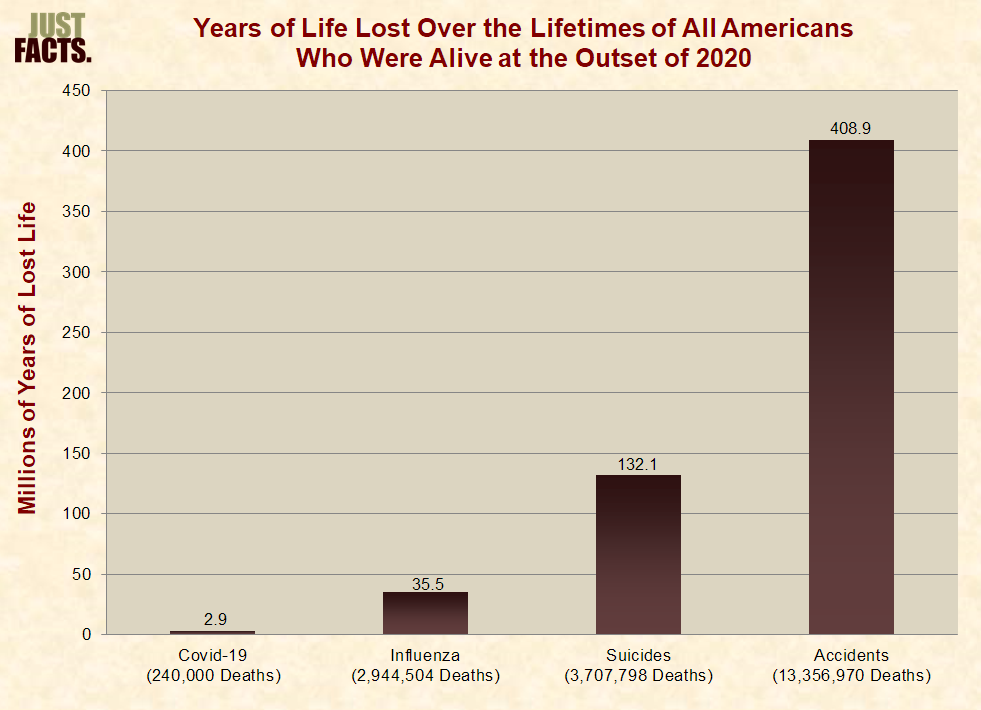
  • if 240,000 Covid-19 deaths ultimately occur in the United States, the virus will rob about 2.9 million years of life from all Americans who were alive at the outset of 2020, while the flu will rob them of about 35 million years, suicides will rob them of 132 million years, and accidents will rob them of 409 million years.

Years of Life Lost Over the Lifetimes of All Americans Who Were Alive at the Outset of 2020

(Source Data)

On the other hand, elderly people and those with chronic ailments are extremely vulnerable to Covid-19. Furthermore, the disease is highly transmissible, which means it could spread like wildfire and overwhelm hospitals without extraordinary measures to contain it. This would greatly increase its death toll.

However, such precautionary measures often have economic and other impacts that can cost lives, and overreacting can ultimately kill more people than are saved.

Likelihood of Exposure

Per the U.S. Centers for Disease Control and Prevention, a total of 4,405,932 people in the United States have been diagnosed with Covid-19 as of 4:00 PM EST on July 29, 2020. The U.S. population is 330 million people, which means that one out of every 75 people has been diagnosed with Covid-19. The disease is not equally dispersed throughout the nation, so this figure is much higher in some areas and much lower in others.

Reported cases don’t include people who may have Covid-19 but have not yet been diagnosed. Because its incubation period is 2–14 days, the number of people who have been infected could substantially exceed the number who have been diagnosed.

Also, the vast majority of people who contract Covid-19 experience only mild or no symptoms, and many of them may never be diagnosed. This means that the count of reported cases further understates the actual number of people who have been infected. A February 2020 study in the Journal of the American Medical Association based on data from China found that 81% of reported Covid-19 cases are “mild.” The true portion of such cases is even higher than this, for as the paper explains, there are “inherent difficulties in identifying and counting mild and asymptomatic cases.”

A rare case in which asymptomatic cases can be counted is the Diamond Princess cruise ship, since all passengers were tested for Covid-19. Among those who tested positive, 51% didn’t have symptoms when they were tested. The number of these people who later developed symptoms is currently unavailable.

In another such rare case, the New England Journal of Medicine reported in mid-April that universal Covid-19 testing of pregnant women at two New York City hospitals found that 88% of the women who tested positive for the disease were asymptomatic.

Conversely, the number of people who have ever been infected may greatly exceed the number who are still infected. Growing numbers of people who were once diagnosed with Covid-19 have recovered, and the count of those who were unknowingly infected and had fast recoveries could be enormous. A March 2020 paper in the journal Microbes and Infection notes that “most infected individuals … appear to be able to recover with little to no medical intervention.”

Moreover, a March 2020 paper in the Pediatric Infectious Disease Journal states: “Preliminary evidence suggests children are just as likely as adults” to contract Covid-19, but they are “less likely to be symptomatic,” and even those with diagnosed infections typically “recover 1–2 weeks after the onset of symptoms.”

The upshot of all this is that the number of people who are actively infected and contagious is lower than the total of reported and undiagnosed cases.

March 2020 paper in the journal Science condenses the factors above into a single number. It estimates that 86% of all Covid-19 infections in Wuhan, China “were undocumented” before the government implemented travel restrictions. This means that the number of people who were infected was six times the number of documented infections. This figure declines as social distancing measures are adopted and as diagnoses and recoveries rise as time passes.

Under that worst-case scenario from Wuhan, if the number of people with contagious Covid-19 infections in the U.S. is actually six times the number of people who have been diagnosed with it, the average American would have to come in contact with 12 people to be exposed to one person who has it.

Numbers of Deaths

According to the CDC’s counts of “confirmed and probable” fatalities from Covid-19, a total of 150,283 U.S. residents have died from the disease as of 4:00 PM on July 29, 2020. To put this figure in perspective:

  • Covid-19 has killed about one out of every 2,195 Americans, whereas one out of every 116 Americans die every year.
  • roughly 12,469 people in the U.S. died from the swine flu from April 12, 2009 to April 10, 2010. Unlike Covid-19, which mainly kills older people with preexisting health problems, 87% of people killed by the swine flu were under the age of 65.
  • an average of 37,000 people in the U.S. have died from influenza (“the flu”) each year over the past nine years.
  • around 170,000 people per year in the U.S. die from accidents.

In other words, deaths from Covid-19 are now 72.5% of the annual fatalities from the flu and accidents. Although Covid-19 is a new disease and took its first reported life in the U.S. during late February, this comparison may substantially overstate the relative deadliness of Covid-19 because fatalities from accidents and the flu occur in droves every year, and this is unlikely for Covid-19.

The primary reason why the flu takes tens of thousands of lives every year is because the viruses that cause it mutate in ways that prevent people from becoming immune to them. Per the Journal of Infectious Diseases, “All viruses mutate, but influenza remains highly unusual among infectious diseases” because it mutates very rapidly, and thus, “new vaccines are needed almost every year” to protect against it. While much remains to be seen about the mutations of the virus that causes Covid-19, the early indications are that it will not mutate rapidly and become an ongoing scourge.

As detailed in a March 2020 paper in a molecular biology journal that cites Michael Farzan, co-chair of the Department of Immunology and Microbiology at Scripps Research, once a vaccine for Covid-19 is developed, it “would not need regular updates, unlike seasonal influenza vaccines” because the part of the virus that the vaccine targets “is protected against mutation” by a feature of its genetic material, or RNA.

The same point applies to naturally acquired immunity. People who get Covid-19 develop natural antibodies that protect against future infections of it. The physiology textbook The Human Body in Health and Illness explains that such immunity, which is called “active immunity,” is “generally long lasting.” The same applies to diseases like measles, mumps, rubella, and polio. If someone contracts these diseases, they rarely get them again, and furthermore, they are very unlikely to transmit them to others. Thus, these people become firewalls against the spread of these contagions.

Media outlets like The AtlanticVox, and Forbes have turned the truth of this matter on its head by confusing the general nature of coronaviruses with that of Covid-19. The habit of calling Covid-19 “the coronavirus” can be very misleading because there are different types of coronaviruses, and Covid-19 is caused by just one of them. Coronaviruses are a family of RNA viruses that includes some common cold viruses. These viruses tend to mutate rapidly, but Covid-19 does not share that trait. Per the same March 2020 paper cited just above, the virus that causes Covid-19 “does not mutate rapidly for an RNA virus because, unusually for this category, it has a proof-reading function” in its genetics.

Likewise, a February 19th editorial in the British Medical Journal about Covid-19 reports that the “genome data available so far show no unexpected mutation rate or signs of adaptation….”

Put simply, Covid-19 does not mutate nearly as much as the flu, and thus, it is far less likely to take lives regardless of acquired immunity and vaccines. If this proves true in the long run, as current evidence suggests it will, the lifetime risk of dying from Covid-19 is greatly overstated by comparing its ultimate death toll to yearly fatalities from the flu, accidents, suicides, and other frequent causes of death.

Years of Lost Life

Beyond raw numbers of deaths, another crucial factor in measuring the deadliness of a public health threat is the ages of its victims. In the words of the CDC, “the allocation of health resources must consider not only the number of deaths by cause but also by age.” Hence, the “years of potential life lost” has “become a mainstay in the evaluation of the impact of injuries on public health.”

In this respect, Covid-19 is much less lethal than common causes of untimely death, such as accidents. The precise average age of death for Covid-19 fatalities is still unknown, but the vast majority of victims are elderly or have one or more chronic illnesses, as is the case with deaths from the flu and pneumonia.

Based on the CDC’s latest data for the age distribution of deaths, the average age of death for accidents is about 53.3 years, while for the flu and pneumonia, it is about 77.4 years. Using flu and pneumonia as a rough proxy for Covid-19, this disease robs an average of 12.0 years of life from each of its victims, as compared to 30.6 years of lost life for each accident. And again, accidents kill around 170,000 Americans per year, while Covid-19 is unlikely to have an ongoing high death toll because of its limited prospects for mutation.

In a March 29th comment that generated headlines in virtually every major media outlet, renowned immunologist Anthony Fauci told CNN’s Jake Tapper that “looking at what we’re seeing now, I would say between 100,000 and 200,000” Americans will die from Covid-19, but “I just don’t think that we really need to make a projection when it’s such a moving target that you can so easily be wrong and mislead people.” The next day, Dr. Fauci emphasized that those figures are based on a model, and “a model is as good as the assumptions that you put into” it.

A day later at a White House press conference, Dr. Deborah Birx, another world-renowned immunologist, presented a slide of model results based upon “five or six international and domestic modelers from Harvard, from Columbia, from Northeastern, from Imperial who helped us tremendously.” The model projects that 100,000 to 240,000 deaths will occur if Americans follow social distancing and hygiene guidelines. She added that “we really believe and hope every day that we can do a lot better than that because that’s not assuming 100% of every American does everything that they’re supposed to be doing, but I think that’s possible.”

If the high-end of that range comes to pass, and 240,000 U.S. residents die from Covid-19, this disease will rob 2.9 million years of life from all Americans who were alive at the outset of 2020. In comparison, the flu will rob them of about 35 million years and accidents will rob them of 409 million years.

These figures reveal that accidents are about 140 times more lethal to Americans than this worst-case scenario for Covid-19 given mitigation. Likewise, the flu is 12 times as lethal. This is a substantially more comprehensive measure of deadliness than the tally of lives lost during a year—or any other random unit of time—because it accounts for the entirety of people’s lives and the total years of life that they lose.

While not diminishing the value of any life, these facts speak to the efforts that society takes to save some lives versus others.

Death Rates

Initial media reports of a 2–3% mortality rate for Covid-19 are inflated, and the actual figure may be closer to that of the flu, which has averaged about 0.15% over the past nine years in the United States. A large degree of uncertainty surrounds this issue due to the same factor that prevents accurate counts of infections: unreported cases.

As explained by Dr. Brett Giroir—who has authored nearly 100 peer-reviewed scientific publications and serves as the Assistant Secretary for Health at the U.S. Department of Health and Human Services—the Covid-19 death rate is “lower than you heard probably in many reports” because the bulk of people who contract coronavirus don’t get seriously ill, and thus, many of them never get tested.

Giroir calls this a “denominator problem” because if you’re “not very ill, as most people are not, they do not get tested. They do not get counted in the denominator.” Giroir’s best estimate is that the mortality rate is probably “somewhere between 0.1% and 1%.” This “is likely more severe in its mortality rate than the typical flu” rate of 0.1% to 0.15%, “but it’s certainly within the range.”

Giroir’s estimate accords with a February 2020 commentary in the New England Journal of Medicine by Fauci and others:

If one assumes that the number of asymptomatic or minimally symptomatic cases is several times as high as the number of reported cases, the case fatality rate may be considerably less than 1%. This suggests that the overall clinical consequences of Covid-19 may ultimately be more akin to those of a severe seasonal influenza (which has a case fatality rate of approximately 0.1%) or a pandemic influenza (similar to those in 1957 and 1968) rather than a disease similar to SARS or MERS, which have had case fatality rates of 9 to 10% and 36%, respectively.

A prime example of how journalists misreport on this issue is a March 12th article in Business Insider by Andy Kiersz. In this piece, he compares the “death rates” of Covid-19 from the South Korean CDC to that of the flu from the United States CDC. Based on these numbers, he reports that “South Korea—which has reported some of the lowest coronavirus death rates of any country—still has a COVID-19 death rate more than eight times higher than that of the flu.”

What Kiersz and his editors fail to understand is that the denominator for the Korean rate is the number of “confirmed cases,” while the denominator for the U.S. rate is based on a “mathematical model.” The CDC clarifies how the model works by citing a study on swine flu, which multiplies “43,677 laboratory-confirmed cases” of the disease by 41 to 131 times to calculate the denominator for the death rate. In the authors’ words, they do this because confirmed cases are:

likely a substantial underestimate of the true number. Correcting for under-ascertainment using a multiplier model, we estimate that 1.8 million–5.7 million cases occurred, including 9,000–21,000 hospitalizations.

Put simply, Covid-19 death rates that are based upon reported or confirmed infections grossly undercount the number of people with the disease. This, in turn, makes the death rate seem substantially higher than reality.

Social Media Amplification

The famous maxim that “there are six degrees of separation between everyone in the world” has changed in recent years due to social media. A 2014 paper in the journal Computers in Human Behavior finds that the “average number of acquaintances separating any two people” has declined from six to 3.9.

2011 paper in the American Journal of Sociology estimates that each American knows an average of 550 people. If 150 of these are mutual connections who already know each other, each American has about 220,000 friends of friends—and 88 million friends of friends of friends.

Thus, if everyone is sharing on social media about people they know who have been infected or killed by Covid-19, it can seem like the world is coming to an end. Yet, if people did the same for other deaths, each person would hear every year about an average of:

  • 1,905 deaths among their friends of friends, and 761,844 deaths among their friends of friends of friends.
  • 38 deaths from the flu and pneumonia among their friends of friends, and 15,075 such deaths among their friends of friends of friends.
  • 6 deaths of people under the age of 65 from the flu and pneumonia among their friends of friends, and 2,385 such deaths among their friends of friends of friends.

In addition to social media, the press acts as another megaphone of Covid-19’s impacts. Because the U.S. is the third-most populous nation in the world, it is easy for journalists to create misleading impressions by focusing on certain events and ignoring the broader context of facts that surround them. This kind of crucial context is missing from much of the media’s coverage of Covid-19 and practically every other public policy issue.

Transmissibility

Another important factor in weighing the risks posed by Covid-19 is its transmissibility, or how contagious it is. In this respect, Covid-19 is much more dangerous than the seasonal flu because it spreads very quickly and can overwhelm hospitals.

Scientists measure the contagiousness of diseases with a basic reproduction number, which is the average number of people who tend to catch a disease from each person who has it. This measure is an innate characteristic of the disease because it doesn’t account for actions that people take to prevent it. A February 2020 paper published in the Journal of Travel Medicine explains that any disease with a basic reproduction number above 1.0 is likely to multiply over time.

The same paper evaluates 12 studies of the basic reproduction number of Covid-19 in various nations and finds that they “ranged from 1.4 to 6.49,” with an average of 3.28 and a median of 2.79. Based on their analysis of these studies, the authors conclude that the basic reproduction number of Covid-19 will likely prove to be “around 2–3” after “more data are accumulated.”

In contrast, a 2014 paper in the journal BMC Infectious Diseases analyzes 24 studies of the seasonal flu and finds that the median result for the basic reproduction number is 1.28. The authors stress that the seemingly small difference between 1.28 and higher figures like 1.80 “represent the difference between epidemics that are controllable and cause moderate illness and those causing a significant number of illnesses and requiring intensive mitigation strategies to control.”

In other words, if the transmissibility of Covid-19 is as high as currently estimated, the aggressive measures that some governments, organizations, and individuals have taken to limit large gatherings and travel from areas with outbreaks will save many more lives than doing the same for common diseases like the flu. Because Covid-19 spreads so quickly, it can easily overwhelm hospitals and thereby prevent people from getting the care they would otherwise receive under normal circumstances.

Overreactions

There are, however, mortal dangers in overreacting because measures to limit the spread of Covid-19 often have economic impacts that can cost lives. As detailed in the textbook Macroeconomics for Today, countries with low economic growth “are less able to satisfy basic needs for food, shelter, clothing, education, and health.” These hazards can manifest quickly and over extended periods of time.

If certain industries adopted the social distancing extremes that many people have embraced, this would shut down food production and distribution, health care, utilities, and other life-sustaining services. Even under far more moderate scenarios where people who are not in these industries shun work, all of those necessities and many more aspects of modern life depend on the general strength of the economy. Thus, overreacting can ultimately kill more people than are saved.

The same applies to people who are flooding supermarkets to stockpile food, toilet paper, and other supplies. In doing so, they have often stood in close proximity to each other and touched the same items, which opens avenues to spread the disease. Panic buying also creates shortages that deprive typical consumers of provisions.

Likewise, panic can fuel suicides, which snuff out about 47,000 lives per year in the U.S. at an average age of 46 years old. Over a lifetime, that amounts to 132 million lost years of life—or 46 times the loss from Covid-19 if it ultimately kills 240,000 people.

The implications of overreacting to Covid-19 or any other potential hazard are aptly summarized in a teaching guide published by the American Society for Microbiology. This book explains why “the factors driving your concept of risk—emotion or fact—may or may not seem particularly important to you, yet they are” because “there are risks in misperceiving risks.”

The Path Forward

Aggressive social distancing can extend the timeframe over which Covid-19 patients are infected and hospitalized, but it cannot by itself reduce those outcomes in the long run. This is because Covid-19 is so contagious that another outbreak will begin and quickly proliferate as soon as the distancing measures cease.

Hence, the Imperial College’s March 16th report on Covid-19 states that in order to “avoid a rebound in transmission,” policies of “population-wide social distancing combined with home isolation of cases and school and university closure” must “be maintained until large stocks of vaccine are available to immunize the population—which could be 18 months or more.”

Moreover, the report notes that the “more successful a strategy is at temporary suppression, the larger the later epidemic is predicted to be in the absence of vaccination, due to lesser build-up of herd immunity.” A 2012 paper in the journal PLoS One about “Immunity in Society” underscores the importance of that point by noting that:

when a sufficiently high proportion of individuals within a population becomes immune (either through prior exposure or through mass vaccination), community or “herd” immunity emerges, whereby individuals that are poorly immunized are protected by the collective “immune firewall” provided by immunized neighbors. In humans and other vertebrate communities … responses to a previously encountered pathogen are faster and stronger than those to a novel pathogen, and thus individuals are better at blocking its spread. [Emphasis added.]

Equally, if very few people are immune to a disease, they can transmit it to others instead of blocking it. Without a vaccine, the only way people can become immune to Covid-19 is by catching it and recovering. This means that too much social distancing may cause more deaths because young, healthy people—who would otherwise catch the disease, recover quickly, and become firewalls—remain as potential carriers.

However, social distancing can keep hospitalizations at reasonable levels so that victims receive proper care, and it can also buy time to discover and mass-produce effective treatments. This is a distinct possibility in the short term, for as Michael Farzan, co‐chair of the Department of Immunology and Microbiology at Scripps Research, has stated, the same physical feature of the virus that makes it so contagious also makes it:

very vulnerable to antibody neutralization, and thus it is a relatively easy virus to protect against. I refer to it as “stupid” on a spectrum where HIV, which lives in the face of an active immune system for years, is a “genius.”

President Trump has touted a small French study showing that treatment with a combination of two drugs, hydroxychloroquine and azithromycin, “is significantly associated with viral load reduction/disappearance in COVID-19 patients….” The study was published in the International Journal of Antimicrobial Agents, and the 18 scholars who authored it wrote that the “results are promising” and “we recommend that Covid-19 patients be treated with” these drugs “to cure their infection and to limit the transmission of the virus to other people.” Nonetheless, media outlets have covered this matter by reporting that Trump “is not a doctor” and that he shouldn’t hype “unproven” and “untested” treatments or give people “false hope.”

Theatrics aside, the authors of the French study make clear that their “study has some limitations including a small sample size, limited long-term outcome follow-up, and dropout of six patients from the study, however in the current context, we believe that our results should be shared with the scientific community.”

During a March 14th press conference, U.S. Surgeon General Jerome Adams asserted that “this situation will last longer, and more people will be hurt” if “we are complacent, selfish, uninformed,” and if “we spread fear, distrust, and misinformation.” Conversely, he said that “we will overcome this situation” if we “pitch in” and “share the facts.”

The vital facts above confirm the wisdom of his words.

Anxiety From Reactions to Covid-19 Will Destroy At Least Seven Times More Years of Life Than Can Be Saved by Lockdowns


Re-Posted from Just The Facts By Andrew Glen, Ph.D. and James D. Agresti

May 4, 2020

Medical studies show that excessive stress and anxiety are among the most debilitating and deadly of all health hazards in the world. Beyond their obvious effects like suicide and substance abuse—these mental stressors are strongly related to and may trigger and inflame a host of ailments like high blood pressure, digestive disorders, heart conditions, infectious diseases, cancer, and pregnancy complications.

Based on a broad array of scientific data, Just Facts has computed that the anxiety created by reactions to Covid-19—such as stay-at-home orders, business shutdowns, media exaggerations, and legitimate concerns about the virus—will destroy at least seven times more years of human life than can possibly be saved by lockdowns to control the spread of the disease. This figure is a bare minimum, and the actual one is likely more than 90 times greater.

This study was reviewed by Joseph P. Damore, Jr., M.D., who concluded: “This research is engaging and thoroughly answers the question about the cure being worse than the disease.” Dr. Damore is a certified diplomate with the American Board of Psychiatry and Neurology, an assistant professor of psychiatry at the Weill Medical College of Cornell University, an assistant attending psychiatrist at New York Presbyterian Hospital, and an adjunct professor in the Department of Behavioral Sciences and Leadership at the U.S. Military Academy.

Stress and Anxiety Levels

Scientific surveys of U.S. residents have found that the mental health of about one-third to one-half of all adults has been substantially compromised by reactions to the Covid-19 pandemic. Examples include the following:

  • An American Psychiatric Association survey in mid-March found that 36% of adults report that anxiety over Covid-19 “is having a serious impact on their mental health.”
  • Kaiser Family Foundation survey in late March found that 45% of adults “feel that worry and stress related to” Covid-19 “has had a negative impact on their mental health, an increase from 32% from early March.” Additionally, 19% of adults said it is having a “major impact” on their mental health.
  • Benenson Strategy Group survey in late March revealed that the Covid-19 “situation has already affected” the “mental health” of 55% of U.S. adults “either a great deal or somewhat.”
  • Kaiser Family Foundation survey in late April found that 56% of adults “report that worry and stress related to” Covid-19 “is affecting their mental health and wellbeing in various ways,” such as “trouble sleeping, “poor appetite or over-eating,” “frequent headaches or stomachaches,” “difficulty controlling their temper,” “increasing their alcohol or drug use,” and “worsening chronic conditions like diabetes or high blood pressure.”

Contributors to these mental health impacts include but are not limited to:

  • empirically grounded concerns about the virus.
  • anguish over the death of loved ones, although this is limited to a relatively small fraction of the public because the virus has killed one out of every 5,000 Americans, while one out of every 116 Americans die every year.
  • media outlets that overstate the deadliness of Covid-19 by:
  • government stay-at-home orders and self-imposed isolation, as evidenced by:
    • survey commissioned by the University of Phoenix in late March that found 44% of U.S. adults are more lonely than they have ever been in their lives, which is a risk factor for suicide and many other psychologically driven fatal afflictions.
    • the late-March Kaiser Family Foundation survey, which “found that 47% of those sheltering in place reported negative mental health effects resulting from worry or stress,” a rate that “is significantly higher than the 37% among people who were not sheltering in place.”
    • the late-March Benenson Strategy Group survey, which found that “71% of Americans say they are concerned that ‘social distancing’ measures will have a negative impact on the country’s mental health—including 28% who are extremely or very concerned about this.”
  • government-mandated shutdowns of businesses in nearly every state that have cost millions of jobs and are reflected in the:
    • late-April Kaiser Family Foundation survey, which found that 35% of adults and 55% of workers “have lost their jobs or had a reduction in hours or pay as a result of” responses to Covid-19.
    • mid-March American Psychiatric Association survey, which found that 57% of adults are concerned that responses to the pandemic “will have a serious negative impact on their finances,” and 68% fear it “will have a long-lasting impact on the economy.”

Among all of the figures above, the lowest nationwide measure of people who have incurred psychological harm from reactions to Covid-19 is the 19% of adults in the late-March Kaiser Family Foundation survey who reported a “major impact” on their mental health. This survey included 1,226 respondents and has a margin of sampling error for this result of ± 2.2 percentage points with 95% confidence.

Therefore, at least 16.8% of 255,200,373 adults in the United States—or 42,873,663 people—have suffered major mental harm from responses to Covid-19. This figure forms the first key basis of this study.

The Deadliness of Anxiety and Stress

Medical journals are rich with studies that attempt to measure the lethality of stress, anxiety, depression, and other psychological conditions. Determining this is very difficult because association does not prove causation, and unmeasured factors could be at play.

For example, a 2011 meta-analysis in the journal Social Science & Medicine about mortality, “psychosocial stress,” and job losses finds that “unemployment is associated with a substantially increased risk of death among broad segments of the population,” but there are conflicting theories as to why this is so. One is that “unemployment causes adverse changes in health behaviors, which in turn lead to deterioration of health.” Put simply, unemployment causes bad health. The other theory is that bad health causes unemployment. Both of these theories may be true, and factors that are not measured in the studies could be causing both unemployment and bad health. Thus, it is very difficult to isolate these variables and determine which is causing the others and to what degree.

While trying to address such uncertainty, the meta-analysis examined “235 mortality risk estimates from 42 studies” and found that “unemployment is associated with a 63% higher risk of mortality in studies controlling for covariates.”

Regardless of whether job losses from Covid-19 lockdowns are brief or sustained, the study found that the death correlation “is significant in both the short and long term,” lending “some support to the hypothesis and previous findings that both the stress and the negative lifestyle effects associated with the onset of unemployment tend to persist even after a person has regained a job.”

Also of relevance to current job losses, the study indicates that added unemployment benefits, like those recently passed into federal law, are unlikely to mitigate the deadliness of job losses. This is because the meta-analysis found that the associations between unemployment and death in Scandinavia and the U.S. are not significantly different, even though the Scandinavian nations offer more generous welfare benefits. Thus, the authors conclude that “these national-level policy differences may not have much of an effect on the rate of mortality following unemployment.”

A broad range of other studies have similar implications for anxiety-related deaths wrought by reactions to Covid-19:

  • 1991 study published by the New England Journal of Medicine found that “psychological stress was associated in a dose-response manner with an increased risk of acute infectious respiratory illness.” A dose-response relationship, as explained by epidemiologist Sydney Pettygrove, “is one in which increasing levels of exposure are associated with either an increasing or a decreasing risk of the outcome.” She notes that when this pattern occurs, it “is considered strong evidence for a causal relationship between the exposure and the outcome.”
  • 2004 paper in The Lancet documents that “stress and depression result in an impairment of the immune response and might promote the initiation and progression of some types of cancer….” The paper details many human and animal studies germane to the Covid-19 lockdowns, such as those dealing with a “lack of social interactions” that cause certain cancers to metastasize.
  • 2005 paper in the Journal of Experimental Medicine finds that “psychological conditions, including stress” trigger a “sophisticated molecular mechanism” that increases “the likelihood of infections, autoimmunity, or cancer.”
  • 2012 meta-analysis in the British Medical Journal finds “a dose-response association between psychological distress and mortality from all causes, cardiovascular disease, and external causes across the full range of distress, even in people who would not usually come to the attention of mental health services.” Furthermore, “these associations remained after adjustment for age, sex, current occupational social class, body mass index, systolic blood pressure, physical activity, smoking, alcohol consumption, and diabetes.” People with the lowest levels of psychological distress in this study had a 20% greater risk of death, and those with the highest levels had a 94% greater risk.
  • 2012 paper in the Journal of the American Medical Association Psychiatry analyzes the death rates of more than a million young males in Sweden who underwent a government-mandated military draft physical that “included a structured interview by a psychologist” during 1969 to 1994. This study is particularly relevant to the effects of the current Covid-19 anxiety because it involves nearly all the healthy young men of a nation and excludes those with “severe” mental or physical disorders because they were excused from the exam. The study finds:
    • Young men who were diagnosed with neurotic and adjustment disorders were 76% more likely to die in the average follow-up period of 22.6 years. A neurotic disorder is a problem dealing with anxiety, and an adjustment disorder—which is now called “stress response syndrome”—is “a short-term condition that occurs when a person has great difficulty coping with, or adjusting to, a particular source of stress, such as a major life change, loss, or event.” These are apt descriptions of the tens of millions of Americans who report that reactions to Covid-19 are seriously harming their mental health.
    • Premature deaths associated with mental illness “are not primarily due to suicide or accidents, although risk of both is increased, but to a range of natural causes, particularly cardiovascular disease.” This suggests that the most pervasive harm from lockdowns does not manifest in obvious ways like suicides and overdoses.
  • 2015 paper in the American Journal of Epidemiology examines the death rates of all “Danes who received a diagnosis of reaction to severe stress or adjustment disorders” between 1995 and 2011. The study found that they “had mortality rates during the study period that were 2.2 times higher than” those of the general population.
  • 2015 meta-analysis in the Journal of the American Medical Association Psychiatry provides a systematic review of 148 studies of death and mental disorders with follow-up times ranging from one to 52 years, with a median of 10 years. It finds that the overall risk of death among people with mental disorders is 2.2 times that of the general population. Breaking these results out by condition, the mortality increases were:
    • 43% for people with anxiety.
    • 71% for people with depression
    • 110% for people with mood disorders.
    • 150% for people with psychoses.

Among all of the results above, the smallest risk of increased death is 20% in the 2012 meta-analysis. This has a margin of error from 13% to 27% with 95% confidence. The lower limit of 13% translates to an average of about 1.3 years of lost life per person.

Corroborating that figure, 22 of the studies in the 2015 meta-analysis included estimates for the average years of life lost by each person with a mental disorder. These “ranged from 1.4 to 32 years, with a median of 10.1 years.” None of these studies were for anxiety, but the low-end figure of 1.4 years provides additional evidence that those who suffer serious mental repercussions from responses to Covid-19 will lose an average of more than a year of life.

Therefore, the figure of 1.3 years of lost life is a bare minimum and forms the second key basis of this study. This varies widely by person and could be:

  • 50 years or more for young people who commit suicide.
  • one month or less for elderly persons who have cardiac events triggered by fear or loneliness.
  • two years for the middle-aged people whose blood pressure begins spiking earlier in life than it would have in the absence of Covid-19-related stress.

Lives Saved By Lockdowns

In the science of epidemiology, or the study of human disease, ethical and practical constraints often make it impossible to conduct experiments that can definitively establish the effects of medical interventions. This applies to determining how many lives might be saved by government lockdowns during the Covid-19 pandemic.

One can easily compare Covid-19 death rates—or the number of people who die from the disease divided by the total population where they live—in nations and states that took different actions. However, many other factors can affect these death rates, such as wealth, age, population density, government, hospital protocols, culture, genetics, diet, and exercise. For example, New York State enacted one of the strictest lockdowns in the U.S. but has 22 times the death rate of Florida, which had one of the mildest lockdowns.

Given such considerations, the highest possible figure for lives saved by lockdowns can be estimated by comparing the nations of Scandinavia. This is because these countries are culturallyeconomically, and genetically similar to one another but have enacted very dissimilar policies to deal with Covid-19. In the words of Paul W. Franks, professor of genetic epidemiology at Lund University in Sweden:

The Swedish approach to Covid-19 could not be more different from its neighbors, placing much of the responsibility for delaying the spread of the virus and protecting the vulnerable in the hands of the public. It’s now April and, albeit with some restrictions, Swedish bars, restaurants and schools remain open. …
This all contrasts the far more assertive physical restrictions imposed in the culturally similar neighboring countries. Across the borders in Denmark, Norway and Finland, schools closed weeks ago and movement has been severely restricted.

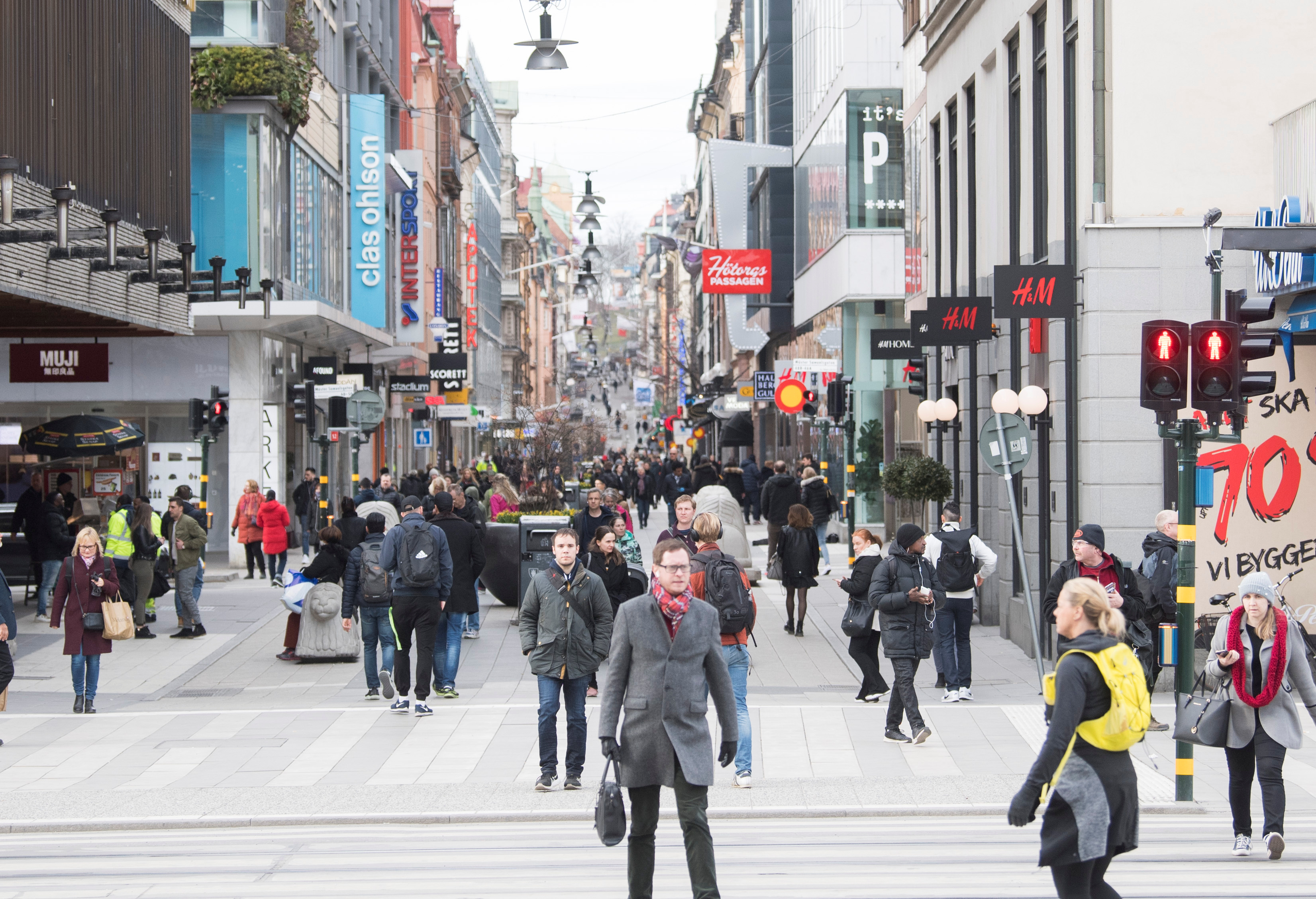
Sweden has taken certain measures to slow the spread of Covid-19, like limiting public gatherings to 50 people. However, these can hardly be characterized as “lockdowns,” and Swedish stores, restaurants, schools, beaches, and other public places are open and bustling.

Stockholm, Sweden on April 1, 2020

Stockholm, Sweden, April 1, 2020 (TT News Agency/Fredrik Sandberg via Reuters)

Comparing the current death rates of Scandinavian nations yields a maximum figure for the lives saved by lockdowns because Sweden’s plan involves more deaths in the early stages of the pandemic but less later on. As detailed by Professor Franks, simulations show that the overall death rate is “expected to be similar across countries,” but “unlike its peers, Sweden is likely to take the hit sooner and over a shorter period, with the majority of deaths occurring within weeks, rather than months.”

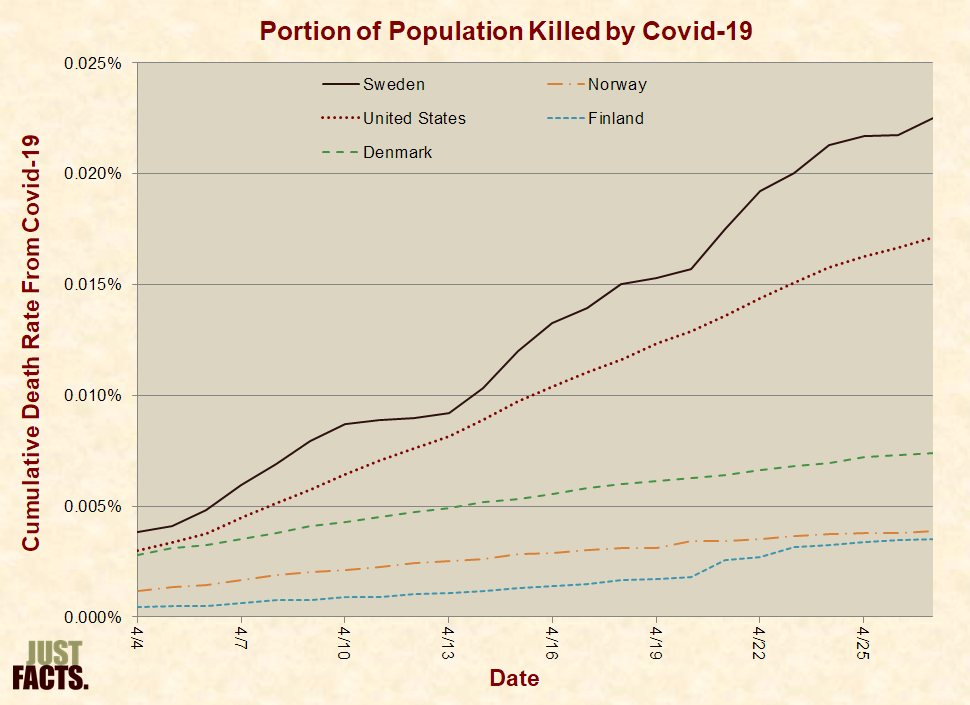
As of April 27th, the death rate in Sweden is 32% higher than in the United States, 3.1 times that of Denmark, 5.8 times that of Norway, and 6.4 times that of Finland:

Portion of Population Killed by Covid-19 in Sweden, the U.S., Denmark, Norway, and Finland

Applying the Sweden/Finland death rate ratio of 6.4 to the United States, the maximum number of Americans who could have been saved by past and current lockdowns is 616,590. This figure is based on the most pessimistic projection of 114,228 deaths in the U.S. through August 4th by the Institute for Health Metrics and Evaluation at the University of Washington. It is calculated by multiplying 114,228 deaths by 6.4 and then subtracting the 114,228 deaths that occur regardless of the lockdown.

The figure of 616,590 lives saved by lockdowns in the U.S. is at the extreme high-end of plausibility because it:

  • uses the worst-case projection for the U.S. death toll.
  • compares the death rate in Sweden to Finland, even though Denmark—which has also implemented a strict lockdown—has twice the death rate of Finland.
  • assumes that Sweden’s death rate doesn’t decline relative to its neighbors over time regardless of Sweden’s strategy to build herd immunity consistent with the following facts:
    • The Imperial College—whose cataclysmic projections of Covid-19 deaths have been a driving force behind government lockdowns—has acknowledged that “the more successful a strategy is at temporary suppression, the larger the later epidemic is predicted to be in the absence of vaccination, due to lesser build-up of herd immunity.”
    • 2012 paper in the journal PLoS One titled “Immunity in Society” notes that “when a sufficiently high proportion of individuals within a population becomes immune (either through prior exposure or through mass vaccination), community or ‘herd’ immunity emerges, whereby individuals that are poorly immunized are protected by the collective ‘immune firewall’ provided by immunized neighbors.”
    • Large portions of people are highly resistant to Covid-19 and experience no symptoms when they catch it, later making them firewalls against the spread of the disease. For example, the New England Journal of Medicine reported in mid-April that universal Covid-19 testing of pregnant women at two New York City hospitals found that 88% of the women who tested positive for the disease were asymptomatic.
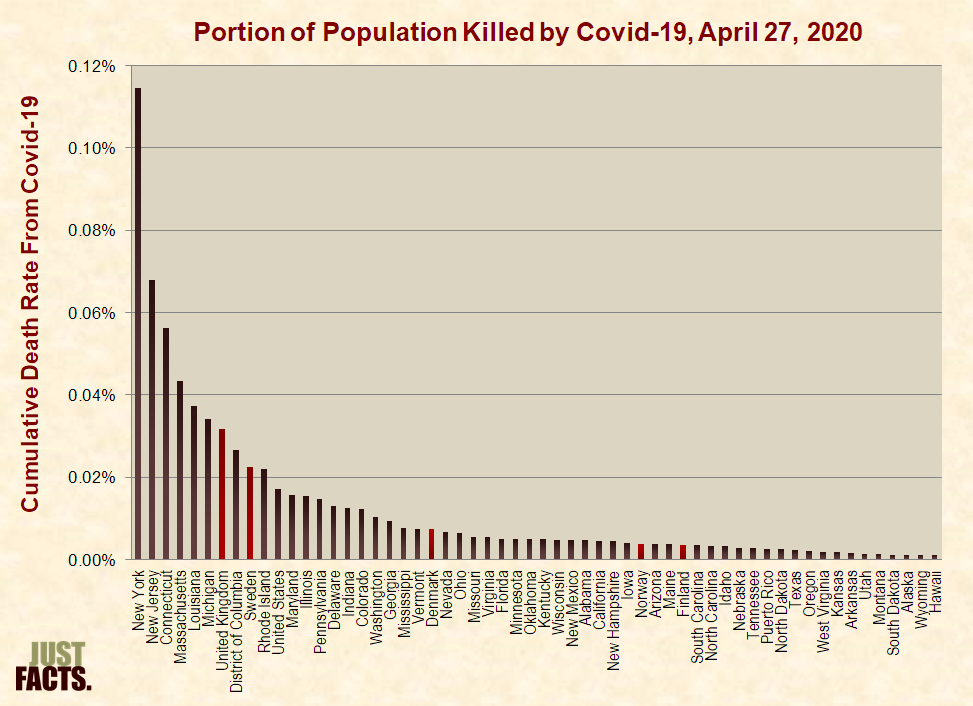
    • U.S. states with strict lockdowns—like New Jersey and New York—have Covid-19 death rates that are three to five times that of Sweden’s:
Portion of Population Killed by Covid-19 as of April 27, 2020 in the U.S. states, England, Sweden, Denmark, Norway, and Finland

Nonetheless, this study uses the highly improbable and optimistic scenario of 616,590 lives saved by lockdowns. This figure forms the third key basis of the study.

Comparing Life Lost and Saved

Combining the first two key figures of this study, anxiety from responses to Covid-19 has impacted 42,873,663 adults and will rob them of an average of 1.3 years of life, thus destroying 55.7 million years of life.

Combining the third key figure of this study with data on Covid-19 deaths, a maximum of 616,590 lives might be saved by the current lockdowns, and the disease robs an average of 12 years of life from each of its victims, which means that the current lockdowns can save no more than 7.4 million years of life.

In other words, the anxiety from reactions to Covid-19—such as business shutdowns, stay-at-home orders, media exaggerations, and legitimate concerns about the virus—will extinguish at least seven times more years of life than can possibly be saved by the lockdowns.

Again, all of these figures minimize deaths from anxiety and maximize lives saved by lockdowns. Under the more moderate scenarios documented above, anxiety will destroy more than 90 times the life saved by lockdowns based on:

  • the mid-March American Psychiatric Association survey that found Covid-19 “is having a serious impact” on the “mental health” of 36% of adults.
  • the 2015 meta-analysis in the Journal of the American Medical Association Psychiatry that found a 43% average increase in mortality for people with anxiety.
  • the IHME’s midpoint projection of 72,433 Covid-19 deaths through August 4th.
  • the fact that the current death rate of Sweden is 5.1 times the average of the other Scandinavian nations.

Even the figure of 90 times is likely a substantial underestimate of the total life destroyed by reactions to Covid-19 because it doesn’t account for:

  • psychological conditions that are more deadly than anxiety, like depression and mood disorders. Among the 36% who report a “serious impact” on their “mental health,” there is a mix of conditions, and the 2015 meta-analysis in the Journal of the American Medical Association Psychiatry finds that the increased risk of death is lowest for anxiety (43%), while it is 71% for depression, and 110% for mood disorders.

Unlike analyses that only compare the number of deaths from Covid-19 to other causes, this study accounts for the years of life lost for each victim. This accords with the CDC’s principle that “the allocation of health resources must consider not only the number of deaths by cause but also by age.” Thus, the CDC explains that the “years of potential life lost” has “become a mainstay in the evaluation of the impact of injuries on public health.” This doesn’t mean that the lives of young people are more important than that of the elderly, but it recognizes and accounts for the facts that:

  • humans cannot ultimately prevent death; they can only delay it.
  • there is a material difference between a malady that kills a 20 year-old in the prime of her life and one that kills a 90-year-old who would have otherwise died a month later.

A possible argument against this study is that it isn’t proper to compare anxiety to Covid-19 because the effects of anxiety often don’t kill until the distant future, while the deaths from Covid-19 are happening right now. Such logic relegates the harms of mental distress to years away, but the facts are clear that it can kill immediately, make life a nightmare in the present, and produce current and lasting physical ailments that end in early death. More importantly, tallying the life lost in any random unit of time, as opposed to an entire lifetime, is shortsighted and exclusionary.

Other distinctions, such as whether or not the cause of death is contagious, are similarly myopic. The primary issues are prevention and harm, and the difference between them ultimately determines how much life is saved or destroyed.

Summary

One of the most important principles of epidemiology is weighing benefits and harms. A failure to do this can make virtually any medical treatment seem helpful or destructive. In the words of Ronald C. Kessler of the Harvard Medical School and healthcare economist Paul E. Greenberg, “medical interventions are appropriate only if their expected benefits clearly exceed the sum of their direct costs and their expected risks.”

Likewise, a 2020 paper about quarantines published in The Lancet states: “Separation from loved ones, the loss of freedom, uncertainty over disease status, and boredom can, on occasion, create dramatic effects. Suicide has been reported, substantial anger generated, and lawsuits brought following the imposition of quarantine in previous outbreaks. The potential benefits of mandatory mass quarantine need to be weighed carefully against the possible psychological costs.”

Yet, when dealing with Covid-19 and other issues, politicians sometimes ignore this essential principle of sound decision-making. For a prime example, NJ Governor Phil Murphy recently insisted that he must maintain a lockdown or “there will be blood on our hands.” What that statement fails to recognize is that lockdowns also kill people via the mechanisms detailed above.

Likewise, a reporter asked NY Governor Andrew Cuomo about the impacts of his lockdown on people who commit “suicide because they can’t pay their bills” and others who die from the economic repercussions and “mental illness.” In reply, Cuomo stated five times that these fatal outcomes are “not death.” He also asked the rhetorical question, “How can the cure be worse than the illness if the illness is potential death?” The obvious answer is that the cure is also potential death.

In situations like pandemics and many other realms of public policy, life-and-death tradeoffs are inevitable, and failing to recognize this can cause tremendous harm. This is the case with Covid-19, where a broad array of scientific facts overwhelmingly shows that anxiety from reactions to the disease will destroy at least seven times more years of life than can possibly be saved by lockdowns. Moreover, the total loss of life from all societal responses to this disease is likely to be more than 90 times greater than prevented by the lockdowns.

A final note for readers who are experiencing anxiety: Healthcare professionals can reduce these effects, so seek help.

Dr. Andrew Glen is a Professor Emeritus of Operations Research from the United States Military Academy. He is a thirty-year U.S. Army veteran and an award-winning researcher in the field of computational probability.

James D. Agresti is the president of Just Facts, a think tank dedicated to publishing rigorously documented facts about public policy issues.

Public School Funding Per Student Averages 80% More Than Private Schools


Re-posted from Just Facts Daily By James D. Agresti

According to the New York Times, one of the main reasons why public K–12 schools are reopening more slowly from Covid-19 lockdowns than private schools is because public schools generally have less money. Times reporter Claire Cain Miller makes this claim three times in a single article, but her assertion is the polar opposite of reality and has been so for decades.

Twenty-five years ago, the U.S. Department of Education (DOE) estimated that public K–12 schools spent an average of 43–52% more per student than private schools in the 1991–92 school year. Since then, DOE data shows that inflation-adjusted average spending per public school student has risen by 40%.

Consistent with that DOE data, new research by Just Facts reveals that average public K–12 school funding per student is about 80% higher than private schools. Specifically, the latest DOE data shows that governments spent an average of $14,439 for every student enrolled in K–12 public schools in the 2016–17 school year. In comparison, Just Facts estimates that private schools spent an average of $8,039 per student in the same year.

The figure for private school spending was determined by Just Facts with data from the DOE and U.S. Bureau of Economic Analysis. All methodological details are provided in the footnotes located here, and all data and calculations are shown in this spreadsheet.

Furthermore, DOE’s figure for public school spending per student doesn’t include the costs of state government administration, unfunded pension liabilities, and public worker post-employment benefits (like health insurance). In contrast, Just Facts’ figure for private schools is comprehensive and includes all spending by private consumers, nonprofit organizations, and governments. This means that the full public school funding advantage is greater than 80%.

The Times’ Deception

Miller doesn’t even attempt to document the following claims that she makes in her article, which is titled “In the Same Towns, Private Schools Are Reopening While Public Schools Are Not”:

  • “Private schools have always had more flexibility, and usually more money” than public schools.
  • Public schools “tend to have less money” than private schools.
  • “Public schools typically don’t have the resources that private schools do….”

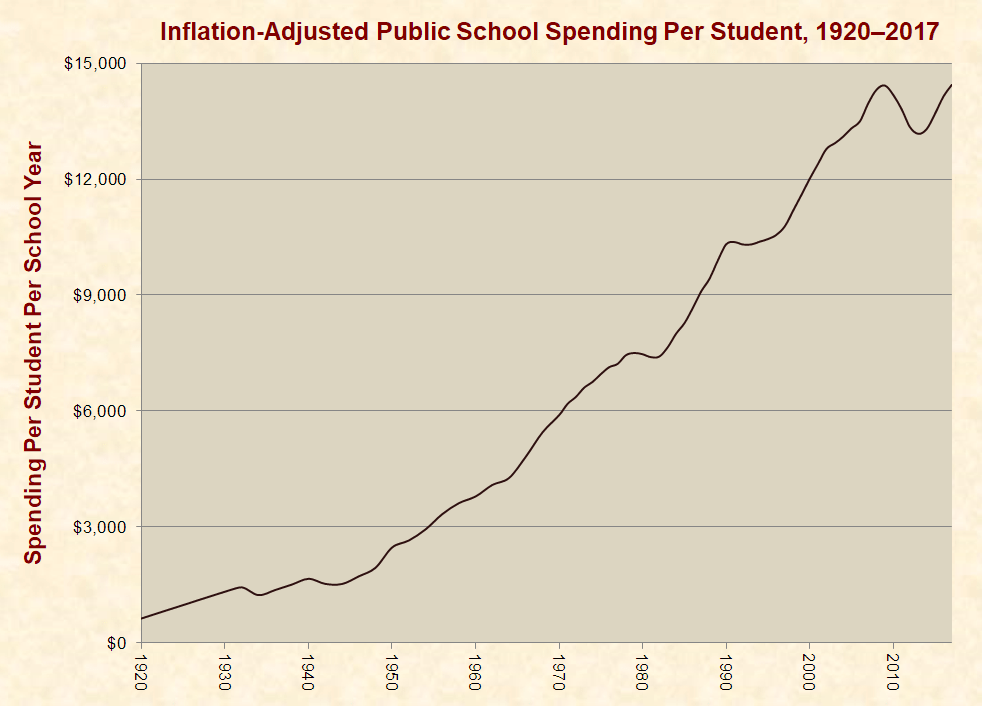
She also alleges without evidence that “public schools faced a funding crisis even before the pandemic.” In reality, the latest DOE data shows that inflation-adjusted spending per public school student is at an all-time high and has grown by 20% since 2000, 93% since 1980, and 3.8 times since 1960:

As Bernie Sanders has done, one can make it seem like funding has declined by cherry picking certain years in certain states, but the primary trend has been upwards, not downwards. This applies in nearly every state, which experienced anywhere from a 1% decrease to a 114% increase in inflation-adjusted spending per student between 1996 and 2016.

Miller also gives Robert Pianta, the dean of the school of education at the University of Virginia, a platform to claim without proof that Covid-19 “has exposed a great deal of inequity” in the education system. Less than a year ago, the Washington Post issued a correction for an op-ed by Pianta in which he wrote that “public funding for schools has actually decreased since the 1980s, adjusting for constant dollars.” That statement is at blatant odds with DOE data, which shows that the average inflation-adjusted spending per public school student rose from $10,316 in 1989 to $14,439 in 2016, or by 40%.

Just Facts provided documentation of the facts about public and private school spending to Miller and the Times corrections desk on July 17th. Ten days later, they have not responded or issued a correction. This adds to an extensive list of uncorrected falsehoods published by the Times.

World Should Come to Standstill When Obama Loses Sleep


Deep State Dialing For Digital Dollars

Judi McLeod image

Re-Posted from the Canada Free Press By  —— Bio and ArchivesJuly 31, 2020

Resistance Leader, Deep State Barry, Barack Obama

“Stop the Press!” Cease everything you’ve been doing to try to get by in a government-imposed Lockdown, Grind everything down to a halt: Self-appointed “Resistance” leader ex-President Barack Obama is in “shock”  and pissed off—all because President Donald Trump stoked an ‘anti-Asian sentiment when he referred to coronavirus as the ‘kung flu’ and ‘Chinese virus’.

“‘That still shocks and pisses me off,’ Obama said of the comments, adding that he hoped the seriousness of what he was saying was resonating through the screen.” (Daily Mail, July 30, 2020)

That some 78 percent of Americans believe that coronavirus is the fault of China seems to have flown straight over the head of the oft media-described “smartest guy in the room”.

Getting to work Obama-style means dialing for digital dollars with actor/activist George Clooney

Obama made the stoking anti-Asian Trump accusation in an event with LinkedIn Founder Reid Hoffman.

‘We already saw this guy win once,’ he said. ‘After he bragged about physically assaulting women — and that didn’t seem to matter. So, enough said. Let’s get to work.’  (Daily Mail)

Getting to work Obama-style means with actor/activist George Clooney to fundraise for his ex-VP presumptive Democrat presidential nominee, Joe Biden.

“On Tuesday, he told Clooney that fears of voter suppression and an effort by Trump to question the legitimacy of the election is stopping him from sleeping.” (Daily Mail)

Folks left sleepless in Seattle because of months-long violence by Black Lives Matter and antifa posing as “peaceful protesters”, nor the millions lying awake at night wondering if they’ll ever be let out from lockdown to get back to their jobs don’t matter, only Barack Obama does.

“Barack Obama has brought up sex assault allegations against Donald Trump, slammed the president’s ‘nativist, racist and sexist’ agenda and told George Clooney the November 2020 election keeps him up at night during a series of fundraisers  for Joe Biden. (Daily Mail)

“Over the last two months, the former president has been dialing into virtual chats for Democrat donors, who pay up to $250,000 a ticket, in a bid to help his former VP win the White House.

Obama made a series of scathing attacks without mentioning Trump by name

“During similar events over the last few weeks, that have raised $24million, Obama also mentioned accusations of Trump ‘assaulting women’, according to the New York Times.

“In conversation with the billionaire Illinois Governor J.B. Pritzker, during that event he spoke out on the state of American democracy under the current administration, even making a loose reference to Nazi Germany.

“He made the scathing series of attacks without mentioning Trump by name.

“Since leaving office Obama has largely refrained from publicly criticizing his predecessor by name.

“During his conversation with Pritzker, Obama spoke out about how Donald Trump has a support base that ‘filters out any contradictory information.’

“‘It’s just glued to Fox News and Breitbart and Limbaugh and just this conservative echo chamber — and so, they’re going to turn out to vote,’ Obama said, according to the Times.

“‘What he has unleashed and what he continues to try to tap into is the fears and anger and resentment of people who, in some cases, really are having a tough time and have seen their prospects, or communities where they left, declining. And Trump tries to tap into that and redirect in nativist, racist, sexist ways,’ he continued.

“Obama also criticized Trump’s seeming obsession with the preservation of Confederate monuments during the coronavirus pandemic, calling it ‘his number one priority’ which ‘gives you a sense of what this is about’.

“‘The endpoint of that we saw in Europe 60 years ago, 70 years ago — what happens when those things get unleashed,’ he said, in a seeming opaque reference to Nazi Germany. ‘If you don’t nip that in the bud, bad things can happen. Among the most quote, unquote civilized societies.’”

Comically enough, during his Clooney event, Obama was routinely interrupted by a dog barking, while Clooney appeared to have the same problem, even accidentally muting himself on occasion.

“According to event attendees, after the former president asked him a question, Clooney apologized for the barking and joked that his dogs ‘must be Tea Party members because every time you started talking about Obamacare’ the barking would start.” (Daily Mail)

Right!

Maybe it was, Obama’s handpicked presidential candidate, Hillary Clinton, who, in desperate attempts at publicity, barked like a dog back in the 2016 campaign.

Hillary Clinton Imitates Barking Dog

Nightmare Obama’s pushing called ‘President Joe Biden’

For sure, Clooney’s dogs are all Democrat, as would be Obama’s dogs that we never hear about anymore.

Meanwhile, Obama’s not the only one not sleeping at night from worry about the November 2020 because millions are losing sleep about the nightmare he’s pushing called ‘President Joe Biden’.

I Think My Dog’s a Democrat Bryan Lewis


Fauci’s Gulag Goggle Gimmick


Would volunteers working at voting booths be able to identify voters wearing face masks and goggles from pictures on Voter I.D.?

Judi McLeod image

Re-posted from the Canada Free Press By  —— Bio and ArchivesJuly 30, 2020

Fauci’s Gulag Goggle Gimmick

Though he hasn’t yet made it mandatory but is so far only suggesting it, will the face mask and goggle wearing advocated by Dr. Anthony Fauci make this a chilling part of the future:

Caller: “Two men just broke into our house and shot my husband!”

Police: Can you give us a description of them?”

Caller: “Hard to do because both were wearing face masks and goggles.”

Not so farfetched in home invasions of the future if Dr. Fauci gets his way.

“Dr. Anthony Fauci, the nation’s top infectious disease expert, this week said wearing goggles or an eye shield in addition to a face mask would provide better protection against the coronavirus, according to a report. (Fox News, July 30, 2020)

“Theoretically you should protect all of the mucosal surfaces [eyes, nose, mouth], so if you have goggles or an eye shield, you should use it,” he said in an interview with ABC News on Instagram Wednesday.

“The Centers for Disease Control and Prevention already recommends wearing a face mask that covers the nose and mouth in public, but the virus can also enter through the eyes.

“Fauci recommended goggles in addition to a face mask for those who want “perfect protection” from the COVID-19, but admitted it’s not “universally recommended.”

There’s no such thing as “perfect protection” from Covid-19 or any other pandemic.

“He added one of the reasons eyewear hasn’t been recommended yet is “it’s so easy for people to just make a cloth mask.” (Fox News)

“Heading into fall, Fauci said he encourages people to get a flu vaccine and hopes face masks will protect people from the flu as well as the coronavirus, ABC reported.”

In 2018/2019 flu season,  35,000 Americans died of influenza even though flu vaccines were readily available.

“Not everyone responded favorably on social media to the idea of adding eyewear to facemasks. Some remarked the next step would be hazmat suits or living inside a bubble, according to Market Watch.” (Fox News)

According to the media, the United States is still outpacing every other country in the number of Coronavirus cases with more than 4.3 million and upward of 150,000 deaths.

Could that be because the U.S. is outpacing the world in testing?

“He continued, “We are encouraging people to get their flu vaccine. because if you have two circulating respiratory viruses that really confuses the situation.” (Fox News)

He added, “Go out there and get your flu shot when the vaccine becomes available.”

Omnipresent Fauci has also weighed in on Monday’s social media-censored ‘White Coat Summit’.

“Wednesday on MSNBC’s “Andrea Mitchell Reports,” National Institute of Allergy and Infectious Diseases director Dr. Anthony Fauci said the video retweeted by President Donald Trump that featured doctors at a press conference touting Hydroxychloroquine as a coronavirus treatment was “people spouting something that isn’t true.” (Breitbart, July 29, 2020).

“Mitchell said, “The president, again today, repeated his endorsement of Hydroxychloroquine, which the FDA said in June should not be used for COVID because it does not have known effects, known benefits, and it does have known risks for cardiac effects. So how damaging is that, that he retweeted the video and defended it again today

“Fauci said, “The only thing that I can do, Andrea, is do what I’ve done all along, consistently, is that you look at the scientific data and the evidence. The scientific data, the cumulative data on trials, clinical trials that were valid, namely clinically trials that were randomized and controlled in the proper way, all of those trials showed consistently that Hydroxychloroquine is not effective in the treatment of coronavirus disease or COVID-19.”

“Mitchell said, “My family received an email yesterday from a young friend of ours, a university graduate. She’s now back home in our village in rural western Kenya, asking us if now there’s a cure because she had seen the video. And now I see in the newspapers in Kenya, warnings in columns to tell people not to believe that video. If this can be transmitted around the country,  and globally, so rapidly, don’t we have to do more to stop these dangerous conspiracies from misleading people?”

“Fauci said, “Yeah, you’re absolutely correct, Andrea, and that’s the reason why I’m very explicit and unambiguous when we say we’ve got to follow the science. If a study, that’s a good study, comes out and shows efficacy and safety for Hydroxychloroquine or any other drug that we do, if you do it in the right way, you accept the scientific data. But right now, today, the cumulative scientific data that has been put together and done over a number of different studies has shown no efficacy. So when there’s a video out there from a bunch of people spouting something that isn’t true, the only recourse you have is to be very, very clear in presenting the scientific data that essentially contradicts that.”