Biden Admits Inflation Reduction Act was NEVER Intended to Reduce Inflation


Posted originally on Sep 9, 2024 By Martin Armstrong |  

PSA:  Joe Biden is still the president of the United States. Biden has been hiding on a beach in Delaware ever since his disastrous debate with Donald Trump that hard-launched Kamala Harris as the Democrat nominee. Biden is speaking off the prompter once again and revealing hard truths that have been concealed from the public. The Inflation Reduction Act, the largest spending measure in American history, was never intended to reduce inflation.

“We should have named it what it was!” Biden said at an event in Westby, Wisconsin, where he unsuccessfully attempted to tout the success of Bidenomics. The president referred to the Inflation Reduction Act as “the most significant CLIMATE CHANGE LAW ever,” adding, “by the way, it is a $369 billion bill, it’s called the–we we we should’ve named it what it was.”

Biden Secon Term

We now know without a shadow of a doubt that the Inflation Reduction Act increased inflation, similar to how the Affordable Care Act under Obama increased the costs of healthcare.

Treasury Secretary Janet Yellen admitted the truth behind the Inflation Reduction Act last year, but the general public does not know of Yellen and her confession did not make headlines. “The Inflation Reduction Act is, at its core, about turning the climate crisis into an economic opportunity,” Yellen clearly stated. It provided the government with an opportunity to eliminate our energy independence. We did not have an energy crisis before Joe Biden took office. He killed the Keystone deal on his very first day in office and has been promoting the larger WEF Build Back Better plan at the expense of the nation. Biden implemented policies that worsened inflation and then convinced mindless politicians, who never read the large bills put forward, to vote for a $369 billion act under the premise of fixing a problem he created.
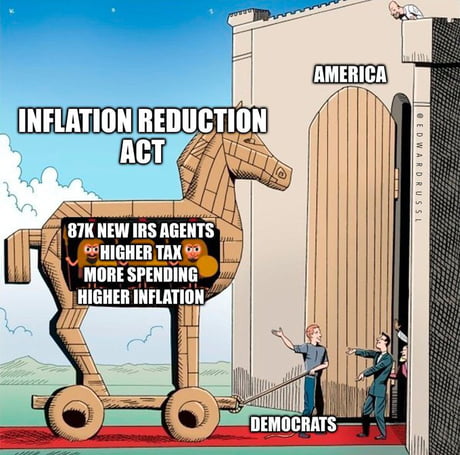
InflationReductionAct.meme_

The Biden Administration is still seeking TRILLIONS in funding for the largest hoax of the century. Climate change has become the untouchable charitable cause that no one can question. COVID-19 was merely a stepping stone for the lucrative tax opportunity that is climate change and the green agenda. As it is a global issue, it gives rise to the need for globalized institutions and coalitions. The G20 meeting stressed the importance of developed nations collaborating to prevent climate change by taking the people.

Janet Yellen declared that it will take $3 TRILLION ANNUALLY into 2050 for nations to meet their climate objectives. They deem climate change “the single-greatest economic opportunity of the 21st century,” but logical minds will see it as the biggest economic obligation. “Neglecting to address climate change and the loss of nature and biodiversity is not just bad environmental policy. It is bad economic policy,” Yellen told the G20. Not one member objected or questioned her proposal.
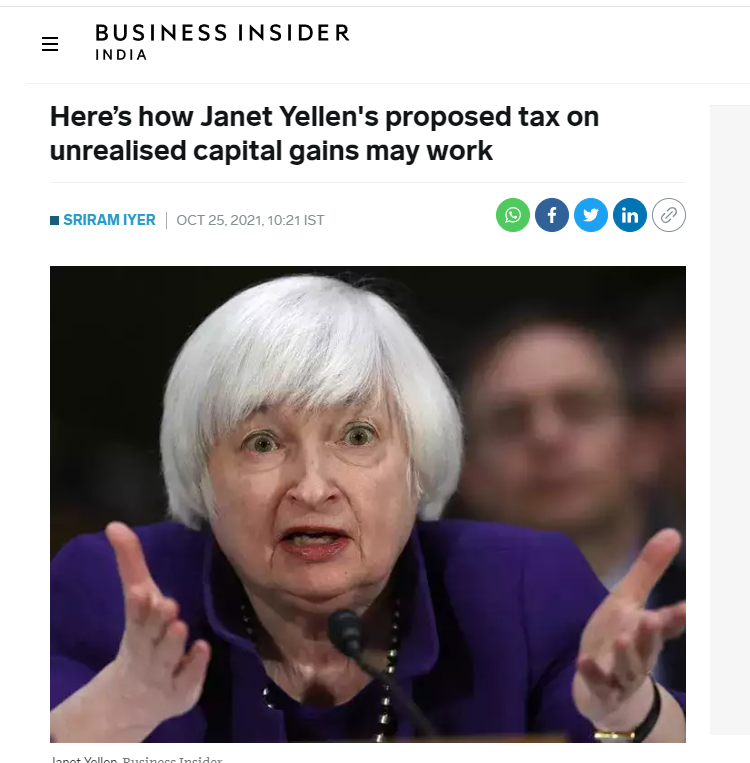
Yellen tax on Unrealized Gains

This is why they are coming after capital gains and expanding the Treasury to shake down the American public for their asinine spending packages that focus of funneling money to green initiatives. Climate change has become a global hoax created by the globalists to usurp power. Now, the global population must collectively defeat through taxation. Even third world nations must look at how they’re releasing emissions and make changes. They are willing to limit the food supply, strangle entire sectors, and completely alter our way of life to reduce carbon emissions.

Every nation must comply. We saw Italy’s Meloni shunned by the European Union for even questioning the climate change agenda and calling it “ideological madness.” Additionally, the globalists plan to implement these extreme measures in record time with no actual plan on how to execute it. All they know is that they need more of our money to save the world by 2035. It would be easier for them to spend and collect trillions from the population at large under a centrally backed currency, digital for good measure. They are testing the waters now to see how and who can hold the power to become the world tax authority. The POTUS has admitted what those who are paying attention already knew and it will take a complete 
Powell: March Rate Cut Unlikely


Posted originally on Mar 7, 2024 By Martin Armstrong

Powell Jerome

Those who follow this blog already knew that the Federal Reserve would not drop rates in the future due to unsustainable fiscal policies paired with America’s increasing involvement in foreign wars. All of the talking heads were preaching that rates would significantly decline to pandemic levels, as if that were the historical norm. Every fiscal policy in recent years has exacerbated inflation and the Fed cannot keep up with government spending. QE FAILED. The artificially low interest rates of the recent past were completely unsustainable and relied on outdated theories.

The outdated understanding based on Keynesian Economics remains to increase the supply of money and it MUST be inflationary. The Fed raises rates to reduce consumption and lower rates to stimulate consumption. It’s a very nice theory, but when actually tested, it utterly fails. Lower rates will NEVER cause people to invest UNTIL they believe that there is an opportunity to invest. We are watching the big players withdraw from equities, let alone government debt. We are in a private wave where money is running off the grid at a rapid pace.

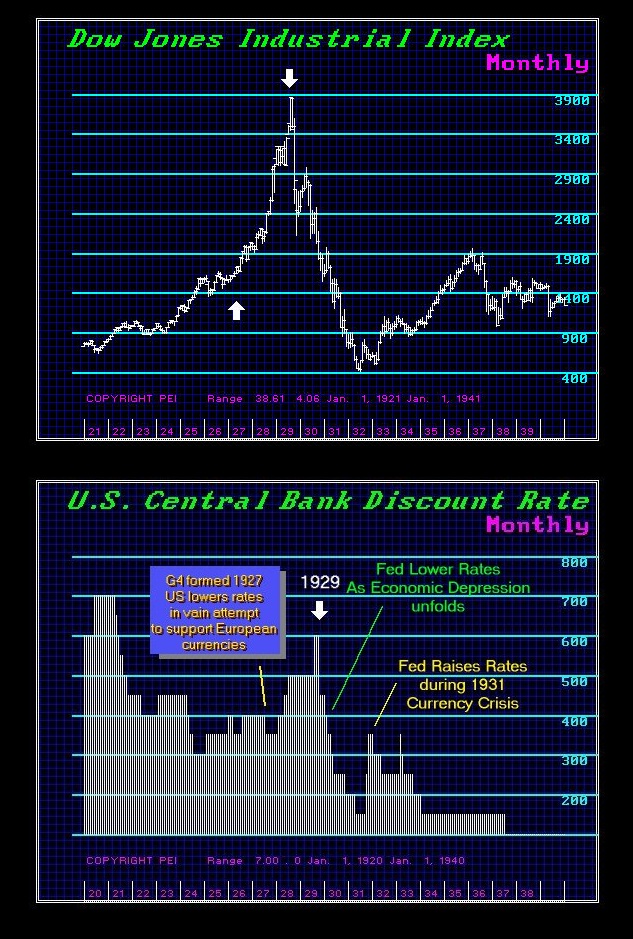
DowIntRates 1929

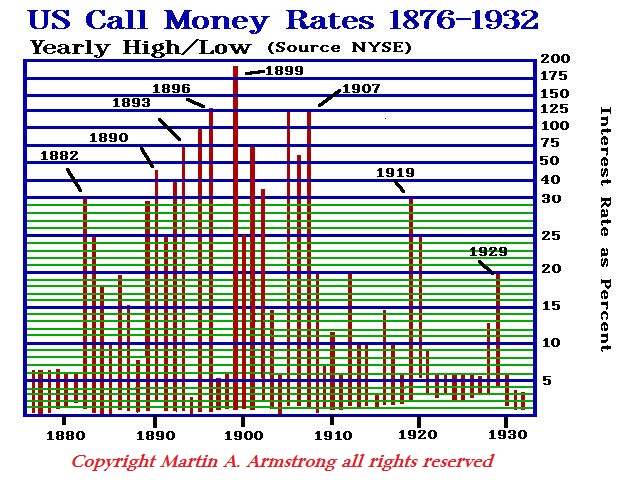
The peak in interest rates took place in 1899 at virtually 200%. Yet, 1929 was the real bubble top and it peaked with 20% interest rates in call money on the NYSE. In theory, the biggest boom should have been met with the highest interest rate. In truth, the “real interest rate” as I have defined it is when the interest rates exceed expectations. If you think the stock market will double, you will pay 25% interest.

As you can see, while interest rates hit nearly 200% in 1899, the share market did NOT crash percentage-wise anything as it did following 1929. Look, there is a lot more to this than meets the eye. Everything must be addressed on a global scale for it all depends also on the direction of capital flows. There is just a lot more to this than simply the money supply and interest rates.

CALLMONY MA

Now, Powell continues to explain to the public that VOLATILITY and economic conditions are beyond the control of the Fed. “We believe that our policy rate is likely at its peak for this tightening cycle,” Powell said. “If the economy evolves broadly as expected, it will likely be appropriate to begin dialing back policy restraint at some point this year. But the economic outlook is uncertain, and ongoing progress toward our 2% inflation objective is not assured.”

Powell Fed Got Inflation Wrong Nov 2021

All the news of inflation waning, including recent data, is inaccurate propaganda intended to calm recessionary fears. Even by the government’s data, inflation is up 3.1% compared to last year. It was an unprecedented moment when Powell broke with Washington and criticized the government for their unsustainable spending. The Fed NEVER criticizes the government, despite the two being separate.

Hence, I say to stop blaming the Fed. They are not the ones creating all the money but are working to match monetary policy with unsustainable fiscal policies. We are looking at trillions in deficits per year. There is no restraint when creating new massive spending packages. Then people blame the central bank with no concept that it’s only a fraction of “money;” the real issue is CONGRESS.

Listen, interest rates cannot decline in the face of war. The 2020 yearly array showed a turning point for a high in 2022 and a possible correction into 2024. I explain this in more detail on the Socrates private blog but buckle up for the year ahead.

State Wealth Migration Re-Posted Nov 15, 2023 By Martin Armstrong 


Migration to USA

In 2019, New York hosted 72 billionaires. That figure has declined to 62 in 2023, with smart money fleeing the state due to high taxes and crime. The state of New York depends on the top 1% of earners to pay 42% of its tax burden. New York is already operating in a deficit and has the added burden of hosting tens of thousands of migrants with tax funds.

The top 1% of Americans have an average net worth of $10,815,000. While billionaires earn on investments and not income, states like New York expect top earners to pay 14.8% in income tax. “If you had someone who was earning $100 million [a year] in New York suddenly move to Florida, that’s something like a $11 million-a-year hit per year recurring to the state,” said Ken Girardin, the research director for the Albany-based think tank, Empire Center for Public Policy. The 62 billionaires that remain in New York have a collective net worth of $562.3. Only the top 5% of Americans have a net worth of over a million dollars.

Inflation is hurting those at every class level and people do not want to downgrade their lifestyles. Policymakers want to scream “Eat the rich!” to appease voters who do not understand that the money held by those at the top is needed for a healthy economy. In 2020 alone, when the pandemic struck, New York lost $19.5 billion in taxes from people fleeing the state. California lost $17.8 in tax revenue that year and counting.

We are seeing a wealth migration in the US. This is why I say that markets like real estate cannot be looked at on the national level, as prices in red states continue to rise as blue states have become uninhabitable. This is only taking into consideration individuals as moneymakers are also taking their businesses to states where they do not need to support the welfare system. Around 160 firms have fled Wall Street since 2019, displacing $1 trillion.

Real Estate

Hence, people are saying Miami is the new Wall Street. Lawmakers do not comprehend the impact that this will have on state budgets.

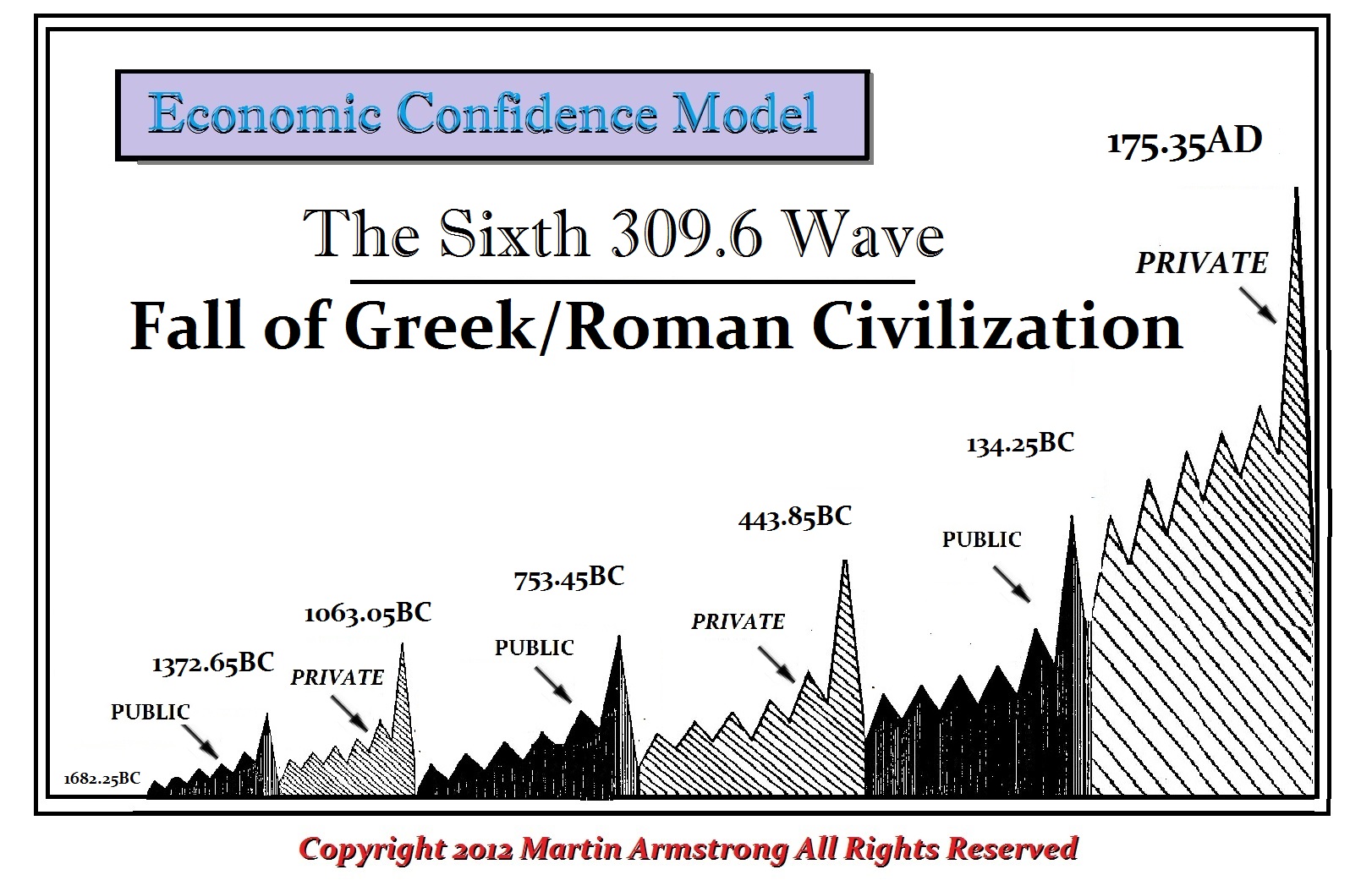
Sixth Wave ECM Greek Roman 309.6

This is precisely what happened prior to the collapse of the Roman Empire. The top 1% half 16% of the empire’s wealth. Wealthy Romans were the first to leave cities when public confidence collapsed. We can see the migration from archaeological finds that saw villas built far from city centers. And even in those days, people felt that the wealthy were selfish for acting in accordance to the invisible hand. As noted in “The Decline and Fall of the Roman Empire” by James William Ermatinger: “Their disinclination to leave may have been caused by forced exactions, confiscations, business concerns, tax pressured, or general economic fears, which made protecting one’s own interests seem more prudent than looking out for the interests of others.”

Rome’s Sovereign Debt Crisis is what ultimately led to its collapse. Yet one of the first signs of major trouble was the mass exodus of wealth from the cities.

The Public’s Top if not ONLY Concern…


Armstrong Economics Blog/Inflation Re-Posted Aug 20, 2023 by Martin Armstrong

INFLATION

The public is not concerned about “Russian aggression,” the Trump inditement, or even the MSM wrench about aliens. No one cares — the average person is struggling to keep up with the rising cost of living. Homelessness is on the rise as people cannot afford shelter. The blank checks to Ukraine are a slap in the face of those begging for help at home. These politicians need to work for us. No one campaigning is going to make a dent in the polls unless they clearly detail how they plan to address INFLATION! And no, the problem is not limited to America. The solution cannot be a universal income, currency, or Great Reset. The economy was strong before they attempted to BUILD BACK BETTER.

Trying to Make Heads or Tails about Recessions


Armstrong Economics Blog/Economics Re-Posted Jul 28, 2023 by Martin Armstrong

QUESTION: Looking at Socrates,  do you think that these people who were constantly calling for a recession because there were two quarters that declined with covid really need revision? Socrates was correct, no recession. But it is showing major turning points in 2024 which seem to align with your old ECM forecast calling for commodity inflation into 2024. How would you define a recession?

EJ

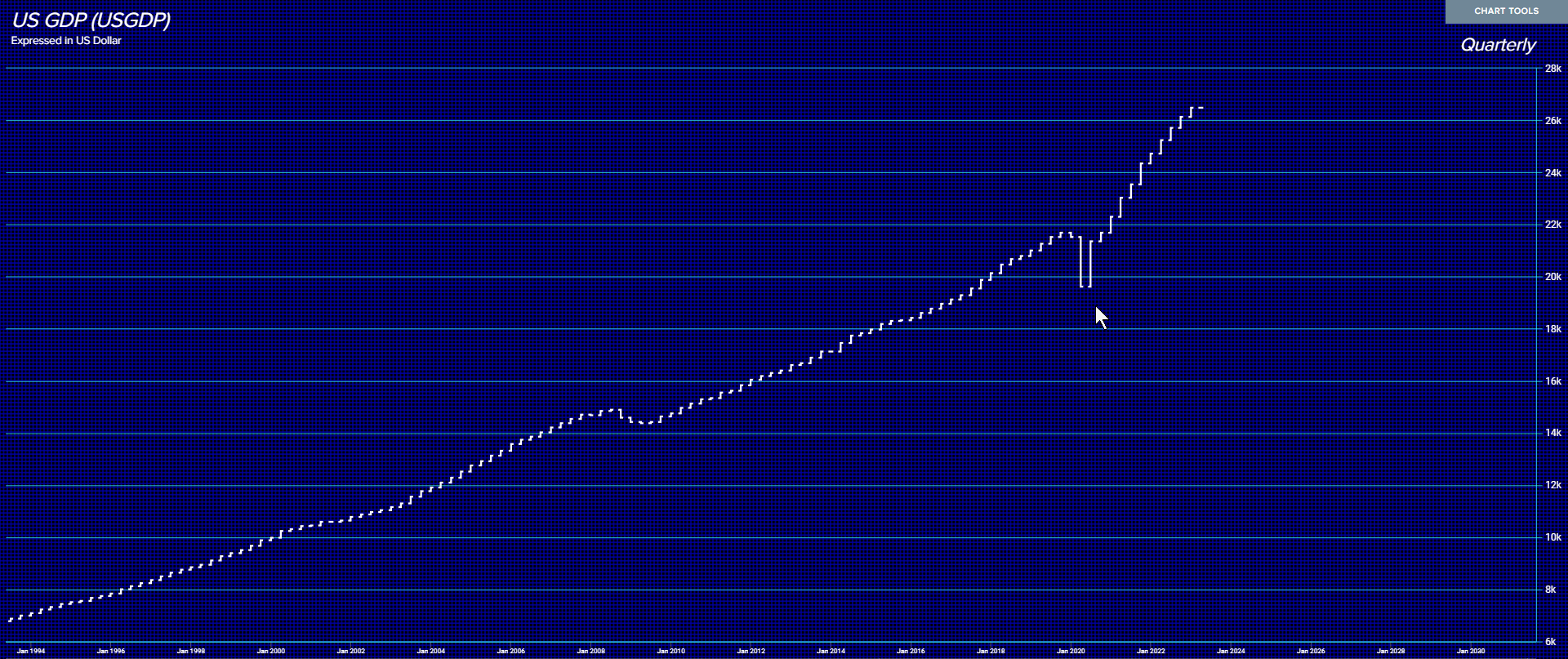
ANSWER: In trading, reactions are 1 to 3 time units. I believe that the same definition should be used for classifying a recession. They define a recession as two consecutive quarterly declines. If you look at the “Great Recession” of 2008-2009, you will see three consecutive quarterly declines and a rebound. If we look at the COVID recession caused by locking everyone down, that was just two consecutive quarterly declines.

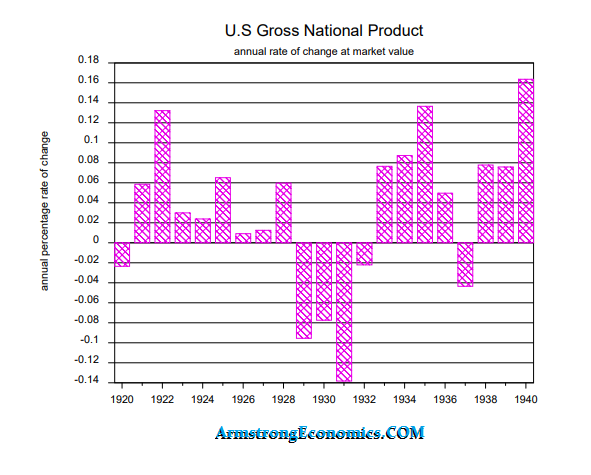
I personally would argue that a true economic recession MUST exceed three consecutive declines. Here is the chart of GNP from 1929 to 1940. There were three years of negative growth. I simply think that this definition of two quarters is wrong. You can have a slight decline of 1 to even 5%, but that does not suggest a recession. In the case of 1929, that was a decline of 9.5% in 1930 – the first year. Now look at the COVID Crash, which was also a decline of 9.53%. But the difference is that the COVID decline was forced and not natural. That is why it rebounded so quickly. Now the so-called “Great Recession” of 2008-2009 only saw a decline in GDP of 3.47%.

The “Great Recession” was not really so great. It wiped out real estate and bankers but did not fundamentally alter the economy. So who is right and who is wrong will always depend upon the definition. Yes, the AI Timing Arrays point to a recession starting Next Year by their definition. This will most likely be caused by the decline in confidence that will lead to UNCERTAINTY, and as such, the consumer will contract. Up to now, the continued expansion of the economy into 2024 has also been fueled by the shift in assets from public to private.

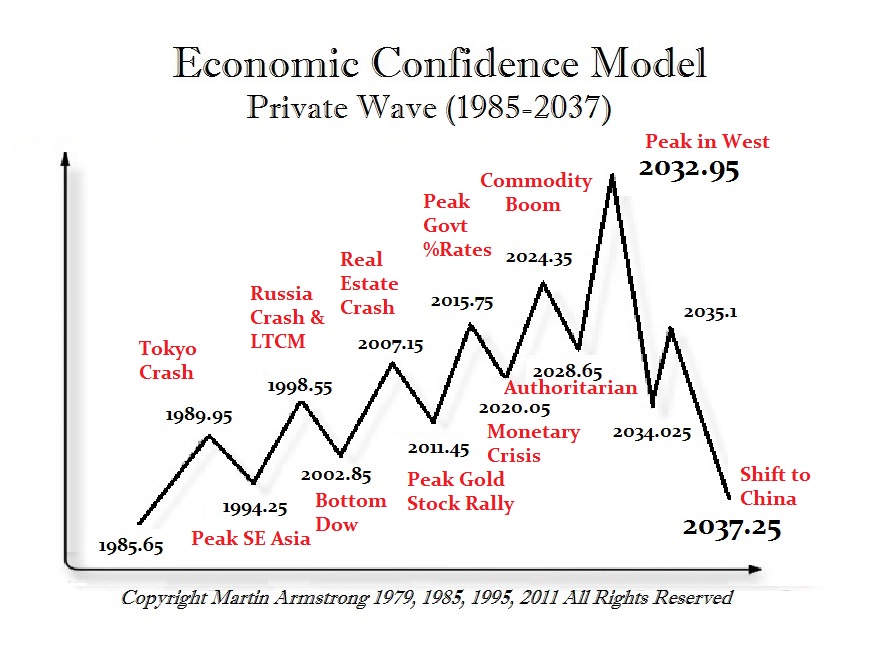
As originally forecast, we should have seen a commodity boom into 2023,

and we should expect a highly authoritarian attempt by 2028.

Powell Understands the Inflation was Created by COVID


Armstrong Economics Blog/Inflation Re-Posted Jul 26, 2023 by Martin Armstrong

Interview: The Real Rate of Inflation


Armstrong Economics Blog/Armstrong in the Media Re-Posted May 13, 2023 by Martin Armstrong

Against Backdrop of Inflation Continuing, Fed Set to Raise Rate Again Before Debating Pause


Posted originally on the CTH on May 1, 2023 | Sundance 

Everything about the process of cutting down energy exploitation, then driving supply side inflation, then raising interest rates to shrink demand (stem inflation) created by a desire to lower economic activity to the scale of diminished energy production, is a game of pretending.

The collateral damage from the rate hikes has been the banking destabilization, which shows the priority of the government officials and central banks to support the climate change agenda.  Into the game of pretending comes the second unavoidable consequence with inflation continuing as a result of the energy policy.

They simply cannot cut energy demand enough to meet the diminished scale of production.  There is no alternative ‘green’ energy system in place to make up the difference. That is the reality.  Now, the fed is scheduled to raise rates again, then begin to debate the collateral damage as they continue the pretending game.

(Via Wall Street Journal) – […] Another quarter-percentage point increase would lift the benchmark federal-funds rate to a 16-year high. The Fed began raising rates from near zero in March 2022.

Fed officials increased rates by a quarter point on March 22 to a range between 4.75% and 5%. That increase occurred with officials just beginning to grapple with the potential fallout of two midsize bank failures in March.

The sale of First Republic Bank to JPMorgan Chase & Co. by the Federal Deposit Insurance Corp. announced early Monday is the latest reminder of how banking stress is clouding the economic outlook.

Fed officials are likely to keep an eye on how investors react to that deal ahead of Wednesday’s decision, just as they did before their rate increase six weeks ago when Swiss authorities merged investment banks UBS Group AG and Credit Suisse Group AG. (read more)

There is no other way to look at the combined policy without seeing a Central Bank Digital Currency (CBDC) in the future.  All of these combined policies are creating a self-fulfilling prophecy.

Stop energy production. [Jan 2021]

Supply side inflation begins.

♦Raise interest rates. [April 2022]

Economic activity slows (but not enough).

♦Continue raising interest rates.

Banks destabilize. [Q1 2023]

Inflation continues.

♦Continue raising interest rates.

Economic activity slows (but not enough).

Banks continue destabilizing. [Q2 2023]

♦Continue raising interest rates.

Evaluate banking pressure. [We are Here]

Banks cannot withstand pressure.

Create CBDC