Understanding the Markets


QUESTION: Mr. Armstrong; On your January 29 blog, you wrote “In the US Share Market, this is now a turning point we have reached. I have warned for months that exceeding the November high would lead to a January high. Now, the failure of February to make new highs warns of a March low. The support for a correction now lies at the 25637 level on a weekly closing basis (this is not a reversal). We will elaborate today on the Private Blog.” You warned that March could produce a high and keep the cycle inversion process in play. That proved correct since the Nasdaq made new highs and the Dow a reaction high. So that led to the drop into the first week of April. For the actual buy and sell signals, we should only do so on reversals and turning points. The January high you did with the turning point I assume and then the reversals kicked in. The buying opportunity I also assume we must wait for the turning point as was the case for the high. Correct?

PF

ANSWER: Correct. I have made it perfectly clear that NORMALLY one turning point is followed by the OPPOSITE event on the next. So a January high would traditionally produce a March low. However, I pointed out that we have been in a Cycle Inversion. September 2017, November 2017, and January 2018 followed by March 2018 were all the monthly sequential turning points. Normally, each would produce the opposite. That was not the case and each produced a high. This is the Cycle Inversion and it is also warning that we are still consolidating. March produced a high in the Nasdaq and only a reaction high in the Dow. This further warned that there was a shift from an international focus to domestic (Dow v Nasdaq). March also produced only a reactionary high the week of 03/12.

Far too many people expect a guru and want to act based solely upon a comment. Buy this or sell that and that person should always be correct. That is the dream of a fool for nobody can do that. They will ALWAYS quickly lose their money and then blame their pretend guru. That is a sure-fire way to go broke and if they are trying to trade short-term on such comments, they must be insane.

I have stated at the outset of this year that 2018 was a Panic Cycle. That means you test both directions! I further warned that we would see consolidation dominate the first part of 2018 so there was no reason to rush back in until we reach (1) turning point and (2) reversals. The closing of the first quarter was neutral in many markets once again showing that we are still in this consolidation mode. Buy or sell signals are on REVERSALS – never comments.

If you are trying to be a short-term trader and you think that will lower your risk, you are dead wrong. The best performance is to go with the trend and act ONLY on Weekly to Monthly signals – not commentary. January was a critical turning point. All our models were converging at that time so it was ripe for the correction which is why I stated that and was already getting criticism by January 31st, 2018.
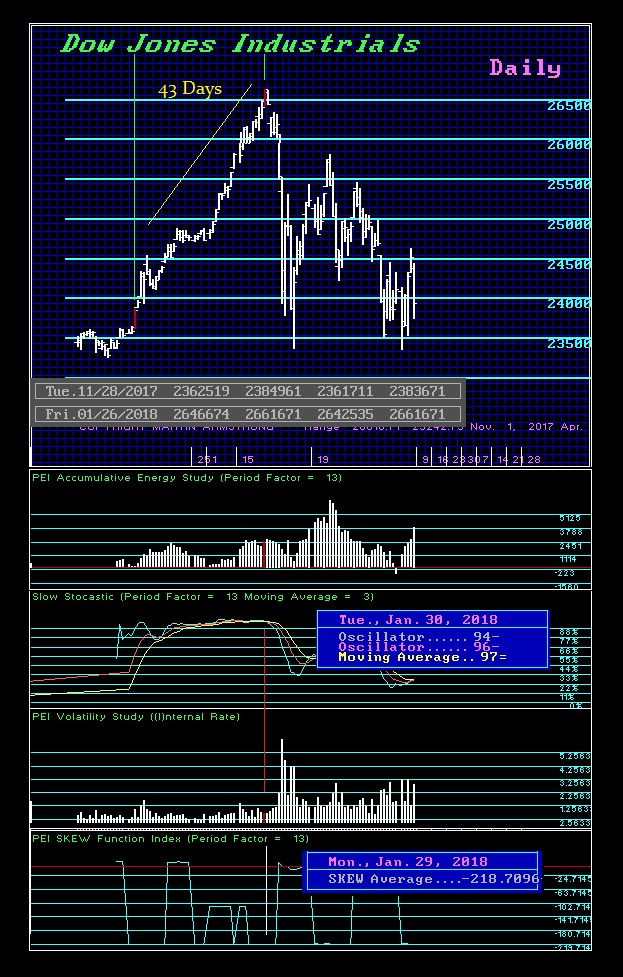
The high was Friday January 26th. Every model we had was starting to scream DOWN! The Cycle Inversion was confirmed on the first day of December. I warned if we exceeded the November high, we would rally into January. The high came exactly 43 days (8.6 /2) from the breakout. That frequency does work in the share market except at extreme turning points. That lined up perfectly. The oscillators, always a lagging indicator, turned down on the 30th. Our Skew Model bottomed one day from the high on the 29th. Our Energy model peaked on the day, The subsequent sharp rally into March confirmed this was a reaction high.

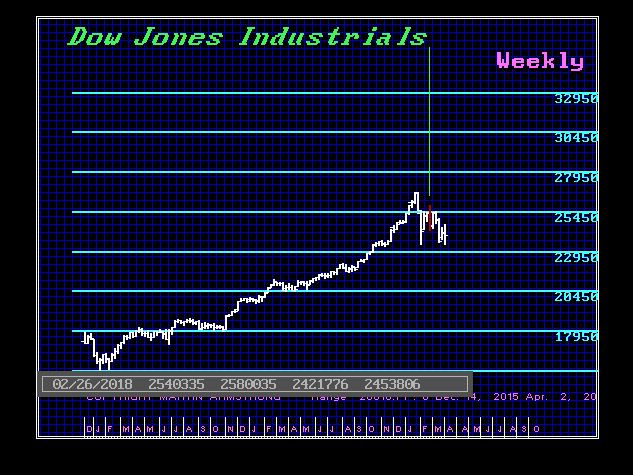
Here is the Array on the Dow. There were three weeks targeted 02/12, 02/26, and 03/12 followed by 04/02. The week of 02/12 was a Directional Change and that sent the market back up leaving the February low intact. The next target was 02/26 which produced the reaction high in the Dow. The next target 03/12 produced the high in the Nasdaq.  Then the next target 04/02 produced the retest of the Feb low. Once again, we can see how the markets were interacting and producing the shift from international to domestic.

Clearly, commentary is just an attempt to expalin what is unfolding. It is NEVER for trading purposes. We trade based upon the Reversals and Toming exclusively.
Companies Stop Buy-Backs Causing January Crash?


QUESTION: Mr. Armstrong; The analysis being punted around is that the crash from January was caused because companies stopped buying back their own shares. The analysis claims that $4 trillion in buy-backs have taken place since 2009 and they stopped because of regs and that was the cause of the crash. It seems to me that this is bogus for the Nasdaq rallied into March and it was the Dow that led the whole way. This analysis appears to be fake news for it is as you say, trying to reduce everything to a single cause. Would you agree?

HC

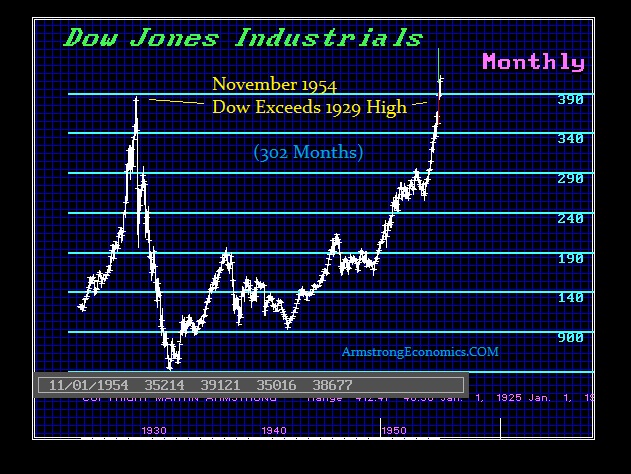
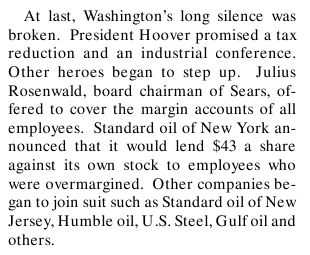
ANSWER: Absolutely. Yes, Bloomberg wrote about that and put out the research of Goldman Sachs. During the Great Depression, companies tried to support the market and were buying back their shares aggressively during the crash. It not only failed to support the market, it undermined the companies themselves and many failed because they could not raise money nor borrow money as the Great Depression continued. This fundamental sounds logical, but it is just nonsense. Not only did companies rush to buy their own shares back as the 1929 Crash unfolded, they even went as far as to offer loans on their own shares to workers. I wrote about that in the Greatest Bull Market:

/id. page 231

None of all this support had any impact in stopping the Crash. As I have stated many times, everything is connected. If the entire market is crashing, a company trying to buy back its own shares to support its share price has NEVER worked even once in reversing the trend. Bloomberg’s report is indeed bogus. It is simply trying to report ah – this was the cause! It never works that way

Comprehending The Capabilities of AI


QUESTION: Mr. Armstrong – Neural nets and deep-learning algos are not all that new. However, with the advent of quantum computing power and huge cloud data stores recording every flinch people make, the business world is abuzz that this is the portent for AI to now transform business, business management, and our lives. Of course, trading systems are now being ‘trained’ on datasets. However, regardless the algo, it’s learning capacity is still limited by the extent of the data that it is presented. Since you have spent so much exhaustive work amassing such a long-term financial (and governmental, etc.) database, using even such things as coinage records for your forensics, I have to wonder if these other systems will still have a long run to go before their forecasting power can match that of your models. Do you expect this to provide Socrates an advantage over the new wave of AI market/trading forecasters that will last for some time yet?

SC

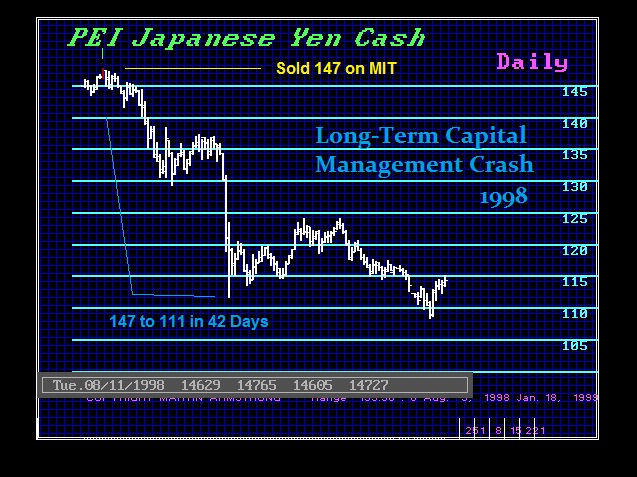
ANSWER: The long-term database is essential. That cost more than $100 million to assemble and quite frankly, nobody seems to be willing to spend that much. This is why all prior models have collapsed creating economic catastrophes such as Long-Term Capital Management debacle. They collapsed again in 2007. Nevertheless, then you have the problem of Neutral Nets are just incapable of handling the vast array of variables. The attempts to create trading models are all flat-model based. Our system has made so many accurate forecasts for so long on so many markets around the globe that I do not even comment on. It is far too much for me to even write about. That is the whole purpose of Socrates.

I had to design a completely different programming technique to work out the complexity. Just image calculating every market in the world in 35 different currencies. The number of variables is beyond comprehension. If we are talking about a limited number of variables for normal business operations, Neural Nets are fine. When it comes to market forecasting, they can develop a Deep Learning system on a single market, but without correlating this with all other markets, you will NEVER see the contagion coming. When everything crashed in 1998 because of the collapse in the Russian debt markets, the illiquidity caused funds to sell other assets to raise cash to cover losses elsewhere. The Russian bond collapse caused a massive sell-off in Japanese yen/dollar rate that had absolutely NOTHING to do with the fundamentals in Japan. Contagions always emerge externally so you can create a model and it will work for a while and then you lose everything.

The Federal Reserve Un-Discussed Structure


COMMENT: Your 4-2-18 FEDERAL RESERVE VS CONGRESS Blog should be framed & sent to every talk show host and politician in the country. It really puts everything in perspective.
SC

REPLY: What I find most astonishing is that to write that article, all you have to do is a little investigation. Nobody bothers to question anything. That is the most shocking thing I have encountered. So often I get responses like how come I am the only one saying this? Some people think this is just sophistry or made up. I cannot explain why investigative journalists never dare to actually investigate. All I can assume is that some have tried, but their editors will not allow such articles to be published. It is truly mind-numbing.

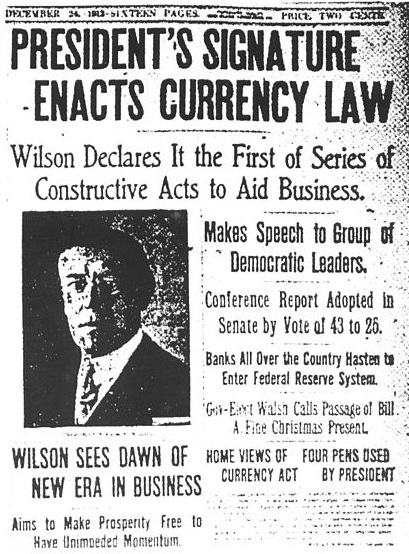
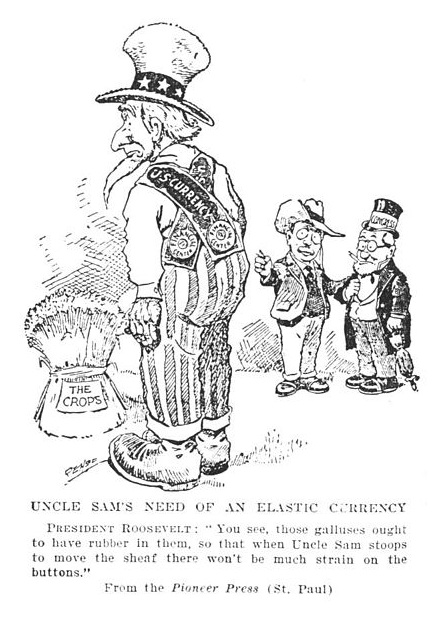
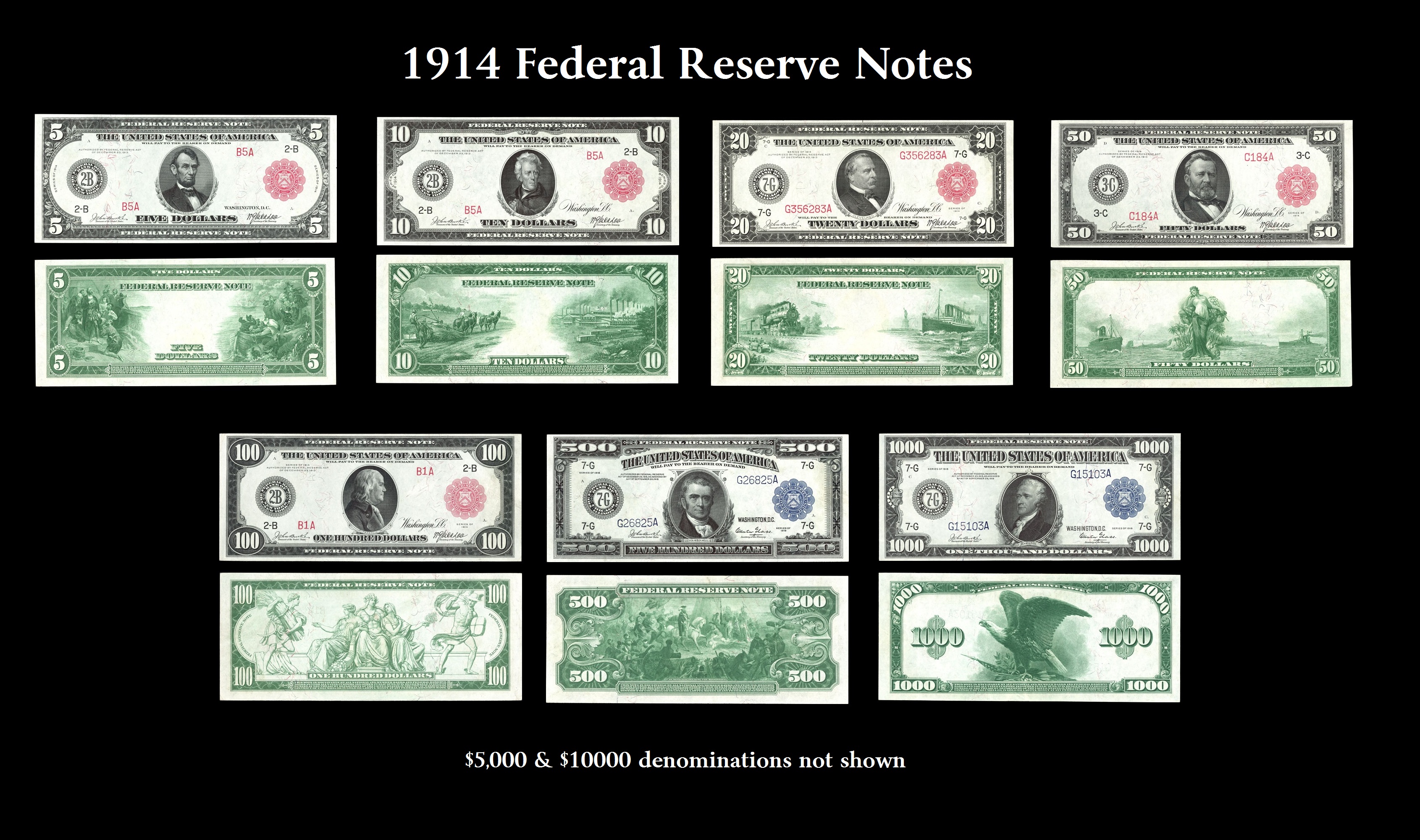
Contemporary journalism back in 1913 called it a monetary change from a national currency system to a national credit system. There were cartoons and well as criticism of the new central bank. The entire theory of elastic money was talked about. Today, the vast majority remain ignorant of the entire debate of that era.

It is no wonder why people just read the Creature from Jekyll Island and assumed evil lurks behind the scenes. They focus on the Fed is “owned” by the banks and merge that with elastic money and have no idea that the ownership was because the taxpayer was not going to fund a bank bailout so the banks had to put up their own money to create the Fed and pay into it to support the system. The elastic money supply was in use since the 1850s and the Fed would buy ONLY corporate paper when banks were not lending to preserve the economy and prevent corporations from laying off workers. The corporate paper is secured and is retired.  The structure was changed with World War I when Congress instructed the Fed to then buy ONLY government paper. Temporary solutions always become permanent and thus the Fed today is nothing close to the original design.

Individual v Institutional Portfolio


QUESTION: Martin, in today’s answer re: Asset Allocation you had mentioned of helping a couple of large funds prepare for what is to come.Was wondering if we regular folks will also be privy to this info at some point and also will we get a heads up when things are getting closer to the Big Event.In an earlier blog you had mentioned something about 2022, will that be a critical time for our savings/economy?

Thank you always for your work.

W

ANSWER: The difficulty in turning around major portfolios is substantially different from a private individual. Often these major portfolios are dominated by real estate and government bond positions in the hundreds of billions of dollars. How to strategically shift such portfolios is highly complicated and it cannot be done on a single phone call. The complexity is significant and the general advice on here is not opposite of recommendations to institutions. How to execute such shifts and when is critical timing.

I have stated many times that you can turn a speedboat on a dime. That is not the case with an aircraft carrier. This is the same difference between a private portfolio and a major institution. They just cannot pick up the phone and yell sell everything at the market! This is substantially a different position altogether.

The advice we provide for a major portfolio shift has to be tailored to the asset allocation mix. We must run timing models on each and every component for selling one aspect can have an adverse impact on other assets classes. It is by no means a simple project.

New York Real Estate


QUESTION: Mr. Armstrong; I listened to you perhaps a bit too late. Put my condo on the market here in New York City and nothing for six months. The realtor said they have never seen buyers disappear so fast. Is there still hope for those of us trapped in the Big Apple?

GB

ANSWER: Real estate in New York has collapsed 25% basis the number of sales by the end of the first quarter. Sorry, but you may have to just lower your price until you find a sucker. Keep in mind that as interest rates rise, banks will tend to run away from mortgages very fast. The last crisis was real estate. They will be more reluctant with real estate than any other sector going forward. If funding for mortgages dries up, prices crash.


Heaven or Hell?


British Lab Admits They Cannot Confirm Russia was the Source of the Poison in the Spy Case


Russian has called upon the Hague’s executive council of the Organisation for the Prohibition of Chemical Weapons (OPCW), to challenge the allegations of Britain that it was responsible for the poisoning of the double-agent. British scientists at the Porton Down have admitted now that the nerve agent used to poison cannot be traced to Russia. Nevertheless, they have stated that the poison had been identified was a military-grade novichok nerve agent, which they maintain was most likely deployed by a nation-state. The UK government has quickly responded claiming that prime minister, Theresa May, had always been clear that the assessment from Porton Down was “only one part of the intelligence picture”. There seems to be some back-peddling but clearly, there is a p[re-disposed attitude toward Russia probably because government social programs are failing and they will economically need an external enemy soon.

France Embracing Austerity?


The old-school ideas of economic theory will ensure that Socialism collapses and very hard at that. The Germany influence upon Europe has infected the mindset of most northern Europeans. French President Emmanuel Macron has come out an made public debt one of the key points of his policy. Macron is supporting austerity and thus the EU’s guidelines. The French statistics office, Insee, reported that new borrowing during 2017 for France was 2.6% of GDP. The worker unions, in general, are starting to mobilize. Public debt is still high and employee protection is now severely limited and this is a dangerous cocktail that will inspireFrench civil unrest. Nevertheless, France has been criticized by the EU for its high level of new debt within the Eurozone. Thus, the country had twice been given more time to fix its budget. Under the Maastricht Treaty, the new debt of an EU state may not exceed 3% of GDP. New borrowing last year was 3.4%.

The entire problem here is the theory that an increase in the deficit spending will be inflationary. Yet after nearly 10 years of Quantitative Easing, this entire theory has been proven to be just nonsense. There are so many loaded assumptions hidden at its core that one must wonder how rational people still believe in a theory that cannot be proven by history. France is where the entire theory of Communism began. It was the French Communists who persuaded Karl Marx to abandon pure socialism.

With Macron embracing austerity and the guidelines of the Maastricht Treaty, we are watching the gradual collapse of socialism. All the promises of government to provide the safety-net are crumbling before our eyes. Austerity supports the bondholders against the people. This will also fuel the rise of class warfare as we head into 2022.

Asset Allocation


QUESTION:  Hi Martin,
First of all I enjoyed your 2018 Share Market Report and I am looking forward to your video updates. I am one of those retired investors with a typical 50% equities and 50% bonds portfolio. In your recent blog you stated, “The biggest losers have been the asset allocation followers. They assume they cannot forecast the future so they spread their assets hoping that the traditional 60% equities will make up for the losses on the 40% bonds.” Since both equities and bonds prices have rallied since 2009. Is this the time to change our portfolio mix to raise our equities percentages over bonds (my bonds are one year US treasuries). If so what should our portfolio mix be going forward?
Thank you for your guidance!
KC

ANSWER: I really cannot wait to launch Socrates. Answering these questions depends entirely upon (1) your currency base, and (2) the country in reference. There will be a great divide between US government debt and that of Europe. The dividing line appears to arrive in 2019. For now, US debt will be the best performing and the short-term debt will have the least risk of a Forced Loan Conversion, which has taken place in Europe before post-World War II. A “Forced Loan Conversion” is a phrase I coined to identify what happens when a government cannot repay its debt. Italy simply decreed that short-term paper such as 90-day bills were converted to 10-year paper. There is no risk of short-term US debt going through a Forced Loan Conversion.

The Italian government engaged in a Forced Loan Conversion which was a mandatory debt conversion, known as “conversione forzosa” during 1926, which they would again impose during 1934. They forced debt holders to extend their debt by lengthening the maturity. This seriously impacted the full faith and trust in the Italian government. During the post-1926 years and then again after 1934, the mandatory conversione forzosa effectively was seen as a partial default by the government, which made it extremely difficult and costly to borrow on a short-term basis thereafter.

Governments are concerned about appearance. They will mere engage in Forced Loan Conversions to be able to say with a straight face that they are not defaulting. Therefore, the shorter paper will have the greater risk in Europe from 2019 onward. Additionally, interest rates will be on the rise as pension funds fail and smart money continues to migrate from Public to Private debt.

Any asset allocation to bonds MUST be private!!!!!!! A government can default or suspend debt and will never be prosecuted. Private companies do not have that luxury. The traditional asset allocation models will all blow up. We are in the process of helping some very huge portfolios to shift in preparation of what is to come.