President Trump Retweets The Reason for the Media’s Recent Racist Attack Narrative…


Rasmussen did a survey of U.S. voters and discovers a significant jump in black support for President Trump from 19% last year to 36% now.   Not coincidentally, the DNC media apparatus has been pushing a recent racist narrative against President Trump.

(Rasmussen Link) (President Trump Tweet Link)

Gold & the Changing Fundamentals


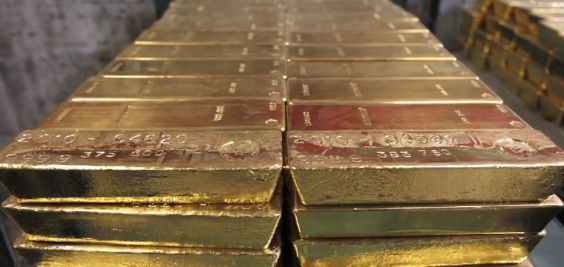
QUESTION: Mr. Armstrong; You are obviously the person worth listening to when it comes to gold. Every fundamental these people have argued to support gold has proven completely false. Confusion in gold is really very high. You have to be really stupid at this point to listen to this nonsense. Can you express any opinion on gold?

It would be very helpful


PL


ANSWER: You are correct, that concerns over U.S.-Russian relations, coming talks on the Korean Peninsula, action in Syria over a suspected chemical weapons attacks and uneasiness over trade conflicts would normally be the battle cry to buy gold.  Traditionally, this would form a cocktail of geopolitical uncertainty that would lead to screams buy gold! The uncertainty has not led to support for gold. They are proving to be a narrative that no longer seems to be factors for the bulls.

We have to understand one thing. The younger generations do not see gold as money as do the aging generation. The older generations remember being taught that is school and the days of the gold standard. The younger generation does not even bother with paper money and pays with their cell phones. This is raising the question of whether gold will remain as a safe-haven instrument in the future if the younger generation does not even consider gold suitable for anything other than a trinket.


There are cycles to yet cycles to cycles. Just as we moved from gold to paper, we have then moved from paper to electronic. With each passing trend, there are always people who refuse to leave behind the old ideas and traditions. The real question emerging shall be: Will people even regard gold as anything but jewelry 300 years from now? Of course, there will be those who immediately will argue that gold has always been money. They are simply wrong. Money has been many things to many different societies. The real issue is not whether gold is money, silver, copper, bronze, seashells, sheepskins or cattle.  The real question is will money be COMMODITY based (Tangible) with its roots in barter or will it be simply a representative of economic output that can be electronic? That is the real question. Are we headed into a future as in Star Trek where physical money is obsolete?

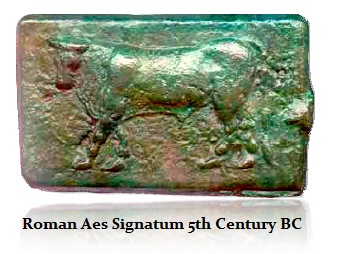
When we look at these transition periods in the monetary system throughout history, we see how money takes shape of a representation of what it once was. The Minoans fashioned their bronze ingots in the shape of a sheepskin because that is what use to be a symbol of value before the Bronze Age. We see the same transition in Rome with ingots of bronze with a picture of a cow because cattle was once money.

The real question is blunt. Are we also passing from a COMMODITY based monetary system to a purely electronic based system with the passing of the generations? Even the pitch that India buys gold because it is a tradition is starting to show it to moves with cycles. The younger generations do not share the same view of gold as the older generation. Things do change with the generations and the problem has always been that those of one generation judge the future ONLY by its own belief system. So, despite all the yelling and screaming that I was wrong and that gold would NEVER retest the $1,000 level, we have broken sharply falling to 1180 yesterday in the fact of a strong dollar as we approach the pending Benchmarks in September. Gold trades inversely to the dollar because it is now just a commodity-based asset class – not money. When we had a gold standard, it traded opposite against all asset classes. It will rally when the dollar backs off and decline as the dollar rallies until everything begins to enter the Great Aligment.

The Crisis is Turkey


President Recep Tayyip Erdogan of Turkey is finding his dreams of an all-powerful resurrection of the Ottoman Empire are falling apart. Qatar has come to the aid of Turkey offering $15 billion in a loan, but keep in mind that the entire issue with Syria began with Qatar proposing a pipeline through Syria to compete with natural gas with Russia. Therefore, it is in Qatar’s best interest to keep Turkey trying to invade Syria. The price will be the pipeline, which we seriously doubt will ever take place.

Erdogan has sent the Turkish economy into a downward spiral for some time. Its soaring inflation has exceeded 100% and rising debt-to-GDP of about 70% under President Recep Erdogan’s regime has been a growing problem. As central banks pumped money into the system over the past decade, nations like Turkey and other emerging market economies used the opportunity to raise more and more “cheap” debt to boost their productivity. Turkey has attracted capital from Europe seeking higher yields because of the negative interest rates policy of the ECB. Now we have a crisis in Turkey that is also the result of Draghi’s Quantitative Easing that drove capital to Turkey and FAILED to revived the European economy.

Erdogan’s dream of restoring the Ottoman Empire is no joke. It has been European money seeking higher yield that kept him in power. It is curious how those who seek dictatorial power are the ones who dream of restoring the power of empires long since dead. Erdogan has wanted to recreate the Ottoman Empire just as the dream of the reestablishment of the old Roman Empire as was the desire behind Napoleon and Hitler. The days of Empire Building are long gone and Erdogan has been living in the past. His goal was to expand his country’s military operations in Syria and this, he hoped, would be the first step as with Hitler’s invasion of Poland.

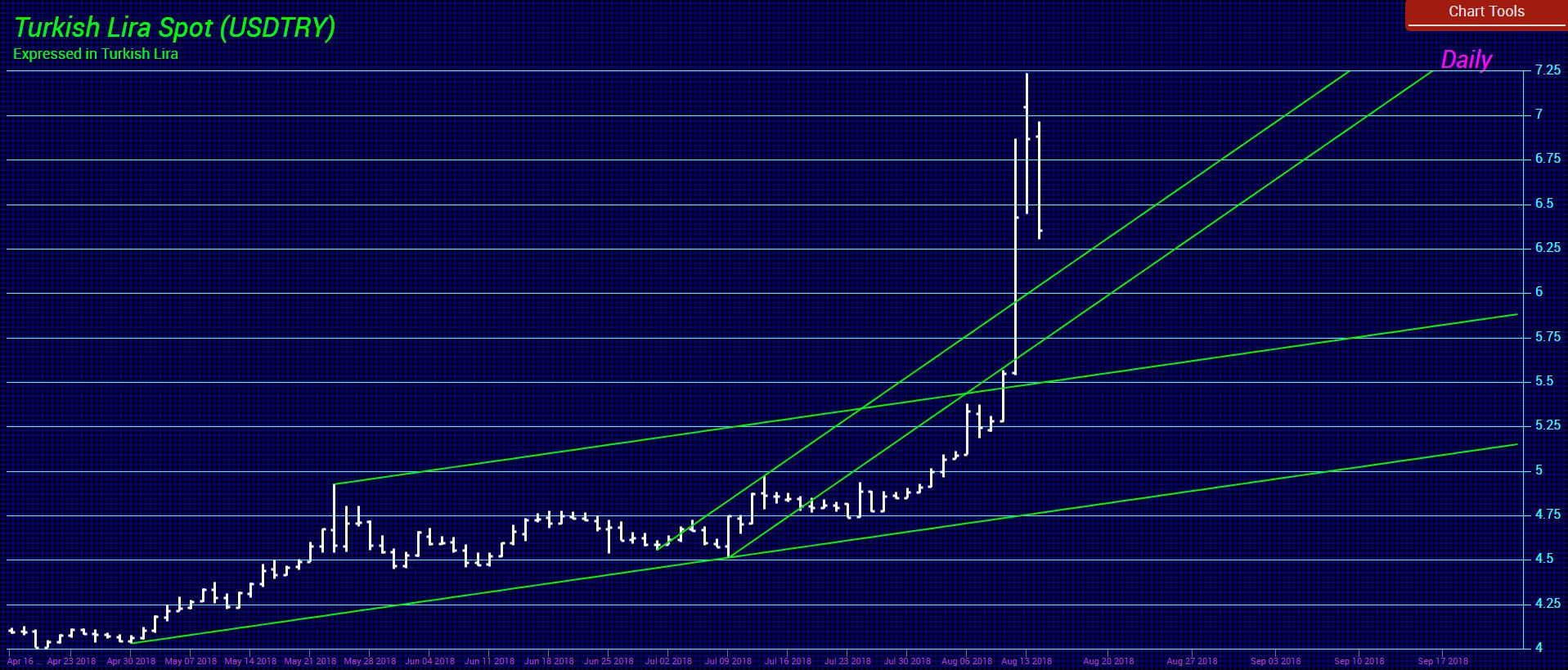
Nevertheless, the Turkish lira collapse and the expensive dollar have been conspiring against him reflecting his disastrous management of the economy and the collapse in confidence among the Turkish people. There remain serious questions about elections in Turkey being rigged to keep him in power. Therefore, on the one hand, Erdogan is attracted to dealing with Russia who is on the opposite side of the game board with Qatar. Erdogan has the free markets moving against him and he is more likely to turn to Russia than the West to retain personal power and the free markets show what most likely the real sentiment of the Turkish people was for the fake elections. Consequently, Erdogan turned to Qatar because he was desperate for money to retain personal power. If he loses the support of his military, then they will side with the people and Erdogan’s head may end up on a spike. Qatar will discover they are dealing with someone who will not be loyal to them either. Yet, the financial markets are working against Erdogan and as the crisis continues to evolve in the months ahead as $15 billion will not reverse the crisis, Turkey can hardly afford military adventures. Erdogan will be more likely to turn to Russia when he cannot retain power otherwise. He can blame the USA all he wants publicly, but the free markets are conspiring against him and that includes his own people.

Many European institutions rushed into Turkey and bought their bonds at 20%. Many Spanish banks had capital was invested in Turkish bonds to get the higher yield to the tune of on average 20%+. Based on the phone calls, there are way too many institutions who invested into Turkey. They simply assumed that NO government defaults because the powers that be will always bail out the bondholders. This time the IMF is really powerless. They can make some noise and others will say the crisis is subsiding. However, this is just talking. There is nobody who can save Turkey at this point as long as Erdogan remains in power. Qatar will discover that Turkey is a bottomless pit. They will try to now ease the crisis with words because of the extensive foolishness of banks and pension funds who bought Turkey bonds to try to get yield.

The fall in the Turkish lira has also benefited the Syrian Army, which launched an offensive on the last large mercenary fortress in Idlib. Turkey was actually against the offensive because it feared that it would fall to Syria and that is against Erdogan’s dreams of taking more territory. What is not really looked at internationally is the plain fact that Turkey does not have its own arms industry. Erdogan needs arms to be imported and as the lira crisis materialized, his Turkish operation Olive branch and shield of the Euphrates in Syria become rapidly too expensive. Back in January 2018, the Siyasi Haber newspaper reported that an estimated $400 million was being spent on Operation Olive Branch alone. Erdogan has spent over $1 billion so far in his attempt to conquer that region of Syria.

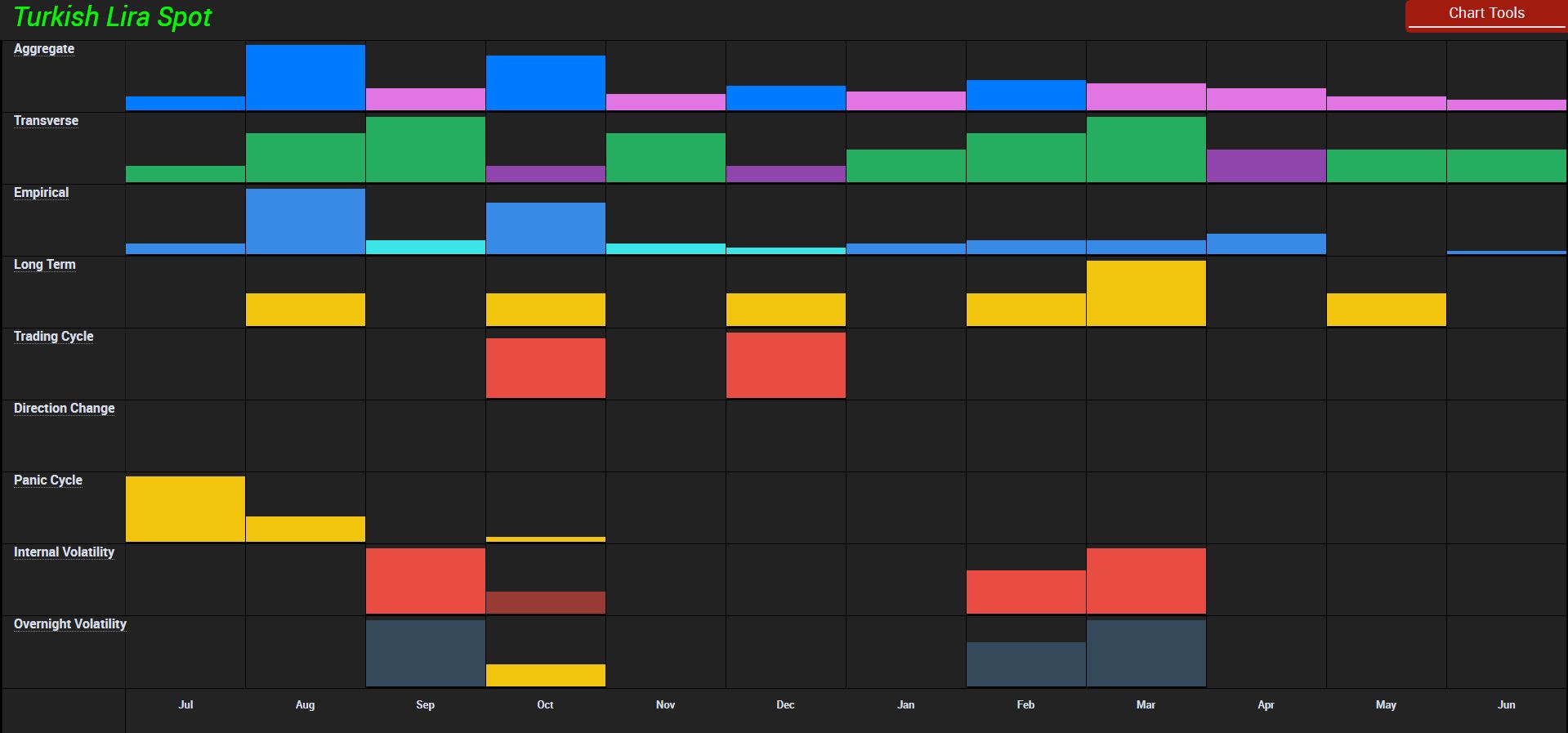
Instead of building his economy and benefiting the people of Turkey, Erdogan has been more interested in resurrecting the Ottoman Empire. It has been his mismanagement of the economy and his hostile attitude even to Greece that is behind the Turkish Lira Crisis. He has lost the confidence of his own people! August has been our target for the crisis and so far the computer has been correct on that score. However, volatility will remain high going into October and then we see it will return as the new year begins. Qatar coming to the rescue should help support the lira for now. Those who are wise had better sell their Turkish bonds and step oy of this trade. August should prove to be only a temporary low for the lira

July Retail Sales Growth: 6.4% “Unexpected”, “Well Beyond Expectations”, “well beyond what experts predicted”…


Remember that 2016 conversation about retail inflation, Q2 wage growth, durable goods spending and non-durable goods expenditures…  Well, in a growing economy; a bigly expanding economy; with wages actually increasing as an authentic outcome of expanded hiring and jobs, jobs, jobs… in conjunction with lowered tax rates…. you get more money in your pocket.

This natural Main Street dynamic leads to increased consumer spending, specifically in the retail sectors influenced by who?… Oh, yeah, those middle-class economic beneficiaries of all the above.

The expert financial pundits are shocked, shocked I tell you… shocked; when, all of a sudden, the convergence of MAGAnomic Main Street policies delivers results.  DUH!

The Commerce Department – Economic and Statistics Administration – released the figures from July 2018 retail sales today (full pdf available here), showing an incredibly strong .5% increase in spending in July, bringing a 6.4% increase year-over-year;  and the results have dropped the jaws of the “experts”:

“Economists polled by Reuters had forecast retail sales nudging up 0.1 percent in July.” (link)

“Retail spending in the United States increased a half-percent during the month of July — well beyond what experts predicted.” (link)

“U.S. retail sales rose more than expected in July as households boosted purchases of motor vehicles and clothing, suggesting the economy remained strong” (link)

(pdf link)

With expanded jobs available; higher wages and the highest workforce in the history of the country currently; and with more U.S. workers re-entering the workforce again; and with expanded optimism and opportunity; the retail sector is a natural benefactor.

Notice the drop in the “sporting goods, hobby, etc.” sector?  Americans love to work… when you’re working, you’re earning…. when you’re earning you ain’t playing as much etc.

Retail sales growth is directly related to the middle-class.  Retail store volume is directly related to the wealth of the middle class.  Build a strong Main Street and you simultaneously build a strong, financially secure, middle-class.  It is a self-fulfilling economic prophecy; this is common sense.

Remember, two-thirds of our GDP, and the subsequent economic growth measured by GDP growth, is directly influenced by retail sales.  The more goods Americans purchase, the higher our GDP growth in the making, manufacturing, distribution and selling of those goods.   This is the Main Street growth cycle dynamic never discussed when all of the economic emphasis is on a service-driven economy (Wall Street).

BIG PICTURE – As a direct result of President Trump’s multifaceted economic strategy, manufacturing companies are having to look at TCO which is “Total Cost of Ownership”. You see, President Trump is not only approaching manufacturing growth policy from the trade-agreement and investment side, his policies also approach the larger impacts on raw material, energy and labor.

This multi-pronged policy approach forces companies to look at transportation and location costs of manufacturing. In combination with more favorable tax rates; if domestic costs of material and energy drop, in addition to drops in regulatory and compliance costs of operating the business, the total operating cost differences drop dramatically.

This means labor and transportation costs become a larger part of the consideration in “where” to manufacture. All of these costs contribute to the TCO. Transportation costs are very expensive on durable goods imported. If the durable goods are made domestically, the transportation costs per unit shipped drop significantly. The TCO analysis then further reduces to looking at labor.

U.S. Labor is more expensive, yes. However, if material costs, energy costs, regulatory costs, taxes and transportation costs are part of the TCO equation – then higher labor costs can be offset by the previously mentioned savings.

… […] Chinese wages have been rising by about 15% a year since 2000. As a result, the Chinese labor cost in dollars per unit of output is now about four times what it was in 2000. We estimate that about 25% of what is now offshored would come back if companies quantified the total cost. These products would generally have characteristics such as high freight cost vs. labor cost, frequent design changes, volatility in demand, intellectual property risk, and regulatory and compliance requirements. (link)

For two years CTH has repeatedly stated that under Trump’s proposals “total costs” drop so dramatically, that off-shored manufacturing is no longer the best play. We are seeing that shake out right now. For the first time in 30 years companies are reviewing the TCO of products and finding less and less financial reasons for off-shore manufacturing.

Their response?….  Well, we need more workers !!

Winnamins baby… moar winnamins.

Qatar to help Turkey by $15 Billion Loan


There has been a lot of lobbying behind the curtain going on asking Qatar to change its position and help Turkey for the IMF would not be able to come to the rescue. Sources are saying that Qatar will help Turkey to the tune of $15 billion for now. Those lobbying have included the United States. This will help ease things a little with Turkey

This is No Joke – Monetary Reform Will Be Forced Upon the World


QUESTION: Mr. Armstrong; I really understand why the government wanted your model so bad. You have been the only one to correctly forecast the entire world. The emerging markets are cracking and the euro is falling apart. What is next in your timetable?

ANSWER: We have been warning that the first to crack would be emerging markets and Turkey was the focal point. We are also beginning to witness the debt crisis in China due to loans in dollars as well. Many of these companies simply lacked the sophistication to understand currency risk or hedging strategies. The second in line would be Europe and the Euro is really in danger of bringing the entire world economy down. The third in line will be Japan, and then finally the crisis will hit the USA. We are just living in an era where people have believed the nonsense for far too long. Adam Smith’s Invisible Hand cannot be defeated.

This is SERIOUS. People have to understand that this is NOT my personal belief, opinion, or anything else based upon some predetermined conclusion. People attack me personally because they cannot defend a system that NOBODY in their right mind would have created from scratch. Our system is a patchwork of band-aids that are applied to each crisis and then never removed. Collectively, that have combined to create a complete nightmare. This has become such a mess, there is NOT a single person I know in government capable to even correcting this mess. The truth ALWAYS is exposed.

I am only one person. I do not have the support to manage a global crisis or step in to help every country. This will take a lot more than just me. The countries who want help are generally the peripheral not the majors for this is too political

ECB Panics – Tells Banks to Stop Converting to Dollars


The European Central Bank is instructing banks to restrict the conversion of Euros to dollars. The Euro has fallen to 113006. Once again, the dangerous game here is when we cross that line of demarcation between CONFIDENCE in government and the REALIZATION that there is nobody in control but the free markets. Once all the talk and all the promises are no longer considered to be worth listening to, that is when the monetary crisis begins to really shake the foundations. We are moving closer to that point of no return.

The truth always comes from the mouths of babes. In the case of politicians, it is the new one who comes to power and has not yet learned the tricks of the trade. In this respect, Italy has spoken the truth. The ECB has had the Eurozone on life-support. They cannot pull the plug without the collapse of the Euro and with that, lies the jobs in Brussels. This is why they will become draconian and attempt to outlaw selling the Euro all to maintain their jobs. They will lose. The free markets ALWAYS win!.

Multinational Wall Street -vs- Main Street U.S.A…


Originally outlined a year ago. Reposted by request. At the heart of the professional/political opposition the issue is money; there are trillions at stake.

President Trump’s MAGAnomic trade and foreign policy agenda is jaw-dropping in scale, scope and consequence. There are multiple simultaneous aspects to each policy objective; however, many have been visible for a long time – some even before the election victory in November ’16.

If we get too far in the weeds the larger picture is lost. CTH objective is to continue pointing focus toward the larger horizon, and then at specific inflection points to dive into the topic and explain how each moment is connected to the larger strategy.

Today we repost an earlier dive into how MAGAnomic policy interacts with multinational Wall Street, the stock market, the U.S. financial system and perhaps your personal financial value. Again, reference and source material is included at the end of the outline.

If you understand the basic elements behind the new dimension in American economics, you already understand how three decades of DC legislative and regulatory policy was structured to benefit Wall Street and not Main Street. The intentional shift in fiscal policy is what created the distance between two entirely divergent economic engines.

REMEMBER […] there had to be a point where the value of the second economy (Wall Street) surpassed the value of the first economy (Main Street).

Investments, and the bets therein, needed to expand outside of the USA. hence, globalist investing.

However, a second more consequential aspect happened simultaneously. The politicians became more valuable to the Wall Street team than the Main Street team; and Wall Street had deeper pockets because their economy was now larger.

As a consequence Wall Street started funding political candidates and asking for legislation that benefited their interests.

When Main Street was purchasing the legislative influence the outcomes were -generally speaking- beneficial to Main Street, and by direct attachment those outcomes also benefited the average American inside the real economy.

When Wall Street began purchasing the legislative influence, the outcomes therein became beneficial to Wall Street. Those benefits are detached from improving the livelihoods of main street Americans because the benefits are “global”. Global financial interests, multinational investment interests -and corporations therein- became the primary filter through which the DC legislative outcomes were considered.

There is a natural disconnect. (more)

As an outcome of national financial policy blending commercial banking with institutional investment banking something happened on Wall Street that few understand. If we take the time to understand what happened we can understand why the Stock Market grew and what risks exist today as the financial policy is reversed to benefit Main Street.

President Trump and Treasury Secretary Mnuchin have already begun assembling and delivering a new banking system.

Instead of attempting to put Glass-Stegal regulations back into massive banking systems, the Trump administration is creating a parallel financial system of less-regulated small commercial banks, credit unions and traditional lenders who can operate to the benefit of Main Street without the burdensome regulation of the mega-banks and multinationals. This really is one of the more brilliant solutions to work around a uniquely American economic problem.

♦ When U.S. banks were allowed to merge their investment divisions with their commercial banking operations (the removal of Glass Stegal) something changed on Wall Street.

Companies who are evaluated based on their financial results, profits and losses, remained in their traditional role as traded stocks on the U.S. Stock Market and were evaluated accordingly. However, over time investment instruments -which are secondary to actual company results- created a sub-set within Wall Street that detached from actual bottom line company results.

The resulting secondary financial market system was essentially ‘investment markets’. Both ordinary company stocks and the investment market stocks operate on the same stock exchanges. But the underlying valuation is tied to entirely different metrics.

Financial products were developed (as investment instruments) that are essentially wagers or bets on the outcomes of actual companies traded on Wall Street. Those bets/wagers form the hedge markets and are [essentially] people trading on expectations of performance. The “derivatives market” is the ‘betting system’.

♦Ford Motor Company (only chosen as a commonly known entity) has a stock valuation based on their actual company performance in the market of manufacturing and consumer purchasing of their product. However, there can be thousands of financial instruments wagering on the actual outcome of their performance.

There are two initial bets on these outcomes that form the basis for Hedge-fund activity. Bet ‘A’ that Ford hits a profit number, or bet ‘B’ that they don’t. There are financial instruments created to place each wager. [The wagers form the derivatives] But it doesn’t stop there.

Additionally, more financial products are created that bet on the outcomes of the A/B bets. A secondary financial product might find two sides betting on both A outcome and B outcome.

Party C bets the “A” bet is accurate, and party D bets against the A bet. Party E bets the “B” bet is accurate, and party F bets against the B. If it stopped there we would only have six total participants. But it doesn’t stop there, it goes on and on and on…

The outcome of the bets forms the basis for the tenuous investment markets. The important part to understand is that the investment funds are not necessarily attached to the original company stock, they are now attached to the outcome of bet(s). Hence an inherent disconnect is created.

Subsequently, if the actual stock doesn’t meet it’s expected P-n-L outcome (if the company actually doesn’t do well), and if the financial investment was betting against the outcome, the value of the investment actually goes up. The company performance and the investment bets on the outcome of that performance are two entirely different aspects of the stock market. [Hence two metrics.]

♦Understanding the disconnect between an actual company on the stock market, and the bets for and against that company stock, helps to understand what can happen when fiscal policy is geared toward the underlying company (Main Street MAGAnomics), and not toward the bets therein (Investment Class).

The U.S. stock markets’ overall value can increase with Main Street policy, and yet the investment class can simultaneously decrease in value even though the company(ies) in the stock market is/are doing better. This detachment is critical to understand because the ‘real economy’ is based on the company, the ‘paper economy’ is based on the financial investment instruments betting on the company.

Trillions can be lost in investment instruments, and yet the overall stock market -as valued by company operations/profits- can increase.

Conversely, there are now classes of companies on the U.S. stock exchange that never make a dime in profit, yet the value of the company increases. This dynamic is possible because the financial investment bets are not connected to the bottom line profit. (Examples include Tesla Motors, Amazon and a host of internet stocks like Facebook and Twitter.) It is this investment group of companies that stands to lose the most if/when the underlying system of betting on them stops or slows.

Specifically due to most recent U.S. fiscal policy, modern multinational banks, including all of the investment products therein, are more closely attached to this investment system on Wall Street. It stands to reason they are at greater risk of financial losses overall with a shift in fiscal policy.

That financial and economic risk is the basic reason behind Trump and Mnuchin putting a protective, secondary and parallel, banking system in place for Main Street.

Big multinational banks can suffer big losses from their investments, and yet the Main Street economy can continue growing, and have access to capital, uninterrupted.

Bottom Line: U.S. companies who have actual connection to a growing U.S. economy can succeed; based on the advantages of the new economic environment and MAGA policy, specifically in the areas of manufacturing, trade and the ancillary benefactors.

Meanwhile U.S. investment assets (multinational investment portfolios) that are disconnected from the actual results of those benefiting U.S. companies, and as a consequence also disconnected from the U.S. economic expansion, can simultaneously drop in value even though the U.S. economy is thriving.

♦The Modern Third Dimension in American Economics – HERE

♦How Multinationals have Exported U.S. Wealth – HERE

♦The “Fed” Can’t Figure out the New Economics – HERE

The FED Begins to Question the Economic Assumptions – HERE

♦Treasury Secretary Mnuchin begins creating a Parallel Banking System – HERE

♦Proof “America-First” has disconnected Main Street from Wall Street – HER