Collectibles Going Crazy?


Armstrong Economics Blog/Collectibles Re-Posted Apr 1, 2021 by Martin Armstrong
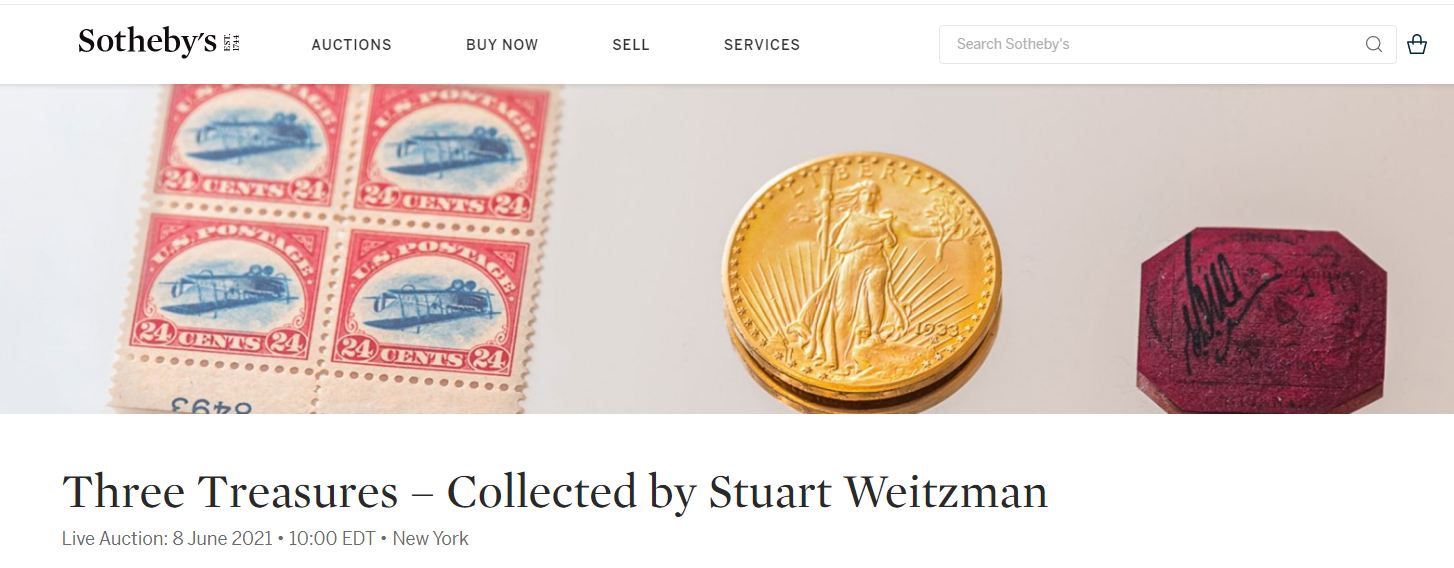
This June, Sotheby’s will be auctioning off three of the greatest rarities in the stamp and coin field. The 1933 Double Eagle $20 gold coin, the unique British Guiana One-Cent Black on Magenta, and the unique Inverted Jenny 1918 Plate Block. This is truly an incredible offering from a single collector to have captured three of the rarest and most unique collectibles in history.

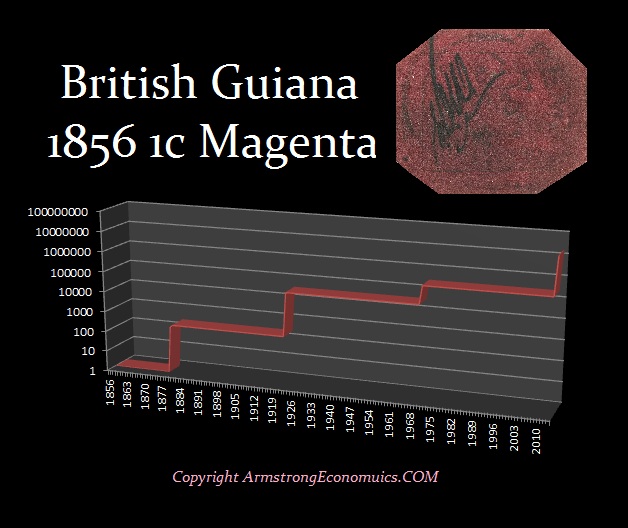
It is a bit unusual that a unique stamp from a less than the mainstream region has emerged as the rarest and sole-surviving example of the British Guiana One-Cent Magenta from 1856. It was last sold in 2014 at Sotheby’s for $9.48 million. While it was rediscovered by a 12-year-old schoolboy living in South America in 1873, perhaps due to fantastic marketing, it has emerged as one of the most important stamps in famous collections that have ever assembled. In 1873 L. Vernon Vaughan, a 12-year-old schoolboy living with his family in British Guiana found the stamp among a group of family papers bearing many British Guiana issues. The young philatelist would later sell the stamp for several shillings to another local collector. The British Guiana then entered the UK in 1878, and shortly after, it was purchased in Paris by Count Philippe la Renotière von Ferrary who many considered to be perhaps the greatest stamp collector in history. Then following the war, France seized Ferrary’s collection, which had been donated to the Postmuseum in Berlin, as part of war reparations due from Germany following World War I. The stamp was then sold in 1922 at auction when it was purchased by Arthur Hind, a textile magnate from New York, for its first auction-record price of $35,000. The stamp changed hands moving from the collections of the Australian engineer Frederick T. Small; then a consortium headed by Irwin Weinberg; then by John du Pont of the famous chemical company. Du Pont paid $935,000 for the stamp in a 1980 auction, before it was last sold at auction to Weitzman for the record-setting price of $9.48 million.
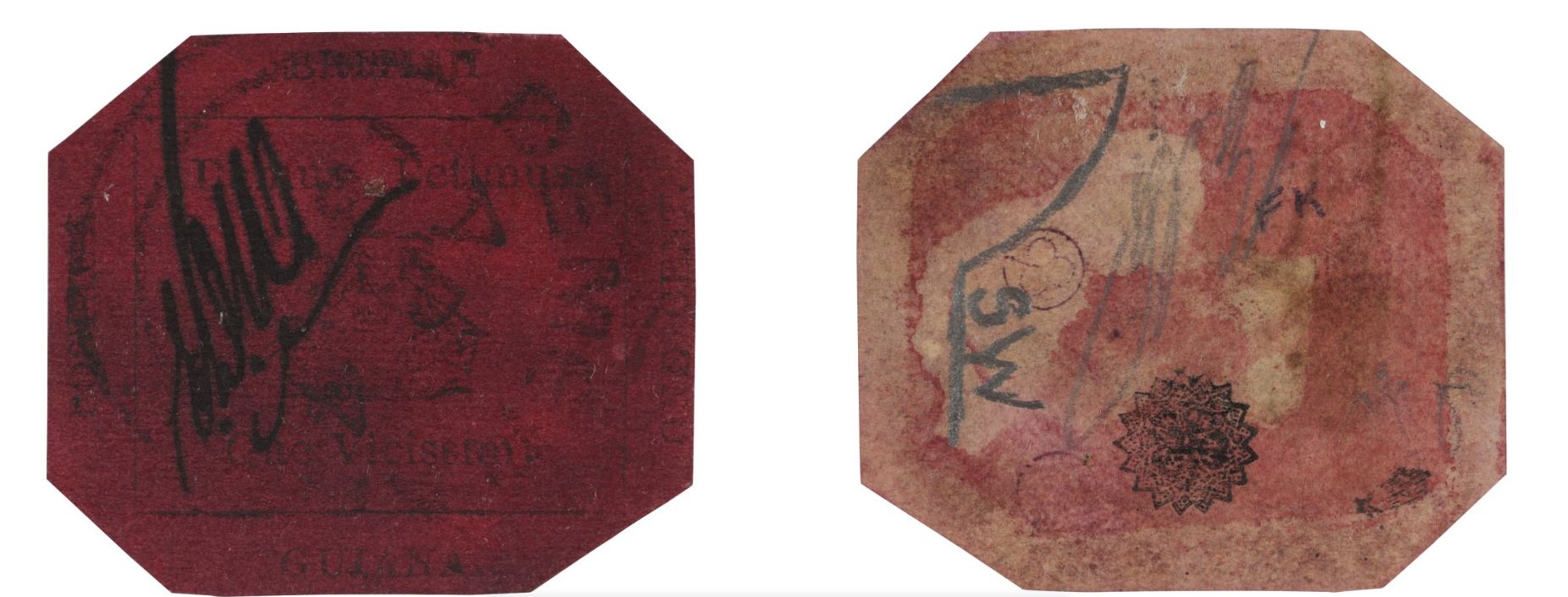
Interestingly, a tradition emerged where previous owners of the British Guiana signed the back of the stamp. Weitzman added his own personal mark to the reverse of the stamp inscribing his initials “SW” along with a line drawing of a stiletto shoe as a nod to his legacy in fashion.
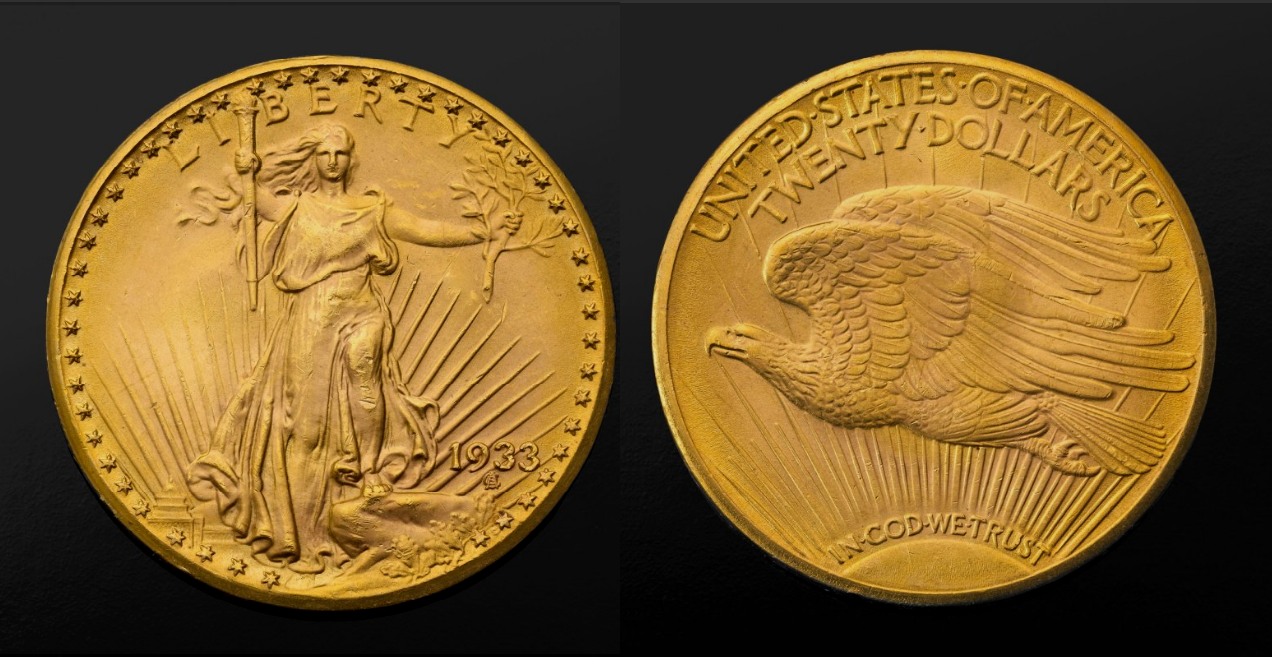
This 1933 Double Eagle ($20 gold coin) is the only example that may be legally owned by an individual. It was the coin acquired by King Farouk of Egypt. Stuart Weitzman purchased the coin at a Sotheby’s/Stack’s auction in 2002 for a world record price of US$7.59 million, nearly doubling the previous record. The Director of the United States Mint signed a Certificate of Monetization that, in return for twenty dollars, authorized the issuance of this single example.

In August 2005, the US Mint announced the recovery of ten additional stolen 1933 double eagle gold coins from the family of Philadelphia jeweler/coin dealer Israel Switt, who was the illicit coin dealer identified by the Secret Service as a party to the theft who admitted selling the first nine double eagles that were recovered. Israel Switt had many contacts and friends within the Philadelphia Mint. As the story goes, the Secret Service found that only one man, George McCann, had access to the coins at the time and served prison time for similar embezzlement in 1940. Israel Switt somehow obtained the stolen 1933 double eagles. One theory is that McCann swapped the previous year’s Double Eagles for the 1933 specimens prior to melting, thereby making sure the count was correct. The US mint began striking Double Eagles on March 15, 1933. Roosevelt’s executive order to ban gold was not finalized until April 5. Therefore, on March 6, 1933, the Secretary of the Treasury ordered the Director of the Mint to pay gold only under a license issued by the Secretary, and the United States Mint cashier’s daily statements do not reflect that any 1933 Double Eagles were paid out.

In September 2004, the claimed owner, Joan Switt Langbord, heir to Israel Swift, tried to sell the 10 coins and they had to be surrendered to the Secret Service. In July 2005, the coins were authenticated by the United States Mint after working with the Smithsonian Institution, as being genuine 1933 double eagles. Joan Switt Langbord claimed to have found them in a box and she went to court to have them returned. On October 28, 2010, US court ruled and the issue went to trial in July 2011. On July 20, 2011, after a ten-day trial, a jury ruled unanimously in favor of the United States government and Lanford appealed. At first, the Court of Appeals overruled the jury, but then it went En Banc and the Court of Appeals ruled in favor of the government. The Langbords appealed to the U.S. Supreme Court, which on April 17th, 2017 denied certiorari.
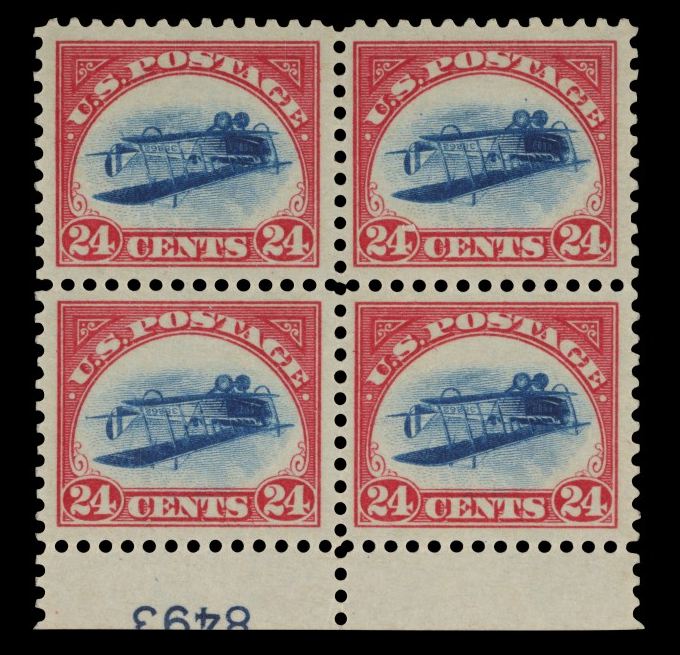
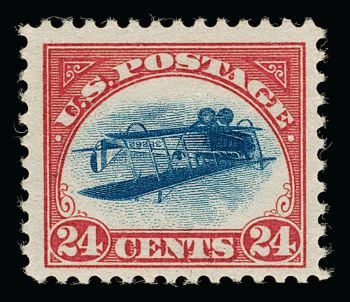
Hetty Green’s son, Edward Howland Robinson Green (1868-1936), was not so frugal and spent $3  million on coins and stamps. He was an avid collector and bought the famous sheet of 100 inverted airmail stamps in 1918, paying $20,000. The last time this Plate Block appeared on the market was 16 years ago when it sold at auction for $2.97 million.

Meanwhile, the classic Ferraris from the 1980s have nearly doubled in price over the past year.
What is 2032?


Armstrong Economics Blog/ECM Re-Posted Mar 30, 2021 by Martin Armstrong

Many people have asked, “Why is 2032 going to be such a major change in the world’s political economy and society as a whole?”

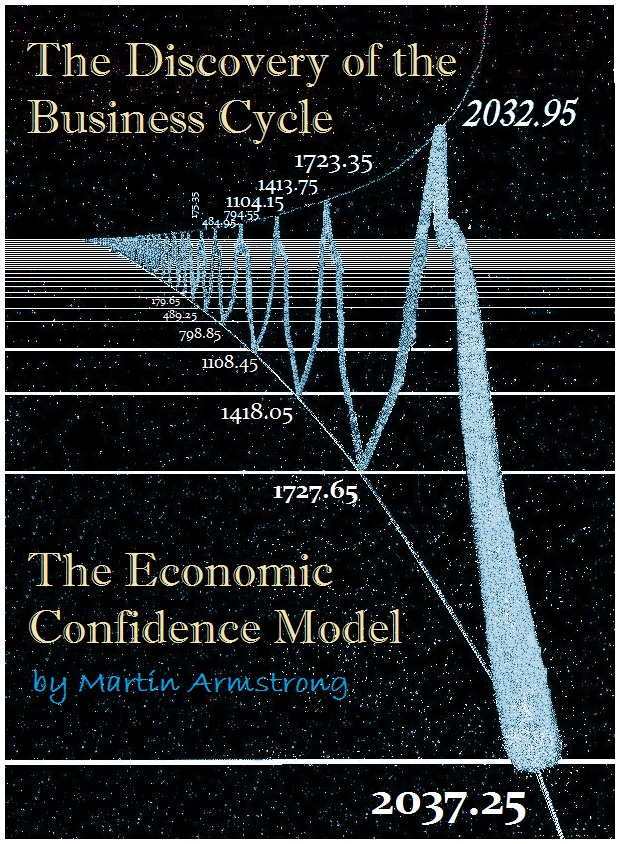
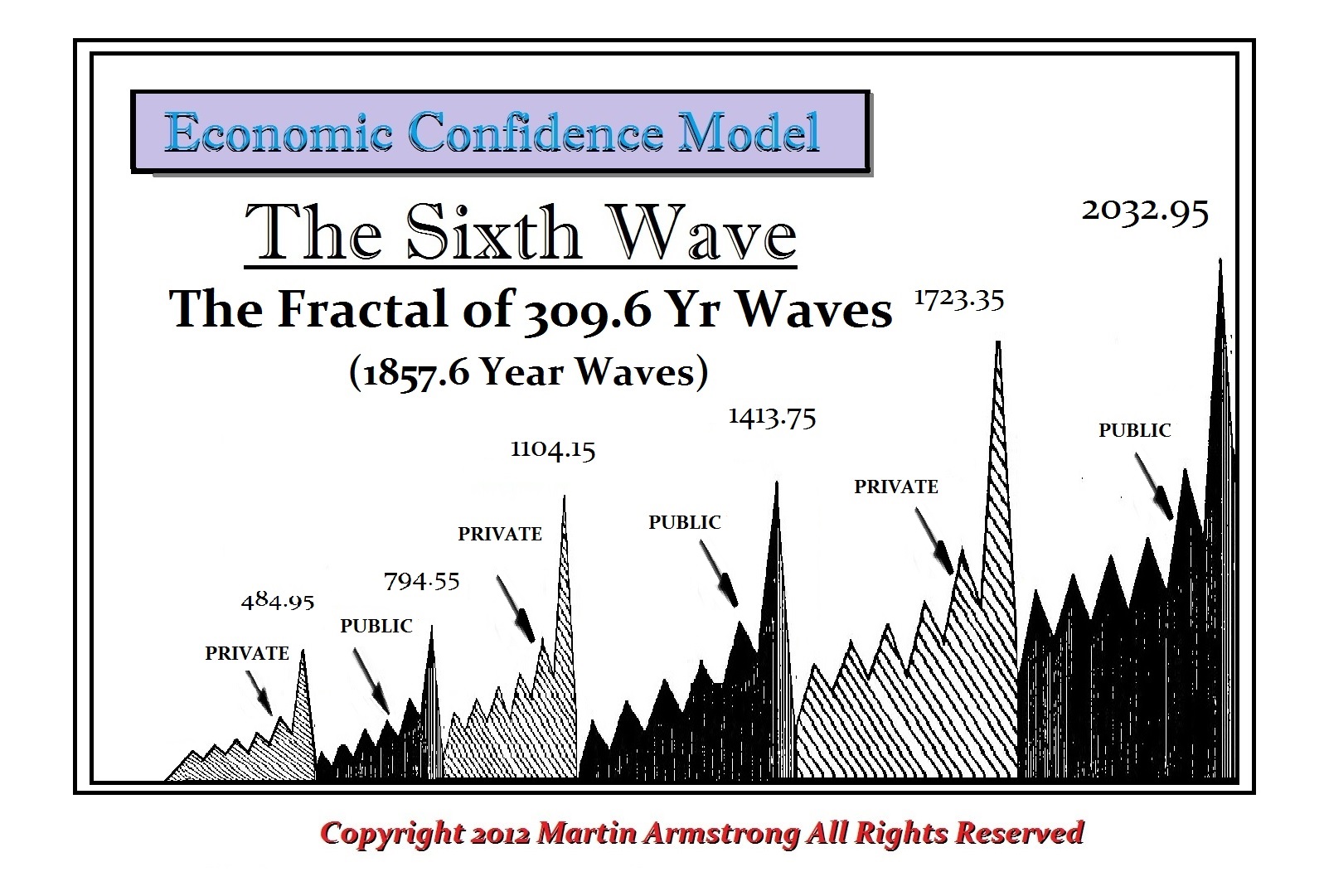
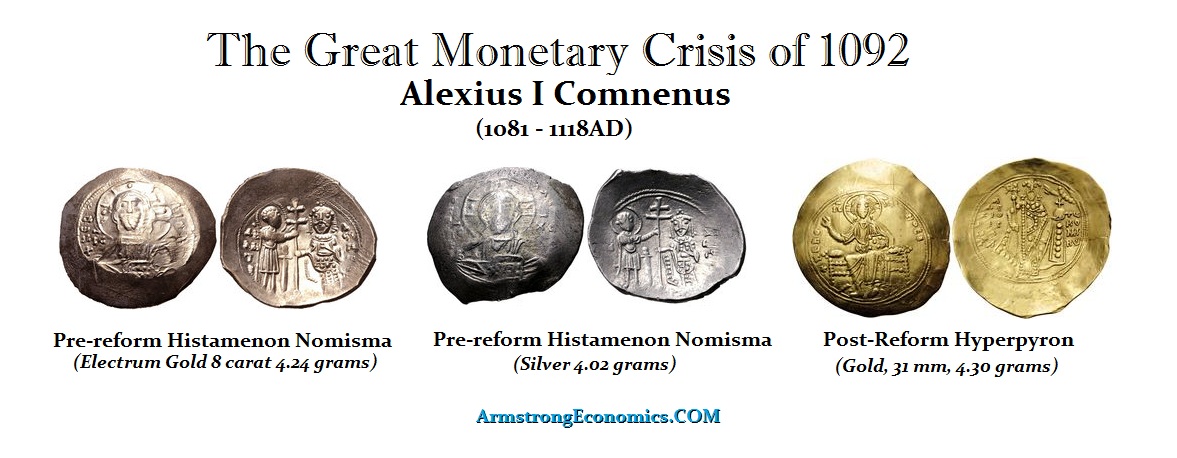
We are confronted by the end of the Sixth Wave come 2032, which will be a profound economic and political change. It appears these world leaders are pushing us toward fulfilling the vision of Kalus Schwab and his distorted view of how society functions. While the first wave marked the collapse of Rome, 794 marked the collapse of the Nara period in Japan as the capital then moved to Kyoto. That would last until 1185 AD when government was overthrown, marking the birth of the Shogun Period (military general authority). The Great Seljuk Turkish Empire had its origins, with its first capital in 1037. By 1092, the Seljuk Empire was at its greatest upon Malik Shah I’s death and had captured most of the Byzantine Empire, creating the Great Monetary Crisis of 1092 in Constantinople. Alexius I (1081-1118AD) of Byzantium saw his empire carved up.

It was 1075 when the Investiture Dispute began, where the Pope opposed kings appointing bishops to control. He had to threaten the ex-communication of kings, which only concluded in 1103. This was the start of the separation of church and state. In 1084, Emperor Henry IV deposed Pope Gregory VII and installed the first Anti-Pope Clement III who then crowned Henry Holy Roman Emperor. A revolution in 1094 resulted in Pope Urban II overthrowing the Anti-Pope and Henry lost power over Italy. But by 1111, Henry V captured the Pope, forced his settlement, and then crowned Henry V as Holy Roman Emperor. By 1112, the Church splits between Papal and Imperial supporters.

The Balkans had been overrun by the Patzinaks who were a nomadic people of the Turkic family. Their original home is unknown, but during the 8th and 9th centuries, they inhabited the region between the lower Volga and the Urals. They then laid siege to Constantinople itself in 1090 AD. They led Alexius to ask for help from Venice, which began the First Crusade (1096–1099) where they took Jerusalem. But the Venetians were more interested in plundering Constantinople. Thus, 1104 marked the peak in the Byzantine Empire and by the Latin rulers who seized Byzantium taking control 1204-1261 AD. It wasn’t until 1298 when the reign of Osman I, founder of the Ottoman Empire, began.

The financial crisis in France led to the default on loans to Italian bankers and the seizure of the Papacy itself moving it to Avignon in France known as the Avignon Papacy, also known as the Babylonian Captivity, which was period from 1309 to 1376. The French Anti-Pope seized the Knights Templars on Friday, October 13, 1307, to confiscate all their wealth and that of their clients. The Knights Templars had become the first real international banking system as they evolved following their founding around 1117/1118 AD, lasting for 22 waves of 8.6 years. This next wave also saw the Black Plague (1347-1351) wipe out 50% of the population, which then changed the economy by shifting it from serfdom in Europe to capitalism as wages began to take place because of the shortage of labor.

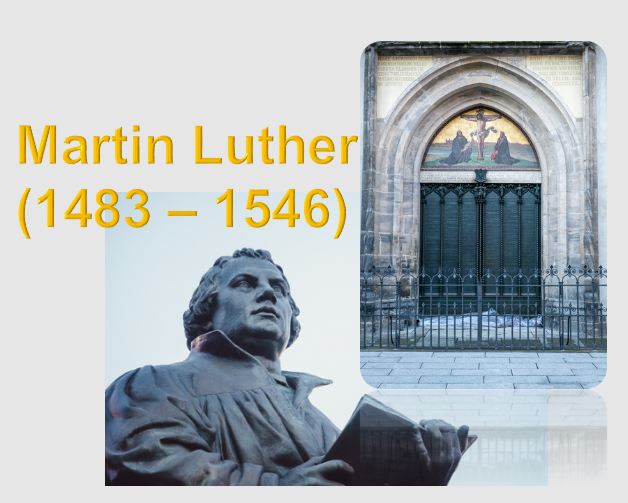
The next peak in the cycle 1413.75 marked the start of the religious revolution. In England, the Oldcastle Revolt was a Lollard uprising against both the Catholic Church and the English King Henry V. Oldcastle was influenced by Lollard cleric William Swynderby, who preached in Almeley during his youth. Lollardy was a politico-religious movement initiated by prominent theologian John Wycliffe during the 1370s. The Lollard beliefs dealt with their opposition to capital punishment, rejection of religious celibacy, and belief that members of the Clergy should be held accountable to civil laws. In addition, it was the rise of the iconoclasty, which took place in the Byzantine Empire, where they rejected ornamentation of churches, religious images, and pilgrimages. They objected to war, violence, and abortion. John Oldcastle led the revolt, and it took place on the night of 9/10 January 1414. The rebellion was absolutely crushed at the battle on St. Giles’s Fields. There was rising discontent in religion that manifested on October 31, 1517, when Martin Luther nailed his 95 Theses to the door of the Wittenberg Castle church in Germany.

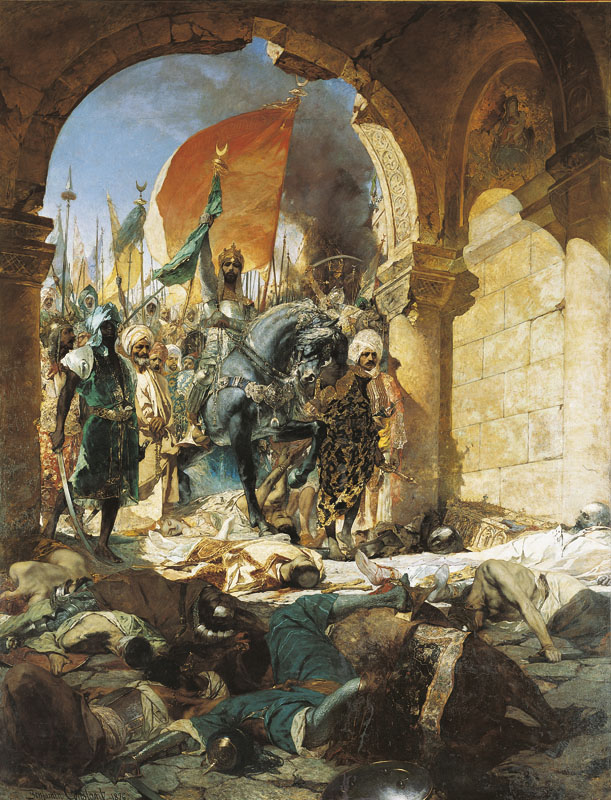
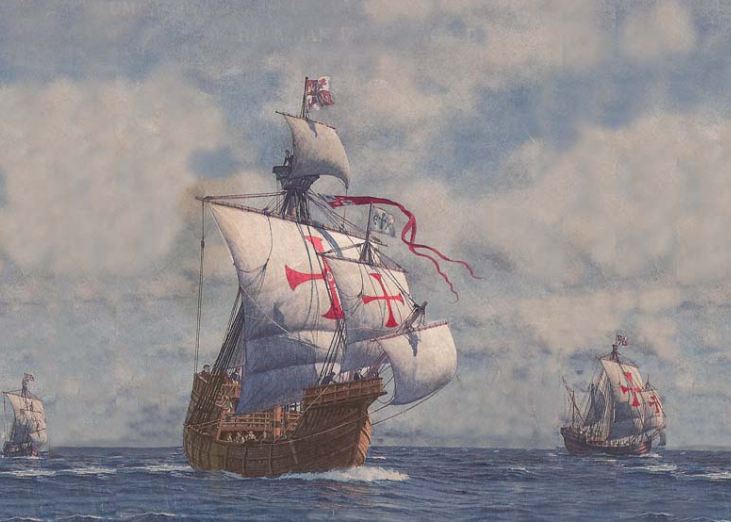
This next wave peaked in 1723.35, not merely saw the Protestant Reformation impact region, but with the fall of Constantinople in 1453, scholars fled to Europe and Russia, taking the wealth of knowledge with them. By 1492, Christopher Columbus convinced others that the world was round and not flat based upon maps that came from Constantinople. While it would slowly expand the knowledge in Europe, the Age of Enlightenment is formally classified as being between 1715-1789, which really became the foundation for the next wave into 2032.

But this wave was the beginning of the crisis with a monarchy. Columbus was backed by Spain, which then became the new financial capital of Europe. But the mismanagement by the monarchy led to Spain becoming a serial defaulter beginning in 1557, followed by 1570, 1575, 1596, 1607, and 1647, ending in a third world status by the end of this wave. King Philip V of Spain abdicated the throne in 1724 to go to a monastery.

In England, on October 17, 1722, the Habeas Corpus Act was suspended because of a Jacobite plot to take the thrown by a Catholic James III they called the Old Pretender, and Parliament prohibited journalists from reporting on political debates. From here on out, the tone for the next wave was set in motion. The rise against the monarchy. This was the wave of human rights and it moves into its culmination come 2032 with the rise against human rights and the attempt once more to suppress the people with the rise of authoritarianism. This is once more a major turning point, and we will face a dramatic change both economically and politically on a global scale.

The forthcoming “The Discovery of the Business Cycle” goes into the details of these waves throughout history with not merely political facts but also the rise and fall of the world’s monetary system.

Australia Committing Economic Suicide – Turning Hard Left


Armstrong Economics Blog/Regulation Re-Posted Mar 29, 2021 by Martin Armstrong

The Greens in Australia want to tax Billionaires 6% Wealth Tax annually (in addition to INCOME) as a property tax on everything this own from art right down to the watch they wear. They claim it will raise $11.2 billion over its first two years, it will cost the Australian Tax Office an extra $110 million to implement the policy and enforce compliance. But it does not stop there. It would apply to Australians who hold more than $1 billion in assets, no matter where they live, and non-residents who hold Australian assets worth more than $1 billion. Therefore, you can see how stupid these people are for they assume those they target would just remain in Australia and that foreign investment would certainly abandon Australia. This is on top of income taxes, and property taxes that already are in place.
I quit managing money domestically in the United States back in 1985. They came in for an audit and government employees MUST find something wrong because their view is nobody is perfect. They said they were going to write me up for improper record keeping. I asked what was wrong. They said my tabs on files were PINK and they were supposed to be RED. I am not one to cower from the government. I demanded their names and told them I would be filing a lawsuit against them personally. They dropped the nonsense and left. I then informed all my American clients that I would no longer manage money inside the United States. I returned all the funds and moved offshore. That incident transformed me into one of the first Hedge Fund Managers. Stupid regulation has an impact and the idiots behind it are too stupid to understand the consequences.

The political left never gets it. If they raised income taxes back to 90% again, I would just quit. Out of principle, I would simply refuse to work as an economic slave. They never read Atlas Shrugged. They think robbing others because they have more than they have is perfectly fine. So if they are walking down the street and someone sticks a gun in their face and says give me everything or your life, they too are justified because whatever they have is still more than the person with the gun.

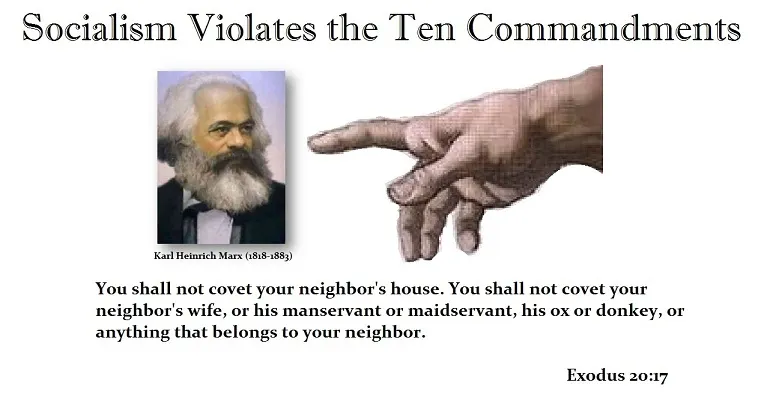
I find it very interesting that these left-wing policies are actually forbidden by the Ten Commandments for they are built upon avarice and envy. The Seven Deadly Sins are Pride, Anger, Greed, Gluttony, Lust, Envy, and Sloth. What is interesting is the fact that what is in the Ten Commandments can be found in just about every religion since the dawn of time. This appears to be a human problem and they always justify it by saying it is not fair that someone else has something they do not. But then again, then do not want to work for it – Sloth.

Hetty Green – the Lost Age of Trading


Armstrong Economics Blog/Opinion Re-Posted Mar 26, 2021 by Martin Armstrong

COMMENT: Mr. Armstrong,
Yes, it is absurd to think that they can train humans to bark, sit and roll over. But given how things have been evolving since last year, I see plenty of people becoming a two legged dog! I feel you just have to live in a place where, slowly but surely, people are losing the ability to reason. This is just a city full of people with their brains in a constant murk. Luckily, Mr. Armstrong, you live in a city where normalcy is still part of life, or at least, more so than here in Toronto.

What an extraordinary woman Mrs. Hetty Green was, and she was a Scorpio just like you! I should get her biography. I gathered three things from what you wrote about her today: 1) walk your own path even if it is an unknown and beaten track 2) listen to your instincts 3) there is no place for weakness and sentimentality in business.
Thank you for a great read today, sir.
Adieu.

GR

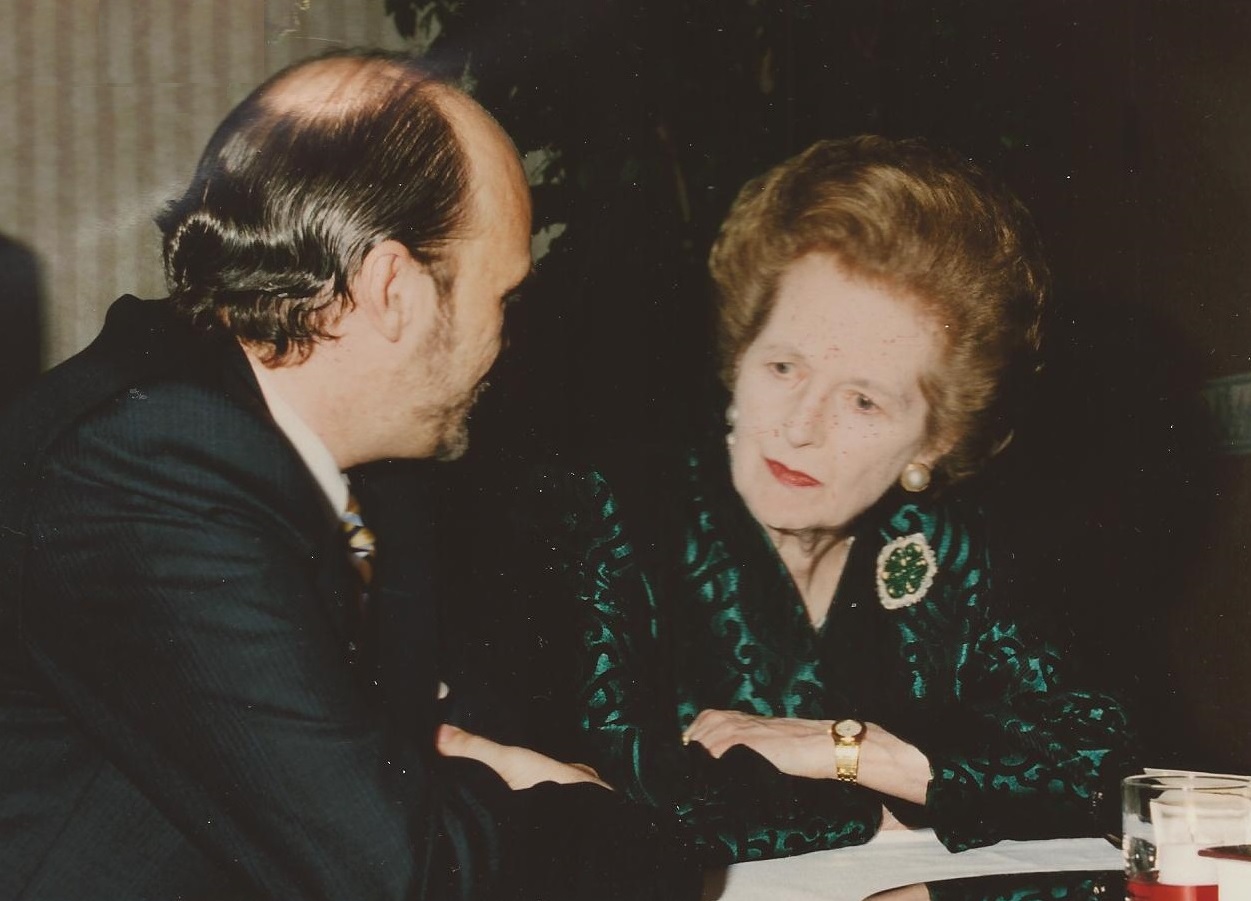
REPLY: I never met Hetty Green, I’m sure it would have been a real experience. Margaret Thacher was such a woman of great insight and instinct. She too had to prove herself in a world of men. She was remarkable and I truly miss being able to talk to heads of state who actually could hold a reasonable conversation without looking at their cue-cards. I fear that as politics has degenerated, the same will happen with analysis and trading.

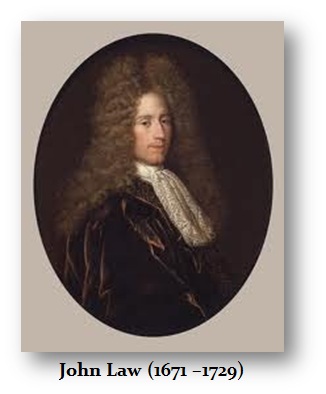
John Law was really the man who set in motion the understanding of the economy which inspired Adam Smith, who plagiarized him. John Law fought a duel when it was tradition, but the King of England was declaring it illegal and would have sentenced him to death. Most likely his jailer released him and told him to flee England and he did. So, because John Law had that criminal charge, everyone else stole his work and never bothered to mention him. But it was John Law who established the first principle of supply and demand because he fled to Amsterdam and was a trader on the floor there.

It was John Law who wrote about the Paradox of Value explaining that things which have the greatest value in use have frequently little or no value in exchange. On the other hand, those objects that have the greatest value in exchange have frequently little or no value in use. John Law explained this Paradox using the example of water and diamonds which Adam Smith copied without credit to Law. Nothing is more useful than water, however, it will purchase scarcely anything in exchange for some other commodity. A diamond, on the contrary, has scarcely any use-value; but a very great quantity of other goods may frequently be had in exchange for it. We could say the same thing about gold or silver. Both have very limited value for use, but a diamond has greater value in exchange.

This served as the foundation of the principle of supply and demand which it took a trader to see. This is why I am hard on academics like Schwab. He has never stood in the dealing room and never experienced how markets really function. Eliminating the dealing rooms and everyone trading in isolation off of silent screens, you do not get the same feel as looking at the emotions on the other side of the trading pit.

The “feel” for the trade is something that is slowly dying. Hetty Green was clearly one who understood trading. I always called it – smelling the blood coming from the tape.

The Paradox of Cash


Armstrong Economics Blog/Gov’t Incompetence Re-Posted Mar 25, 2021 by Martin Armstrong

While central banks are hard at work trying to come up with the magic bullet to kill cash and avoid having to bail out bankers again, they are faced with what has been termed the “Paradox of Cash,” whereby the demand rises in the face of declining use of cash in normal transactions. In Europe, studies show that about one-third of all households are hoarding cash. Interestingly, they seem to be just hoarding it rather than spending it. The supply of physical money has doubled over the last 10 years, yet its actual use has been declining. This is no doubt the result of negative interest rates. Why keep money in a bank and be charged a negative interest rate for not spending? If you do not earn interest anymore, then why keep savings in a bank to begin with? This is creating the Paradox of Cash.

You would think that a third-grader could figure out that if you lower interest rates to negative, people would just hoard their cash. Socrates was famous for saying that he knew that he knew nothing. It seems that to be in government, you assume you know everything, and when it moves in the opposite direction, it must be a paradox!

The Greatest Female Trader of All Time?


Armstrong Economics Blog/Traders Re-Posted Mar 25, 2021 by Martin Armstrong

QUESTION: First I want to thank you for your guidance. You have helped me understand markets where I can see I was clueless before. You seem to be a contrarian. I take it that is why you say the majority must always be wrong. Have you learned this to be the best way to look at the world?

Thank you for shining a light in these dark times.

GR

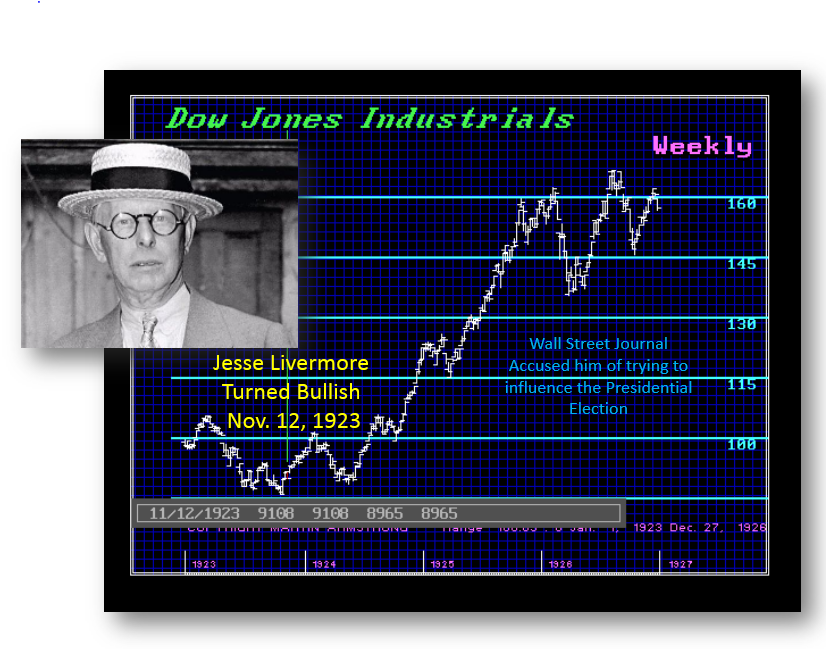
ANSWER: The greatest traders of all time have always been contrarians. They can see the patterns within patterns and how history repeats right before their eyes. Jesse Livermore (1877 – 1940) turned bullish in 1923. He could see the bull market coming. The Wall Street Journal accused him of turning bullish to influence the presidential elections. When they were proven wrong, they simply refused ever to quote Jesse ever again. Many have pointed out that Barrons had reported that our model was calling for new highs back in 2010 more as a joke. They have never reported ever again how it was correct. It appears that the media does not like it when they are wrong and will retaliate.

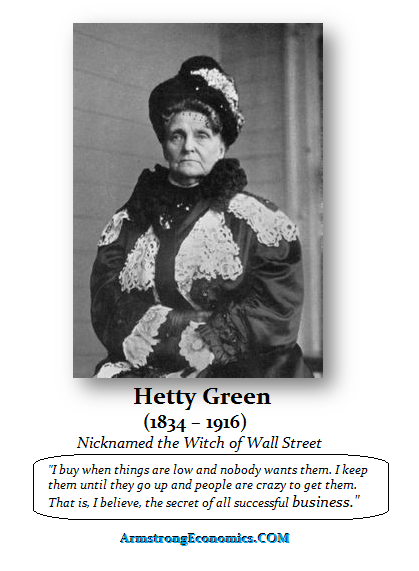
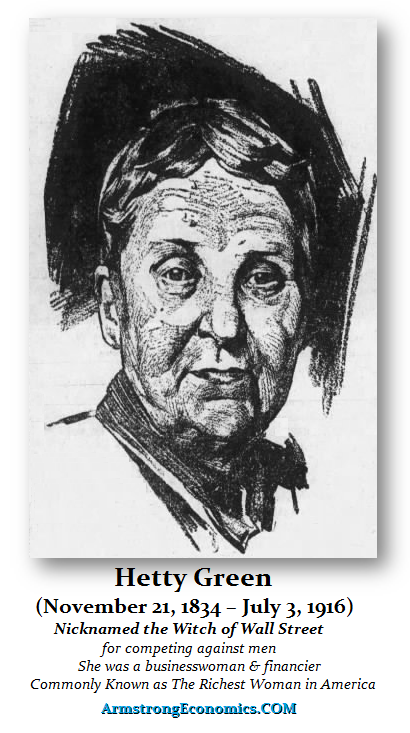
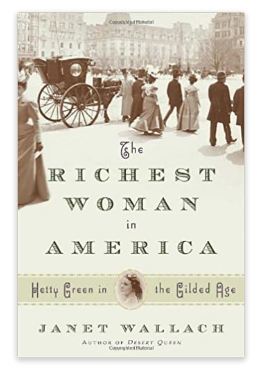
Hetty Green (1834-1916) was a woman in a man’s world. She became not just one of the wealthiest and most astute investors in American history, but she became the richest woman perhaps in the world. Hetty’ was known for her extreme frugality, which was exploited by her adversaries and made for good copy in the press. They dubbed her the “Witch of Wall Street” because she was such a good trader her wealth could outdo even the top ten Wall Street bankers in her day. She was in reality a woman in a man’s world, during the era of robber barons when deals were done in dark oak wooden rooms filled with cigar smoke clouds that you would think it was going to rain.

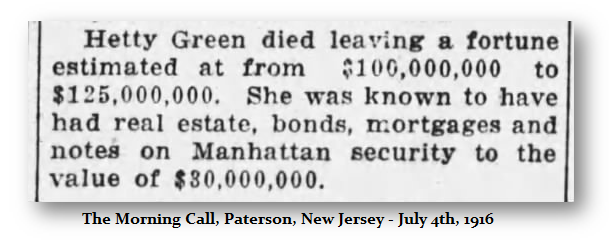
Her reputation as the “Witch of Wall Street” was undeserved and today they would call it sexist. Hetty was the first female billionaire in modern terms who would be worth $10 billion+ in 2021. When she died in 1916, she was worth between $100-$125 million when a dollar was really worth something. She actually despised many of the titans of industry and finance of the day for their predatory ways and profligate spending. She actually sympathized more with the average hardworking citizen, yet she followed in her father’s Quaker footsteps.

Hetty Green was the woman of the Gilded Age. Few men could compete with her mentally. Hetty was abandoned at birth by her mother and she was viewed as a female by her father. Against this backdrop, Hetty set out as a child to prove she was of substance and had value. She followed the simple rules of her wealthy Quaker father, and always was extremely frugal. She would accompany him to the counting houses, storehouses, commodity, and stockbrokers. She observed trading from an early age and clearly saw the patterns within patterns.

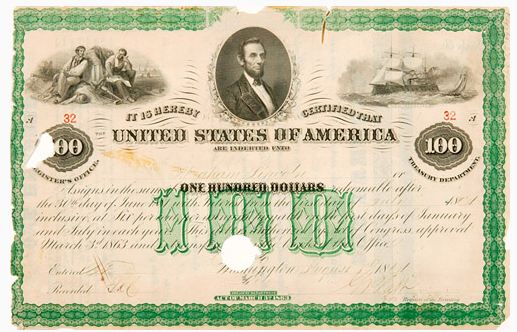
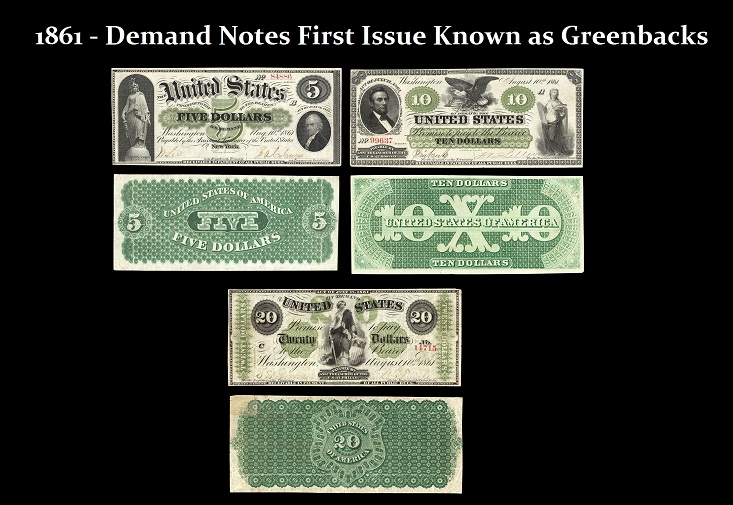
While she inherited money, she understood trading. Perhaps her greatest trade was buying greenback bonds during the Civil War and into the panic of 1869. Some painted it as she never lost faith in America’s potential, but from a practical standpoint, she could see that the North was the industrial hub against the South which was agricultural. Others claim she just ignored the herd mentality and took advantage of financial panics and crises.

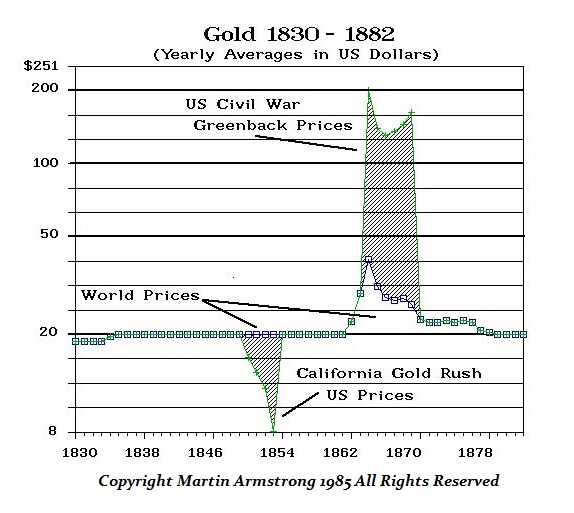
Indeed, during the civil war, Hatty bought federal bonds when the greenback would collapse against gold. In 1862, the greenback declined against gold until the end of the year when gold was trading at a 29% premium to the paper greenbacks. The following year, by spring of 1863, the greenback collapsed to $152 against $100 in gold. After the Gettysburg victory, the greenback bounced back to $131 to $100 in gold. Then came 1864 when General Grant was making very little headway against General Lee. When it looked bleak in 1864, that is when the Greenback collapsed to its lowest point reaching during July 1864 briefly to $258 greenbacks to $100 in gold.

The Greenback began to recover, dropping back to the $1509 level. Congress limited the total issue of greenbacks to $450 million, which helped to support their value. Then the Panic of 1869 hit, and Greenbacks fell again to $162.50. Hetty made a fortune buying the Greenbacks at the lows. Then in December 1878, Congress made the Greenbacks on par with gold. What bonds in Greenbacks she was buying, she gained not just the interest but also about doubled her money on this trade alone.

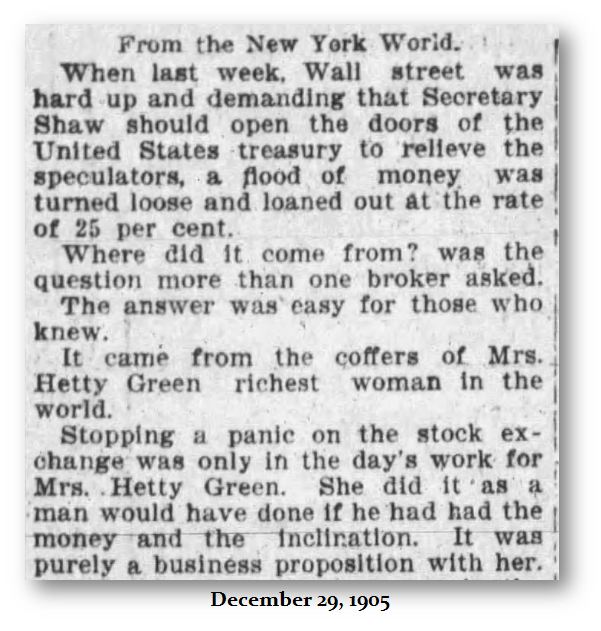
Therefore, Hetty bought railroads, real estate, and bonds. She could smell blood in the streets, as they say in financial markets, and she was there to buy it up. Men mocked her, and women scoffed at her frugal ways. Nevertheless, she had thick skin, and because she would buy in the panics and win, they called her the “Witch of Wall Street.” Yet, she even supplied the loans that kept the city of New York itself from going bankrupt. Even when the markets panicked, Hetty looked at the trend and had a nose for seeing the market. She would be there lending money at 25%.

Hetty is said to have relished a challenge. When her aunt died and did not leave Hetty the fortune she expected, she filed a groundbreaking lawsuit that still resonates in law schools and courts. When her husband defied her and sank her money on his own risky interests, she threw him out and, marching down to Wall Street, quickly making up the loss. Her independence, outspokenness, and disdain for the upper crust earned her a reputation for harshness that endured for decades.  Yet, those who knew her admired her warmth, her wisdom, and her wit.

When Hetty died, she did leave a fortune.

Her son, Edward Howland Robinson Green (1868-1936), was not so frugal. He was an avid collector and bought the famous sheet of 100 inverted air mail stamps in 1918, paying $20,000. The last example sold after a few years and brought in $1.3 million. He also had bought all five of the known 1913 Liberty Head nickels and as many as seven of the rare 1838-O half dollars. He also held dozens of high-grade 1796 quarters.

World Share Markets


Armstrong Economics Blog/Interest Rates Re-Posted Mar 19, 2021 by Martin Armstrong

QUESTION: Mr. Armstrong, you always paint the US market as outperforming everything else. There are some who are calling this the new Weimar Republic and the market is destined to crash. Where does the US market rank in your opinion? With interest rates rising, do you think the market can continue to move higher?

Thank you for your insight

DL

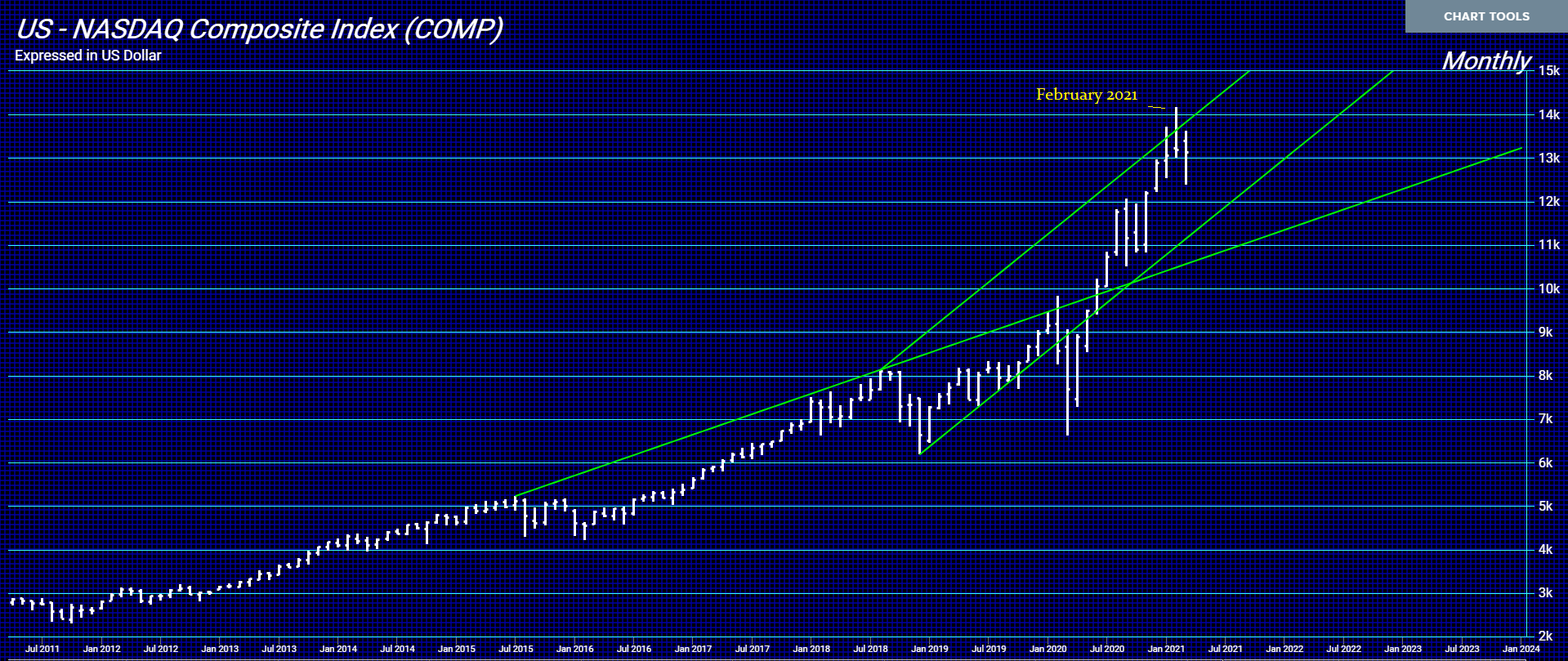
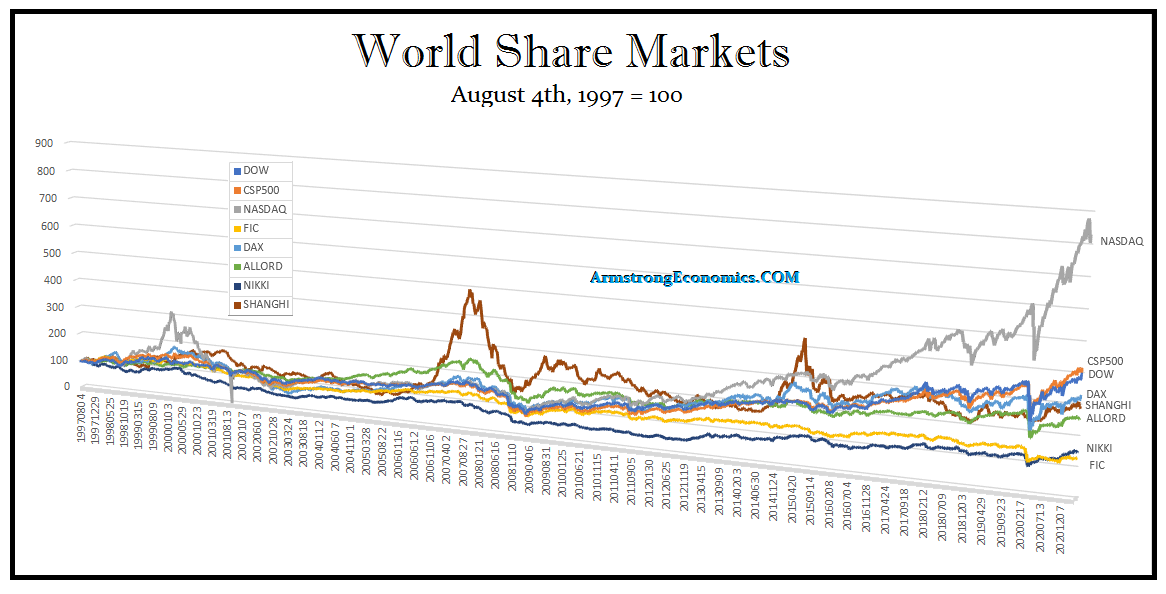
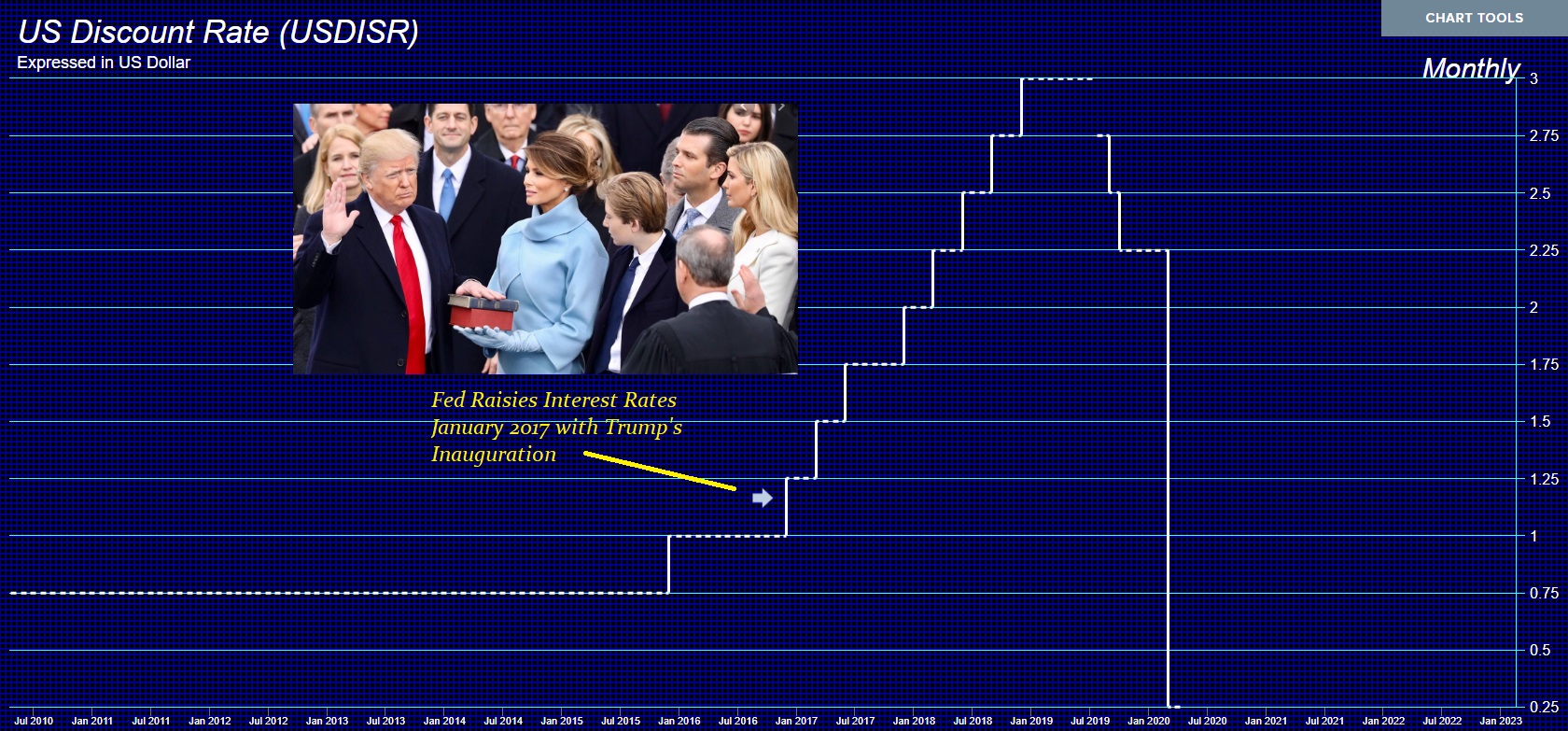
ANSWER: The US share market has been the best performing market consistently in nominal terms since 2016. The NASDAQ 2000 Dot.Com Bubble was the beginning of the shift in the economic structure that is now starting to materialize with online commerce exceeding even store sales starting in 2019. Here you can see a nominal comparison with 1997 = 100 and the three top performers were the Nasdaq, S&P500, and the Dow. The worst has been the FIC (London FTSE). You can see from 2016 onward, the bull market was set in motion by Trump’s policies.  The Fed kept raising rates all the way throughout the Trump Rally.

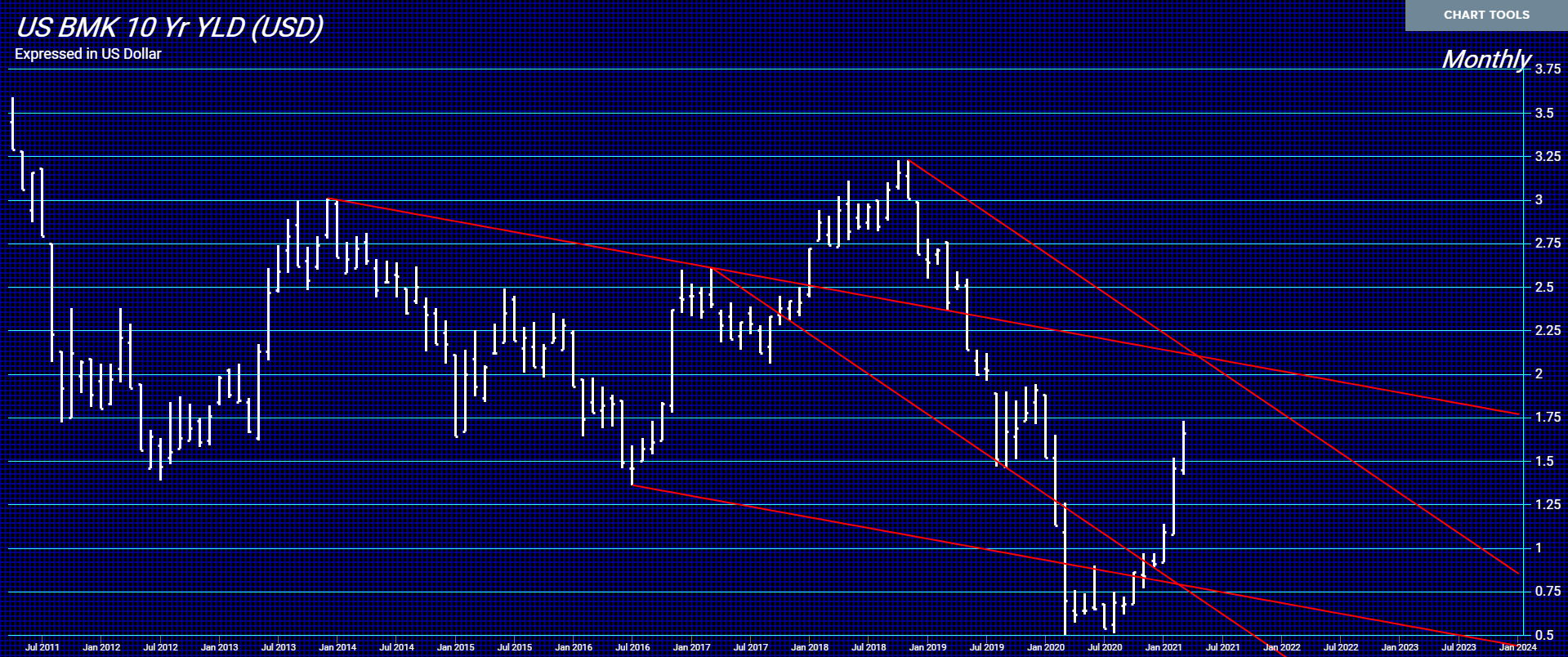
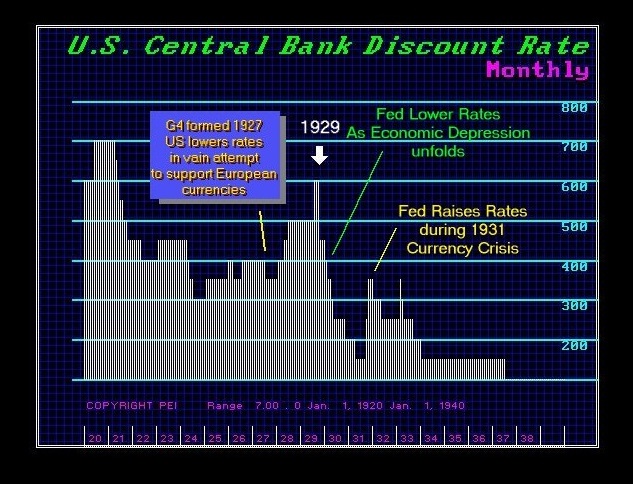
Note that during the Roaring ’20s, the Federal reserve also nearly doubled interest rates and the market still rallied substantially. So the answer is that bull markets always rally with rising interest rates for rates rise when the economy is expanding so people are willing to borrow. Rates drop like a stone when people are not interested in borrowing so all you get is economic stagnation.

Biden will most likely spend another $1 trillion on infrastructure. Then he will come out with a sharp tax increase saying we now have to pay for all this. So rates will probably jump next year and he will probably try to impose a rise in capital gains taxes retroactively. It is not likely that he will raise the income tax rates for 2021 because that would leave a lot of people with under-paying withholdings. So 2022 will probably be the Democratic dream come true as they seek to punish anyone who benefits from the expanding economy.

Gold & the Persistent Decline


Armstrong Economics Blog/Gold Re-Posted Mar 19, 2021 by Martin Armstrong

COMMENT: Marty; I just wanted to tell you an old friend of mine is still a gold bug. When I said I follow you and have actually made money, it was like you were the antichrist. He said you support the central bankers and they create endless amounts of money to fund the military but then keep gold capped to make the system work. I could not even follow his argument. Then he said you were conspiring with the bankers to take your client’s money. When I said the bankers had to return the money and you had no restitution, he just ignored it. He just said gold is dropping because of you.

Whilst I do not comprehend the argument, it just seems to be vengeance because he has been wrong. You seem to be blamed for everything.

Keep up the good work

PB

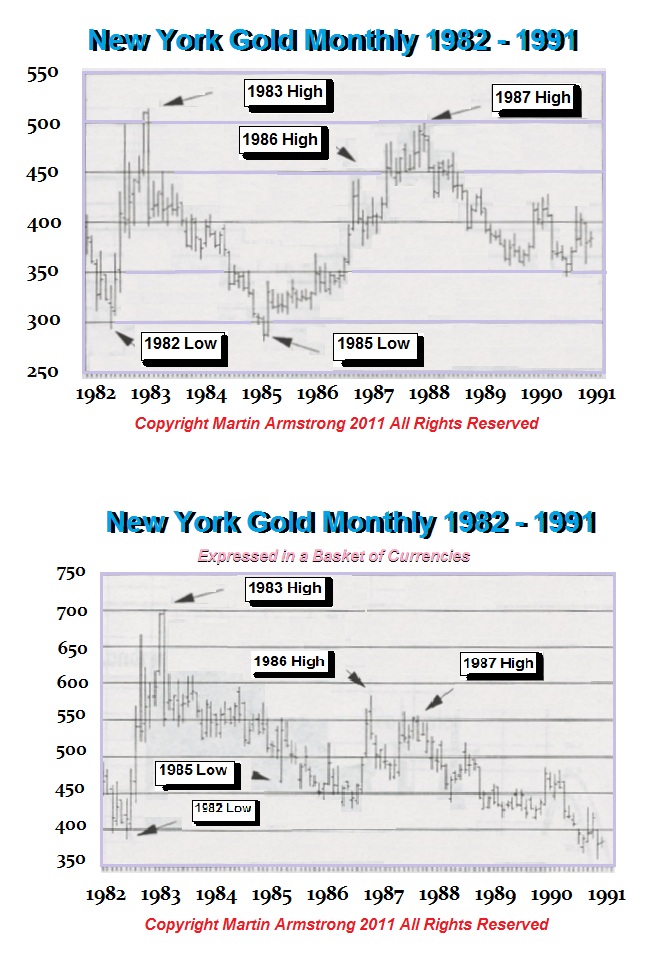
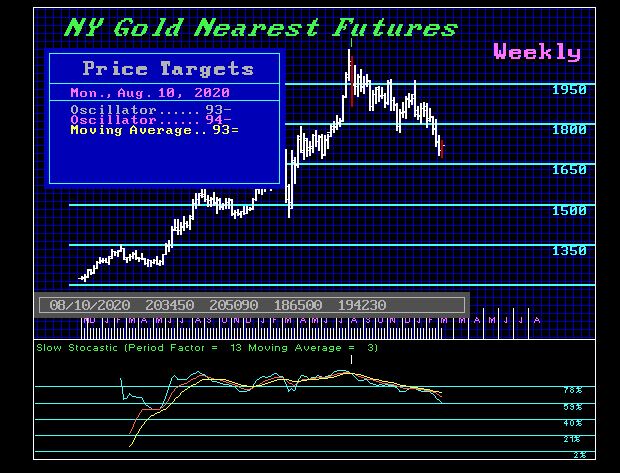
REPLY: I really do not know what to say. Even a trend following stochastic turned negative in August 2020, and 2020 was 21 years up from the 1999 low. It failed to close 2020 above a key yearly buy signal. Some of these people just want to blame others for their own mistakes. He is obviously not someone who is ever going to become a professional investor. As for the central banks printing money to help the military, that’s a good one. Never heard that one before.

I will be doing the gold report soon. I have been so busy trying to get out two books and dealing with so many companies in trouble because of COVID that it really makes me so sad. Socrates writes over 1,000 reports every day. Surely, I could never do that. But they love to blame me personally rather than be objective. There are not enough financial analysts in the world to cover all the markets Socrates does daily. When I am dead, who will they have to blame? It will be like when communism fell. They suddenly had to find a new enemy.

As for the restitution issue, the docket clearly states that the bankers “co-deft” paid the restitution. That was their deal. They agreed to return my client’s money provided no bankers went to jail. That is how New York always works. And they put a lifetime gag order on me to prevent me from helping my clients sue HSBC, which has been involved in numerous criminal activities. But the game is always rigged. The bank pays huge fines so nobody goes to jail, and the shareholders always end up paying for the illegal activities of the bankers. It is always a one-way street.