Powell Understands the Inflation was Created by COVID


Armstrong Economics Blog/Inflation Re-Posted Jul 26, 2023 by Martin Armstrong

The True Story of Hyperinflation


Amstrong Economics Blog/Cryptocurrency Re-Posted Jun 12, 2023 by Martin Armstrong

QUESTION: Dear Mr. Armstrong,
could you please explain what happens in technical terms from a capital flow perspective, when confidence is lost and hyperinflation starts to begin?
For example Turkey. When Erdogan was elected i think you wrote that ever since the lira started dropping. So confidence in politics is key. Do you think one day we will see hyperinflation in Turkey?
And another example, is Yugoslavia: what caused the hyperinflation (in technical terms/capital flow perspective)? Are foreign investors getting rid of the dinars? Too many dinars than suddenly rushed back into Yugoslavia causing hyperinflation?
Regards,
Magdalena Š.

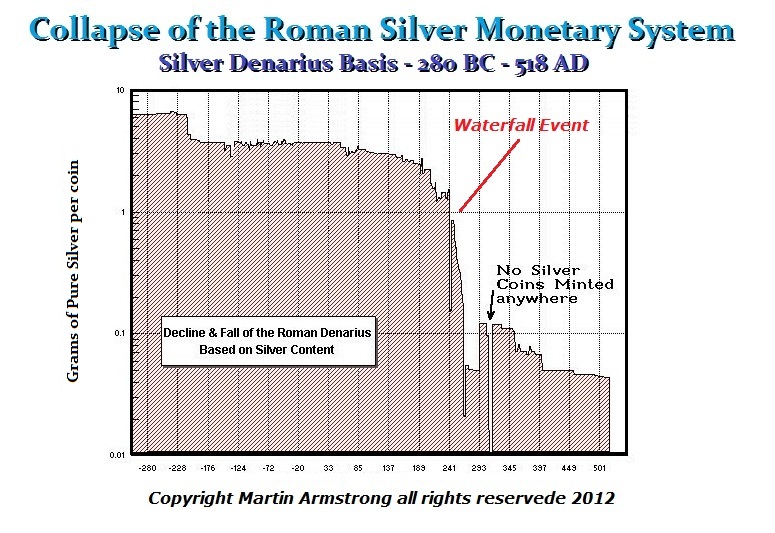
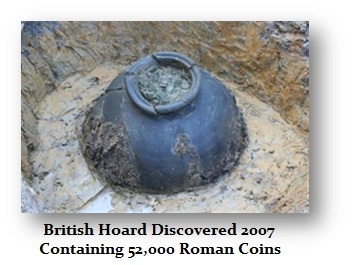
ANSWER: The misnomer about hyperinflation is that it is caused by printing money. It is a RESPONSE to the collapse in the confidence of the government.  If we look at the 3rd century, this is where we find the greatest number of hoards of ancient coins. What began this was the capture of Valerian I by the Persians in 260AD.

Valerian was the first Roman Emperor to be captured and Rome was unable to recuse him. That shook the confidence of the Roman people, but it also was a signal to the barbarian tribes in the North that if the Persians could do it, they could as well. Within 10 years, Emperor Aurelian constructed the great wall around Rome. Never before did Romans have such a defensive wall. That had a powerful army.

There was a trend toward debasing the silver coinage which began with Nero to try to fund the rebuilding of Rome after the Great Fire. But that did not undermine the confidence in the Roman Monetary System any more than our perpetual deficit spending since World War II.

However, a spark is ignited and suddenly that trend turns into what I have called a Waterfall event in the purchasing power of the currency. Such an event has taken various forms. However, the end result is the collapse in the confidence of the government and as a result, that is when you get that waterfall event.

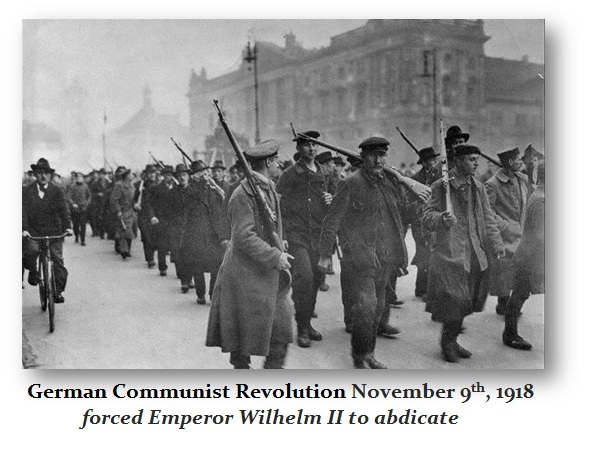
In the case of Germany, Yugoslavia, Hungary, etc, there was a 1918 Revolution where communists seized power and the emperor of Germany lost power. In that case, they actually asked Russia to take Germany after their revolution in 1917. This was the beginning of the Weimar Republic.

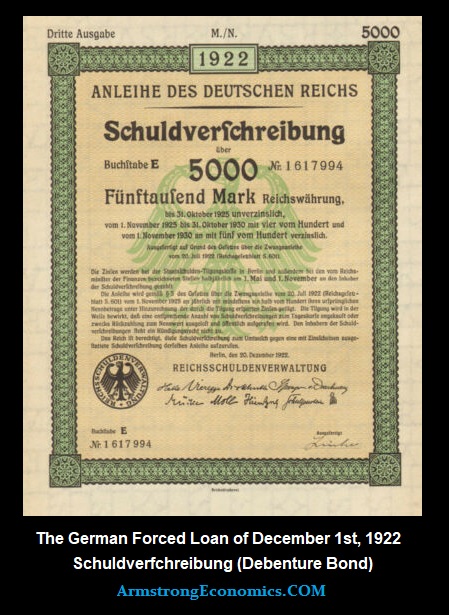
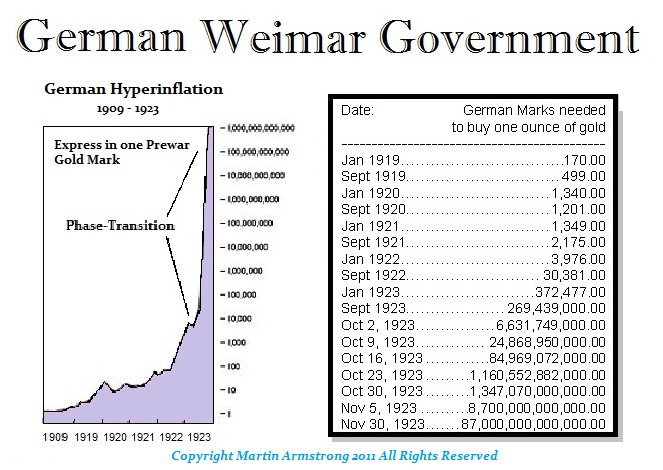
Germany was saddled with reparation payments demanded by France. First, you had a communist revolution and people with capital began to flee to other places in Europe or certainly move their money out of German banks. It was this drain of wealth that forced the Weimar Republic to print money to try to make their reparation payments. Then in December 1922, they seized 10% of everyone’s assets and handed them a bond.

Here you can see that after that December 1922 confiscation, hyperinflation simply took over. It was NOT the printing of money that caused the hyperinflation it was the collapse of confidence FIRST which then compels the government to expand the money supply lacking taxation revenues etc.

I suspect the spark this time may be the Digital Currency and the proposed cancellation of paper currency. This is why people are moving to anything tangible from real estate, gold, silver, ancient coins, and even equities. With DIGITAL CURRENCY they will have capital controls and prevent you from even moving money outside of your country.

The precise day of the ECM was the announcement of the IMF Digital Currency which they intend to replace the US dollar as the reserve currency. This may be timed with the turning point in 2024. It is unlikely that they would cancel paper currencies before the 2024 election. This is all being

Interview: The Real Rate of Inflation


Armstrong Economics Blog/Armstrong in the Media Re-Posted May 13, 2023 by Martin Armstrong

Supply Chain Crisis and Inflation


Armstrong Economics Blog/Inflation Re-Posted May 17, 2023 by Martin Armstrong

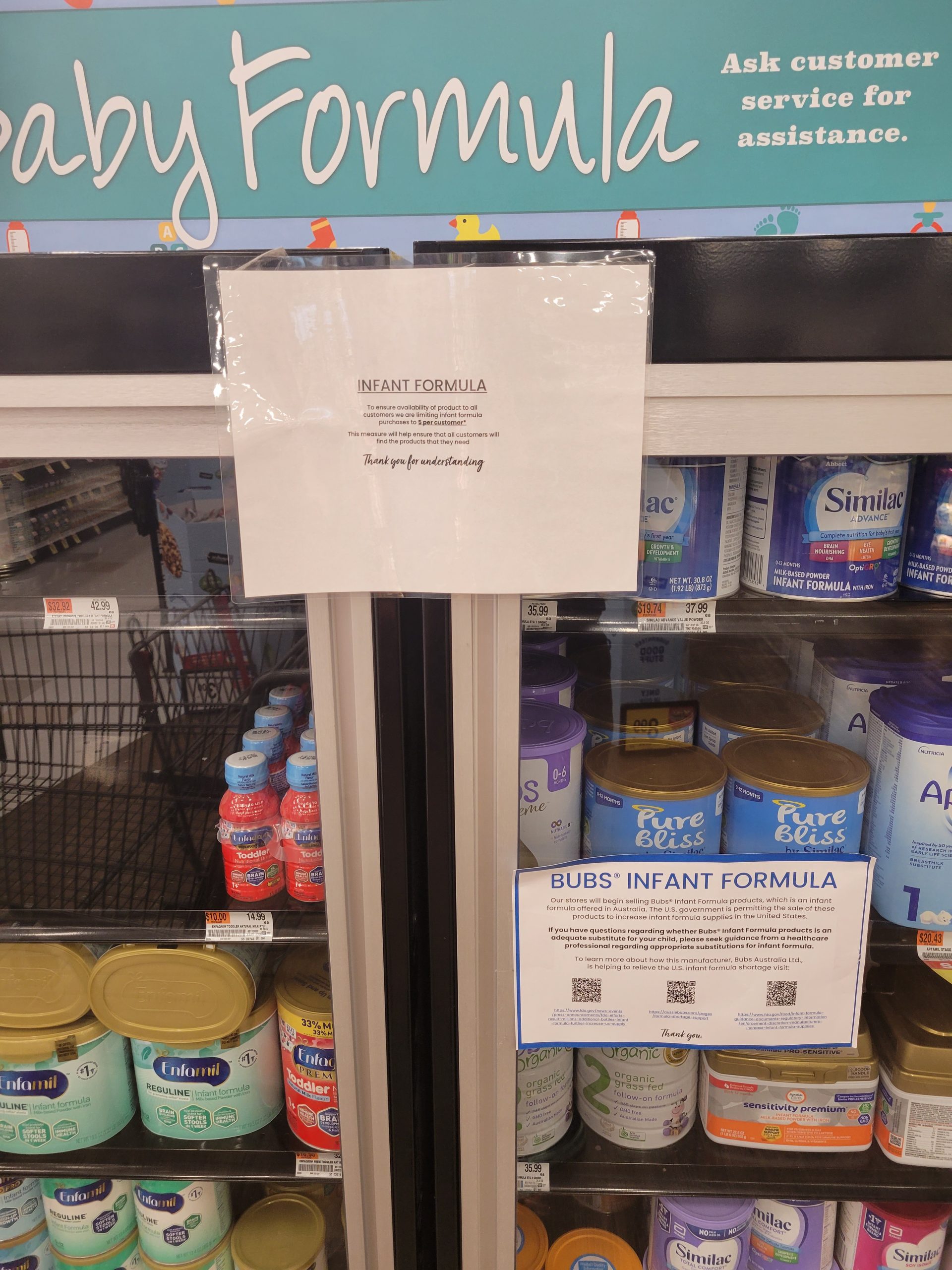
COMMENT: Hello Mr. Armstrong. Thank you for my daily dose of reality. Your blog is one of the last sources of untainted news. I would like to show these pictures my daughter sent me last week. We live in an affluent neighborhood in New Jersey where petty theft does not occur. The news outlets have not mentioned baby formula shortages. I do not believe they are locking up the baby formula to prevent crime. What is going on here?

Thanks — C.G.

REPLY: The supply chain issue has never been resolved. It improved from the days of bare shelves in the grocery stores, but many essentials are stuck in the pipeline. Products that expire will see additional shortages naturally. The supply shortage is fueling inflation and raising rates will not solve the problem.

The Fed thinks that raising rates will curb inflation by raising the cost of borrowing. That is not the problem here. Part of the inflationary crisis we are witnessing is due to demand outweighing available supply across industries. The Fed cannot control government spending nor the money supply. People are viewing the crisis today from the perspective of the ‘60s when it was NOT possible to borrow on T bills. After the collapse of Bretton Woods in ’71, you COULD trade off government debt and that eliminated the idea that it was less inflationary to borrow rather than spend. Artificially low rates that created a borrowing addiction among institutions who believed it was safe to do so.

Powell cannot come out and criticize Congress for their spending. These rate hikes are not good for the supply chain shortages. Inflation went up two years before the Fed even addressed rates due to the supply chain crisis. The central bank only began to hike rates after the war in Ukraine began. Notice how at the last meeting, the FOMC incorporated that they will monitor “international events.” WAR is the primary driver of inflation and there is nothing that the central bank can do to prevent the destruction caused by government and years of poor monetary policy.

Study Puts Data Together Showing Joe Biden Inflation Impact on Pet Food Products


Posted originally on the conservative tree house on May 16, 2023 | Sundance 

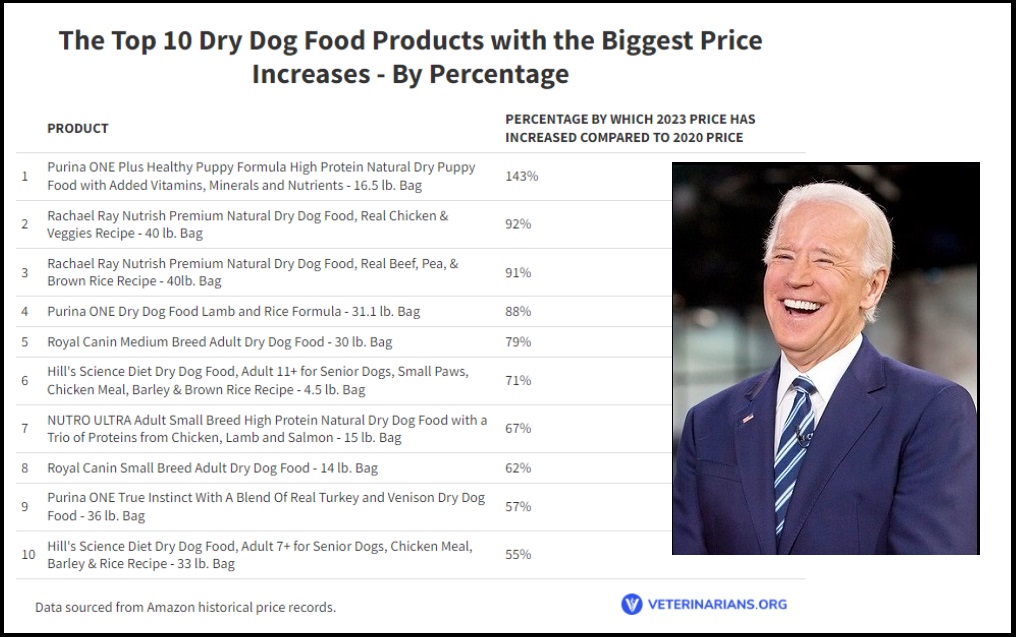
We have talked about the stunning price increases in pet foods during our discussions about food price overall.  However, a remarkable study by Veterinarians Org gives some context to just how much the Joe Biden inflation has driven up the cost of pet foods. [ARTICLE HERE]

Mostly driven by Biden’s created inflation hitting raw farm materials, energy prices, manufacturing and transportation costs, the prices for the most popular wet and dry dog foods have skyrocketed.

One in four pet owners have even contemplated giving their animal up for adoption because they can no longer afford them.   This is terribly sad.

(Veterinarian Org) – […] The largest percentage increase compared to 2020 prices is for a wet dog food product by PEDIGREE, which has increased by 207% compared to its 2020 price.

The largest dollar amount increase compared to 2020 prices is for a dry dog food product by Royal Canin, which is currently $43.99 more expensive per bag than it was in 2020.

In a recent Veterinarians.org survey of 1,000 U.S. pet owners, 50% of respondents indicated having to shop for cheaper alternatives to pet food as a result of rising costs. Pet owners also found themselves shopping for cheaper alternatives to pet treats (41%), pet toys (34%), and pet health supplements (28%).

55% of surveyed pet owners indicated having to cancel pet food subscriptions on Chewy.com, Amazon.com, or through a raw food/pre-cooked meal service as a result of rising costs.

22% of pet owners indicated having applied to special services in their state that help pet owners pay for pet-related costs, while 73% of pet owners felt a food pantry for pets would be helpful to them.

24% of pet owners indicated considering rehoming their pet or surrendering their pet to a shelter as a result of rising pet food/pet supply costs.

According to the American Pet Products Association, Americans spent $50 billion on pet food and snacks in 2021. (read more

[Source]

Yellen & Biden Should be Impeached to Save America?


Armstrong Economics Blog/Gov’t Incompetence Re-Posted May 12, 2023 by Martin Armstrong

Janet Yellen has become way too partisan to be a trustworthy government official. Since Biden now says he will nominate a Latina for Fed governor regardless if they are qualified or not is precisely why SVB failed for starters. Everyone just wants to be WOKE and hire people based entirely on their race or gender preference. SVB hired risk managers to check a box. Why is Yellen still there? She would be fired being a white over-the-hill official. Or is it that she is just like Biden and says whatever the people writing cue cards instruct her to say next?

All Yellen does now is illustrated if she had any economic qualification, she is either corrupted or senile. Yellen just preached that the Biden Administration should be allowed to spend recklessly and it’s all Republican fault about a default. She said that the US will default somewhere if the debt limit isn’t raised. How about we start with ending the Ukrainian black hole? How about the $3 trillion unaccounted for in the Pentagon budget?

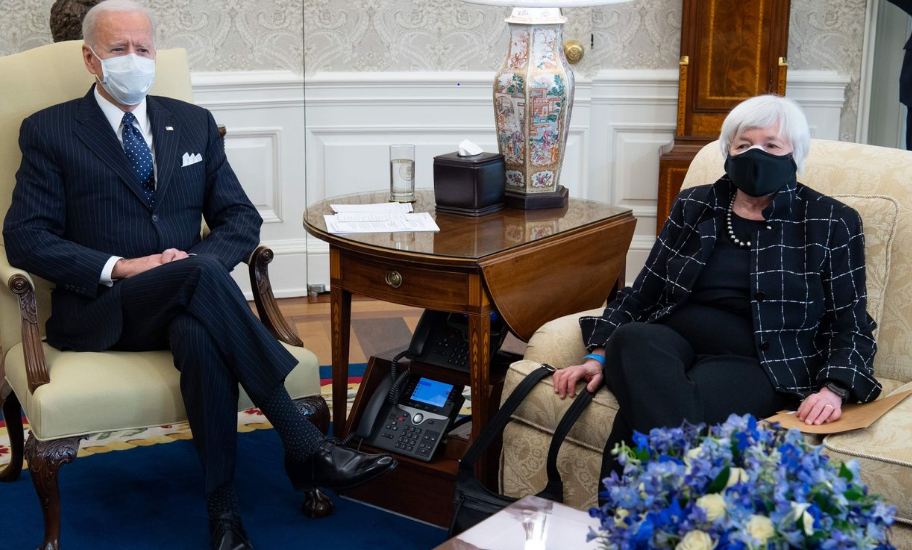
Janet Yellen and Biden should not wear masks, they should be gagged. Yellen only claims doom and gloom and it is all the Republican fault. She said that they will have to renege on “some obligation, whether it’s Treasuries or payments to Social Security recipients,” if Congress fails to act. You can bet that she will default on Social Security before anything else to inflict as much pain on people and then blame the Republicans for the next election.

Neither Biden nor Yellen should be in office. They are spending recklessly with no regard for the economy or the American people. What they have given Ukraine would have paid off ALL student loans. They constantly screw the American people all for the agendas of the Neocons and the Climate Change zealots. Since the FBI infiltrated the Catholic Church because of this gender nonsense, all Catholics should go light a candle and pray for the United States to be spilt soon than later. It is rapidly approaching the time to just turn out the lights on this failed experiment.

Once upon a time, this was supposed to be a country run by We the People.

Interview: The Real Rate of Inflation


Armstrong Economics Blog/Armstrong in the Media Re-Posted May 13, 2023 by Martin Armstrong

Against Backdrop of Inflation Continuing, Fed Set to Raise Rate Again Before Debating Pause


Posted originally on the CTH on May 1, 2023 | Sundance 

Everything about the process of cutting down energy exploitation, then driving supply side inflation, then raising interest rates to shrink demand (stem inflation) created by a desire to lower economic activity to the scale of diminished energy production, is a game of pretending.

The collateral damage from the rate hikes has been the banking destabilization, which shows the priority of the government officials and central banks to support the climate change agenda.  Into the game of pretending comes the second unavoidable consequence with inflation continuing as a result of the energy policy.

They simply cannot cut energy demand enough to meet the diminished scale of production.  There is no alternative ‘green’ energy system in place to make up the difference. That is the reality.  Now, the fed is scheduled to raise rates again, then begin to debate the collateral damage as they continue the pretending game.

(Via Wall Street Journal) – […] Another quarter-percentage point increase would lift the benchmark federal-funds rate to a 16-year high. The Fed began raising rates from near zero in March 2022.

Fed officials increased rates by a quarter point on March 22 to a range between 4.75% and 5%. That increase occurred with officials just beginning to grapple with the potential fallout of two midsize bank failures in March.

The sale of First Republic Bank to JPMorgan Chase & Co. by the Federal Deposit Insurance Corp. announced early Monday is the latest reminder of how banking stress is clouding the economic outlook.

Fed officials are likely to keep an eye on how investors react to that deal ahead of Wednesday’s decision, just as they did before their rate increase six weeks ago when Swiss authorities merged investment banks UBS Group AG and Credit Suisse Group AG. (read more)

There is no other way to look at the combined policy without seeing a Central Bank Digital Currency (CBDC) in the future.  All of these combined policies are creating a self-fulfilling prophecy.

Stop energy production. [Jan 2021]

Supply side inflation begins.

♦Raise interest rates. [April 2022]

Economic activity slows (but not enough).

♦Continue raising interest rates.

Banks destabilize. [Q1 2023]

Inflation continues.

♦Continue raising interest rates.

Economic activity slows (but not enough).

Banks continue destabilizing. [Q2 2023]

♦Continue raising interest rates.

Evaluate banking pressure. [We are Here]

Banks cannot withstand pressure.

Create CBDC

The Great De-Dollarization


Armstrong Economics Blog/USD $ Re-Posted Apr 23, 2023 by Martin Armstrong

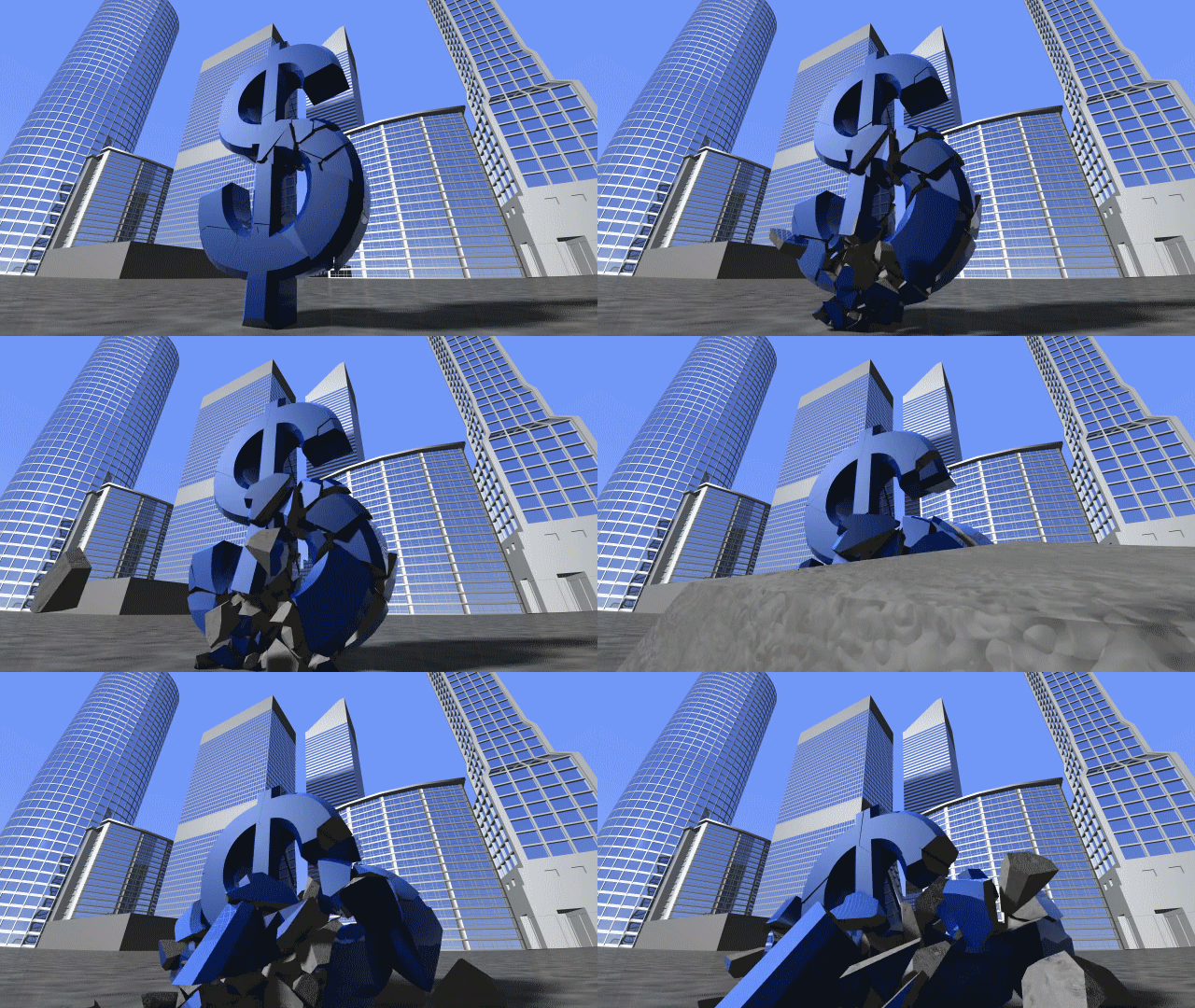
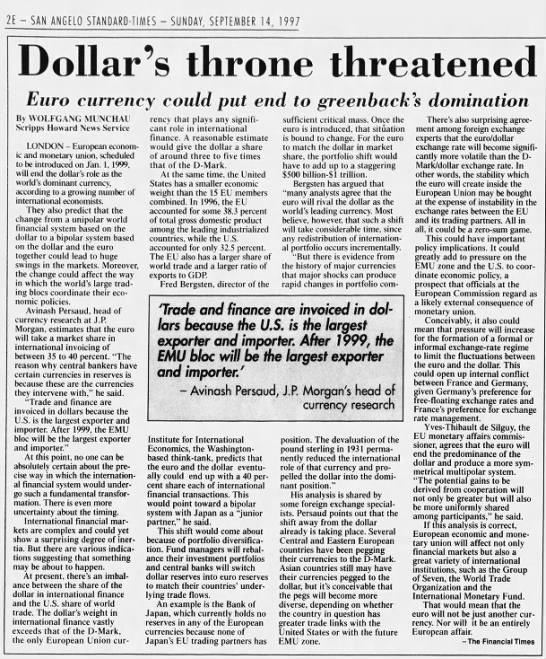
All we hear is the same claims that the dollar is dead and it will be totally worthless any day now. Over the last few weeks, all we hear from the majority now is that the dollar is finished. Virtually every page you turn or site you visit claims the death of the dollar. They are calling this the de-dollarization of the world economy and that the future of the US dollar as well as the American empire itself is now collapsing. The general claim is that the group of economically-aligned nations known collectively as BRICS is a major threat to the greenback. That was the same story we heard about the Euro back in 1997.

As their scenario goes, the BRICS [Brazil, Russia, India, China, and South Africa] have moved to form an anti-dollar colation and Saudi Arabia is considering jumping on board. They insist that once that happens, the “petrodollar” will die and cease to be a reserve currency.

This is then followed by the forecast that the economy will suffer and that any bounce in exports will be short-lived simply because the dollar will be dead for the long term. Of course, this has been the favorite forecast that they keep putting out since Bretton Woods collapsed. They were wrong back then for the dollar rose between 1972 and 1976 against the British pound, with the collapse of Bretton Woods. To try to explain why the dollar did not collapse, that is when they claimed that the dollar was backed now by oil rather than gold. That was just an excuse as always to cover up their wrong forecast.

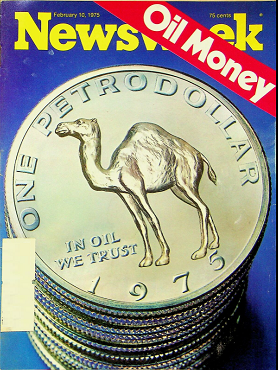
They sold that story to Newsweek and now the dollar rally was because of oil which replace gold. Suddenly the dollar became de facto backed by oil. They needed an explanation to explain why all the old theories were wrong. They sold this theory and it made the front cover of Newsweek. Everyone said YES! That must be the reason. OPEC priced oil in dollars! Naturally, everything was priced in dollars because, under the fixed exchange rate of Bretton Woods, everything from wheat and corn to copper and gold was all priced in dollars.

Now they are saying the American empire is threatened by the potential commercial real estate collapse and the BRICS anti-dollar venture. So they are forecasting a great depression-style crash is possible in the not-too-distant future. They spin this to forecast the end of the America Empire. The London FT, always anti-American/Pro WEF, reports that the dollar as a reserve currency has declined from  73% in 2001 to around 55% by 2021. Yet the FT did state an obvious fact:

“But if you are a reserve-rich central bank elsewhere that isn’t going to be a lot of comfort. Moreover, would you really feel more comfortable in, say, the renminbi? Even if it was fully convertible and liquid, would you honestly feel more sure that Beijing will behave lawfully than DC? The dollar still looks like the proverbial least dirty shirt in the closet.”

COVID actually has played a major role in shifting the world economy. In 2020, the US economy was 24.75% of the world’s GDP. By the start of 2022, it had fallen marginally to 24.15%. What these dollar-forecasting jockeys do not understand, is that if they were correct and the dollar collapsed, then the very BRICS would collapse even further. Economically speaking, when the United States gets a head cold, the rest of the world catches ammonia. You can’t have it both ways. The strength of the dollar is not gold or oil, it is the American consumer.

The risk to the entire world is runaway inflation thanks to Biden pouring untold amounts of money into the black hole known as Ukraine. The Neocons, who control Biden, are planning to launch a war against Russia and China before 2024. This will only continue to accelerate inflation. That reduces the spending power of the American consumer and in the process, the US economic growth declines in real terms and with it, the rest of the world plunges into recession.

While Macron has figured it out that the Neocons are in charge of US foreign policy and he is telling Europe to stop being the puppet of the USA, that all sounds nice but Europe is marching into war with Russia. NATO is firmly in control of the American Neocons and they need war or face losing power. With Trump in the lead, they must stop him at all costs for he is anti-war, would haul the Neocons out by the necks, and defund NATO, as well as stop the climate change agenda.

The US dollar in the global economy has been supported by the size and strength of the US consumer-based economy. Its stability and openness to trade and capital flows without restrictions and it has never been canceled, are the major foundation of the dollar in addition to strong property rights and the rule of law. That is why Russians and Chinese buy US property for they are secure in their ownership of US property which cannot always be guaranteed outside the US.

Consequently, the depth and liquidity of US financial markets remain unmatched. For institutions parking billions, the United States represents a large supply of extremely safe dollar-denominated assets. Are they really going to switch to China or buy debt from Brazil?  Not a single institutional client will take that bait.

China has been divesting of dollar reserves because it KNOWS that the American Neocons want war. You do not fund your adversary who intends to wage war against you. China cannot shift reserve assets to Europe or Japan. They have been buying gold because it is geopolitically neutral territory. They are NOT buying gold as an investor thinking it will rally. That is irrelevant. If gold drops 25%, that does not translate into them becoming a seller.

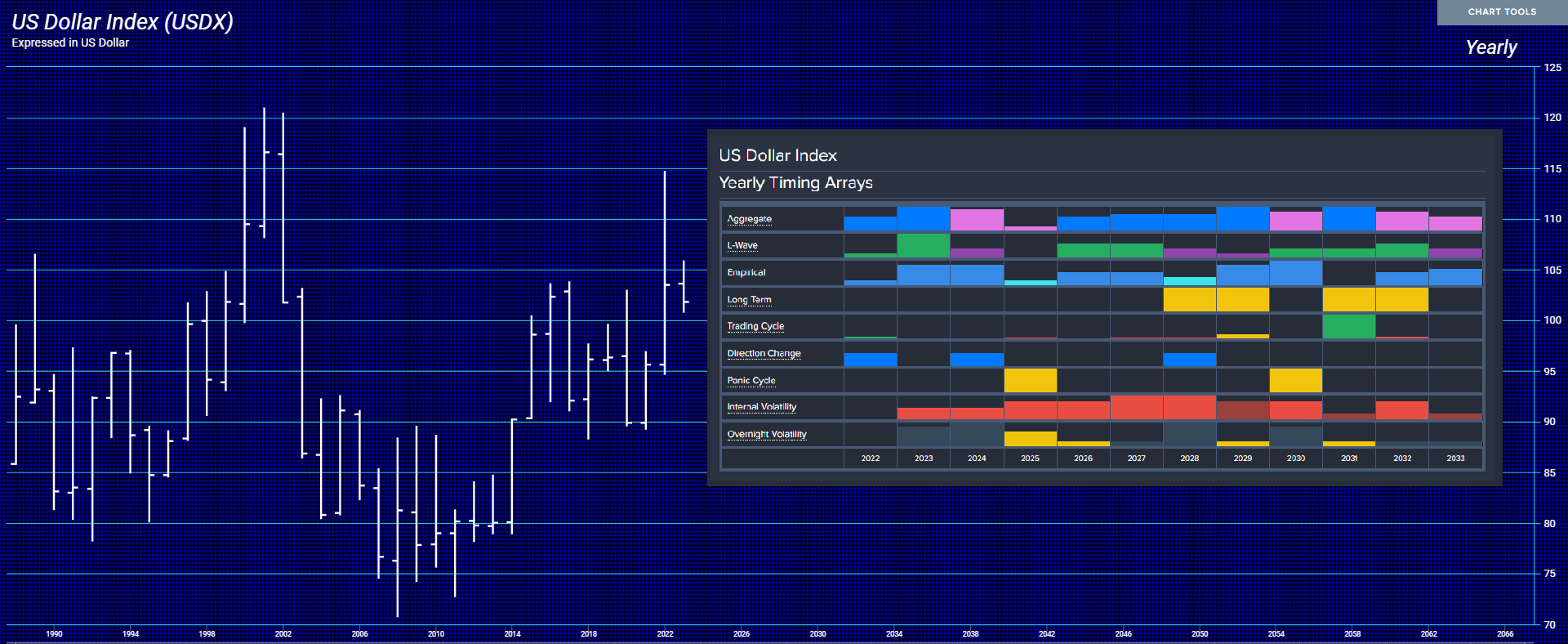
The dollar in international reserves stood at 60+% at the start of 2022 against the US share of GDP at 24.25%. This comparison belittles the argument that the dollar is finished. Eventually, the US will lose the wars it is starting and the dollar will be replaced perhaps as soon as 2028. The IMF is already licking its lips and rubbing its hands together eager to get control of the reserve currency. But they too will collapse. We have a Directional Change next year and a Panic Cycle in 2025. So buckle up.!

Remember one thing, even with the debasement and collapse of the Roman Denarius between 260AD and 268AD, it still took 224 years for Rome to completely collapse. When war breaks out, capital flight will still be to the dollar. It will not be to public assets, but private. The United States is still supporting the entire world economy. The BRICS need the US consumer to keep their economies functioning. All this talk of the dollar being finished is really nonsense. That day will come, but when the US consumer no longer buys.

Remember 1997? The Euro was going to dethrone the dollar. They claimed the new EU will be a bigger economy than the US. The problem was, they lacked a consumer economy, and low taxes, and they routinely canceled their currency to force people to pay taxes. It is always the same story over and over again.

March Housing Sales Drop 2.4%, Year Over Year Decline of 22% From March 2022


Posted originally on the CTH on April 20, 2023 | Sundance

As higher interest rates continue to put pressure on borrowers, the ability of the average person to afford a mortgage diminishes.  Higher mortgage rates lead to downward pressure on residential home values as fewer borrowers can afford higher payments.  Simultaneously, commercial real estate is dropping in value as vacancies continue increasing.

Put both of these issues together and already tenuous banks holding mortgage bonds as assets can become more unstable.

This dynamic creates the continual tremors in the background of an economy already suffering from high inflation and low consumer purchasing of durable goods.

A perfect storm starts to realize.

(Wall Street Journal) U.S. existing-home sales decreased 2.4% in March from the prior month to a seasonally adjusted annual rate of 4.44 million, the National Association of Realtors said Thursday. March sales fell 22% from a year earlier.

March marked the 13th time in the previous 14 months that sales have slowed. The housing market had a surprisingly strong February, when sales rose a revised 13.75% from the previous month. But after mortgage rates ticked higher, March sales resumed the extended period of declines.

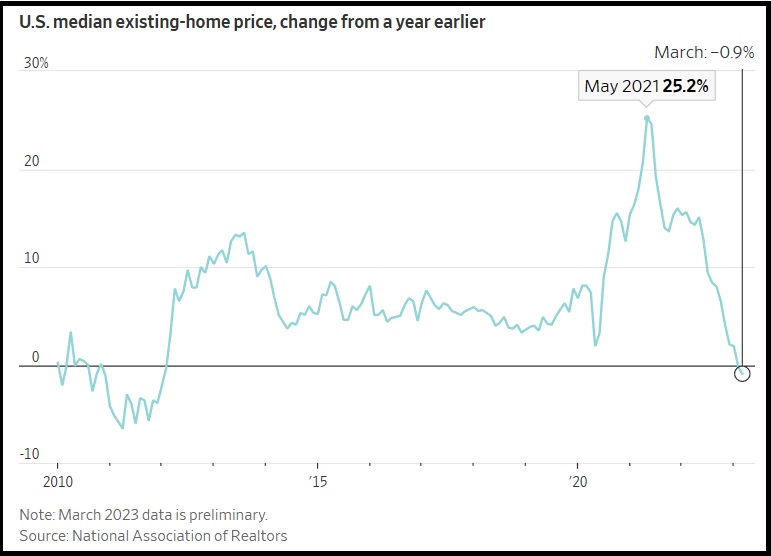
The housing market’s slowdown is now starting to weigh on prices, which have fallen on an annual basis for two consecutive months for the first time in 11 years. The national median existing-home price decline of 0.9% in March from a year earlier to $375,700 was the biggest year-over-year price drop since January 2012, NAR said.

Median prices, which aren’t seasonally adjusted, were down 9.2% from a record $413,800 in June. Home prices in the western half of the U.S. experienced some of the biggest gains for many years but are now falling the fastest.

[…] Housing starts, a measure of U.S. home-building, fell 0.8% in March from February, the Commerce Department said this week. Residential permits, which can be a bellwether for future home construction, dropped 8.8%.

The housing market slowdown shows one of the main ways that the Fed’s aggressive interest-rate increases are rippling through the economy. Housing is one of the most rate-sensitive economic sectors, and high housing costs have been a big contributor to inflation. (read more)

Before looking at today’s graph showing median existing home values, remember me saying this in 2021?:

“I said in June, at a macro level home prices had reached their peak (last two weeks of May, first two weeks of June was apex).  Obviously, there are some geographic home value increases still happening as COVID related regional issues and work opportunities are shifting populations.  There is also a lag and ripple effect that takes time to work through the economy.  The macro-apex will not be visible until next year.”

When I said that in 2021, people said I was wrong.   Well, with hindsight now visible within the data as it is reflected, look at the result:

May and June 2021 was the peak of year-over-year percent of change in median home value increases.

So, what was going on?

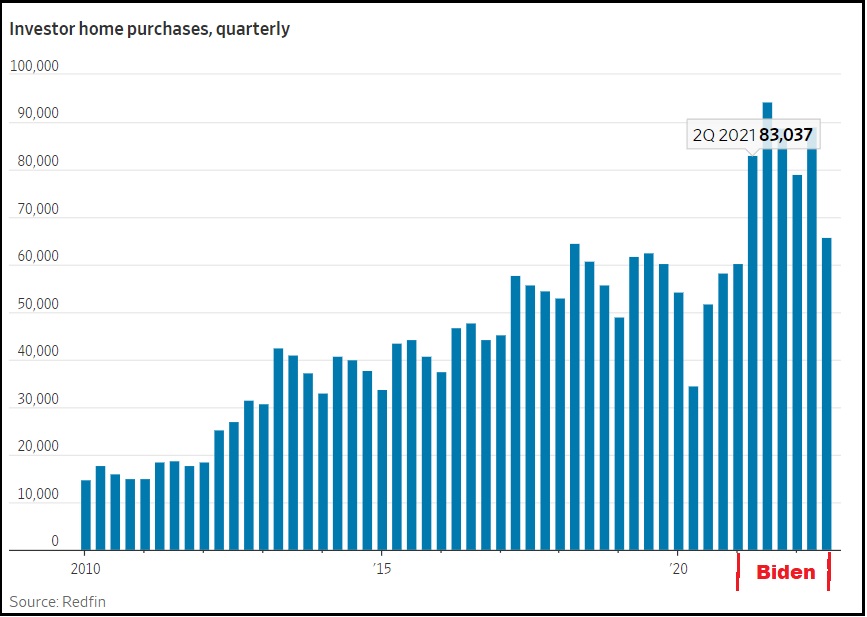
As CTH outlined in 2022:  If you look closely at the timing (keep in mind the data reporting lag) what you will notice is that financial institutions began a big surge in purchasing hard assets, specifically real estate, as soon as Joe Biden took office (Jan ’21), and the economic policy became evident.   Intangible financial instruments became an immediate risk as the professional financial control groups recognized energy policy would drive inflation (supply side) and devalued money would fuel it (demand side).

As an offset to predictable inflationary policy (the insiders’ game), institutional money (Blackrock, Vanguard etc) was moved into hard assets with tangible value.

This shift in asset allocation, institutional sales, helped fuel a false surge in home prices and their valuations.  CTH was writing about this in 2021, and sounding alarms as it took place.  25% of all real estate purchases were being made by institutional investors.

We The People got screwed. 

The dynamic was predictable.  The Biden administration economic policy, energy policy and monetary policy, was going to cause massive inflation.  CTH was shouting about it in early 2021 and warning everyone to prepare for waves of price increases that would naturally surface first on high-turn consumable goods, and then embed into longer-term durable goods.

Despite claims to the contrary, this 2021 inflationary explosion had nothing to do with the pandemic or supply chain shortages.  It is entirely self-created by western governmental policy; the collective ‘Build Back Better’ agenda.  You can see now from the background moves within the financial sectors, they too knew the reality and their money shifts reflected that despite their ‘transitory’ pretending they were mitigating their own exposure.

We the People were yet again going to be victims of specifically intended monetary, regulatory, energy and economic policy.

The investment class rulers of the WEF assembly shifted assets to avoid the pain that we would feel.   We “would own nothing and be happy,” and their shifts would position them to own everything and be in control.

Overall govt spending and regulatory controls drove inflation for these past two years.  The ‘demand side’ was blamed, despite the lack of demand. I will be proven right when history is concluded with this.  Interest rates were raised by central banks in an effort to support the policies that are driving ‘supply side’ inflation, not demand side.

Energy policy was/is crushing the consumer by driving up the cost of all goods and services.  To support the overall goal of changing global energy resource and development (a false and controlled global operation), central banks raised interest rates.  Various western economies, including our own, have been pushed deeper into a state of contraction by central banks crushing consumer demand, and eliminating investment via increased borrowing costs.

In short, the goal was/is to lower energy consumption by shrinking the economic activity.  This, according to the BBB plan, was needed at the same time as energy development was reduced.  These economic outcomes are not organic, they are all being controlled by collective western government agreement.

Within this control dynamic, there was always going to be a point where the reaction of the people to their economic reality means the financial control elements need to shift direction.  They will always maximize profit and minimized risk, while knowing what the larger objective remains.

Just like every other durable good, housing demand contracts as prices and costs become unaffordable.  The loss of equity within your home is damaging to your own value or ability to borrow against it.

From the perspective of an institutional asset, that same equity drop is an investment loss.  However, the investment loss is not materialized until the sale of the lower valued asset is completed.  Retaining declining real estate on investment books, creates an artificially high appearance of the investment result; unless and until the real estate is sold at a diminished value.

As mortgage rates rise, just as a consumer would pull back from the housing market, so too will institutional investment groups now control the slow dumping of the asset to remove the equity they pumped into it.  Much of the investment housing will be retained as rental housing, with the monthly rents being part of the returns on the investments.    However, as this dynamic unfolds further investment purchases of houses stop, because the asset overall is declining in value.  This halt of investment activity also worsens a steeper drop in home values.

Notice this line within today’s WSJ article: “The housing market had a surprisingly strong February, when sales rose a revised 13.75% from the previous month.

What happened in February?  The BIG CLUB [Blackrock, Vanguard, Citadel, etc.] moved liquid assets out of banks into hard assets (real estate), to avoid a predictable banking issue which surfaced a month later in March.  They knew what was going to happen in banking, they moved their own assets to avoid it.