Massive Increases in U.S Natural Gas Exports are Driving Up U.S. Energy Prices


Posted originally on the conservative tree house on September 10, 2022

It is good to see at least one energy finance analyst at the Institute for Energy Economics and Financial Analysis, speaking commonsense.  In an article by Clark Williams-Derry for Barron Magazine [SEE HERE], the author accurately outlines how significant U.S. Liquified Natural Gas (LNG) exports are driving up prices for American consumers.
The author accurately refutes the notion that exports do not drive-up domestic prices, by walking through the example of how natural gas prices dropped for U.S. consumers when the liquefied natural gas plant in Quintana, Texas [Freeport LNG] was temporarily shut down, blocking a portion of the export capacity.  However, that facility is about to come back on-line and with increased exports from other facilities domestic U.S. prices have already doubled.

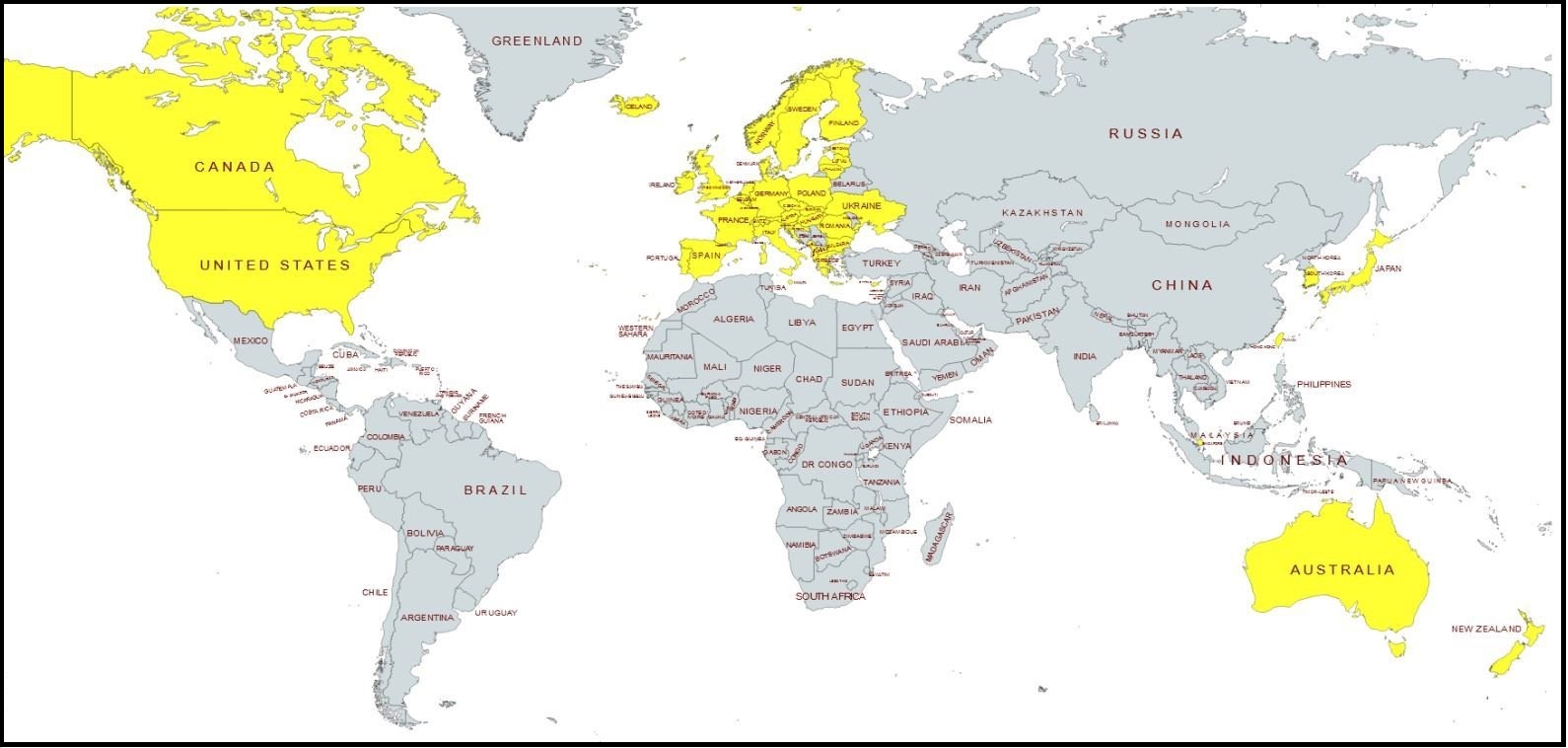
According to the U.S. Energy Information Association (IEA), U.S. storage of Liquified Natural Gas (LNG) is 12% below the five-year average (LINK).  Additionally, the IEA is expecting the U.S. to export 11.7 billion cubic feet of LNG per day during the fourth quarter of 2022 — up 17% from the third quarter. The destination of that export is Europe.

Consider that 43% of U.S. households use LNG for home heating, and power suppliers use LNG to create electricity.  With the massive 2022 exports of LNG to Europe (+17% in fourth quarter alone), that means lower domestic supplies and increased prices here in the United States for electricity and home heating.  We are seeing and feeling these massive price increases right now.

Barrons – […]  If you need more evidence of the impact of natural gas exports on prices, just compare supply and demand fundamentals for the year leading up to February 2020 (the last pre-pandemic month) versus the year leading up to this May (the most recent month with full federal data). Annualized production rose over the period, while domestic consumption remained roughly flat. Yet LNG exports almost doubled—a surge that tightened U.S. gas markets and doubled the price that U.S. consumers pay for the fuel. 

The growth of global demand for U.S. LNG can be tied to many market forces, including the shortfalls in Europe due to Russia’s manipulation of European Union gas markets. Sustained high demand in wealthy Asian nations has contributed to export growth as well. And so has the U.S. gas industry’s dogged determination to ship its wares to the highest bidder, foreign or domestic. 

Russia’s role has been particularly critical in the rise of global LNG demand. As Russia choked off gas shipments to Europe, EU buyers have turned to global LNG markets to make up the shortfall. Global LNG prices rose in response, and U.S. LNG companies ramped up output, shipping more cargoes to Europe. But Russia responded by further clamping down on gas supplies to the EU—a vicious circle that has hurt Europe’s economy even more severely than it has harmed America’s.

There’s little sign that U.S. gas prices will ease in the coming years. Freeport’s demand will be back online soon enough, and there are three other massive LNG export projects under construction, with more than a dozen of others waiting for financing.

[…] Curiously, federal regulators have consistently found that the gas export projects are in the public interest—meaning they were in the economic interest of LNG companies and gas drillers. But now, exports are creating sky-high costs for U.S. consumers, and drillers are reluctant to boost gas output lest prices fall back to earth. So, it’s high time to consider whether soaring U.S. LNG exports are actually in America’s interest—or if, instead, runaway LNG exports are fueling energy inflation and undermining the nation’s economic competitiveness. (read more)

Not only are U.S. taxpayers directly paying for the majority of costs in Ukraine, but we are also subsidizing the European Union by exporting LNG and driving up the price for energy here at home.

We the taxpayers are directly paying Ukraine, and indirectly paying Europe to maintain gas sanctions against Russia.  As a result, we the taxpayers are also paying higher prices here at home.  This is the reality of the current exfiltration of wealth as created by the Biden administration.

FUBAR

U.K Energy Reaches Crisis Point, Britain Announces New Oil and Gas Leases and Lifts Moratorium on Fracking


Posted originally on the conservative tree house on September 10, 2022 

There is a particular historical irony in the timing.  On the same day King Charles III ascends the throne, previously Europe’s most isolated from consequence – yet loudest voice in chasing the catastrophic climate change energy policies, the British government is forced to reverse course on years of energy regulations and restrictions.

Britain’s new Prime Minister Liz Truss announced, “a new round of oil and gas licensing will come next week with more than 100 licenses issued. A moratorium on fracking will be lifted and planning permission can be sought where there is local support,” in an urgent emergency effort to lower energy costs for British citizens.

The move comes in combination with a government plan to help citizens and businesses cope with skyrocketing prices for electricity and home heating fuel.  The climate change chickens have come home to roost throughout Europe and the British government is urgently trying to head-off the calamitous consequences.

Inside the media announcements of the Truss plan, the biggest concern expressed is how the financial and multinational banking sector (the ESG investment groups) will respond to the government position. After decades of ideological “green” outlooks flowing into the energy industry, the biggest concern expressed in the financial analysis is how a reversal by such a large economic system will reverberate.

The climate change ideology has a stranglehold on the energy sector of the economy, this move by Great Britain would be the most significant push-back in decades.  The minority green activists are apoplectic that they may lose control over the majority of opinion.  The economics of a reversal in energy policy could reverberate throughout the western alliance, particularly in Europe.  It will be interesting to see whether this shift in U.K. policy has ripple effects in the U.S.

LONDON, Sept 8 (Reuters) – Britain’s move to green-light dozens of new oil and gas fields will leave investors and banks with a tough PR job as Britain struggles to shore up its energy security whilst sticking to its climate commitments.

Starting new oil and gas projects runs counter to the world’s shift away from fossil fuels in the fight against global warming and a commitment at last November’s U.N. climate talks to phase down their use.

Yet runaway inflation amid conflict in Ukraine has forced the hand of new British prime minister Liz Truss as Russian President Putin seeks to use energy as a weapon this winter.

Britain will launch a new round of oil and gas licensing next week with more than 100 licenses issued, part of a wider package of measures to tackle the energy crisis announced by Truss on Thursday.

And Britain’s not alone in reassessing its energy strategy. Germany, for example, has been forced to turn back to even dirtier thermal coal to help fuel its power plants and keep the lights on, hampering short-term efforts to rein in climate-damaging carbon emissions.

But for energy companies and the investors, bankers and insurers that finance them, new investment in fossil fuels also presents a challenge given many have made their own pledges to reach net-zero emissions by mid-century.

“This will absolutely hinder companies’ … ability to hit their climate targets,” said Pietro Bertazzi, global director of policy engagement and external affairs at non-profit environmental disclosure platform CDP. (read more)

This is the first crack in the western alliance and the ‘climate change’ agenda of the World Economic Forum as it relates to energy policy and ultimately control over human life within the alliance.

The war in Ukraine was being used as a justification to explain the consequences of European energy policy, particularly rapidly increasing costs for energy and food, but the war in Ukraine was not the cause.  The true root cause of the exploding inflation and economic mess was the Build Back Better agenda, and the series of policies dictated from within it, that each nation willingly accepted.

Fearing a Complete Shutdown from Russia, Europe Scraps Plans to Cap Russian Gas Prices


Posted originally on the conservative tree house on September 10, 2022 | Sundance 

War is an outcome of ideology and economics, and the latter is perhaps the most powerful weapon.  As the harsh reality of Europe’s insufferable decades-long efforts to embrace the virtues of climate change begin to settle in, the reasonable adults in the conversation are able to see how their weakness is being exploited by their adversary.

On Sept 7, the President of the European Commission, Ursula von der Leyen held a press conference in Brussels, announcing five initiatives to contain the expensive EU energy crisis: “The goal is clear. We must cut the revenues of Russia that Putin uses to finance this atrocious war against Ukraine.” {Go Deep}

However, Russian President Vladimir Putin made it very clear that any further efforts to weaken his economy, via western sanctions and interventionist efforts against his economy, would be met with retaliation in the form of cutting off all oil and gas supplies to Europe.  It appears the Europeans now understand the nature of their vulnerability.

(Via Reuters) – The EU has dropped plans to cap the price it pays for Russian gas.

Energy ministers from the bloc met Friday (September 9) in Brussels. They scrapped plans for the cap after the idea failed to win broad support.

Member states in central and eastern Europe who still get gas from Russia feared retaliation by Moscow. Russian President Vladimir Putin had said he would cut off supplies altogether if a cap was imposed.

However, ministers did agree to claw back revenues from some power producers and will use the money to curb consumer bills. European energy prices are typically set by gas plants. That leaves generators using nuclear, wind or coal raking in revenue, as their running costs haven’t risen as much or at all.

On Friday, some EU nations also argued in favor of a general cap on all gas imports. However, European energy commissioner Kadri Simson said any such move would be risky:

“The general price cap, including LNG imports, could present a security of supply challenge, because the LNG market is a global market. We are not among the three biggest LNG-importing regions or countries, and there is very strong competition in the LNG market and right now it is very important that we can replace the decreasing Russian volumes with alternative suppliers.”

The EU windfall plan will now be fleshed out in the coming days, with another meeting of energy ministers seen possible later in the month. (read more)

President of the European Commission, Ursula von der Leyen previously announced five initiatives to contain the expensive EU energy crisis: “The goal is clear. We must cut the revenues of Russia that Putin uses to finance this atrocious war against Ukraine. And now our work is paying off. At the start of the war, gas from Russian pipelines accounted for 40% of all imported gas. Today it has dropped to only 9% of our gas imports. These are tough times. But I am convinced that Europeans have the economic strength, the political will and the unity to maintain the upper hand,” she said.  The United States and Norway are the primary suppliers of gas to the EU to fill the void.

Commissar von der Leyden’s five initiatives included:

(1) Conservation of electricity through forced and mandated cuts in electricity use.  The amount of the cut has yet to be determined but reducing demand through forced curtailment of electricity use is the first approach.  [Insert California as an example here in the United States.]

(2) A cap on the profit generated by energy suppliers who use renewable energy like wind and solar.  The renewable industry has lower costs, yet they are profiting from the top line increase in delivered electricity.  The EU commissar is proposing to confiscate the profits of Green Energy suppliers, direct the funds to the member states and then use those funds to subsidize the energy costs of poorer EU citizens.

(3) A cap on the profits generated by traditional fossil fuel energy suppliers (oil, coal, nuclear, gas electricity generation), and the diversion of those profits following the same formula as above.

(4) Banking support and financial liquidity for smaller regional energy providers who are having short term financial issues as they must pay massive amounts of money for the raw material needed to generate electricity.  Essentially, the cost of coal, oil and LNG has skyrocketed, and there is a lag between the time they energy company must pay for the fuel source and the time the customer pays the electricity bill.   The inbound fuel costs (new) are so extreme the inbound payments for prior electricity (old) are not covering the cost of the new supplier purchase.

(5) A price cap on Russian natural gas.  To accompany the increased import of Norwegian and U.S. gas.  This sounds like a bizarro effort to manipulate the market which could backfire.  If Russian gas is cheaper than EU market gas, the smart energy providers will purchase the Russian gas.

Number five is now scrapped.

Not a single word about increasing the supply of any traditional energy resource.  These EU ideologues -bureaucrats within a system that is not representative of democracy- are so committed to the cult of climate change and renewable energy, they are willing to destroy the EU economy in order to lower demand to the level of their windmills and solar farms.  However, it looks like alternate, perhaps even sensible people within the EU, are starting to realize the ‘climate change’ ideologues are the real and present danger.

Why Liberals Hate The Queen (Ep. 1848) – The Dan Bongino Show


The Dan Bongino Show Published originally on Rumble on September 9, 2022

Dan always has a good story

Things Might be WORSE than You Think!


Awaken With JP Published originally on Rumble on September 8, 2022 10,189

It might be worse than you think…

When a Clown Moves into a Palace


Armstrong Economics Blog/Uncategorized Re-Posted Sep 10, 2022 by Martin Armstrong

-Record-high inflation

-Proxy war with Russia

-Open borders

-Loss of energy independence

-Looming recession

-Reckless spending

-Woke agenda

-Increase in violent crimes

-Polarized nation

-Compromised elections

-America now seen as vulnerable to enemies

The list goes on and on…

President Trump and DOJ Present Their Selections for Special Master Appointment


Posted originally on the conservative tree house on September 10, 2022 | Sundance

Lawyers representing the DOJ National Security Division (DOJ-NSD) and lawyers representing President Trump have presented their list of candidates for Special Master to review documents seized from Mar-a-Lago. [8-page pdf Here]

The DOJ-NSD has listed their candidates including:

♦ The Honorable Barbara S. Jones (ret.) – retired judge of the United States District Court for the Southern District of New York, partner in Bracewell LLP, and special master in In re: in the Matter of Search Warrants Executed on April 28, 2021 and In the Matter of Search Warrants Executed on April 9, 2018.

♦ The Honorable Thomas B. Griffith (ret.) – retired Circuit Judge of the United States Court of Appeals for the District of Columbia Circuit, special counsel in Hunton Andrews Kurth LLP, and Lecturer on Law at Harvard Law School.

President Trump lawyers have listed their candidates including:

♦ The Honorable Raymond J. Dearie (ret.) – former Chief Judge of the United States District Court for the Eastern District of New York, served on the Foreign Intelligence Surveillance Court, formerly the United States Attorney for the Eastern District of New York.

♦ Paul Huck, Jr.—founder, The Huck Law Firm, former Jones Day partner, former General Counsel to the Governor, former Deputy Attorney General for the State of Florida.

The majority of the remaining filing lists the agreements of both the DOJ-NSD and Trump lawyers, as well as points of disagreement for how the special master process should continue.   The position of the DOJ-NSD is the special master should not review any documents they deem classified or vital to national security, regardless of whether they contain markings or not.   The DOJ just doesn’t want anyone to review what they are calling “classified documents.”

President Trump’s lawyers contend the special master should review all of the documents, regardless of DOJ-NSD definitions, and make an independent determination as to the validity of the DOJ-NSD claims, as well as consideration for ‘executive privilege.’

Plaintiff believes the Government’s objection to the Special Master reviewing documents they deem classified is misplaced. First, the Government’s position incorrectly presumes the outcome — that their separation of these documents is inviolable. Second, their stance wrongly assumes that if a document has a classification marking, it remains classified in perpetuity. Third, the Government continues to ignore the significance of the Presidential Records Act (“PRA”). If any seized document is a Presidential record, Plaintiff has an absolute right of access to it while access by others, including those in the executive branch, has specified limitations. Thus, President Trump (and/or his designee) cannot be denied access to those documents, which in this matter gives legal authorization to the Special Master to engage in first-hand review.  (filing source)

At the heart of the matter, we find ourselves back in the original place we were in 2017, when we first began discussing the relationship between the DOJ-NSD and the FISA Court surrounding the issue of the Carter Page FISA application.

The DOJ-NSD is an agency within the DOJ that views themselves as beyond any apparatus that would conduct oversight.  This is the entire reason why the DOJ National Security Division refused to accept any inspector general oversight from formation until 2020.  In essence, the DOJ-NSD quantifies everything they do as vital to the interests of national security, and therefore beyond the reach of any outside entity to review or audit their work.

Using the national security angle, just as the FISA court is a star chamber within the judicial branch seemingly omnipotent and without a counterbalancing check on their power, so too is the DOJ-NSD a star chamber within the executive branch.  The DOJ-NSD makes determinations and then says, as in the example of the Trump documents, these things are what we say they are – and you have no standing to question us.

Both the FISA court and the DOJ-NSD operate in the realm of omnipotent power and internal definitions, and the legislative branch doesn’t do anything about it; worse yet, the legislative branch defers to the arbitrary determinations of both.

Within this corrupted and bastardized system, you find the FISC and DOJ-NSD are two of the four pillars that construct the unspoken Fourth Branch of Government. The other two are the Dept of Homeland Security and the Office of the Director of National Intelligence.  Few people have yet to grasp what takes place, and fewer still will admit it exists.  Yet, the outlines of the political operations that take place within this fourth branch surface frequently.

[Understand the Fourth Branch

Tucker Carlson Outlines Reasons Latino Community Aligns with Trump and MAGA Movement


Posted Originally on the conservative tree house on September 10, 2022 | Sundance 

This is good to see and a little funny at the same time.  Since 2015 CTH has been outlining how the MAGA working-class movement is in direct alignment with the values and priorities of Latinos and Hispanics.

More Latinos support President Trump than supported any republican modern in history.  In the bigger picture, Latino voters support President Trump for the same reasons the Amish voters support President Trump, the absence of political correctness. WATCH:

.

Professor Alan Dershowitz Recommends a Retired Federal Judge Should Hold Special Master Appointment in Mar-a-Lago Raid Document Review


Posted originally on the conservative tree house on September 9, 2022

September 9, 2022 | Sundance | 1 Comment

The deadline for both the Trump Team and DOJ-NSD Team to submit their recommendations for a special master to review the Mar-a-Lago documents is tonight at midnight.

During an interview presented by Newsmax, Harvard Professor Emeritus and legal scholar Alan Dershowitz gives his impression on the appointment itself as well as the background issues surrounding the documents at the heart of the conflict.

Mr. Dershowitz recommends that a former federal judge would be the best candidate for the role of special master and supports the opinion with his viewpoint. WATCH:

.

U.S. Household Net Worth Drops $6.1 Trillion in Second Quarter, Despite Home Values Increasing $1.5 Trillion


Posted originally on the conservative tree house on September 9, 2022 | Sundance

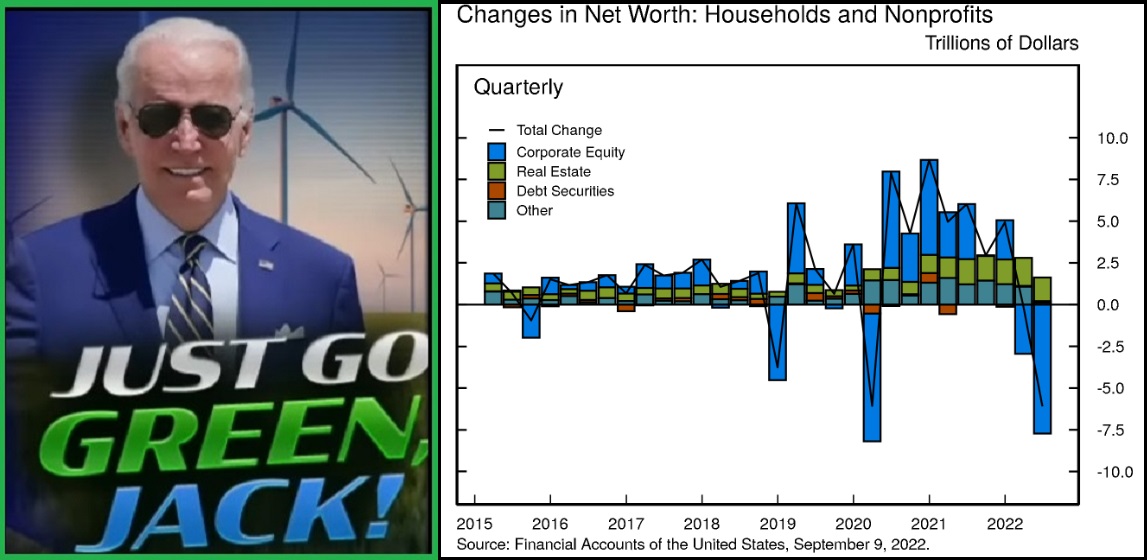
The U.S. Federal Reserve has published the second quarter 2022 balance sheet of U.S. total household wealth [DATA HERE].

In the second quarter (April, May, June) 2022, the total U.S. household wealth dropped $6.1 trillion, despite a calculated increase in home value of $1.5 trillion.  The majority of the loss is connected to a drop in Corporate Equity (stock market) and household investment in the stock market.

FED “The net worth of households and nonprofit organizations declined $6.1 trillion to $143.8 trillion in the second quarter. The value of stocks on the household balance sheet declined by $7.7 trillion, while the value of real estate increased by $1.5 trillion.”  Keep in mind this is backward looking data, and after a period of decelerating rates of growth, the overall real estate market is now in a period of decline as calculated for the most recent month of July [DATA].

The equity position of homeowners is now considerably less than the equity position when the feds calculated the second quarter household wealth (two months ago).  Part of the issue goes back to what we have been discussing with inflation and specifically energy driven increases in fuel and electricity.

Inflation sucks money out of the economy, making people less wealthy.  Energy inflation sucks money exponentially faster out of each household, potentially making the already working-class poor, much poorer.

The higher prices paid for housing, food, fuel and energy do not contribute to anything, the increased costs are just sucked out of the consumers’ pockets without generating any additional value.  It just costs more to live, and that reduces wealth.  Consider this the cost of going green.

Joe Biden and his economic team are introducing phrases like “a growth recession,” to explain a dynamic where earned wages are replaced by government subsidy.  You can no longer afford food, energy, housing etc, so the government steps in as the provider of subsidy based on income level to supplement the gap between wages and the new costs of products and services within the Biden created “green” economy.

However, in the bigger of big pictures, the government does not create wealth.  Wealth is created outside government by private activity.  Government income via taxation is lowered when the economic activity of the private sector drops.

There is currently a massive lag in recording dropped economic activity that is going to surface very soon.  The rate of energy price increase has been so large, so fast, the ability of producers to transfer the cost creates an economic lag.

Total product costs (except imports) are rising faster than finished good prices to consumers.  At the same time, consumer demand for goods has dropped dramatically due to the speed and rate of increased energy costs.  As a combined result, the equity market will likely continue to decline as each earnings report comes in lower than prior expectation.

Now, looking at wealth over time, what happens to the economic model of Biden when current housing value ($41.2 trillion) simply drops back to 2020 levels ($33.0 trillion a conservative real estate market correction)?

Continued higher prices to consumers, less money to government, less economic activity and lower household equity.   That’s trouble, big trouble.

Wave #3 of food inflation starts hitting hard next month as the increased costs at the field start to transfer through the supply chain from harvest to the fork.

WASHINGTON DC – […] The sour mood appears to stem from record food, energy and housing prices. Positive views of the grocery industry dropped 14 percentage points from last year, the biggest drop in the survey. The real estate industry dipped 9 points, the second-largest decline.

Just 22 percent of respondents reported having a positive view of the oil and gas industry, down from 28 percent last year. Twenty-nine percent reported having a positive view of electric and gas utilities, down from 36 percent last year. 

Grocery prices rose a stunning 13.1 percent over the last 12 months ending in July, the largest annual increase in more than four decades, according to Labor Department data. 

Housing affordability has fallen to its lowest level since the Great Recession, according to the National Association of Home Builders, with rents and home prices at record levels.

Gas prices reached an all-time high in June before falling slightly in recent months, while energy bills are also soaring amid huge demand for natural gas. (read more)

Meanwhile Biden’s economic team is bragging that Main Street is in better shape?

“The President’s first two years in office have been two of the most productive in American history, and as the Blueprint explains, these accomplishments are all part of one economic vision.”  (more)