COMMENT #1: You were right. You said there would be a political change here in Malaysia in 2018 at your Bangkok conference. How do you do this? I am coming to Singapore.
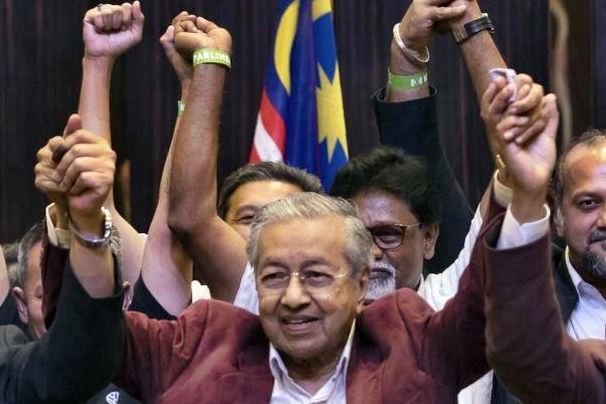
COMMENT#2: Wind of change has swept through Malaysia on May 9th as incumbent Barisan Nasional (BN) coalition 61-year rule since 1957 Independence was ended after people rose up to reject a super corrupt and tyranny regime. An opposition coalition called Pakatan Harapan (PH) form a new federal govt, the first time in our history we have a peaceful transition of power.
People are fed up with BN blatant corruption like 1MDB scandal, abuse of power whereby cases of whistleblowers that expose politicians corruption are charge and sentenced to jail while the perpetrators still walk free and holding senior govt positions!
But the hard work has just begun as the new govt inherit a mess from decades of mismanagement, corruption, and abuse of power. Reform in judicial, executive and legislative branches are badly needed. Also, our country is facing a severe debt crisis due to our corrupt politician’s insatiable appetite to borrow.
Socrates forecast of this global trend is indeed amazing. A new Malaysia is born.
REPLY: Malaysia’s former leader Mahathir Mohamad, 92, won the election last week, which has shocked everyone for they said it could not be done. This election is part of the same movement globally where we are witnessing a rising up of the people against the corruption of governments that have been ruling in general since World War II. This wave of political change brought Trump to power, BRXIT, Hungary election against the EU, Catalonia rising up in Spain, and the Italian election just to mention a few.
This year, 2018, in the case of Malaysia, was 72 years from the April 1st, 1946 event when the Straits Settlements were dissolved and replaced by the Malayan Union, which was conceived to unify the Malay Peninsula under a single government. Then in 1956, a constitutional conference proposed the appointment of the Reid Commission to devise a constitution for a fully self-governing and independent Federation of Malaya. In February that year, talks between representatives of the government of Malaya and Malayan Communist Party sought to resolve the Malayan Emergency situation. Therefore, 2018 was on a very simplistic way, the convergence of two important cycles – the 72-year cycle and two Pi cycles of 62 years. However, we will see the culmination of the full political reform finally come to pass in 2043. Malaysia is still in the transition period. Do not expect the corruption to go quietly into the night.
The corruption in Malaysia was far deeper than anyone suspected. I explained that previously and the involvement of Goldman Sachs. True, this has been a political earthquake that toppled the scandal-plagued premier. Ousting his regime that has ruled for over six decades is easier said than done. Behind the curtain, there are way too many bureaucrats who benefit from the corruption. So while the people delivered a political triumph that, like Trump, almost no one had predicted, the end of the grip of the power of the Barisan Nasional party which has ruled Malaysia since its birth as an independent country will indeed be a struggle going forward.
Mahathir previously ruled the country with also an iron fist for 22 years. You can replace the head of state, but the corruption never ends there. It has infected every possible level of government. This is why revolution often ends up the only final recourse because the bureaucracy is far too often the real problem. So the final victory will come more likely in 2043.
Today, after a briefing session between Secretary of State Mike Pompeo and his counterpart from South-Korea, Secretary Pompeo and Foreign Minister Kang Kyung-wha held a joint press conference. Serious discussions with resolute heart. WATCH:
.
[Transcript] SECRETARY POMPEO: Good afternoon. It is my honor to welcome Foreign Minister Kang to Washington. It is important to meet with such a critical ally so early in my time as Secretary at this incredibly critical time as well. Our alliance with the Republic of Korea was forged in the crucible of war 65 years ago. Tens of thousands of Koreans and Americans sacrificed their lives in the pursuit of freedom for South Korea.
In the years since, the citizens of South Korea took the hard-earned freedom and transformed their war-shattered country into an economic wonder. The Republic of Korea is now the 11th largest economy in the globe, the sixth largest trading partner of the United States, and a key force multiplier for U.S. leadership in the world. The U.S.-Republic of Korea alliance has been fortified by the trials of history and is unequivocally now stronger than ever. Over 28,500 men and women of the United States Forces Korea serve as the forward-deployed face of the ironclad U.S. commitment to the security of the Republic of Korea, its people, and indeed to the entire region.
The prospect of peace and security in the Korean Peninsula and across the Asia Pacific region is why we have stood shoulder to shoulder for more than six decades. Just yesterday, I returned from Pyongyang, where I had productive discussions with Chairman Kim Jong-un in preparation for President Trump’s summit with him. It was an honor as one of my first actions as Secretary of State to negotiate the safe return of three U.S. citizens and bring them home to freedom. We wish these Americans and their families the best as they reconnect after a very difficult time apart. On behalf of the American people, we say welcome home.
The release of these three citizens helps set the conditions for a successful meeting between President Trump and Chairman Kim. We look forward to our continued preparations with the DPRK to make the summit in Singapore on June 12th a true success for the American and Korean people and for the world. I congratulate South Korea and North Korea on their historic meeting last month. The United States is encouraged by President Moon and Chairman Kim’s stated goal of complete denuclearization in the Panmunjom declaration.
Today, Foreign Minister Kang and I discussed the summit, my trip to North Korea, and the bold step President Trump is about to take when he meets with Chairman Kim. We would not be where we are today without the close and coordinated leadership of Presidents Trump and Moon. The United States and the Republic of Korea remain committed to achieving the permanent, verifiable, and irreversible denuclearization of the Korean Peninsula. If Chairman Kim chooses the right path, there is a future brimming with peace and prosperity for the North Korea – North Korean people. America’s track record of support for the Korean people is second to none.
If North Korea takes bold action to quickly denuclearize, the United States is prepared to work with North Korea to achieve prosperity on the par with our South Korean friends. The United States looks forward to continued close cooperation with our South Korean allies on this issue and many others.
Foreign Minister, thank you for being with me today. It was a pleasure to work with you.
♦FOREIGN MINISTER KANG: Thank you very much, Mr. Secretary, for the very warm welcome. Let me reiterate my congratulations on your becoming the top diplomat of the United States at this historic moment. Secretary Pompeo, you have already been at the center of our joint efforts on North Korea, and I very much look forward to working closely with you.
We spoke on April 28th right after the momentous inter-Korean summit, and today we met just after Secretary Pompeo’s return from Pyongyang. During our meeting, I congratulated him and President Trump for the successful release of the three U.S. citizens, all Korean Americans, from North Korea. This is a promising signal for the upcoming summit between President Trump and Chairman Kim.
Over the past weeks, both Korea and the United States have been engaged in intensive diplomatic efforts regarding North Korea, and we briefed each other on the latest endeavors, including Secretary Pompeo’s visit to Pyongyang and the Korea-Japan-China trilateral summit in Tokyo, which adopted a special statement welcoming the outcome of the South-North Korean summit and expressing the strong hopes for the success of the upcoming U.S.-North Korea summit. In this context, Secretary Pompeo and I discussed preparations for the summit meeting between President Trump and Chairman Kim in Singapore on June 12th. We agreed that the summit would be a historic opportunity for resolving the North Korean nuclear issue and securing enduring peace on the Korean Peninsula. We reaffirmed that our goal is to achieve the complete, verifiable, and irreversible denuclearization on the Korean Peninsula.
In this regard, Secretary Pompeo and I agreed the next few weeks will be critical, requiring air-tight coordination between our two countries. As announced, President Moon will visit Washington, D.C. soon to meet with President Trump. The close communication and trust between Presidents Trump and Moon have been the driving force that has brought us to this point of breakthrough for the denuclearization and peace on the Korean Peninsula. So their meeting on the 22nd will be instrumental in preparing for a successful U.S.-North Korea summit.
Secretary Pompeo and I reaffirmed that the ROK-U.S. alliance, which celebrates its 65th anniversary this year, has long served as the linchpin for peace and stability on the Korean Peninsula and in the region. We also reaffirmed that for the last 65 years, the USFK, the United States Forces in Korea, has played a crucial role for deterrence and peace and stability of the region, and we would like to emphasize again that the U.S. military presence in Korea is a matter for the ROK-U.S. alliance first and foremost.
After today’s meeting, I am even more confident that our alliance is as robust as ever and that there is no daylight in our cooperation on the denuclearization and peace on the Korean Peninsula.
Once again, I would like to thank Secretary Pompeo for today’s fruitful discussions and look forward to building a close working partnership relationship with him. And in addition to the upcoming summit meeting in Washington, D.C. on May 22nd, I hope to see him again in Seoul and reciprocate the hospitality very soon. Thank you very much.
MS NAUERT: Thank you. And we have time for two questions total. The first goes to Rich Edson from Fox News Channel. Rich.
QUESTION: Thank you, Mr. Secretary. You just mentioned and have mentioned before, as have the South Koreans, that you are looking for permanent, verifiable, irreversible denuclearization. How does the United States specifically define that? Is it inspections, full facility dismantling? Is it more than that, less than that? And also, you have had more substantive conversations with Kim Jong-un than arguably any other Westerner. What is your impression of him? Do you think he’s rational? And simply, what’s it like to talk to him?
And to the foreign minister, are South Korea and regional allies discussing providing any sanctions relief to North Korea before the summit between President Trump and Kim Jong-un, and what kind of outcome does South Korea need to secure its security, and does that include the maintenance of current U.S. military assets in the region? Thank you very much.
SECRETARY POMPEO: So I have spent more time with Chairman Kim other than perhaps President Moon working on this incredibly important challenge that lays before the world. President Trump and the world have set the conditions for a successful outcome from June 12th and the activities that are necessary to follow there from. You asked about my conversations with Chairman Kim. This question is sort of undignified, “Is he rational?” Yes, we had good conversations, substantive conversations, conversations that involve deep, complex problems, challenges the strategic decision that Chairman Kim has before him about how it is he wishes to proceed and if he is prepared in exchange for the assurances that we’re ready to provide to him if he is prepared to fully denuclearize. And I’m not sure how to define it fully.
It’s pretty clear what that means. It would be an activity that undertook to ensure that we didn’t end up in the same place that we’d ended up before, or multiple passes at trying to solve this conundrum for the world, how to ensure that North Korea doesn’t possess the capacity to threaten not only the United States but the world with nuclear weapons. And so in order to achieve that, it will require a robust verification program and one that we will undertake with partners around the world, which will achieve that outcome in a way that frankly no agreement before it has ever set forth. A big undertaking for sure, but one that Chairman Kim and I had the opportunity to have a good, sound discussion on so that I think we have a pretty good understanding between our two countries about what the shared objectives are.
QUESTION: What’s he like?
SECRETARY POMPEO: I’m sorry.
QUESTION: What’s he like?
SECRETARY POMPEO: We had good conversations. There – it was – there’s some videos that have been released. You can see our conversations were warm. We were each representing our two countries, trying our best to make sure that we were communicating clearly, that we had a shared understanding about what our mutual objectives were. But we had good conversations about the histories of our two nations, the challenges that we’ve had between us. We talked about the fact that America has often in history had adversaries who we are now close partners with, and our hope that we could achieve the same with respect to North Korea.
MS NAUERT: All right. Thank you, Rich. Our next question goes to Yonhap News Agency.
FOREIGN MINISTER KANG: Could I just —
MS NAUERT: Oh, pardon me.
FOREIGN MINISTER KANG: — answer that —
MS NAUERT: Yes.
FOREIGN MINISTER KANG: I think your question about sanctions relief, I think we were very clear that the sanctions remain in place until and unless we see visible, meaningful action taken by North Korea on the denuclearization track. The North Korean leader has committed to denuclearization, and formally so through the Panmunjom Declaration. We very much hope to see further steps, more concrete steps towards denuclearization being produced at the U.S.-North Korea summit. So we’re not talking about sanctions relief at this point.
Your question about what are we looking in terms of for our own security, we are confident of our security through the Korea-U.S. joint security stance, which is why we say the issue of the alliance – any issue of the alliance, including the troop presence in our country, is a matter for our two allies to discuss and not to be put on the table with North Korea.
MS NAUERT: Okay. And our next question goes to Yonhap, to Mr. Lee Seungwoo.
QUESTION: Hello, Secretaries.
SECRETARY POMPEO: Hi.
QUESTION: So I have two questions for each of you. So —
MS NAUERT: We only have time for one, please. Thank you.
QUESTION: Oh, yeah. One for —
MS NAUERT: Yes, one.
QUESTION: Okay. So one for our Minister Kang. Can I say in Korean?
SECRETARY POMPEO: Sure.
FOREIGN MINISTER KANG: Sure.
QUESTION: (Via interpreter) Recently, there was a talk that possibly USFK can be reduced. Was it discussed in your bilateral talks today? And when President Moon visits Washington D.C. before the Pyongyang and Washington, D.C. talks, what kind of coordination did you make in the run-up to this upcoming discussion between Pyongyang and Washington, D.C.?
(In English) (Inaudible) Pyonyang and (inaudible) Kim Jong-un, and our historic summit between President Trump and Kim is fully set up. However, the key issue is dismantling North Korea’s WMD. And I guess there’s a quite a big gap between U.S. and north standpoint. So did you actually discuss the issue with Kim, with – this issue with Kim? And have you two narrowed the differences? And do you think he’s willing to give up his WMD? Thank you.
FOREIGN MINISTER KANG: (Via interpreter) So there was no talk about reducing USFK at all. If there was any talk about USFK, it was only about how solid our alliance is, and any issue, any discussion about USFK or alliance should be discussed as such, between our two nations which are in alliance, and not in North Korea and U.S. talks, which was confirmed by Secretary Pompeo. And May 22nd is the day when U.S. President, the South Korean president will meet again. And along the way, President Trump and President Moon have a close relationship and trust with each other, and it played a key role. So in the run-up to the North Korea and the U.S. summit, discussion between the two leaders will play a key role in preparing and setting the tone for the talks. So we are making our best effort to best prepare for this summit.
SECRETARY POMPEO: Your question was about were details discussed. We had quite a conversation about it. I’m not going to share that here; we’re not going to negotiate the details of the agreement in this setting. We’ll do it in conversations between our leaders and our working teams that are hard at preparing for the summit. I am confident that we have a shared understanding of the outcome that the leaders want – certainly Presidents Trump and – President Trump and Chairman Kim, but I think President Moon as well. I think we have a shared vision for what we hope, when this process is completed, the Korean Peninsula looks like. I think we have a good understanding, and I think there is complete agreement about what the ultimate objectives are.
We began to work through the modalities, how we would achieve that, but I’ll leave conversations about that to another time. So thank you for your question.
MS NAUERT: Thank you, everyone. Have a great afternoon.
President Donald Trump, First Lady Melania Trump, Vice-President Mike Pence and Karen Pence are all going to be at Joint Base Andrews overnight to welcome home three people released after detainment in North Korea.
UPDATE: Video Added
Kim Dong Chul, Kim Sang Duk, Kim Hak Soon are the names of the three detainees who were released. Two of the captives, Hak-Soon and Sang Duk, belong to the Pyongyang Univ of Science & Technology and were detained in Apr & May 2017: they’ve been held for a year. The third, Kim Dong Chul, is an ordained minister held since 2015 when he was commuting from China and was serving a 10-year sentence on espionage charges.
Their anticipated arrival time is between 2:30am and 3:00am Eastern. Fox News is broadcasting their return live.
The following statement by Kim Dong Chul, Kim Sang Duk (Tony Kim), and Kim Hak Song, after their release was secured by Secretary Mike Pompeo on behalf of the Trump Administration on May 9, 2018:
“We would like to express our deep appreciation to the United States government, President Trump, Secretary Pompeo, and the people of the United States for bringing us home. We thank God, and all our families and friends who prayed for us and for our return. God Bless America, the greatest nation in the world.” (link)
Last year during punditry discussions of North Korea, the traditional crowd were waxing philosophically about military expansionism, and the threat of nuclear war as a likely outcome.
However, all of those Gordian-knot sellers held references from a fundamentally flawed foundation; they viewed the DPRK as a separate nation from China. There were a few voices who challenged geopolitical orthodoxy and presented a different view; the DPRK as a proxy province of China.
When you think of North Korea as a proxy province of China, everything changes. Every possible action and consequence changes. If the DPRK is inherently a proxy province of Beijing, then North Korea already had nuclear weapons; or at least access to nuclear weapons as needed; the argument to stop them was moot.
Additionally, if Beijing was structurally and factually controlling Pyongyang, attaining a peaceful Korean peninsula between Kim Jong-un and his South Korean neighbor Moon Jae-in, was entirely different.
The first step in achieving less hostility becomes removing the ruse behind the China-DPRK disconnect.
The first step in removing the ruse is to treat China as having full control over the problem.
Now, it must be pointed out that no-one prior to President Trump would have ever gamed-out how to do this. Heck, no-one prior to President Trump would ever admit that North Korea was essentially a proxy province of China.
The paradigm shift therein is so consequential, as evidenced in the 2017 analysis of doom, none of the intellectual set could/would even fathom it. Hence, almost none of the smart set could/would accurately discuss how to solve the issue, or even understand what POTUS Trump was doing. In essence their points of debate were built upon a false premise.
Hopefully, with hindsight now becoming less opaque, more people are realizing the outcome(s) today are entirely because the Trump approach was looking at a different problem. President Trump’s solution came from accepting a relationship that was factually evident. This is what happened.
Almost no western (U.S. or EU) media seem to understand the historic concepts behind the cultures of communist China and Asia in the world of strategic politics. Because they don’t understand the outlook, U.S. media cannot fathom solving problems.
There is no doubt President Trump thought out a long-term strategy regarding North Korea and China. The approach was evident in how President Trump presented his messaging toward the people of China. He clearly understood Beijing’s preferred panda image was a mask.
President Trump played the game and very publicly discussed friendship toward Chairman Xi Jinping. Consistent praise for Chairman Xi based on his character, strength and purposeful leadership retained the panda approach.
To build upon that projected and strategic message – President Trump seeded the background by appointing Ambassador Terry Branstad, a 30-year personal friend of President Xi Jinping.
To enhance and amplify the message President Trump used Mar-a-Lago as the venue for their first visit, not the White House. And President Trump’s beautiful granddaughter, Arabella, sweetly serenaded the Chinese First Family twice in Mandarin Chinese song showing the utmost respect for the guests and later for the hosts.
Why the constant warm messaging? What was the purpose? What did all this have to do with a geopolitical confrontation, and North Korea?
It’s really rather simple actually. President Trump played to the panda image, while understanding that Beijing fully controlled Pyongyang – the red dragon aspect.
Historic Chinese geopolitical policy, vis-a-vis their totalitarian control over political consequences, and their diplomacy through silence, is evident in the strategic use of the space between carefully chosen words, not just the words themselves.
Each time China takes aggressive action (red dragon), or instructs an aggressive action to take place (via Kim Jong-un), China projects a panda face through silence and non-response to opinion of that action;…. and the action continues. Wash, rinse, repeat.
The red dragon will say one necessary thing publicly, while manipulating another necessary thing completely privately. The Art of War.
President Trump was the first U.S. President to understand how the red dragon hides behind the panda mask and plays the same game. It was specifically because Trump understood the Panda is a mask that President Trump messages warmth toward the Chinese people, and pours vociferous praise upon Xi Jinping, while simultaneously confronting the geopolitical doctrine -the outcomes- of the Xi regime.
In essence President Trump mirrored the behavior of Chairman Xi while confronting their economic and military duplicity within North Korea.
China has no cultural or political space between peace and war; they are a historic nation based on two points of polarity. They see peace and war as coexisting with each other.
China accepts and believes opposite or contrary forces may actually be complementary, interconnected, and interdependent in the natural world, and they may give rise to each other as they interrelate to one another. Flowing between these polar states is a natural dynamic to be used -with serious contemplation- in advancing objectives as needed.
Peace or war. Win or lose. Yin and Yang. Culturally there is no middle position in dealings with China; they are not constitutionally capable of understanding or valuing the western philosophy of mutual benefit where concession of terms gains a larger outcome. If it does not benefit China, it is not done. The outlook is simply, a polarity of peace or war. In politics or economics the same perspective is true. It is a zero-sum outlook.
President Trump aligned all activity to benefit China ONLY IF the North Korean challenge was solved.
As an outcome, China has now begun openly displaying the relationship with North Korea previously kept hidden.
Technically, there is no denuclearization of North Korea because China has nuclear weapons and China always controlled North Korea. However, President Trump has removed the veil covering the secret without technically confronting it head-on.
In the future, North Korea will likely be as much of a communist system as China. The key changes will be the action inside the buffer-zone between communism (China, Chairman Xi Jinping) and democracy (South Korea, President Moon Jae-in).
This new reality we see today the first official notation of Kim Jong-un as “Chairman” Kim Jong-un:
North Korea will now enter a geopolitical phase of economic activity and expansion similar to China 1995 through today. Chairman Xi (Big Panda), will guide his protégé Chairman Kim (Little Panda) in all matters of strategic economics, thereby guaranteeing the continuance of his influence.
It will be interesting to watch how the North Korean people interact with the South Korean people. A similar litmus or reference point, albeit not as stark, was available in how Beijing interacted with Hong Kong when China took over.
The natural flow of freedom is toward organic expansion if not held-down by controlling and oppressive government.
This report out of South Korea, while not confirmed, makes sense. Earlier today President Trump announced Secretary of State Mike Pompeo was en route to North Korea to finalized details for upcoming summit. Secretary Pompeo tweeted he was going to DPRK “at the invitation of N-Korean leadership.”
It makes sense, as an advanced gesture of goodwill ahead of the summit, for Kim Jong-un to release the U.S. captives.
SEOUL, May 9 (Yonhap) — North Korea is expected to release three U.S. citizens held in the communist state on Wednesday, an official from Seoul’s presidential office Cheong Wa Dae said, in an apparent goodwill gesture ahead of a historic meeting between its leader Kim Jong-un and U.S. President Donald Trump.
The official said U.S. Secretary of State Mike Pompeo was expected to return with the exact time of the Trump-Kim summit, along with the three U.S. captives in North Korea. “We expect him to bring the date, time and the captives,” the official said, while speaking on condition of anonymity. (more)
(left to right) Kim Dong Chul, Kim Sang Duk, Kim Hak Soon
Kim Dong Chul, Kim Sang Duk, Kim Hak Soon are the names of the three hostages being released. Two of the captives, Hak-Soon and Sang Duk, belong to the Pyongyang Univ of Science & Technology and were taken in in Apr & May 2017: they’ve been held for a year. The third, Kim Dong Chul, is an ordained minister taken in 2015 when he was commuting to Rason from China and and has been serving a 10-year sentence on espionage charges.
U.S. Secretary of State Mike Pompeo specifically requested their release while visiting Pyongyang on Easter weekend. The three are US citizens with Korean heritage. National Security Adviser John Bolton said on Fox News Sunday that North Korea could show its sincerity by releasing US hostages prior to the summit.
In March of this year Sweden was initially playing a large role and helping negotiate the terms of the North-South Korea summit as well as the release of three Americans held captive in North Korea.
“We believe that Mr. Trump can take them back on the day of the U.S.-North Korea summit, or he can send an envoy to take them back to the U.S. before the summit,” said Choi Sung-ryong, an activist pursuing release of North Korea’s political prisoners.
Wow. You have to watch this video to see how history was just encapsulated.
North Korean Leader Kim Jong Un and South Korean President Moon Jae-in meet at the village of Panmunjom, the historic site where the Korean War armistice was signed in 1953 for the start of talks between the two countries.
Their unified meeting is the third inter-Korean summit, but this meeting is the first time a leader from the communist North has entered the democratic South. South Korea then holds a welcoming ceremony for the North Korean leader that includes full military honors and a military guard review.
.
North Korean leader Kim Jong Un writes: “new history starts now; age of peace, from the starting point of history” on guest visitor book at Peace House.
WHITE HOUSE – On the occasion of Republic of Korea President Moon Jae-ins historic meeting with North Korean leader Kim Jong Un, we wish the Korean people well. We are hopeful that talks will achieve progress toward a future of peace and prosperity for the entire Korean Peninsula.
The United States appreciates the close coordination with our ally, the Republic of Korea, and looks forward to continuing robust discussions in preparation for the planned meeting between President Donald J. Trump and Kim Jong Un in the coming weeks.
French President Emmanuel Macron arrives in the United States tomorrow for the first official State Visit and State Dinner of the President Trump Administration.
In advance of the visit, the pontificating media ambassador to the DC swamp, foie gras Wallace, briefs President Macron on what horrible vulgarian affronts he may encounter:
.
A bit of background color – As noted in the interview, President Macron will bring with him a gift, offering to President Donald Trump and the American people, an oak sapling taken from Bellau Wood, about 60 miles northeast of Paris in the Champagne region. The site is where a famous World War One battle took place, where the U.S. Marine Corps repelled a German offensive in the final year of the conflict almost exactly a century ago.
The sapling grew close to the so-called “Devil Dog” fountain, a spot that has become legendary within Marines ranks. It is where U.S. soldiers are said to have gathered after the battle. The “dog” in the fountain’s name refers to its spout, which resembles the head of a bull mastiff. But the nickname also stems from the German moniker “Teufelhunden”, or “devil dogs”. That term is said to have been used by the Germans to describe the U.S. Marines due to the ferocity with which the Americans fought.
As a consequence, “Devil Dog” soon became a common nickname for U.S. Marines.
In the past 48 hours South Korea (Moon Jae-in) and North Korea (Kim Jong-un) have been working out the details of their upcoming summit. Within the discussions between North and South Korea some stunning news has surfaced.
♦ Yesterday Moon Jae-in announced that North Korea had agreed to complete denuclearization of the Korean Peninsula without any preconditions or expectations of changes in the relationship between the U.S. and South Korea:
SEOUL, South Korea — North Korea has expressed its commitment to “complete denuclearization” of the Korean Peninsula and is not seeking conditions, South Korean President Moon Jae-in said on Thursday, as the United States vowed to maintain “maximum pressure” on Pyongyang.
[…] “I don’t think denuclearization has different meanings for South and North Korea,” Moon said during a lunch with chief executives of Korean media companies. “The North is expressing a will for a complete denuclearization.”
“They have not attached any conditions that the U.S. cannot accept, such as the withdrawal of American troops from South Korea,” he continued. “All they are talking about is the end of hostile policies against North Korea, followed by a guarantee of security.” (read more)
As the summit discussions continued today; and to assure the previous U.S. envoy CIA Director Mike Pompeto; and in affirmation of direct talks with President Trump; North Korea made an even more stunning statement from the Korean Central News Agency:
North Korean leader Kim Jong Un has declared he will suspend nuclear and missile tests starting Saturday, and that he will shut down the site where the previous six nuclear tests were conducted.
“From April 21, North Korea will stop nuclear tests and launches of intercontinental ballistic missiles,” the Korean Central News Agency said in a report Saturday morning.
This came out of a meeting of the central committee of the ruling Worker’s Party of Korea held Friday to discuss policy issues related to “a new stage” in a “historic” period.
“The North will shut down a nuclear test site in the country’s northern side to prove the vow to suspend nuclear test,” KCNA reported.
This comes less than a week before Kim is due to meet with South Korean president Moon Jae-in in the first inter-Korean summit in 11 years. Moon has said that Kim is willing to discuss denuclearization and that he will not insist on American troops being withdrawn from South Korea as part of any deal. (read more)
Exactly a year ago, April 20th, 2017, the headlines were:
“North Korea nuclear threat: should California start panicking?” (LINK)
Today, April 20th, 2018:
“North Korea willing to accept ‘complete denuclearization’ without conditions” (LINK)
“North Korean leader suspends nuclear and missile tests, shuts down test site” (LINK)
During the Easter holiday weekend, CIA Director Mike Pompeo traveled to Pyongyang North Korea and met with Kim Jong Un, laying the groundwork for an upcoming summit between Kim and President Trump. There were no leaks about the meeting.
“We’ll either have a very good meeting or we won’t have a good meeting; and maybe we won’t even have a meeting at all, depending on what’s going in. But I think that there’s a great chance to solve a world problem.” ~ President Trump
I have created this site to help people have fun in the kitchen. I write about enjoying life both in and out of my kitchen. Life is short! Make the most of it and enjoy!
This is a library of News Events not reported by the Main Stream Media documenting & connecting the dots on How the Obama Marxist Liberal agenda is destroying America