Posted originally on Aug 1, 2025 by Martin Armstrong |
The PELOSI Act, which BANS Congressional stock trading, has just passed out of committee, 8-7. I have personally been asked by a Congressman who is no longer there for information. “The number one question from my constituents is where to put their money these days.”I did everything to prevent myself from laughing. When the Insider Trading nonsense was crafted, they deliberately excluded themselves.
Yet I advised on so many takeovers, and the Assistant US Attorney, Richard Owens, tried so hard to come up with a charge to cover up what they did, and I did not even have a trading account for stocks, which really pissed him off. He checked my entire family. He was angry because he could not find anything and said, “You are one smart SOB.” Yet, I was not a member of a board and was informed of what they wanted to do, which would be indistinguisable from a person in Congress.
I got my son a summer job in a brokerage house while he was in college. They had to vet not just him, but me for a simple job for the summer. Yet Congress is exempt, and I suspect they will ensure that exceptions for spouses and trusts (not so blind) will be in there. That does NOT apply to those of us outside of Congress.
Posted originally on Jul 30, 2025 by Martin Armstrong
The fact that Trump is threatening sanctions against India for buying Russian oil and to hammer Russia to somehow force Putin to his knees and accept whatever terms Europe demands, proves that Trump is now taking advice from Lindsey Grachm, NATO, their puppet EU leaders, and the Neocons with the likes of Cheney in the background witgh a HUGE smile on her face.
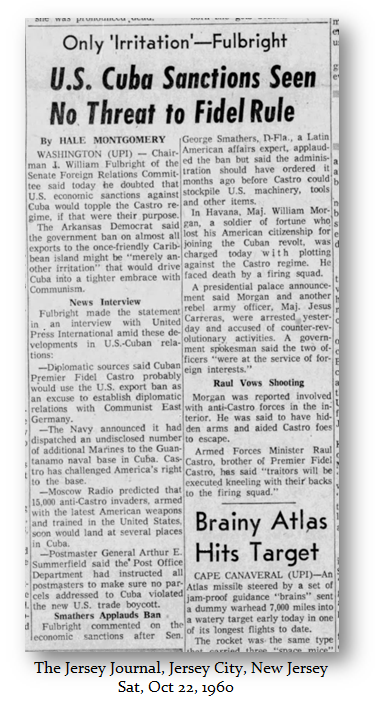
Cuba (1960s-present): U.S. sanctions have failed to topple the Castro regime or force democratic reforms. Despite economic hardship, the government adapted through alternative trade partners and domestic resilience, suggesting sanctions can entrench regimes and slter the world economy, which has taken place with the development of BRICS. The U.S. embargo (blockade) against Cuba remains in place, requiring Congressional action to lift it entirely. While some sanctions have been eased temporarily, no administration has completely ended them. After more than 60 years, this stands as a prime example of how sanctions have NEVER worked even once.
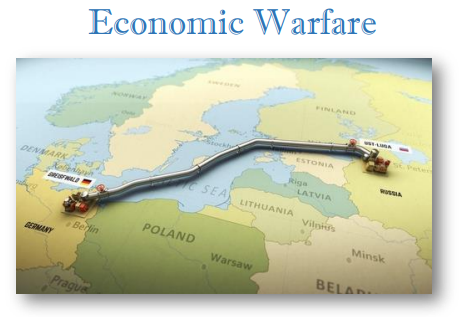
The United States has imposed sanctions on German and other European companies involved in the construction of the Nord Stream 2 gas pipeline, which was designed to transport Russian natural gas to Europe. In 2019–2021, the U.S. sanctioned firms like Swiss-based Allseas (forcing it to withdraw) and later targeted Russian and German entities.
The U.S. imposed sanctions on the Soviet-European gas pipeline in 1982 (under Reagan), targeting Western companies supplying equipment for the Urengoy–Pomary–Uzhhorod pipeline, which supplied gas to Western Europe. The U.S. opposed this project due to concerns over European energy dependence on the USSR. They, too, failed and had to be relaxed under Allied pressure.
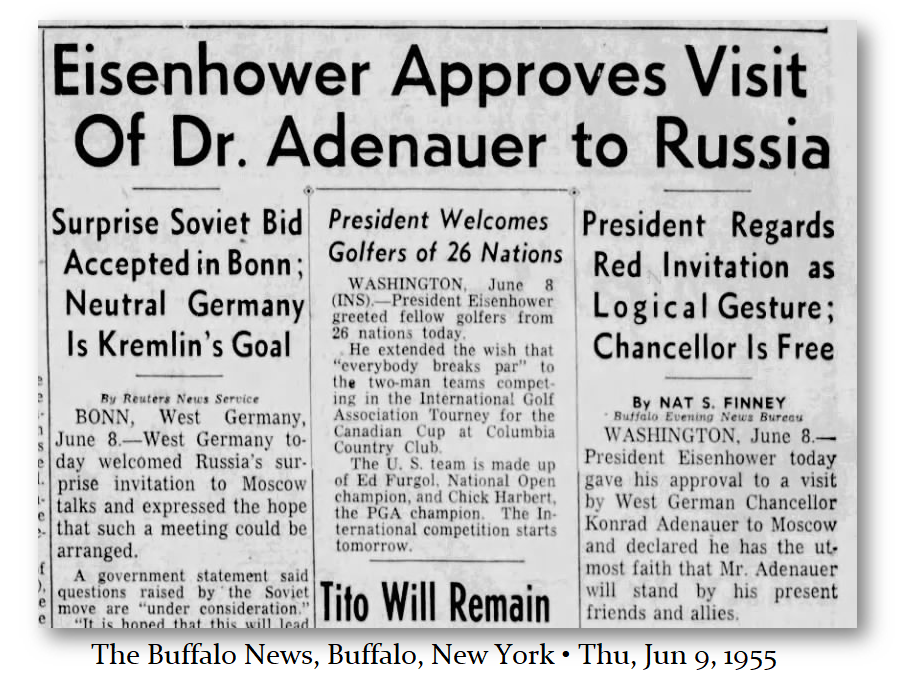
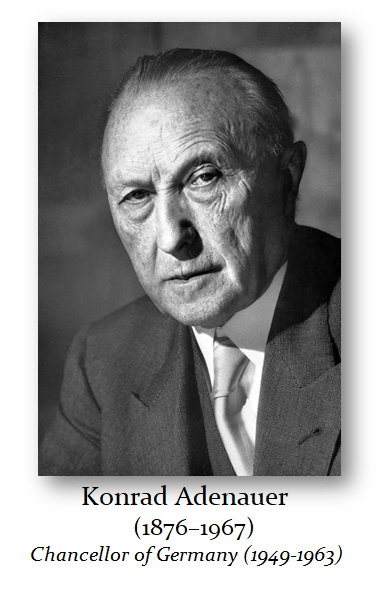
The Neocons, from the outset of any negotiations between Germany and Russia back in the communist days, did everything in their power to deny Germany access to Russian energy. It was 1955 when West German Chancellor Konrad Adenauer (1876-1967) visited Moscow in June and then established diplomatic relations for the first time between the new Federal Republic of Germany and the Soviet Union. The Neocons were outraged, but President Eisenhower saw it as no threat given Adenauer’s oppression by Hitler. The Necons wanted to prevent any meeting but Eisenhower declined.
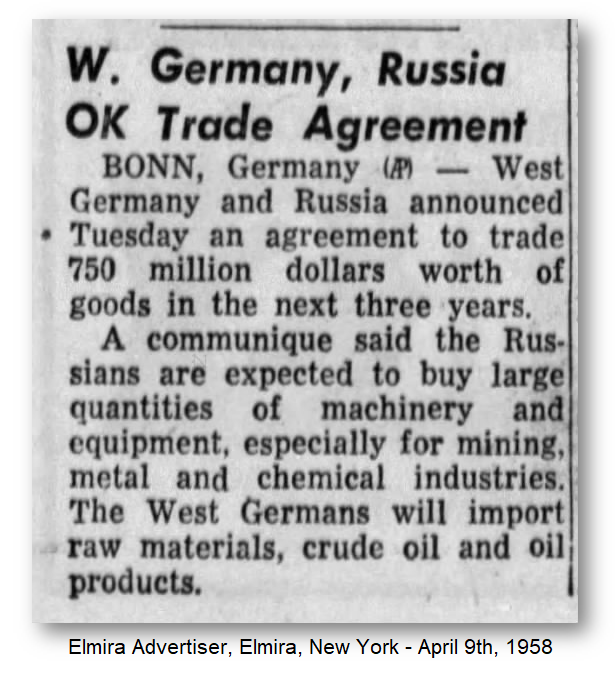
Adenauer was Chancellor from 1949 to 1963. Adenauer was one of the first opponents of the leader of the Nazi Party. Konrad Adenauer helped draft a constitution completed in May 1949. He opened the door for the trade agreement that followed in 1958, and by 1960, bilateral trade between the countries was booming.
The Trade Agreement was reported worldwide by the Associated Press on April 9th, 1958 (1958.271). Even so, from the very beginning, that trade link between Germany and Russia was controversial, to say the least. The United States, at the direction of the Neocons, was always against it and would criticize Germany behind every closed-door session. However, the US intimidation failed because it was necessary for the German people and their future.
While the U.S. did not impose formal sanctions on German pipe producers in 1955–1958, it actively discouraged such trade, setting the stage for the 1960s pipe embargoes. The major crackdown came later, but diplomatic and economic pressure began in the late 1950s.
Iraq (1990s): UN sanctions after the Gulf War devastated the economy, reducing GDP by nearly 50%, but Saddam Hussein’s regime remained intact. Political change only occurred after the 2003 invasion, not sanctions alone, and civilian suffering often strengthened regime propaganda.
North Korea (2000s-present): Decades of sanctions have crippled the economy but haven’t shifted the Kim regime’s policies or structure. Black market trade and Chinese support have mitigated impacts, and the regime uses isolation to reinforce control.
South Africa (1980s-1990s): Comprehensive sanctions, including trade bans and financial restrictions, the Neocons insist, contributed to ending apartheid. However, there was already internal resistance. It still took 14 years before any democratic reforms took place by 1994. Studies estimate that the sanctions reduced South Africa’s GDP only by 1-2% annually.
Iran (2010s): Heavy U.S. and EU sanctions targeting oil exports and banking, which the Neocons insist forced Iran to negotiate the 2015 nuclear deal (JCPOA). Oil revenues dropped by over 50% from 2011 to 2013, and inflation soared, but the regime did not fall. The regime didn’t fundamentally change its political system, showing again that sanctions have NEVER even once overthrown the core governance.
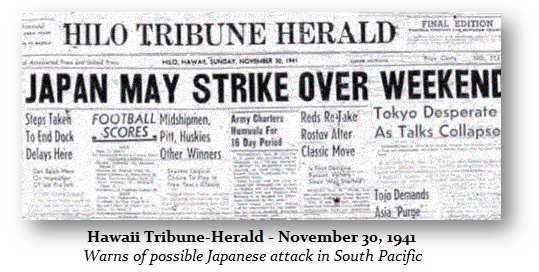
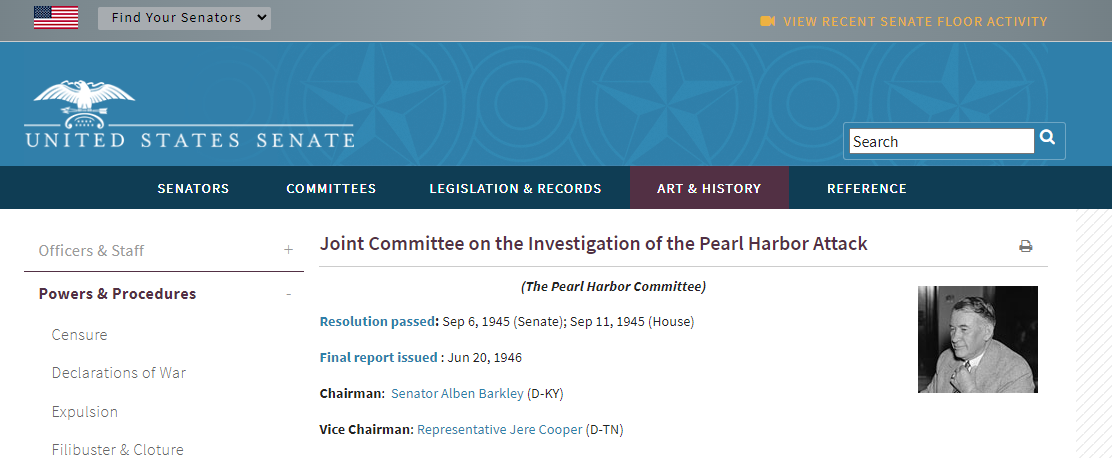
FDR deliberately imposed sanctions on Japan to get them to attack the United States, all because Congress would not authorize joining World War II in Europe. That led to a Senate investigation later because it became so obvious that FDR even knew when Pearl Harbor would take place and deliberately allowed thousands to be killed just so he could enter the war. It came out that US had broken the Japanese code and knew all about the attack. There was even a lead to the press a few days before reporting that they were about to be attacked.
Before the attack on Pearl Harbor on December 7, 1941, President Franklin D. Roosevelt (FDR) imposed a series of escalating economic sanctions on Japan in response to its aggressive expansion in Asia, particularly its invasion of China. These sanctions were meant to pressure Japan into halting its militaristic actions, but ultimately contributed to the tensions that led to war.
In 1938, FDR imposed a “moral embargo” on aircraft and aviation parts sales to Japan following its bombing of Chinese civilians. This was not a formal ban but a strong discouragement of exports. Then in July 1939, FDR announced the termination of the 1911 U.S.-Japan Treaty of Commerce and Navigation, removing legal barriers to future trade restrictions. This took effect in January 1940.
Now that the door was open for sanctions, in July 1940, the U.S. restricted exports of aviation fuel, lubricants, and high-grade scrap metal to Japan under the Export Control Act. That was followed by the September 1940 complete embargo on scrap iron and steel.
Then, FDR, like the West has done to Russia, froze all Japanese assets in the U.S. (July 26, 1941), effectively cutting off trade and financial transactions. That was followed by a complete oil embargo along with Britain and the Dutch government-in-exile. Since Japan relied on the U.S. for 80% of its oil, this was a crippling blow. FDR knew that Japan would take it as an act of war, as they then saw these sanctions as an existential threat, as they crippled its ability to fuel its military and industry.
The oil embargo, in particular, forced Japan to either negotiate a withdrawal from China (which it refused) or seize oil-rich territories in Southeast Asia (which risked war with the U.S.). The sanctions contributed to Japan’s decision to attack Pearl Harbor (December 7, 1941) to neutralize the U.S. Pacific Fleet before invading British and Dutch colonies. These sanctions deliberately pushed Japan toward a desperate military confrontation, culminating in the attack on Pearl Harbor and the U.S. entry into World War II, which was the objective of FDR from the outset. The outrage was so intense that in 1945, after the war, the Senate was forced to investigate FDR’s action and whitewashed the affair, claiming they were unsure if FDR had been fully advised of the Pearl Harbor attack in advance, even though leaks made the papers in advance.
There is NOT a single incident to demonstrate that sanctions have EVER worked. Nevertheless, the Neocons constantly advise heads of state to impose sanctions, hoping that they will bring about the collapse of that government. They will not work this time either and the real risk is that they will lead to war as we saw in FDR’s actions against Japan.
Posted originally on Jul 31, 2025 by Martin Armstrong
President Trump announced a 25% on India beginning August 1 due to its continued purchase of Russian oil. “Remember, while India is our friend, we have, over the years, done relatively little business with them because their Tariffs are far too high, among the highest in the World, and they have the most strenuous and obnoxious non-monetary Trade Barriers of any Country,” the president posted to Truth on Wednesday morning. “Also, they have always bought a vast majority of their military equipment from Russia, and are Russia’s largest buyer of ENERGY, along with China, at a time when everyone wants Russia to STOP THE KILLING IN UKRAINE,” he added.
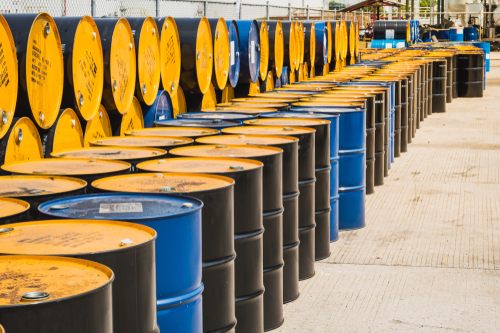
India began drastically increasing its imports of Russian crude at the start of the Russia-Ukraine war in 2022, with good reason, as the oil became significantly cheaper and India was able to resell it at a premium to nations that simply wanted to bypass all things Russia. In January 2022, India was importing around 68,000 barrels per day (bpd) in Russian crude, which represented only 0.2% of crude imports. The war broke out a month later and by June India was importing 1.12 million bpd from Russia who overtook Iraq as the nation’s top supplier. Nearly a year later in May 2023, Russian imports peaked at 2.15 million bpd, with India currently importing around 1.7 million to 2.1 million bpd as of July 2025.
Around 35% to 40% of India’s crude oil now comes from Russia. Now, Russian crude was around $50 per barrel in May 2025 when imports to India peaked. Middle Eastern grades were around $10 to $20 higher at the time. The deal was a no-brainer.
India-US bilateral trade hit $118.4 billion in 2024. India exported approximately $79.4 billion in goods to the US and imported $39 billion. The current trade deficit with the US sits at $45.7 billion. A 25% tariff could cost India billions in lost revenue from exports and threaten jobs in key sectors such as autos, chemicals, jewelry, gems, electronics, and textiles. Other Asian exporters would become more desirable, but China actually purchases more Russian crude than India at this point and other nations in the region have drastically smaller economies. Estimates state India could risk losing $15 billion to $20 billion annually as a result of the 25% tariff.
Now, if India were forced to buy from the Middle East for $10 to $20 more per barrel, the nation would need to spend around $6 to $10 billion more on energy annually. India does refine and resells Russian crude and is said to bring in around $1.5 billion to $3.5 billion from that practice.
On paper, it would seem as if India has more to lose by continuing to purchase Russian oil. However, the US is showing the world that it has the ability to dictate political policy through economic warfare. India declared that it remains committed to continuing “mutually beneficial bilateral trade” with the US after the 25% tariff was announced. The US will go after all BRICS nations in an attempt to dismantle the alliance, but BRICS members have shown that they no longer need to rely on the West, and tariffs from the US may not hold the same leverage as they once did.
Posted originally on Jul 31, 2025 by Martin Armstrong
A farm with 175 years of family ownership will be seized by the state of New Jersey under eminent domain. The Henry family inherited the 21-acre farm in Cranbury Township in 1850. The farm is still profitable for the Henry family, and they intend to maintain it for generations to come. However, the state of New Jersey determined that the land must be reappropriated for affordable housing and has notified the family that their land now belongs to the government.
The township offered to buy the Henry farm with a multi-million-dollar offer. When the family declined to sell, Cranbury officials unanimously voted to steal the land by eminent domain. The New Jersey Supreme Court determined that the state must produce a set number of affordable housing options annually, and Cranbury has a target of creating 265 units over the next decade. “They saw this little patch of green out there and said, ‘oh, we’ll just snatch that up.’ It’s very disappointing to me,” a member of the Henry family stated.
There were alternatives such as changes in zoning laws or looking into voluntary land sales. Instead, the government began to conduct public hearings back in April regarding the farmland without the Henry family’s knowledge. Mayor Lisa Knierim insists, “there simply was no way to meet the 265 unit obligation.”
“There’s four generations of my family buried in that town,” says Henry. “I can’t imagine going back there and driving by and seeing that house having been bulldozed.”
The issue garnered attention from the federal government, and U.S. Agriculture Secretary Brooke Rollins stated that the US Department of Agriculture is exploring “every legal option” to save the family farm. “On the phone with Andy Henry of Highland Ranch in Cranbury, NJ. The city govt has approved seizing his 175-year-old family farm via eminent domain for affordable housing units. Whether the Maudes, the Henrys or others whom we will soon announce, the Biden-style government takeover of our family farms is over,” Rollins posted on X.
What about the countless other Americans who are losing their land under eminent domain laws?
Amendment V
No person shall be held to answer for a capital, or otherwise infamous crime, unless on a presentment or indictment of a grand jury, except in cases arising in the land or naval forces, or in the militia, when in actual service in time of war or public danger; nor shall any person be subject for the same offense to be twice put in jeopardy of life or limb; nor shall be compelled in any criminal case to be a witness against himself, nor be deprived of life, liberty, or property, without due process of law; nor shall private property be taken for public use, without just compensation.
Most know the right to remain silent provided by the Fifth Amendment. There is a “takings clause” clearly written in the Constitution that forbids the government from seizing private property. The current US Agriculture Secretary may be Republican, but both sides support eminent domain laws. Donald Trump wanted to invoke eminent domain to expand the Keystone XL pipelineand border wall, deeming it “an absolute necessity.”
We do not live in a free society. The government has absolute power over everyone, and everything we own is merely an illusion, as the government has granted itself the authority to seize anything on its soil. Eminent domain cases are a ploy for centralized power to confiscate private property and a total violation of our Constitutional rights.
I have created this site to help people have fun in the kitchen. I write about enjoying life both in and out of my kitchen. Life is short! Make the most of it and enjoy!
This is a library of News Events not reported by the Main Stream Media documenting & connecting the dots on How the Obama Marxist Liberal agenda is destroying America





 Centinel2012