Sunday Talks: Secretary of State Mike Pompeo -vs- Margaret Brennan…


Secretary of State Mike Pompeo sits down for an interview with CBS’s Margaret Brennan on Face The Nation today. The primary topics of discussion were the denuclearization talks between President Trump and Chairman Kim Jong-un, the upcoming summit in Singapore and the Iran nuclear issues.

Secretary Pompeo outlines the U.S. position on DPRK negotiations from the perspective of bold and refreshing common sense. Therein, there’s an interesting part of the conversation where Margaret Brennan asks if full denuclearization is achieved will the U.S. remove sanctions… Secretary Pompeo almost said “DUH”; and reminded Ms. Brennan the purpose of the sanctions is to achieve denuclearization.  WATCH:

How the Rich Get Richer!


COMMENT: You always support the rich and never see what they do to the rest of us.

LW

ANSWER: You simply believe the propaganda of governments. The rich get richer by INVESTING in assets. They list Bill Gates among the top in the world. Do you really think one gets rich by making more per hour than the next guy? Wealth is created through assets – not wages. The NUMBER ONE suppressor of the people is all governments. I worked hard trying to get Social Security reformed and privatized when the Dow was 1,000 instead of 100% government bonds. I gave up. Ther are to many pension funds that are restricted to buying government bonds.

It is not the rich that prevent others from investing. It is always the government. If you really add up what you pay in property taxes each year and subtract that from the value, you will quickly see that you probably lost money. When you sell the house, they do not count the taxes paid for decades as part of the cost.

Wealth is created by INVESTMENT – not buying bonds. Who prevents the average person from investing? It’s not Bill Gates.

President Trump Weekly Address – A Mothers Day Message…


President Trump delivers the weekly address with a special message about Mothers Day:

Happy Mothers Day


Historians tell us that the predecessor of the Mother’s Day holiday was the spring festival honoring mother goddesses.

In ancient Greece, the spring festival honored Rhea, wife of Cronus and mother of the gods and goddesses.

Cybele was honored in Roman festivals. This Roman celebration, known as Hilaria, lasted for three days – from March 15 to 18, and began several hundred years before Christ was born.

England observes “Mothering Sunday”, observed on the fourth Sunday in Lent. It is possible that the ceremonies to honor Cybele were adopted by the early Church in honor of Mary, Mother of Christ.

In seventeenth century England, young men and women would bring small gifts to their mothers in observance of this day. This British holiday would not carry over to America. One explanation is that life on the American frontier was simply too harsh to take time out for this celebration. Some also believe this conflicted with rigid Puritan beliefs. It would be several centuries later before Americans redesigned their own day dedicated to the memory of their mothers.

Julia Ward Howe

Julia Ward Howe, author of Battle Hymn of the Republic, after the death and destruction of the Civil War, asked mothers to come together and protest sons killing sons of other mothers. In 1870, twelve years after writing the Battle Hymn, she issued a call for an international Mother’s Day to celebrate peace. Howe funded celebrations, but they did not continue. Though her idea did not catch on at the time, Howe had planted the seed that would grow into what we know as Mother’s Day today.

Anna Reeves Jarvis holding Anna Marie

In West Virginia, a women’s group led by Anna Reeves Jarvis, began to celebrate Mother’s Friendship Day in order to re-unite families and neighbors divided between the Union and Confederate sides of the Civil War. After the death of Anna Reeves Jarvis, her daughter Anna M. Jarvis began a campaign for the creation of an official Mother’s Day in remembrance of her mother and in honor of peace. In 1908, Anna petitioned the superintendent of the church where her Mother had spent twenty years as a Sunday School teacher, and her request was honored.

Andrew’s Methodist Church

On May 10, 1908, the first official Mother’s Day celebration took place at Andrew’s Methodist Church in Grafton, West Virginia and a church in Philadelphia, Pennsylvania. Two white carnations, the favorite flower of Anna Reeves Jarvis, were given to every Mother in attendance.

Today white carnations are used to honor deceased Mothers, while pink or red carnations pay tribute to Mothers who are still alive. I remember the sadness in my mother’s eyes the first time she pinned a pink carnation on me, as she wore her white one.

Today we pause and honor our Mothers, those who are still with us, and those who are not. If I wore corsages, mine would be white. How I wish that were not so. I was blessed to have had two mothers in my life, for my mother-in-law was a second mother to me, as beloved as the woman who gave birth to me.

Today I pray for those women who gave me so much, the one who gave me life, who sacrificed and did without many things so that I could have what I needed, or maybe just wanted. I pray for the woman who gave birth to and raised the wonderful guy I married. He would not be the man he is without the mother God gave him.

Here in the Treehouse, we join in prayer for the mothers we love. We unite in thanks for their selfless love and sacrifice. We pray for mothers of the unborn, that God might give them the strength and wisdom to hold onto that precious life, that unique gift to our world. We offer thanks to all our mothers. May your day be spent with the ones you love.

Share a story of your mother here. Remember with us, that we may never forget the sanctity of life, and that sacrifice to bring it forth.

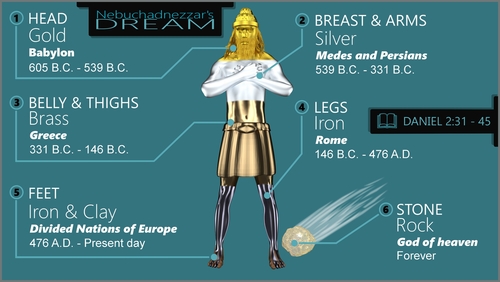
Daniel’s Interpretation of Nebuchadnezzar’s Dream


QUESTION: You have previously said that the Persian monetary system was based on gold, the Greeks used silver and the Romans began with bronze. That actually described the Biblical story of the dream of Nebuchadnezzar’s Statue interpreted by Daniel. Do you think your research into the world Monetary System confirms that interpretation?

WK

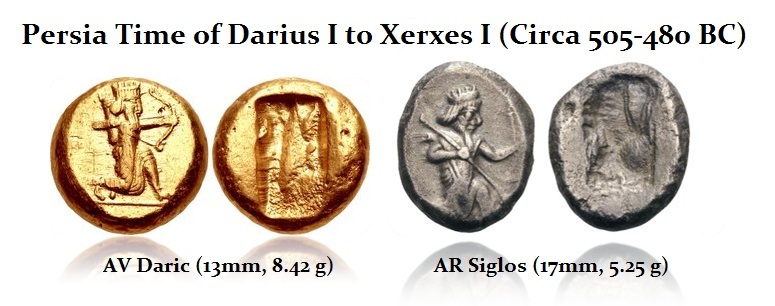
ANSWER: I have been asked that question before. Perhaps I have never answered it on this blog. The history of the world monetary system does appear to provide an accurate interpretation of that dream. However, I have my differences. The Persians had plenty of gold from Anatolia. The foundation of their monetary system began with gold. The first coins were actually issued by the Greeks who occupied Anatolia, (Turkey) which was conquered by the Persians who adopted their monetary system. The first coins were gold electrum, a natural alloy of gold and silver mixed. They eventually refined the electrum into gold and silver coins. That was the birth of the bimetal monetary system.


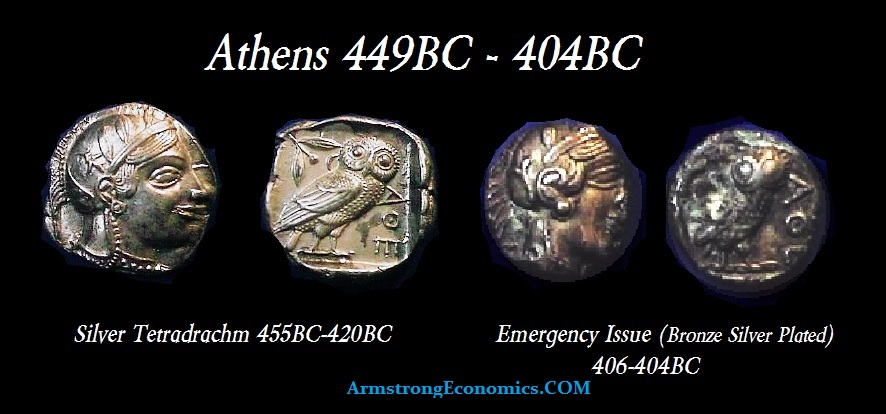
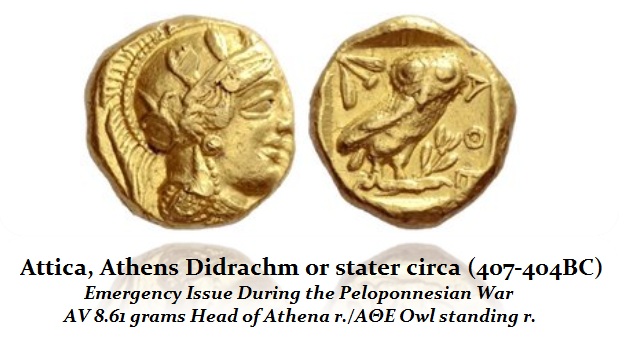
Mainland Greeks possessed silver mines. Athens was famous for its Athenian Owls. The only time we see Owls struck in gold was as an emergency issue during the Peloponnesian War. This is when we see the first debasement of the silver coinage. It was against this backdrop of war in a desperate fight for survival an emergency coinage was issued in gold.  Gold was scarce in the Greek world which relied upon silver. Athens in the last decade of the fifth century was surrounded by the Spartans who cut off their supply of silver by denying them access to their silver mines.

Athens was brought to its knees in the midst of military defeat. At first, Athens survived the by tapping into a reserve treasury of some 1,000 talents of silver. This enabled them to produce about 1.5 million silver tetradrachms. Then by 407BC or 406BC, Athens was no longer able to issue silver coinage. This was when they were forced to coin silver plated tetradrachms.  Aristophanes’ Frogs (718-33) indicate that the gold coins were struck in 407/406BC, and that silver-plated coins were struck in the year as well. The coinage confirms Aristophanes’ account. Some have argued that the Spartan forged the Athenian Owls to undermine their currency as a war tactic.

As for the rare gold coinage of Athens, the Athenians turned to the offerings stored on the Acropolis and the gold-covered statues of Nike. Perhaps this is when one of the Seven Wonder of the ancient world was stripped of her gold – Athena Parthenos. Most people have no clue that the famous Parthenon means ‘house of Parthenos’ meaning the house of Athena the Virgin. The Statute is said to have been taken during the 5th century AD. Some claim it was removed to Constantinople.

Athens had possessed an immense treasury, but it was completely depleted to defend in the war. These emergency funds were used to build and outfit a new fleet that in 405BC was defeated at Aegospotami in the Hellespont by the Spartan general Lysander. The Athenian gold from the war is uncommonly well documented for an ancient coinage. The bullion was stripped from seven of the eight golden Nikai on the Acropolis. Each statue was covered in about two talents worth of gold in the form of removable plates which perhaps could have produced 100,000 drachms weight in gold or 50,000 of the coin pictured here – Didrachm. What happened to this production is not known. Very few of these coins have survived and are worth up to $500,000 each. Perhaps the Spartans just melted down everything they could find.

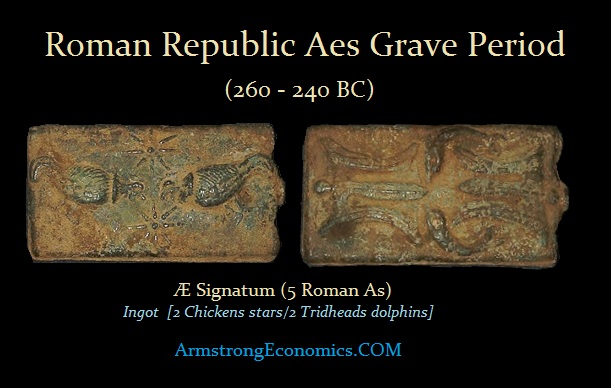
Nero presenting giftsThe Monetary System of Rome began with bronze which traded at first in clumps known as Aes Rude and then took form in ingots and round coins all cast at first rather than struck from dies. The “brass” is Orichalcum which was a rare natural alloy. It was first introduced by Augustus (27BC-14AD).  Nero (54-68AD) made use of Orichalcum to give higher value to certain denominations as the Sestertius and Dupondius.
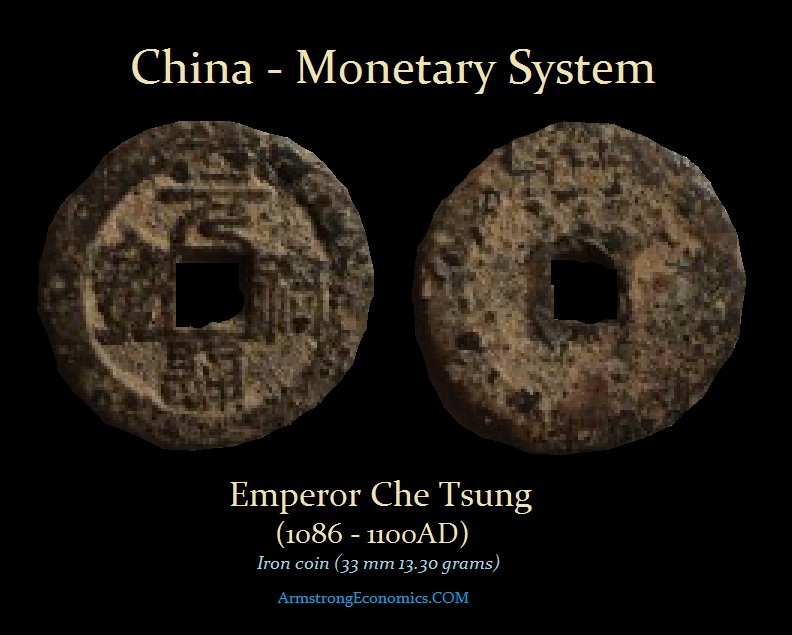
If we are to address the legs of Iron, sorry that does not fit the monetary description of the Roman Empire. The only monetary system to use iron for coinage was China – not European. Here is an Iron coin made during the period of Emperor Che Tsung (1086 – 1100AD)(33 mm 13.30 grams). After the fall of Rome/Constantinople, the Financial Capital of the World migrated to Asia. So I fail to see where the legs of Iron can be fairly interpreted to be a European Empire.

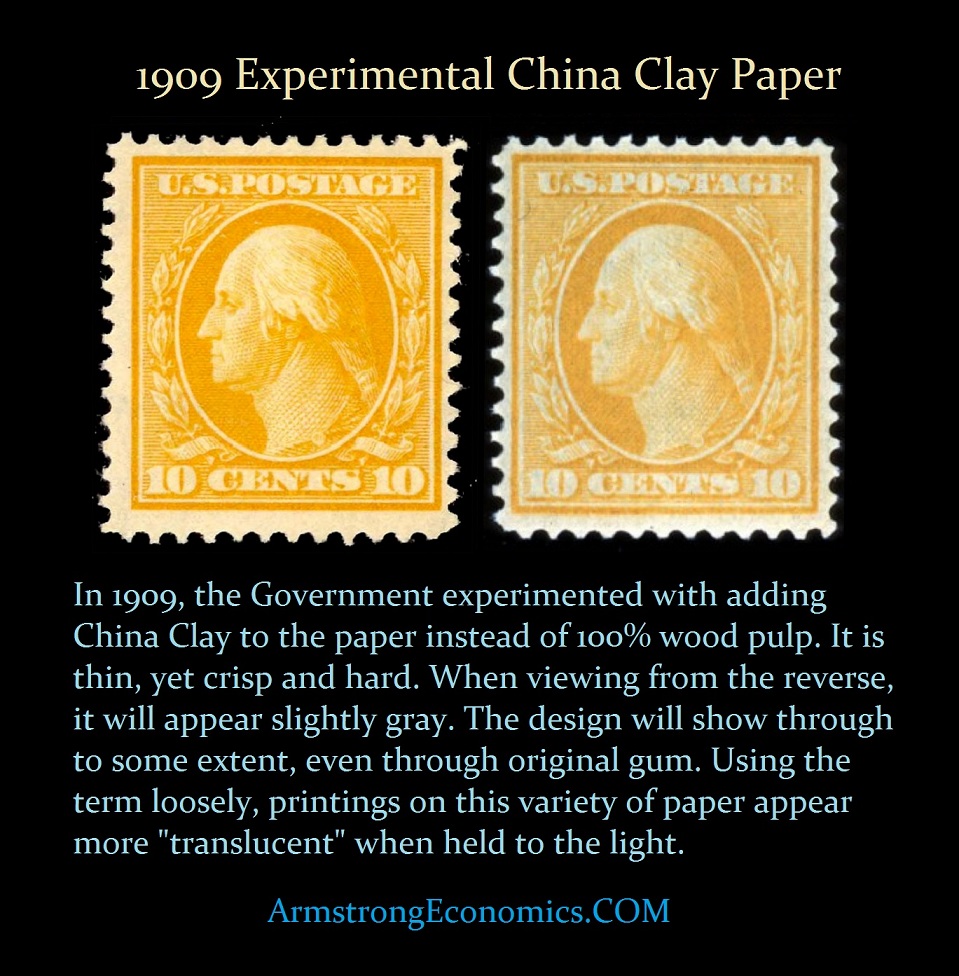
As far as part clay and part Iron, there is such a use of clay in the production of paper. It was known as China Clay Paper. Even the United States used it in the production of postage stamps for a brief period. It tended to have a bluish cast or tint to the paper.

In 1909, the United States briefly experimented with printing stamps on paper with 20% China Clay added to the otherwise 100% wood pulp used to make paper. The paper had a faint grayish tone, and the stamps printed on it are known as “China Clay” stamps.

While many know that paper money was invented in China, what they usually do not know is that paper itself was invented in China. Ever since the invention of writing, people had been trying to come up with something easier to write on than clay tablets, sheep skins (parchment), or papyrus or. However, it actually took a very long time – some 3000 years to be closer to the notch in the timeline of human society. Paper was invented around 100 BC in China. In 105 AD, under the Han Dynasty emperor Ho-Ti, a government official in China named Ts’ai Lun was the first to start a paper-making industry. He made paper by mixing finely chopped mulberry bark and hemp rags with water. He then mashed pounding it flat. After pressing out the water and letting it dry in the sun, he discovered paper. To be fair, for centuries before people used the mulberry bark to make cloth. Consequently, Ts’ai Lun’s paper was a derivative of that process and turned out to be a huge success. With paper available, Buddhist monks in China began to work on ways of mass-producing prayers. By 650 AD they were block-printing prayers. Tang Dynasty (618-907AD) marks the birth of paper money.

Consequently, I believe that the prevailing interpretation of Nebuchadnezzar’s Dream seems to be biased toward Western culture. There is no known use of iron being used for money outside of China in Europe. If we are going to use the monetary system to explain the empires, we should not omit China.

Victims, Victims Everywhere: Trigger Warnings, Safe Spaces, and Academic Freedoms


Published on Mar 9, 2018

Dr. Bret Weinstein, Dr. Heather Heying, Dr. Christina Hoff Sommers, and PSU’s own Dr. Peter Boghossian discuss free speech on campus, and professional victimhood. Dr. Peter Boghossian on Twitter: https://twitter.com/peterboghossian Dr. Bret Weinstein on Twitter: https://twitter.com/BretWeinstein Dr. Heather Heying on Twitter: https://twitter.com/HeatherEHeying Dr. Christina Hoff Sommers on Twitter: https://twitter.com/CHSommers

Greg Lukianoff: Ridiculous Cases of Prohibited Speech on University


Published on Dec 18, 2017

Greg Lukianoff is the president of the Foundation for Individual Rights in Education (FIRE). He previously served as FIRE’s first director of legal and public advocacy until he was appointed president in 2006. He graduated from American University (Washington) and Stanford Law School. In this clip, he talks about ridiculous cases of prohibited speech on university and how they are losing on free speech issues in court. Full clip, quoted under fair use: https://www.youtube.com/watch?v=Autfo…

Heather Mac Donald: How Much More Delusional Can University Students Get?


Published on Dec 23, 2017

Heather Lynn Mac Donald (born 1956) is an American political commentator, essayist, attorney and journalist. She is described as a secular conservative. She has advocated positions on numerous subjects including victimization, philanthropy, immigration reform and crime prevention. She is a Thomas W. Smith Fellow of the Manhattan Institute. In this clip, she talks about delusional university students who see a threat in anything even though they are the most privileged people. Until this victimhood complex stops, there can be no win for free speech. Full clip, quoted under fair use: https://www.youtube.com/watch?v=a2-JO…

Jonathan Haidt: How to Clean Up the Universities of Sjws


Published on Sep 6, 2017

Jonathan David Haidt (born October 19, 1963) is an American social psychologist and Professor of Ethical Leadership at New York University’s Stern School of Business. His academic specialization is the psychology of morality and the moral emotions. Haidt is the author of two books: The Happiness Hypothesis: Finding Modern Truth in Ancient Wisdom (2006) and The Righteous Mind: Why Good People are Divided by Politics and Religion (2012). He is also founder of the Heterodox Academy to support viewpoint diversity in academia: https://heterodoxacademy.org/ In this talk he presents his case for viewpoint diversity and the truth goal of science against the social justice goal. Full clip quoted under fair use: https://www.youtube.com/watch?v=ntN4_… — This channel aims at extracting central points of presentations into short clips. The topics cover the problems of leftist ideology and the consequences for society. The aim is to move free speech advocates forward and fight against the culture of SJWs.

Thomas Sowell: How the Government Creates a “Crisis”


Published on Aug 19, 2017

Thomas Sowell is an American economist, turned social theorist, political philosopher, and author. He is currently Senior Fellow at the Hoover Institution, Stanford University. In this segment he talks about how the Government creates a crisis and feeds on it, especially demonstrated with medicare and health care. Institution for World Capitalism. Jacksonville, Florida. October 14, 1993. Full video quoted under fair use: https://www.youtube.com/watch?v=9TkKu… ——- This channel aims at extracting central points of presentations into short clips. The topics cover the problems of leftist ideology and the consequences for society. The aim is to move free speech advocates forward and fight against the culture of SJWs.