Secretary Tillerson Makes The Case for Denuclearization to the U.N. Security Council…


The United States leading diplomat, Secretary of State Rex Tillerson, makes the historic case for peaceful denuclearization to the U.N. Security Council.

.

[Transcript] SECRETARY TILLERSON: Well, good afternoon. And I appreciate the opportunity to address the Security Council again, and I thank this month’s – this month’s chair, Ethiopia.

Members of the Security Council talk often of threats to global security.

The focus of today’s Security Council meeting is an issue of worldwide implications: nuclear proliferation.

At a time when stabbings, crudely constructed bombs, and trucks driven into crowds of innocent men, women, and children are often our enemies’ weapons of choice to attack us, it is easy to become complacent and see the threat of nuclear attacks as a relic of the Cold War.

The threat of a nuclear attack remains a grim reality. Those who would trigger such a horrific scenario pose a unique threat to the security of peace-loving nations.

The challenge for each of us is, “How can we decrease the threat posed by nuclear weapons, not just to our own people, but people the world over?”

Today I want to put four points forward:

The first is to highlight the positive trajectories of nations that have voluntarily relinquished nuclear weapons.

The second is to emphasize the moral burden of possessing nuclear weapons, and the enormous responsibility that accompanies stewardship of such devastating weapons, as well as the technologies and nuclear materials that go into them.

The third is to make clear acquiring nuclear weapons capability does not provide security, prestige, or other benefits – but instead represents a path to isolation and intense security scrutiny from the global community, as those responsible nuclear powers will check such uncertain, unpredictable threats.

And lastly, all nations, but most particularly the current nuclear powers, must recommit to sound nuclear security practices and robust and effective non-proliferation efforts in order to keep nuclear weapons and associated materials and technology out of the hands of irresponsible nations, terrorists, and non-state actors.

There are historical precedents of nations abandoning their nuclear weapons programs and arsenals out of self-interest. Belarus, Kazakhstan, South Africa, and Ukraine all weighed the risk and responsibility of nuclear weapons and made the decision to eliminate their nuclear programs or give up their nuclear weapons.

As the apartheid regime in South Africa ended, the country’s leaders eliminated its nuclear weapons and joined the Non-Proliferation Treaty as a non-weapon state. After the dissolution of the Soviet Union, Belarus, Kazakhstan, and Ukraine willingly gave up the nuclear weaponry that the Soviet collapse bequeathed to their territories. And, over the years, several other countries were willing to abandon clandestine nuclear weapons development efforts when reassured by the United States and others that their relationships with us and the global community enabled them to meet their national security needs without such tools.

The Republic of Kazakhstan is a particularly illustrative example of the wisdom of relinquishing nuclear weapons.

In partnership with the United States, and aided by the Cooperative Threat Reduction Act spearheaded by U.S. Senators Sam Nunn and Richard Lugar, Kazakhstan opted to remove from its territory former Soviet weapons and related nuclear technologies, and joined the Non-Proliferation Treaty as a non-weapons state.

This courageous decision by the leaders of Kazakhstan greatly reduced the prospect of nuclear weapons, components of nuclear weapons, or nuclear materials and dual-use technologies from falling into the wrong hands. Nuclear weapons introduced complexity into relations with other countries, and they introduced the risk of miscalculation, accident, or escalation.

Kazakhstan’s actions represented a key step in that country becoming part of the community of nations. As a result of letting go of nuclear weapons, the world does not look on Kazakhstan as a potential nuclear aggressor or a rogue state. It did not make enemies of its nuclear neighbors, Russia or China.

Today Kazakhstan has overwhelmingly been at peace with its neighbors, and its trade relations are robust. This year, it hosted World Expo 2017, an event in Astana, which showcased the sources of future energy and investment opportunities in Kazakhstan to attendees from around the world. This is a modern nation making a substantial contribution to regional and international peace and prosperity. Kazakhstan has only benefitted from its early decision.

In my previous career, I met President Nazarbayev on many occasions and had the opportunity to ask him about this decision. He is more at peace with his choice than ever. He once remarked to me, “It was the best thing I ever did for our young country.”

Ukraine made a similar courageous choice. Even after Russia’s incursion – incursion into its territory in Crimea and east Ukraine, a violation of Moscow’s commitments under the Budapest Memorandum – Ukraine’s leaders reaffirmed yet again the wisdom of their decision to remove nuclear weapons. Their friends and allies quickly came to their aid in response to this violation of their sovereignty with a strong, unified set of sanctions on Russia and are steadfastly committed to ending this conflict through full implementation of the Minsk accords.

By rejecting the power of nuclear weapons, both of these two proud nations are in a better place than they would have been otherwise. They reduced the danger of nuclear conflict and helped reduce the chances of such capabilities falling into the hands of irresponsible third parties.

As the only nation on Earth to have used nuclear weapons in warfare, the United States bears a heavy responsibility to exercise proper stewardship of nuclear weapons and to lead in working with other nations to reduce global nuclear dangers.

It is a blessing, and perhaps in many ways a miracle, that nuclear weapons have never been used again. All the peoples of the world pray that they will never be. Experience is a hard but wise teacher and has taught everyone the grim moral responsibility that accompanies nuclear weapons.

The United States is reliant upon nuclear deterrence today not only for the purposes of safeguarding our own security interest but also those of our allies who otherwise might feel the need to acquire such weapons themselves. Such deterrence and such relationships have contributed to the absence of war between the great powers since 1945 and indeed to the fact that nuclear weapons themselves have never been used again.

We’re all fortunate that John F. Kennedy and Nikita Khrushchev, when they stood on the brink of a nuclear holocaust during the Cold War, came to a common understanding of the fearful and awesome power of nuclear weapons. As potential human extinction loomed over the Cuban Missile Crisis, the dominant emotion was fear. Nuclear weapons brought the most powerful men in the world no comfort, but it did make clear the need to minimize the risk of ever repeating this near-miss of a catastrophe by permitting nuclear capabilities to spread further.

Just this week, the world learned of the passing of a little-known but important figure in the history of the Cold War. His name was Stanislav Petrov, and he is sometimes referred to as “the man who saved the world.” In 1983, Petrov was a Soviet military officer on duty at a nuclear early warning center when his computers detected a barrage of incoming American nuclear missiles. He said, “I had all the data to suggest” it was true. He said, “If I had sent my report up the chain of command, nobody would have said a word against it.” He said, “All I had to do was to reach for the phone to raise the direct line to our top commanders, but I couldn’t move. I felt like I was sitting on a frying pan.”

Petrov had a hunch that the computer had made an error, and fortunately he was right about a false alarm. Instead of notifying his commanders to prepare an immediate nuclear counterattack, he instead called army headquarters and reported a system malfunction. This episode illustrates just how high the risk factor is with nuclear weapons, especially when decisions to use them are entrusted or could be entrusted to sometimes unreliable technologies or fallible human judgment. Countries who want nuclear weapons must ask themselves: Am I prepared to deal with this type of scenario in my own country?

The history of the Cuban Missile Crisis and the Soviet early warning malfunction illustrate how challenging it can be even for the most experienced and most sophisticated nuclear possessors to control nuclear dangers.

Rogue regimes fail to appreciate the responsibilities inherent to nuclear weapons. They wish to develop or expand their holdings of nuclear weapons in what they claim to be a search for security, but in fact they desire to use such tools to intimidate and coerce their neighbors and destabilize their regions. Such acquisitions risk creating an escalating spiral of regional or global instability and conflict, not just as a direct result of their own proliferation, but by prompting other nations to undertake their own nuclear weapons programs in response. In such circumstances, nuclear weapons are not instruments of mutual deterrence and strategic stability, but instead are tools of destabilization.

Rogue regimes may have persuaded themselves that they pursue nuclear weapons to establish and enhance their security and prestige, but, in fact, nuclear weapons are more likely to undermine both. There’s a very good reason why almost every country in the world has joined the Non-Proliferation Treaty: All parties can know that they will not in the future face the threat of nuclear catastrophe from any new direction.

If would-be proliferators seek security or to improve their standing in the world or to enhance the prosperity of their citizens and their people’s hope for a brighter future, proliferation will not provide these things. There are much better, proven ways for nations to establish and enhance their standing, such as deepening their trade integration with the rest of the world, adhering to international standards and agreements, and participating in humanitarian activities.

The Korean Peninsula serves as a stark example of these differing paths. While North Korea has shunned the international community and let its people starve while it relentlessly pursues nuclear weapons, South Korea has opted not to pursue nuclear weapons and is fully engaged with the international community. As a result, South Korea has grown into one of the world’s great economic powers, with a GDP over 100 times that of its neighbor to the north.

By contrast, though North Korea may assume that nuclear weapons will ensure the survival of its regime, in truth, nuclear weapons are clearly only leading to greater isolation, ignominy, and deprivation. Continued threats against us – against us, the U.S., and now, the entire global community, will not create safety for the regime, but will rather stiffen our collective resolve and our commitment to deterring North Korean aggression.

North Korea is a case study in why nations must work to preserve and strengthen global nonproliferation norms. As we look to the future, the international community’s record of enforcing compliance with nonproliferation obligations and commitments is not what we need it to be.

It is partly for lack of such accountability that we find ourselves in the situation we are in with North Korea at the moment. Though it joined the Non-Proliferation Treaty in the mid-1980s, North Korea never came into full compliance with the treaty, and cheated on every subsequent arrangement designed to remedy that noncompliance and rein in the nuclear threat it now presents.

There are also lessons here for Iran, which was on its own pathway to develop nuclear weapons – in violation of its Non-Proliferation Treaty and nuclear safeguards obligations and multiple, legally binding UN Security Council resolutions. Iran seems keen to preserve for itself the option to resume such work in the future, even while sponsoring international terrorism, developing missile systems capabilities of delivering nuclear weapons, and destabilizing its neighbors in a dangerous quest of regional hegemony.

The collective responsibilities of meeting such proliferation challenges will require more from all of us. As President Trump said in his speech on Tuesday, “If we are to embrace the opportunities of the future and overcome the present dangers together, there can be no substitute for strong, sovereign, and independent nations.” As strong, sovereign, and independent nations, we must work together, bilaterally, regionally, and globally, to stem the tide of proliferation. Sovereign states acting in unison will produce a global good.

We especially urge Russia to examine how it can better support global nonproliferation efforts. As the world’s two most powerful nuclear states, Russia and the United States share the greatest responsibility for upholding nonproliferation norms and stopping the further spread of nuclear weapons.

We have cooperated well before: the United States and the Soviet Union worked together closely in drafting most of the text that became the Non-Proliferation Treaty, which helped keep proliferation under control through the Cold War. Washington and Moscow did this, moreover, notwithstanding their own Cold War rivalry and the many problems in their bilateral relationship. In the post-Cold War era, Russia worked hard to improve accountability for its nuclear stockpile dispersed across the former Soviet Union, and we engaged closely in cooperative efforts – through the Nunn-Lugar program – to reduce the risk of weapons or material falling into the hands of proliferators or terrorists.

Unfortunately, in recent years, Russia has often acted in ways that weaken global norms and undercut efforts to hold nations accountable. Examples include violating its own obligations under the Intermediate-Range Nuclear Forces Treaty, flouting the security assurances it made at the end of the Cold War, impeding efforts to build on the legacy of past international efforts on nuclear security, and seeking to weaken the International Atomic Energy Agency’s independence in investigating clandestine nuclear programs.

If Russia wants to restore its role as a credible actor in resolving the situation with North Korea, it can prove its good intentions by upholding its commitments to established international efforts on nuclear security and arms control.

Cooperation from China is also essential if the international community is to bring North Korean nuclear and missile threats under control and prevent a catastrophe spiraling of instability and conflict on the Korean Peninsula.

If China truly desires to denuclearize the Korean Peninsula, to promote stability, and to avoid conflict in that sensitive region, right on its own border, now is the time to work with the rest of us, the rest of the international community, to put the kind of pressure on North Korea that can change its strategic calculation before it’s too late.

And lastly, we must be fully aware that there are non-state actors who will never conform to international norms governing nuclear weapons.

Their grand-scale terror attacks, beheadings, crucifixions, burnings, rapes, torture, acts of enslavement expose ISIS, al-Qaida, and other groups as those who seek to find glory through death and destruction.

Their eagerness to commit atrocity makes clear that, if given the chance, they would commit death and destruction on an even larger scale.  And there is no scale larger than a nuclear attack on one of the world’s cities.

Many jihadist groups aspire to detonate a nuclear device in the heart of a booming metropolis. Their mission is to kill our people and send the world into a downward spiral. We must never allow this.

We must continue to work to secure nuclear technologies, blueprints, and materials at their sources and disrupt proliferation networks.

We must deepen information sharing between intelligence agencies in order to identify actors and identify when nuclear materials have been or may be diverted from legitimate uses.

And we must revive the practice of creating alternative career and job opportunities for nuclear experts, so they do not sell their skills on the black market.

But ultimately, the best means to halt jihadists in their quest for nuclear weapons is to destroy them long before they can reach their goal.

Whether on the battlefield, in the streets, or online, terrorism must be given no quarter.

We must remain ever vigilant against the spread of ISIS and other Islamist groups in new locations, whether in Africa, Asia, Europe, or elsewhere.

One of the great successes of the campaign of the Coalition to Defeat ISIS in Iraq and Syria has been uprooting ISIS from formerly safe havens in which they could freely mastermind attacks against targets the world over. These efforts must continue.

As a body committed to security, we must treat nuclear proliferation with the seriousness it deserves.

For those of us on the Security Council, counteracting nuclear threats begins with full enforcement of the UN Security Council resolutions all member-states are bound to implement. To make sure all nations are able to play their part, we must continue to work for full and effective implementation of UN Security Council Resolution 1540.

But signing treaties and passing resolutions is not enough. Stopping nuclear proliferation also entails exercising other levers of power, whether diplomatic, economic, digital, moral, or, if necessary, military.

Ultimately, we each have a sovereign responsibility to ensure that we keep the world safe from nuclear warfare, the aftermath of which will transgress all borders.

The United States will continue to halt – to work to halt the proliferation of nuclear weapons. We ask all peace-loving nations to join us in this mission.

Thank you.

[Transcript Link]

Spain Showing the World It is Still A Fascist Government – Sell Spanish Debt


The Spanish government is facing the real moment of truth. It is displaying that it is by no means concerned about human rights nor is it a true democratic system. Spain has reverted to Franco fascism as now more than 40,000 people have gathered in Barcelona to protest over the Catalan independence vote being shut down as the Spanish Government sends in 16,500 troops to deal with the activists. This is showing just how far out of touch this entire EU anti-democratic government has gone. The people no longer matter – the elite know what is best for them.

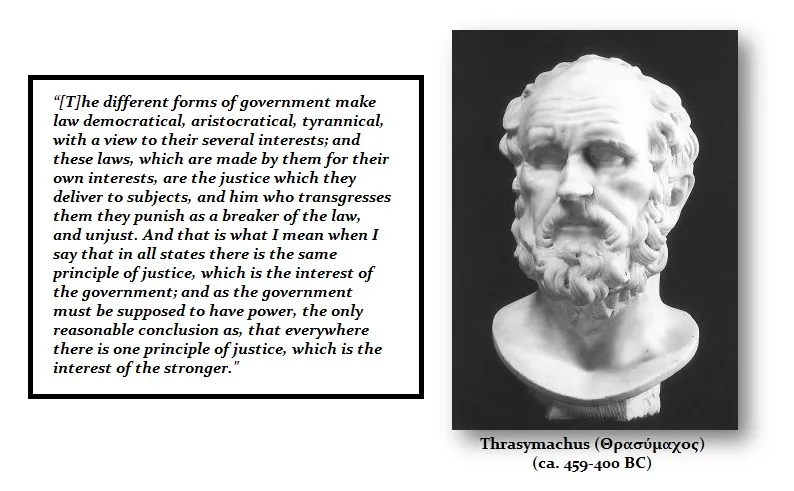
This is 86 years from the beginning of the Second Republic in Spain so 2017 is precisely on target for this type of civil unrest. What this is demonstrating is the old adage – the king is dead, long live the king. No matter what form of government takes power, it will ALWAYS, and without exception, seek to act only in its own self-interest precisely as Thrasymachus argued against Socrates.

You cannot short Spanish debt. So those who hold it, had better sell it to the ECB before it is too late. This is a very serious event that reflects upon the entire European Project. It should have been a trade union – not a political union by force of arms. Napoleon and Hitler tried that one before. It cannot work. Human rights include the dignity to assemble and the freedom of thought. Article 17 provides that no one may use the rights guaranteed by the Convention to seek the abolition or limitation of rights guaranteed in the Convention. This addresses instances where states seek to restrict a human right in the name of another human right, or where individuals rely on a human right to undermine other human rights (for example where an individual issues a death threat). Human Rights includes the freedom to hold opinions, and to receive and impart information and ideas. Spain has ignored the European Convention on Human Rights and is pretending that its national security overrides human rights – i.e. self-interest.


Climate Change on the Horizon


QUESTION: Marty,

I’ve been looking at the Year Without a Summer on Wikipedia and read that there was a cooling trend prior to the winter-like conditions during the summer of 1816. It mentioned that it affected the northeast. Also that the reason for the cooling trend is associated with the volcanic activity prior to and including 1816 and the reduction in solar output. The article also mentions that from 1628-1626BC that there was another climate disturbance, Minoan eruption of Santorini. Looking at 1628BC to 1816AD and using 3141.592 days/cycle results in 400.13 cycles. Using 1628BC and projecting it 424 cycles puts us around 2021.42. Knowing from history how this climate disturbance affected the Northeast, is that one of the reasons why you moved from New Jersey to sunny Florida, besides the hunt for taxes in NJ?

ANSWER: Yes, Add the 300 year cycle in the energy output of the sun and we see that we are headed into a cold period. This should also result in a commodity cycle boom going in the next 8.6 year wave into 2024.

Spain Invades Barcelona & EU Shows Its Fascist Character


Spain has invaded Barcelona sending in an army of 16,500 as pretend riot police to effectively suppress and intimidate the people. Armed police have seized almost 10 million ballots for the referendum to shut down any democratic process showing the entire world that Spain is still fascist and that is really supported by Brussels. The Spanish police have beaten citizens as if this were some third world dictatorship demonstrating the democracy is truly dead in Europe.

Catalonia represents a fifth of Spain’s 1.1-trillion-euro ($1.32 trillion) economy and enjoys wide self-government, although key areas such as infrastructure and taxes are in the hands of central authorities. The region has about 5.5 million eligible voters.


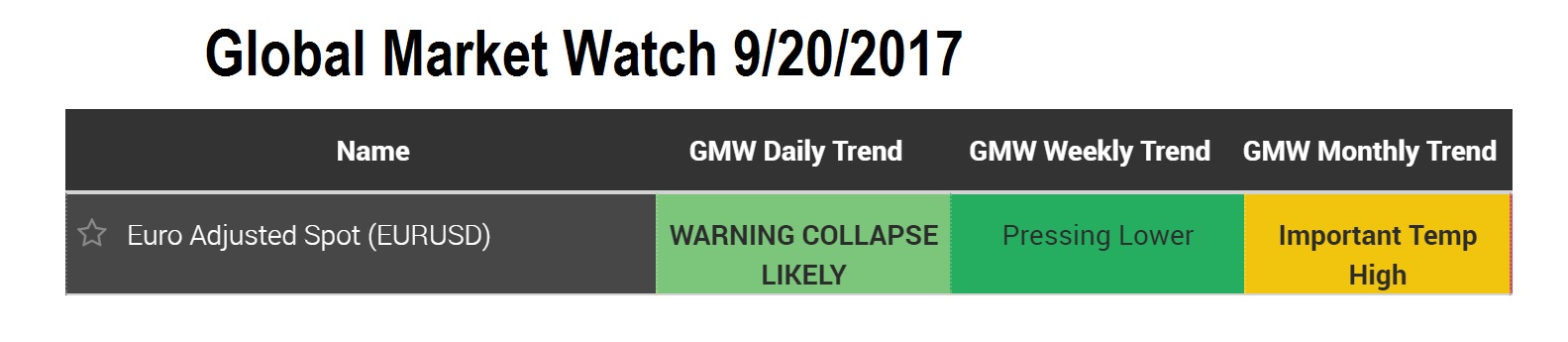
The Spanish police have raided several print works and newspaper offices in Catalonia hunting for voting papers, ballot boxes and leaflets to be used in an October 1st independence referendum which Madrid vehemently opposes. Madrid has revealed its true nature to the entire world on center stage and this is starting to show up in our models for Europe.  The Global Market Watch picked up patterns yesterday warning that there is trouble in the wind.

Thousands have taken to the streets in protest of what is clearly a full blown restoration of Spanish fascism. Meanwhile, shorting Spanish bonds has been outlawed. The free markets have been utterly destroyed. The ECB is buying all Spanish debt trying to pretend that confidence in Spain is strong. Clearly, any institution holding Spanish debt at this point should sell it to the ECB before it is too late.

The EU is starting to shape up as you can check in, but you cannot check out. This is certainly more of a fascist system than democratic. This is reflecting the serious political issues for the EU looking into the next few years.

Afghan President Says Trump’s Strategy (Trump Doctrine) Much More Effective Than Obama’s Failures…


Afghanistan President Ashraf Ghani delivered remarks today at the U.N. discussing the difference between U.S. President Donald Trump’s current strategy and the failed policy of former President Obama.

Two key differences underline the optimism of Ghani: #1) President Trump listened to what the region needed for stability; and #2) The Trump Doctrine of appropriately placing responsibility on Pakistan due to their enabling conduct with the extremist Taliban.

(Reuters) – Afghan President Ashraf Ghani said on Wednesday that U.S. President Donald Trump’s strategy to win the war in Afghanistan will work where his predecessor’s failed because the Afghan army is stronger and Trump wants a regional approach and a harder line with Pakistan.

Ghani also said that former President Barack Obama “did not have a partner in Afghanistan,” implicitly criticizing former Afghan President Hamid Karzai, who frequently disdained U.S. policy and the U.S.-led international military force.

“President Trump is not just an individual (but) a team of partners in Afghanistan,” Ghani told the Asia Society in New York, where he is attending the U.N. General Assembly. “The Trump administration’s strategy has the uniqueness of immense consultations with us.”

At the same time, Ghani said, Obama’s decision to maintain some U.S. forces in Afghanistan “ensured our survival” despite advances by Taliban insurgents.

U.S. Defense Secretary Jim Mattis said on Monday that more than 3,000 additional U.S. troops are being deployed to Afghanistan under the new strategy announced last month. The number of U.S. forces would rise to more than 14,000, compared to a high of more than 100,000 under Obama.

While providing few details, Trump pledged stepped-up operations against the Taliban and an open-ended commitment of U.S. military advisers, trainers and counter-terrorism units.

He also vowed to take a tougher line to end what U.S. officials say is Pakistan providing refuge and other support to the Taliban and other extremist groups. Pakistan denies the charge.

Asked how Trump’s strategy differs from Obama‘s, Ghani said Trump’s plan takes “a regional approach” to security and a harder line with Pakistan while providing a new opening for peace talks.

“The message to Pakistan to engage and become a responsible stakeholder in the region and in the fight against terrorism has never been clearer,” Ghani said. “What I am offering the Pakistan government, the Pakistan security apparatus, is the invitation to a comprehensive dialogue.”

“If Pakistan does not take this opportunity, I think they will pay a high price,” he said, without elaborating.  (read more)

Catalonia Independence Vote October 1st


The Spanish government refuses to listen to anything from Catalonia  and announced it would intervene in Catalonia’s finances to ensure that “not one euro” of public money was used to fund the “illegal” vote. Meanwhile, the Spanish police arrested 13 people in the region of Catalonia and Madrid for their alleged involvement in planning a vote to secede from Spain. This is clearly demonstrating that the Spanish government is reverting to its old fascist ways for it is the boldest move yet by Spanish authorities to stop the separatist movement.

It was 1931 when the nations defaulted on their debts that saw Estat Català and other parties began to form Esquerra Republicana de Catalunya (Republican Left of Catalonia)(ERC). The ERC won a dramatic victory in the municipal elections that year and this is when we must regard the first major step in the separatics movement.

Francesc Macià founded Estat Català (Catalan State) and proclaimed the Catalan Republic. However, after negotiations with the leaders of the new Spanish Republic, he instead accepted autonomy within the Spanish state. In the Spanish Civil War, General Francisco Franco abolished Catalan autonomy in 1938. Following Franco’s death in 1975, Catalan political parties concentrated on autonomy rather than independence.

To put this in context, it was 1931 which gave birth to the Second Republic of Spain on April 14th, 1931 after the departure from Spain of King Alfonso XIII, following local and municipal elections where republican candidates won the majority of votes in urban areas. Though Alfonso did not formally abdicate, his departure from the country led to a provisional government under Niceto Alcalá Zamora. It was at this time that a constitution was drawn up.

The Second Republic of Spain in 1931 raised the hopes for the Spanish people that the middle and lower classes would be allowed to at last advance. This included at the time women rights and for the curtailment of special privileges for the Church. It was Spain’s attempt to establish a non-religious basis for national culture and citizenship.

Nonetheless, there was the largest working-class party that was the Socialists. Their principal goal was Marxist-inspired economic and social change, but they strongly favored a republic. The situation changed dramatically on May 10, 1931, as a result of the “Burning of Convents”. The provisional government of the Second Spanish Republic had little interest in restraining manifestations of anticlericalism, as became apparent shortly after the proclamation of the Republic. Many of the new political leaders were openly anti-Catholic. So we had at this time a growing Marxist movement in Spain as well. Then on May 10th, 1931, the playing of the monarchist anthem or hymn at a royalist club in Madrid provoked an attack by supporters of the Republic that soon degenerated into three days of violence directed primarily against churches, convents and monasteries. Rioting soon spread from Madrid to Seville, Malaga and four other cities. The government at first did nothing to quell the growing violence. This fragmentation would lay the foundation for the rise of Franco and the Civil War.

The Spanish Constitution of 1931 was approved by the Constituent Assembly on December 9th, 1931. It remained in force only until  April 1st, 1939. This was the second period of Spanish history in which both head of state and head of government were democratically elected.

The planned referendum will take place on October 1st. Madrid refuses to address any issues despite the Catalan President and the mayor of Barcelona appealing for an agreement on a vote and issuing “a new call to dialogue” without preconditions. The 1931 movement for independence was the watershed moment. Cyclically, this is now 86 years in 2017. There is no question that independence will eventually succeed, but this is also coming at a critical time to try to save the EU. Cyclically, this is simply right on time 2017.

A comment from a reader in Barcelona says it all how memories still run deep:

“I follow your blog out of curiosity since I am a person with low income … I have been Catalan independentista since the 10 years 1980 i agree wth that all my life . my grandfather was in prison for speaking Catalan and my father forced him to learn fascist hymns, also spanish fascim of franco favored Spanish immigration in catalunya to Spanishize the region… my convictions that I am Catalan and I fight for a nobler cause of freedom not only for the interests of taxes that come from Madrid, if my main anger is by its stupid laws inherited from fascism to its inherited legacy of an old fallen Catholic empire, I consider that my struggle it is a struggle for the diversity of languages, the diversity of cultures which in this global world are being eaten lenguajes to extind in the name of great dictadors gloval interests.”

Climate Change Scientists Backtracking On New Data At Last


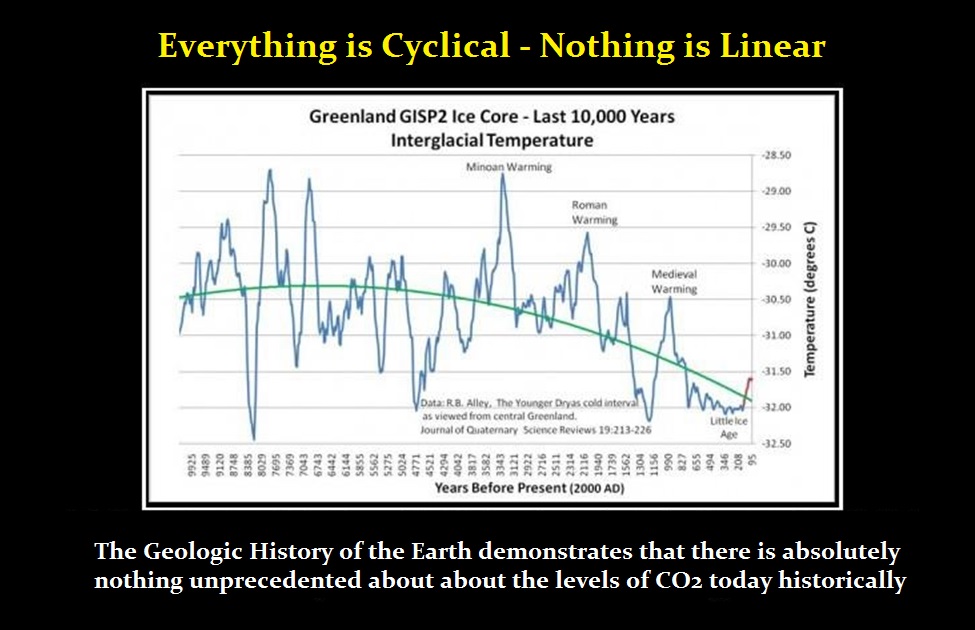
The headline in the London Times: “We were wrong — worst effects of climate change can be avoided, say experts Scientists admit that world is warming more slowly than predicted.” The analysis of Global Warming has been the one of the greatest absurd propositions of modern times. With a tiny fraction of data on climate from 1850 forward, the argument that man has created global warming is as absurd as looking at the Dow Jones Industrial Index for one month and concluding that it only rises.   There has been a climate cycle to the arctic that has been reported all along. There was a warming period in 1939 and again in 1952 reported in newspapers of how Greenland was melting. They there have been periods of expansion of ice as we have see this past year. The bottom line – it’s just a cycle and we lack the ability to alter the climate of the earth. Pollution is a separate and distinct issue. Creating smog or polluting a lake is certainly within our capacity. But changing the climate of the earth is far removed from the ability of humankind. Even nuclear bombs and accidents do not alter the climate.

Analysis of Global Temperature Trends, August, 2017, what’s really going on with the Climate?


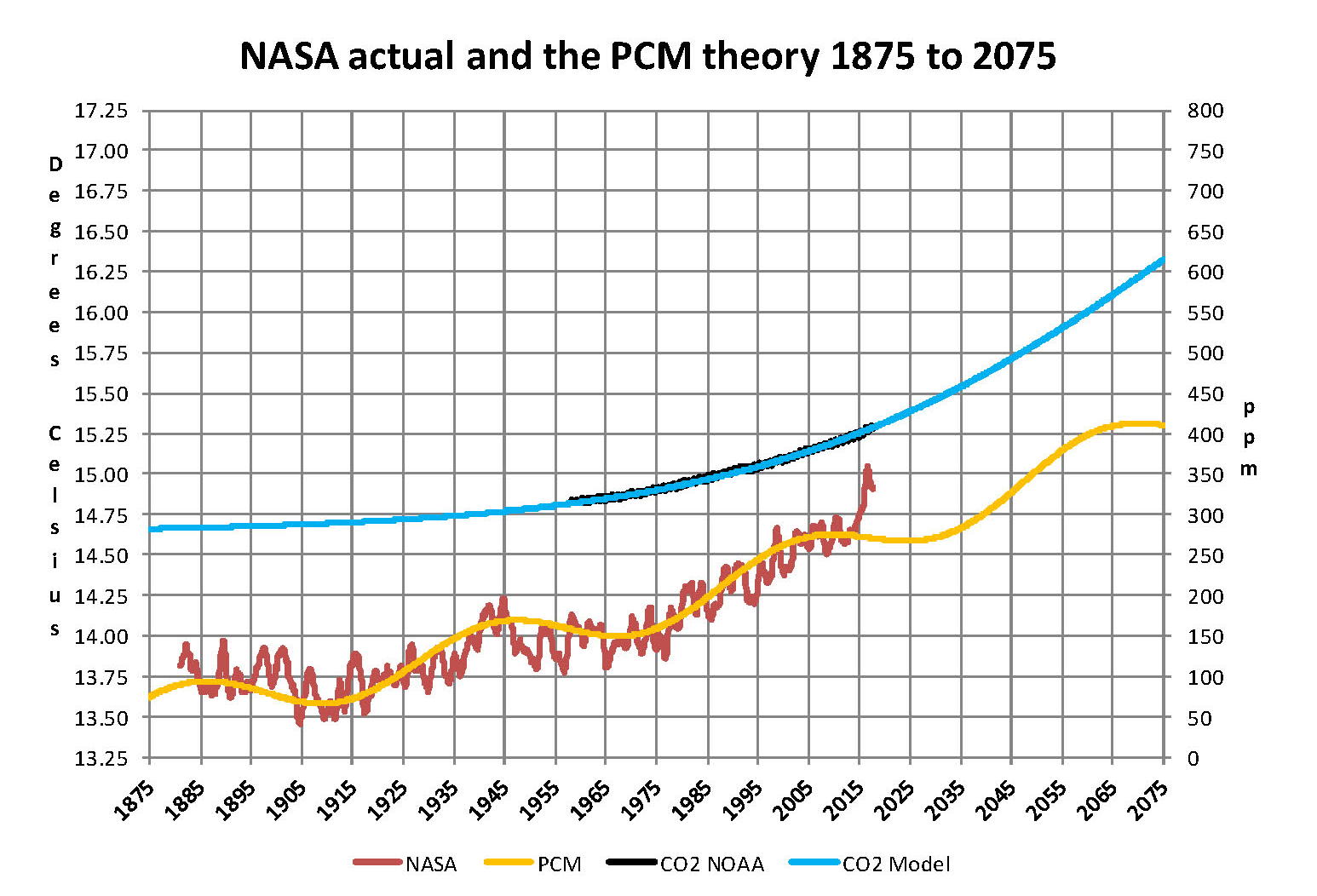
The analysis and plots shown here are based on the following two data series. First NASA-GISS estimates of a global temperature shown as an anomaly (converted to degrees Celsius) as shown in their table Land Ocean Temperature Index (LOTI) and shown in the following Chart as the red plot labeled NASA. This plot is shown as a twelve month moving average to minimize the large monthly swings and better show trends; the scale for the temperatures is on the left. Second NOAA-ESRL Carbon Dioxide (CO2) values in Parts Per Million (PPM) which are shown in the following Chart as a black plot labeled NOAA. This plot is shown exactly as the data from NOAA is presented and there is no need for a moving average the scale for CO2 is shown on the right.

NASA published data as stated in the first paragraph is shown as an anomaly, but what is a temperature anomaly?  An anomaly is a deviation from some base value normally an average that is fixed. There were two problems with the system that NASA picked which were number one there is no “actual” global temperature and two since climate is a variable there cannot be a real base to measure from. NASA known for its science and engineering expertise back in the day thought it could get around these issues and created a system to do so. First they developed a computer model which took readings from all over the planet and made significant adjustments to them called homogenization and came up with the estimated global temperature. Second they picked the period 1950 to 1980 (30 years) and averaged the values and came up with 14.00 degrees Celsius and make that their base.  Then they took the calculated temperature and subtracted the base from it which gave them the anomaly. The problem is that both the base and the anomaly are arbitrary.

Now that we have a base to work with we are going to add to the previous Chart three things. The first is a trend line of the growth in CO2 since that is the entire basis for climate change according to the government through NASA and NOAA. That plot is superimposed over the black plot of the actual NOAA CO2 values as the cyan line labeled as the CO2 Model and one can see there is a very good fit to the actual NOAA values so there should be no dispute about its validity.  This plot allows us to make projections to future global temperatures according to the projected level of CO2 .  The second added item is James E. Hansen’s Scenario B data, which is the very core of the IPCC Global Climate models (GCM’s) and which was based on a CO2 sensitivity value of 3.0O Celsius per doubling of CO2. This plot is shown here in lavender and is part of a presentation that Hansen showed to congress in 1988 when the UN was about to set up the International Panel on Climate Change (IPCC) and this plot is labeled as Hansen Scenario B which Hansen stated was the most likely to happen based on his theories’.  The third item is the current plot of the most likely temperature of the planet based on the growth of CO2 published by the IPCC. This plot is shown in Red and is labeled as IPCC AR5 A2 as that is the table where the data was found. This plot is a GCM computer projection of the planets temperature based on the complex relationships developed on the levels of CO2 by the IPCC primarily though NASS and NOAA.

It can be seen in this Chart that the lavender plot and the Hansen plot are very close from 1965 to around 2000 after that, from 2000 to 2014, there is a very large and growing deviation reaching close to .5 degrees Celsius in 2014, which is not an insubstantial number.  Also of note is that there doesn’t seem to be a good correlation between the growth in CO2 and the increase in the planets temperature. The CO2 is going up in a log function and the Temperature was going down in a log function until recently where it reversed in 2015 and is now going up in a log function. That unexplained and major change in temperature direction appeared to have occurred between 2013 and 2014 and is the subject of this monthly paper.

The next Chart is developed from the raw data from NASS and NOAA as shown in the first Chart.  This plot was made first by adding ten years blocks of temperature and CO2 as indicated in the Chart and diving by 120 to give an average for each.  Then the average Temperature was divided by the average CO2 to give degrees of temperature increase per PPM of CO2. After that was plotted it appeared that there were two different curves. the first was from block 1965-1974 through block 2004-2014 shown as Black Dots and the second was from block 1995-2004 through block 2005-2016 shown as Black Dashes. When trend lines were added they were both almost perfect fits to the raw data and so you cannot see the data points very well on the Chart.  These blocks were picked to represent the entire period of time where we had both NASA temperature data and NOAA CO2 levels.

On the following Chart are two sets of color coded information. The first is Cyan plot and the Cyan box with the equation in it along with the R2 value of 1.0 are for the first series from block 1965-1974 through block 2004-2014. The other is the Red plot and the Red box with the equation in it along with the R2 value of 1.0 which are for the first series from block 1965-1974 through block 2004-2016. We can speculate on how this change has happened but it cannot be said that the plot change is not real; however additional data over the next few years will be required to actually prove that something has changed.

In summary the Cyan data set indicates a diminishing effect of CO2 on global temperature for about 54 years and the Red data set represents an increasing effect of CO2 on global temperature for the past 2 years. Since both data sets have an R2 value of 1.00 the trend lines cannot be in question.

Before we get into a possible explanation to the drastic change from the Cyan data to the Red data that occurred in 2014 we need to consider other factors than CO2 on Climate change.  The fault that occurred in the work that was done in the 1980’s was in assuming that there was an optimum or constant global temperature and therefore any change that was being observed was from the increasing amount of CO2 in the atmosphere.  There may have been correlation but it was never proved that there was causation (high R2 value) between CO2 and global temperatures. With that assumption, which limited options, we moved from true science into the realm of political science.  True science has an open mind and finds relationships that work in matching observations with predictions.  Political science changes history and/or facts to match the desires of the politicians. Since the politicians control the money political science is what we get; which means that what we get may not be technically correct.

A decade ago when I started looking at “climate” change the first thing I did was look at geological temperature changes since it is well known that the climate is not a constant; I learned that 52 years ago in my undergrad geology and climatology courses in 1964. The next paragraph explains currently observed patterns in climate related to this subject and is historical accurate.

Ignoring the last Ice Age which ended some 11,000 years ago when a good portion of the Northern hemisphere was under miles of ice the following observations give a starting point to any serious study on the subject of climate. First, there is a clear up and down movement in global temperatures with a 1,000 some year cycle going back at least 3,000 to 4,000 years; probably because of the apsidal precession of the earth’s orbit of about 20,000 years for a complete cycle. However about every 10,000 years the seasons are reversed making the winter colder and the summer warmer in the northern hemisphere. 10,000 years from now the seasons will be reversed again. Secondly, there are also 60 to 70 year cycles in the Pacific and the Atlantic oceans that are well documented. These are known as the Atlantic Multi Decadal Oscillations (AMO) in the Atlantic and as La Nina and El Nino in the Pacific. Thirdly, we also know that there are greenhouse gases such as carbon dioxide that can affect global temperatures. Lastly the National Academy of Sciences (NAS) estimated that carbon dioxide had a doubling rate of 3.0O Celsius plus or minus 1.5O Celsius in 1979 when there were only two studies available and one for sure and maybe both were not peer reviewed.

The result of looking objectively at the three possible sources of global temperature changes was a series of equations based on these observations that when added together produced a sinusoidal curve that seemed to follow NASA published temperatures very closely when first developed in 2007.  Since this curve was based on observed temperature patterns it was called a Pattern Climate Model (PCM) which has been described in previous papers and posts on my blog and since it is generated by “equations” many assume it is some form of least squares curve fitting, which it is not. It does seem to be related to ocean currents where the bulk of the planet’s surface heat is stored.

The following Chart shows the PCM which is a composite of two cycles and CO2. There is a long trend, 1036.7 years with an up and down of 1.65O Celsius (.00396O C per year) also observed in the NASA data as the base. Then  there is a 69.1 year cycle that moves the trend line up and then down a total of 0.29O Celsius and we are now in the downward portion of that trend (-.01491O C per year) which will continue until around ~2035.  This short cycle is clearly observed in the raw NASA data in the LOTI table going back to 1880. Lastly, there is CO2 currently adding about .0079O Celsius per year so together they all basically wash out at -.0039O C per year, which matched the current holding pattern we were experiencing until 2014. After about 2035 the short cycle will have bottomed and turn up and all three will be on the upswing again duplicating what was observed in the 1980’s.  Note: the values shown here are only representative as the actual model uses many more places than what are shown here.

When using the 12 month running average for global temperatures up until 2014 the PCM model was within +/- .01 degrees of what NASA was publishing in their LOTI table since the early 1960’s as shown in the next Chart. Further the back projection of the PCM plot matched historical records and global temperatures going back past the time of Christ. It should also be consider that geologically CO2 levels have reached levels many times that of the current 400 ppm without destroying the planet so the current hysteria over the current small numbers can only be explained by political science not real science.

The nest step in this analysis is to put all of the known data and projections into one Chart which will contain: NASA’s table LOTI global temperature estimates, NOAA’s actual CO2 values, the CO2 model projections, the PCM model global temperature plot, Hansen’s Scenario B 1988 global temperature plot, and lastly the IPCC AR5 A2 global temperature plot. With that done we can look at the results and try to make some sense of what is going on with the various arms of the federal government that are promoting that carbon based fuels be eliminated since they are responsible for the global temperature level  going up.  As previously started when the government pours money into the sciences the sciences respond with technical papers the support the governments views, this is what I call political science verses real science as was done prior to the 1980’s; money talks and BS walks as everyone on the street knows.  This Chart views a good overview of the current situation showing all the facts and all the projections.

This Chart contains no manipulation of the data and the only change that was made was to convert the NASA anomalies back to degrees Celsius to make it more readable to lay people.  This is only a change in units and has no bearing on the look.  A subject not broached here is that of the NASA homogenization process itself and the base period from 1950 to 1980. The portion in the black circle contains the NASA base period of 14.00 degrees Celsius and the reason it’s brought up here is that the Homogenization process causes the global temperatures to move around since the entire data base all the way back to 1880 is recalculated each month.  But since the base has to stay at 14.00 degrees Celsius the program must be set to not allow changes in that period of time. I’m sure the programmers have fun with that. Prior work here has shown how this creates a teeter totter effect with the data plots, some of which have recently been significant.

The next Chart will be a look at the period from 2010 to 2020 so we can see the detail of the past few years where a change in CO2 of only a few ppm has caused a major change in the global temperature way beyond anything previously shown in any published NASA data. There are two black ovals on the Chart one at the top of the Chart which is a black oval around the CO2 levels for 2012, 2013, 2014, 2015 and part of 2016 and it’s very obvious that there has been very little change, maybe 7 ppm or about 1.9%. Then at the bottom of the Chart is another black oval around the NASA global temperature levels for 2012, 2013, 2014, 2015 and part of 2016 and its very obvious that there has been a very large change, almost .50 degrees Celsius or about 3.1%. There has never been such a large increase in temperature from such a small increase in CO2.

By contrast the previous comparable period of the last part of 2010 through 2013 shows about the same increase for CO2 at 1.1% but no increase for global temperature but actually small decrease. Worse it appears that this current strange upward trend will continue as the values shown here are based on a 12 month moving average and the current values being published by NASA were unusually high starting in 2014 and therefore I expected the NASA plot to be well over 15.00 Celsius before the end of 2015 and that is exactly what happened. After COP21 the need for Fake Warming was no longer needed and so we are now seeing a downward trend developing. With the new administration we may see the end of data manipulation from NOAA and NASA and a return to real science political science.

In summary, the IPCC models were designed before a true picture of the world’s climate was understood. During the 1980’s and 1990’s CO2 levels were going up and the world temperature was also going up so there appeared to be correlation and causation. The mistake that was made was looking at only a ~20 year period when the real variations in climate all move in much longer cycles of decades and centuries.  Those other cycles can be observed in the NASA data but they were ignored for some reason.  By ignoring those trends and focusing only on CO2 the models will be unable to correctly plot global temperatures until they are fixed.

Lastly, the next chart shows what a plot of the PCM model, in yellow, would look like from the year 1400 to the year 2900. This plot matches reasonably well with recorded history and fits the current NASA-GISS table LOTI data, in red, very closely, despite homogenization.  I understand that this model is not based on physics but it is also not true curve fitting. It’s based on observed reoccurring patterns in the climate. These patterns can be modeled and when they are, you get a plot that works better than any of the IPCC’s GCM’s. If the conditions that create these patterns do not change and CO2 continues to increase to 800 ppm or even 1000 ppm than this model will work well into the foreseeable future.  150 years from now global temperatures will peak at around 15.750 to 16.000 C and then will be on the downside of the long cycle for the next ~500 years.

The overall effect of CO2 reaching levels of 1000 ppm or even higher will be about 1.50 C which is about the same as that of the long cycle.  The Green plot on the Chart shows the observed pattern with no change in CO2 from the pre-industrial era of ~280 ppm. CO2 cannot affect global temperatures more than 1.500 C +/- no matter what the ppm level of CO2 is. The reason being that the CO2 sensitivity value is not 3.00 per doubling of CO2 but under 1.00 C per doubling of CO2 as shown in more current scientific work.

The purpose of this post is to make people aware of the errors inherent in the IPCC models so that they can be corrected. 

The Obama administration’s “need” for a binding UN climate treaty with mandated CO2 reductions in Europe and America was achieved as predicted at the COP12 conference in Paris in December 2015. To support this endeavor NASA was forced to show ever increasing global temperatures that will make less and less sense based on observations and satellite data which will all be dismissed or ignored.  Within a few years the manipulation will be obvious even to those without knowledge in the subject, but by then it will be to late the damage to the reputation of science will have been done.

In closing keep this in mind. The current panic generated by the government using political science is that the current global temperature of around 15.0O Celsius is an increase of 7.14% from the 1960’s when the global temperature was 14.0O Celsius; and that does seem like a lot. However those views would be in error as the actual increase in thermal energy, as measured by temperature, would be only .35% because we must use Kelvin not Celsius when working with heat energy. When we use kelvin the temperature goes from 287.15O K to 288.15O K which is only .35% not 7.14% about 1/20 of what is implied by the IPCC.


Sir Karl Raimund Popper (28 July 1902 – 17 September 1994) was an Austrian and British philosopher and a professor at the London School of Economics. He is considered one of the most influential philosophers for science of the 20th century, and he also wrote extensively on social and political philosophy. The following quotes of his apply to this subject.

If we are uncritical we shall always find what we want: we shall look for, and find, confirmations, and we shall look away from, and not see, whatever might be dangerous to our pet theories.

Whenever a theory appears to you as the only possible one, take this as a sign that you have neither understood the theory nor the problem which it was intended to solve.

… (S)cience is one of the very few human activities — perhaps the only one — in which errors are systematically criticized and fairly often, in time, corrected.

Dark Age v Renaissance


QUESTION: Hi Martin,

Thank you for everything that you do.  Concerning the post, The Long-Term Cycle of Monetary Crisis, you describe the corruption of power that leads to monetary crisis and the subsequent reform: the thread that repeats throughout history.

I was wondering if you could contrast this with the periods of history where there is a renaissance/age of enlightenment, and the common tread there (is it the people revolting, which is the only way that corruption of power is defeated?).

Many Thanks Again,

Danny

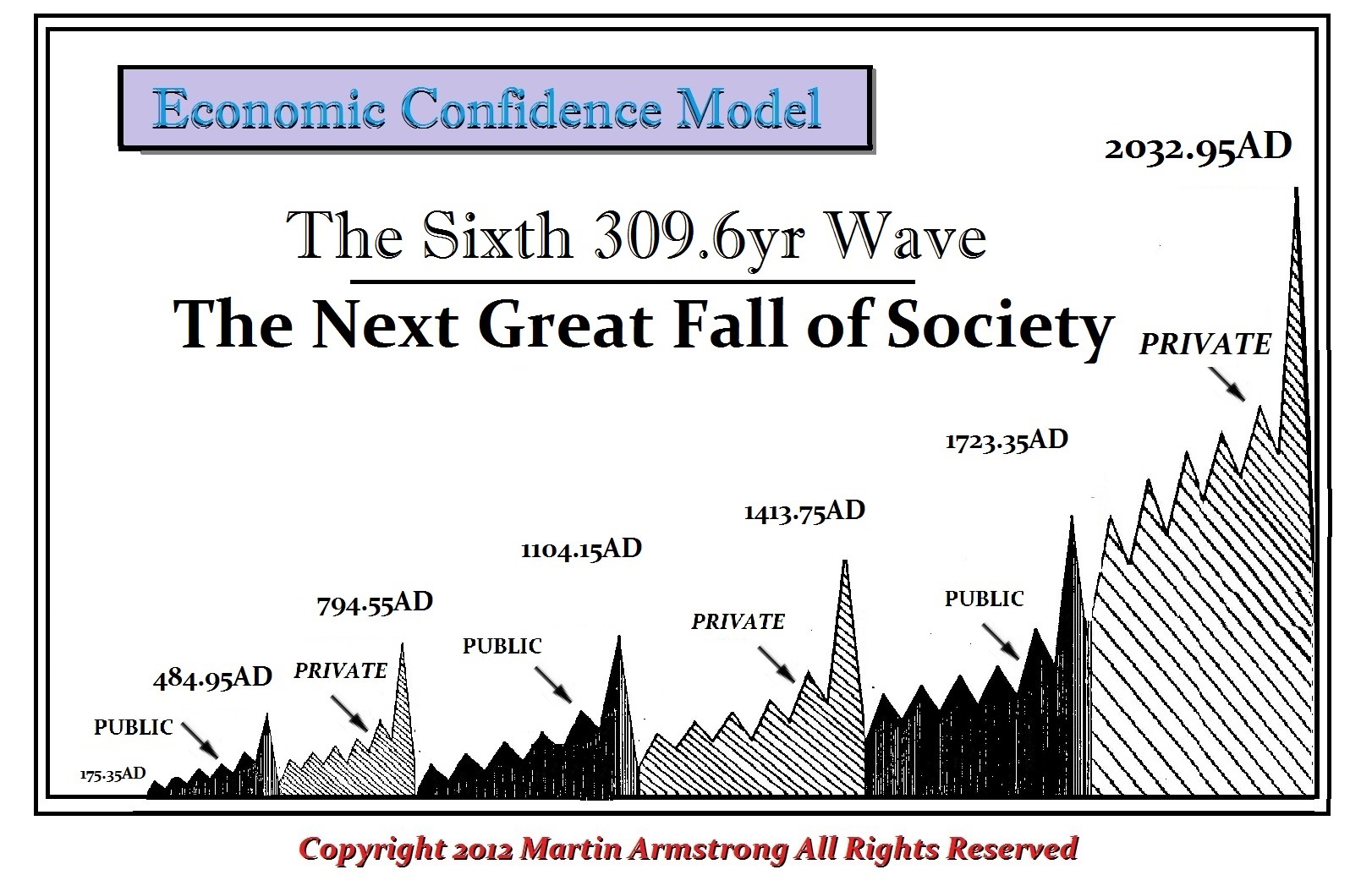
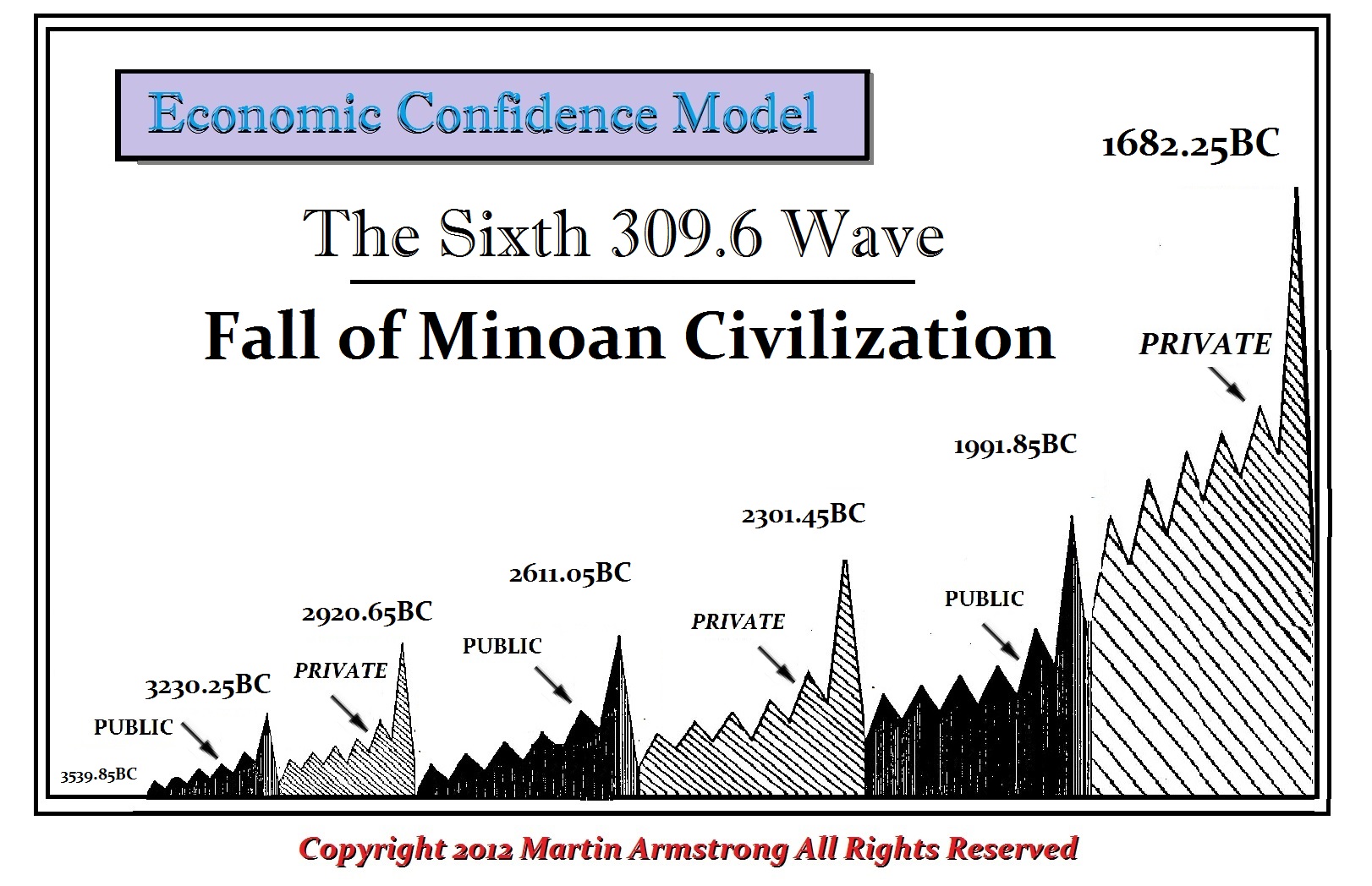
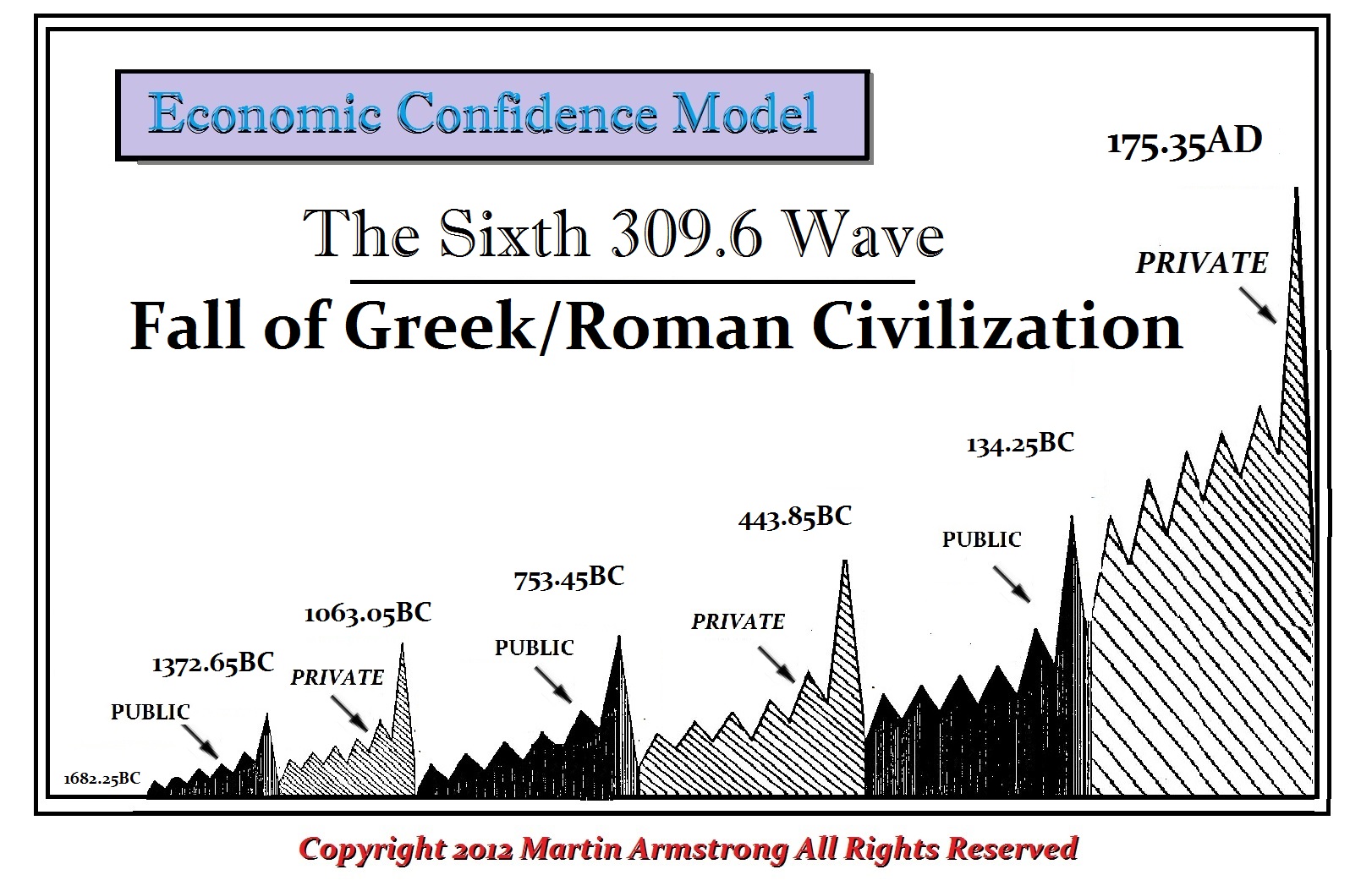
ANSWER: Oh yes. This is part of the Cycle of Civilization but now you are at the 309+ year level where major change begins to appear. The big one comes on the Sixth Wave of the 309.6 Year level. This is the only reason I do what I do. I have written many times that when this wave peaks in 2032, when we come to a crossroads. We either regress contracting into authoritarianism, then break-up into a fragmented feudal type system of local tribes basically, or we can perhaps crash and burn, but then see the light and we make a major technological leap forward.

Even at each 51.6 year wave culmination there is a major structural reset. It is my HOPE that if we reach a level of understanding how and why things work, then we have a shot and perhaps pushing back and we can make do what Neil Armstrong said upon landing on the moon: “That’s one small step for man, one giant leap for mankind.

This is the third set of the Sixth Wave. This is why I say if it was just me, I am ready- Beam Me Up Scotty. I have my posterity to think about. So I am trying to do what I can. I bumped into cycles in the middle of the night. They found me. I never approached this as a theory to go out and prove. Most major discoveries in science have been by accident.

The Renaissance really began when Constantinople fell to the Turks. Then the scholars fled to the West bringing the known with them in 1453. Note the year. They began schools and started to teach people all the knowledge they had forgotten. There were some who were starting to reintroduce mathematics like Fibonacci (c. 1175 – c. 1250) during the 13th century. But it was the schools that opened following the fall of Constantinople that brought educate back to Europe. Hence, Columbus was exposed to that knowledge and he realized the Earth was round. He set sail in 1492.

The full Age of Enlightenment truly began with the confrontation that cycles existed. It all began with the discovery in 1772 of a frozen intact woolly rhinoceros . Then intact woolly-mammoth followed in Siberia. Suddenly people were stunned. This meant that you could be frozen with food still in you mouth. This inspired tremendous investigation into gravity to the cyclical nature of comets.

The Dark Age is the fragmentation of society reverting back to where we see nations breaking up unto regions and then all the way back to city states. The  Renaissance is typically inspired by the rediscovery of lost knowledge. This is really an extensive subject. I have written a book on this entire topic documenting everything from math and science to political rise and fall. I am hiring more editors to try to get out several books that have been backlogged for way too long.

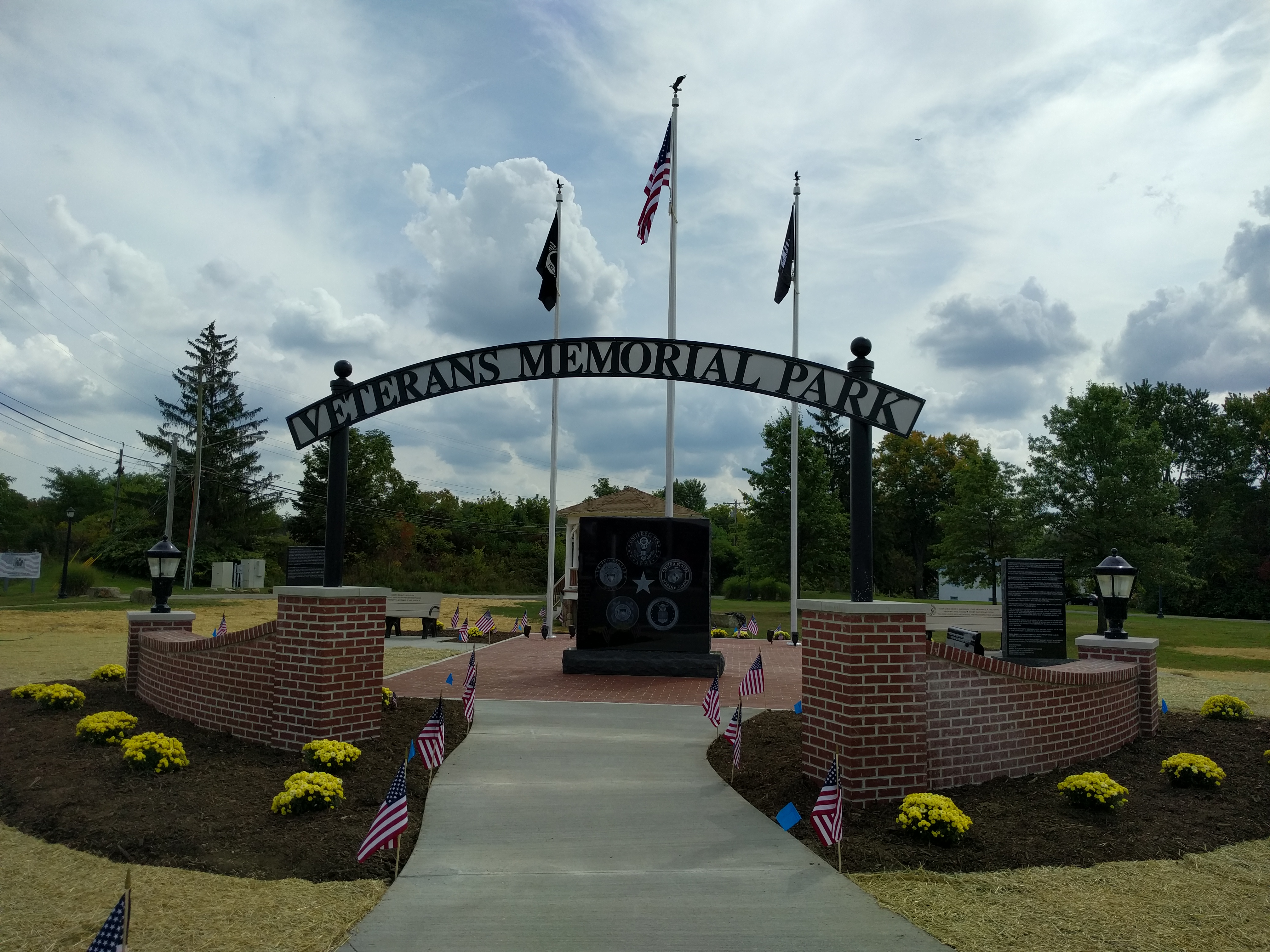
A New Park has been set up in Macedonia, Ohio Honoring Veterans


For the past 2 years my American Legion Nordonia Hills Post 801 with the help of Veterans of Foreign Wars Post 6768 and the city of Macedonia has worked on establishing a Veterans Memorial Park dedicated to honor all veterans.  It has now completed the first phase of the Park.  The AL Post Commander and Chairperson of the committee established to create this park first created a team of motivated veterans.  The team raised about 40% of the estimated $364,000 required to construct the entire park.  These funds allowed us to design and build the park’s main entrance starting in May 2017.  Construction was completed on September 15, 2017, POW/MIA Recognition Day.   The next day, September 16,  the first part of this projected was dedicated.

There were three monuments displaced, this is the Main One to all veterans.

The other two are one for the War on Terror and one for Vietnam

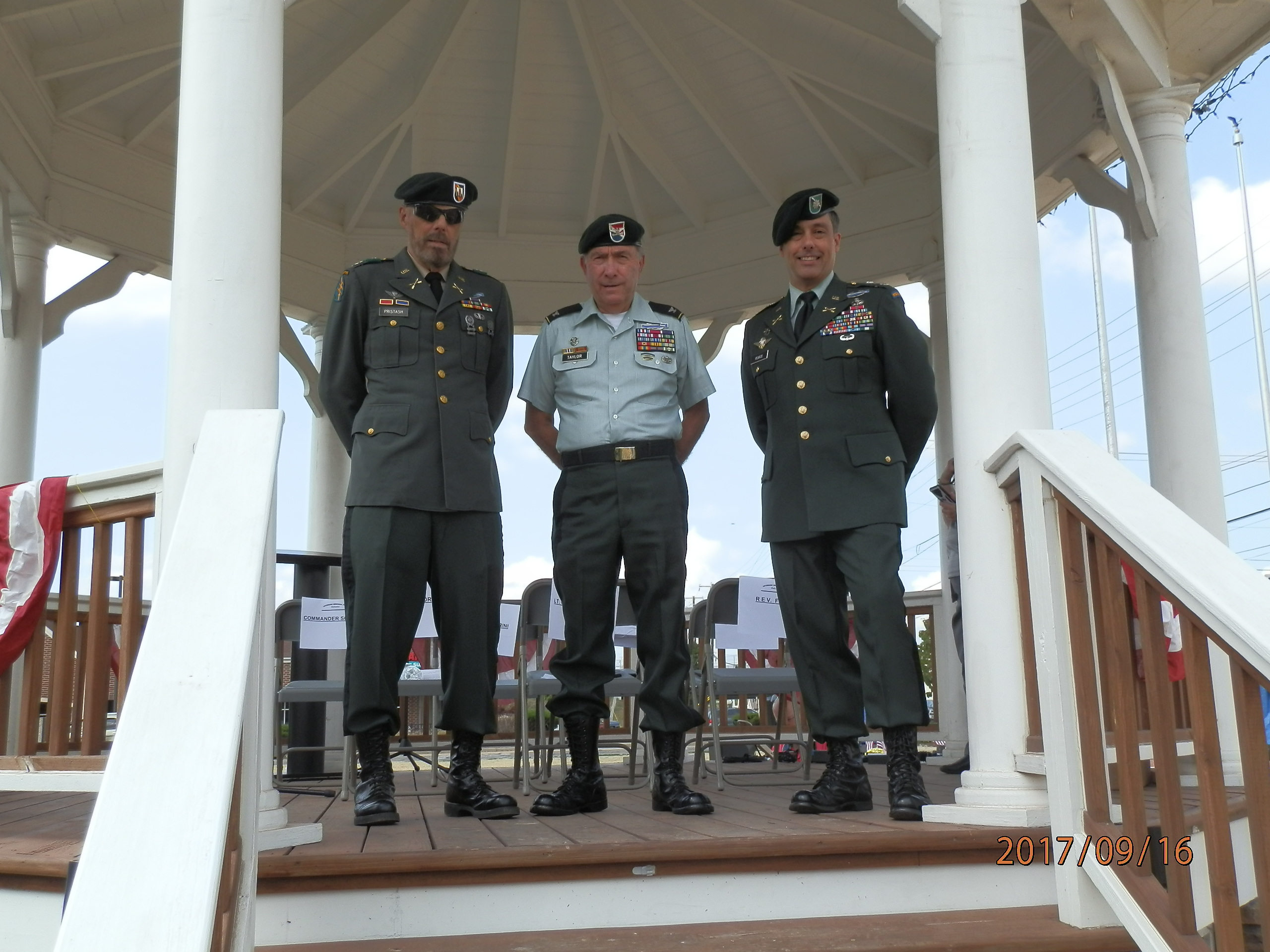
We had a band and many local politicians as well as three Former Green Berets as speakers. Colonel David Taylor (center), Lt Colonel Howard Pearce (Right) and myself (Left).

The Crowd

Nordonia Hills Veterans Memorial Park