FTX & Crypto-Implosion


Armstrong Economics Blog/Cryptocurrency Re-Posted Nov 14, 2022 by Martin Armstrong

The collapse of the FTX Exchange is pretty straightforward insofar as this is the same lesson that constantly repeats in finance time and time again. Basically, FTX lent US$10bn of client funds to their trading arm Alameda, which used it for leveraged their own crypto speculation because the crypto market has been collapsing. Typically, someone like Sam Bankman-Fried had his whole life wrapped up in this venture. Lacking financial controls operating from the Bahamas, moving the money from client funds to his trading arm Alameda was possible. Historically, someone in this position sees his world collapsing but is not prepared to see that unfold for it requires admitting that he was wrong on crypto, to begin with. Consequently, such a person is not trying to actually rob clients’ money, they most likely see it as a temporary loan to save the company and the market will bounce back – or so they believe.

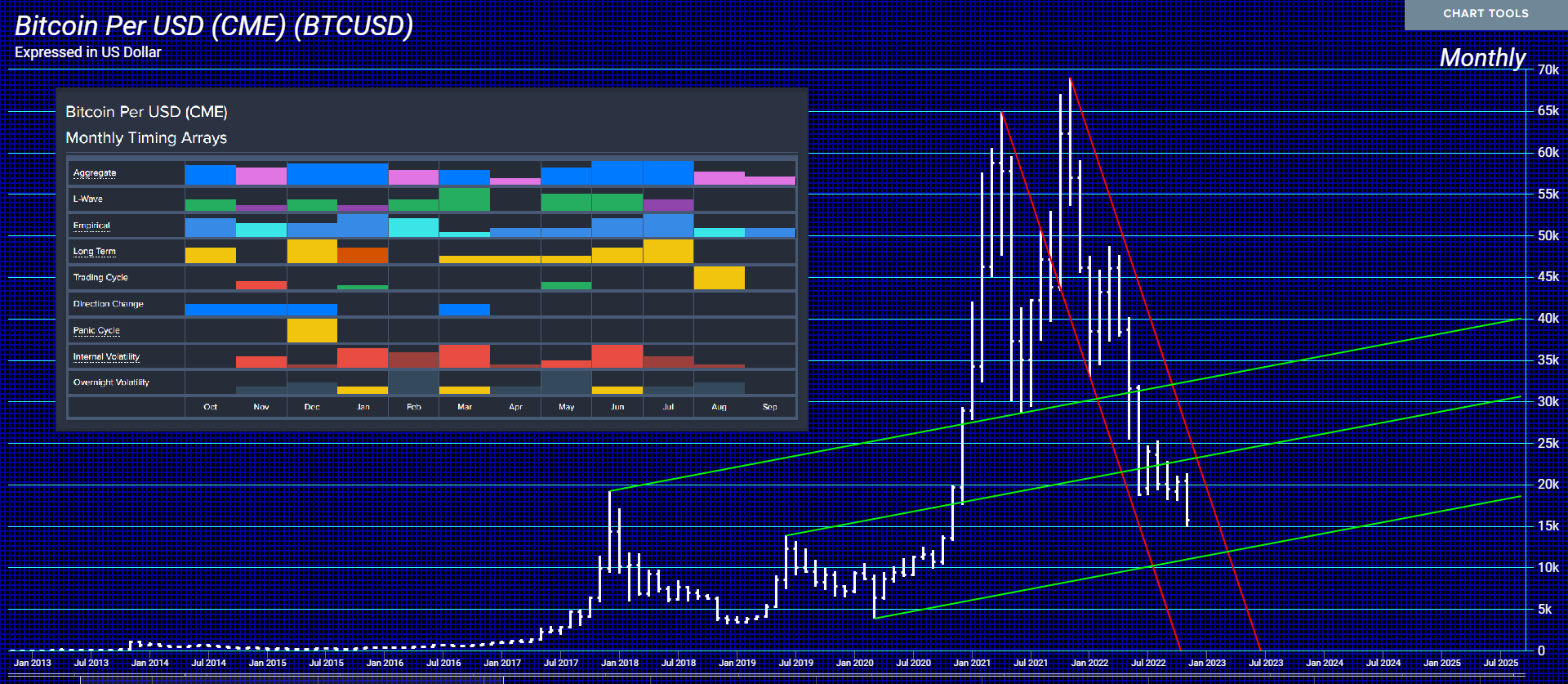
Our computer had picked the high in Bitcoin perfectly and has been projecting the collapse all along the way. But crypto has become a religion and in so doing it clouds the judgment of people who want to believe the story. Alameda blew up in a crypto meltdown because it did not want to accept that the crypto boom was over. The loan he probably thought would be temporary, vanished in the implosion. At first, I would have assumed they had actually invested the money and lost it on the bond market collapse. But that was perhaps too traditional. Here, it appears they were trying to defend their own cryptocurrency and trying to buy the low that kept moving lower. It appears he was allegedly simply using clients’ funds to trade keeping gains for his firm and the clients now suffer the risk.

It appears that they allegedly were trying to defend the crypto market and did not understand that the boom was over. The loans could not then be repaid. As crypto was crashing, some people needed to cash out. The attempt to pull out US$5bn from FTX exposed the fact that the cash was all gone. This is not so unusual. It has happened before. This time, the prosecutors are clamoring to be the one to charge him so they can become famous over his dead body.
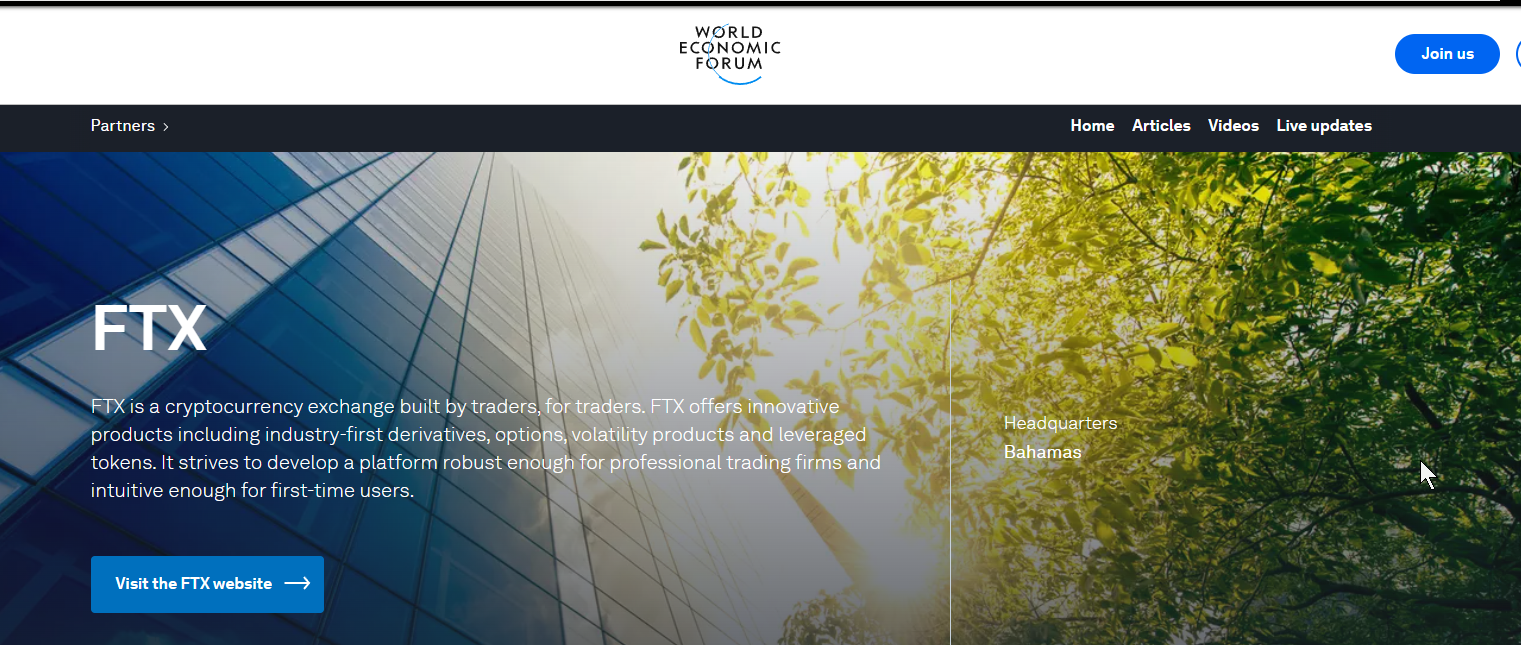
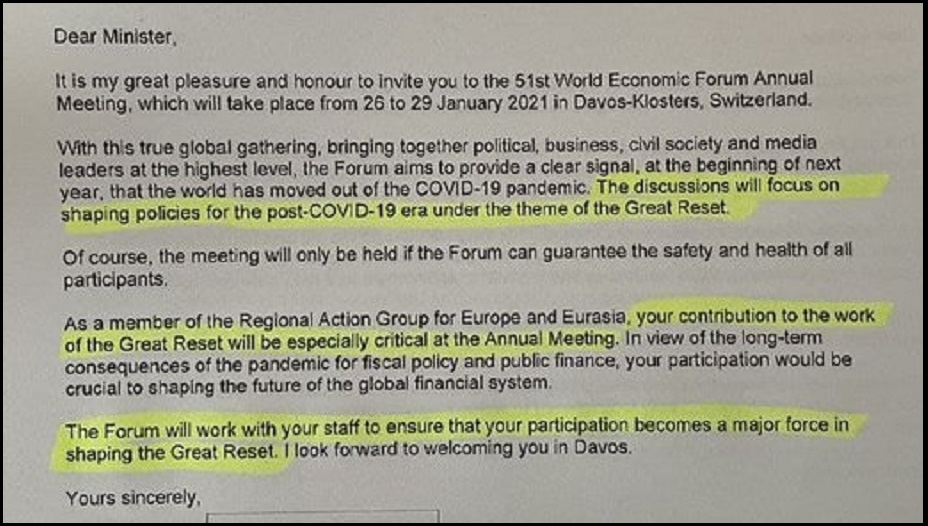
FTX was a partner with Klaus Schwab’s World Economic Forum (WEF). Of course, the WEF has suddenly removed the page and is desperately trying to hide their involvement with FTX and Sam Bankman-Fried. Naturally, eliminating paper currency has been the goal of the WEF because they support the end of not just capitalism, but also democracy. Schwab’s push has been his Great Reset and to control society to impose his economic philosophy inspired by Marx and Lenin.

Corsine-2

This is by no means the first violation of fiduciary responsibility that presents a custodial risk. MF Global Holdings Ltd., you might recall, was a firm formerly run by New Jersey ex-Gov. Jon Corzine was accused in 2013 of unlawfully using customer money to meet his firm’s funding needs. When MF Global went bust because of trading by ex-Goldman Sach’s Jon Corzine’s trading using his client’s money in London also outside the regulatory eye of the USA, he was NEVER prosecuted for illegally using $1.6 billion of 26,000 client’s money. That is not going to be the case this time. So what is the difference between Corzine and Bankman-Fried? Corzine was ex-Goldman Sachs.

Indeed, Corzine was well-connected right into the White House with Obama. Nobody went to jail and clients had to wait in bankruptcy to get their money – even cash in the accounts was taken. There are clear risks with the broker and clearer. As long as the SEC is run with former Goldman Sachs staff, there will NEVER be an honest regulator. Even when all the banks pled criminally guilty, the SEC exempted everyone from losing their licenses. They would NEVER do that with anyone outside of New York City. The SEC will never prosecute the banks – EVER!!!!

Indeed, several federal investigations had been launched into MF Global, including probes by the Commodity Futures Trading Commission (its main regulator), the Securities and Exchange Commission, the Federal Bureau of Investigation, and Justice Department prosecutors in both Chicago and New York. The brokerage has also been the focus of several congressional hearings. Not a single one charged Corzine with trading with his client’s money. The losses that eventually drove MF Global into bankruptcy stemmed from high-risk bets on European sovereign bonds that Corzine made as he swung for the fences. Corzine bet big that the bond issuers would not default.

Commodity Futures Trading Commission simply fined Jon Corzine only $5 million over MF Global’s rapid descent into bankruptcy on Oct. 31, 2011, as an estimated $1.6 billion of customer money went missing. Anyone else would have been in prison for a minimum of 20 years.

Glenn

It was Martin Glenn who was the judge in New York on M.F. Global bankruptcy. He was the first one to engage in FORCED LOANS by abandoning the rule of law to help the bankers by protecting them from losses taking client accounts to cover M.F. Global’s losses. He simply allowed the confiscation of client funds when in fact the rule of law should have been that the bankers were responsible and M.F. Global’s losses should have been reversed as they did even when Robert Maxwell’s companies failed in London from his illegal trading taking employee pension funds.

Yes, that was Ghislaine Maxwell’s father and the guy who was in control of the company that Bill Browder worked for before Edmond Safra. Never should the client’s funds be taken for M.F. Global’s losses to the NY Bankers. It was Judge Martin Glen who placed the entire financial; system at risk by trying to protect the bankers. Martin Glenn pampered these bankers making them the new UNTOUCHABLES. We have to be concerned that there really is no rule of law that will protect you in a crisis.

On Bloomberg TV, Sam Bankman-Fried explained why he even created FTX. He said he was experiencing his own frustration at Alameda Research, which was his crypto-focused proprietary trading firm. He was frustrated with the execution he was receiving at various crypto exchanges so he claimed that inspired FTX’s creation in May 2019. FTX grew rapidly to become the third largest crypto exchange in the world, with approximately $16 billion of customer assets under custody over 43 months.

Bankman-Fried stated that Alameda was making lots of money, but it could have been making more and he did not have access to venture capital. Claims of 100% annualized returns are not uncommon in a boom, but any experienced trader knows what goes up, also comes down. Alameda was relying on “cobbling together lines of credit” to expand its capital base. He then created FTX to solve his funding problem creating his own exchange that even the WEF cheered as a partner. He actually created a platform that was tailored for his own company, Alameda, to facilitate its trading needs. FTX coined the phrase “built by traders, for traders.”

There was an obvious conflict of interest questions regarding the close relationship between FTX and Alameda. Being operated from the Bahamas raised questions among those of us who are seasoned financial market observers whether the two were truly arm’s length from each other. However, people were so pumped up on adrenalin with crypto being the end of the dollar and central banks that this new free-wheeling crypto world believed what they wanted to believe and never looked too closely. FTX operated outside the reach of the US regulatory domain and there was a lack of any fiduciary confirmation. When the founder of Binance, the world’s largest crypto exchange, Changpeng Zhao, openly questioned the soundness of the FTX/Alameda nexus on Twitter saying he would sell over $500 million worth of FTX’s token FTT, that was the kiss of death weather or not he realized he would unleash a crypto panic that would engulf the entire industry in a matter of days.
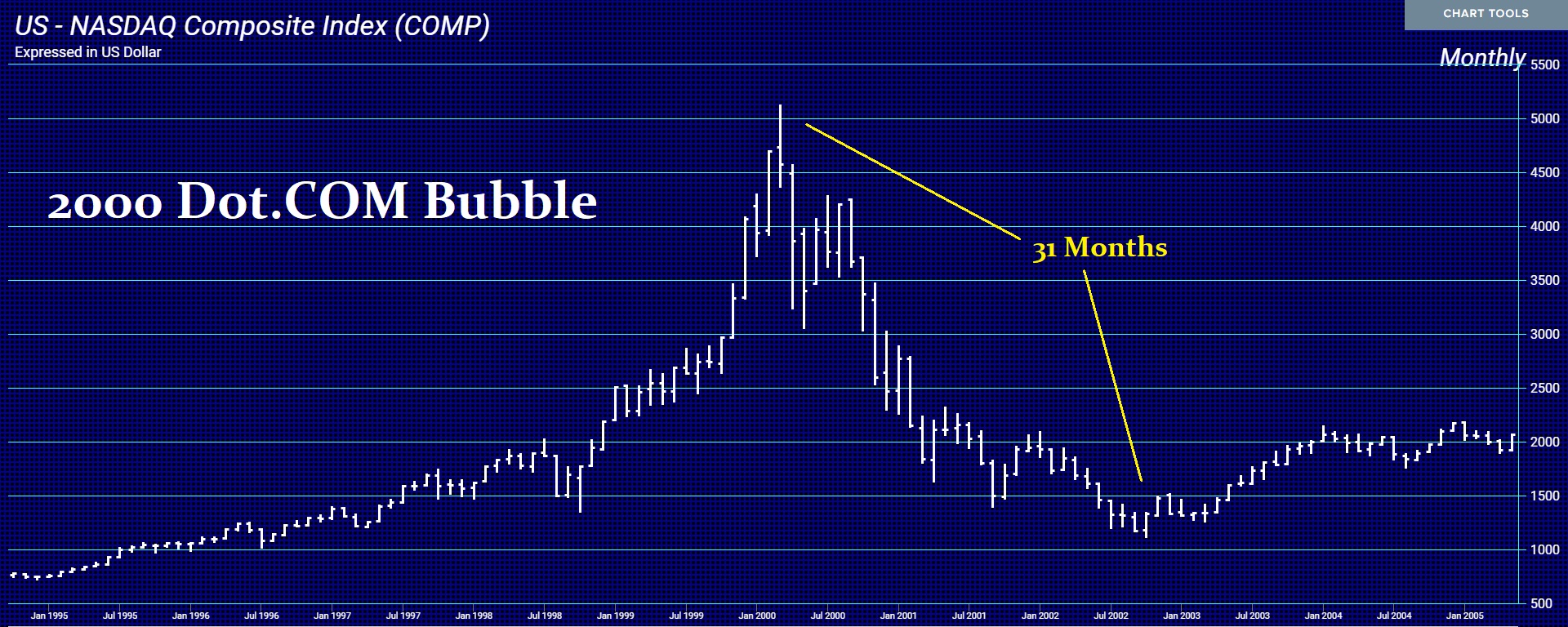
The collapse of FTX will now become a contagion for the crypto world. This 20-something group of inexperienced traders has signaled the demise of an industry that was getting all the hype with no substance. This crypto world will be seen as the DOT COM Bubble of 2000. With a recession on the horizon, the collapse of sovereign debt, and the monetary system as a whole, people will be looking for more of the safe bets rather than roll the dice on crypto. Nothing ever goes straight down. But by year-end, the volatility should perk up everyone’s view of the world.
Interest Rates Rise will Not be Slow


Armstrong Economics Blog/Interest Rates Re-Posted Nov 13, 2022 by Martin Armstrong

This interview with FXStreet is from 2015. Some are surprised at the consecutive rate hikes, but our models have been indicating for a very long time that rates would rise rapidly. There would be no soft landing. Central banks maintained artificially low rates for far too long and were backed into a corner. They created a problem long ago, and it will cause pain for “some time,” as Powell usually states, for the situation to be under control.

The UK is Not Prepared for a Prolonged Recession


Armstrong Economics Blog/Central Banks Re-Posted Nov 11, 2022 by Martin Armstrong

People are simply not prepared for a sharp economic downturn. The Money and Pensions Service conducted a poll in the UK in which it found around 25% of adults have under £100 in savings. The 3,000-person survey found that 17% reported having absolutely nothing set aside. Around 5% reportedly had under £50, while 4% had between £50 and £100.

The drastically increased cost of living has many living paycheck to paycheck. The Building Societies Association (BSA), as reported by the BBC, conducted a separate survey that found that 35% of people in the UK simply stopped saving due to inflation. Around 36% said they are already dipping into their savings accounts to pay the bills.

The Bank of England is anticipating a long recession ahead. The central bank sees economic conditions contracting through the first half of 2024. The central bank’s prediction of five consecutive quarters of contraction would mark the longest recession in UK history. The people have not experienced the full effects of this recession, and most are simply not prepared for what lies ahead.

CPI Report – Inflation on Food, Fuel, Home Heating and Essentials Continues Growing – Overall Inflation Moderation Now Claimed as Calendar Cycles


Posted originally on the conservative tree house on November 10, 2022 | Sundance

The Bureau of Labor and Statistics (BLS) provides the latest data on consumer prices (inflation) [DATA HERE].  We explained in 2021 how inflation would grow on a month-over-month and year-over-year basis until the calendar became more friendly and the government officials could claim “diminished inflation growth.”  Well, we are now entering that phase of economic parseltongue.

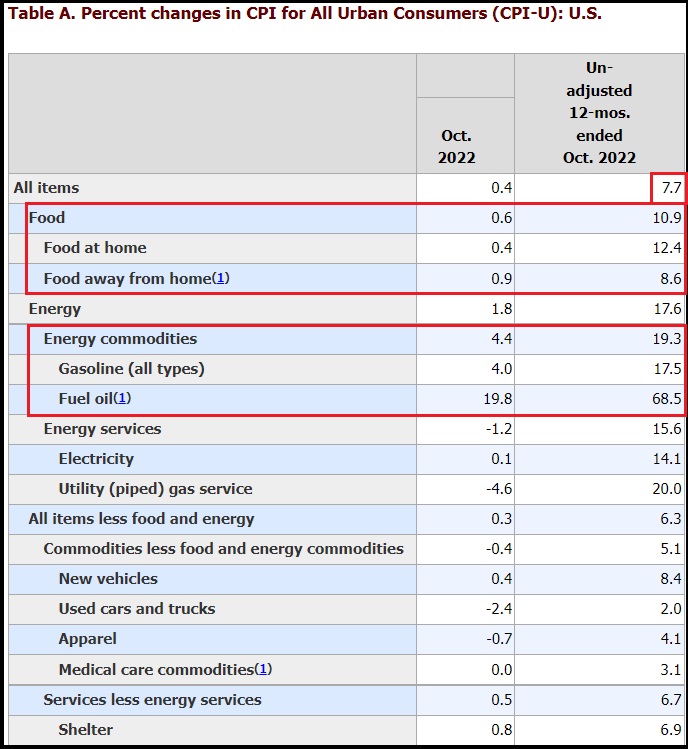
October consumer prices increased 0.4% over September.  However, we are now comparing year-over-year (Y0Y) inflation to the period where last year’s prices had already skyrocketed, so YoY inflation seems to be moderating at 7.7%, it’s a false premise. {Go Deep}

As expected, the energy-driven consumer inflation in the food sector has arrived.  The proverbial field inflation is arriving at the fork, and the October CPI now shows the third wave of food price increases we had previously discussed.

Table 2 Details: Egg prices increased +10.1% last month and now 43% higher than last year.  Butter +1.9% last month, 26.7% for year.  Margarine +1.3% for month, 47.1% for year.  Coffee +1.3% for the month, 15.6% for the year.

Heading into baking season we find flour +0.2% for the month, +24.6% for year.  Essentially, as expected, all of the holiday foodstuffs are now rising in price as the increased field and commodity prices hit the store shelves.

Some row crops are starting to moderate in price growth, while dairy products continue rising throughout the fall season.  It is going to be painful on the checkbook grocery shopping this holiday season.

On the energy front, home heating oil increased 19.8% in October and is now a whopping 68.5% higher than last October.  Unleaded gasoline increased another 3.5% and now is now 20.9% higher than last year (Oct ’21), which was already 40% higher than January 2021.

Food, fuel, electricity, home heating and housing costs continue growing monthly, but give the illusion of moderating when compared to last year.

Food away from home (restaurants etc.) are starting to show the cumulative price impacts for restaurants, hotels and cafeterias.  Additionally, as the kids returned to school the lunchroom prices have skyrocketed a jaw-dropping +3.8% for October and +95% compared to last year [Table 2].  Packing lunches for kids is going to become an even more important aspect for the family food budget.

The stock market is happy with the news because the lowered 7.7% (YoY) inflation number, a product of the calendar and nothing else, gives optimism the Fed may moderate the increased federal reserve rate hikes.  However, don’t count on it because inflation is easily identified as embedded now.  Lemons at the grocery store are now $0.99/each.

Think about that.  $1 for a single lemon and roughly 50¢ per egg at the supermarket.  A full shopping cart of groceries now easily exceeding $200.  This is devastating for those on fixed incomes and blue-collar workers.

Wages are nowhere near keeping up with this level of price increase.

(CNBC) The consumer price index rose less than expected in October, an indication that while inflation is still a threat to the U.S. economy, pressures could be starting to cool.

The index, a broad-based measure of goods and services costs, increased 0.4% for the month and 7.7% from a year ago, according to a Bureau of Labor Statistics release Thursday. Respective estimates from Dow Jones were for rises of 0.6% and 7.9%.

Excluding volatile food and energy costs, so-called core CPI increased 0.3% for the month and 6.3% on an annual basis, compared with respective estimates of 0.5% and 6.5%.

A 2.4% decline in used vehicle prices helped bring down the inflation figures. Apparel prices fell 0.7% and medical care services were lower by 0.6%.

“The report overstates the case that inflation is coming in, but it makes a case inflation is coming in,” said Mark Zandi, chief economist at Moody’s Analytics. “It’s pretty clear that inflation has definitely peaked and is rolling over. All the trend lines suggest that it will continue to moderate going forward, assuming that nothing goes off the rails.” (read more)

The Biden energy policy is the root of the consumer inflation. Nothing will happen to moderate overall consumer inflation on Main Street until energy policy changes.

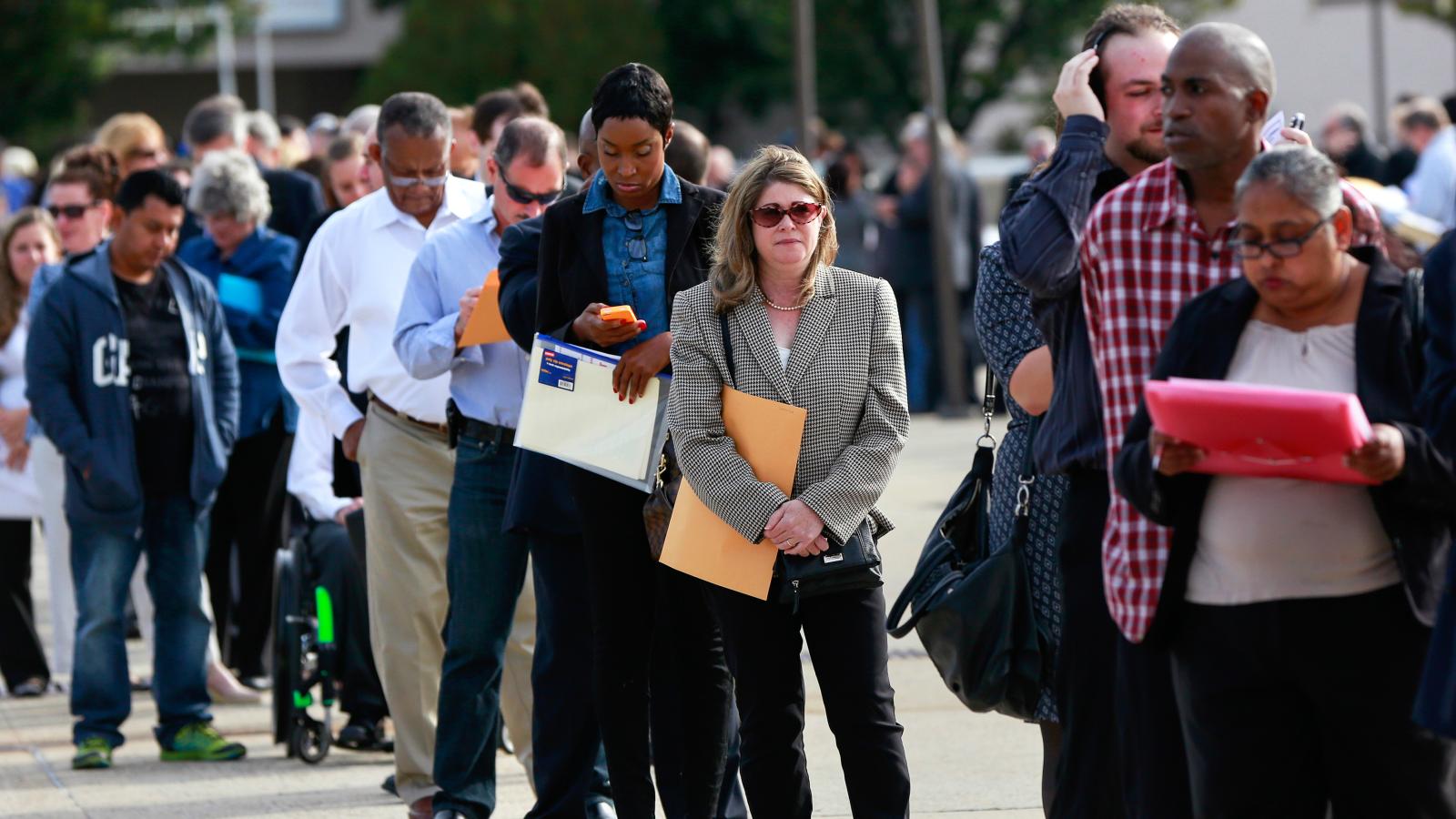
Additionally, with the 2022 election in the rear-view mirror, we should start to see layoffs and unemployment increasing now.  The bureaucrats will now let the recession become evident.

2022 WEC: In the Dollar We Trust


Armstrong Economics Blog/World Economic Conference Re-Posted Nov 8, 2022 by Martin Armstrong

At the World Economic Conference in 2021, the Armstrong Socrates model predicted that 2022 was going to be volatile and chaotic featuring a strong US dollar, a huge move in interest rates, a major bond market decline, fertilizer and food shortages, as well as escalating geopolitical tensions in Ukraine.

What now? Socrates forecast that 2023 will be more volatile and chaotic, featuring violent moves across all markets as monetary and geopolitical tensions and debt problems intensify.

At this year’s World Economic Conference, November 11-13, Martin Armstrong will talk about what’s next for the US dollar and other currencies, the liquidity/credit crisis, as well as price targets for oil, gold, stocks, bonds/interest rates, and stocks.

Give yourself an “unfair” advantage over the markets by joining us at this year’s conference remotely or in person. Meet Martin Armstrong – have your questions answered and get the best roadmap for 2023 and beyond in the investment business.

Multinational Advertisers Begin Pulling Out of Twitter


Posted originally on the conservative tree house on November 3, 2022 | Sundance

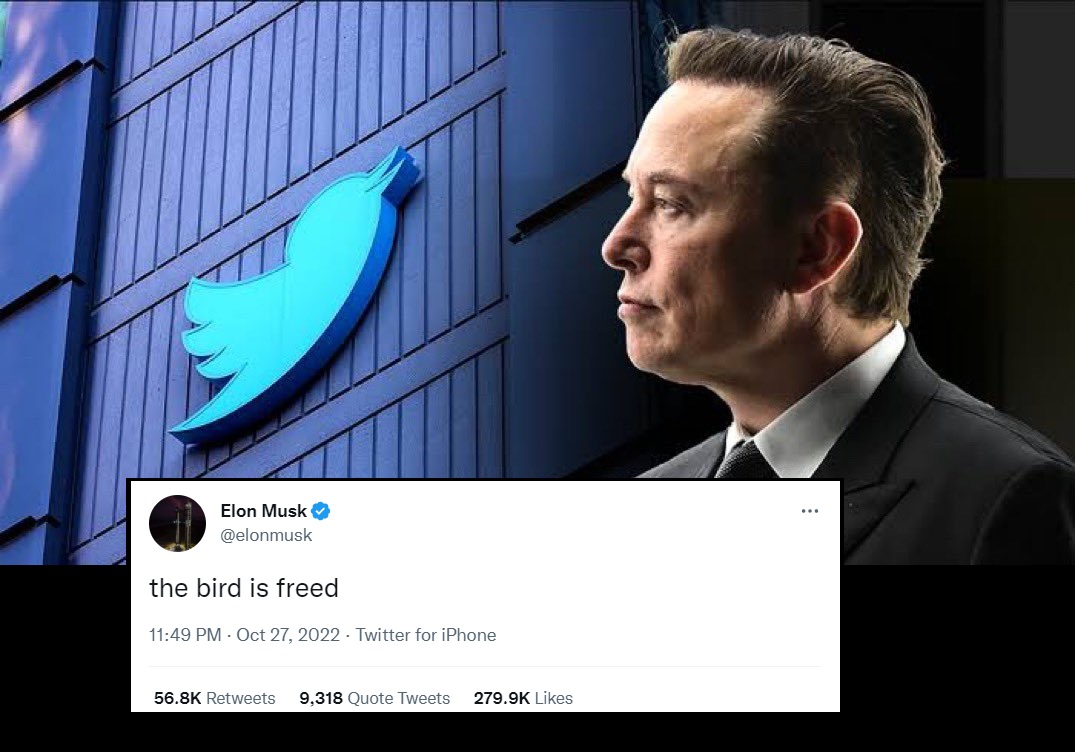
In the prediction section of the recent Twitter discussion {Go Deep} CTH mentioned the reason and unspoken motive behind a prediction that multinational corporations would start to pull their advertising money from Elon Musk.

We are simply in an era where there is no distinction between the WEF guidance for multinational corporations and the instructions toward governments’ they support.  Free speech and freedom of expression are against both their interests.

Multinational corporations are political entities.  The former distinctions between the private and public sector have been purposefully erased.  Evidence can be found in the vaccination mandate and within corporate responses to voter outcomes during elections. {Go Deep}

As predicted, it begins….

(Via Wall Street Journal) – Food company General Mills Inc., Oreo maker Mondelez International Inc., Pfizer Inc. and Volkswagen/Audi are among a growing list of brands that have temporarily paused their Twitter advertising in the wake of the takeover of the company by Elon Musk, according to people familiar with the matter.

Some advertisers are concerned that Mr. Musk could scale back content moderation, which they worry would lead to an increase in objectionable content on the platform. Others are temporarily halting their ads because of the uncertainty at the company as top executives exit and Mr. Musk considers a raft of changes, some of the people said.

Kelsey Roemhildt, a spokeswoman for General Mills, whose brands include Cheerios, Bisquick and Häagen-Dazs, confirmed the company has paused Twitter ads. “As always, we will continue to monitor this new direction and evaluate our marketing spend,” she said.

A Twitter representative didn’t immediately respond to a request for comment.

General Motors Co. paused its spending on the social-media platform last week.

Several ad buyers say they expect the number of brands pausing Twitter ads to rise. They say that the platform isn’t considered a must-buy for many advertisers, with far larger budgets going to tech giants such as Alphabet Inc.’s Google and Meta Platforms Inc., and that pausing makes sense during the bumpy transition under Mr. Musk.

Many executives on Madison Avenue are uneasy with the rash of sudden executive departures from Twitter’s advertising sales and marketing units. Among those who have exited are Chief Customer Officer Sarah Personette, Chief Marketing Officer Leslie Berland, and Jean-Philippe Maheu, Twitter’s vice president of global client solutions. Those executives helped reassure advertisers that their ad dollars were being spent wisely and appropriately on Twitter. (read more)

Fascism was traditionally defined as an authoritarian government working hand-in-glove with corporations to achieve objectives. A centralized autocratic government headed by a dictatorial leader, using severe economic and social regimentation, and forcible suppression of opposition.

That system of government didn’t work in the long-term, because the underlying principles of free people reject government authoritarianism.  Fascist governments collapsed, and the corporate beneficiaries were nulled and scorned for participating.  Then, along came a new approach to achieve the same objective.

The World Economic Forum (WEF) was created to use the same fundamental associations of government and corporations.  Only this time, it was the multinational corporations who organized to tell the government(s) what to do.

The WEF was organized for multinational corporations to assemble and tell the various governments how to cooperate with them, in order to be rewarded by them.   Corporatism was/is the outcome.  The government is now doing what the multinationals tell them to do, and in return the multinationals install the compliant politicians.

Fascism, the cooperation between government and corporations, is still the underlying premise; the World Economic Forum simply flipped the internal dynamic putting the corporations in charge of handing out the instructions.

What results is a slightly modified definition of fascism:

A massive multinational corporate conglomerate; telling a centralized autocratic government leader what to do; and using severe economic and social regimentation as a control mechanism; combined with forcible suppression of opposition by both the corporations and government.

Doesn’t that define our current reality, especially visible in the era of COVID?

The instructions from the multinational corporations to government would be called the “Great Reset“, or as commonly transposed by the government officials receiving the instructions, “Build Back Better”.

 ~ Go Deep ~

Halloween Spending Amid Inflation


Armstrong Economics Blog/USA Current Events Re-Posted Nov 1, 2022 by Martin Armstrong

Spread the love

The National Retail Federation estimated that 172 million Americans spent $10.6 billion on Halloween this year, or $100 per person. Around $1.2 billion went into costumes for children, not to be outdone by adults spending $1.7 billion on their own costumes. Around $710 million was spent on pet costumes as well. Around 67% of consumers handed out candy, 51% decorated, 47% wore a costume, 44% carved pumpkins, and 26% participated in a Halloween party. Halloween spending is back to pre-pandemic levels, but inflation is to blame.

Food, candy, pumpkins, décor – all of these items cost significantly more in 2022, but Americans are still willing to spend. Candy alone is up 13.1% from last year, surpassing food inflation at 11.2%.

This is foreshadowing for the Christmas season, which historically is the most lucrative time for retailers and a big boost for overall GDP. Around 25% of all retail spending occurs in November and December each year, but many have already begun holiday shopping as stores are forced to offer more appealing sales. Retailers who fail to profit in the remaining months of 2022 will be forced to downgrade their forecasts and re-evaluate their businesses in the current economy. Layoffs and store closures are likely, and many retailers have already halted hiring. Americans do not have more disposable income to spend on the holidays, but those who can are willing to pay inflated prices to participate in age-old traditions.