Friedman – Equality & Freedom


How Many Times? That Is The Question


Finance Committee Hearing or Liberal Campaign Ad?

Ken Grafton image

Re-posted from the Canada Free Press By  —— Bio and ArchivesAugust 4, 2020

How Many Times? That Is The Question

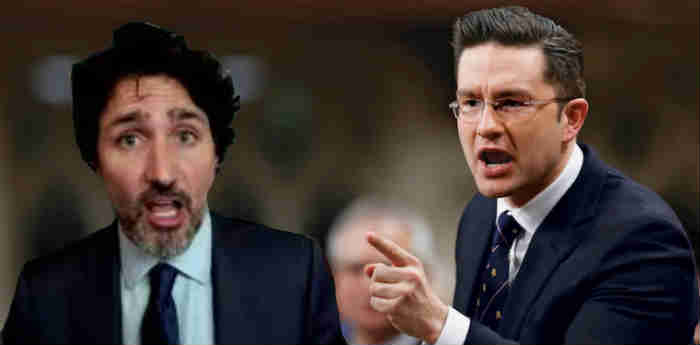
Prime Minister Trudeau testified before the Parliamentary Finance Committee on July 30th in connection with the WE Charity scandal, currently under investigation by Ethics Commissioner Mario Dion.

Canadians can be forgiven for wondering why.

Amping up the Trudeau charm, well lit and smiling directly into a high-resolution camera, coiffed hair blacker than beard; the relaxed PM was clearly focused upon communicating directly with voters, rather than answering questions from committee members.

The Trudeau brand was under attack, and the message for Canadians was that his Liberal government is doing a great job. The narrative ran that they would in fact be doing even more for Canadians, if it weren’t for Conservatives bringing up this nettlesome conflict of interest thing. Sure, he should have recused himself from approving the sole-source WE contract, but that wouldn’t have happened if it weren’t for COVID-19…and his long-standing interest in youth-affairs. The Liberals’ commitment to providing financial assistance to students during COVID-19 led to an accelerated implementation of the CSSG Program…which caused the PM to slow down the approval process because of the increased scrutiny and appearance of conflict of interest that his family affiliation with WE would bring…before then failing to recuse himself from the process. The Civil Service made all the decisions anyway, not the PM. If the logic is difficult to grasp here…well….

Although it is impossible to disconnect the damming, feculent bright-red Liberal dots leading from WE to the Prime Minister, distraught Liberal spin doctors had obviously been billing some overtime on damage control.

The central pivot from conflict of interest and Liberal corruption seems to be good intentions and the tremendous benefit to young Canadians that could have been…if only the unfortunate scandal hadn’t blown up (read, if they hadn’t been caught).

Canadians should blame the Conservatives and Bloc Quebecoise, for making a mountain out of a mole-hill, really…when you think about it…from a Liberal prospective…

The questioning began:

MP Pierre Poilievre – “What is the total dollar value of all expenses reimbursed and fees paid and any other consideration provided by the WE group to you, your mother, your spouse, your brother and any other member of your family? Just the total please.”

PM Trudeau – “Uh…I don’t have that exact figure…uh…reimbursing expenses is something done by an organization…uh…for example…so I don’t have…uh…those totals.”

Liberal MP Julie Dzerowicz (trying) – “Mister Speaker…uh…Point of Order…Mister Chair, sorry…not Mister Speaker. My Point of Order is what’s the relevance of these questions…uh…of ancillary…uh…fees paid to family members to the official motion…?”

Chairman Wayne Easter – “I don’t think that is a Point of Order Miss Dzerowicz, back to Mister Poilievre.”
Poilievre – “So you are telling me that you don’t know how much immediate family members have been paid in expense reimbursements by this organization.”
Trudeau – “Uh…my mother and my brother are professionals in their own right who…uh…have…uh engagements…uh…and have for many, many years with organizations across the country…”
Poilievre – “Do you know?”
Trudeau – “…uh…and I…uh…don’t have the details of their…uh…work…uh…work experiences of their…uh…expenses.”
Poilievre – “What about your spouse? What is the dollar figure?”
Trudeau – “Uh…WE…uh…I think WE Charity has been able to share those figures with you.”
Poilievre
 – “When was the last time that she had an expense reimbursed by WE Charity?”
Trudeau – “Uh…I…uh…believe it would have been to uh…”

As one can gather from this short excerpt, the Prime Minister was less than forthcoming. It’s a fine line between pivoting and refusing to answer. In Court, it may well have led to a charge of Contempt. Perhaps a Contempt of Parliament charge would be appropriate here.

Trudeau’s repetitive and vexatious use of the word “uh”

Also telling was Trudeau’s repetitive and vexatious use of the word “uh”. In linguistics, “uh” is known as a “hesitation form”, or “filler word”. Filler words are often a red flag for deception. In Psychology Today, Professor Jack Schafer of Western Illinois University, a behavioral analyst for the FBI, explains. “Little words, often ignored in normal speech, can signal deception. Words such as um and uh indicate cognitive load. Liars experience increased cognitive load. Um and uh signal impending delays is speech. Liars need time to evaluate their answers to ensure their lie will be believed. Liars also need additional time to choose the right words to camouflage the truth. Truthful people do not need extra time to convey information.”

The Prime Minister wouldn’t lie though, would he?

So, what are the issues with WE-Gate exactly?

The growing Hydra-like list may keep Commissioner Dion up at night:

  • Was CSSG designed specifically for WE to administer?
  • Why the Canada Service Corps was not tasked with CSSG?
  • Why a sole-source contract?
  • Details of due diligence done, due to the fact that WE appeared to be in financial trouble and in violation of bank covenants. WE Board Members had resigned and mass layoffs of staff had occurred. WE had also never delivered a similar program previously.
  • Why was WE paid $30M upfront, and how will it repay taxpayers?
  • Why was a WE real estate shell company used, instead of WE Charity?
  • Why was a $30M upfront payment made on contract award?
  • WE claimed initially that the PMO had called, asking if they wanted the CSSG contract.
  • Who authorized WE, and why, to begin spending money on May 5th, prior to June 23rd approval?
  • Failure to recuse/Conflict of Interest –
    • PM has spoken for WE in past
    • WE has paid for Trudeau campaign ads/gave Trudeau a platform to connect with hundreds of thousands of young voters
    • WE has paid Margaret and Alexander Trudeau
    • WE has paid Sophie Trudeau
    • WE relationship with Katie Telford
    • WE paid Bill Morneau $42K expenses
    • WE employs two Morneau daughters.

Beyond the blatant corruption

Beyond the blatant corruption issues however, the CSSG model may have also been fatally flawed from birth. The very real possibility exists that CSSG could violate Minimum Wage laws. CSSG would pay a student up to $10 per hour, which is less than the minimum wages in all of Canada’s provinces and territories. If the concept of paid volunteers seems counter-intuitive, the law actually recognizes two classes of volunteers. According to Labour Law firm Goldblatt Partners, “Volunteers are not covered by the Employment Standards Act in Ontario, and need not be paid the minimum wage. But that does not mean that an employer can evade its obligations under the Act by classifying anyone as a volunteer. Only a ‘true volunteer’ is excluded from the protections of the Act…if a participating student views the program as a means to make a livelihood during a time that fewer summer jobs are available, they may be able to argue that they are not a ‘true volunteer.’” A class action lawsuit waiting to happen then.

But, back to the show.

Poilievre (translation) – “I have a simple question for you. How many times does a Minister in your Government need to break the Ethics Act before being sacked? How many times?”
Trudeau (translation) – “We…uh…take it very seriously, every time there are Ethics issues…
Poilievre – “How many times?”
Trudeau – “…and…”
Poilievre – “How many times?”
Chair – “The Prime Minister has the floor…and he has the right to answer. Mister Prime Minister”

He had the right to answer, but apparently not the ability.

How many times? That is the question…for all Canadians.

Great campaign slogan for Conservatives next election cycle…

Real Money’s Revenge


Beware of a Cashless Society where all is digital — Electronic digits have no value and are extremely easy to change or remove!

Just over 10 years ago I drew several pro-silver cartoons. One of them showed a giant, fast-moving silver coin cutting the JP Morgan ‘paper tiger’ in half. For years, JPM has shorted silver and has been doing it illegally and collusively. I knew this, but I went ‘all in’ on silver anyway because I thought JPM would have to cover and spark a massive short squeeze. I was convinced my long positions would make me a fortune. Instead JPM drove the price of silver down from almost $50 early in 2011 all the way down to $13 just a few years later. Paper covered rock. Needless to say, I learned a hard lesson about putting all my eggs in a silver basket. I should have bought Bitcoin instead.

Now silver is back up over $20 and some are predicting much higher prices on the horizon, just like they said over 10 years ago. Gold is also close to making ‘all-time highs,’ which is incorrect because inflation needs to be factored into such a high due to years of incessant dollar printing. Silver and gold have broken out higher due to a weaker dollar and some experts such as Peter Schiff claim ‘King Dollar’ will die due to over-printing. I have my doubts.

The dollar is still greatly desired by America’s poor and the middle classes, whose wages have not risen much in nearly 30 years. They are not getting more dollars like citizens did in Weimar Germany. You won’t see dollars in wheelbarrows any time soon. Most of the Federal Reserve’s dollar printing goes directly to a handful of fantastically wealthy people at the top of the pyramid. Many of them own the Federal Reserve. The Fed is propping up a market that is mostly owned by the top.

We The People are not receiving what the Fed is buying whether it be treasuries, corporate bonds, or ETFs, but we are forced to pay for it. Citizens must cough up more taxes to pay the interest on the absurdly high debt in order to make sure the fabulously rich get fabulously richer. Until those at the very top start giving their money away to the rest of the country, the dollar will be fine. No, I’m not advocating class warfare and it’s not socialism. What we’re seeing is not capitalism. The top 1 percent are getting their money by ill-gotten means. It’s fascism when their Fed gets to pick and choose which globalist company or sector to prop up.

I took some time off in Idaho last week and I visited one of my favorite places on Earth: Wallace. It’s a mining town in northern Idaho. It’s just off I-90 and has a long, storied history. It’s also known as the center of the universe and it is—at least when it comes to silver. There are many silver mines in the surrounding area, also known as ‘The Silver Valley.’ A total of 1.2 billion ounces of silver came out of those mines over the years and there’s still plenty of silver left to be mined.

It costs a lot of dollars to run a gold or silver mine. Sometimes it costs lives. 91 miners died of carbon monoxide exposure at the Sunshine MIne in 1972 after a ventilation system caught fire.

Precious metals are not easy to find. Gold is rare. It takes a lot of money to start a mine. Equipment, labor, environmental permits—all very expensive. Once the ore is removed it must be milled and smelted. Gold in particular is very hard to find. I know—I drove many miles to do some gold panning on a claim in eastern Idaho only to go away completely gold-less. I could not find gold with my metal detector, either. Compare this to how easy it is for the Federal Reserve to create debt dollars with a flip of a switch.

Gold and silver remain Constitutional money, but they are no longer in common circulation. Gold and silver (and copper, too) have been the best form of money throughout the ages, but no longer. They have become anachronisms and are incompatible with the digital age. There will be no revenge. Sure, the dollar can become gold backed once more, but that’s not likely. What’s likely is the Fed will convert us to a cashless society and adopt a social credit system. This will be the worst form of money because it will mean the total enslavement of humanity.

—Ben Garrison

Ayn Rand – What is Capitalism?


Is Capitalism Humane?


Wheat & the Fourth Quarter of 2020


COMMENT: Hope all is well

We as farmers are paying a price as our pm is bad-mouthing the Chinese. We, Australian farmers, have had a rough deal over the last 30 years because we lost $12 /ton on the Iraq debt, the UN destroyed our AUST WHEAT BOARD SHARE PRICE OVER WHAT SALES TO SADDAM HUSSEIN  so the SHARE  went FROM $6.5 TO $1 PER SHARE and then it was taken over by a Canadian company for $1.5/share.

Cheers P

REPLY: This coronavirus has been a political coup, and we are heading into a confusing time for markets as well as politics. We have the CEO of Facebook, Mark Zuckerberg, who is now calling for the breakup of the US government and boldly saying that no one government can stand up against Facebook. This political turmoil has reached an absolute toxic level, and the impact of that is the destabilization of confidence in the future. That undermines the markets going forward.

As it now stands, we should see a retest of support in wheat produce going into the fourth quarter of 2020. We still see 2020 as a Directional Change, but the market will routinely create the false move to get everyone on the wrong side in order to create the necessary powerful slingshot. So just understand that it will get worse BEFORE it turns around. This virus has undercut the supply chain, and the rising tensions with China will only add to the confusion. We seem to have the worst possible politicians in key places at the exact wrong time.

Recession Part II


As we head into the fall of 2020, the damage from this coronavirus lockdown will begin to make its full impact felt. While about 25 million unemployed receive $600 a week, there remain arguments to reduce that to $200. Meanwhile, the real impact will be witnessed as the eviction moratorium, which lasted for nearly four months, ends as it will raise the risk of many being put out on the street. Over 12 million renters are already behind on rent payments thanks to these lockdowns. The small businesses that are in trouble cast a very dark cloud over commercial real estate. Virtually every small shopping strip even in Florida has signs out for rent.

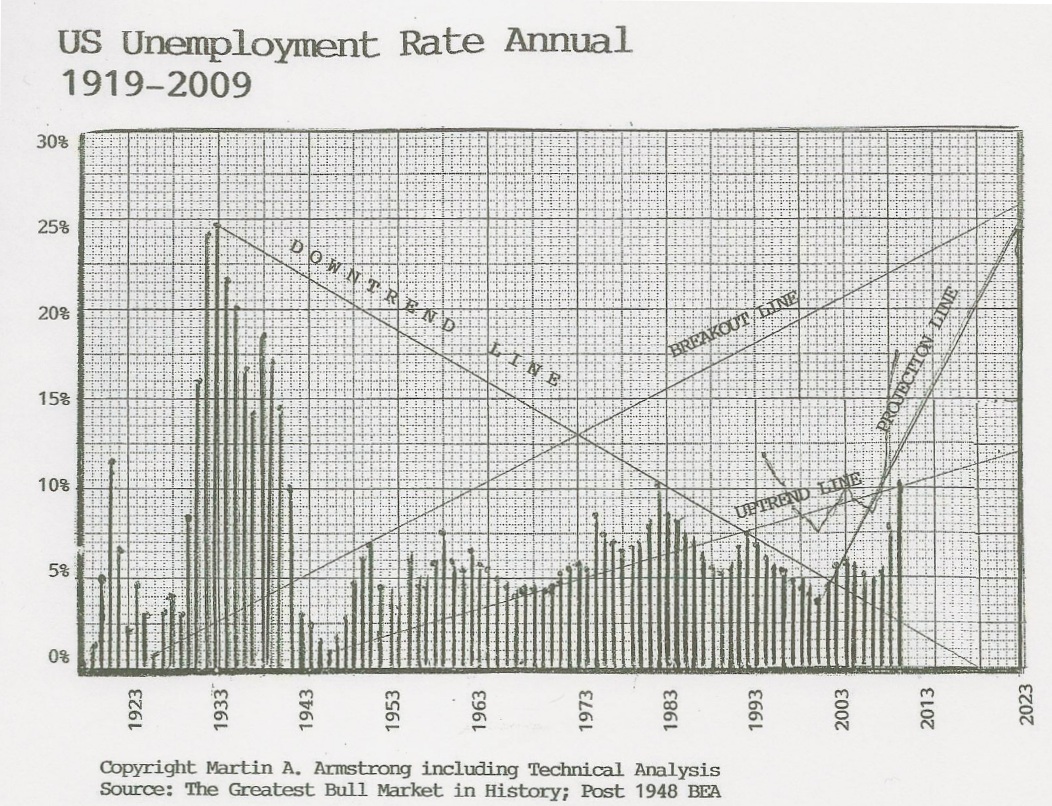
The total official unemployment figure for the US stands at more than 31 million who have collected unemployment benefits of some form. However, our model shows the real number is closer to 40 million given all the part-time people who were not entitled to unemployment. At the start of the year, the total civil workforce was about 164,606,000. The official unemployment rate is about 19%, but counting the full scope we have reached the same levels of the Great Depression. Small business always suffers the most during such declines disproportionately. This will impact future economic growth.

Is the Dollar Overvalued or Undervalued?


The latest claim running around is that the dollar is overvalued relevant to its trading partners, and it will decline as the economy recovers due to imports. You really have to wonder if these analysts are just working from home and have lost all sense of the world because they are locked down. In that forecast, they are ASSUMING that the world economy will recover as if nothing has taken place.


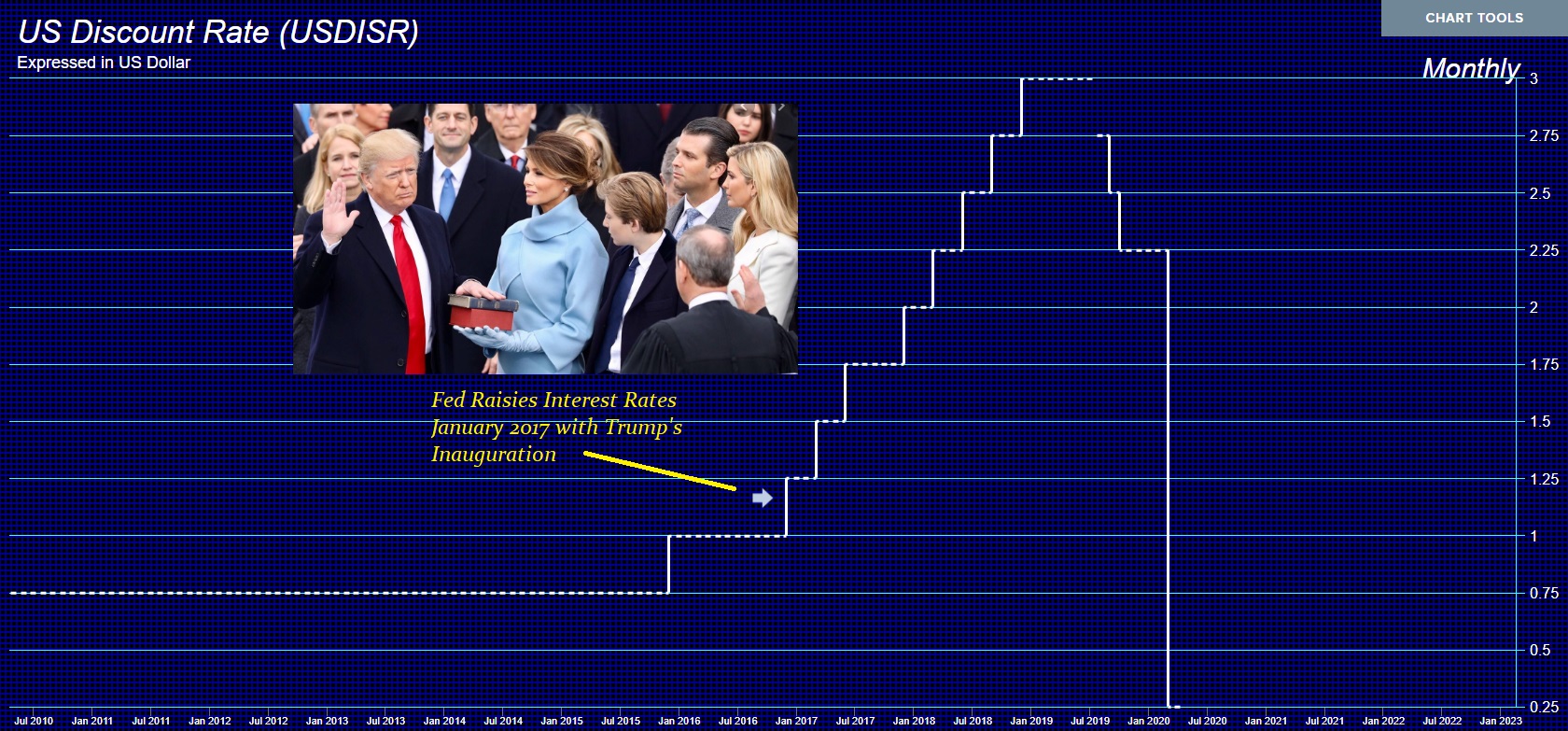
This is the typical analysis that simply focuses on domestic numbers and assumes that if you import more goods, then the dollar must decline. This theory is up there with thinking raising interest rates will be bearish for the economy and the stock market. Interestingly, both the economy and the stock market rallied as long as interest rates were RISING!


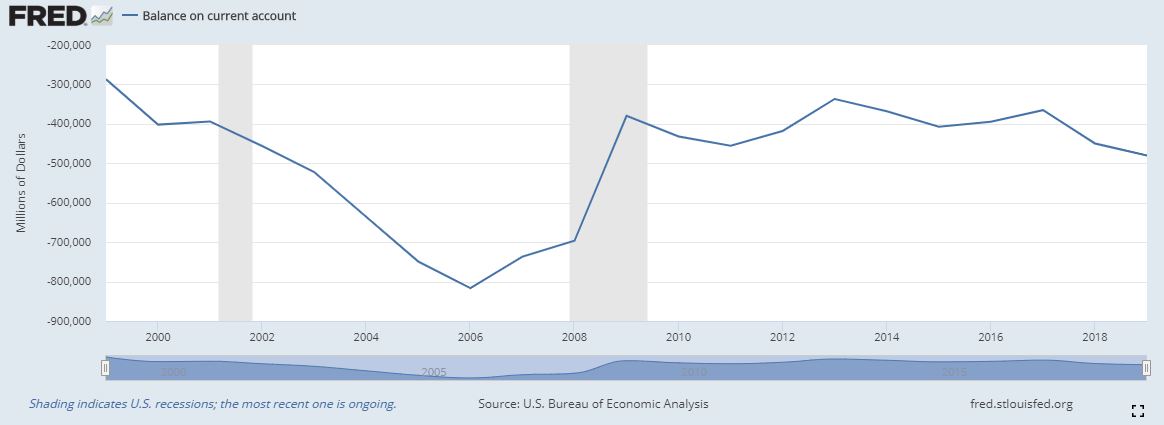
This is not a world that you can judge simply by looking at trade statistics. It is pure sophistry. In 2018, exports of goods and services from the United States made up about 12.22% of its gross domestic product (GDP), while US imports amounted to 15.33%. We have allocated trade according to the flag the company flies, and then you will see that the US has a trade surplus. Moreover, I assisted the Japanese on how to reduce their trade surplus buying gold in New York, taking delivery, and exporting it to London and selling it there. It does not matter what is exported; the statistics only look at dollars — not goods. This theory about trade to claim the dollar will decline is laughable.

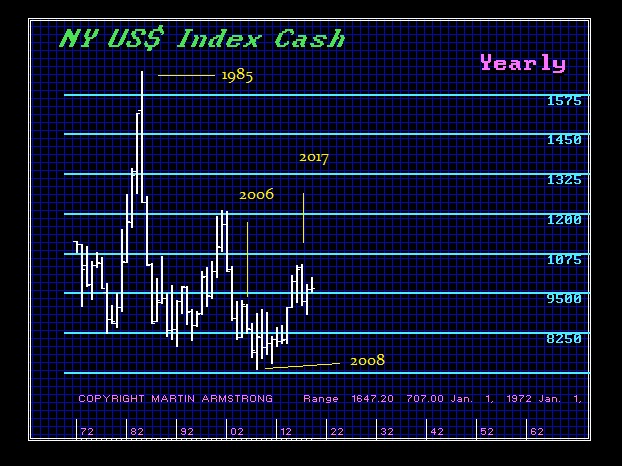
All you have to do is real correlation analysis. Here is the US dollar Index, which was wrongly constructed based upon trade rather than capital flows, and the low in the trade deficit took place in 2006. It began to IMPROVE as the world economy turned down, and in 2008, we see an outside reversal with the dollar rising. The dollar peaked in 2001 on this index and that was the crash in the market from the 2000 peak in the Dot.com Bubble.


The true trends that reveal the future are based upon capital flows. The dollar rallied and peaked in 1985 during that recession, but on the US stock market, the Dow performed a rare outside reversal to the upside in 1982, which began the explosion from 1,000 to 6,000. That also attracted capital flows for investment. The dollar peaked in 2001 during that recession as capital contracted.

Italexit – New Party in Italy to Exit the EU


We are witnessing the rise of the new party in Italy headed by Gianluigi Paragone calling for the exit of there EU. New Italian party calls for the exit from EU bolding saying: “Germany takes everything and leaves the crumbs to the rest of the states.” As the economic hardship rises thanks to the virus scam, this risk our computer shows is not that they will win, but they are sowing the seeds of their own destruction. They will move to eliminate the physical currency and then they will advocate for perpetual bonds.

Paragone began as a journalist. In 2018 he was elected Senator of the Five Star Movement. Then on January 1, 2020, he was officially excluded from the Five Star Movement but remained in the Senate as an independent. Then now in July 2020, Paragone has launched his own political movement, Italexit, with the aim of bringing Italy out of the European Union

The oppression of this virus agenda to force compliance with their Great Reset runs the risk of destroying the economies of Southern Europe which have a very high reliance upon tourism which has been brought to a halt in Europe.

The Humane Side Of Capitalism


Re-posted from Uncommon Knowledge by Russell Roberts  Thursday, July 23, 2020

A lot of people reject capitalism because they see the market process at the heart of capitalism—the decentralized, bottom-up interactions between buyers and sellers that determine prices and quantities—as fundamentally immoral. After all, say the critics, capitalism unleashes the worst of our possible motivations, and it gets things done by appealing to greed and self-interest rather than to something nobler: caring for others, say. Or love. Adam Smith said it well:

It is not from the benevolence of the butcher, the brewer, or the baker that we expect our dinner, but from their regard to their own self-interest.

Capitalism, say its critics, encourages grasping, exploitation, and materialism. As Wordsworth put it: “Getting and spending, we lay waste our powers.” In this view, capitalism degrades our best selves by encouraging us to compete, to get ahead, to win in business, to have a nicer car and house than our neighbors, and to always look for higher profits and advantages. In the great rat race of the workplace, we all turn into rats. Is it any wonder so many want to kill off capitalism and replace it with something more just, more fair, more humane?

This urge to try something else seems to be on the rise. In a 2019 Gallup poll, 43 percent of respondents said socialism would be good for the country. A self-avowed socialist, Bernie Sanders, came closing to winning the Democratic nomination for president in 2020, finishing a close second as he had four years earlier.

One answer to this increased taste for socialism is that socialism has to be specified in order to compare it to capitalism. I think a lot of people are attracted to socialism because they believe it means capitalism without the parts they don’t like. How to get there from here is left unspecified. A second answer is that the American economic system is, in fact, a hybrid of capitalism and socialism. Some parts of the American economy are pretty free market, or what we might call capitalist: those parts where profit and loss determine success or failure, where prices and wages are mostly free to adjust to what the market will bear, and where subsidies are small or nonexistent. But other parts of the American economy, such as education, health care, and housing, are highly distorted—they are heavily subsidized or regulated in ways that make innovation and competition very difficult. They’re not fully socialist, but you can’t really call them free market, either.

Capitalism, somehow, gets blamed for anything that goes wrong. Consider health care—it is highly subsidized; its prices are distorted by those subsidies along with incredibly complex regulations; the supply and allocation of doctors are highly constrained by regulations; hospital competition is curtailed by certificate of need requirements; and finally, on top of that, a highly regulated private insurance business is tangled up with everything. And when outcomes go sideways, people claim it proves that markets don’t work for health care. One of the essential pillars of capitalism is people spending their own money on themselves. The essence of the health-care market is people spending other people’s money, often on other people.

People decry the high price of housing in New York and San Francisco, and some blame it on the greed of landlords. But greed is as old as humankind. What has changed in recent decades and driven prices upward is ever more restrictive zoning that has made it harder to build new rental units in cities where the demand is highest.

But let’s put aside the question of whether capitalism can fairly be blamed for the ills of health care in America or the high price of housing in certain American cities. Let’s look at the more basic charge of immorality.

Is capitalism good for us? Does it degrade us or does it lift us up? The critics are right that competition is an important component of the capitalist system, but the dog-eat-dog nature of that competition is greatly exaggerated. We call it competition, but it can also be thought of as the availability of alternatives. As Walter Williams likes to point out, I don’t tell the grocery store when I’m coming. I don’t tell them what or how much I want to buy. But if they don’t have what I want when I get there, I “fire” them. The existence of alternatives, choices of where to shop, and competition incentivizes the grocer to stock the shelves with what I want.

My cleaning crew speaks almost no English and has little or no formal education. Yet I pay them about double the legal hourly minimum. It isn’t because I’m a nice person. If I paid them only the minimum, they wouldn’t show up, because many other people are willing to pay much more to have their houses cleaned. Competition, not the minimum wage, is what protects my cleaning crew from the worst side of me and anyone else they work for.

Competition in sports is typically zero sum. The team with the higher score wins and the other team must lose. But economic competition is positive sum. Market share has to sum to 100 percent. When highly reliable Hondas and Toyotas showed up in the United States at very reasonable prices in the 1970s and 1980s, for example, they took market share from American companies. But the total number of cars sold wasn’t fixed. By making better and cheaper cars, the number of cars sold increased. And the quality wasn’t static, either. Spurred by Japanese competition, American car companies improved their products’ quality. And the American consumer was better off.

The essence of commercial life is positive sum. You hire me at a wage that makes it worthwhile for you to do so. I work for you because the wage is high enough to make me better off as well. Without both of us gaining, there’s no deal to be made.

Of course, some people have fewer or less attractive alternatives than other people. Why does Walmart pay what its critics claim are inadequate wages? It’s not because Walmart is especially cruel or greedy. (After all, I could make more on Wall Street than I do in academic life. That’s not because Goldman Sachs is kinder than Stanford University.) Walmart pays what it does because it can. And it can pay what it does because the people who choose to work there have unattractive alternatives. Otherwise, they’d take a job somewhere else.

Similarly, workers in overseas factories make very little relative to their American counterparts because their alternatives are much worse than those available to American factory workers. It’s not the cruelty of greedy international corporations that keeps the wages low. It’s the poor alternatives those workers have available to them. In fact, poor workers in poor countries typically line up for the opportunity to work for an international corporation. Wages there, while low by American standards, are much higher than in other parts of the economy.

Over time, the poorest workers in countries such as China have seen their wages rise dramatically. Again, this is not because of the compassion of corporate employers but because of the competition they face in attracting good workers. There are two positive ways to help both foreign workers and low-wage American workers at places such as Walmart: increase the demand for their services and find ways to help them increase their skills. That makes them more attractive to employers, who can pay them more because the workers are more productive.

Competition in a free-market system is about who does the best job serving the customer. Unlike traditional competition, there isn’t a single winner—multiple firms can survive and thrive as long as they match the performance of their competitors. They can also survive and thrive by providing a product that caters to customers looking for something a little different.

Finally, there is a great deal of cooperation in capitalism. One kind is obvious: investors cooperate with managers, who cooperate with employees to produce a great product or service. Many people find the opportunity to work with others in this way—to produce something of value for the consumer—deeply rewarding in ways that go beyond money. Part of the reason people start businesses is money, of course. But there is a large nonmonetary component: the experience of joining with others to create a great product or service that people value.

In the second Keynes-Hayek rap video I created with filmmaker John Papola, we tried to capture the best of this entrepreneurial side of capitalism:

Give us a chance so we can discover

The most valuable way to serve one another.

When Apple introduced the iPod in 2001, the 10GB model held two thousand songs, the battery lasted ten hours, and its price was $499. By 2007, the best iPod held twenty times that number of songs, the battery lasted three to four times longer, and its price was $299. Apple didn’t improve the quality and lower the price because Steve Jobs was a nice or kind person. Apple improved the iPod because its competitors were, as always, constantly trying to improve their own products. But I don’t think money was the only thing motivating improvement at Apple. Steve Jobs was happy to get rich. But he was also eager to keep his firm afloat in order to employ thousands of people at good wages and to work alongside those workers to create insanely great, ever better products. The money was nice. But it was not all (and maybe hardly at all) about the money.

Steve Jobs wanted to put what he called a dent in the universe. He wanted to make a difference. To do that, he needed to convince people of his vision, and then that vision had to be made real in a way that could profitably sustain an enterprise. Free markets gave Jobs the landscape where he could make his vision a reality.

You do have to pay the bills. The money that comes from consumers who value your product has to be sufficient to cover your costs. That’s the profit-and-loss criterion that underlies capitalism—you have to do as good or better than your competitors at serving your customers. But that’s not enough. You also have to do it at a price and pay a wage to your employees that result in a profit.

The other moral imperative of capitalism comes from repeated interactions between buyers and sellers. When there are repeated interactions, sellers have an incentive to treat their workers and their customers well—otherwise, they would put future interactions at risk. The safety of air travel, for example, is highly regulated. But cutting corners to save money and thereby putting passengers at risk are bad ideas for an airline that wants to exist past tomorrow. Crashes caused by negligence destroy an airline’s reputation. In markets, reputation helps insure honesty and quality. Being decent becomes profitable. Exploitation is punished by future losses.

None of the above rules out a role for government. You can defend free markets and capitalism without being an anarchist. Government plays a central role as the most effective enforcer of property rights and contracts. It administers the legal system. And it can and should restrict opportunities for people to impose costs on others. There’s nothing un-capitalist about making it illegal to dump your garbage into the air or water.

But what about the poor? How can we applaud the morality of capitalism if its gains go only to the richest Americans? Who wants to champion a system that gives the 1 percent the richest of chocolate cake and leaves everyone else with crumbs?

While there is evidence that supports this claim of the poor as bystanders who are left unchanged by decades of economic growth, this evidence typically looks at snapshots of workers at two different points in time, comparing changes in income or wealth of the top 1% to the to the standing of the top 1% decades later. The implicit assumption is that the people who were at the top in the past got much richer over time. This approach ignores economic mobility and falsely assumes that the top 1 percent are a fixed group. The people composing that 1 percent change; the same people do not simply get richer while everyone else treads water. The 1 percent includes people who once were much poorer but, now that they have reached the top, are richer than the people who previously were at the top. Similarly, the bottom twenty percent today are not the same people who were at the bottom in the past. When you follow the same people over time, rather than comparing group snapshots at two different points in time, all groups—poor, middle class, rich become more prosperous over time. A rising tide lifts all boats and not just the yachts. (I’ve explored these issues in videos and essays published elsewhere.)1

I would also point out that the guards in Cuba face south; they prevent Cubans from escaping the egalitarian paradise of Cuba for the unequal American economy. Poor people from all over the world risk their lives to come to the United States. Certainly they come here for opportunity for themselves and for their children. They expect—correctly, in my view—to share in the future growth of the American economy.

But I think poor people come here for more than just the financial opportunities of the American economy. They come for a chance for their children, and for themselves, to flourish, to use their gifts and skills in ways that bring meaning well beyond financial rewards. Money is pleasant, and not starving beats starving. But the real morality of capitalism and of the American system, with all its flaws, is that it gives people the chance to flourish through their work.

Not everyone has this chance in America today. But I believe that many of the challenges that the poorest among us face are not the fault of capitalism but the result of the breakdown of other institutions, which makes it hard for people, especially young people, to acquire the skills that would allow them to thrive. The US school system needs an overhaul. In particular, it could use more competition. The charter school movement is one part of a potential policy improvement. Even more competition—including private school options funded by scholarships—would go a long way toward allowing the poorest among us a chance to share in the American economic system, imperfectly capitalist that it is.